Tag Archives: ModPo

Madeline Miller’s Song of Achilles and November verse 2

Madeline Miller, The Song of Achilles (HarperCollins 2011)

The first half of The Song of Achilles is in effect a Young Adult boy-meets-boy love story, as the demigod Achilles befriends our narrator Patroclus, one of his father’s many foster-sons. The friendship becomes increasingly steamy until, while the language remains as chaste as anyone could wish, the two teenage boys find rapture in each other’s arms and are soon tacitly acknowledged as a couple. ‘Patroclus is my sworn companion,’ Achilles announces at a state occasion. ‘His place is beside me.’ This is against the will of Achilles’ goddess mother, Thetis.

Most of my readers won’t need to be told that Patroclus and Achilles are key characters from The Iliad, and that the emotional heart of that epic is Achilles deep love of Patroclus and his inconsolable grief when Patroclus is killed. This novel is mainly back story. The explicit sex isn’t so much a departure from the original as a confirmation.

At about the halfway point, after spending years being trained by the centaur Chiron and an episode in which Achilles hides out dressed as a girl, the two young men arrive with the vast Greek war force at the beach near Troy. Achilles is now acclaimed as the greatest of the Greek warriors, and the second half of the book is a completely engrossing retelling of The Iliad.


Because it’s November*, I won’t linger on page 77, when teenaged Patroclus wakes up in bed next to Achilles in Chiron’s cave. Instead, I have gone to page one, and read until I came to a potential first line for an Onegin stanza. The book begins with Patroclus’ mentally incompetent mother and his own physical ineptitude (the only element in Madeline Miller’s telling that conflicts with my own reading of The Iliad – it had never occurred to me that Patroclus was less than formidable). Patroclus’ first glimpse of Achilles is when Patroclus is five years old. Achilles is among the youngest boys who compete in games hosted by Patroclus’ royal father and, being a demigod, he wins. This is in spite of being easily the youngest competitor: ‘He is shorter than the others, and still plump with childhood in a way they are not.’

In the book, this last sentence signifies that Achilles is gifted well beyond his years. When I nicked part of it for my first line, my mind went somewhere completely different, to a memory from 60+ years ago.

Verse 1: Nudgee College, 1961–1962
He is shorter than the others,
thinner too, not seen as cool.
We've all been sent here from our mothers,
to this Christian boarding school,
sons of far-flung Queensland farmers,
just four hundred teenage charmers:
ten grown men. It's no surprise
that kindness doesn't rule our days.
His nakedness provokes derision,
soapsuds sprinkled in his sheets
cause eczema, and laughter greets
his asthma. Here's my shamed admission:
terrified, I turn my back
glad it's not me they attack.

OK, maybe tomorrow will get cheerful.

Added later: Inspired by the online course in Modern and Contemporary American Poetry (ModPo) I’m currently doing, here’s a chance-based/ procedural poem created from The Song of Achilles. It begins with the book’s first word beginning with A, which is followed by the first word after that to begin with B, and so on. It took 52 pages to get to ‘Zeus’.

A built ceremony
did eye forward
glints.
He is jest kneeling
looked man
not one present quieted
raised
said things
upbringing vividness
when exile you Zeus

I wrote this blog post in Gadigal Wangal country, and am posting it as lorikeets shout to each other about the rain that is about to come down. I acknowledge Elders past, present and emerging for their continuing custodianship of this land, over which their sovereignty has never been ceded.


For the last 14 years, I have challenging myself to write fourteen 14-line poems during November. The poem may be inspired by a book I’m blogging about, or may be connected to it by the vaguest of tangents, as here.
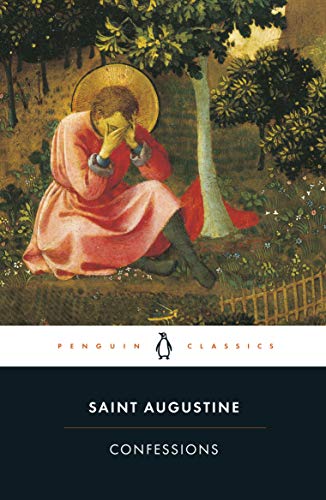
The Confessions of Saint Augustine, third and final report

Saint Augustine, Confessions (approx 400 CE, translated by R S Pine-Coffin 1961, Penguin Classics edition): pages 191–347 , from Book IX chapter 6 to Book XIII chapter 38

A month ago, when Augustine finally gave himself over to God, I was half expecting the remaining third of his Confessions to be pious anticlimax. I was partly right.

There’s a moving account of the death of his mother, which makes a point of her not wishing to be buried in her homeland. I wonder if this marks a point in the history of the west when people stopped seeing themselves as inextricably bound up with their place of origin, their Country – a disjunct that in the anthropocene we may be trying to reverse.

The rest of the book is given over to philosophical and theological argument – about the virtuous life, the nature of time and memory, the nature of God and eternity, the creation of the world, the meaning of faith. I let a lot of this go through to the keeper, happy to half-understand the intricate arguments. My impression is that his overarching project is to reconcile Platonist philosophy with the Christian scriptures and the doctrines of the Church – a major contribution to the development of Western thought, but not exactly a barrel of laughs.

Some bits grabbed my attention.

There’s a long passage where Augustine goes through the five senses and talks about how to best renounce the pleasures associated with them, or at least not enjoy them for their own sake (because after all you have to eat, and you can’t help but smell nice things). It’s a pretty perverse project that cast a long shadow – my own Catholic childhood and adolescence fairly bristled with notions of self-denial and discipline of the senses, and the ‘examination of conscience’ we were taught to perform from the age of seven could have been based on Augustine. I was struck by the hard intellectual work he puts into it. As he says:

I am working hard in this field, and the field of my labours is myself. I have become to myself like land that a farmer works with difficulty and with much sweat.
Ego certe, domine, laboro hic et laboro in me ipso: factus sum mihi terra difficultatis et sudoris nimii.

(10:16, pages 222–223)

I love it that he clearly had experienced the pleasures which he was renouncing. He protests a bit too much about the awfulness of sensual pleasure, but lesser pleasures can be acknowledged. For instance:

What excuse can I make for myself when often, as I sit at home, I cannot turn my eyes from the sight of a lizard catching flies or a spider entangling them as they fly into her web? Does it make any difference that these are only small animals? It is true that the sight of them inspires me to praise you for the wonders of your creation and the order in which you have disposed all things, but I am not intent upon your praises when first I begin to watch. It is one thing to rise quickly from a fall, another not to fall at all. And my life is full of such faults.
quid cum me domi sedentem stelio muscas captans vel aranea retibus suis inruentes inplicans saepe intentum me facit? num quia parva sunt animalia, ideo non res eadem geritur? pergo inde ad laudandum te, creatorem mirificum atque ordinatorem rerum omnium, sed non inde intentus esse incipio. aliud est cito surgere, aliud est non cadere. et talibus vita mea plena est

(10:35, page 243)

It’s interesting, by the way that where the translation has ‘such faults’ at the end there, the Latin has ‘such things’, leaving the possibility open that it may not be a fault at all.

Possibly because I’m currently doing an online course in modern and contemporary American poetry (‘ModPo‘) which has a focus on close reading, I’m fascinated by Augustine’s extended discussion of the first verses of the book of Genesis. Some readings, he argues – probably against his former companions the Manichees – are just wrong. But there is room for different interpretations: the text is open, as the ModPo teachers would say, and it’s impossible for anyone to know what was in the mind of the human author (whom he takes to be Moses). There’s something wonderfully modernist about this, for example:

For my part I declare resolutely and with all my heart that if I were called upon to write a book which was to be vested with the highest authority, I should prefer to write it in such a way that a reader could find re-echoed in my words whatever truths he was able to apprehend. I would rather write in this way than impose a single true meaning so explicitly that it would exclude all others, even though they contained no falsehood that could give me offence.
ego certe, quod intrepidus de meo corde pronuntio, si ad culmen auctoritatis aliquid scriberem, sic mallem scribere, ut, quod veri quisque de his rebus capere posset, mea verba resonarent, quam ut unam veram sententiam ad hoc apertius ponerem, ut excluderem ceteras, quarum falsitas me non posset offendere.

(12:31, page 308)

Mind you, quite a lot of Augustine’s readings are so tortuously allegorical as to surpass the most fanciful offerings of today’s poetry readers. He somehow manages, for instance, to make ‘God made the birds of the air’ signify something about God allowing ideas to float in humans’ minds.

It’s a shame that towards the very end he says that, although ‘in mind and rational intelligence’ women have a nature the equal of men’s (‘in mente rationabilis intellegentiae parem naturam‘), ‘in sex’ they are physically subject to men (‘sexu tamen corporis ita masculino sexui subiceretur‘). Perhaps it was a mercy to the women of his time that he chose a life of celibacy.

But I don’t want to leave on such a sour note. Here’s a passage from Book XIII chapter 9, which illustrates both the way his reasoning works and the way he presents himself:

A body inclines by its own weight towards the place that is fitting for it. Weight does not always tend towards the lowest place, but the one which suits it best, for though a stone falls, flame rises. Each thing acts according to its weight, finding is right level. If oil is poured into water, it rises to the surface, but if water is poured on to oil, it sinks below the oil. This happens because each acts according to its weight, finding its right level. When things are displaced, they are always on the move until they come to rest where they are meant to be. In my case, love is the weight by which I act. To whatever place I go, I am drawn to it by love.