Han Kang, We Do Not Part (2021, translated e. yaewon & Paige Aniyah Morris, Hamish Hamilton 2025)
Before the Book Club meeting: Han Kang was awarded the 2024 Nobel Prize in Literature, so her most recent book to be translated into English seemed a good choice for the Book Club.
The book falls into at least three parts. (Spoilers ahead.)
Part One: The narrator, who is experiencing suicidal depression, receives an urgent request from a friend, Inseon, to come to her in hospital. When she arrives, she finds Inseon has done a terrible injury to her hand and is receiving frequent, excruciatingly painful treatment, graphic descriptions of which are interspersed with a history of their friendship and their artistic collaborations. Inseon asks the narrator to go to her house on the remote island of P– and feed her pet bird, who will otherwise die.
Pat Two: The narrator makes the arduous journey to Inseon’s house, the final stage of it on foot through a blizzard. When she arrives, the bird is dead. Though she herself has barely survived her ordeal, she immediately buries the bird out in the snow.
Part Three: While the ghost of the bird casts flittering shadows around the walls, Inseon turns up, with an uninjured hand. Evidently she is some kind of supernatural projection of the living person still back there in the hospital, though the narrator suspects at one stage that both she and Inseon are actually dead. Anyhow, Inseon guides the narrator through a number of documents that record a terrible massacre committed during the Korean War, apparently with US connivance, and the decades-long attempt by surviving relatives to have the massacre acknowledged.
At the level of narrative, I didn’t understand the book. When the exhausted narrator goes back out into the snow to bury the bird without even putting on warm clothes, I nearly stopped reading, and from then on my disbelief remained unsuspended. But as the story of the massacres emerged from the piles of documents, I was glad to be learning about a part of history I’d been completely ignorant of. On the other hand, given that the information is embedded in an unabashedly unrealistic narrative, I’m left not knowing how much of the massacre story is itself fiction. In effect, then, the book is a signpost pointing its readers to the need for further research.
WIkipedia has a minimalist entry about the Sancheong–Hamyang massacre of 7 February 1951, in which 705 civilians were killed, 85% of them women, children and elderly people. The files concerning the massacre, Wikipedia confirms, were not found until February 2006. That is the emotional heart of this novel: I have no idea how the story of the injury, the blizzard and the dead bird fit together with it.
The meeting:
I wasn’t the only one perplexed by this book. We were pretty well unanimous that we wouldn’t recommend it to friends, even though there is some beautiful writing in it. We were divided on the question of whether we would want to read anything else by Han Kang,
The narrator’s ordeal in the blizzard, we all agreed, is compelling.
One valiant soul found rich metaphor in the account of Inseon’s injury and treatment: her severed fingers represent the divided state of Korea and the painful injection every three minutes suggests that the process of reunion will involve sustained, painful work. My literal-mindedness at first rebelled at such a reading, but maybe it’s there for readers with a Korean cultural background, who I expect are also better equipped for the ghost-not-ghost parts of the narrative.
I wasn’t the only one who had done some research into the history that is the subject of the book’s final movement. Whereas I had looked up a single Wikipedia entry, S– had read a number of articles on the Korean War – but, she said, she ended up more confused than when she started
We discussed this book along with Ferdia Lennon’s Glorious Exploits. Both books build fictions around historical events, but no one felt compelled by Glorious Exploits to study up on the Peloponnesian War.
The Book Club met on Gadigal land. I wrote the blog post on Wangal and Gadigal land where just now the sun is shining from a cloudless sky and the wind has died down. I gratefully acknowledge the Elders past and present who have cared for this beautiful country for millennia.
Before the meeting: This is a strange book. It’s a satire set in contemporary Nigeria. With Boko Haram atrocities in the immediate background, the country is rife with corruption. I’m pretty sure that if I knew more about Nigeria’s history and its current politics the book would reveal more of itself to me as a devastating, possibly despairing denunciation of Soyinka’s homeland. As it was, I enjoyed it pretty much as a child would enjoy Gulliver’s Travels – as a fantastical tale. I’m sorry to say, though, that I enjoyed it a lot less than I enjoyed the story of Lilliput as a child.
Almost half the book is taken up with setting the scene in magisterial, ironic tones. There’s a charlatan religious leader, a deeply venal and media-savvy Prime Minister, an awful lot of sarcastic hoptedoodle about national festivals and awards. It takes a long time for a central narrative thread to become clear. (Arguably, the over-all shape isn’t revealed until the last page, so what follows is possibly a spoiler of the first magnitude.) Four young Nigerian men form a strong bond when at university in Europe, agreeing that they will each contribute in a major way to their homeland. They become respectively a doctor, an engineer, a financial wizard and a public relations genius. In the book’s present time, one has gone missing, one runs foul of the government and becomes inexplicably catatonic, one has been nominated to a prestigious position in the UN, and the fourth, who I think of as the book’s central character, is a surgeon whose work patching up the survivors of Boko Haram attacks has earned him one of the country’s top honours.
The rubber hits the road at last when the surgeon discovers a monstrous commercial-culinary trade in human body parts, and the narrative finally develops a forward momentum as he and his engineer friend pit themselves against the shadowy figures behind the trade.
But just as that narrative seems to be getting somewhere, the book swerves off into interminable machinations to do with a bombing, and questions of transporting a body between Austria and Nigeria. The main story is finally resolved in an ultra-perfunctory way, with a lot of loose threads left hanging. There’s a ‘surprise’ revelation on the last page that is about as surprising as having hot water come out of a tap marked H.
The story is told with tremendous gusto, but for much of it the writer seems to care less about telling it than with having angry, satirical fun. I found myself thinking of Edward Said’s posthumously published essay, On Late Style, which we read in the Book Group a while ago (link here). He wrote of the artists who create in the late style:
The one thing that is difficult to find in their work is embarrassment, even though they are egregiously self-confident and supreme technicians. It is as if having achieved age, they want none of its supposed serenity or maturity, or any of its amiability or official ingratiation. Yet in none of them is mortality denied or evaded, but keeps coming back as the theme of death which undermines and strangely elevates their uses of language and the aesthetic.
This book is supremely unembarrassed by its own excesses and absurdities. It certainly doesn’t aspire to serenity or seek attempt to ingratiate itself with authorities, or with readers. And it is full of mortality.
At page 77*, we’re still being given the general set-up. It’s part of the engineer’s back-story, explaining how he ‘succumbed’ and agreed to work for the government:
It did not take too long to discover – with some chagrin, he would reveal to his ‘twin’, the surgeon Kighare Menka – that there was a strong work ethic in control, indeed a pervasive hands-on ethic, near identical to both theirs, with unintended literalism, just a slight slant – a prime ministerial finger in every pie!
His friendship with the surgeon Kighare Menka is the heart of the book. Here it’s invoked so that we know both men share a perspective on the Prime Minister’s corruption, and that they share an enjoyment of the ponderous wordplay that pervades the book.
The next paragraph is a good example of the narrative style. Bisoye is the engineer’s wife:
Only the twenty-million-dollar question remained: How long would he last? Thus came the pact with Bisoye – first three months, I’ll stick it out, no matter what. Agreed? After that, a choice of his single-malt whisky, always a different brand, for every month survived, plus a night out followed by a bed in, no holds barred. The nation never knew how much it owed to the blissful athleticism of the couple, and Duyole did come close to earning a full case of Islay malt, Collector’s Reserve – just one bottle short of a full case. In the display cabinet he conspicuously left a gap in the row of twelve, a silent accusation of Bisoye’s ungenerous spirit. Was it his fault he completed the task so far ahead of time?
This mock-pompous style characterises most of the narrative. A man of integrity decides to do research for a corrupt government, and to report honestly on what he finds. But he’s a man with a sense of humour and a zest for life. Like him, the narrative refuses to be drawn into hand-wringing over the corruption. It barely gets to the specifics of that corruption – saving its fire for the (hopefully) imaginary trade in human flesh. It is happy to assume the reader doesn’t need details of the realistic stuff and gives us instead the ‘blissful athleticism’ of our heroes, the opposition.
While that paragraph may fill out the engineer’s character a little, one can’t help but feel that it’s just there because the author was having a good time. Not that there’s anything wrong with that. On the contrary. But I’m not surprised to learn from the WhatsApp conversation before the meeting that most people failed to persevere to the moment when the story proper gets started.
After the meeting: There were eight of us, and we met in a pub in Balmain. Two of us had read the whole book. All but one of the others had no intention of finishing, most having given up after a hundred pages or so.
Interestingly, the person who had read about a third was the book’s keenest supporter. I don’t take notes, and I have a terrible memory, but he said something like, ‘I was irritated, intrigued, amused, horrified, perplexed, enlightened, admiring. I kept seeing parallels with news from the US in the bizarre corruption, and the dominance of bogus religion. The back story of the religious charlatan fascinated me, and I want to know what becomes of him.’
I think he was on the cusp of the moment when the character who fascinated him pretty much drops out of the story, to make a functional comeback very late in the piece. He had barely even met the surgeon Kighare. But it was excellent to be reminded that up to a certain point you think you’re reading a book where a number of strands are kind of coming together.
Someone had read that Wole Soyinka wrote the book during Covid lockdowns in two stretches of 32 days. Maybe that was just a first draft.
Someone said that they kept wondering if they’d missed something, as for instance when a character last seen entering a meeting turns up a couple of chapters later in a catatonic state, but the writing was so elliptical that they couldn’t be bothered to go back to check if there was some explanation. (No one could remember if we are ever told what happened to him. I suspect the author made a mental note to go back and flesh it out, and then forgot about it.) I think that means it’s a book that asks a lot of the reader at the sentence level, without generally offering much in return.
Someone said it might have been better in the original Nigerian. I think his point remains valid even though the book was written in Nigeria’s official language, which is English. Nigerian writer Ben Okri wrote a review for the Guardian, which I’ve found since our meeting (link here). Given how negative we all were about the book, it’s only fair that I quote from that review (though I must not that ben Okri gets a number of key plot points wrong in this review):
There are many things to remark upon in this Vesuvius of a novel, not least its brutal excoriation of a nation in moral free fall. The wonder is how Soyinka managed to formulate a tale that can carry the weight of all that chaos. With asides that are polemics, facilitated with a style that is over-ripe, its flaws are plentiful, its storytelling wayward, but the incandescence of its achievement makes these quibbles inconsequential.
Our conversation turned to other, happier things: the recent local council elections and the pleasure a couple of us had had in helping a young person vote for the first time; parenthood after 40 years; the relationship of the Bauhaus to the Arts and Crafts movement; another book group where they don’t set a date until everyone has read the book (shudders all round!); a spectacular alcoholic episode from the life of Mary McKillop (now a saint); the unmarked site of Hitler’s bunker; Rugby League (the Roosters, and the Jets at Henson Park); some swapping of notes about streaming shows. The food was excellent, though the emerging Artist could teach the pub a thing or two about caponata.
I wrote this blog post on the land of Gadigal and Wangal. I acknowledge Elders of those Nations past, present and emerging for their continuing custodianship of this beautiful land.
* My blogging practice is to focus on the page that coincides with my age, currently 77.
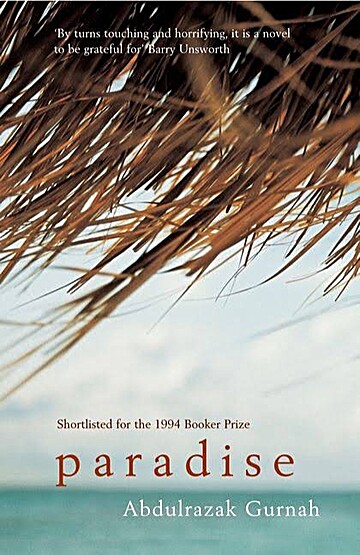
Abdulrazak Gurnah, winner of the Nobel Prize in Literature in 2021, was a wonderfully urbane guest at this year’s Sydney Writers’ Festival. In the session I attended he spoke mainly about his 2021 novel, Afterlives, but talked a lot about that book’s relationship with the much earlier Paradise. (Added much later: you can listen to the podcast of the conversation at this link.)
We read Afterlives a while ago in my all-male Book Group, and had a wonderful discussion of it. Now my predominantly female Book Club is tackling the earlier novel.
Before the meeting:Paradise is a long way from languishing in the shadow of Afterlives. Its action unfolds in the same part of East Africa, beginning a couple of decades earlier, in the years leading up to the First World War.
The book begins with a boy named Yusuf looking forward to receiving a customary gift of money from Uncle Aziz when Aziz’s brief visit comes to an end. There is no gift, and instead the boy is taken away with the uncle. Then he realises that he is not going back to his family and soon learns that he has been given to Aziz, who is not actually his uncle, as surety against his father’s debts. He has become little more than a slave in the merchant’s household.
The story unfold from there. There’s adventure, involving an arduous, perilous expedition into the unknown. There’s romance, where intimate moments, perhaps even a kiss, may be snatched in dark corners of a walled garden. There’s a gallery of rich, exuberant characters – Khalil, an older boy in a similar state of bondage to Yusuf; an older woman, infatuated by Yusuf’s beauty, who harasses him to the amusement of onlookers; an ancient gardener who long ago refused his freedom when actual slavery was abolished; a formidable, scarred man who organises Aziz’s trade expeditions and has a reputation as a sexual predator on young men; Aziz himself, a formidable commercial operator who remains calm in the most extreme situations.
Meanwhile, European powers are colonising East Africa. They are mostly peripheral, offscreen characters who threaten to destroy the whole world experienced by the main characters. German soldiers appear twice, once at roughly the midpoint and then again at the very end. Both times they function as a deus ex machina: the first time their unexpected arrival saves Aziz and his expedition, including Yusuf, from a vengeful tribal chief, but the incident leaves a nasty sense of something unresolved; the second time they provide the book’s final moment, which left me staring into space for a long time.
The book was only transated into Swahili – the official language along with English of Gurnah’s home nation Tanzania (known as Zanzibar back then) – after he was awarded the Nobel Prize.
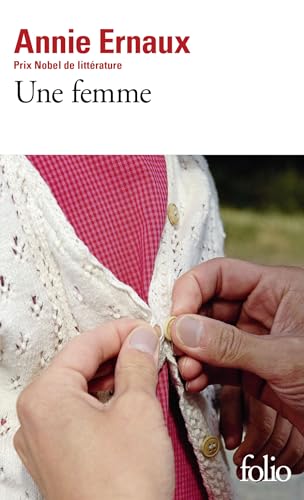
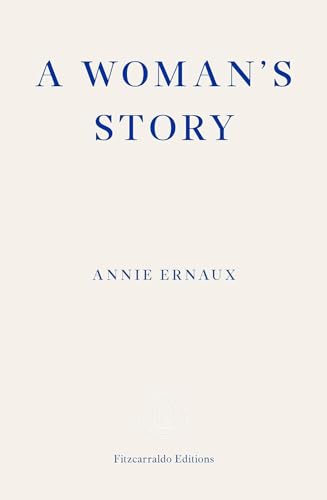
After the meeting: At this meeting we discussed Annie Ernaux’s Une femme / A Woman’s Story along with Paradise, an odd pairing which meant we had two quite separate discussions.
All but one of us enjoyed this book a lot, and the dissenting voice meant we had an interesting conversation. The main character, she said, is completely passive: things just happen to him, one after another, and especially on the gruelling trade expedition that takes up a good slab of the book the bad things are repetitive. The book only becomes interesting once Yusuf is back in town and a powerful woman, in a complex way, is lusting after him. Though others were able to point out that Yusuf was constantly taking initiatives – a surreptitious excursion to town just for fun, offering unauthorised help to the ancient gardener, etc – I was struck by the similarity of this observation to what someone in my other Book Group said about the main character in Afterlives: because of the constraints on the characters, they don’t have the space to attend to their inner lives. When I tried to articulate this thought, someone said something beautifully concise and wise about the way trauma can alienate a young person from their own experience. Sadly I didn’t write it down, but to my mind it captured beautifully the way Yusuf does indeed move from one thing to the next, having no real say about the direction of his life, and no ability to form coherent thoughts about it.
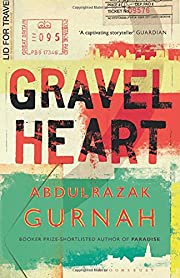
I realised in the course of the discussion that the story is full of references to Joseph / Yusuf in the Hebrew Bible and the Quran, in particular the episode of Potiphar’s wife / Zuleikha. I just read a version of the Quran story on Wikipedia, and the parallels are even closer than I thought. It makes me wonder what other references may be hovering around this eminently readable tale. Joseph Conrad’s Heart of Darkness comes to mind. (Gurnah’s Gravel Heart includes a retelling of Shakespeare’s Measure for Measure, set in modern East Africa.)
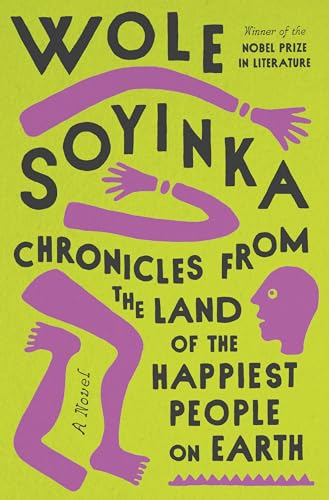
We discussed the final paragraph, which I’d love to expand on here but, unlike some surprise revelations (see my blog post on Wole Soyinka’s Chronicles from the Land of the Happiest People on Earth, coming in a month or so), it really is a surprise.
Being of a certain age, we said goodnight a little after 10 o’clock.
I wrote this blog post in Gadigal Wangal country, where it is my great joy to live. In particular right now the days are getting warmer, the sun is rising earlier and setting later, and whenever I walk out my door I see tiny lizards scurrying for cover. I acknowledge Elders past, present and emerging for their continuing custodianship of this land.
Annie Ernaux, Une femme (Editions Gallimard 1987) —–, A Woman’s Story (translated by Tanya Leslie 1991, Fitzcarraldo Editions 2024)
Before the meeting: The press release announcing that Annie Ernaux had won the Nobel Prize in Literature spoke of:
the courage and clinical acuity with which she uncovers the roots, estrangements and collective restraints of personal memory.
Every word of that is well chosen. Ernaux revisits her own life story in every book, pitting her ‘personal memory’ against what she finds in old photographs and diary entries, constantly questioning and challenging herself. She makes most other autobiographies / memoirs seem at least a little glib and self-serving.
I read Une femme / A Woman’s Story in both French and English. I could do this because it’s a short book – 60 pages in English, 95 in French. Apart from an opportunity to flex my rusty French, I was motivated by the way the English title departs from the original. Une femme is literally ‘A woman’. Calling it A Woman’s Story is a tiny change, but it significantly shifts the meaning. I wondered if similar shifts happened in the body of the book. (I think they do, and I apologise in advance for the way this blog post gets bogged down in the details of translation – fascinating to me, but maybe not to you!)
A Woman’s Story / Une femme does tell the story of a woman: Ernaux’s mother. But actually there are three stories. There’s Ernaux’s reconstruction of her mother’s life: her youth, her time as a shopkeeper in an impoverished part of France, her marriage, her ageing, and at last her dementia and death. There’s the story of Ernaux’s relationship with her, including the times that she lived with her and her family, and at the very end a brilliantly concise statement of what, after the initial intense grief, her mother’s death meant for her. And there’s the story of writing the book, begun in April 1986, very soon after her mother’s death, and finished in February the following year. This is a book in which une femme writes about une femme, and either could lay claim to the book’s French title.
I love this book. It reaches tendrils into parts of my own life that could do with a bit of ‘courage and clinical acuity’. I find Ernaux’s sheer dogged determination to find truthful words completely engrossing. In one of several moments when she steps in to tell us about the process of writing, she says:
When I speak of her, my first impulse is to ‘freeze’ her in a series of images unrelated to time – ‘she had a violent temper’, ‘she was intense in everything she did’ – and to recall random scenes in which she was present. This brings back only the fantasy woman, the one who has recently appeared in my dreams, alive once more, drifting ageless through a tense world reminiscent of psychological thrillers. I would also like to capture the real woman, the one who existed independently from me, born on the outskirts of a small Normandy town, and who died in the geriatric ward of a hospital in the suburbs of Paris. The more objective aspect of my writing will probably involve a cross between family history and sociology, reality and fiction [la jointure du familial et du social, du mythe et de l’histoire] … I would like to remain a cut below literature.
(Page 17)
That is to say, don’t look for fine writing here. Look for a serious attempt to see the reality of this woman’s life and how it was interwoven with Ernaux’s own.
My practice of looking at page 77 is a good way of giving you a flavour of the book, and of some of the issues that must have faced Tanya Leslie, the translator.
On page 77 of the French edition, page 51 of the English, it’s the early 1970s. Ernaux’s mother, now a widow, has sold her business and abandoned her life as a shopkeeper. She has moved to Annecy at the other end of France to live with Ernaux and her young family. She isn’t thrilled with her new life: she is no longer a significant part of a community. Her life has shrunk. ‘Now she felt she was a nobody’ / ‘Elle ne se sentait plus rien.’ She was proud of the life Annie had made for herself, but felt uneasy with the middle-class life that now surrounded her.
I ought to say that after my partner’s father died, her widowed mother became a much bigger presence in our lives, after a time spending a couple of nights a week living with us and then moving in full time. We didn’t have the class difference that Ernaux describes, but this page resonates powerfully, and I am in awe of the way the writing reaches for a deeply respectful understanding of the mother’s point of view:
Living with us was like living in a world that welcomed her and rejected her at the same time. One day she said angrily, ‘I don’t think I belong here.’
The transition from the generalised to the particular in those two sentences is typical Ernaux. In the French, it’s slightly different:
C’était vivre à l’intérieur d’un monde qui l’accueillait d’un côté et l’excluait d’un autre. Un jour, avec colère: « Je ne fais pas bien dans le tableau. »
There are three departures from a literal, word for word translation. First, there is no ‘us’: it’s all about the mother. Second, the English has tidied up the second sentence and given it a verb – ‘she said’ – which is not there in the French. There’s a lot of that in the book. The French text sometimes reads like quick notes: no need to spell out who was speaking etc. The English tidies it up, with the effect that what in French feels rough and raw becomes in English a more polished, considered text. And third, what the mother says has been softened: the tentativeness of ‘I don’t think’ is an insertion, where the French just has an angry statement of fact: ‘I don’t belong here.’
The rest of the page, in English:
And so she wouldn’t answer the phone when it rang next to her. If her son-in-law was watching football on television, she would make a point of knocking on the door before entering the living room. She was always asking for work – ‘Well, if there’s nothing to do, I might as well leave then’ – adding with a touch of irony, ‘After all, I’ve got to earn my keep!’ The two of us would argue about her attitude and I blamed her for deliberately humiliating herself. It took me a long time to realise that the feeling of unease my mother experienced in my own house was no different from what I had felt as a teenager when I was introduced to people ‘a cut above us’. (As if only the ‘lower classes’ suffered from inequalities which others choose to ignore.) I also realised that the cultural supremacy my husband and I enjoyed – reading Le Monde, listening to Bach – was distorted by my mother into a form of economic supremacy, based on the exploitation of labour: putting herself in the position of an employee was her way of rebelling.
And in French:
Donc elle ne répondait pas au téléphone quand il sonnait près d’elle, frappait d’une manière ostensible avant de pénétrer dans le salon où son gendre regardait un match à la télé, réclamait sans cesse du travail, « si on ne me donne rien à faire, je n’ai plus qu’a m’en aller» et, en riant à moitié, « il faut bien que je paye ma place!». Nous avions des scènes toutes les deux à propos de cette attitude, je lui reprochais de s’humilier exprès. J’ai mis longtemps à comprendre que ma mère ressentait dans ma propre maison le malaise qui avait été le mien, adolescente, dans les « milieux mieux que nous » (comme s’il n’était donné qu’aux « inférieurs » de souffrir de différences que les autres estiment sans importance). Et qu’en feignant de se considérer comme une employée, elle transformait instinctivement la domination cultureIle, réelle, de ses enfants lisant Le Monde ou écoutant Bach, en une domination économique, imaginaire, de patron à ouvrier: une façon de révolter.
You can see what the translator had to wrestle with. She breaks two long sentences into shorter ones. I can’t tell if this is her way of making the text more elegant, or if it’s a difference in the way the languages work. And domination must have given her nightmares: ‘supremacy’ isn’t a dictionary equivalent, but it’s surely eccentric to describe reading Le Monde as an act of domination. Yet maybe that eccentricity is exactly what Ernaux intended – certainly ‘economic supremacy’ makes less sense than ‘economic domination’.
This is one place where I was happy I had read the French as well as the English. I didn’t understand the bit in brackets about the ‘lower classes’ until I read the French, where, rather than the ‘others’ choosing to ignore inequalities, they consider some différences to be unimportant (and yes, différences translates as ‘differences’, no inequality necessarily implied). Le Monde is just a newspaper to Ernaux and her husband, and Bach is pleasant to listen to. For the mother, they are markers of cultural superiority. A smaller oddity of the translation is that whereas the French insists that the ‘cultural supremacy’ / domination culturelle is real (réelle) and that the ‘economic supremacy’ / domination économique is imaginary (imaginaire), the English lets the word ‘distorted’ carry that distinction. On top of that, leaving out the word instinctivement, it seems to me, makes the mother seem much more calculating, and perhaps makes Ernaux less patronising. I don’t think Ernaux wants to blame her mother, or spare herself, in this way.
After I’d written that last sentence I noticed a moment in the previous paragraph that struck a chord with me. One of the things Ernaux’s mother has to do to conform to the household’s lifestyle is, in English:
‘observing personal hygiene’ (blowing the boys’ noses on a clean handkerchief).
That’s unremarkable, just one more detail in the list of things she has to adapt to. The original French is:
avoir de l’« hygiène » (ne pas moucher les enfants avec son propre mouchoir).
A literal translation of the phrase in brackets is, ‘not to blow the children’s noses with her own handkerchief’. They say a translation can never be complete, but still I allow myself to mourn the loss of this tiny, graphic image of grandparent–grandchild intimacy forgone in the name of upward mobility, and lost to the English text for who knows what reason: perhaps handkerchiefs themselves are so repugnant to modern Anglo sensibilities that sharing them is unspeakable.
After the meeting: In the Book Club, we traditionally discuss two books. This book was paired with Abdulrazak Gurnah’s Paradise (linkto come added later). I think the reason for the pairing was that they’re both by Nobel laureates. At the start of our discussion, an astute person pointed out that they both feature shops (the mother’s shop in Ernaux’s book, and two different shops where Gurnah’s protagonist worked). That’s about where the similarities began and ended. Our evening – or at least that part of it not taken up with excellent food and even more excellent conversation about life, physical afflictions, travel plans and so on – was split neatly into two parts.
As you’d expect, my having read the book in both languages was met with eye rolls, but there was general recognition that the difference was substantial between blowing a child’s nose on a clean handkerchief and not blowing it on one’s own handkerchief.
We had a very interesting discussion of a passage where Ernaux describes her aim as to set aside her own emotional memories about her mother (how she felt when she was angry etc) and tell the story from her mother’s point of view, but says that she finds those emotions breaking through anyway. I think we agreed that this, far from being a failure, is one of the things that makes the book so rich.
One person out of the five of us didn’t care for the book. Reading it, she couldn’t see any reason why Annie Ernaux would have been given the Nobel. Those of us who had read a number of her books tried to articulate our reasons for holding her in high esteem, but maybe it’s a matter of taste. What I/we saw as minimalism, for example, she saw as sketchiness.
One person spoke of the way the book had inspired her to try to write about her own childhood, focusing on specifics rather than a broad narrative. The exercise had led to interesting insights into her early life. We had a brief but interesting conversation about how for ‘our generation’ in Australia (we range from a couple of weeks short of 70 to a couple of years beyond 80), as for Annie Ernaux, there was a shift in class – ‘upward mobility’ – that hadn’t been so widespread in previous generations. This shift was due in part to increased access to education – so we did the Australian equivalent of listening to Bach and reading Le Monde.
It might seem that that conversation was of the same order as travel plans and medical reports, but I think it’s a quality of Ernaux’s books – not just this one – that they prompt readers to reflect on their own lives.
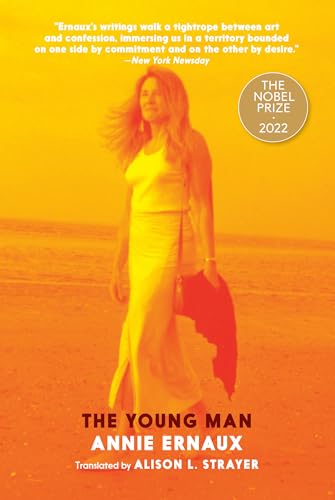
My family still give each other far too many presents at Christmas, but I’m not complaining. Among the many thoughtful gifts I received recently were these two tiny books by Annie Ernaux. The first is the story of a sexual relationship the writer had with a much younger man when she was in her mid 50s; the second is the text of her Nobel Lecture, delivered in Stockholm in December 2022. Each of them includes about 20 pages of supplementary material, with a lot of overlap between the books: photographs, a ten-page self-written biography, praise for Ernaux’s other books. They’re clearly designed to catch impulse buyers at the till, but they are written by the incomparable Annie Ernaux and I love them.
Neither book has a page 76, or even a page 47, so my usual arbitrary blogging practice is stymied.
If I don’t write things down, they haven’t been carried through to completion, they have only been lived.
Which captures perfectly the nature of this book. It serves to complete a strangely inconclusive episode in the writer’s life.
Dates at the end of the text indicate that it was written over a span of time, from 1998 to 2000, perhaps immediately after the relationship ended, and then prepared for publication – rewritten? – in 2022. It shows the signs of both dates. There’s the freshness of description of, say, sleeping together in his cold student flat, or of feeling the gaze of other people when they lie on the beach together, a gaze that neither of them would have attracted solo. And then there are reflections that have had time to mature:
In more than one domain – literature, theatre, bourgeois customs – I was his initiator, but the things I experienced because of him were also initiatory. My main reason for wanting our story to continue was that, in a sense, it was already over and I was a fictional character within it.
(page 28)
After that last comment, she continues: ‘I was aware that this entailed a kind of cruelty towards this younger man who was doing things for the first time.’
There are at least two high-profile fictional works around at the moment in which an older woman has a sexual ‘affair’ with a boy, Ian McEwan’s novel The Lessons and Todd Haynes’s movie May December. This is not that. This unnamed young man was in his twenties, and Annie Ernaux was not his teacher. There is no question of criminality, but some of the same ethical issues arise. She was an admired cultural figure to whom he could barely speak when they first met in person. She does not spare herself in the writing, but nor does she rush to judgement. As that tiny excerpt illustrates, class is always an issue, and there is a constant sense of the feedback loop between her life and her art.
The copious photos that the publishers have included to make up a decent number of pages attest to the fact that she was, and is, gorgeous. The young man didn’t love her just to learn bourgeois customs.
The title of Ernaux’s Nobel lecture comes from something she wrote in her diary in her early 20s: ‘J’écrirai pour venger ma race.‘ She expands on this sentence in the lecture:
I proudly and naively believed that writing books, becoming a writer, as the last in a line of landless labourers, factory workers and shopkeepers, people despised for their manners, their accent, their lack of education, would be enough to redress the social injustice linked to social class at birth.
(page 12)
The lecture traces the way she moved away from this goal, until she was brought back to it ‘through byroads that were unseen and proximate’. And it explains beautifully her central preoccupation with telling intimate stories from her own life (The Young Man among them):
This is how I conceived my commitment to writing, which does not consist of writing ‘for’ a category of readers, but in writing ‘from’ my experience as a woman and an immigrant of the interior; and from my longer and longer memory of the years I have lived, and from the present, an endless provider of the images and words of others. This commitment through which I pledge myself in writing is supported by the belief, which has become a certainty, that a book can contribute to change in private life, help to shatter the loneliness of experiences endured and repressed, and enable beings to reimagine themselves. When the unspeakable is brought to light, it is political.
(pages 19-20)
(Alison L Strayer has rendered both this lecture and The Young Man into impeccable English. I do wonder, though, whether ‘internal migrant’ might have been better than ‘immigrant of the interior’. I haven’t read the original, but I believe Ernaux is referring to her ‘migration’ from rural working class to the lettered bourgeoisie as opposed to migration between countries.)
There’s a lot more. If you see this little book on the front counter as you’re leaving a bookshop, let yourself be tempted.
Annie Ernaux, The Years (Fitzcarraldo Editions 2022, from Les Années 2008, translated by Alison L Straya 2017)
Annie Ernaux won the Nobel Prize in Literature last year, which probably accounts for my long wait for this book at the library. It was worth the wait.
It’s a memoir, covering roughly the first 60 years of the author’s life, from listening to adults telling heroic stories of the Resistance in the late 1940s to presiding over family gatherings at the turn of the century full of lively exchanges in which ‘there was no patience for stories’.
It’s not like any other memoir I’ve read. Ernaux describes how she imagined it, referring to her past self as ‘she’:
This will not be a work of remembrance in the usual sense, aimed at putting a life into story, creating an explanation of self. She will go within herself only to retrieve the world, the memory and imagination of its bygone days, grasp the changes in ideas, beliefs and sensibility, the transformation of people and the subject that she has seen … To hunt down sensations that are already there, as yet unnamed, such as the one that is making her write.
(Pages 222–223)
Earlier (on page 162), she says she wants to assemble the multiple images of herself that she holds in memory, and thread them together with the story of her existence – ‘an existence that is singular but also merged with the movements of a generation’.
So it’s the story of the changing attitudes and sensibilities of a generation (the broader ‘they’ and the more specific ‘we’), and of an individual member of that generation (‘she’), embedded in an impressionistic account of France’s political, social and cultural history over half a century.
Algeria gains independence but anti-Algerian racism persists. 1968 happens, and leaves a deep mark on Ernaux’s generation, including those like her who weren’t actually throwing cobblestones. Catholicism vanishes ‘unceremoniously’ and consumer capitalism invades all aspects of life. There’s AIDS, wars and climate change.
The early sexual experiences of Ernaux’s later memoir A Girl’s Story (the link takes you to my blog post) take up a couple of paragraphs. ‘She’ marries, divorces, becomes a grandmother, teaches, retires, ruminates on the approach of death, and writes.
As I read this book, I often just let a series of specifically French references wash over me – resigned to never knowing everything. An Australian The Years might mention Gough Whitlam pouring sand into Vincent Lingiari’s hands, Jack Thompson’s nude centrefold for the first edition of Cleo, or Auntie Jack threatening to rip your bloody arms off: immediately recognisable to some readers, mystifying to others, and opening a whole new vista to the latter if they go exploring.
My practice of looking at a single page is a good fit for this book – the writing is so compressed that practically every page cries out for detailed explication.
Page 76 focuses on the general scene, talking about ‘we’ and ‘they’, as opposed to the passages that begin with a photograph of ‘a woman’ – always Ernaux – and talk about ‘she’. (It’s a book where you watch the pronouns.)
It’s 1962, near the end of the Algerian liberation struggle. Page 75 has described an incident in October 1961, when Algerian demonstrators were attacked by police, and a hundred of them thrown into the Seine, largely ignored by the press. Page 76 begins:
Try as we might, we would see no resemblance between October’s heinous attack on Algerians by Gaullist police and the attack on anti-OAS militants the following February. The nine dead crushed against the railings of the Charonne Métro station bore no comparison with the uncounted dead of the Seine.
As with many passages, I’m happy to guess at the general drift, but since I’m blogging about it, I’ll delve a little.
The OAS (Organisation Armée Secrète / Secret Armed Organisation) was a violent rightwing organisation opposed to Algerian independence. A demonstration against them was organised in February 1962 by leftist groups including the Communist party. The nine victims of police violence at the Charonne Métro station received a lot of publicity and the event came to be seen as a defining moment in the struggle. Ernaux reflects that ‘we’ – her generation, and I would add most people since – give value to the things the press highlights and have trouble giving full value to the sometimes much greater things it ignores. The narrative doesn’t pause to sermonise on the underlying racism.
Nobody asked whether the Évian Accords were a victory or a defeat. They brought relief and the beginning of forgetting. We did not concern ourselves with what would happen next for the Pieds-Noir and the Harkis in Algeria, or the Algerians in France. We hoped to go to Spain the following summer – a real bargain, according to everyone who’d been there.
You probably guess, correctly, that the Évian Accords were the treaties that brought an end to the Algerian war (Wikipedia entry here). The Pieds-Noir were the Algeria-born whites who opposed independence; the Harkis were Algerians who supported French forces (shades of the people abandoned when the USA and Australia quit Afghanistan). ‘We’ don’t include those people, and though our sympathies are with the freedom fighters we’re more interested in our next holiday abroad (again, a familiar syndrome).
The next paragraph shifts smoothly from ‘we’ to ‘people’ and then ‘they’. Though it’s not a hard border, Ernaux is no longer talking specifically about her own cohort, but about French people generally. It’s a characteristically brilliant summary of the mood of a time, beginning:
People were accustomed to violence and separation in the world. East/West. Krushchev the muzhik/ Kennedy the leading man, Peppone/ Don Camillo, JEC/UEC, L’Humanité/L’Aurore, Franco/Tito, Cathos/Commies.
Peppone and Don Camillo are a Communist mayor and a priest who clash in a series of popular books (Wikipedia entry here). JEC is Jeunesse étudiante chrétienne / Christian Student Youth); the UEC is Union des étudiants communistes / Union of Communist Students). L’Humanité was the Communist newspaper; L’Aurore was a centrist mainstream newspaper. All these dualities can be reduced to the almost affectionate diminutives ‘Cathos/Commies’.
The paragraph continues, now definitely in ‘they’ territory, a clear distance between Ernaux’s student grouping and the attitudes described:
Under cover from the Cold War, they felt calm. Outside of union speeches with their codified violence, they did not complain, having made up their minds to be kept by the state, listen to Jean Nochet moralise on the radio each night, and not see the strikes amount to anything. When they voted yes in the October referendum, it was less from a desire to elect the president of the Republic through universal suffrage than from a secret wish to keep de Gaulle president for life, if not until the end of time.
I suppose every French person would know that Jean Nochet was a vehemently anti-Communist broadcaster and that the referendum of 1962 meant that the French presidential election moved from a US style electoral college to direct popular vote. The motive attributed to the electorate reflects De Gaulle’s changing status in Ernaux’s mind over the years.
And then, a characteristic change of focal length, this time from national politics to Ernaux’s own group, with just a whiff of a suggestion that the students at that time didn’t pay much attention to politics (which was to change six years and a few pages later):
Meanwhile, we studied for our BAs while listening to the transistor. We went to see Cleo from 3 to 7, Last Year at Marienbad, Bergman, Buñuel and Italian films.
As I write this blog post, I recognise a way the book touched me personally. My oldest brother was pretty much the same age as Ernaux. Like her he moved from home in a small town to go to university in a large centre. This list of movies reminds me of the enthusiasms he brought home on uni holidays. He certainly talked about Last Year at Marienbad. I don’t remember if Agnès Varda featured. It was probably in 1962 when he took me on an excursion from boarding school to see my first subtitled movie, Bergman’s The Seventh Seal.
Though the book might not be for everyone, it’s a richly instructive evocation of an era, and at the same time I’m pretty sure most readers would find something in it that speaks directly to their own experience.
This is one of those tiny, beautifully designed books that sit at the front of bookshelves offering themselves as last-minute birthday gifts. At least, that’s how I think it came to be sitting on my to-be-read bookshelf for years, possibly decades. I don’t remember who gave it to me, but I’m glad they did.
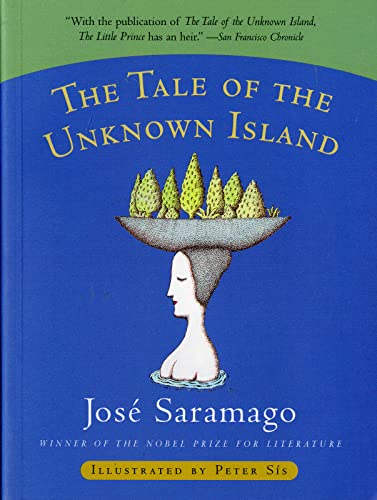
José Saramago published this very short, parable-like story in 1997 in Portuguese with the title O conto da ilha desconhecida. This version, translated into crystal clear fairy-tale English by Margaret Jill Costa and illustrated by the brilliant children’s illustrator Peter Sís, followed two years later.
In 2017 the story was adapted for the stage by Ellen McDougall and Clare Slater and performed at the Gate theatre in London with the title The Unknown Island (the Guardian‘s enthusiastic review here).
It’s not a children’s book, but it builds on conventions of children’s literature. A man appears at a gate of the king’s castle and asks for a boat. He refuses to be sent away, and the story goes from there. He wants the boat in order to set sail to find the unknown island. Everyone, from the king to the cleaning lady, tells him that there are no more unknown islands, but he persists, first in his request and then, when (not a spoiler really) the king gives him a boat, in persuading other people to help on the quest.
It’s a parable about creativity, or perhaps about scientific enquiry. Certainly it resonates against the kinds of things that reactionary politicians say regularly about university research grants (as in this example from almost exactly a year ago). But it twists and turns, slipping out from under such neat encapsulations. Naive readers like me will be surprised and delighted by how it turns out.
The book was perfect for reading in the sauna, and I read it there in two sessions, both of them with quite a lot of chat eating into potential reading time. Sadly the glue holding my beautiful little book together couldn’t withstand the heat, so now I need to handle it with great care.
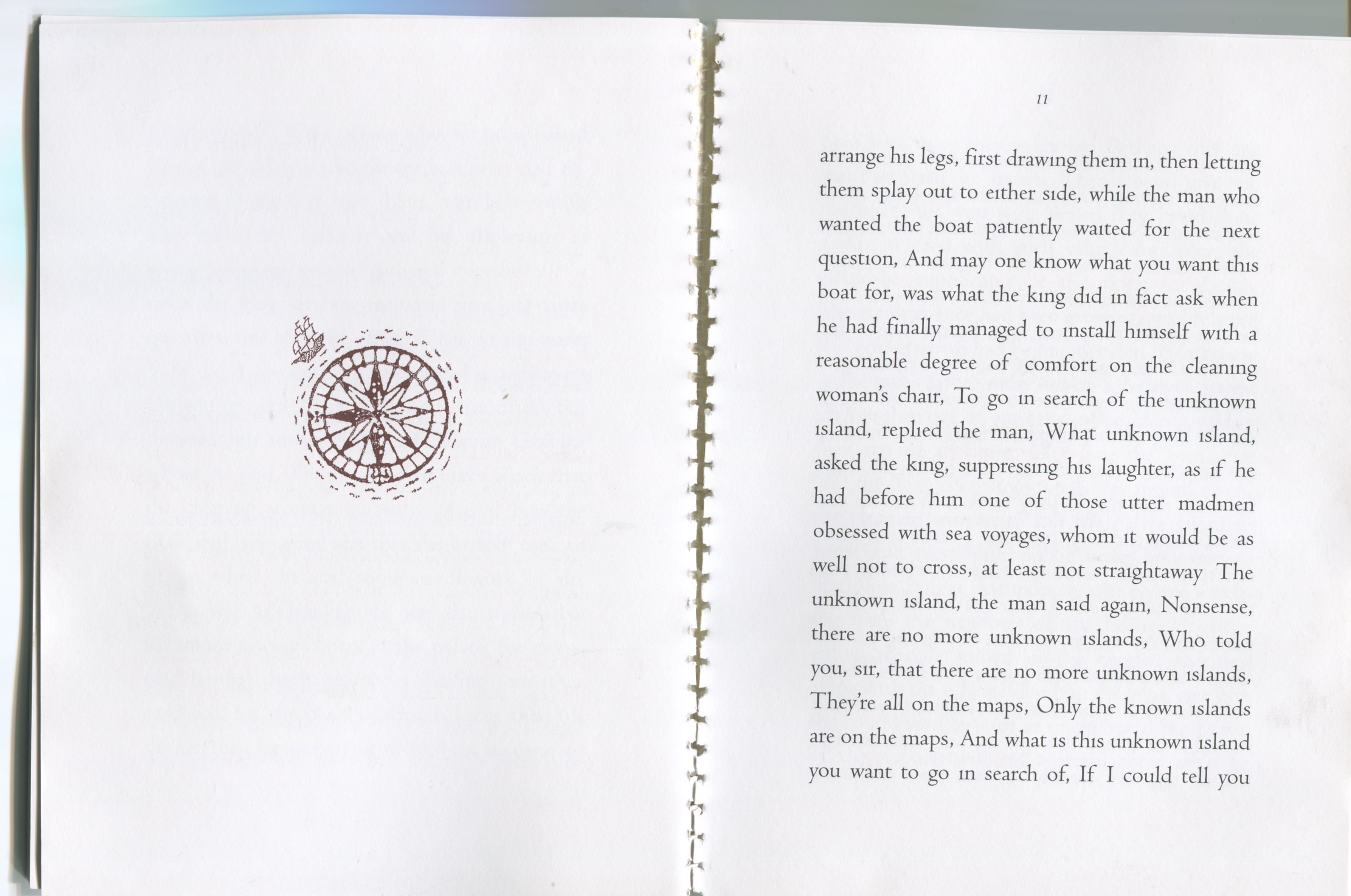
For a closer look, I can’t take a snapshot of page 75*, because there are only 51 pages. Assuming that page 75 is usually about a fifth of the way through a novel, I’ll focus instead on pages 10 and 11. Here they are, heat damage and all, at the beginning of the king’s encounter with the man who wants a boat:
Peter Sís’s compass sits in the middle of the left hand page, silently endorsing the man who wants a boat. All his illustrations have a similar simplicity of line, and make similar luxurious use of white space, though some of them, like the cover image above, have a weird, surrealist quality.
This is early in the book. The king has condescended to meet the man at the door for petitions, a door he rarely visits in person, and his discomfort manifests as awkwardness in the only chair available, which belongs to the cleaning woman (who is to feature prominently in the rest of the story).
Characteristically, the narrative isn’t broken up with a paragraph for each speaker, and sometimes the transition from one speaker to another doesn’t even merit a full stop. Commas will do, suggesting that we don’t need to pause over the king’s questions, because the man will answer them easily – whether he is indeed ‘one of those utter madmen’ or not. (He’s not. But though his insistence that unknown islands still exist is impeccably logical, he’s not what any conservative arts fund would consider a sound prospect either.) So on the one hand there’s a fine, childlike simplicity to the narrative, but on the other there’s an unsettling edge to its presentation. That unsettling quality becomes more marked as the story progresses.
José Saramago received Nobel Prize for Literature in 1998. The press release accompanying the announcement described him as a writer ‘who with parables sustained by imagination, compassion and irony continually enables us once again to apprehend an elusory reality’. This little book with its hugely resonant tale is my excellent introduction to his riting.
* Currently when blogging about books I take a closer look, arbitrarily, at page 75 – moving on to page 76 at my next birthday if the idea works well enough.
Before the meeting: It was my turn to pick the book. I loved Abdulrazak Gurnah’s Gravel Heart when I read it last year, and I chose this one over three contenders because a) I like the idea of us reading work by Nobel Laureates, and it’s so good to have one whose writing is accessible, b) it’s time we read a book by a non-European writer – the last ones were Burruberongal woman Julie Janson’s Benevolence in October 2020, and two months before that In the Country of Men by US-born Libyan-parentage Hisham Matar.
Afterlives is a terrific book. It was longlisted for the Walter Scott Prize for Historical Fiction 2021. That prize was won by Hilary Mantel’s The Mirror and the Light. I have no quarrel with the judges, but my horizons were expanded much more by this book than by that one.
It’s set in the first half of the 20th century in what is now Tanzania and was then German East Africa / Deutsch-Ostafrika. It’s a family saga, a romance, a war story, a picaresque, a colonial tragedy. It tells the huge story of colonial brutality and East African engagement in two world wars, and also focuses closely on the intimate story of a handful of characters. It’s beautifully written, brilliantly visual, and paying attention to the intricacies of language in Africa under colonial occupation.
It takes risks: in the first third of the book a main, beloved character named Ilya disappears – he’s an African who was educated by German missionaries, and decides as an adult to join the askari, the native troops who serve under the Germans. His absence remains an unresolved ache for the other characters and the reader until the final pages, when a character from the next generation manages to unearth his story – and then the book abruptly ends.
In this colonial context, possibly the most painful story is that of the askari or schutztruppe, African soldiers who are brutally treated by their German officers and in turn perpetrate terrible atrocities on other Africans – not unlike the Native Police in the colony of Queensland where my great-grandfather grew sugar in the late 1800s. This passage is from the account of the First World War as experienced by the characters (my emphasis):
Even as the schutztruppe lost soldiers and carriers through battle, disease and desertion, their officers kept fighting on with manic obstinacy and persistence. The askari left the land devastated, its people starving and dying in the hundreds of thousands, while they struggled on in their blind and murderous embrace of a cause whose origins they did not know and whose ambitions were vain and ultimately intended for their domination. The carriers died in huge numbers from malaria and dysentery and exhaustion, and no one bothered to count them. They deserted in sheer terror, to perish in the ravaged countryside. Later these events would be turned into stories of absurd and nonchalant heroics, a sideshow to the great tragedies in Europe, but for those who lived through it, this was a time when their land was soaked in blood and littered with corpses.
(Page 91)
My love for the absurd and nonchalant heroics of The African Queen just became much more complex. After reading this book, it would be hard to think of African suffering, or for that matter African love or prayer (the mosque is significant for some characters), as a sideshow to anything.
After the meeting: There were only five of us, others being out of town with family for Easter/school holidays and otherwise detained – no one in Covid iso this time. We’re still a little bit thrilled to be meeting in person: this is the third time in more than two years. Our host departed from recent bring-a-dish tradition and provided all the food – tuna steaks and a fabulous broccoli salad resting o a bed of tahini. I had been dreading a conversation about the election campaign and had laid bets that someone would predict an LNP win: it didn’t happen until the very end of the evening when there was consensus that it was a toxic topic, press coverage was abysmal and the leaders of both major parties, for different reasons, were invitations to despair.
We talked about theatre – Girl from the North Country, The Picture of Dorian Gray and WhitePearl – and other books and podcasts (the ABC’s The Ring In on the Fine Cotton Affair was strongly recommended). There were outrageous travellers’ tales, gossip about the very rich, and general catch-up. When we finally came to the book, we had a terrific conversation, all appreciative.
The book conversation began with a confession: ‘I read it weeks ago, in a single sitting. I loved it but I don’t remember anything of it.’ When asked to say what he loved about it, he who had confessed proceeded to give an account of the book that was much more specific than I would have been able to manage: the detailed descriptions of life in a small Tanzanian town, the sweetness of the characters, the way terrible violence is described but doesn’t dominate the narrative, the overall sense that one is learning history that has been a closed book, the sex scenes – and there was more.
One chap was interested enough in the history to do some research. He produced an atlas and showed us the part of Africa where the action takes place. He had printed out a number of pages on the history of what was German East Africa, and some illustrations of askari in uniform. He was happy to report that the novel’s public events – mainly rebellions and battles – were historically accurate.
One man had read the book twice. The first time, several months ago, he appreciated all the things others had named but was left feeling somehow distanced from the characters – so different from reading that other novelist of colonial pain, Amitav Ghosh. He cared enough to read it again. This time he was no more engaged, but felt it to be a feature rather than a problem. On reflection, he came to understand (I hope I’m representing his subtle comments accurately) that his sense of non-engagement was because we are being shown the deep effects of colonisation on the colonised: the characters are beset by cruelty and oppression on all sides, and they are intent on survival. This means they reach out with kindness to each other – there is an amazing amount of kindness in this book, often in unexpected places – and live very much for what joy and they can find in the present. There’s no room for them to reach out to us readers.
I loved this insight. It helped to see the book as a whole. For example, Hamza, the male romantic lead, responds to most situations with silence. We can tell that he is variously humiliated, elated, disappointed, puzzled, grateful, terrified, but he never communicates it. The narration shows us what happens to him and what he does in response (usually he tends to passivity), but we are not given his internal dialogue. He doesn’t talk to us, the readers.
It also makes sense of the ending. Someone said that the last few pages, in which the fate of Ilya is discovered, feels like a postscript, yet (I think it was me who said this) it resolves an issue that has been hanging from very early in the story. In such a beautifully constructed book, it’s unlikely that this is a rough and ready tying up of loose threads. It’s hard to say more about this without being spoilerish so I’ll just say, with apologies for being vague, that the book’s final sentence, which on first reading felt naggingly anticlimactic, picks up the deep theme the group member identified, and offers a sharp change of perspective on the way the rest of the narrative has been resolved.
Afterwards, I thought it would be interesting to hear a conversation between Abdulrazak Gurmah and Alice Walker, the final moments of whose very different novel Possessing the Secret of Joy make an interesting contrast.
When we arrived the sky was clear. As we left the rain was bucketing down and, just like after the last meeting, the streets were awash.
Abdulrazak Gurnah won the 2021 Nobel Prize for Literature, ‘for his uncompromising and compassionate penetration of the effects of colonialism and the fate of the refugee in the gulf between cultures and continents.’ He was born in Tanzania in 1948 and has lived in the United Kingdom most of his life. Gravel Heart is his ninth novel, and the only one available in my local library. It’s not singled out in any of the biographical outlines I’ve read, but it’s a wonderful novel. Here’s how it starts:
My father did not want me. I came to that knowledge when I was quite young, even before I understood what I was being deprived of and a long time before I could guess the reason for it. In some ways not understanding was a mercy. If this knowledge had come to me when I was older, I might have known how to live with it better but that would probably have been by pretending, and hating.
Not to be too spoilerish: when I read the last page of the novel, I immediately flipped back to those sentences. It’s hard to imagine an introduction to the story that follows that is more misleading, and yet at the same time true to the story.
The narrator, born in Zanzibar, travels to England when he finishes school, with the support of a wealthy uncle, leaving his father who is eking out a miserable existence on the margins of their town, and his mother who is having a liaison with a powerful man in the government. After decades, in which he leads a fairly aimless life in the UK, he goes back home for a visit. His mother has died and he spends a substantial amount of time with his father.
I approached the book tentatively – these Nobel Laureates can be tough going. But I’m happy to recommend the book as a completely absorbing read. I felt the young man’s painful yearning for home and his mother, and his difficulty in communicating in letters across the widening cultural gulf was so intimately real to me that I had to keep reminding myself of the vast difference between his life experience and mine. (I was sent off to a prestigious boarding school a thousand miles from home at age 14 and had no idea what to write in my mandatory weekly letter home.) Mostly in England he associates with other non-White people, though some of his amorous liaisons might be white. There’s only one moment of explicit, vile racism, and though the reader sees it coming the young man is caught completely, devastatingly off guard.
The real thrill of the book for me is in the final chapters where the naturalistic mode of storytelling is stretched to its limit as the father tells his son the story of his life over two long nights. But you decide to accept the manifestly artificial set-up because the story is so powerful, and fleshes out the tantalising hints that have been there from that first paragraph. Then, stretching verisimilitude just a bit further, the son realises that his father’s story is a variation on Shakespeare’s Measure for Measure. (The book’s title is a phrase from that play, though I still don’t know what it means.) I can’t say how or why, but I found that moment deeply moving: something in my understanding of the world, of colonisation and racism, moved deep inside my head.
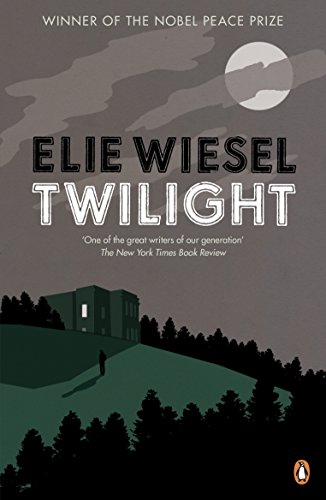
Elie Wiesel, Twilight (1987, translated from the French Le Crépuscule, au loin by Marion Wiesel 1988;)
I was given this book as a birthday gift some years ago. I was finally spurred to read it by a moment in Russell Shorto’s Amsterdam when he says that Holocaust survivor Frieda Menco became an international activist ‘after hearing fellow Auschwitz survivor Elie Wiesel discuss his experiences’.
Elie Wiesel was awarded the Nobel Peace Prize in 1986. The Nobel Committee described him as ‘one of the most important spiritual leaders and guides in an age when violence, repression, and racism continue to characterise the world’, and his Wikipedia entry offers ample justification for that description. His writing of memoir and fiction about the Holocaust is just part of his extraordinary activism; it’s the part I’m interested in here.
His first book, published in 1956, was a memoir in Yiddish of his Holocaust experiences, And the World Remained Silent. Night (published in French in 1958, then in English translation in 1960) was a shorter version, focusing on his relationship with his father in the camps. According to Wikipedia, Night ‘now ranks as one of the bedrocks of Holocaust literature’. In the next years, he wrote the novels Dawn (published in French in 1960, and in English translation in 1961) and Day (1961/1962), making a trilogy that marked (again I’m quoting Wikipedia) ‘Wiesel’s transition during and after the Holocaust from darkness to light, according to the Jewish tradition of beginning a new day at nightfall’.
It’s reasonable to suppose that Twilight (especially in its original French title, which translates as ‘Twilight, at a distance’) is meant to be read as a footnote to that trilogy, an extra phase of the diurnal sequence. Not having read those earlier books, then, I’ve come to this one at a disadvantage: I suspect it picks up lines of argument from the trilogy, either amplifying them or refuting them. So bear in mind, if you read on, that I’m writing as someone who came in late. (Imagine reading only Harry Potter and the Deathly Hallows and none of the first six HP novels.)
Raphael Lipkin was a young Jew in Poland during the Second World War. His entire family was wiped out, mostly by the Nazis but some by the Soviets, but he survived thanks to the intervention of a character known only as the madman with veiled eyes, and Pedro, a heroic member of Briha, the underground organisation that helped Holocaust survivors escape Europe. The novel tells the story of his traditional Jewish family as the reality of the Nazi threat becomes clearer and eventually overtakes them. Intertwined with this narrative is the story, some decades later, of Raphael’s time spent in a New York psychiatric hospital where all the patients believe they are characters from ancient history. He goes to the hospital on the pretext of learning from the patients in his academic field of Jewish mysticism, but he is actually trying to find out what happened to Pedro.
The Holocaust narratives here are mostly stories of richly diverse Jewish life – there are Judaic scholars, historians, young people in love, Communists, Zionists. The focus is on the rich culture and community life that was being destroyed rather than on the horror of the process (though there are moments of horror). In the modern story, Raphael speaks constantly to the absent Pedro, whose name he seeks to clear, but though Raphael’s main motivation is to do with Pedro, that story becomes secondary to his engagement with the hospital inmates. He has substantial conversations with Adam, Cain, a prophet, a dead man, the ‘Messiah of mad people’, and finally God himself. As I read it, in all these conversations, Wiesel is addressing the question of how the Judaic religious tradition can deal with the fact of the Holocaust – is it possible to still believe that God exists, that life has meaning. I suspect that as a confirmed atheist, and from a Christian tradition to boot, I missed a lot of the nuance, and if a conclusion is reached it passed me by (though there is a revelation in the final pages that may amount to Wiesel’s theological conclusion, and that revelation is foreshadowed in the epigraph from Maimonides, ‘The world couldn’t exist without madmen’).
The passion and intelligence of the writing held me captive the whole time. As a for-instance, here’s part of a monologue from the mad Adam, early in the book, which states an extreme despairing response to the horrors of the 20th century:
Listen, God. What I am about to tell you is for your own good. Stop! Yes, God: Stop this senseless project. Believe me, even you who are omnipotent cannot succeed in this. You thought man would be your glory, the jewel of your crown. You make me laugh. Man is your failure. Face it. Give up your illusions. Wake up. Be considerate. Close the book before you turn the first page. Does it shame you to admit that I’m right? Then forget it’s my idea. Let it be my gift to you. Legally, philosophically, you will have fathered it. And you know what? Theologically too. All you have to say is: I tried, I was wrong. And, luckily for the world, I realised it in time. Thus, even if your dream will have lasted but one day, one lifetime, you will be applauded. By your angels and seraphim. By the countless souls who will escape the curse of being born only to die. By the trees that will not be felled by man. By the animals that will not be slaughtered. By the earth that will not be despoiled. And all of Creation, pure and resplendent, will say: Look how great is God, how admirable His honesty. He does not shrink from admitting His error. And yes, He can manage perfectly well without man …
(page 28-29)
As you see, this isn’t a book that offers easy answers. It’s not a comfortable read. But (and remember, I’m a man who said last week that I need a novel to be fun) it’s kind of exhilarating.





 Me fail? I fly!