
Richard James Allen, More Lies (interactive Press 2021)
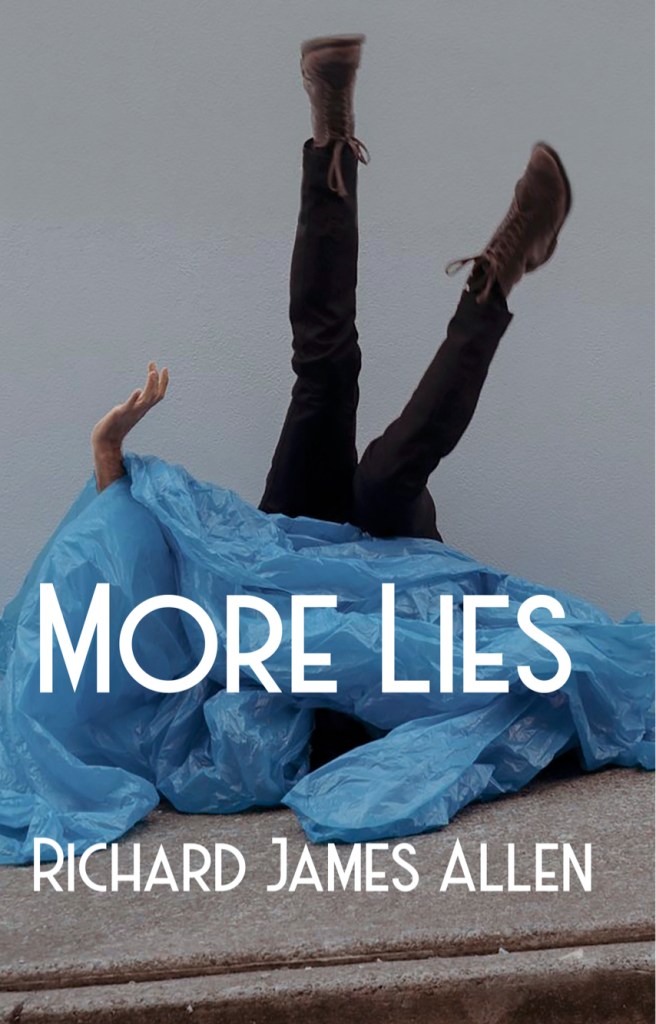
Rae Desmond Jones, poet and one-time mayor of Ashfield, is quoted on the back cover of More Lies saying it was ‘like swallowing a tab spiked with speed – with Raymond Chandler’s spook dealing and watching from the corner’. It’s a clever way to encapsulate the weirdly surreal noir, high-velocity, trippiness of the book, and perhaps there’s a hint of the narrator’s intrinsic unreliability in the inconvenient fact that Rae Jones died four years before the book was published.
It turns out, according to Richard James Allen’s unusually informative Acknowledgements, that though this slim volume can be read and enjoyed in a single sitting, it has been a long time in the making: a first draft was written in the 1990s; a version was performed as a monologue at the 2000 Sydney Writers’ Festival; adaptations for stage and screen were created but never made it to performance. Rae Desmond Jones had plenty of opportunity to read it after all.
In the first of 34 short chapters, the unnamed narrator is strapped to a chair, being forced to keep typing by a ‘divine creature’ to whom he has just made love, and who is now holding a gun to his head. He tells us that he’s been caught up in a planned assassination and a drug-running scheme, that he has to keep typing because the noise provides a cover for his criminal captors. But soon he admits that he’s lying – or perhaps not. Anyhow, his situation changes dramatically, and improbably, and soon he’s typing on a laptop in a jail cell. And so it goes: localities change; characters change names, motives, identities and gender. The narrator is a self-confessed liar caught up in a Kafka-esque nightmare, or is it a Dada-esque dream? Occasionally he breaks into verse. Through all his vicissitudes – sometimes he seems to be in a hard-boiled detective novel, sometimes an episode of Breaking Bad, sometimes a dark existential tract, sometimes a spoken word event – he keeps typing, reasonably sure that none of the other characters will read his text, but not at all sure he can trust the reader – that’s you or me – whom he addresses with deep suspicion.
You can see why I had my doubts about the blurb from Rae Desmond Jones.
Confused? Well, read the book. It won’t clear up your confusion, but it will amuse, and while it’s at it, it may stir up some thinking about the nature of fiction.
The book was launched in a cheerful, well-attended zoom event, where Richard James Allen read the first couple of chapters. You can see a recording at this link.
I’m grateful to Interactive Publications for my complimentary copy.


 It’s easy for English-speaking readers to forget that a vast amount of writing exists in the world independent of the English language: neither written in English nor translated into it. In India, I’m told, there are a number of languages in which novels can find much greater audiences than the one we Anglophones arrogantly assume to be universal.
 Ramapada Chowdhury’s 1972 novella Je Jekhane Danriye is a gem that would have remained invisible to non-Bengali readers if Swapna Dutta’s love for it hadn’t led her to make it available to us. A film version was released in 1974, but there’s very little information about it on


 Me fail? I fly!