Tag Archives: Palestine

Raja Shehadeh, We Could Have Been Friends, My Father and I

Raja Shehadeh, We Could Have Been Friends, My Father and I: A Palestinian Memoir (Profile Books 2022)
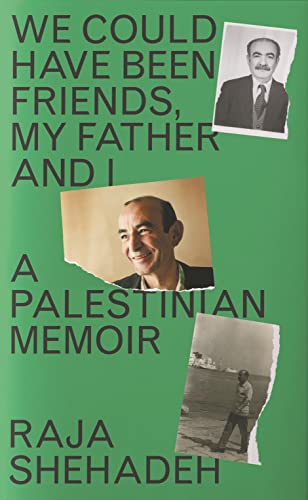
When a young man at the Sydney Writers’ Festival recommended this book to me, I said, ‘What a great title!’ He didn’t miss a beat: ‘Yeah, a great dust jacket too.’ You’ve got to love the sarcastic young.

Superficial old man I may be, but the promise of the its title is what led me to this book rather than one of Raja Shehadeh’s other recent books, such as What Does Israel Fear from Palestine? (2024) or his Orwell Prize winning Palestinian Walks: Notes on a Vanishing Landscape (2008) – both with excellent titles. Since reading Annie Ernaux’s book about her father, A Man’s Place / La place (my blog post here), I’ve been hungry for more books in which the writer sets out to understand their father. This promised to be that. I was not disappointed, and I also received a masterly lesson in the history of Palestine since the nakbah in 1948.

In 1984, Raja was 33 years old and working in the legal practice of his father, Aziz Shehadeh, on the West Bank. When he saw a map that he realised was a blueprint for an Israeli occupation, he wanted to challenge Israel’s plan through the courts. His father gave advice and put his name to brief that Raja prepared, but when the PLO failed to support it he didn’t share his son’s surprise and distress. Raja asked, ‘Had he given up on using the law to resist Israel’s occupation?’

The next year, aged 73, Aziz was murdered. (The case has never been resolved. Apparently the Israeli police knew who the murderer was but didn’t want to charge him.) For maybe 20 years, filing cabinets crammed with his papers remained unopened until Raja decided to have a proper look, and found a wealth of well-ordered material which may have been the preliminary work for a memoir. This book is the narrative Raja constructed from those papers.

Aziz Shehadeh was a prominent lawyer in Jaffa, Tel Aviv, who lost everything in 1948. At first he thought he and his family would be able to return home after a couple of months when things calmed down. It was not to be.

What followed was a long, intense engagement in political debate with other Palestinians and endless attempts, some successful, to mount legal challenges to Israel’s actions. And with it all the terrible sense of betrayal by other Arab nations. As Raja said at the Sydney Writers’ Festival, he had known the broad outline of his father’s activism, but only on reading the papers did he understood his suffering.

Page 78* is part of the story of one of Aziz’s great successes, what he called the ‘frozen money case’, an episode that illustrates the way Britain, Israel and the Arab states in effect combined forces against Palestinians.

When the British Mandate ended in 1948, the British Treasury declared that the Palestinian pound was no longer legal tender. This meant that for the thousands of Palestinians who had fled to other countries, any bank accounts in Palestinian currency were useless. Arab banks and the Bank of England denied all responsibility, and the fate of those accounts was left to the new state of Israel.

Israel ordered every commercial bank operating in its territory to ‘freeze the accounts of all their Arab customers and to stop all transactions on all Arab accounts’. Shehadeh points out that they refrained from calling them Palestinian accounts: ‘To them Palestine was no more and the Palestinians had ceased to exist.’
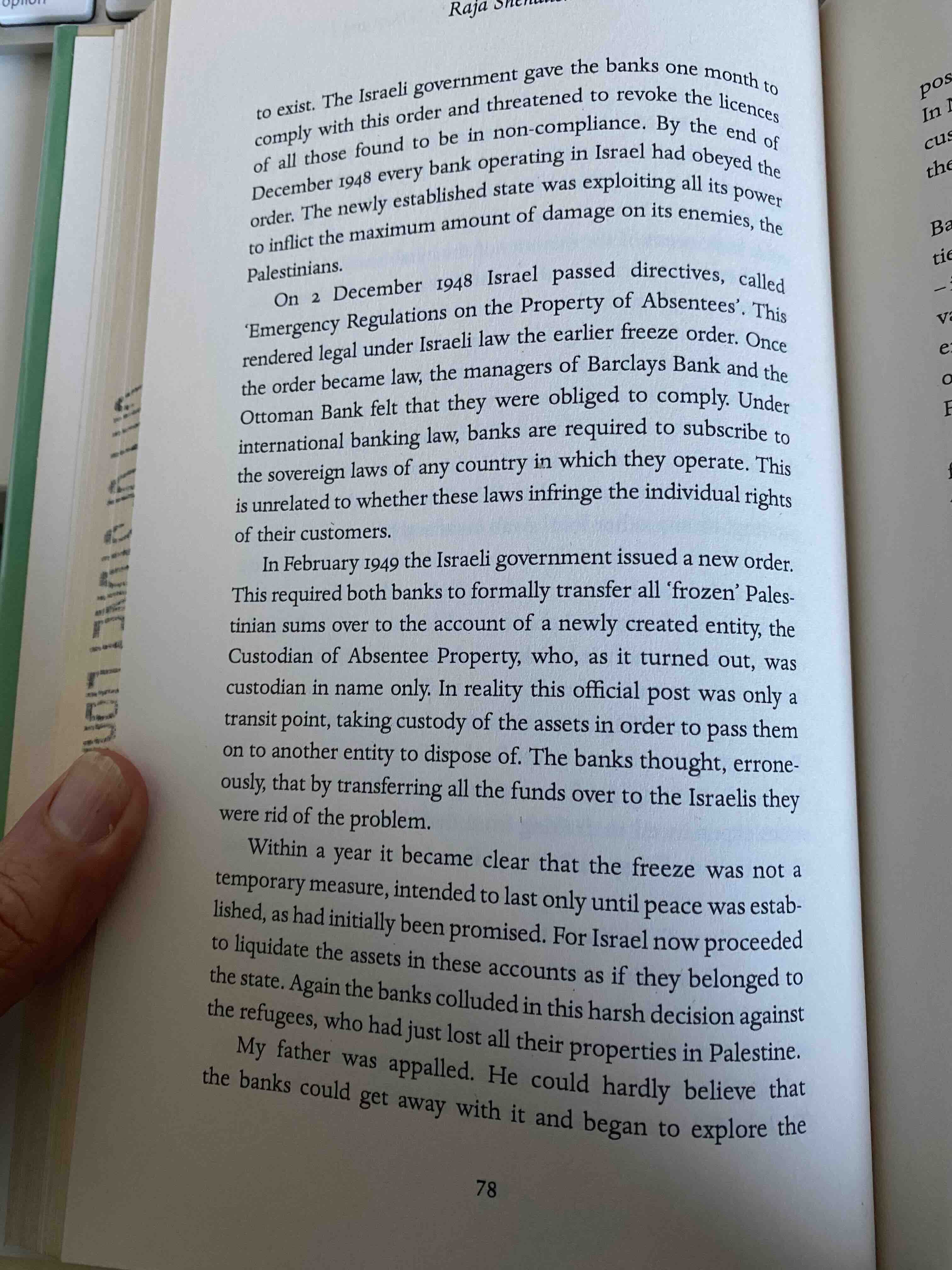
By the end of December 1948 every bank operating in Israel had obeyed the order. The newly established state was exploiting all its power to inflict the maximum amount of damage on its enemies, the Palestinians.

On this page, in measured, objective prose, Shehadeh outlines the ruthlessness of the new Israeli government. First, in December 1948, there were directives called Emergency Regulations on the Property of Absentees, with which both active banks, one British and the other Arab, felt obliged to comply. In February 1949 the Israeli government required the banks to transfer the affected funds to a new entity called the Custodian of Absentee Property. The banks could wipe their hands of the issue.

Within a year it became clear that the freeze was not a temporary measure, intended to last only until peace was established, as had initially been promised. For Israel now proceeded to liquidate the assets in these accounts as if they belonged to the state. Again the banks colluded in this harsh decision against the refugees, who had just lost all their properties in Palestine.
My father was appalled. He could hardly believe that the banks could get away with it and began to explore the possibility of a legal challenge.

The pages that follow tell of a protracted legal battle, which Aziz eventually won, alleviating the suffering of thousands of Palestinian refugees. One significant win along the way.

Aziz was at odds with the PLO. He argued that the refugees should accept that they would never be able to return to their homes. He campaigned for the notion of two states – a Palestinian state and an Israeli state – side by side. His personal story is intimately bound up with the story of the Palestinians, and it is one of many stories of sustained, systematic, heroic resistance.

Edward Said famously wrote that Palestinians have been denied permission to narrate. This book, like others by Raja Shehadeh and a score of other writers, defies that prohibition. I’ve read very little of that writing, but there are a couple of books I can recommend if you’re interested (links to my blog pasts): Drinking the Sea at Gaza (1999) by Israeli journalist Amira Hass; 19 Varieties of Gazelle (2002), a collection of poems by Palestinian-American Naomi Shihab Nye published in response to the rise of anti-Arab sentiment in the USA after September 2001; Palestine (2003) and Footnotes in Gaza (2009), groundbreaking comics journalism by USer Joe Sacco.


I wrote this blog post on land of Gadigal and Wangal of the Eora Nation, whose occupation since 1788 has never been legally resolved. I acknowledge the Elders past and present of this country.


My blogging practice is focus arbitrarily on the page of a book that coincides with my age, currently 78.
Journal Catch-up 29: Overland Nº255

Evelyn Araluen and Jonathan Dunk (editors), Overland Nº 255 (Winter 2024)
(Links are to the online versions unless otherwise indicated.)

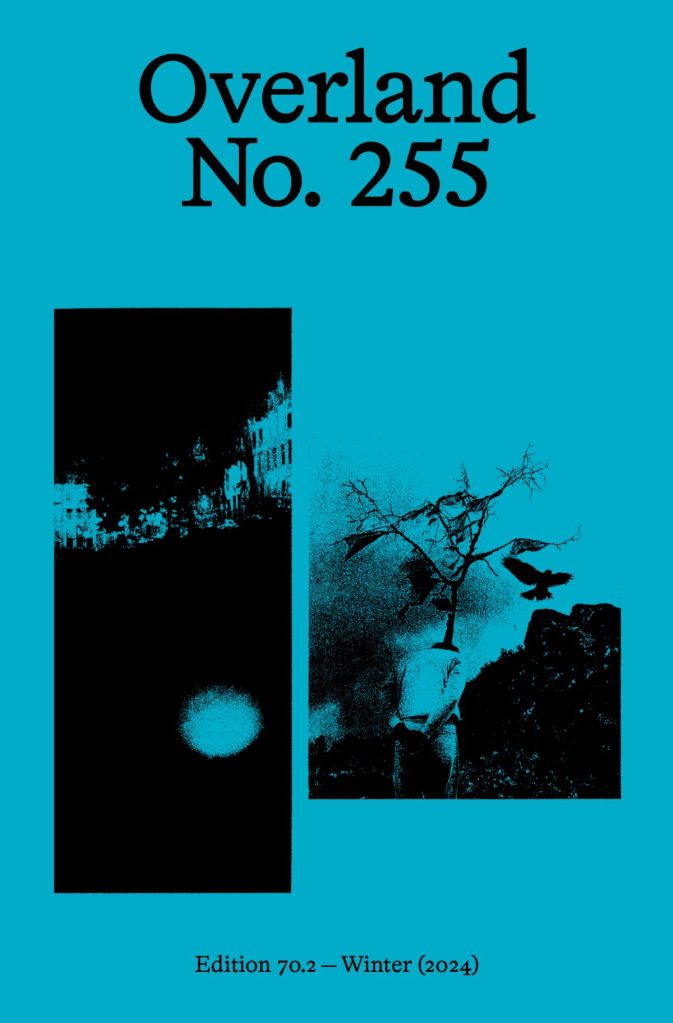
I sometime approach literary journals as if shouldering a grim obligation – doing my bit in the cultural ecology. (Added later: The morning after I uploaded this post, I read in a letter from Esther Anatolitis, editor of Meanjin, that my subscription ‘supports the ecosystem of Australian writing: that fragile yet incredibly powerful space where the finest new work is written’. Great minds draw on the same tropes.) The austere retro design of this Overland, one of four to mark a 70th anniversary, didn’t do much to dispel the grimness. Nor did the editorial, which underlines the darkness of our times. But then

The first thirty pages or so are taken up with ‘Writing from the South: an interview with Kim Scott’. It’s leisurely, full of unfinished sentences and swirling crosscurrents of thought and information – there’s no apparent attempt to tidy up the spoken conversation, and as a result you (or at least I) get to feel you’re in the room with the the living, breathing, thinking author of, among other things, That Deadman Dance, Taboo (links to my blog posts) and (what I haven’t read but now really want to) Benang. He’s in conversation with Samuel J. Cox.

I’ll mention two other non-fiction pieces: ‘The Australian media’s problem with Palestine’ by Juliet Fox, which tells about decades of government suppression of Palestinian voices on a Melbourne community radio station; and ‘“Arts funding is fucked”: Overland 1973–1975’, a plus-ça-change piece by Overland‘s digital archivist Sam Ryan about the politics of funding to the arts in Australia 50-odd years ago.

As always, there’s poetry, ranging in this issue from probably-very-good-if-you’re-motivated-to-spend-a-lot-of-time-with-it-but-today-I’m-not to a beautifully executed punch to the guts. The latter is ‘The Killer in Me’ by Ann-Marie Blanchard, in which the speaker personifies her uterus after a miscarriage. Somewhere between the two extremes is the dauntingly titled ‘Poem in asymmetric transparency’ by Shari Kocher, a meditation on a Margaret Preston painting:

Three lotus lookalikes floating in solar darkness.

As it happens, page 78* occurs in the piece of fiction that speaks most to me, Jordan Smith’s ‘Something Is Rotten’, in which a technological solution to the climate emergency goes terribly wrong, seen from the point of view of young lawyers who thought their normal work was high-pressure. At page 78, the catastrophe is beginning to unfold, though the characters stay with their usual preoccupations. Paul, one of the barristers, looks out of his high-rise window at the ‘sat-drones’ doing hi-tech stuff to the upper atmosphere:

‘Fuck knows what they’re doing but it does look good.’ The sat-drones twinkled as, one by one, they flew up then plunged down, like waves running up and down a skipping rope. The colour of each oscillated between a crystal blue and a sharp, metallic crimson. Rob felt a bit dizzy. He and Sarine looked at each other.

As required by a tight deadline, Rob puts the dizziness aside, takes ‘a few painkillers’ and gets back to work.

His phone buzzed incessantly.

Sydney 6G
Friday, 6 June 11:43
Notification centre
News alert:
PM urges calm after atmospheric pressure dr… (10+)

Rob cleared notifications and switched on do not disturb.

The reader feel the disaster happening while the character sticks to the his mundane urgencies. It’s deft storytelling. Like the poems I’ve mentioned it’s marked as ‘Online soon’ on the Overland website, and may be available by the time you read this.

I don’t usually google authors, but I did look up Jordan Smith. He’s a barrister who has an Honours degree in nuclear physics, so I guess he knows what he’s taking about on both sides of the equation.

I haven’t exactly dispelled the notion of grimness I invoked in my first sentence – colonisation, genocide, miscarriage, climate catastrophe aren’t cheery subjects. But taken along with the evocative decorations from past issues (Richard Tipping in the 1970s, Rod Shaw and John Copeland in the 1990s) there’s something exhilarating about the way Overland has survived so much change in the world and in itself, still giving a platform to new voices, still saying things that aren’t easy to hear elsewhere.


I wrote this blog post on the land of the Wangal and Gadigal clans of the Eora nation. I gratefully acknowledge the Elders past and present who have cared for this beautiful country for millennia, and lived through extraordinary changes in the land and climate over that time.


My blogging practice is focus arbitrarily on the page of a book that coincides with my age. This is first time I’ve looked at page 78.

Journal Catch-up 27: Overland Nº254

Evelyn Araluen and Jonathan Dunk (editors), Overland Nº 254 (Summer 2023)
(Only the editorial is online at the time of writing – so I haven’t included links, sorry!)

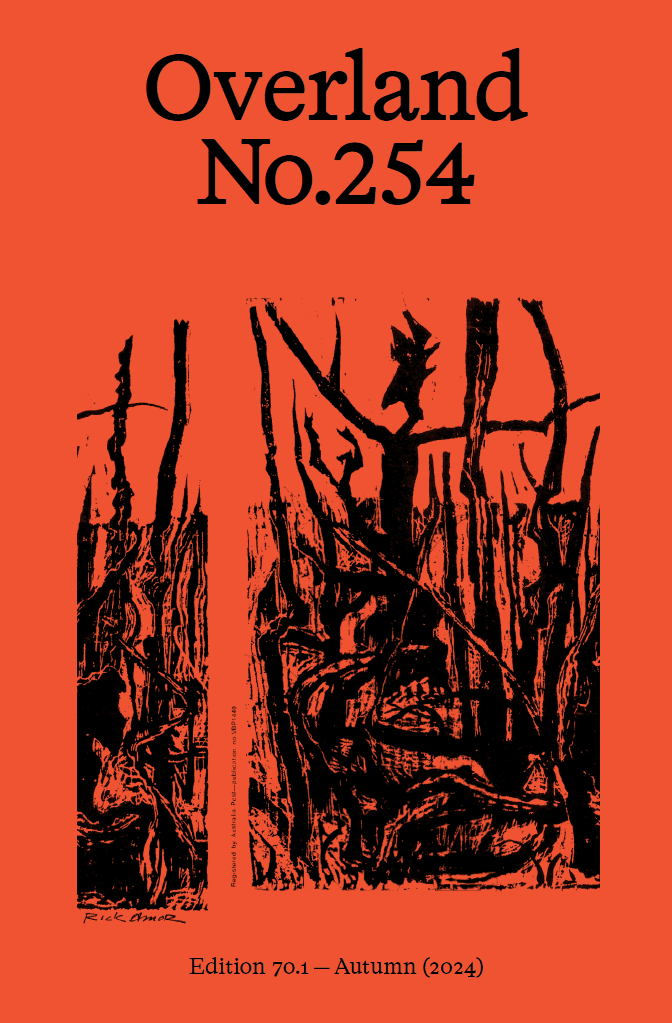
The first thing you notice about this issue of Overland is its design – an austere black and red cover and monochrome throughout, a smaller format, and surely the paper stock is cheaper than we’ve become used to. Could this be a sign of a funding crisis?

Of course there may be a funding crisis – this is an Australian literary journal after all. But there’s a definite retro aesthetic to the new look. Editors Evelyn Araluen and Jonathan Dunk call it an ‘archivally informed design’, and explain that it’s the first of four issues to mark Overland‘s seventieth year of publication. The internal illustrations are all from the archives, and include stunning ink drawings by Noel Counihan from the 1970s and Rick Amor from the late 80s and early 90s. Fabulously, page 128 features a Bruce Petty cartoon from 1976.

The nostalgia stops with the look. The words are all 2024.

I recommend the whole issue, but want to single out two articles that make me sorry so little of this content has made it to Overland‘s website. They are ‘“A State of Waste”: Myall Creek, the Sydney Herald and the Foundations of Australian Capitalism’ by Jeff Sparrow, and the anonymous essay, ‘Writing after … October 7’.

I’ve recently read how the 16th century Papal ‘Doctrine of Discovery’ (Wikipedia entry here) was explicitly invoked to justify dispossession and genocide of Indigenous people in the Americas and elsewhere well into the 19th century. Jeff Sparrow’s magisterial essay offers a very different account of how similar acts were justified in Australia. It’s a clear and cogent history of how the closing of the commons in 18th century Britain led to a new understanding of ‘ownership’ of land, which was applied ruthlessly by the settlers in Australia. The content may not be startlingly new, but Sparrow’s copious quotation from the Sydney Herald in the first part of the 19th century is, for me at least, revelatory. It’s not that the way First Nations people related to the land was strange to the settlers. It was all too familiar:

Like the British commoners, Indigenous people clearly did ‘make use’ of the land. They lived in a use-value society, tending their country to encourage the animals and plants they required. The Herald, however, understood ‘productivity’ in capitalist terms, with use values significant only insofar as they generated profit. (Page 67)

The essay spells out the way this thinking leads shockingly, but logically to the minds of the Sydney Herald editors, to justification of massacres.

What can I say? If you get a chance, read this essay.

The author of the other stand-out essay is a person of Arab background, writing in the context of conversations with Arab and Palestinian friends who work in academic or cultural contexts. They describe how they have always held in their mind the history of Palestine as ‘a bustling site of plurality and coexistence’. The establishment of the state of Israel in the nakba put an end to that condition but it has remained as a vision of possibility.

Jews worldwide were shaken by the visceral hatred shown for them in the Hamas attacks on 7 October last year. Palestinians and Arabs have been no less shaken by the hatred and disregard for them that subsequent events have demonstrated. The multi-religious and plural world of pre-1948 is now unthinkable. ‘We had not realised until this carnage started,’ the author writes, ‘how dehumanised Palestinians and Arabs are in the eyes of most Israelis.

There’s more. Back here, well-intended and well-informed colleagues have been carefully ‘balanced’ when discussing the situation of Palestinians in Israel, in large part because of not wanting to be seen as antisemitic. The author and friends have believed that if a point came when Israel unleashed its full fury on Palestinians their colleagues would take a stand. But it has happened, and many have not changed their stance:

It is not hyperbole to say we are grieving as we watch our kin annihilated on an hourly basis … We feel neglected, betrayed and discarded. We have always stood in solidarity with the causes these colleagues are most passionate about because those causes are ours too. Why isn’t Palestine their cause? (Page 49)

There’s another fine Palestine-related essay – providing devastating perspective on the brouhaha over three actors wearing a keffiyah at a preview of The Seagull in Sydney last year. But it’s the anonymous writer’s cry from the heart that strikes home.

There’s poetry – including the winners of the 2023 Judith Wright Poetry Prize and an excerpt from Nam Le’s 36 Ways of Writing a Vietnamese Poem.

There are short stories, of which my favourite is ‘Who Rattles the Night’ by Annie Zhang, a comic ghost story that won the Neilma Sidney Fiction Prize.


I finished writing this blog post in the land of the Bidjigal and Gadigal clans of the Eora nation, overlooking the ocean and surrounded by birdsong. I gratefully acknowledge the Elders past and present who have cared for this beautiful country for millennia.