Tag Archives: poetry

Colleen Z Burke’s Cloud Hands

Colleen Z Burke, Cloud Hands (Feakle Press 2024)
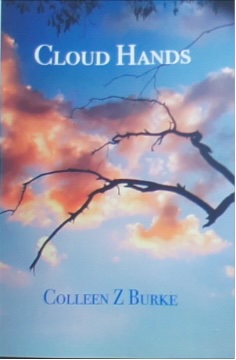
Cloud Hands is Colleen Z Burke’s thirteenth book of poetry.

As in those of its forerunners that I’ve read, its typical poem is a short, impressionistic snapshot of landscape, or especially skyscape, mostly in the inner-west Sydney suburb of Newtown. As snapshots, these poems are mostly embedded in a specific moment, a specific circumstance, so we often get a sense of the life of the person taking the shot, and of the broader context.

There are also memories of a working-class childhood. ‘Each Way’, about gambling as part of the family’s way of life, begins, ‘Minor crime was woven / into our lives just like / the salty tang of the sea.’ (I can relate: my own family of origin wasn’t working class, but my farmer father, like Colleen Burke’s, was a patron of illegal SP bookies.)

There are a three poems (‘Illusion’, ‘A nefarious enterprise’ and ‘A magnet’) recalling youthful romance. Colleen’s partner was Declan Affley, the folksinger who accompanies Mick Jagger’s terrible rendition of ‘A Wild Colonial Boy’ in Tony Richardson’s 1970 movie Ned Kelly. Though it is many decades since he left us, he is still a vibrant presence in these poems.

There are people-watching poems, incidents from inner-suburban life, comments on the news, snippets of science and social history. Covid and the bushfires of 2019–2020 loom large. Climate change and environmental degradation threaten to sour the joys of the natural environment.

This is a collection that bears witness to a persistent practice of paying attention – to the world, to history, to life.

Page 77* is ‘Invisibility’:
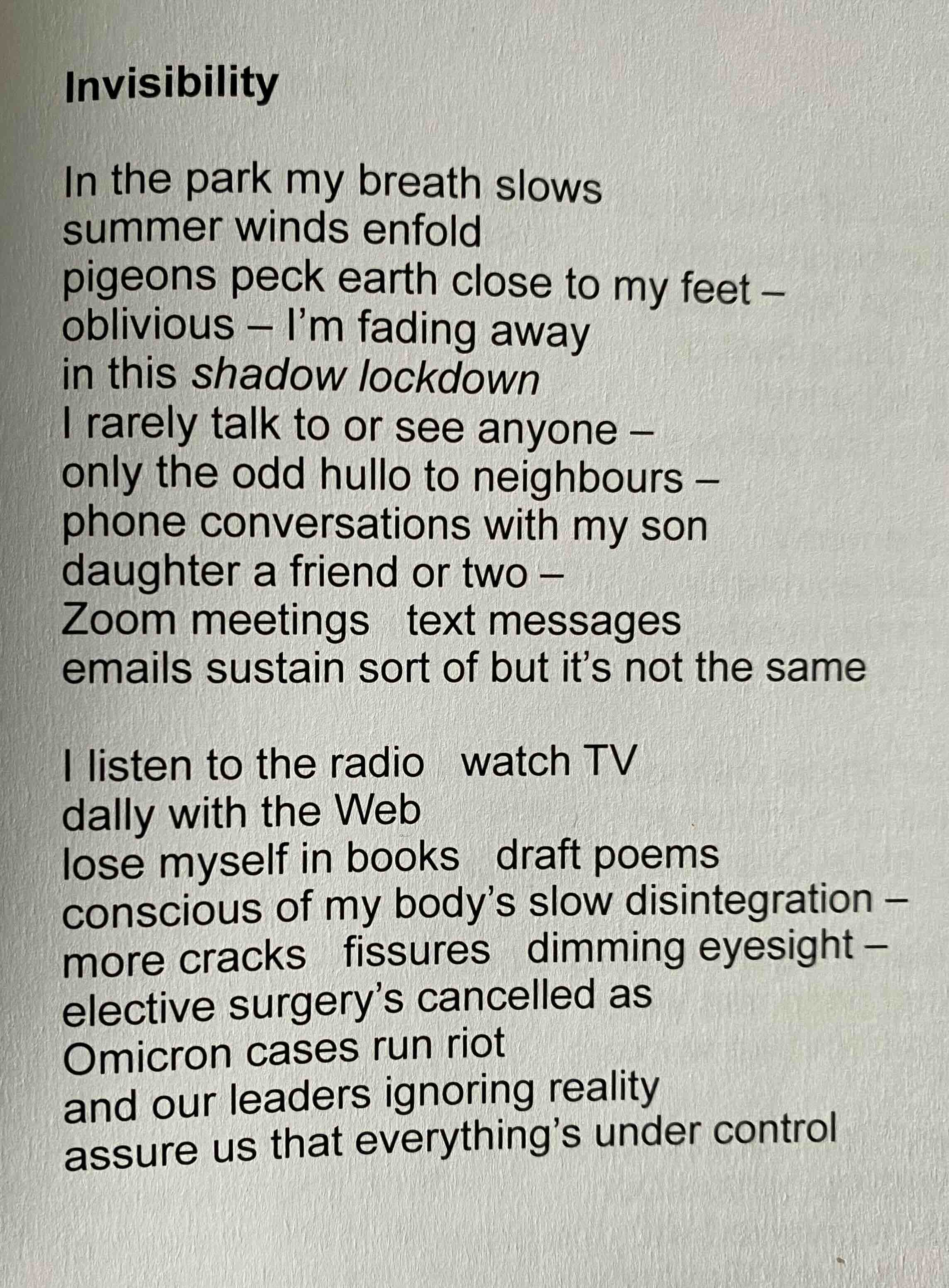
Yes, page 77 of the last book I read had a pigeon poem too. But here the pigeons are oblivious rather than chatty, and the despair in the poem is not worn lightly.

This poem is a great example of the value of slow reading. At first quick reading, it’s a straightforward cry of the heart from the dark days of January 2022, when the Omicron variant of Covid was on the rampage in Sydney. In case you need reminding, there were no official restrictions on movement at that time, but Australia had moved from having a remarkably low level of serious illness and death from Covid to having among the highest. The assistance to individuals and businesses from the Federal government had largely dried up, and the Prime Minister of the time was trumpeting a business-as-usual message. Here’s a link to Mike Secombe on that nightmare in The Saturday Paper.

So this poem is, perhaps, an unremarkable record of how one woman suffered in that time: she has minimal contact with other people, she fills her time with solitary activities, and her age-related health issues go unattended to. Like most of us, she finds fault with the Morrison government’s handling of the situation.

That’s all there. But, interestingly, after I started writing this blog post I had a number of conversations that kept sending me back to the poem. One person spoke about a gobsmacking experience using the (I think) Apple Vision Pro goggles – it was as if he was in the room with a musician, could almost touch her. Someone else is reading Naomi Klein’s Doppleganger, and described her account of people involved in the riots of 6 January losing track of the difference between the gaming world and the actual world where there are consequences. Burke’s ‘sort of but it’s not the same’ stops feeling like a banal statement of the obvious and takes on a profound resonance. The poem expresses one woman’s feelings in a specified circumstance, but it sends ripples out well beyond it.

The other thing I noticed as I sat with the poem, or had it sit with me, is the part played by the pigeons. The poem begins, like many of Burke’s poems, with a moment of relaxation in the park – the breeze, pigeons, the earth, her breath slowing down. Then, with the word ‘oblivious’, it turns to the poet’s inner turmoil. The pigeons might have provided a calming anchor, their obliviousness an invitation to pay attention to the present moment. But it was not to be. Skip to the final lines, and the notion of obliviousness returns to round out the poem with ‘our leaders / ignoring reality’. The poem’s speaker is invisible to the pigeons who are engrossed in pecking the earth. She is also invisible to the political leaders who deny that the coronavirus is out of control. The tension between the pigeons’ focus on reality and the political leaders’ wilful ignoring of it is what holds the poem most satisfyingly together.

You can read my blog posts on some of Colleen Z Burke’s previous books here, here, here and here, and on her memoir The Waves Turn here.


I wrote this blog post in Gadigal Wangal country, where I believe Colleen Z Burke also lives. I acknowledge Elders past, present and emerging for their continuing custodianship of this land, over which their sovereignty has never been ceded.


My blogging practice, especially with books of poetry, is to focus on the page that coincides with my age, currently 77.
Ken Bolton’s Whistled Bit of Bop

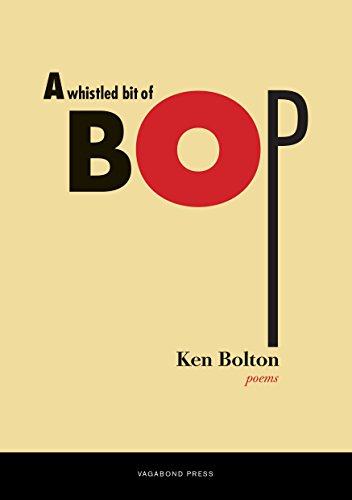
Ken Bolton, A Whistled Bit of Bop (Vagabond Press )

I recently heard a British podcaster describe Louis MacNeice as ‘a highbrow ordinary bloke.’ The implied combination of approachability and erudition struck me as a spot-on description of Ken Bolton in these poems.

As the book’s biographical note tells us, Bolton is a prolific art critic and journal editor as well as a poet. As if to emphasise his intimidating high-browness, the back cover blurb speaks of poetic abstraction and lists members of a ‘pantheon’ who appear in the poems: a timid reader who wasn’t sure who Ashbery or Berrigan are (note the use of second names only – the highbrow equivalent of Cruise and Nicholson), or had never heard of F T Prince or Peter Schjeldahl, might quail.

It’s true that the poems fairly bristle with erudite references. But when one turns to the endnotes for help, here’s part of what they say the second poem in the book, ‘Europe’:

As with many of these poems there are references to art – to Winckelmann, Mengs, Jacques-Louis David – but as the joke is that they are so little thought of now it would be perverse to explain them here.

I stopped worrying about my ignorance, and started getting the joke.

In these poems, an ordinary bloke hangs out in cafes people-watching, or stays up late writing to his adult son on the other side of the planet, broods about friends alive and dead, meditates on art and poetry, and (so it generally feels) somehow lets the flow of his mind find its way onto the page. It’s a lively, questioning, self-conscious and sometimes self-mocking mind. You really don’t need to know who Winkelmann is to have fun reading ‘Europe’. Probably it’s more fun for better educated readers, but that’s not a reason to be intimidated.

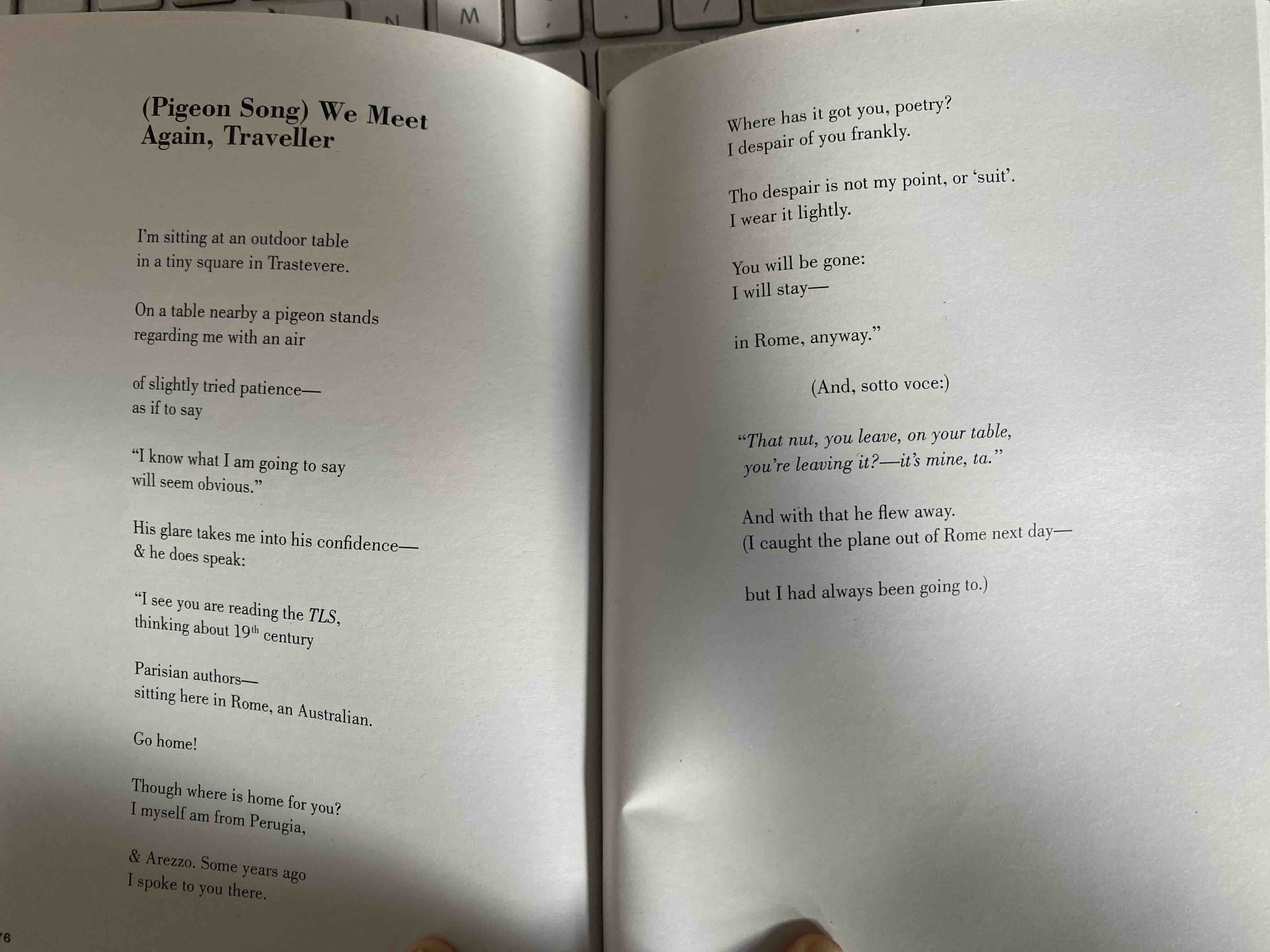
I loved the whole book, but I’ll keep to page 77*. It’s the right-hand side of the spread containing ‘(Pigeon Song) We Meet Again, Traveller’ which, by sheer good blogging fortune, is the shortest poem in the book. Click to enlarge this image:

Not strictly part of the poem, there’s an endnote:

Pigeon Song: a white pigeon with reddish brown flecks on it & around one eye. Strangely the bird had no accent, & spoke in English.

It’s a quietly comic poem in which an Italian pigeon questions an Australian poet about his life choices, after which both pigeon and poet do what they would have done if the conversation hadn’t happened. I hope I won’t make it any less enjoyable by doing a little ‘slow-reading’. With a lovely light touch, it airs some serious issues.

First the title. Its complexity is explained by yet another endnote: the words in brackets, ‘Pigeon Poem’, were a working title, and ‘We Meet Again, Traveller’ is the title finally settled on. Showing his working in this and other ways is one of the things I love about Bolton’s poetry: he lets the reader in on his process. Apart from the title, there’s not a lot of that in ‘We Meet Again, Traveller’. The comic endnote makes up for that absence a little: it implies that the fantasy is based in a real-life moment, and suggests that Bolton may have considered having the pigeon speaking in Italian or with an accent, but – happily – rejected both options.

The action of the poem takes place, typically, in an intellectual ambience. Bolton is sitting at a cafe table in Trastevere, a cool part of Rome that’s home to four or five academic institutions, where sitting at a table reading a literary journal wouldn’t stand out. (As even middlebrow ordinary blokes know, the TLS is the Times Literary Supplement.)

But there’s nothing rarefied or highbrow about the pigeon. Who among us, sitting alone at an outdoor table, hasn’t felt judged by a beady-eyed pigeon (or ibis if you live in Sydney)? This particular judgmental pigeon voices something of the complex unease of being a settler Australian poet, deeply meshed in European culture with an unresolved relationship to the actual land where one lives:

I see you are reading the TLS,
thinking about 19th Century

Parisian authors –
sitting here in Rome, an Australian.

Go home!

London, Paris, Rome, Australia, past and present: it’s complex. I’m reminded irresistibly of a music hall ditty I loved as a child (and which, as a complete irrelevance, I once heard the late Dorothy Hewett sing):

Why does a red cow give white milk
when it always eats green grass?
That's the burning question.
Let's have your suggestion.
You don't know, I don't know, don't you feel an ass?
Why does a red cow give white milk
when it always eats green grass?

The pigeon then asks a key question with characteristic Boltonian (Boltonic?) lightness of touch.:

Though where is home for you?

If you are so immersed in European culture, is your home in a physical location or in a less tangible ‘place’? As in the music hall song, the burning question goes unanswered.

The pigeon knows where its home is, though it too has travelled. Then:

and Arezzo. Some years ago
I spoke to you there.

This may be referring to an earlier Bolton pigeon-poem that I haven’t read, or to a time when he visited Perugia in real life, perhaps to study at the Università per Stranieri. (Decades before Duolingo, Perugia was often mentioned among Australians of a certain age and education as a place to go to learn Italian.) The content of that earlier conversation, whether the subject of an earlier poem or not, was evidently the Bolton’s poetic aspirations:

Where has it got you, poetry?
I despair of you, frankly

But then, having dipped by pigeon-proxy into the well of settler-anxiety, self-doubt and possible despair, the poem returns to lightness. (I’ll just note in passing that I don’t understand the word ‘suit’, or why it’s in inverted commas – any help welcomed in the comments.) The pigeon, dropping its role as cultural challenger, asks the question that’s actually on any judgemental-looking pigeon’s mind. And both pigeon and poet fly away, as they were both going to anyway.

The poem consists of eighteen stanzas, most of them couplets. I can’t say much more than that about the form, except it’s good to notice the use of rhyme in the last third of the poem: stay, away, sotto voce, away, day. Reading those lines aloud, the rhyme creates a sense of relief that the awkward conversation is over: things flow easily. The pigeon’s sotto voce couplet about the nut and the final line both depart from the rhyming flow, suggesting that bird and poet both now exit the staged conversation.


I wrote this blog post in Gadigal Wangal country, where it is my great joy to live, as a settler Australian who tries to remain aware of unceded Indigenous sovereignty. I acknowledge Elders past, present and emerging for their continuing custodianship of this land.


My blogging practice, especially with books of poetry, is to focus on the page that coincides with my age, currently 77.
Judith Beveridge’s Tintinnabulum

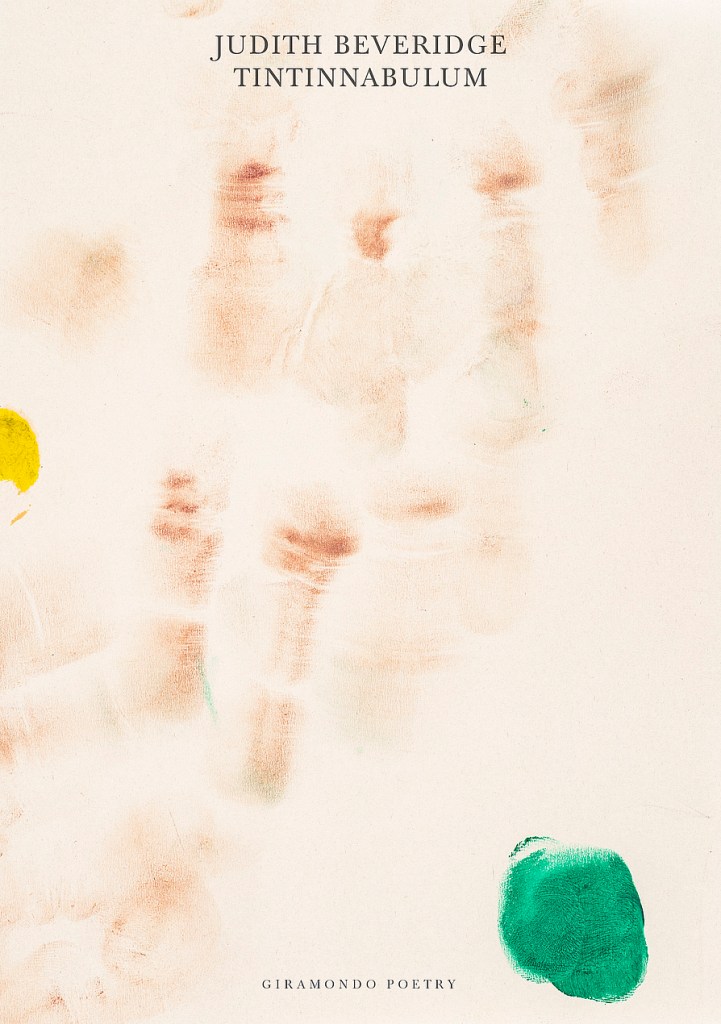
Judith Beveridge, Tintinnabulum (Giramondo Poetry 2024)

As a rule on this blog I focus on the page of a book that corresponds to my age. There’s a lot I could write about Tintinnabulum (it’s a very rich collection from one of Australia’s brilliant poets), but let’s see what happens if I skip any general discussion and go straight to page 77.

Page 77 is the second page of the poem ‘Choirwood’, the last poem in the book, which gives its name to the book’s final section. Earlier sections have dealt with the animal and human world, including a fair amount of death, danger and cruelty. So when the fourth section arrives with ten poems celebrating the natural world, it feels like the final stage of a broad conversation. Celebration has the last word:

I wouldn’t be unhappy if you stopped reading this right now, clicked on the image, and let the poem go to work on you. The speaker goes for a walk in the bush near her house one early morning and pays attention to what she sees and hears, inviting us to join her in rich, descriptive language, and then taking us further into contemplating the unseen, unheard wonders of the universe. There’s a play of metaphors to do with religion, commerce and art. It’s a gorgeous celebration of the natural world, expanding from the back yard to the cosmos.

It’s a thing about poetry that what the reader brings is an important part of how a poem works. So rather than discuss the poem line by line. I’ll tell you what I bring to it – and also some places it takes me to.

First a snippet of personal history. In early 1965, after finishing high school, I was training to be a member of a Catholic religious order. I was a postulate, the step before becoming a novice. We would rise hideously early each morning summer and winter, wash in cold water (as the wood-fired boiler wasn’t lit yet), and gather in the chapel for prayers, meditation, Mass and more prayers. All that before an eight o’clock breakfast. I was terrible at meditation – it was too easy to nod off – but loved the communal prayers, especially the call-and-response reading of psalms. I loved the bloodthirsty psalms and the whingey ones, but most of all I loved the exuberant songs of praise. This poem brings to mind a specific psalm-related memory.

There were terrible bushfires that year, and as a community of 50 or so able-bodied young men we became volunteer fire fighters. I had my turns at going out, but on this occasion I was not one of the 20 or so who had been away all night lugging their backpack sprays. Those of us who had stayed behind were in the chapel as usual when we heard the truck loaded with wearily noisy, charcoal-stained novices roaring home up the hill outside. We didn’t pause, but surely we put a little extra gusto into the resounding verses of Psalm 148. I don’t have the actual, almost singable English version we used, but here is a bit from the Jerusalem Bible:

Let earth praise Yahweh: sea-monsters and all the deeps,
_____fire and hail, snow and mist, gales that obey his decree,
mountains and hills, orchards and forests
_____wild animals and farm animals, snakes and birds,
all kings on earth and nations, princes, all rulers of the world,
_____young men and girls, old people, and children too!

No lie, we were chanting about fire praising God when that truck drove past the chapel windows.

Since that moment, any poetic celebration of nature – and ‘Choirwood’ is one – carries for me the whiff of bushfire smoke and the paradoxical joy, even exhilaration, of being young and helping to fight the fire.

It’s not odd that I should think of the psalms: the poem itself is not explicitly religious, but it has plenty of religious references – the title, the St Andrew’s Cross spider as a martyred apostle, a mandala. It’s even possible that the poet had Psalm 148 in mind. Thinking of bushfire, on the other hand, is pure idiosyncrasy …

… except …

… there’s this in the book’s acknowledgements:

The poem ‘Choirwood’ was commissioned by Judith Nangala Crispin in 2022 for the Judith Wright Regeneration Road Trip.

I looked up the Regeneration Road Trip (it has a webpage here, a facebook page here, and the album of its poetry reading for sale at this link). Organised by a group of artists who lived between Canberra and the Far South Coast of New South Wales, it took place over 10 days in September–October 2022. According to the website, that In the wake of the terrible destruction caused by bushfires the previous year, the organisers:

came together to try to find a way to help voice the emerging tidal wave of feeling and give back to the communities which are hurting. Rather than focusing on what was lost, the project began to unearth and celebrate the deep connection between the people and the landscapes, animals and plants of this special region. 

So if you know its origin story, ‘Choirwood’ itself carries a whiff of smoke.

Without the origin story, there is no word in the poem of all that destruction. There has been enough of that earlier in the book, perhaps – there’s no need to name the thing being negated, the ‘what was lost’. But a closer look reveals a hint. A note tells us something that a better-read reader might have spotted off their own bat:

The phrase ‘madrigal field’ is from Denise Levertov’s poem ‘Clouds’.

That refers to the lines where the poem’s perspective widens out:

____________________________I give thanks 
too for the forces and interactions running
beneath it all, the flowing, spinning, changing
dynamics, the 'madrigal field' choiring everything
into existence.

(By the way, notice how all those ‘ing’ words create a sound equivalent to the constant motion being described.) Especially when read in connection with the poems final lines, the ‘madrigal field’ is a wonderfully resonant phrase that suggests the mediaeval notion of the music of the spheres, and so invokes a sense of the awe-inspiring, beautifully ordered universe. But the knowledge that it is taken from ‘Clouds’ by US poet Denise Levertov (which you can read at this link) suggests a more nuanced reading. In that poem, the speaker is faced with the recent death of a loved one (or perhaps only a chilling intimation of their death). She forces to her mind a ‘vision of a sky’, that at first appears as a grey mist, but when looked at intently reveals ‘radiant traces’ of green. Only then ‘a field sprang into sight’:

a field of freshest deep spiring grass   
starred with dandelions,
green and gold
gold and green alternating in closewoven
chords, madrigal field.

Perhaps, the poem goes on, death’s chill is ‘a grey to be watched keenly’.

I can’t say I understand Denise Levertov’s poem, but her ‘madrigal field’ is a synesthesian (synesthetic?) vision of a grassy field, quite different from Judith Beveridge’s cosmic concept. Comin from ‘Clouds’, however, it keeps its emotional connotation: the field is what you see when you turn away from death / the premonition of death / destruction, and look ‘keenly’. ‘Choirwood’ is full of keen looking and listening. This, it suggests ever so subtly, can be an important part of coping with catastrophe.

I am grateful to the Giramondo Publishing Company for my copy of Tintinnabulum.


I wrote this blog post in Gadigal Wangal country, where it is my great joy to live. I acknowledge Elders past, present and emerging for their continuing custodianship of this land.

Ali Cobby Eckermann, She Is the Earth

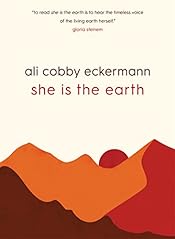
Ali Cobby Eckermann, She Is the Earth: a verse novel (Magabala Books 2023)

Ali Cobby Eckermann is a Yankunytjatjara woman. Her mother and grandmother were taken from their families when very young as part of the government policy. She herself was also taken. Raised by a loving German-heritage family, she found her way back to her First Nations family as an adult, after years of searching.

I first met her poetry in Black Inc’s Best Australian Poems 2009, edited by the late Bob Adamson. In his introduction, Adamson said of her wonderful dramatic monologue ‘Intervention Pay Back’ that it made ‘a new shift in what a poem might say or be’. You can read it in the Cordite Review at this link. Two poems by her, also dramatic monologues, were included in the special Australian issue of the Chicago-based Poetry journal in May 2016. They can be read on the Poetry Foundation website: ‘Black Deaths in Custody’ here and ‘Thunder Raining Poison’ (on the effects of the Maralinga atomic tests on traditional APY lands ) here.

I haven’t read her memoir, Too Afraid to Cry (Ilura Press 2013), or her first verse novel, His Father’s Eyes (OUP 2011). But I can tell you that her second verse novel, Ruby Moonlight (Magabala Books 2012), which deals with the aftermath of massacre, is brilliant (my blog post here). Of her verse I have read the chapbook Kami (Vagabond Books 2010) and Inside My Mother (Giramondo 2015, my blog post here), which are both filled with the intensities of re-uniting with her Yankunytjatjara kin and culture, and the loss of her birth mother soon after finding her.

All of this work has enormous power, and has garnered many awards in Australia and elsewhere.

She Is the Earth, which arrived eight years after her previous book, is a different kind of writing.

It’s described on the title page as a verse novel. There are no characters apart from an unnamed narrator, and no clear events apart from her meandering through an Australian landscape. Any movement is internal. But the book is meant to be read as a single text rather than a collection of short, untitled poems.

At first, I thought it was an imagined story of pre-birth existence, in which the narrator moves towards being born, taking on substance in the world. But that didn’t seem to work and in the end, I gave up on trying to find a narrative, and just went with the flow.

The flow is far from terrible, and the language is never less than gripping, but I don’t know what to say about the book as a whole. I can refer you to better minds than mine.

Here is part of what the judges had to say when the book won the Indigenous Writers’ Prize at the 2024 NSW Premier’s Literary Awards (go to this link for their full comments):

Ali Cobby Eckermann writes in a poetics of self-emergence in which the spectral is made solid through an eloquent economy of language and lifeforms. Each word of this verse novel is deeply considered and rich with meaning, forming as a whole a narrative which is sometimes gentle and sometimes sharp, both beautiful and terrible, and always profound in its exploration of healing, hope and the earth. Each word reads as a gift to the reader.

I recommend Aidan Coleman’s review in The Conversation (at this link). He discusses the book as an example of minimalism, and says interesting things about its recurring images, and even about the developing narrative:

The speaker in these poems is both child and mother, pupil and teacher. References to children and motherhood abound. Initial images of disconnection, anxiety and trauma give way, in later sections, to wholeness and calm.

But the journey is not linear: hope is present from the earliest sections and trauma haunts the closing pages. Healing is presented as an ongoing process that is projected beyond the poem.

[Added later in response to Kim’s comment: Kim on reading Matters had a very different, and more attuned response than mine. You can read her blog post at this link.

Page 77* occurs toward the end – there are 90 pages in the book. Piggybacking on Aidan Coleman’s reading, I can see it as a moment of consolidation, of identity firming up in the landscape:

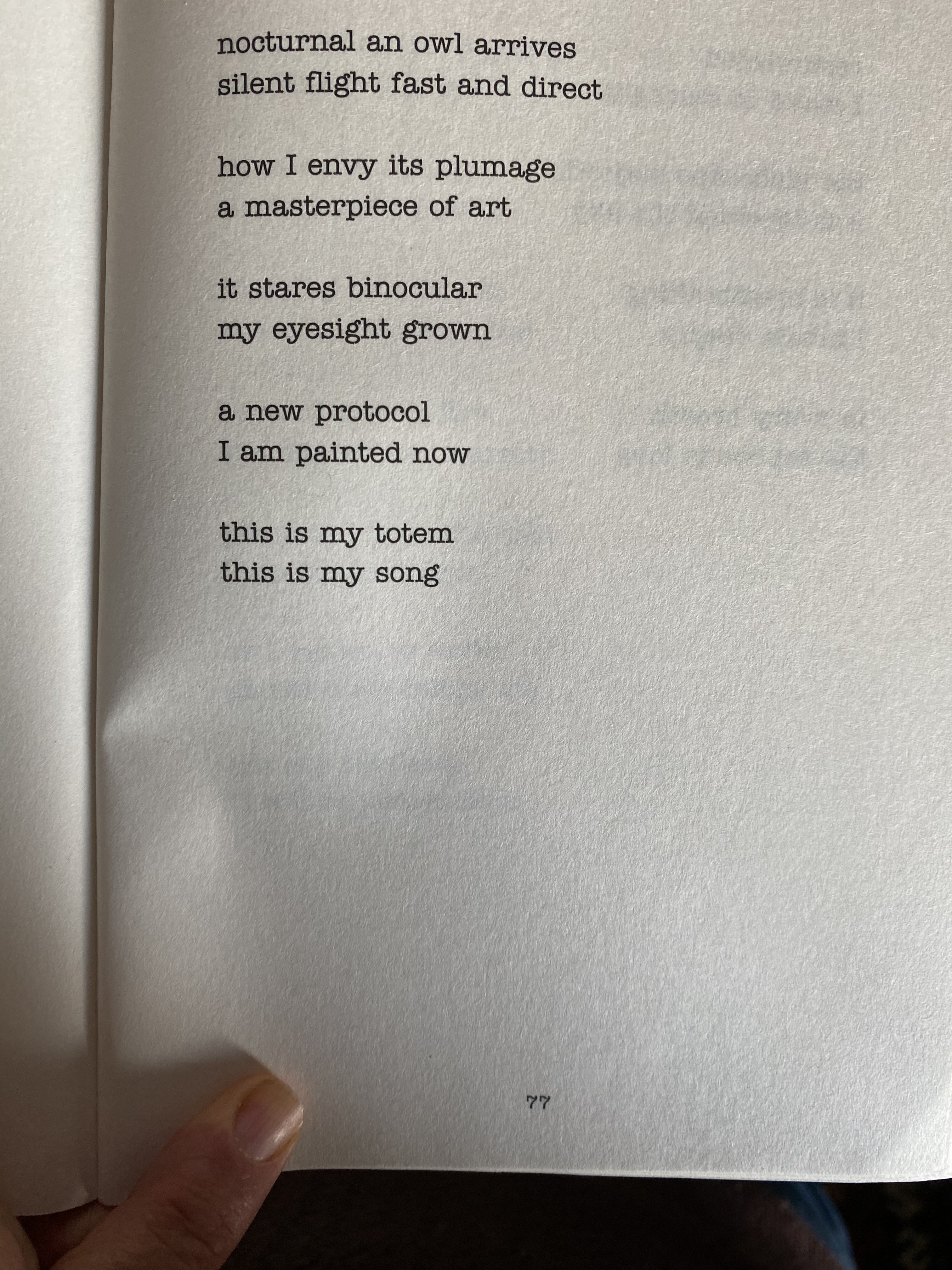
The pleasure of these lines doesn’t depend on their function in the broader narrative. The owl arrives; the narrator admires it; their eyes meet, and there is a moment of identification with the bird; the ‘masterpiece of art’ of the bird’s plumage somehow transfers so that the narrator is painted. The final couplet pulls all that together.

In the wider scheme, that last couplet resolves more than the preceding eight lines. Up to now, the narrator has been full of yearning and unease. Here she seems to find peace:

this is my totem 
this is my song

‘Totem’ takes the hint of identification in the comparison of eyes a step further. There’s something about finding a place of belonging, of deep affinity, of being at home in the world. Once that’s found, there’s the possibility of singing, of having one’s own song.

The first word on the next page is ‘resurrected’, and a couple of pages further on my favourite lines in the book:

I am a solo candle
inside a chandelier

this is the wisdom
I need to succeed.

I still can’t say I understand what’s going on at any given moment in this book. But maybe that’s OK.


I wrote this blog post in Gadigal Wangal country, where it is my great joy to live. I acknowledge Elders past, present and emerging for their continuing custodianship of this land.


* My blogging practice, especially with books of poetry, is to focus on the page that coincides with my age, currently 77.

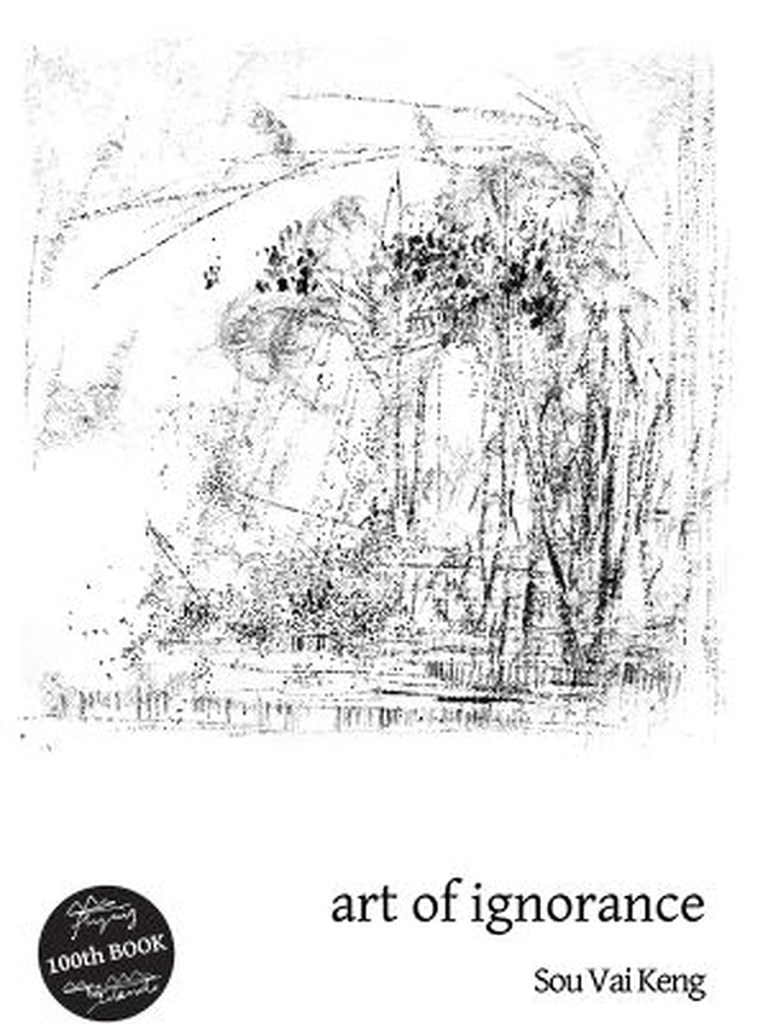
Sou Vai Keng’s art of ignorance

Sou Vai Keng, art of ignorance(Flying Island Books 2023)

art of ignorance is the last of the small but substantial books I took with me on my recent fortnight in North Queensland. Like the others, it’s part of the Flying Island Pocket Poets series.

It’s a bilingual book – that is, each poem appears first in English then in Chinese. As there is no mention of a translator, I assume Sou Vai Keng wrote both versions. She also created the generous number of elegant drawings that intensify the book’s relaxed, contemplative feel.

A note tells us that all the poems were written in mountain areas in Germany and Switzerland between 2014 and 2018. Reading the book felt like sharing the experience of immersion in those mountains with someone with sharp eyes and a seriously playful mind – there’s not a lot of explicit description, things are seen in close-up, sometimes with a touch of surrealism, there are tiny fables and fantasies.

The opening line of the title poem could stand as an eight-word statement of the book’s prevailing mood:

the butterfly does not know the French call it papillon

Page 77* is a good example of how the book works: English on the left, Chinese on the right, with a delicate drawing in the middle (I’m sorry my tech skills aren’t up to showing the drawing without it being sliced in half by the gutter):

The poem starts with sweet whimsy:

she believes she is a tree

The rest of the first stanza elaborates: to be a tree is to ‘live on blessings from heaven’ in the form of rain and dew, and not to need anything else. A different poem might have mentioned roots and connection with other trees by way of the complex underground tangle of fungi. It might have mentioned birds’ nests, or arboreal animals, or fruits and flowers. But not this one. Here the character, like certain ascetics in the early Christian tradition, and in Chinese tradition as well I think, is opting out of active social life, choosing solitude and passivity in relation to a world she assumes to be benign.

But society intervenes. If she was ‘mean and nasty’, she could vanish, but her version of opting out is ‘a lovely idea’. It’s an idea that, by implication, the passers-by find attractive but not permitted. It’s ‘lunacy’. The poem is a parable of sorts, in which a character indulges for a moment a yearning to be stable and self-sufficient like a tree, only to be drawn back gently to the reality of human connectedness and instability:

out of sympathy and solidarity 
people drag her away from where
trees stand firm and strong
and from now on she has to
roam and rove around
together with other
rootless nuts

The final word, far from offering a neat resolution of the poem’s conflict, raises more questions. What does it mean to equate humans with nuts? Nuts as opposed to sane, stable beings; nuts as fruits, insubstantial compared to the tree; nuts as bearing the possibility if one day taking root and developing into something more like trees? She is dragged away from her wistful belief, but at the very last moment the poem opens up to the possibility of her fantasy somehow becoming real.

It’s a fine example of the way Sou Vai Veng’s poem’s twist and turn beneath apparent simplicity. I enjoyed the book a lot.


I wrote this blog post in Gadigal Wangal country, as the days are warming up, the worms are fat and busy in the earth, the adolescent magpies are developing their adult colours. I acknowledge Elders past, present and emerging for their continuing custodianship of this land.


My blogging practice, especially with books of poetry, is to focus on the page that coincides with my age, currently 77.
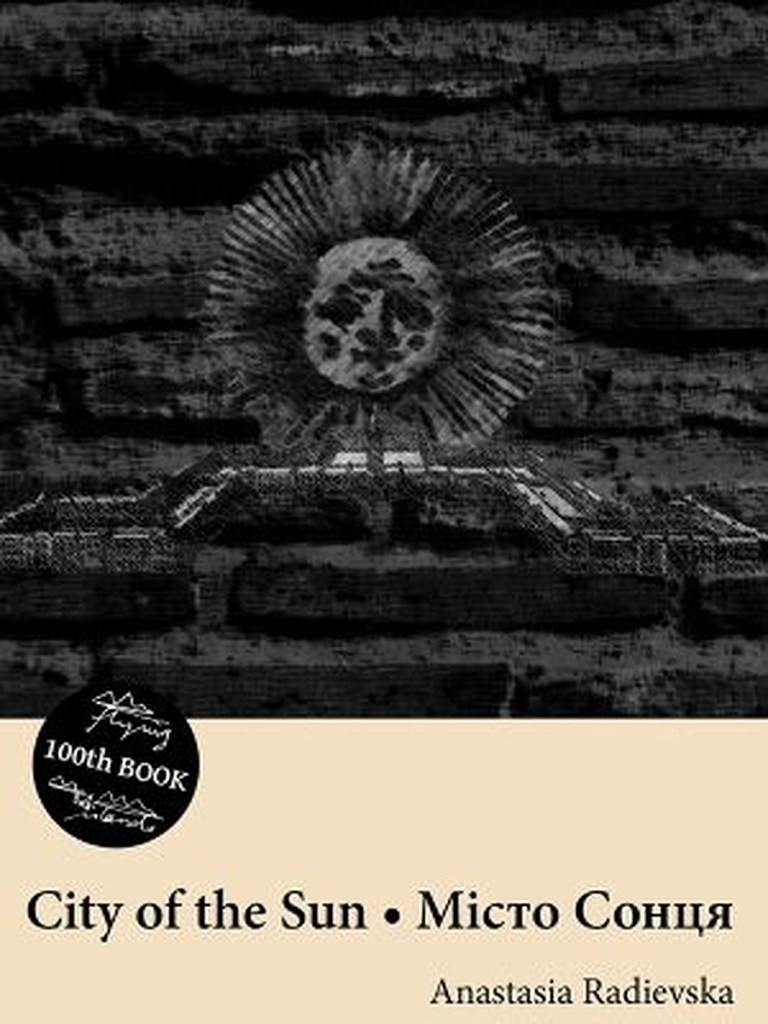
Anastasia Radievska’s City of the Sun

Anastasia Radievska, City of the Sun / Місто Сонця (Flying Island Books 2024)

This is Ukrainian-Australian poet and artist Anastasia Radievska’s first book of poems. It’s a rich, complex creation.

There are poems in English and Ukrainian, which means that almost half the book’s contents remain enigmatic and even unpronounceable to readers like me who can’t read Ukrainian script – but beautiful to look at.

The book takes its title from The City of the Sun, an early 17th century philosophical work by Tommaso Campanella, which according to Wikipedia is an important early Utopian work. Campanella’s city is protected by a series of walls, and this book’s sections are named for six of those walls. Each section is introduced with what I assume to be a quote from Campanella describing the images painted on its wall – followed by a double-spread illustration, a semi-abstract painting that mostly relates to that description.

For example, ‘The Fifth Wall’ is introduced by this paragraph:

On the fifth interior they have all the larger animals of the earth, as many in number as would astonish you. We indeed know not the thousandth part of them, for on the exterior wall also a great many of immense size are also portrayed.

For a casual reader like me, this framing has a pleasingly decorative effect, but as with the beautiful characters of the Ukrainian alphabet I expect that a more serious approach would make the reading experience much richer. More serious readers, please speak to us in the comments.

Page 77* includes neither Ukrainian text, quotation from Campanella, nor illustration. It’s ‘instructions for lunchtime’, one of six English poems in the ‘The Fifth Wall’ (which also includes six Ukrainian poems). As you would expect from the section’s introduction above, the poem features some of ‘the larger animals of the earth’.

instructions for lunchtime

always remember
dogs are beautiful for having been engineered
and well-loved
to engineer us back

the gaze turned inward
towards something worthy –
finally – of looking back at

and an entire piece of ginger in the mouth
doesn't say otherwise

but thinks of course
of racing horses
with ginger in the sacrum
a culinary cruelty
somebody's paying to have
done to them

and on a Monday
I would too if hadn't thrown away
a fortune on tom kha soup
in little brown bowls
and a seat by the window

watching the dog wag its tail at the Lime bike
like it might be relevant to it
as a conspirator or fellow thing
to answer our doubts with –
throw in the river
– price – chase
at fleece rabbits –
does it not breed, breed, breed?

As with Radievska’s poems generally, part of the pleasure here lies in the poem’s difficulty. It’s not that there’s a puzzle to be deciphered; what the poem asks for is a little patience – understanding will come.

The poem starts with an abstract consideration about dogs, goes to the sensation of ginger in the mouth, then to a memory of cruelty to horses. Only at about the fifteenth line, you get to see some coherence. As advised in the title, it’s a lunch poem: the speaker is having her customary tom kha soup in a Thai eatery. Just as she sees a dog in the street outside the window wagging its tail at a hire bike, she finds she has put a whole piece of ginger into her mouth and her mind wanders to something she has heard about a use of ginger in horse-racing. Her attention returns from the ginger and horses to what she is seeing in the street, and she indulges some fanciful imaginings about the dog and the bike.

That’s the narrative.

There’s a lot else happening. The opening injunction, ‘Always remember…’, is a nice reminder of something we all know: we find dogs beautiful because we have bred (‘engineered’) them to be that way, but they have their own subjectivity and have changed us in turn. It’s not the standard joke about how dogs have made us their servants – bringing them food, throwing balls for them, cleaning up their messes, etc. It something about the dogs’ gaze: meeting a dog’s eyes can make you feel (‘finally’) that you are worth looking at (unlike the often indifferent or critical gaze of other human beings).

The piece of ginger in the mouth introduces a different human–animal relationship – a piece of ‘culinary cruelty’ in the racing industry. I don’t know what ‘ginger in the sacrum’ is and couldn’t find anything in a quick online search, but I’ll trust the poem that it’s a thing.

someone is paying 
to have done to them

The cruelty to horses is a comparatively malevolent, profit-driven parallel to the engineering of dogs.

But this isn’t a poem of indignation or protest:

and on a Monday
I would too

At first glance this seems to be condoning cruelty to racehorses, but it’s worth spending time on the convoluted syntax to realise that it’s actually a little joke, playing perhaps on the ambiguity of ‘them’ in the previous line – callous about the horses, perhaps, but only because not keeping them in mind. A paraphrase might be: ‘When I have to drag myself to work on a Monday, I’d happily pay someone to do something similar to me …’

I would too if hadn’t thrown away
a fortune on tom kha soup

And with this mock-lament at having spent money on soup rather than self-torture, we’re back by the restaurant window, or in the reader’s case, realising for the first time that that’s where we are, watching with idle amusement as a dog confronts a hire bike (Lime bikes are everywhere in my part of town).

The thoughts projected onto the dog pick up on the poem’s opening lines: dogs are bred to please us but they look back and have an effect on us. Can a bike do the same? The answer isn’t as obvious as we’d like. Sure, a bike can be thrown in the river, the cash transaction is front and centre, and (we know, even if the dog doesn’t) that a bike won’t play with a soft toy. But the final line introduces some doubt:

does it not breed, breed, breed? 

On the surface, this is a version of the joke about the discarded hire bikes that litter some parts of our cities – they’re breeding like rabbits. The dog asks if that’s literally so. But there are further possibilities: there may be something about capitalism as a creature that has got out of hand, but what strikes me is a suggestion that as artificial intelligence develops, perhaps objects like this bike will, like dogs, develop agency of their own, and if they haven’t already changed the way we see ourselves (with ‘the gaze turned inward’), that may be just a few generations of breeding/engineering away. Dogs and horses are among the ‘larger animals’; the poem asks if bicycles also belong in that category, or will some day.

Not bad for a poem that presents as capturing the idle play of mind during a lunch break.


I finished writing this blog post on Gadigal Wangal country, where the days are growing longer, and some wattle trees are in exuberant flower. I acknowledge Elders past, present and emerging for their continuing custodianship of this land.


My blogging practice, especially with books of poetry, is to focus on the page that coincides with my age, currently 77.
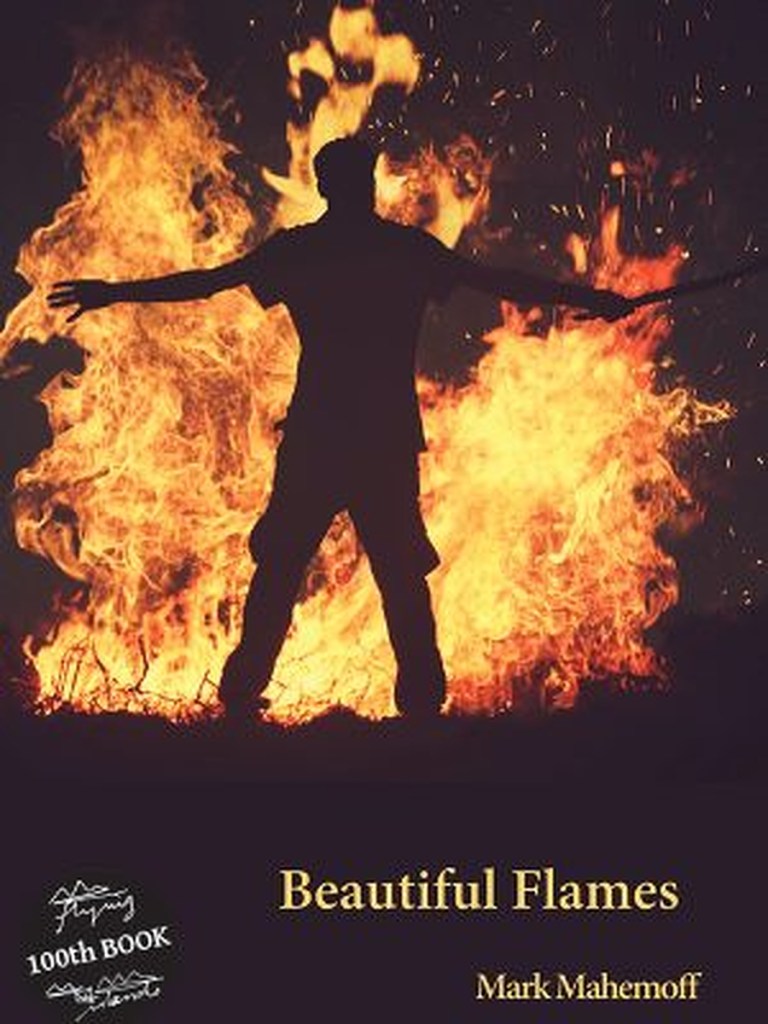
Mark Mahemoff’s Beautiful Flames

Mark Mahemoff, Beautiful Flames (Flying Island Books 2024)

This is another pocket-sized book I took with me on my recent trip to North Queensland. It’s Mark Mahemoff’s sixth book, a modest, user-friendly poetry collection in four sections.

The first section, ‘Chronicles’, mostly includes brief stories taken from life – family events, losses, a school reunion, the process of leaving home. From ‘Leaving’ (page 20):

Because childhood is a country
no one escapes unscathed
we haul it like a suitcase
stuffed full of unwashed clothes.

The second section, ‘Observations’ is what it says on the lid, observations on life’s passing parade. The titles of its poems generally tell you what to expect: ‘Kookaburras’, ‘Night Train’, ‘A Mediation’, ‘Bar Sport’, ‘Professional Development’.

The main pleasure of these first two sections is like what can get from a photograph of something ordinary – not claiming that it’s anything other than ordinary, but inviting us to pay attention to it for a moment. I generally try not to quote the final lines of poems – it’s too much like revealing the punchline of a joke – but the last stanza of ‘Nasturtiums’ (page 53) is too good an example of what I mean. Having described the large patch of these flowers on a lawn ‘somewhere in Haberfield’, and wondered whether they count as ‘weeds, food or flours’, the poem concludes:

But just devour them with your eyes
and you'll find that's enough
when you're walking beside someone
or alone
in sunlight.

That might seem banal but there’s some subtle, even self-effacing complexity. Mahemoff isn’t just talking about his own walk, but gently and elliptically inviting us to go on a walk of our own, to see for ourselves, and the last two line breaks create an unsettling effect. (What if it’s an overcast day, will it be enough then? If not, is it because the flowers look drab without the sun on them? Or is the sunlight a kind of companion?) The poem isn’t tied off in a neat bow.

The third section, ‘Travelogue’, comprises six poems in the form of notes from visits to, respectively, Western Australia, New Zealand, Melbourne, two unnamed places (one of which has a river and the other cactus plants), and Texas. The last-mentioned (‘Dallas in January’, page 84) forms a nice companion piece to Andrew O’Hagan’s essay ‘The American Dream of Lee Harvey Oswald’ in The Atlantic Ocean, which I read a couple of weeks ago: O’Hagan and Mahemoff describe the same museum, and have similar responses.

Page 77* contains two of the nine short poems that make up ‘New Zealand Snaps’.

The first is ‘Lower Shotover’:

Lower Shotover
Cool in the shade.
Singeing in the sun.
'The ozone layer is thinner here,'
she said.
You watch washing flap
while jets cruise past mountains.
How does one manage
this surfeit of beauty?
A bee falters
from flower to flower.

I had to look Lower Shotover up, but even without seeing images online (here are some if you’re interested), I knew from the poem the kind of place it is. And that’s without any of the kind of writing you might find in a tourist brochure or a poem that trusted its readers less.

It’s a thing in some contemporary poetry to plonk one thing down after another – an image, a quote, an aphorism – and call on readers to make their own connections. The poem becomes a collaboration between writer and reader. ‘Lower Shotover’ does a version of that, giving us a two-line observation about the temperature, a snippet of dialogue, images of washing on a line and jets in the sky, an abstract question, an image of a bee. We’re not left entirely to our own devices. We know from the title that the disparate items all refer to a place, but it’s up to us, for example, to imagine who speaks the third line (I think it’s the host at a tourism spot, but you might think it’s a visiting climate scientist), or whose washing flaps in the fifth line. But what is definitely there is the way the poem moves from bodily sensations in the first lines, to human connection in the third and fourth, to attention first to things seen and heard in close-up and then things seen and heard heard far-off . Only then, in the seventh and eight lines, is there an oblique reference to the reason the poem exists: the beauty of the place. But instead of trying to describe the beauty, the poem in effect confesses itself inadequate to the task. The image of the bee in the last two lines brings a nice meta touch – the poem itself has been faltering from one thing to another.

The second poem, unlike most of the poems in this book has a strict form. Each of its stanzas consists of 17 syllables – 5 in the first and third lines and 7 in the middle line. Yes, they are haiku, as we have come to understand that form in the English-speaking world.

Fox Glacier
Mountains demand awe.
We whisper in their presence,
take snapshots, and leave.

It rains ceaselessly.
A single set of headlights
burns through the distance.

Haiku, like sonnets, have a turn. In these examples, the turn has a visual quality: in the first, our gaze rotates (literally turns!) from the mountains to the tourists; in the second, there’s a change of focus from wide to narrow. I’m not sure that the rules of haiku, strictly speaking, allow words like ‘I’ and ‘we’, but the point of this ‘we’ here is that the human presence is tiny, and temporary, barely there at all.

Having written that, I have just read in Mark Mahemoff’s bio at the back of the book that his poetry

is chiefly concerned with framing, reimagining and memorialising commonplace moments, primarily in an urban setting.

Which makes me notice one more thing about these haiku: the Fox Glacier is about as far from an ‘urban setting’ as you can get, yet both haiku have industrial elements – snapshots and headlights – that make their (momentarily puny) demands on our attention.


I finished writing this blog post on Gadigal Wangal country, where I’ve noticed leaf-curling spiders waiting patiently in their rain-spangled webs. I acknowledge Elders past, present and emerging for their continuing custodianship of this land.


My blogging practice is to focus on the page of a book that coincides with my age, currently 77.
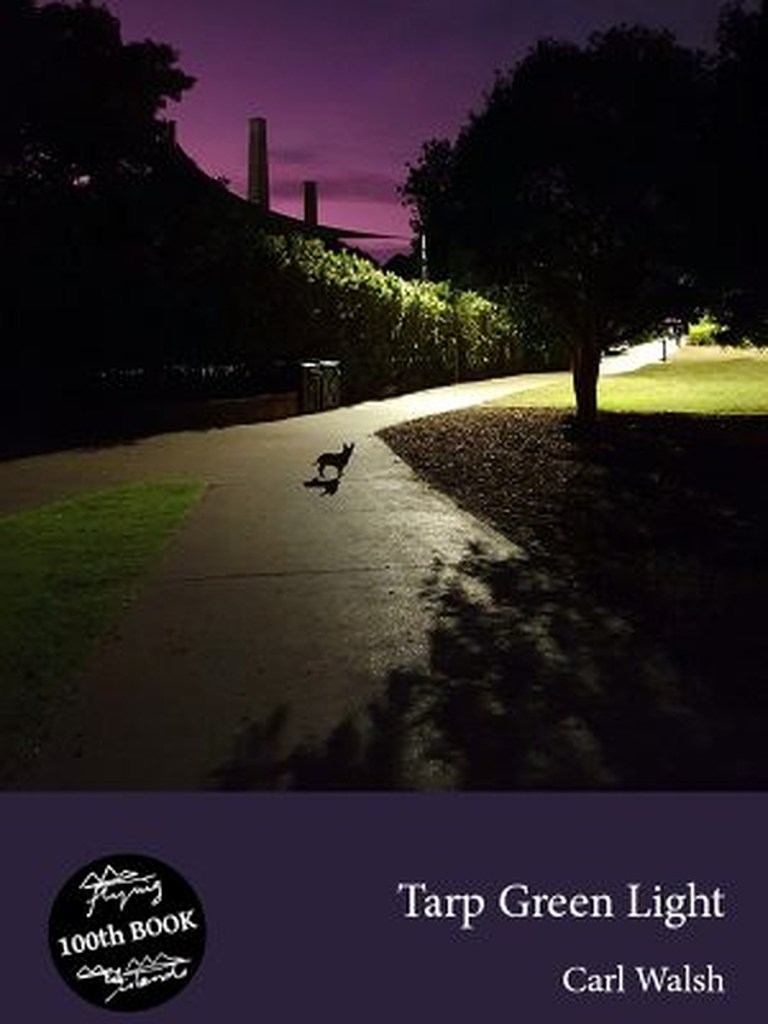
Carl Walsh’s Tarp Green Light, page 77

Carl Walsh, Tarp Green Light (Flying Island Books 2023)

Of recent years the emerging Artist and I have travelled north for a couple of weeks each winter. In last year’s fortnight on Yunbenun (Magnetic Island) I read and subsequently blogged about nine books, eight of which were in Flying Island’s Pocket Poets series.

This year we have come further north, and I’ve read a lot less. Tarp Green Light is the first of four Pocket Poets I’ve read.

The Note on the Author tells us:

Originally a tradie, Carl snuck into uni in his mid-twenties, after two years volunteering in PNG. He’s almost always written poetry – some poems in this book had their genesis in notebooks while backpacking in 1997.

Those backpacking notebooks have borne wonderful fruit. There are fine poems on other subjects – Linnaean categories, the Old Norse alphabet (I think), childhood memories, family history, and more. But it’s the poems that evoke particular places that create the strongest impression. The places include Papua New Guinea, Ireland, rural Australia, a number of European countries, and Japan.

The book’s title comes from one of the PNG poems, ‘Sepik Wara’. The poem is hard to quote from, as it’s laid out with text on either side of a broad winding river of white space, but here’s an attempt:

_________________________ _____________ we eye
rush of black clouds____________ __ _ pooling
in the sky; unfold ______________plastic tarps
to array over_______________________ our heads
as rain sheets________________ down we breathe
the close_______________ air and laugh at each
other__________________ in the tarp green light

At least one poem, ‘Idiot Fruit’, visits the Daintree, where I have recently spent a day:

Is it cassowary plums that lay 
as blue/grey eggs on the ground?

My blogging practice is to focus on page 77 (at least until I turn 78). In books like this, the practice saves me the impossible task of choosing one poem to represent them all. ‘Niseko miso’, on this book’s page 77, is one of the very few prose poems in the book, but in other ways is a fine example of how Carl Walsh can evoke a place::

Niseko miso
The cloudiness of my miso is reflected in
afternoon sky with dark seaweed stretches of
kombu cloud and strips of white tofu. But this sky
is perforated with peaks. Active in their inactivity
– three thousand years just a nap. How old I
am in their years? My head hurts at the maths.
Perhaps I should get Isabelle to calculate it? Some
are wild for ten thousand years. Even resting,
prone to throwing unexpected parties. I glance
at Mt Yōtei, its dark bulk everywhere. Hope it's
content with its sleeping. That Kagu-tsuchi-no-
kami
, the fire-spirit, is happy. I stir my miso – and
the clouds burst with rain.

Like many travel poems, this becomes more enjoyable when you know something about the places it names. A quick bit of browsing told me that Niseko is a ski resort area in Hokkaido; kombu is the kind of seaweed you might find floating in a bowl of miso soup; Mt Yōtei is a volcano, one of the hundred famous mountains of Japan, and popular for backcountry skiing expeditions; and Kagu-tsuchi-no-kami is, as the poem implies, a fire spirit whose rages are to be feared. Mt Yōtei last erupted about 3000 years ago but it is still active.

The poem deftly conjures up a situation: the speaker is drinking miso soup one afternoon in the foothills of Mt Yōtei, probably at a resort of some kind (his mind goes to wild parties as a synonym for volcanic eruption). He may be alone while drinking soup and composing the poem, but he has a female companion, Isabelle, who is probably travelling with him, certainly within easy communication distance.

The speaker idly/playfully notices a similarity between the appearance of the sky and that of his soup: clouds and seaweed allow sky and soup to be synonyms for each other.

Then there’s a but, a word I’m coming to love in poetry as signifying a turn of some kind. Here the speaker notices the major flaw in his synonym: the soup has no equivalent to the mountain peaks that pierce the clouds. The mountains dominate the rest of the poem, prompting thoughts about geological time. The tone is still playful – volcanic activity is described as wild partying, prolonged or brief and unexpected – but there are quiet hints of awe in the presence of the sublime.

In the two sentences before the last one, another dimension of the place of the poem comes into play. These mountains have had stories told about them for millennia. The speaker acknowledges this, by naming the fire spirit Kagu-tsuchi-no-kami, at the same time expressing anxiety about a potential eruption. (Maybe it’s just me but that seems to be a very Australian response, given how very extinct our volcanoes seem to be.)

Then in the last sentence, the poem comes down to earth, and attention returns to the soup and the clouds. There’s a hint of sympathetic magic – did stirring the soup make the rain come? – but the main effect is to pull back from vast, fearsome, mythological thoughts to the present moment, the place where the poem started.


I read this book near the mountains of Yidinji land and finished writing the blog post on Gadigal–Wangal land, where the sky is brilliant blue and the wind is chill. I acknowledge the Elders past and present of both peoples.

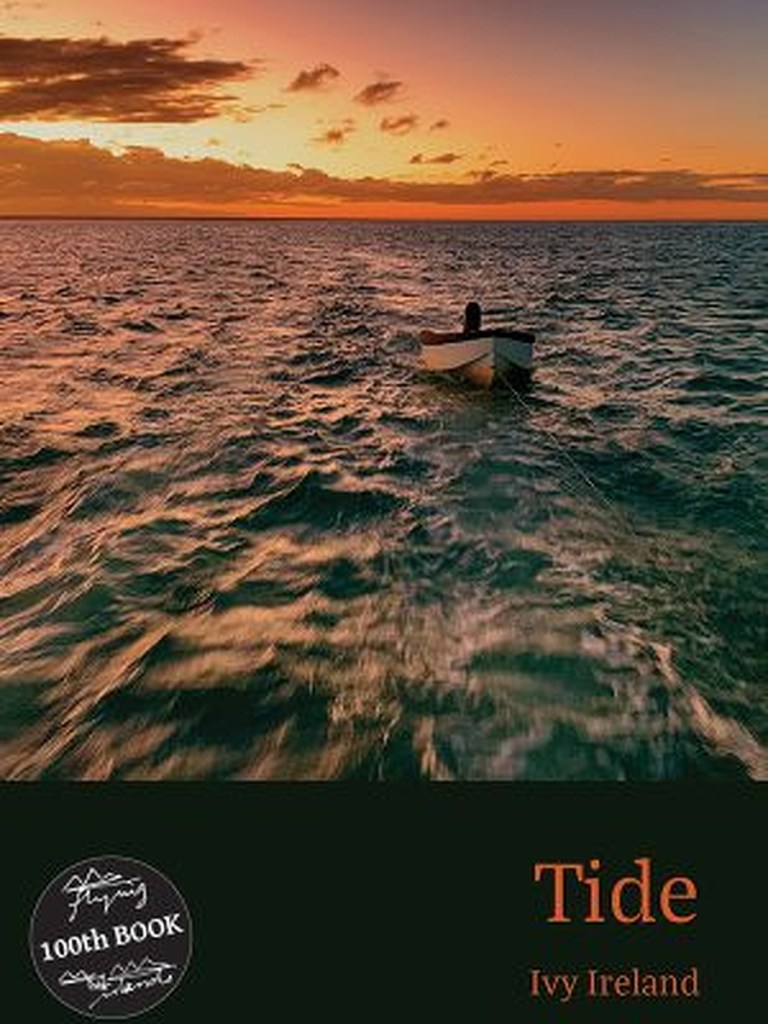
Ivy Ireland’s Tide

Ivy Ireland, Tide (Flying Island Books 2024)

Tide may seem like a quietly generic title for a book, especially one that has a number of poems about the sea, but a laconic note on sources suggests a dark subtext:

The title of this book, Tide, and the title of the poem, ‘A Shallow Boat’, are both taken from Alfred, Lord Tennyson’s poem ‘The Lady of Shalott’ (1832) with the necessary reverence.

I decided to read the Tennyson poem. I’m pretty sure I hadn’t read it before, but many of its lines (‘the mirror cracked from side to side’, ‘The curse is come upon me’) were familiar, probably from young Dorothy Hewett’s romanticism as recorded in her autobiography, Wild Card. Certainly Ivy Ireland’s compressed, science-related poems, with close observations of the real world, are not at all like Tennyson’s flowery, relentlessly rhyming lines. The word ‘tide’ occurs only once:

For ere she reach'd upon the tide
The first house by the water-side,
Singing in her song she died,
The Lady of Shalott.

The note on sources, then, leads one to expect something death-related: the tide is metaphorical, bearing us inexorably away. The book only partly meets that expectation. There’s a lot of life here, and not much death.

The book is divided into four sections of unequal length named for tidal phases: ‘Ebb’, ‘Low’, ‘Flood’, and ‘High’. If I had to pick favourites, I’d say I enjoyed the poems in ‘Low’ most: in ‘Lake Poet’, in the context of the climate emergency (not explicitly named, but definitely there in my mind) the lake is less a thing of sublime beauty than a place that will hold the poet to account, as opposed to the city, where ‘nobody has to answer for anything; in ‘Cane Toad’, the poet and her young daughter encounter some teenagers on Valentine’s Day:

She asks me,
of all people,
if they are going to marry,
those beatified ones,
out decking each other in posies
in the quiet toilet paper aisle.

‘Killing Plovers’ is a yarn about family life that takes on a fable-like quality about humans’ relations to other animals; ‘The Birth of the Universe’ is a wonderful poem about a) the Big Bang and b) giving birth.

The section ‘Flood’ comprises six prose poems, including ‘I Am John Is Dead’, long enough to be called a short story, about a young woman’s encounter with a New Age guru in the outback, which accurately describes itself as ‘like a Jim Jarmusch film’.

Page 47* is the title page for the book’s final section, ‘High’. The section includes just one poem, ‘A Shallow Boat’, in which the narrator with one other person goes sailing off the Queensland coast. Since the note on sources mentions this poem, I looked at the Tennyson poem again, and found:

In the stormy east-wind straining,
The pale yellow woods were waning,
The broad stream in his banks complaining,
Heavily the low sky raining
Over tower'd Camelot;
Outside the isle a shallow boat
Beneath a willow lay afloat,
Below the carven stern she wrote,
The Lady of Shalott.

This is the boat on which the Lady of Shalott floated to her doom.

Happily, the speaker of Ivy Ireland’s sailing excursion survives, having had a very nice time, even if it is sometimes scary and perhaps humiliating as she feels her incompetence.

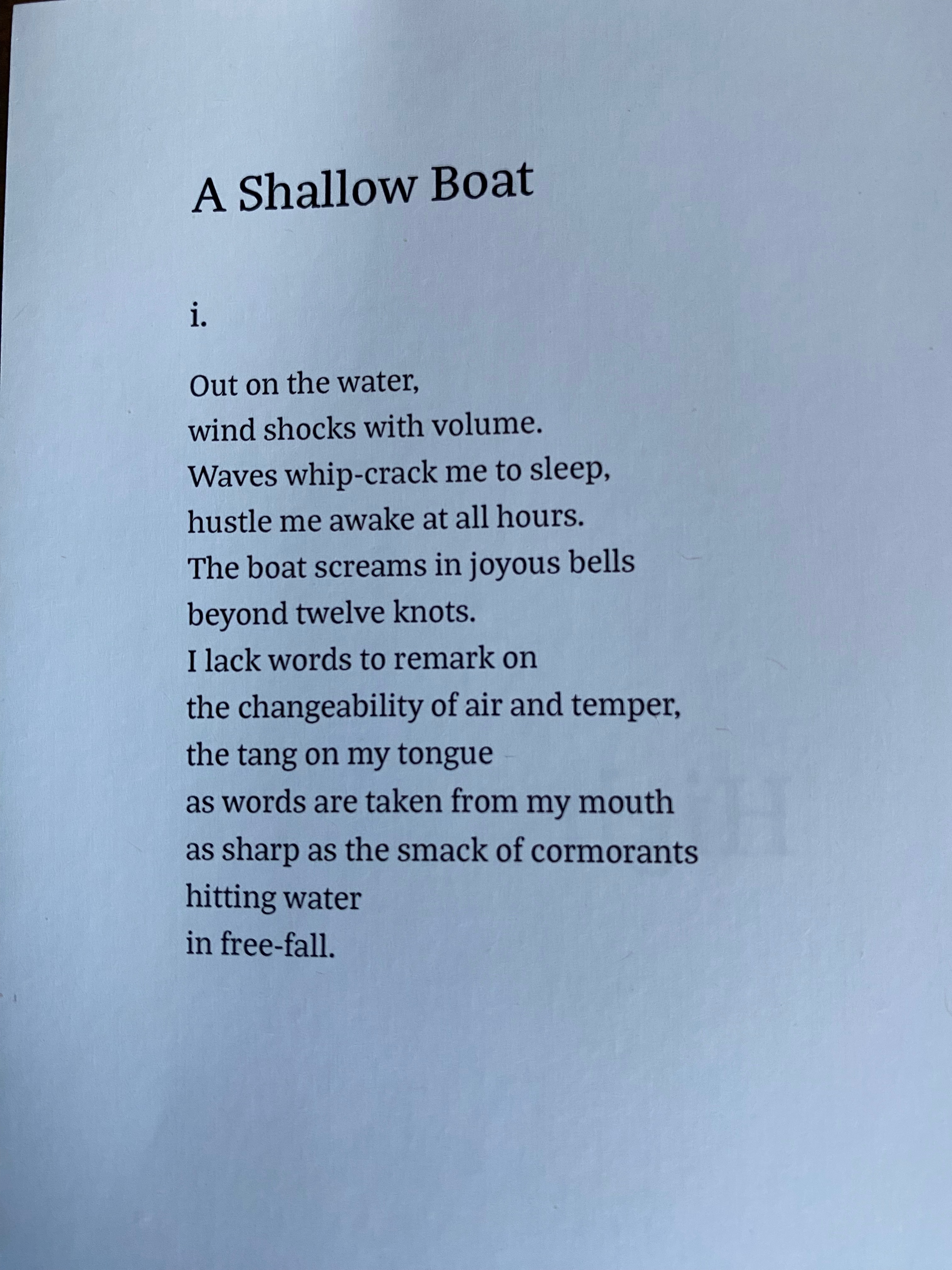
Here’s the first of the poem’s 12 parts, from page 48:

A Shallow Boat

1.

Out on the water,
wind shocks with volume.
Waves whip-crack me to sleep,
hustle me awake at all hours.
The boat screams in joyous bells
beyond twelve knots.
I lack words to remark on
the changeability of air and temper,
the tang on my tongue
as words are taken from my mouth
as sharp as the smack of cormorants
hitting water
in free-fall.

All I really want to say about this is that I love it. I have no desire to go sailing. I breathe a guilty sigh of relief when I realise that the Emerging Artist gets seasick very easily, so is unlikely to be urging me to do it. But I love it as evoked in this poem.

The poem is almost a sonnet. The first six lines describe the wind, the waves, the sounds of the boat. Then there’s a turn, and in the next five lines the poet tries and fails to articulate a response. Then there’s a three-line equivalent to a sonnet’s final couplet – rather than a witty encapsulation of what has gone before, here it’s the cormorants, ostensibly a metaphor for the poet’s speechlessness but actually just there, smacking the water.

Every verb, every adjective, every noun is carrying its share of the meaning-load, and the sound design is wonderful. The echoing Ws bind the lines together, with a little respite for Ts (‘temper’, ‘tang’, ‘tongue’, ‘taken’, and then ‘cormorants’) in lines 8 to 11. Back to W and then the Fs in the last line introduce a new, final sound.

The Tennysonian hints of doom may be realised in later parts of the poem, as in these chillingly succinct lines from part viii:

There's a point 
where climate emergency,
once witnessed,
ticks over from
possible to inevitable;
anything else is inconceivable.

But that’s context rather than substance. The joy in this poem, as in the whole book, is in celebrating engagement with the natural world, vulnerable, dangerous, fragile, awesome, beautiful, breathtaking (sometimes literally). From section ix:

Orange shifts over the horizon, and here we are: 
alive, while countless others are not.
Who am I to deserve daybreak. This happening here,
sea eagle fishing beside the boat,
sea turtle snorting to the surface. What's it for,
to be so honoured.

I wrote this blog post on land of the Gadigal and Wangal clans of the Eora Nation. I’m posting it on a day that has shifted from bright blue sky to heavy downpour within hours. From my window I can see wet gum leaves reflecting the afternoon sunlight as they have been witnessed by First nations peoples here for tens of thousands of years.


* My blogging practice for some time has been to focus arbitrarily on the page of a book that coincides with my age. A focus on just one page seems to me to be almost necessary with books of poetry, where the parts are so often greater than the whole. As Tide has fewer than 77 pages, so I’m focusing instead on my birth year, ’47.

Chris Mansell’s Foxline

Chris Mansell, Foxline (Flying Island 2021)

Chris Mansell is an Australian poet with an impressive list of books and awards to her name. She has also played a significant role in fostering and publishing other poets. Here’s a link to her website. Foxline is part of Flying Island’s Pocket Poets Series, small enough to fit into a shirt pocket, but offering a substantial reading experience.

The book’s last page has a note describing its genesis:

I came across a fenceline of foxes scalped and strung by their hind legs on the boundary fence of a farm. There were about two hundred dead and even dead they were beautiful. … I imagined the farmer, perhaps less articulate than the fox. I imagined him walking the paddocks in stolid opposition to the creatures that were taking his sheep.
It is real and it is also traditional. It is in his blood as it is in the blood of the fox to hunt and feed their young.

Each of the book’s 30 poems is spoken by the farmer or a fox. In most of the fox poems the speaker is a female fox; occasionally we hear from a young male, and even once or twice a flying fox. Both Fox and Man (they are capitalised in the marginal notes) are interested in more than each other, but mainly the poems deal with their relationship: their antagonism, their attempts to understand each other, and their recognition of what they have in common. They even manage to learn from each other.

In one poem (‘Dark Solo’) a young male fox becomes the fox in Ted Hughes’s poem ‘The Thought-Fox’. But the literary work I was most strongly reminded of is Roald Dahl’s The Marvellous Mister Fox. In some ways Mansell’s book could be read as an adult response to Dahl’s. Here there is no easy resolution to the conflict between Man and Fox and, contrary to what you might expect from Mansell’s account of the book’s origins, both characters elicit our sympathy.

Before I talk about page 77*, I want to name my favourite stanza in the book. It’s the beginning of ‘Surprise’, one of the Man’s poems, and is a haiku-like stanza (or more accurately senryu-like, as haiku aren’t supposed to mention people):

we are always surprised
here every winter
we are amazed it's cold

The poem goes on to arrive, elegantly, at how we are ‘astounded / by death especially’. I love the way the poem makes poetry from an often-heard New-South-Wales joke, then takes it somewhere unexpected but completely right.

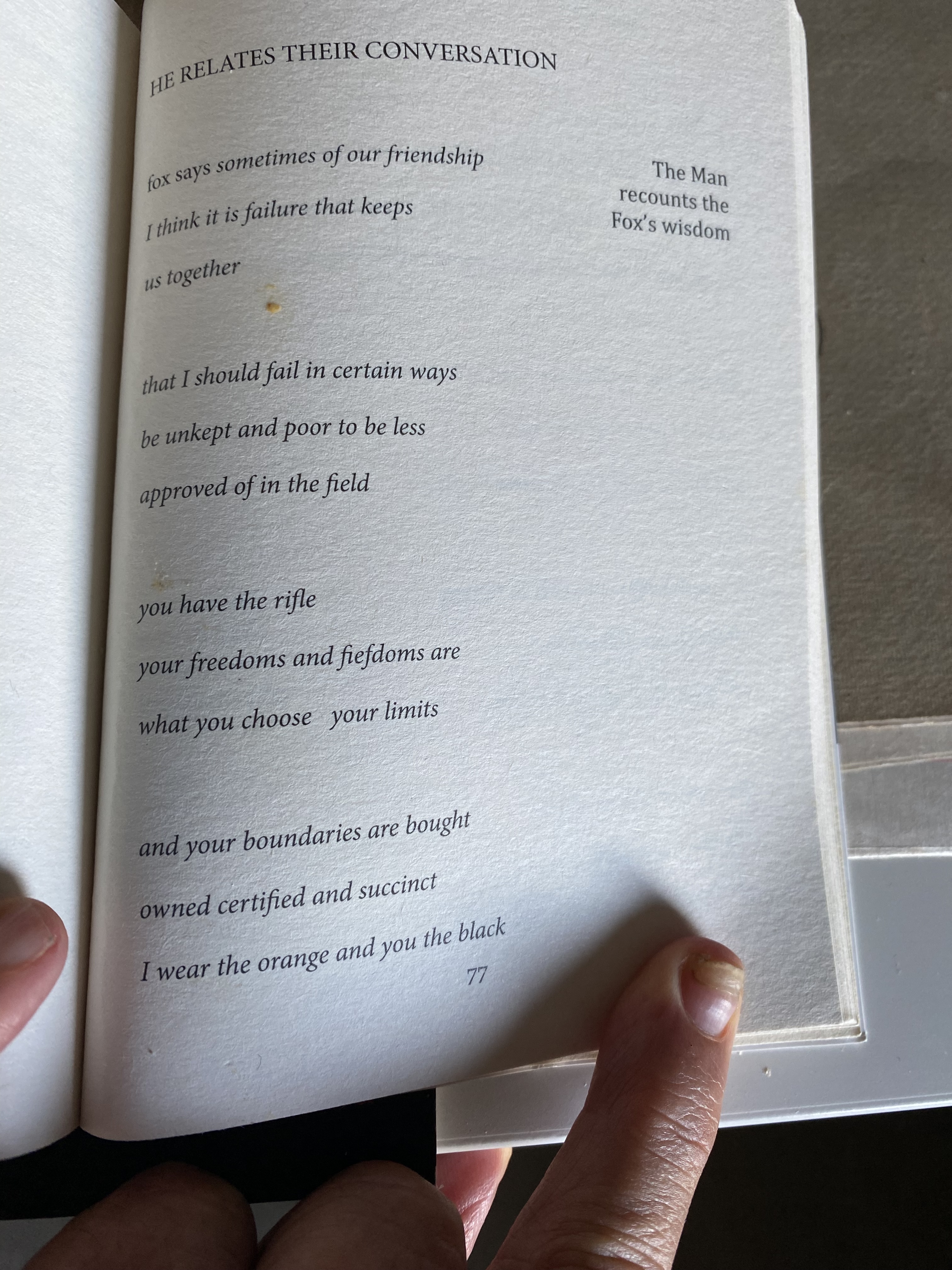
Page 77 is the beginning of the poem, ‘He relates their conversation’.

HE RELATES THEIR CONVERSATION

Like every poem in the book, this one has a note in the margin telling us who is speaking and offering a brief summary, the way some 18th century novels do, as if acknowledging that the semi-articulate protagonists don’t always make themselves clear:

The Man 
recounts the 
Fox's wisdom

The italics on this page signify that though the Man is speaking, he is relating the Fox’s words. The Fox’s ‘wisdom’ is paradoxical:

fox says sometimes of our friendship
I think it is failure that keeps
us together

In what way are they together? And whose failure does she mean? An obvious meaning is that ‘together’ really means ‘both alive in the same locality’, and the failure is that of the Man – he has failed in his quest to kill the fox. But the word ‘friendship’ in the first line suggests that something else is going on. Its cryptic possibilities provide the impetus to read on.

that I should fail in certain ways 
be unkept and poor to be less
approved of in the field

Before she gets to ‘friendship’, the Fox expands on what she means by ‘failure’. She is the one who must fail. To understand ‘in certain ways’ we don’t need to think beyond the Fox’s activity as sheep-killer. If she succeeds in killing or even damaging the Man’s livestock that’s the end of any fellow-feeling. ‘Unkept’ is an example of the way the Fox’s language is interestingly off-kilter throughout the book. It’s not quite ‘unkempt’ though it possibly includes that. It suggests the opposite of ‘well-kept’ as in well-fed. The fox needs to be bad at her job – ‘less / approved of’ in the field’ by other foxes, perhaps.

you have the rifle 
your freedoms and fiefdoms are
what you choose_ your limits

and your boundaries are bought 
owned certified and succinct

(The double space in the third line here acts as a break in the meaning – a full stop.) But yes, the Man must also fail in his quest to eliminate the fox. He has the means, but he can choose to act freely or according to an imposed order. ‘Freedoms and fiefdoms’ is a wonderfully evocative phrase: is this farmer a free operative or is he pretty much a serf in the current economic order? It’s his choice. the limits and boundaries are those of the farm, but they are also limitations and constrictions on himself that he has bought into.

I wear the orange and you the black

On first reading, I had no idea what this meant. Now that I’ve pondered the previous lines, its meaning leaps out at me. The Fox is making an analogy to sporting teams – Australian cricketers wear the baggy greens, Indians the bleed blues. The Fox and the Man belong on different teams.

I won’t go on in detail about the remaining page and a bit. In short, the man now speaks in his own voice, expressing a wish to become the Fox, and they recognise the similarity between the rifle and the fox’s ‘whitesharp teeth’. According to an explanatory side note:

They know 
they have a
tense
commonality

‘Tense commonality’ is an excellent human-prose translation of the Fox’s term ‘friendship’.


* My blogging practice is to focus arbitrarily on the page of a book that coincides with my age. This page often reveals interesting things about the book as a whole.