This is my ninth and last post on books I took with me on my escape from Sydney’s winter, focusing as usual on page 76. I’ve been home for a while, but it takes a while for the blog to catch up with life.
Like the other titles in Flying Island’s ‘minor works / Pocket Poets’ series, Text Messages from the Universe is a physically tiny book – just 152 x 102 mm. But it’s part of a broader multi-media project.
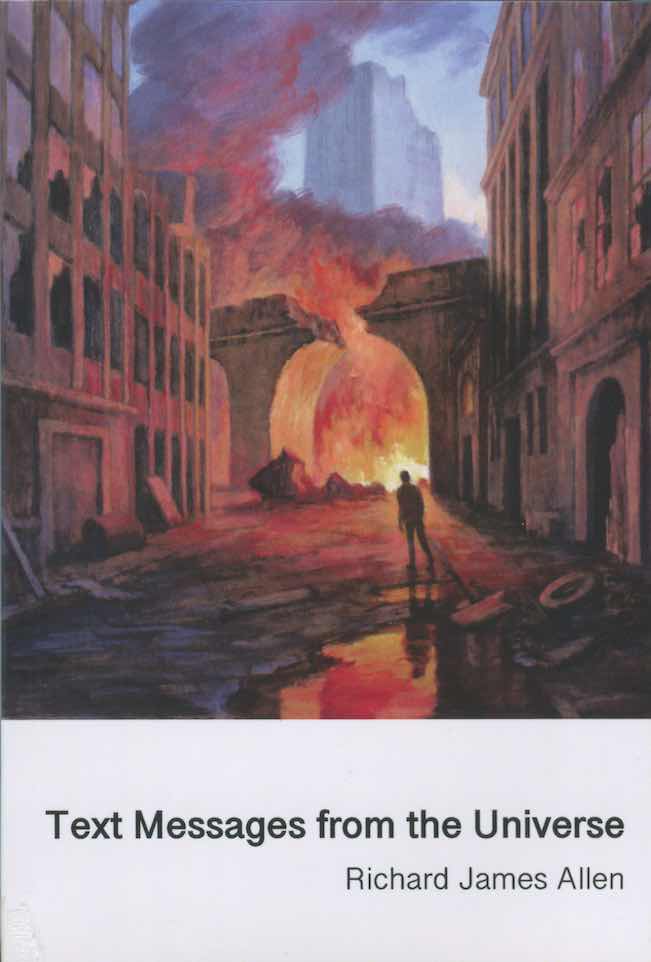
There’s a movie of the same name directed by Richard James Allen, which is the source of the lavish images of dancing figures that accompany the text (or perhaps, depending on how you see things, that are accompanied by the text). The front cover is from a painting created for the book by 2023 Archibald finalist Michelle Hiscock. The text itself, a single prose poem, is the final work in the multi-volume The Way Out At Last Cycle, which has been three decades in the making (Hale & Ironmonger published The Way Out At Last and other poems in 1985).
The poem is inspired by the Tibetan Book of the Dead. The first, shorter section is addressed to a person who dies in a car accident. In the second section, made up of 49 short parts, the person is lost in a state between death and rebirth, the bardo, in a cycle of dreaming and waking, bewildered, disoriented and panicking. The poetry takes on a weirdly insubstantial quality that is beautifully enhanced by the billowing drapery of the dancers on every page. I haven’t read the Tibetan Book of the Dead – that part of 1960s enthusiasm passed me by – so I don’t know if the poem follows it with any precision, but there’s a wonderful sense of being carried along on a current leading to detached oblivion and then, perhaps, to a new beginning.
No spoiler intended, but the text messages of the title are revealed towards the end of the poem, in part 46: ‘This is your last moment,’ closely followed by, ‘This is your first moment.’ Part 47 adds this gloss:
As for the rest, Your text messages from the universe
seem to be happy to take any form and any language
they please.

Some of them aren't even text messages, just
whispers inside your head.
Speaking as someone who is currently reading Saint Augustine’s Confessions, I’d add they may also come in the form of a child chanting on the other side of a wall.
Even while I’m enjoying the poem’s journey in an invented universe (apologies to any of my readers for whom the bardo is as real as purgatory is to some Catholics), my tendency as a reader is to cast around for the kind of actual experience that the invention draws on and possibly illuminates. The short poem on page 76, section 36, rewards this tendency:
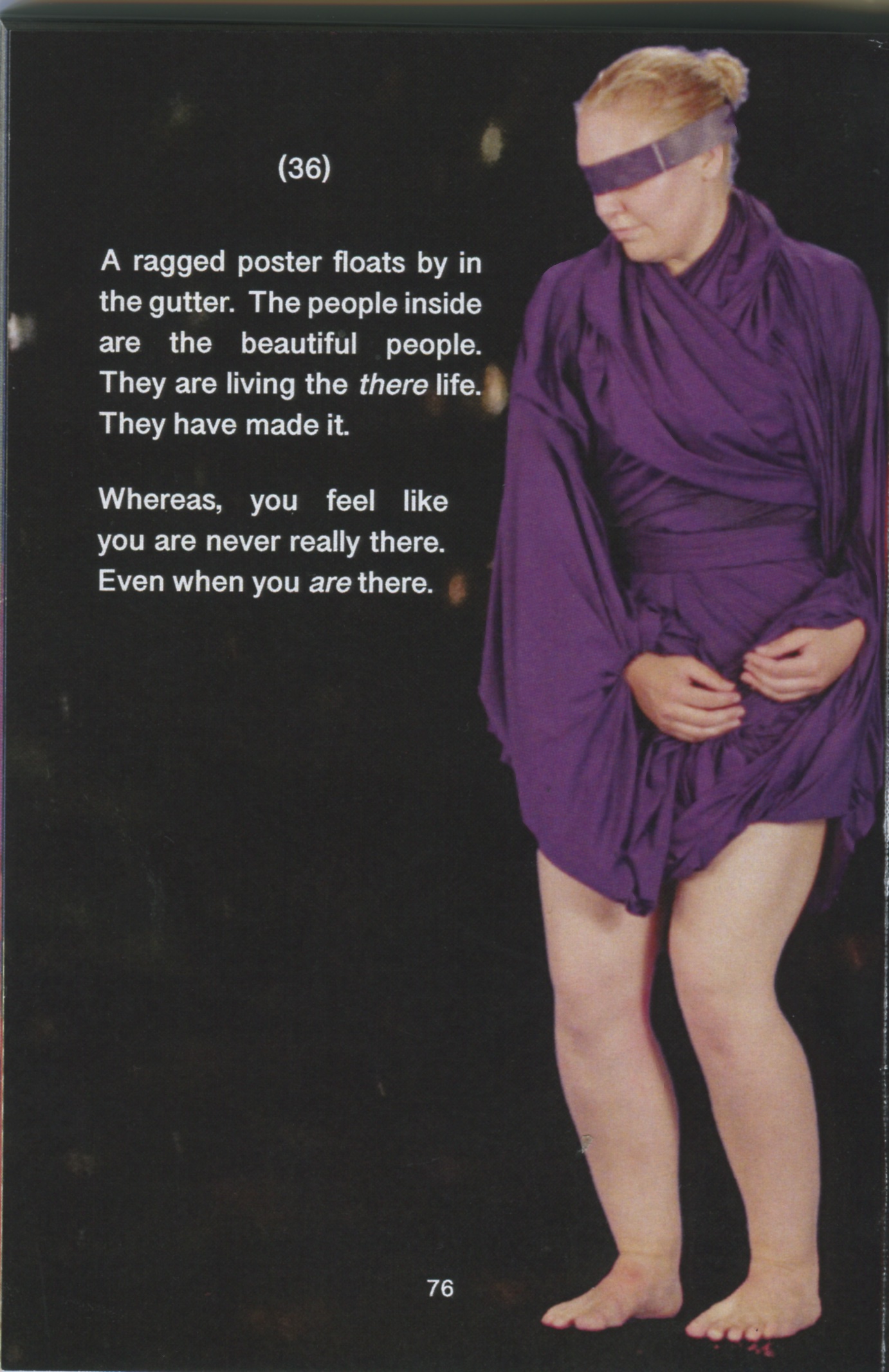
(36)
A ragged poster floats by in
the gutter. The people inside
are the beautiful people.
They are living the there life.
They have made it.

Whereas, you feel like
you are never really there.
Even when you are there.
Incidentally, this is the only image in the book where the dancer is less than elegant, where the fabric is not floating in an ethereal breeze. It signals that, as so often happens, page 76 is a kind of turning point, in this case a low point.
The text offers one of the poem’s many noir-ish images – one of many alleys, gutters and empty lots. The poster is a piece of detritus from the life left behind. In the dream world of the poem, it asserts the substantiality of that life, its thereness. These lines reward my penchant for literalness by drawing on a moment of a kind I imagine we’ve all had: you see a poster for some event and reflect fleetingly that the life represented in the poster is unreal – either that, or it’s part of a reality that you have no part of. This is the moment in the bardo when the newly-dead person is closest to nothingness: it’s the rubbish poster that’s real.
In the years that this poem was fermenting, the bardo attracted the attention of a number of other creators. I’m aware of George Saunders’s multivocal novel Lincoln in the Bardo (2017), which I haven’t read, and Laurie Anderson’s movie Heart of a Dog (2015), for which I just couldn’t stay awake. I had no trouble staying awake on the journey with Text Messages from the Universe.
I’m grateful to Flying Islands Books for my copy of Text Messages from the Universe.
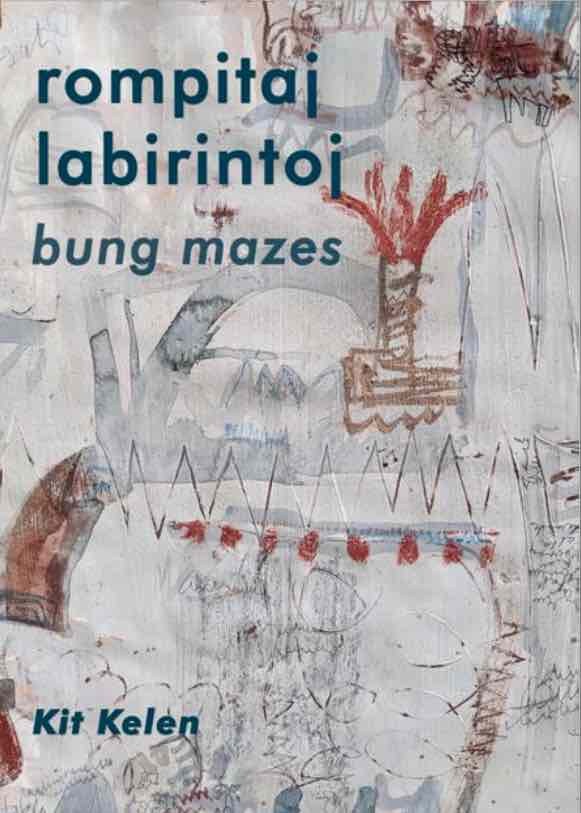
It was my great pleasure to launch the English part of this bilingual book today. The Esperanto part was launched by Jonathan Cooper from the Australian Esperanto Associaton, in an afternoon that also featured Kit Kelen’s’s exhibition of palimpsest works on paper with the same title, plus music, at the Shop gallery in Glebe, all MCd by Richard James Allen. There was music, and a conversation between Kit and Magdalena Ball. Here’s a version of my launch speech.
Rompitaj Labirintoj / Bung Mazes is not the first bilingual poetry book Kit Kelen has been involved in, not even the first bilingual book of his own poetry. But it marks his debut as translator of his own work, both from English into Esperanto and in the other direction as well.
Mostly, unless you’re appropriately bilingual, you can ignore the language that’s not your own when you read a bilingual book. This one isn’t like that. The Esperanto isn’t an added extra. To read the book thoughtfully is to engage with Esperanto, maybe learn a word or two, discover some of its history, and glean some understanding of its underlying philosophy.
It’s easy to see why Esperanto is a good fit for Kit’s poetry. Esperanto, as I understand it, is all about opening channels of communication where none might otherwise have existed. Kit’s work shows a deep commitment to being open to other cultures, other languages, and to other minds. for example, when he asked me to give this talk, he didn’t say, ‘I hope you like the book,’ but ‘I’m interested to hear what you think of it.’
The English versions of many of poems in this book predate Kit’s interest in Esperanto. They cover a wide range of subjects, from the plight of refugees and the climate emergency, to simple celebrations of the natural world and poems about poetry itself. But there’s no great discontinuity between them and the poems dealing explicitly with Esperanto.
One example of these older poems is ‘here’s the story to save the world’, which includes these lines:
what is it keeps us alive? keep talking I want to know how the story ends keep talking I’ll listen
You can draw a straight line from that to ‘Hitching my wagon to a green star’, a statement of allegiance to Esperanto, which has the lines, ‘we come here for a conversation / while we wait for states to wither away’.
There are poems about learning the language. ‘thank you poem for Trevor Steele’ is explicit:
these lines here are just to say –
thanks for the grammar I know it must be very annoying –
all the stupid mistakes I make
but how can there be so many accusatives?
Or there’s this from ‘being a humble beginner’:
often I slip sometimes I slip off the tongue together
This is the poem that most makes me wish I could read Esperanto. What’s the Esperanto equivalent of the mistake ‘slip off the tongue together’? ‘tute glitas de mia lango’ doesn’t tell me anything. It makes me wonder how many references there are that Esperantists get but just sail past me.
Beyond this interest in learning the language, the book engages with its underlying philosophy. ‘being a humble beginner’ again:
but I’m here for the conversation I believe that is an art like leaving the world better than found – another impossible thing
L L Zamenhof, the language’s creator, is quoted in one of the book’s two epigraphs:
Rompu, rompu la murojn inter la popoloj!
Translation hardly seems necessary, but Google translates it as:
Break, break the walls between the peoples!
‘Bialystok dreaming’ tells how Zamenhof first thought of inventing a neutral second language in Russia in the late 19th century. ‘Suprasegmentals’ makes fun of Chomsky’s declaration that Esperanto is not a language. ‘samideanoj!’ spells out the vision with characteristic Kelenian paradox. It begins:
today we are building a dead language syllable by syllable, from scratch
it is a tiny country all between and never was at all
Esperanto, to paraphrase, has no currency except the people who speak it. Incidentally, this poem stands out for two reasons: the title, meaning ‘like-minded people’ isn’t translated, and the first one-word line – ‘kamaradoj’ – doesn’t appear in the English. The book is aware of its dual readership.
The poems about Esperanto don’t pull back from its utopian aspirations. In fact they endorse them, but there’s a feeling of astonishment, perhaps even with an edge of amusement, at the vastness of those aspirations. The poems are completely serious, but not self-important.
The two poems that for me are the guts of the book, are ‘shelter’ and ‘bung mazes’. The book has been described as ‘an abstract treatment of the situation of asylum seekers’. The poems celebrating our common humanity, and Esperanto as a way to sharing it, the poems about openness to the natural world and the value of conversation, create a version of the world in which the current treatment of asylum seekers is a cruel absurdity. In ‘shelter’ and ‘bung mazes’, the point is made explicitly.
The title poem ‘Bung Mazes’, begins with a line from the public debate about asylum seekers, ‘everyone knows there is no queue’, and goes on in fifteen short poems to create a kind of maze of its own. I found it the most difficult poem in the book. Sentences don’t finish, images rub up against each other, it’s hard – even maybe impossible – to grasp how some lines hang together. For example:
where you see desert’s edge a labyrinth in canvas shook
lent to, how it blows off who’s after you? can it be imagined?
their weapons and the names they call crime of a clock, dreamt that too
There’s the image of a refugee camp, and a general anxiety is evoked, but it’s hard to pin down a clear meaning. If there is a meaning there, it’s just beyond my grasp (whose weapons? what clock committed what crime? who dreamt what?)
Generally if a poem grabs me, but I don’t understand why, I’ll sit with it, and let it brew in my mind. Sometimes a meaning becomes apparent in the brewing process. In this case, it’s not a meaning, but the effect created by the poem’s elusiveness. In effect the poem, made up largely of unparsable moments like this, gives me a faint inkling of the emotional impact of being lost in the dangerous maze of asylum seeking.
‘Shelter’ includes lines that cry out to be quoted:
now they are changing all the world’s weather island here, river there, tents blow away tanks shift borders out of the way
big bird flies where it will, drops its droppings
fire now flood now famine war we were forced to flee
then where to shelter? in the cave in my head? but you’ll never get in there’s never been a queue
there’s a maze of rules and rights of yours, not mine and my turn never comes
and later:
for the sixty million wandering this world is a maze gone bung
Sixty million is the UNHCR’s 2015 estimate of the number of people displaced worldwide by wars, conflict, and persecution.
So this is a book about intensely serious subjects.
My mind goes to something Kit wrote almost 10 years ago. Speaking of the problematic nature of writing in the pastoral mode as a settler Australian, he said: ‘The challenge is to have fun while you problematise (otherwise please don’t write a poem).’
This book is fun. Even at its most serious, it avoids ponderousness. It delights in paradox, puns and syntactical playfulness. It always treats the English language – I can’t speak of the Esperanto – as an endlessly enjoyable and challenging playground (‘bung mazes’ is an example; it rejects the obvious English for Rompitaj Labirintoj, that is to say, Broken Labyrinths, in favour of something much less respectful). The poems are full of music, as I hope the bits I’ve read demonstrate.
In this context, fun can be many things. Take the short poem ‘parable’ for example. I loved it at first reading because I felt it brought a much needed lightness of touch to the climate emergency, a step back from the details of rising temperatures, collapsing ice sheets, greenwashing by corporations and governments, and so on. I read it as a kind of wistful fantasy. Then, while I was preparing for this talk, I read it to a friend who’s a climate activist, and it made us both cry – I think because it manages to strike a note of forgiveness along with terrible grief. Here it is. I don’t expect it to make you or me cry today, but just listen to it:
parable
we came from the ice and out of the trees and wanted the whole world warmer
we lit fires and at timber we were the axe we were the flame
as if winter were our own forever
we only wanted the whole world warmer
o fearful the dark but we brought the firelight
the others we’ve eaten by now
we burnt till all of the forest was gone
we came to the clock that’s where we are now
hard to hear anything everyone’s in charge we all follow orders
it’s hard to see how this will pan out but I predict, in time to come at the Court of All Spirits our defence will simply be
we came from the dark we came from the ice we wanted the whole world warmer
[It didn’t make me cry when I read it out, and I don’t think anyone else shed a tear either.]
Anyhow:
It’s my honour and privilege to commend this book to you. Buy a copy, and, as the poem ‘keep this book’ says with only a hint of over-selling:
walk with it sleep with it read it out loud quote it at will
I declare Rompitaj Labirintoj / Bung Mazes, the English half, launched.
And here’s a pic of me talking, with Kit’s art in the background and Kit wearing a hat in the corner
The Flying Islands Poetry Community has been publishing pocket-sized poetry books (14 x 11 cm) for more than 10 years. According to its website:
The Flying Island Pocket Poets series originated as a simultaneous entity in Markwell, NSW and Macao, China, through the work of Professor Christopher (Kit) Kelen. Running since 2010 (in association with the Macao-based community publisher, ASM), Flying Islands has published more than eighty volumes, with authors from all over the world, but more from Australia and China than from anywhere else.
We can subscribe from within Australia for $120 to receive a year’s publications (details here). From the beginning of the series, the RRP for individual copies has been kept to A$10. But that’s not all. To quote the website again:
These books that magically appear out of pockets are part of a gift and exchange art-economy. They are our currency!
Those aren’t just empty words. It was through versions of the gift and exchange art-economy that I found out about the Pocket Poets series, and came to possess, and read, two of these niftily designed books.
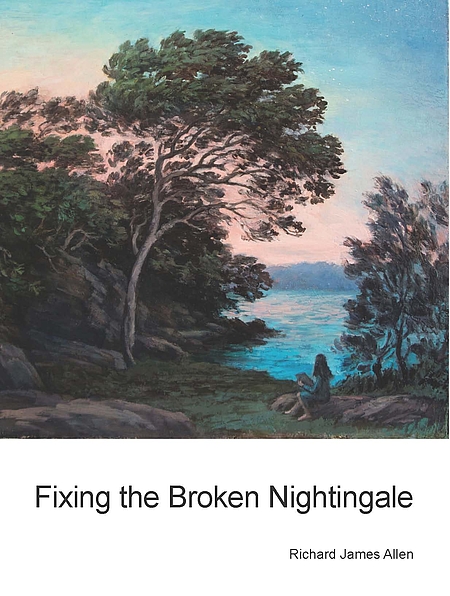
At a poetry reading in Sydney a couple of years ago, Richard James Allen read his poem ‘It’s Saturday night in almost any city in the world and’, and offered a prize for whoever could guess the city in which he wrote it. The audience called out the names of almost every city in the world, but I was the one who finally shouted, ‘Florence!’ and won the prize, Fixing the Broken Nightingale, which did seem to magically appear out of a pocket.
There’s a rich variety of poems in the book, ranging from straightforward love poems to poems that turn back on themselves like Escher drawings. There’s whimsy and melancholy, moments of ontological despair and intimations of mortality. The most striking poem is ’13 Acts of Unfulfilled Love’, which has some extraordinarily explicit sexual images, to arrive at this, in ‘ACT TWELVE‘:
These are my real thoughts,
not my dirty thoughts.
______________________ ____________This is my real love,
_________________________ ____________not my dirty love.
I am trying to live a real life,
not a dirty life.
_________________________And I'd like you there with me,
_____________________________in this soiled, holy world.
When I bought a copy of Kit Kelen’s Book of Mother at its launch in Sydney, neither of us had correct money. This little book materialised as if by magic to be my change.
It’s very different from Book of Mother and from other books of Kelen’s that I’ve read (blog posts here, here, here and here). As the title suggests, it’s a kind of sampling of his work, rather than a collection organised around a central subject or theme. A first Pocket Kit was published in 2011.
This is mostly a cheerful book. There are poems celebrating elements of Australian culture, like ‘Blokes’ (‘They know it’s bad luck to speak / when gesturing would do the trick’) and ‘shed’ (‘the peasant is the king here / where monarchs tinker with old crowns / no need for revolution’). The same ironic celebratory tone comes to bear on Macau where Kelen was a professor when this book was published, on his Hungarian heritage, on the prospect of having children, on the yellow umbrellas of Hong Kong in 2014.
My favourite in the book is ‘to tend’. If I remember correctly, Kelen like me had a Catholic childhood. This poem delicately addresses the question of what to do about the gap created when you stop believing. It starts:
to tend the gods as given, as found
new habits of homage are required

in word untamed, in sight unframed
paths to follow are so chosen,
by you, for you, willing, blind

go to the makers
not to the mockers
take the trouble to tell them apart
And ends:
go to the makers
never the mockers

tend to the habits of homage
you've found
Even though Kelen can begin a poem called ‘ancestor worship’ with ‘people smelt bad in the old times / they had bad teeth, they were stupid’ and can continue in that vein for 20 lines, he is certainly one of the makers, not one of the mockers.
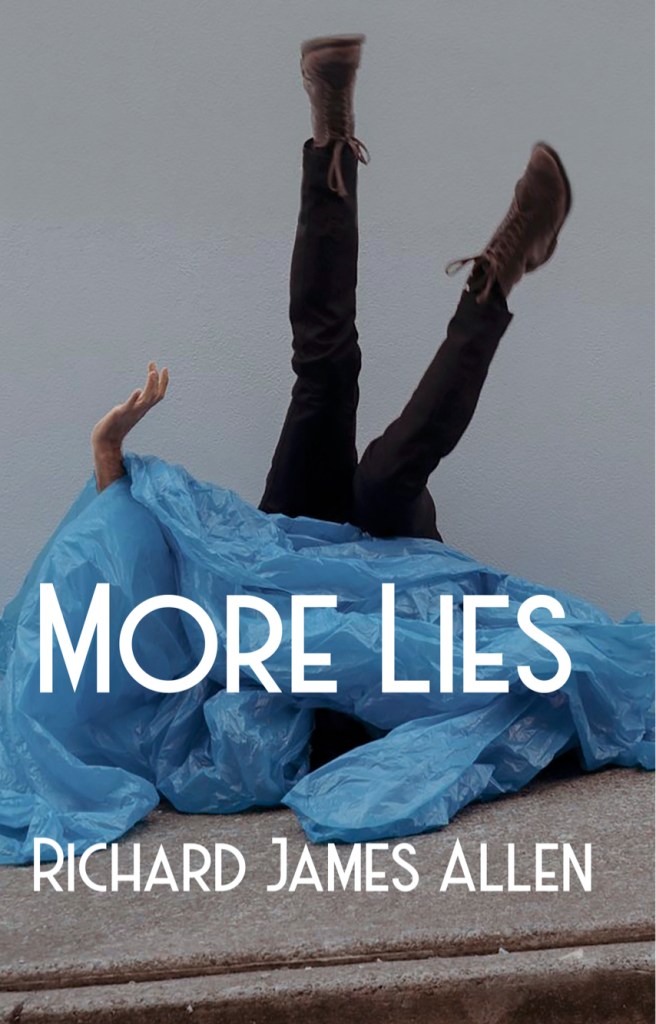
Richard James Allen, More Lies (interactive Press 2021)
Rae Desmond Jones, poet and one-time mayor of Ashfield, is quoted on the back cover of More Lies saying it was ‘like swallowing a tab spiked with speed – with Raymond Chandler’s spook dealing and watching from the corner’. It’s a clever way to encapsulate the weirdly surreal noir, high-velocity, trippiness of the book, and perhaps there’s a hint of the narrator’s intrinsic unreliability in the inconvenient fact that Rae Jones died four years before the book was published.
It turns out, according to Richard James Allen’s unusually informative Acknowledgements, that though this slim volume can be read and enjoyed in a single sitting, it has been a long time in the making: a first draft was written in the 1990s; a version was performed as a monologue at the 2000 Sydney Writers’ Festival; adaptations for stage and screen were created but never made it to performance. Rae Desmond Jones had plenty of opportunity to read it after all.
In the first of 34 short chapters, the unnamed narrator is strapped to a chair, being forced to keep typing by a ‘divine creature’ to whom he has just made love, and who is now holding a gun to his head. He tells us that he’s been caught up in a planned assassination and a drug-running scheme, that he has to keep typing because the noise provides a cover for his criminal captors. But soon he admits that he’s lying – or perhaps not. Anyhow, his situation changes dramatically, and improbably, and soon he’s typing on a laptop in a jail cell. And so it goes: localities change; characters change names, motives, identities and gender. The narrator is a self-confessed liar caught up in a Kafka-esque nightmare, or is it a Dada-esque dream? Occasionally he breaks into verse. Through all his vicissitudes – sometimes he seems to be in a hard-boiled detective novel, sometimes an episode of Breaking Bad, sometimes a dark existential tract, sometimes a spoken word event – he keeps typing, reasonably sure that none of the other characters will read his text, but not at all sure he can trust the reader – that’s you or me – whom he addresses with deep suspicion.
You can see why I had my doubts about the blurb from Rae Desmond Jones.
Confused? Well, read the book. It won’t clear up your confusion, but it will amuse, and while it’s at it, it may stir up some thinking about the nature of fiction.
The book was launched in a cheerful, well-attended zoom event, where Richard James Allen read the first couple of chapters. You can see a recording at this link.
I’m grateful to Interactive Publications for my complimentary copy.
Richard James Allen is a mover and shaker in Australian poetry and beyond. He has been Artistic Director of the Poets Union Inc and director of the inaugural Australian Poetry Festival. He has edited – among other things – an anthology of Australian performance texts published by my old employer, Currency Press. He’s also a filmmaker, dancer and choreographer with the Physical TV Company. The short story of you and I is his tenth book of poetry, and my introduction to his work.
Within the first couple of pages of this book I had read a number of poems out to the Emerging Artist – something I rarely do. She didn’t tell me to go away, which, given her generally low tolerance of poetry, is high praise. One of the poems I read to her was ‘Closing time for Melancholy’. Here’s the whole thing:
Bring your adult ears
and your childish hearts –
life is short,
desire is long,
and what the universe wants
the universe gets.
There’s a voice in these early poems that’s attractive, charming, even seductive, even while saying grim or gloomy things, the voice of a lively mind that is drawn to melancholy. Speaking of the word ‘melancholy’, the poem of that name says:
It must be that no other bloom
creates the decadent, fin-de-siècle atmosphere I experience in my soul.
And while there’s a lot of melancholy in the book, there’s also metaphysics, love, lust, loss, illness, art, Buddhism, and pleasure for the reader on pretty much every page. Only when I’d read it all for the first time did it occur to me, what a smarter person might have been on the lookout for, given the book’s title, that there’s an overarching narrative. The speaker is in a despondent state, a ‘maelstrom of gravitational torpor’ (‘The Resurrection and the Life’). There’s a relationship, and there are some wonderful poems about the early stages of physical and emotional rapture – the title of one of them, ‘In the 24-hour glow’, is almost a poem in itself. It’s never spelled out, but it seems the relationship ends after only a short time – there are many poems in which the beloved ‘you’ is a ghost or a memory, and the second last poem, ‘The Captain of the Men of Death’, actually an eighteen-page sequence, is about serious and possibly terminal illness – a note explains that the poem takes its title from an early 20th century nickname for pneumonia. The time line isn’t clear. Perhaps, reading for the narrative, you would take it that the relationship, the love story, is already in the past when the book begins.
But here’s the thing. Even though I’m usually happiest when there’s a narrative line for me to follow, in this case I’m glad I didn’t read looking for a narrative – that would have tied the poems down to a particular context rather than letting them resonate out to who-knows-where. Take the first lines of ‘The Wedding Dress’:
---------------------------Why am I so angry
-------------------------------------at this wedding dress?

It floats through space
like an abandoned satellite,
gliding without sound or friction
Reading these lines, I took it that the poem was a response to an art work. More precisely, I thought of Rosemary Laing’s Bulletproof Glassseries of photographs which I had misremembered as featuring a wedding dress exactly as beautifully described here (but Laing’s flying dress is inhabited by a woman who has been shot, a whole other story). I’m pretty sure that the poem is a response – not to Rosemary Laing’s photo, but to an image like it. (You can read the whole poem here. It’s quite long.)
The opening question is asked eight times, each time followed by a number of lines groping for an answer: like the monolith in 2001, the dress ‘stands at the limits, the frontiers of our knowing’; it’s a memento, like ‘golden calves raised to the banality of our happiness’; it’s emblematic of the institution of marriage, which the speaker is at best ambivalent about, and of the deep human impulse that gives rise to the institution.
The fifth time the question is asked, the poem takes a personal turn: ‘I had been dreaming about you.’ If one was reading for the narrative, this is where one would start paying attention, but so much has already happened and the narrative is frustratingly elusive:
I had been dreaming about you.
After a rocky start, I was happy to report that
we had been beginning to get along again.
The next two ‘answers’ stay at the personal level. At the end of the sixth, the relationship between the memory/dream of past love and the image of the flying empty dress in the present can be condensed into two short lines:
I was drowning in love
I am drowning in fury
The seventh answer actually answers the question:
And so now the dress remains.
Not the memories of the lives lived in it.
Not the excitement of the first fitting.
Not the moment when all eyes were turned
because they had to
and then because they wanted to.
Not those early hours
when it was peeled off in tenderness
to reveal, under its skin of beauty,
the skin of love.

Now the dress remains,
with only the air inside it.
The same air I breathe.
It’s still a response to that image, but it has moved decisively from general connotations to intensely personal. The final time the question is asked, the reply is:
for the first time in a long time perhaps I am not
and the question is transformed (including a subtle move to less self-important lower case for the first person pronoun):
---------------------------Why am i so in love
 -------------------------------------with this wedding dress?
And the final lines move away from the wedding dress altogether – it has done its work – to address the remembered lover: ‘i started dreaming of you again tonight’. In the exultant final lines, he has found renewed joy in dreaming and remembering, and the poem takes up and transforms the opening image of floating through space:
--------the unspoken sharing of
-----------------------our own private
parallel universe

--------which i feel
 ----------------i am out there in

---------------orbiting
------------------------------------some blazing star
--------with you

----------------------tonight
I read somewhere that ekphrastic is a wanky word. But I want to use it anyhow: an ekphrastic poem is one that relates to a work of art. And though the work of art this poem relates to may not actually exist, I read this as an ekphrastic poem: spending time with the opening image allows the speaker to move from grim anger at loss to joy in what he once had. (How’s that for a reductive paraphrase? Sorry, Richard.)
You might think from my description that this poem was a turning point in the overarching narrative. But I don’t think so. The poem works in its own terms, enacts its own drama in its own five pages. I don’t think there really is a narrative in the way a novel or a movie has a narrative, with clear structural beats. This is one moment in a long process of grieving, and the book contains many such moments. There’s a lot more besides, but that’s what struck me the hardest.
But then, I’m back to my first reading of the book as a whole: the ‘you’ of the title isn’t just one person, the one who has died and is being remembered and grieved for. It’s also, in other poems and sometimes in the same poem, the reader, which means potentially any other human being:
 As much as we have to begin
we have to end

As much as we are magic
we are dust
('An Aria, before the Requiem')
Now I want to go on quoting. You can take it that that means I recommend the book.
My copy of The Short Story of You and I was a gift from the author.





 Me fail? I fly!
