
Richard Russo, Everybody’s Fool (Allen & Unwin 2017)
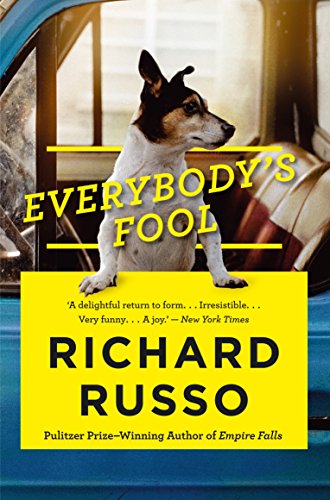
Before the meeting: This is the second book in Richard Russo’s trilogy set in the dead-end town of North Bath in rural New York: it was preceded by Nobody’s Fool (1993) and followed by Somebody’s Fool (2023). I read it as a stand-alone. At about page 80 I went to Wikipedia for a synopsis of Nobody’s Fool, and really I needn’t have. (I also watched a trailer for Robert Benton’s 1994 movie, which was probably a mistake, as the image of Paul Newman as the character Sully was seriously different from the one I’d built up for myself, even allowing for the fact that Sully has aged 20 years since the first book.)
All the same, even for those who haven’t read about the characters’ earlier lives, it’s clear that they are living in various aftermaths. It begins with a burial and returns to the cemetery again and again. One man has been given a year to live, another is stuck in grief for his wife who died in the act of leaving him, a third has been released from jail and proclaims unconvincingly that he has turned over a new leaf. One couple remain affectionate though their affair is long since over, another deal with a long history of mental illness. Friendships endure in spite of mutual irritation, enmities are maintained in spite of deep-seated fellow-feeling. It’s complex, sometimes laugh-out-loud funny, sometimes wretchedly painful, abounding in situational ironies. There are two violent deaths that we don’t witness, and one shockingly violent scene that we do. There are two villains, three if you count the out-of-town dealer in snakes and drugs. There’s a disgustingly incontinent dog. A couple of characters from the first book make cameo appearances, for no obvious reason apart from letting longterm readers know what they’re up to.
Class is ever-present. Most of the book’s characters know they have been excluded from the good things of life. They’re rough with each other, but there’s also kindness and integrity and a strong sense of belonging. At one point Sully, who has the strongest claim to be the main character, reflects that he has made sure ‘that his destination at the end of the day was a barstool among men who had chosen to be faithful to what they took to be their own natures, when instead they might have been faithful to their families or to convention or even to their own early promise’ (page 448). It’s an attitude that elsewhere might be called quiet despair, but here it includes an assertion of connection.
I enjoyed it a lot. It deals with serious themes, but it’s a lot of fun in all sorts of ways.
On page 78*, nobody is being nice to anyone, but nobody’s going anywhere. The scene is Harriet’s diner, one of the three eating and drinking establishments in the town. The characters are Ruth, owner of Harriet’s; her daughter Janey who has just come in complaining about a scene in her bathroom; Carl, a failing developer whose post-prostate-surgery incontinence (which everyone knows about) is responsibe for the bathroom scene; Roy, Janey’s violent ex-husband, fresh out of jail and claiming to have turned over a new leaf, who has just left; and Sully, one-time lover of Ruth, who now hangs around every day to be generally helpful and has just picked a fight with Roy. Ruth is speaking to Janey:
‘Sorry about the bathroom,’ she said, ‘but Carl had an accident.’ She emphasised the name ever so slightly. Remember? she seemed to be saying. What I told you about Carl?
‘Oh, right.’ Janey shrugged. ‘I guess that makes it okay.’
‘That was my thought,’ Ruth said. ‘I’m glad you agree.’
Janey rolled her eyes to show that she most certainly did not agree but wasn’t going to go to the mat over it, either. ‘Was that my idiot ex-husband’s voice I heard earlier?’ Ruth apparently took this to be a rhetorical question, because she didn’t bother answering. ‘He’s taking that restraining order real serious.’
… ‘He hasn’t caused any trouble so far, or even tried to,’ Ruth said, glancing at Sully. ‘Unlike some people.’
‘That’s the thing about Roy,’ Janey said, putting her now-empty mug into a plastic busing tub. ‘He won’t, until he does. But when he does, it’ll be my jaw that gets broke, like always.’
‘He breaks your jaw because you’re always mouthing off.’
‘No, he breaks it because he enjoys breaking it.’
‘Like you enjoy mouthing off,’ Ruth said as Janey brushed past her.
‘Well, jeez,’ Janey mused, pausing in the doorway to her apartment. ‘Let’s think a minute. Where the fuck do I get that from?’
I could probably have picked any page in the book and found similarly alive dialogue, and a similar complexity of relationships. Notice that Sully doesn’t say a word. Ruth’s glance in his direction comes from a woman you don’t want to cross. Likewise, we know that Janey is right about her ‘idiot ex-husband’, but Ruth isn’t gong to back down meekly. It’s no spoiler to say that Ruth’s attributing Roy’s violence to Janey’s mouthiness is rich with narrative irony: what she says in the heat of mother-daughter irritation is a standard blame-shifting rationale used by perpetrators of family violence. That irony goes deep in the light of events yet to come, but my lips are sealed.
After the meeting: We read this along with Christine Dwyer Hicks’s The Narrow Land (yesterday’s blog post here).
They’re very different books, and though I tried in my post on The Narrow Land to note things they had in common, no one else was much interested in such attempts. I’d say that a couple of us enjoyed this book much more than the other, but others not so much. One got to about 20 percent (this is how Kindle readers talk) and then went no further, another read about four percent. The first, probably being polite to those of us who enjoyed it, said that while she could see that the writing was very good, she had no desire to spend any more time in the depressing world of the novel.
Two of us talked about the human warmth and humour. I fond myself laughing helplessly as I recounted one of the more macabre episodes. Others remained stony-faced. The other person who found the book funny said it was like Carl Hiaasen’s work (‘Without alligators,’ I agreed). She also made a cogent argument for the book’s acknowledgement of class in a way that isn’t common in novels from the USA. Similarly civil but unconvinced response.
When I said I could imagine a movie adaptation directed by the Cohen brothers that seemed to bridge the chasm a little.
As I’m about to hit ‘Publish’, I realise that nowhere in my ‘Before the meeting’ section did I mention the wonderful comedic energy of the writing: the book opens with a bravura description of the North Bar cemetery; the town doesn’t have alligators, but it is terrorised by a king cobra; there are terrible smells; a building collapses like something out of a Buster Keaton movie. All of this seems to have passed most of the other club members by. Maybe you have to have to temporarily suspend solemn empathy as well as disbelief.
The Book Club on the land of the Bidjigal and Gadigal clans of the Eora nation, overlooking the ocean. I wrote the blog post on Wangal and Gadigal land as rain poured down. I gratefully acknowledge the Elders past and present who have cared for this beautiful country for millennia.
* My blogging practice is focus arbitrarily on the page of a book that coincides with my age, currently 78.





 Me fail? I fly!