Tag Archives: Robert Adamson

SWF 2112: Poets, Harbour, pitches and more poets

This was my first day at Walsh Bay, and in striking contrast to recent weather, the sky was cloudless and there was no wind – perfect festival weather.

The tiny harbourside room generally reserved for poets at the Festival couldn’t have been a more appropriate venue for my first event of the day, Harbours and Rivers, with Robert Adamson, Neil Astley, Martin Harrison and Jennifer Maiden. I joined the uncharacteristically long queue with minutes to spare, and only when it became clear I wasn’t going to get in I realised I was in the wrong place: this time the tiny room had been given to young writers talking about the Second Novel Effect, and the poets had been given a much bigger and incidentally much darker space. I briskly walked the length of the Wharf and arrived part way through the introductions.

The poets, refusing as poets should to be pigeonholed, paid at best slant regard to their allocated topic. Jennifer Maiden read a long new poem, ‘The Uses of Powerlessness’, which she described as a diary poem but was actually pretty much a philippic on Julia Gillard, not in the ‘X woke up in X’ form, but a straightforward furious meditation. I wrote down one of many striking lines: ‘The Labor Party, like Gillard, is an obedience addict.’ Martin Harrison and Robert Adamson both spoke of the complex interplay between observation of the natural world and self-discovery. ‘All my harbours and rivers are internal,’ the latter said, somewhat disingenuously, ‘even though I live on a river.’ Among the poems he read was the sublime ‘Kingfisher’s Soul’, an intensely personal love poem that grows richer with each hearing. Neil Astley, advertised as editor of English publishing house Bloodaxe Books, turns out to be a poet as well. He was in Darwin for Cyclone Tracy, about which he read two striking poems followed by an excerpt from a novel that engages with an English countryside.
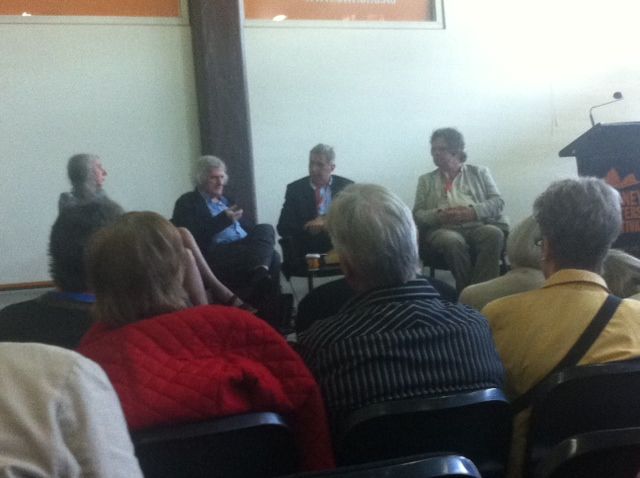
Jennifer Maiden, Robert Adamson, Martin Harrison and Neil Astley not far from the Harbour

In short, it was very good. Afterwards I ventured to introduce myself to Jennifer Maiden, but I was probably working so hard at no being too fanboyish for the conversation to have made much sense.

After a brief interval I went to the Club Stage for So You Think You Can Write, my first time to this a regular Festival event in which random audience members get to pitch a project to a panel of publishers.
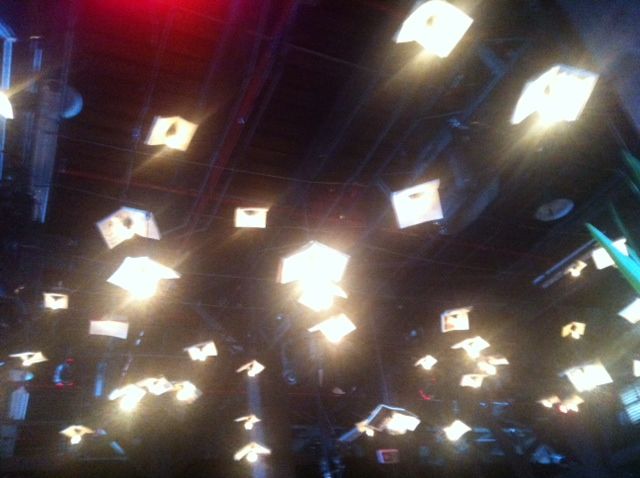
The specially decorative lights for the Club Stage area – each bulb has an open book for a shade.

I don’t know that anyone who was at all savvy about publishing would participate in this, unless for the sheer fun of it. And it was mostly fun. A 15 year old boy pitched a detective story set among the Egyptian pyramids. There was an earnest tract for children aiming to foster leadership skills and an understanding of democracy. One or two pitches were for books that could have been anything, so broad were the descriptions. One woman had already had an iBook version of her project downloaded thousands of times. The winner – of nothing apart from the glory – was a psychological detective story in which the character realises a day of her life has gone missing and then is shown photos of herself taken on the missing day. The thing that won the audience and panel’s approval was that the photos were improbably and bizarrely orgiastic, involving vegetables and cigars in unspecified lewd ways. It may not be Scandi-Crime, but this audience loved it. You read about it here first.

And then off to the poets’ lightfilled room. Gig Ryan and Kate Lilley, feminist-identifying experimental poets, drew an overflow crowd, including Adamson, Harrison and Astley from this morning, plus John Tranter, Ivor Indyk, Toby Fitch and many faces familiar from the Sappho open mike nights. Each of the poets introduced the other. They read from recently published books and, on being requested by an audience member to  compose a poem together on the spot, they parlayed the request down to each of them reading a poem by the other – with interesting results.

I confess that I went to this session expecting to suffer. I’ve read very little of either of them and my experience has been that if I don’t know a poet’s work I have trouble hearing it when read to me. (A possible contrary experience was hearing Jennifer Maiden this morning, but I am familiar with her voice and preoccupations, so had a head start.) Gig Ryan reads quickly, and her language is very compressed: I had difficulty distinguishing the words, let alone grasping the connections between them. Kate Lilley has a gratifyingly expressive delivery, and the woman beside me kindly allowed me to look over her shoulder and read along as the poems were read. But I was still pretty completely mystified. Both women talked about how people in their lives met their work with blank expressions, so I didn’t feel too stupid, or at least not alone in my stupidity.

One of Kate Lilley’s poems, ‘Maisily’, consists of a string of about a hundred adverbs. This was the first time she’d read it aloud and it was quite a feat – all those lys. It seemed like pointless nonsense to me. Then she explained that it was made up of all the adjectives used by Henry James in What Maisie Knew. That made it seem like hi-falutin pointless nonsense to me. Then I remembered that it was part of an elegiac sequence about the poet’s relationship with her mother, and it no longer seemed so pointless – maybe I was finding an emotional subtext because that’s the kind of reader I am, but I did find one, like a deeply submerged nostalgia for childhood when the adult world was as inscrutable as to little Maisie in James’s novel. I wonder how it wold go if read, not as a near tongue twister, but with the rhythm of a tolling bell.

As if the poets had read my thoughts, their conversation turned to the business of reading poetry aloud. Lilley said she knew and loved her poetry long before she heard her read, but when she did hear her read it was a revelation. Maybe my difficulty is as much to do with my increasing deafness as with unfamiliarity with the poetry.

So the poetry was difficult, but the session was excellent. Both were very funny about the business of being poets, and how they see each other’s poetry. Even when they drew our attention to the complete absence of critical articles on Gig Ryan’s work, even though she is generally acknowledged as an important Australian poet, and surmised that this absence may well be because she is a woman, somehow that seemed richly comic.

On the way home in the bus, I ran into an old friend who had been to a panel with Peter Hartcher, George Megalogenis and a third journalist talking about Australia’s parlous economic situation. I felt I had been very frivolous, but I was glad of it.

Adamson’s Kingfisher’s Soul

[I accidentally posted a beginning draft of this a couple of days ago, and couldn’t make the automatic Twitter feed shut up. Sorry!]

Robert Adamson, The Kingfisher’s Soul (Bloodaxe 2009)

I’ve read many of these poems before, in Mulberry Leaves (Paper Bark Press 2001) and The Goldfinches of Baghdad (Flood Editions 2006). But they all feel new to me. This may be because I’m a lousy reader of poetry. It may also have something to do with this book’s careful ordering of the poems into something like a sequence (most evident in the middle and third of the three sections, the former playing obliquely with the mythic figure of Eurydice, the latter consisting entirely of poems named after birds). And it may have to do with the nature of the poems themselves: bear in mind that I know very little about poetic schools and movements (I wouldn’t know a Black Mountain poem from a New York lunch), so anything I say is sure to be crude and/or naive, but it seems to me that Adamson’s poems flow into one another: edges and boundaries blur, as he and the Hawkesbury River, birds and fish, and other poets and artists, all intermingle in a strangely compelling, elusive oneness.

When he read at Sappho’s recently, Adamson remarked in passing that he generally doesn’t know what his poems are about until he’s finished writing them, and often not even then. I’ve heard a couple of people recently say that a lot of contemporary poetry is like cryptic crosswords – it’s largely a matter of unravelling complex codes etc etc. I don’t think that’s what Adamson is talking about. I don’t have the book with me so can’t give examples (I’m at the airport), but time and again a poem will move from a vivid description of a bird and the speaker’s interaction with it; a metaphoric or even allegorical meaning, sometimes with satirical will be set up; and then it’s as if the poem gives up such ventures as futile and we’re left with the bird, the river, the silent poet.

I recently heard a passage from a recent novel read on the radio, beginning, ‘The Hawkesbury was lovely.’ It’s hard to imagine Adamson writing that sentence, or going on to talk about its golden cliffs as the novelist did. Adamson’s poetry doesn’t describe the Hawkesbury. It lives it. My flight is being called.

Sappho & Penguin play rough

Two literary events with the Art Student in the last week: Robert Adamson and Devin Johnston at Sappho’s on Tuesday night, and Tom Cho and others at Penguin Plays Rough on Saturday.

I’ve been to one previous poetry reading at Sappho’s, in May this year. On that occasion Rhyll McMaster and the open-mikers read from just inside the shop, to an audience spread comfortably on the verandah and courtyard in the balmy evening, enjoying warm drinks and tapas. Tuesday night was a bit different, bitterly cold (by Sydney standards) with rain pelting down. We arrived early enough to claim the sole remaining indoor table, opting for dryness and comparative comfort behind the microphone rather than huddling in the chilly and dripping plastic-roofed and -sided balcony with good sight lines. The courtyard was completely out of the question. When the Talent arrived, they were given tables in the semi-exposed area, tables that we had rejected because they were awash.

It speaks volumes for the pulling power of these poets that the space, though small, was crowded. Adamson and Johnston were an excellent double bill, lots of river water and birds from two continents. The two stand-out poems for me were Johnston’s ‘Marco Polo‘ (the link, which needs Flash, has DJ reading this poem and two others) and Adamson’s ‘The Kingfisher’s Soul‘ (this also needs Flash), which he told us he’d written in response to his wife asking why he never wrote any love poems: it is indeed an achingly personal love poem.

Adamson, Johnston and their small entourage departed – presumably to a warmer, drier, better fed place – before the open mic, along with enough others to create the impression that all who were left were the open mikers and their pals: ‘And now, ladies and gentlemen, the Dregs of the Evening’. But we soldiered on, reading one poem each. There was a long piece in terza rima that I couldn’t quite hear, a pantoum, a sharp witty observation on cockatoos, a tribute to Francis Webb, and to conclude the evening next month’s featured poet Eileen Chong gave us Mary Wollstoncraft addressing her unborn daughter, praying that one day her fingers would close around a pen. And somewhere in there I read a sonnet about snoring. To polite applause. Come to think of it, even the most excellent poems of the evening received only polite applause. Given the weather, that was about all that could be expected.

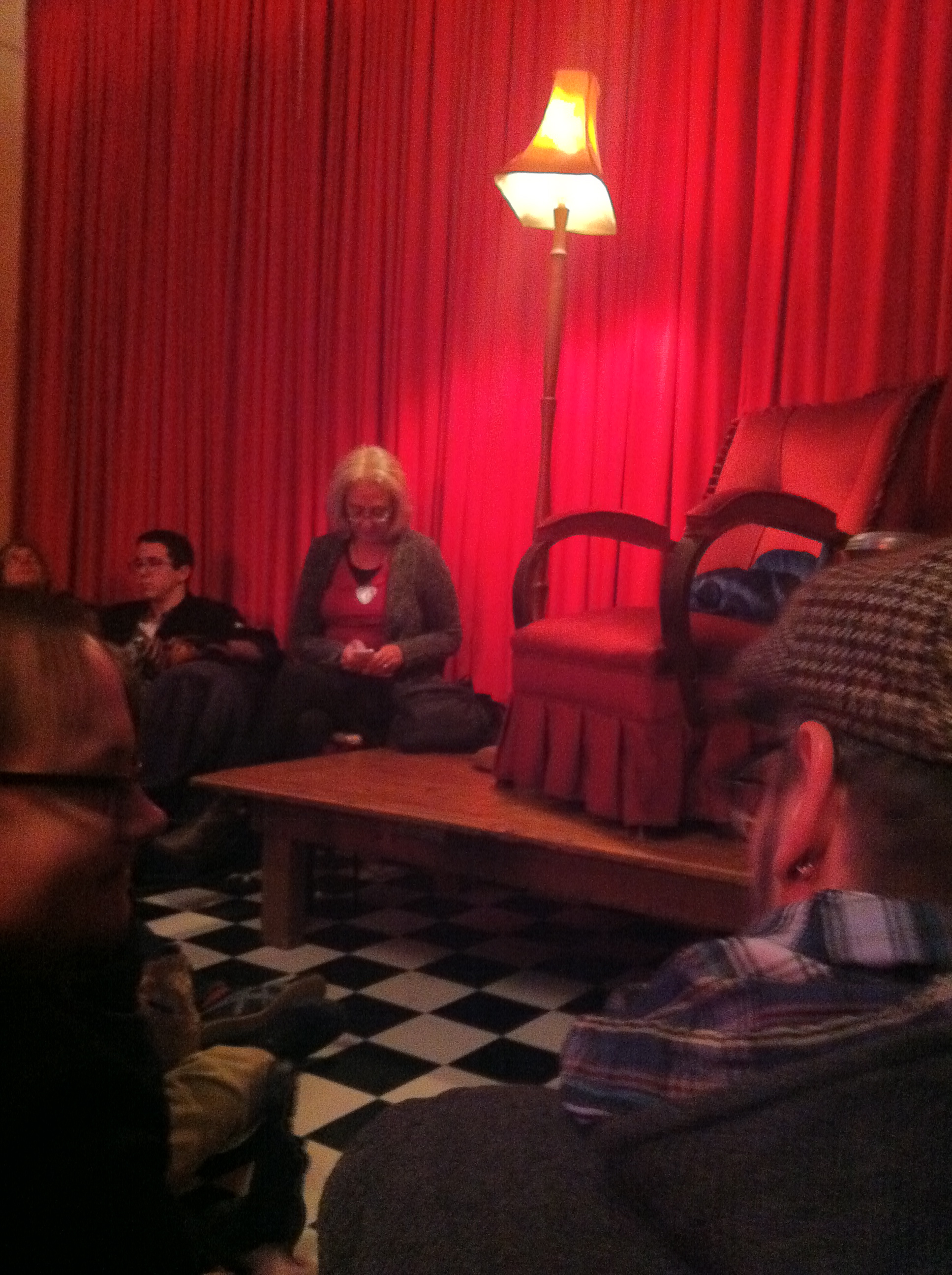
Penguin Plays Rough had a very different feel. It was my second time there as well, but my first at the new venue. The front section of an old warehouse has been curtained off from what I assume is the living space further back. The heavy red curtains lend a suitably theatrical atmosphere to the chequered lino floor, cosily ill-assorted couches and armchairs around the walls, and wooden podium with iconic red chair and standard lamp. By the time we arrived all but one of the sears were taken, and no mercy was shown to our elder status. We found a place on the lino. (At the first break in proceedings when we stood up to stretch our legs, I was shocked to discover a pack of young people moving in to claim the space we were relinquishing – behind us, in the tiny space between the front door and the first heavy curtain, they had been standing three deep, envying us our vantage point.)

We were physically uncomfortable, but we were warm, and we were part of a cheerful crowd. Many people were drinking mulled wine. Those in the know – and they seemed to be many – had brought their own mugs. Pip Smith, who edited and published The Penguin Plays Rough Book Of Short Stories, was a brilliant MC, using words like ‘awesome’ and generally exuding a mi casa es su casa aura. With one possible exception (he said humbly), the readings were terrific. The advertised readers were Emma Dallas (a character sketch of an inner west personality), Ryan O’Neil (a piece about depression that would have been scary if it wasn’t so brilliantly playful), Sam Twyford-Moore (a tale of travel, crosscultural romance and writerly rivalry), Jess Bellamy (letters to celebrities whose dysfunction feeds the tabloids, which became retrospectively more substantial with news of Amy Winehouse’s death yesterday), and the star of the evening Tom Cho. Tom read from ‘The Attributes of God’, a story that will be in a book he describes as being about the meaning of life. I wouldn’t have minded the physical discomfort of the evening anyway, but hearing this story would have been worth even more suffering. ‘God is love’ has taken on new meaning for me. He ended with a YouTube clip of otters that, far from being gratuitously cute, was a perfect accompaniment to his story.

Penguin Plays Rough doesn’t have an open mic. They do have ‘wild cards’: anyone can sign up at the door to read, and a selection of those who sign up are interspersed between the advertised readers. On Saturday we had an essay on relationships between the genders with a focus on schoolyard handball, a piece that Pip Smith described as a theatre review written by James Joyce … and me.

Yes, I put my name in the ring again, which I wouldn’t have done if I’d realised that PPR is actually a short story event and I only had a couple of sonnets and a dog poem in my pocket, and even more definitely not if I’d known I was going to be at the end of the evening – after Tom Cho and the otters. Astonishingly, the whole audience stayed put and even seemed to enjoy what I had to offer.

These are the first two times I’ve ventured to read in public. It’s not so bad.

Added later: I forgot to mention that I met Adrian Wiggins there, the mover behind the Sydney Poetry web site. He has uploaded some wonderfully atmospheric photos to facebook. Mercifully he had to leave before Tom Cho’s and my moments in the chair, so we don’t appear, except in the background of one of the shots.

SWF: Busy Friday

I had tickets for a 10 o’clock session yesterday morning. One of the participants was prevented from being there by the Chinese government, and I was kept away by an act of vandalism (see previous post). There’s a photo of Liao Yiwu on a chair in the Gleebooks shop, but I got my whole body to Walsh Bay in time to spend a little money and queue successfully for

11.30 am: The Fascinator
Delia Falconer, Ashley Hay and Gail Jones have all recently written books set in Sydney. With Jill Eddington in the chair, the three of them – one a lifelong Sydneysider, one here since she was about 20, one a very recent arrival – chatted interestingly. Jill Eddington recommended reading all three in succession because the effect was like three movements in a piece of music. She imagined a movie that might be made of the three of them wandering the Harbour foreshores, going in and out of the Mitchell Library, walking in each other’s footsteps, almost meeting. The conversation that followed was a nice contradiction to the myth that writers are essentially in vicious competition with each other: Ashley Hay, for example, said that when her book was finally with the printer, reading Delia’s, which covered so much of the same territory but from a very different perspective, was like a special reward.

I tore myself away early, just as they were playing with possible readings if the session’s title: were we meant to think of the Harbour as a hat or an evil enchanter from a Margo Lanagan short story, or – the preferred option – both? I left reluctantly so as not to risk missing out on the Francis Webb session at 1 pm. This turned out to be a wise move, and brought a sweet bonus: I was hailed by a friend I hadn’t seen for 40 years, and while I kept one eye on the Webb queue we snatched a quarter of an hour to get reacquainted. When the growing queue vanished into the dark, we promised to follow up on Facebook, and I skedaddled to:

1 pm: The Lost Poetry of Francis Webb
This was in a much bigger venue than other poetry events, and we were told that it could have filled a space twice the size. It was one of a series of events around Australia to celebrate the recent publication of the UWA Collected Poems. The book’s editor, Toby Davidson, has organised and chaired the events, in which local poets read poems by Webb and speak briefly of their connections to him.

Toby D is a young man whose enthusiasm for his subject wouldn’t have shamed a revivalist preacher. He wants us all to read Webb, in solitude and aloud to our friends. He recommends the practice of carrying a book of his poems everywhere with us (which Bob Adamson told us later he actually does). He kicked things off by reading ‘Ball’s Head Again’. He didn’t read badly by any means, but he did demonstrate the difficulty of Webb’s verse and gave us a yardstick by which to judge the other readers.

By any measure they were all brilliant.

Judith Beveridge spoke of the texture of Webb’s language, its compression and richness, and read ‘Images in Winter’ and ‘For My Grandfather’.

Brook Emery quoted a speaker from an earlier session who referred to ‘songs that please the ear and songs that please the heart’ and said he would add ‘songs that please the mind’ – Webb’s poems, he said, are always reaching for meaning. He read ‘Night Swimming’, the first poem by Webb I ever read, when I was 24 or so, and ‘Nessun Dorma’.

Johanna Featherstone, easily the youngest of the poets, struck a blow against the view that Webb is a poet’s poet, read only by scholars and fellow poets. She takes poetry into correctional centres, where prisoners, possibly influenced by knowledge of his time in institutions, believe him. She read ‘The Runner’ and ‘Harry’.

Craig Powell, a psychiatrist in his day job, told a little story of his acquaintance with Webb when in a psych hospital in Melbourne. He read ‘Five Days Old’, prefacing it with the story of its creation: a psychiatrist in England took Webb on an outing, and asked him to hold his little baby for a moment. Powell almost spoiled the moment by asking with a snigger, ‘Who would hand their baby over to a certified chronic schizophrenic?’ But he gave us the poem with sound and heart and head. He also read ‘Hospital Night’.

Robert Adamson talked about the stigma of ‘mental illness’, quoting an eminent poet-critic-media-personality’s description of Webb as ‘the maddy’. When they met, Webb asked Adamson, ‘Are you a Communist?’ ‘Why?’ ‘The long hair.’ He read ‘Bushfire’, ‘Black Cockatoos’ and ‘End of the Picnic’. As a final comment he said that whereas a lot of discussion of Webb’s poetry focuses on his ‘mental illness’, the poetry itself is full of hope and lucidity.

The young Bulgarian woman sitting next to me said she’d loved the poetry, though there were many words she didn’t understand. Me too.

As I was on my way to the next session, I accosted Bob Adamson and said how much I’d loved his reading. He reached into his briefcase and gave me a book! So, dear reader, when someone does something that delights you, make a point of thanking them.

2.30 pm: The Merchants of Doubt
Naomi Oreskes’s eponymous book (can you say that?) is an exploration of the doubt-mongering techniques developed by the Marshall Institute in the US to defend vested interests against the implications of scientific research. They began with the connection between tobacco smoking and cancer, and progressed to a range of environmental issues, reaching some kind of peak with climate change They don’t have to lie (though they do anyway), but they do systematically create disinformation. She was in conversation with Robyn Williams, and they are clearly kindred spirits, science journalists passionately concerned about the current attacks on science.

I won’t try to summarise. Robyn recommended a BBC doco, Science Under Attack. In a neat echo of Adamson’s anecdote, he told of meeting one of the doubt-mongerers at a conference, and being asked of his journalist colleagues, ‘Are they all Communists?’

My main take-home point was that scientists (and, I would add, others) have a deeply held belief that the facts will speak for themselves. But this is manifestly not so on matters with big emotional charges on them.

Adamson’s best of 2009

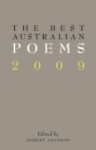
Robert Adamson, The Best Australian Poems 2009 (Black Inc 2009)

This is an excellent anthology. In fact, in the context of previous years’ round-ups, both from Black Inc and UQP, it’s a strong contender for Best of the Best. It includes a wonderful range of poetic styles and modes and subjects – incomprehensible post-modern stuff, impassioned story-telling, linguistic virtuosity, delicate lyric. There’s Clive James‘s assured iambic pentameter, Pam Brown‘s asthmatically short lines, Ali Cobby Eckermann‘s lines you might need to know didgeridoo breathing to recite adequately. In the introduction, Robert Adamson talks about his solution to the difficulty of reducing his short list to fit the space available – he persuaded Black Inc to give him more space. I’m glad he did, and that he kept commentary, analysis and explanation to a bare minimum. He does offer this gem of commentary:

People ask me, why are so many bird poems being written and published? I have a theory: we miss having poets among us who can imagine that a soul can ‘clap its hands and sing, and louder sing’, that we need to acknowledge visitations by intense psychological presences, and that birds are the closes things we have, more or less, to angels.

Perhaps that’s mainly a clue as to how to read his own poems, but it’s an interesting general thought as well.

I’m not going to try to name the poems I liked best.  My copy has far too many page-corners turned down for that.

As I was reading this anthology, my Art-Student Companion, as part of her preparation for an assignment on Australian Federation, was reading The Sentimental Nation by John Hirst, and kept regaling me with interesting bits about the major role poetry played – poetry, he says, is ‘the best guide to the ideas and ideals that inspired the movement’ for Federation, and again: ‘The nation was born in a festival of poetry.’ Well, even though poetry festivals rarely make the news pages these days, to judge by this book poems are still looking for words for what inspires and ails us as a nation and a species. But now, instead of writing bush ballads or ponderous and forgettable sonnets, they tell about Iraq, global warming, the ills of capitalism, but they tell it slant. There are any number of examples, but I’ll just mention Luke Davies’ ‘Maldon, 991 AD’ which ends:

oooooooooooo I felt an outsider
to laughter. Out there the Vikings sang,
that was more like it, something eerie
to get spooked about, distracted by:
and the world so tenderly
unveiling its final unveiling.

I was also struck by the sense of community among the poets, particularly as shown in the number of poems honouring those who have died: Dorothy Porter (‘Word‘ by Martin Harrison), but also John Forbes (‘Letter to John Forbes‘ by Laurie Duggan, Jan McKemmish (Pam Brown’s ‘Blue Glow‘), Francis Webb (‘Reading Francis Webb‘, by Philip Salom [the link is to a PDF]) and Bruce Beaver (a couple of mentions, but mainly Peter Rose’s beautiful imitation, ‘Morbid Transfers‘).

Buying this book in March felt a little bit silly, like buying hot cross buns in July, but it turns out it’s not a seasonal thing at all. It’s an anthology that I’m sure I’ll go back to.

Footnote: One of my wise younger relatives recently chided me for reading while walking: ‘It’s as bad as walking around with those things in your ears, Jonathan,’ she said (by which you can she’s not so very young). ‘You have to let the world in.’ She may be right in general. But sometimes reading while walking is a way of letting in both world and poetry. The other morning I was throwing the ball for Nessie at the bottom of the hill and noticed that the longish grass was pearled with dew so that previous walkers both human and canine had left tracks of darker green, and the rosellas wouldn’t shut about something. I realised it must have rained quietly in the night. The next words I read were these, from Sarah Day’s ‘A Dry Winter: Some Observations About Rain‘:

… an elemental transition from dry to damp.
Listen, you can hardly hear its outward breath

on the tin roof. In the morning,
grass and earth are wet and everything

but the mercuric globe in the nasturtium leaf
is translucent.

I don’t know anything about nasturtiums, but the rest could have been a condensation from my surroundings. (The whole poem is lovely, by the way.)

Added later: Tara Mokhtari on the Overland blog has a completely different view. She does identify herself as a ‘shunned poet’.