
Evelyn Araluen and Jonathan Dunk (editors), Overland Nº 255 (Winter 2024)
(Links are to the online versions unless otherwise indicated.)
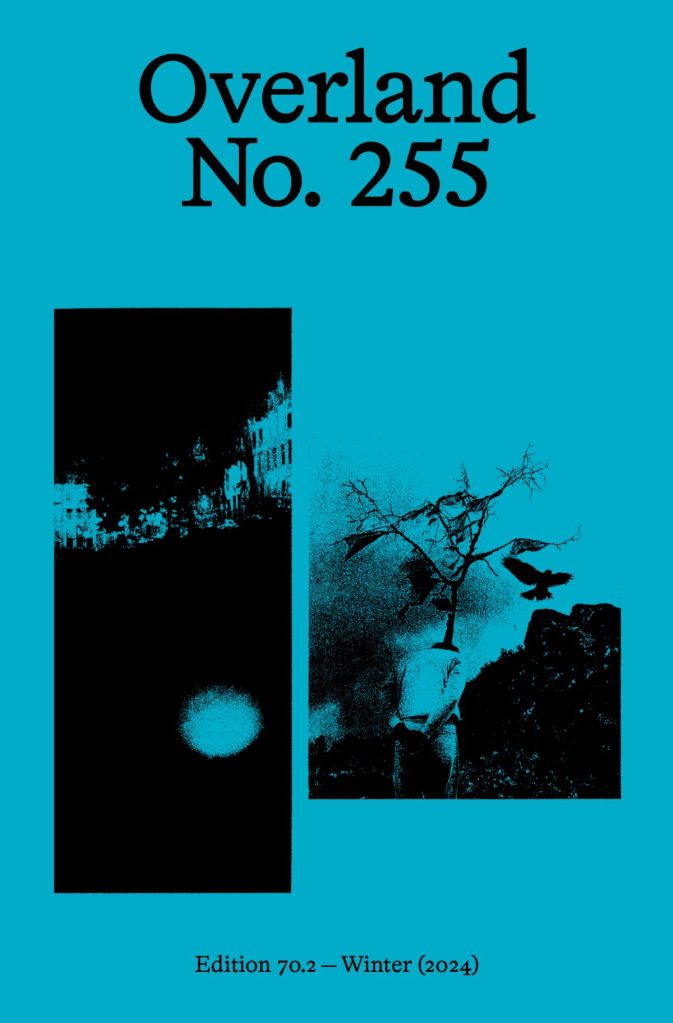
I sometime approach literary journals as if shouldering a grim obligation – doing my bit in the cultural ecology. (Added later: The morning after I uploaded this post, I read in a letter from Esther Anatolitis, editor of Meanjin, that my subscription ‘supports the ecosystem of Australian writing: that fragile yet incredibly powerful space where the finest new work is written’. Great minds draw on the same tropes.) The austere retro design of this Overland, one of four to mark a 70th anniversary, didn’t do much to dispel the grimness. Nor did the editorial, which underlines the darkness of our times. But then …
The first thirty pages or so are taken up with ‘Writing from the South: an interview with Kim Scott’. It’s leisurely, full of unfinished sentences and swirling crosscurrents of thought and information – there’s no apparent attempt to tidy up the spoken conversation, and as a result you (or at least I) get to feel you’re in the room with the the living, breathing, thinking author of, among other things, That Deadman Dance, Taboo (links to my blog posts) and (what I haven’t read but now really want to) Benang. He’s in conversation with Samuel J. Cox.
I’ll mention two other non-fiction pieces: ‘The Australian media’s problem with Palestine’ by Juliet Fox, which tells about decades of government suppression of Palestinian voices on a Melbourne community radio station; and ‘“Arts funding is fucked”: Overland 1973–1975’, a plus-ça-change piece by Overland‘s digital archivist Sam Ryan about the politics of funding to the arts in Australia 50-odd years ago.
As always, there’s poetry, ranging in this issue from probably-very-good-if-you’re-motivated-to-spend-a-lot-of-time-with-it-but-today-I’m-not to a beautifully executed punch to the guts. The latter is ‘The Killer in Me’ by Ann-Marie Blanchard, in which the speaker personifies her uterus after a miscarriage. Somewhere between the two extremes is the dauntingly titled ‘Poem in asymmetric transparency’ by Shari Kocher, a meditation on a Margaret Preston painting:
Three lotus lookalikes floating in solar darkness.
As it happens, page 78* occurs in the piece of fiction that speaks most to me, Jordan Smith’s ‘Something Is Rotten’, in which a technological solution to the climate emergency goes terribly wrong, seen from the point of view of young lawyers who thought their normal work was high-pressure. At page 78, the catastrophe is beginning to unfold, though the characters stay with their usual preoccupations. Paul, one of the barristers, looks out of his high-rise window at the ‘sat-drones’ doing hi-tech stuff to the upper atmosphere:
‘Fuck knows what they’re doing but it does look good.’ The sat-drones twinkled as, one by one, they flew up then plunged down, like waves running up and down a skipping rope. The colour of each oscillated between a crystal blue and a sharp, metallic crimson. Rob felt a bit dizzy. He and Sarine looked at each other.
As required by a tight deadline, Rob puts the dizziness aside, takes ‘a few painkillers’ and gets back to work.
His phone buzzed incessantly.
Sydney 6G
Friday, 6 June 11:43
Notification centre
News alert:
PM urges calm after atmospheric pressure dr… (10+)Rob cleared notifications and switched on do not disturb.
The reader feel the disaster happening while the character sticks to the his mundane urgencies. It’s deft storytelling. Like the poems I’ve mentioned it’s marked as ‘Online soon’ on the Overland website, and may be available by the time you read this.
I don’t usually google authors, but I did look up Jordan Smith. He’s a barrister who has an Honours degree in nuclear physics, so I guess he knows what he’s taking about on both sides of the equation.
I haven’t exactly dispelled the notion of grimness I invoked in my first sentence – colonisation, genocide, miscarriage, climate catastrophe aren’t cheery subjects. But taken along with the evocative decorations from past issues (Richard Tipping in the 1970s, Rod Shaw and John Copeland in the 1990s) there’s something exhilarating about the way Overland has survived so much change in the world and in itself, still giving a platform to new voices, still saying things that aren’t easy to hear elsewhere.
I wrote this blog post on the land of the Wangal and Gadigal clans of the Eora nation. I gratefully acknowledge the Elders past and present who have cared for this beautiful country for millennia, and lived through extraordinary changes in the land and climate over that time.
* My blogging practice is focus arbitrarily on the page of a book that coincides with my age. This is first time I’ve looked at page 78.


 Me fail? I fly!