Tag Archives: S Shakthidharan

2025 End of Year list 2: Theatre

I went to the theatre seventeen times this year, counting a National Theatre Live screening. Mostly I was accompanied by the Emerging Artist, but as luck woUld have it she was home with a painful post-surgery foot for the play that gets the Jonathan Shaw Award for the year:
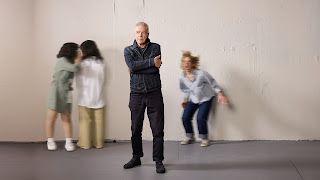
The True History of the Life and Death of King Lear and his Three Daughters at the Belvoir Street Theatre, directed by Eamon Flack, with Colin Friels in the title role. From the beginning this Lear was in crisis. Colin Friels somehow communicated that he was dividing up the kingdom, not on some weird whim, but because he had a sense of impending cognitive and physical incapacity. That he (the actor, not the character) collapsed on another evening, leading to the cancellation of that performance, is perhaps an indication that he was drawing on his own felt experience.

Of the shows we saw together, we agreed on this list of The Best, in alphabetical order:
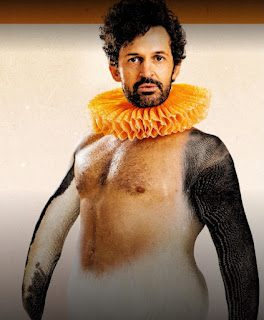
Classic Penguins, in which Garry Starr (not his real name), wearing webbed feet, a ruffed collar and not even that much for some parts of the show, took us on a tour of Penguin Classic paperbacks, performing mostly silly skits based on their titles. For Around the World in 80 Days, for instance, he spun around while the audience counted to eighty. I laughed a lot, I cried, I did as I was told and helped the naked Garry crowd surf.

Jacky by Declan Furber Gillick, directed by Mark Wilson and starring the wonderful Guy Simon, was a Melbourne production transported to Belvoir Street as part of the Sydney Festival.

The Visitors by Jane Harrison, which we saw as part of the Clancestry Festival of first Nations arts in Brisbane/Meganjin. Representatives of the local clans meet on the headlands of what is now Sydney Harbour and debate how to respond to the fleet of ships that is coming through the heads.

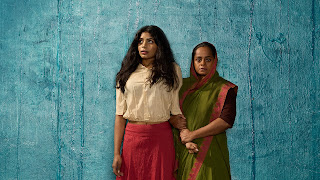
The Wrong Gods written and co-directed by S Shakthidharan (his co-director was Hannah Goodwin). Everything about this was superb – the set the music, the dancing, the writing, the acting. Wonderful theatre , and a serious look at the devastating encroachment of capitalism on Indian village life.

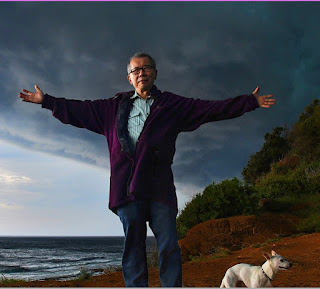
William Yang: Milestone, in which one of Australia’s living treasures marks his eightieth birthday with a slide show and his undimmed gift for storytelling. We saw it as part of the Sydney Festival.

Next, television!


I  saw most of these shows on Gadigal land. I wrote this blog post on the  Wurundjeri Woi-wurrung land. I acknowledge their Elders past and present, and welcome any First Nations readers.

NSW Premier’s Literary Awards Night

The NSWPLA night used to be a grand affair. Long before my time there was a bread-roll throwing affair when Morris West droned on too long in his acceptance speech. I got to be on the free list one year, then coughed up good money for a number of years after that, and one year I got to be the plus one of my shortlisted niece. It became less fun when it changed from being a full-blown dinner to a drinks and powerpoint affair, but I still followed it, at least on Twitter. (I dutifully blogged the event for quite a while, and if you really want to, you can plough through my blog posts for 2006, 2007, 2009, 2010, 2012, 2013, 2014, 2015, 2016 and 2017).

This year, thanks to the Great Leveller, SARS-Cov2, it was again possible to attend the whole event without stirring from home or spending a cent.

So here’s how it went:

After an elegant introduction by John Vallance, Chief Librarian, speaking to us from an empty Mitchell Library, President of the Library Council George Souris spoke from his home and introduced Gladys Berejiklian, who somehow found time off from crisis-management to record a short message. John Vallance then announced the winners without any frills apart from little speeches from a range of relevant politicians:

Multicultural NSW Award went to The Pillars by Peter Polites (Hachette Australia). Peter did a to-camera piece expressing gratitude to, among other things, his publisher’s bowties.

Nick Enright Prize for Playwriting: Counting and Cracking, S Shakthidharan and auxiliary writer Eamon Flack. The writer, the second from Western Sydney: ‘This award helps to weave this little story from Western Sydney into the tapestry of all the great Australian stories.’ Eamon Flack used his platform to contrast the ‘neglect and carelessness’ of current art policy with the years of policy that enabled Counting and Cracking to happen.

Betty Roland Prize for Scriptwriting: joint winners The Cry, Episode 2, Jacqueline Perske (Synchronicity Films), and Missing, Kylie Boltin (SBS). Kylie Boltin dedicated the award to her mother and grandmother. Her grandmother died yesterday.

Patricia Wrightson Prize for Children’s Literature: Ella and the Ocean, Lian Tanner, Jonathan Bentley (Allen & Unwin). Both author and illustrator spoke. She spoke of starting the book twelve years ago and then leaving it in the folder marked ‘Abject Failures’ for years. He, a humble illustrator: ‘Thank you for choosing me.’

Ethel Turner Prize for Young People’s Literature: Lenny’s Book of Everything, Karen Foxlee (Allen & Unwin). Karen said, ‘I want to use this platform to thank readers everywhere who continue to buy books in these times. I want to thank everyone who supports the arts.’

Kenneth Slessor Prize for Poetry: Enfolded in the Wings of a Great Darkness, Peter Boyle (Vagabond Press). Peter Boyle paid tribute to his late partner Debora Bird Rose (herself a great writer).

Indigenous Writers’ Prize: The White Girl, Tony Birch (University of Queensland Press). Tony Birch gave a shout out to ‘every Blackfella across Australia who is writing’.

Douglas Stewart Prize for Non-Fiction: from 136 entries, the winner was Tiberius With a Telephone, Patrick Mullins (Scribe Publications), a book about William McMahon. Patrick Mullins, looking scarily young, acknowledged his debt to writers and journalists whose work was important to his, and to the many people he interviewed.

UTS Glenda Adams Award for New Writing: Real Differences, SL LIM (Transit Lounge). SL LIM looked even younger, with pink hair and a soft toy, and plugged her coming book, which (I think I heard correctly) calls for the end of the family.

Fiction (Christina Stead Award): The Yield, Tara June Winch (Penguin Random House). Tara June Winch spoke of the centrality of language to human life. ‘It is a sacred thing,’ she said, in Wiradjuri. The Yield also won the People’s Choice Award and the Book of the Year. Tara June Winch got to speak again, and spoke of her esteem and fellow feeling for the other writers having a hard time just now. She asked the Federal Government to treat ‘our sector’ as our families do. ‘We can’t tell you the story of what is happening to our country now if the only thing on our minds is how to afford the next week’s rent.’ She hopes that our First Languages will be included in our schools’ curriculum.

That was it. It turns out that though I’d read a couple of the shortlisted books, I hadn’t read a single one of the winners, and had seen only one of the performances – the absolutely stunning Counting and Cracking.

You can watch the whole ceremony at: