Tag Archives: Simone Weil

George Herbert’s Love (III), Simone Weil and me

I’ve been suspicious of the notion that a poem is always a collaboration between poet and reader (or readers) – that each reader, even each reading, creates a different poem. My suspicion has been softened, but not completely dispelled, by taking part in the fabulous online Modern and Contemporary American Poetry course (‘Modpo’).

But I’ve realised that one of my favourite poems, ‘Love III’ by 17th Century English poet George Herbert, is a brilliant example of how that notion can hold up.

Here’s the poem:

Love (III)

Love bade me welcome. Yet my soul drew back
Guilty of dust and sin.
But quick-eyed Love, observing me grow slack
From my first entrance in,
Drew nearer to me, sweetly questioning,
If I lacked any thing.

A guest, I answered, worthy to be here:
Love said, You shall be he.
I the unkind, ungrateful? Ah my dear,
I cannot look on thee.
Love took my hand, and smiling did reply,
Who made the eyes but I?

Truth Lord, but I have marred them: let my shame
Go where it doth deserve.
And know you not, says Love, who bore the blame?
My dear, then I will serve.
You must sit down, says Love, and taste my meat:
So I did sit and eat.

If you’re interested, there’s a beautiful, scholarly account of the poem by Hannah Brooks-Motl at this link. What follows is not particularly scholarly. If you make it to the end you may even find it amusing.

I’m currently reading Wolfram Eilenberger’s The Visionaries, translated by Shaun Whiteside, a fascinating look at a decade in the parallel lives of four brilliant women – Hannah Arendt, Simone de Beauvoir, Ayn Rand and Simone Weil. The book reminded me that Herbert’s poem played a major role in the life of Simone Weil.

In 1938, Weil was suffering extreme pain. She had lost her teaching job, and doctors couldn’t find a diagnosis or offer any respite. She found relief mainly in listening to sacred music, when, to quote Eilenberger, ‘the pain receded into the background and even allowed her to feel, in her deep devotion, removed from the realm of the physically restricted here and now.’ As well as the music, she turned to poetry. ‘Love (III)’ was important to her. In her Spiritual Autobiography, quoted by Hanna Brooks-Motl, she wrote:

Often, at the culminating point of a violent headache, I make myself say it over, concentrating all my attention upon it and clinging with all my soul to the tenderness it enshrines.  I used to think I was merely reciting it as a beautiful poem, but without my knowing it the recitation had the virtue of a prayer. It was during one of these recitations that ... Christ himself came down and took possession of me.

It was a turning point in her life, and a wonderful example of how to read a poem. George Herbert would have been thrilled.

My reading was a little different.

I was 23 year old English Honours student at Sydney University in 1970. At the end of the previous year I had left a Catholic religious order where I had been ‘in formation’ for seven years, and at the time I’m talking of I was in my first intimate sexual relationship.

In my youthful enthusiasm, emerging from a world dominated by concepts like the love of Christ into one where I was experiencing the joys of sex and human connection as a different kind of sacred, I loved this poem for the way it eroticises the love of God.

No one else seems to have noticed that it can be read as a sexual encounter. (And I did my BA Honours thesis on Herbert, so I read a lot of critics.) It’s hard to spell out what I mean without seeming to snigger, but I don’t, and didn’t, feel at all sniggery. Love (the beloved), observes me ‘grow slack / When I first entered in’, and asks what the problem is. ‘It’s not you, it’s me,’ says the speaker of the poem. There’s a bit of back and forth, reassurance from the beloved and so on, and then she (because, heterosexual me, I was quite capable of letting ‘Lord’ be feminine) says, ‘You must sit down … and taste my meat.’ And the last line fills me with joy every time.

The poem spoke to me powerfully, and kindly, and with great tenderness about (to use cold 21st century words) performance anxiety, erectile dysfunction and alternatives to penetrative sex.

I don’t know what Simone Weil, or George Herbert for that matter, would think of that, but well, it’s my poem now.
The Iliad: Progress report 10

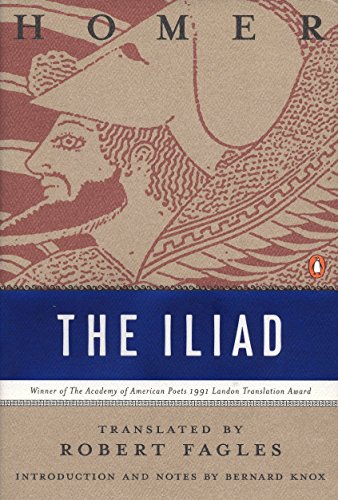
Homer, The Iliad (translated by Robert Fagles, ©1990, Penguin 1998)
Book 23 line 768 to Book 24 line 944 (the end)

It’s taken me nearly 10 months to read The Iliad, two pages most mornings, and it’s been a huge pleasure.

In the final pages, Hector’s body is reclaimed and given a proper funeral. The way it is reclaimed is incredibly moving. The Trojan king, Priam, goes into the Greek camp at night, alone except for one companion and the god Hermes to protect him. He pleads with Achilles to release his son’s body, begging him to think how his own father would feel in a similar situation. Achilles, the embodiment of unstoppable destructive force, begins to weep and soon the two of them are sobbing together, weeping for the parents who have lost sons including Achilles’ own father in the near future, and for the loss of beloved comrades. Then Achilles retells the story of Niobe weeping for her murdered children: in his version instead of turning immediately to stone and becoming a waterfall, she takes time off from weeping to eat a hearty meal, and that is what he and Priam now do. He tucks Priam in for the night, safe from being accidentally spotted by other Greeks.

That passage itself is enough to explain why the Iliad has such status. After all the violence of the previous thousands of lines, these two implacable enemies share a moment of common humanity. I could feel my mind – and heart – expanding as I read it.

Pretty soon after that, Hector’s funeral rites take place and the story is over. The story is over, but not the war. It’s very clear that in another day, the Greeks will resume hostilities. Troy will fall. The women will be captured. Babies will be thrown over the battlements. Achilles will be killed. It’s a standard thing that epic poems begin in medias res – in the middle of things. This one ends there too.

I’m having a breather before starting my next slow-read project. I’m thinking maybe Middlemarch.

The Iliad: Progress report 9

Homer, The Iliad (translated by Robert Fagles, ©1990, Penguin 1998)
Book 21 line 486 to Book 23 line 768

As I make my way through The Iliad, roughly 70 lines first thing each morning, I regularly encounter references to it in the rest of my day.

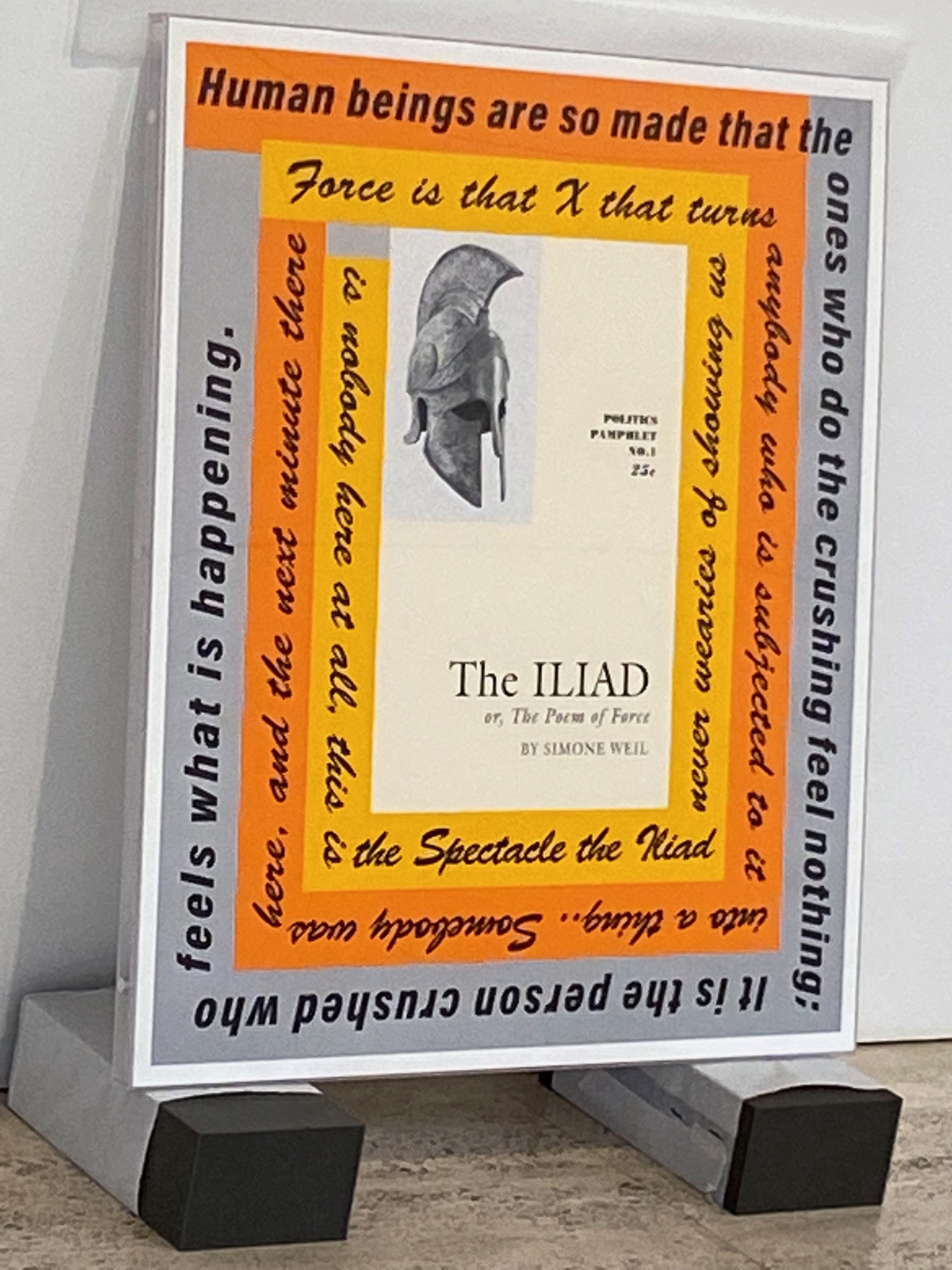
In my last progress report I quoted from Simone Weil’s 1939 essay, The Iliad, or The Poem of Force. Serendipity struck a couple of days later when, visiting the Queensland Art Gallery to see the wonderful Chiharu Shiota exhibition, I spotted a screen print waiting to be hung in a coming exhibition:

To save you the trouble of opening the image separately, the spiralling text is a quote from that same essay:

Human beings are so made that the ones who do the crushing feel nothing; it is the person crushed who feels what is happening. Force is that X that turns anybody who is subjected to it into a thing … Somebody was here, and the next minute there is nobody here at all, this is the Spectacle the Iliad never wearies of showing us.

The image is ‘Poem of Force’, one of a series of silkscreens in the Simone Weil Project by artists Janet Burchill and Janet McCamley. You can see a clean image of it here.

There has been some ludicrous comedy among the gods this month. Hera boxes Athena’s ears, and the latter runs to curl up weeping in the lap of Zeus. I tell you, after seeing the arbitrary, petty, infantile behaviour of the gods in this book, I’ve completely changed my attitude towards them.

But the main action has been the death of Hector, speared in the throat by Achilles. Hector dies a true hero’s death. He realises that his own heroics earlier have led to the deaths of many Trojans, and decides that the honourable thing to do is engage Achilles in personal combat, knowing the likely outcome. As Achilles approaches, Hector’s nerve fails and he runs, and the two run around the walls of Troy ‘endlessly as in a dream’. Then he stands to face Achilles once again. He offers a bargain: ‘If I kill you, I’ll ensure that your body is treated with full respect, and I ask you to do the same for me.’ Achilles, the embodiment of Simone Weil’s Force, refuses, and promises to leave Hector’s corpse to be eaten by dogs. At one stage he says, ‘I’d eat you raw.’ The gods step in for one last bit of disgusting cheatery, and Hector is slain.

Huge grief is unleashed among the Trojans. While I find it hard to read some of the Iliad‘s action scenes without a Marvel Universe version playing in my head, the scene where Andromache is interrupted at her embroidery and gives way to full-bodied lamentation completely transcends any such association. In particular, she wails for the fate of her son, who we met as a baby in Book 6:

The day that orphans a youngster cuts him off from friends. 
And he hangs his head low, humiliated in every way ... 
his cheeks stained with tears, and pressed by hunger 
the boy goes up to his father's old companions, 
tugging at one man's cloak, another's tunic, 
and some will pity him, true, 
and one will give him a little cup to drink,
enough to wet his lips, not quench his thirst.
But then some bully with both his parents living
beats him from the banquet, fists and abuses flying:
'You, get out – you've got no father feasting with us here!'
And the boy, sobbing, trails home to his widowed mother ...

Book 22 ends with her lament, and Book 23 turns to the grandiose ceremonies for Patroclus down by the Greek ships. It’s good to be reminded how deeply loved Patroclus was, and not just by Achilles, but the chariot race (mercifully conducted without godly interference) and then the bickering over prizes is a bit of an anticlimax. Where I left off this morning, two men were preparing to box, their eyes on a donkey-prize. It’s hard to credit that this book is the work of one writer.

The Iliad: Progress report 8

Homer, The Iliad (translated by Robert Fagles, ©1990, Penguin 1998)
Book 19 line 162 to Book 21 line 485

For eight months now I’ve started most days reading two pages – roughly 70 lines – of The Iliad. I’m away from home at the end of July, and didn’t bring it with me, but there’s still quite a bit to report.

At the end of last month, Achilles was about to re-enter the battle. This month’s reading began with Hephaestus, god of fire, creating magnificent new armour for him, including a shield whose decorations include images of all aspects of life. Achilles dons the armour and, basically, starts killing people. Zeus lets all the gods of the leash – they’re now free to join in on whichever side they like, and they do. Fleeing Trojans fall into the river, and the river god, enraged at being filled with corpses, rises up and attacks Achilles. But Hephaestus comes to his aid – so it starts to look like Australia in the current phase of climate change: raging floodwaters and relentless fire at war with each other.

There’s a lot more. My key take-away this month is a realisation that the word ‘hero’ has changed meaning quite a bit since Homer’s day. I doubt if anyone took Achilles to be a role model. First he takes offence and brings terrible destruction on his own people by sulking in his tent when they desperately need his help, behaviour that gets him called a beeyatch online these days (Sorry, I couldn’t find the place again to give you a link). Then, once he’s back in the battle he is absolutely, brutally ruthless. He not only sets out to slaughter everything in his path, including the river, but he makes callous, mean-spirited speeches to those he is about to kill. A hero in the sense of role model or exemplar of moral virtue he is not. Achilles as a hero doesn’t inspire admiration so much as terror. ‘Thank the gods this is set in the ancient past,’ I imagine Homer’s first readers muttering, ‘because it would be a nightmare to have someone like that alive today.’

When I went looking for the beeyatch quote, I stumbled on this, from Simone Weil:

The true hero, the true subject, the centre of the lliad is force. Force employed by man, force that enslaves man, force before which man’s flesh shrinks away. In this work, at all times, the human spirit is shown as modified by its relations with force, as swept away, blinded, by the very force it imagined it could handle, as deformed by the weight of the force it submits to.

(from ‘The Iliad, or The Poem of Force’, 1939)

Maybe that’s the point. Achilles isn’t so much a hero, as a person at the mercy his passions, transformed by them into something monstrously destructive.