Tag Archives: Tom Keneally

Don Watson’s High Noon

Don Watson,  High Noon: Trump, Harris and America on the brink (Quarterly Essay 95, September 2024)
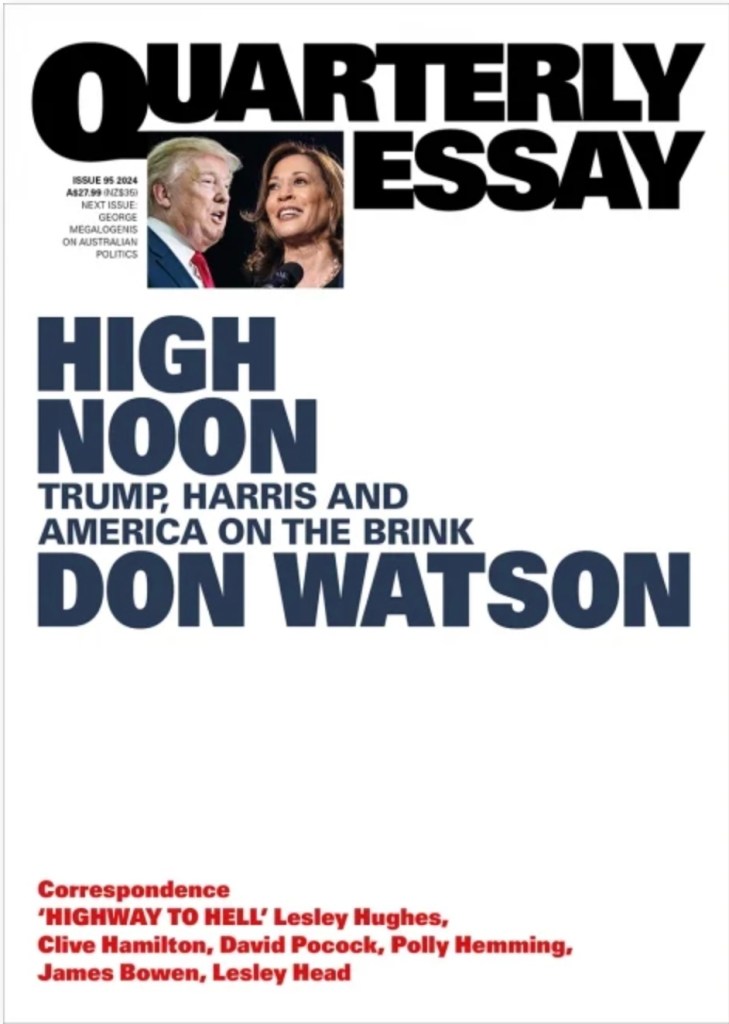
Eight years ago Don Watson reported on the presidential election face-off between Donald Trump and Hilary Clinton. According to my blog post, his Quarterly Essay 63, The Enemy Within: American politics in the time of Trump dwelled on Bernie Sanders as belonging to ‘a much assailed and greatly debilitated, but unbroken American tradition of democratic socialism’, and expanded his point by focusing on the history of the state of Wisconsin.

In this Quarterly Essay, as Trump is once again up against a female opponent, Watson doesn’t have a third option to discuss but he again goes local, and gives fascinating brief histories of two US cities, Detroit and Kalamazoo. These snapshots, plus his reports on conversations with Trump supporters, make the essay worth reading even though its journalistic moment is past. Maybe it’s even more readable now, because its resistance to the temptation to predict outcomes might have frustrated his readers three months ago.

The fifteen pages on Detroit are excellent: Watson traces the city’s history from the first half of the twentieth century when:

White folk from the economically depressed regions of the United States, especially Appalachia and the South; Black folk from the South and east-coast cities where wages were low and jobs hard for Blacks to get; Poles, Greeks, Irish, Italians, Germans, and people from the Middle East and the countries of Central America were all drawn to Detroit by the unstoppable car industry and the promise of five dollars a day.

In 1960 it had a population of 1.8 million. Since then ‘the city that gave the world the Ford Mustang and Stevie Wonder’ has fallen on hard times as the motor industry collapsed. Corruption, racism, predatory lending, the destruction of unions had their effects:

Detroit became a shrinking city of the poor, the poorly educated, the unemployed and the unskilled. A city of crime: corrupt in its high places, its streets plagued with violence, theft, arson, prostitution, drug dealing and addiction.

Detroit, Watson writes, ‘was the definitive American city … For a city like Detroit to fail was more than a disaster, it was a humiliation.’ Yet, his strategy of focusing on this one city, and then the contrasting city of Kalamazoo, brings home the immense diversity of the United States. It’s not a country where one story covers all.

There are insightful discussions of Trump and Harris, but you know, though I’m as mesmerised by the Trump phenomenon as anyone could be, I can’t bear to say much about that here.

The essay ends with the date: 23 August 2024. It was written after Joe Biden withdrew from the presidential race, after the Democratic Convention, but before the ‘They’re eating the dawgs’ debate.

Even the Correspondence in the following Quarterly Essay was written before the election results were known.


In the correspondence, Tom Keneally, lively as ever, contrasts Australian and US politics but doesn’t engage with Watson’s essay in any detail. David Smith, who did his PhD in Detroit, makes fascinating additions to Watson’s account of that city, including more examples of how unhinged US public life can be. Bruce Wolpe, senior fellow at the US Studies Centre, does a nice job of validating and amplifying Watson’s points. And Paul Kane, among other things former director of the Mildura Literary Festival, praises Watson for his ‘adroit outsider’s perspective’, and, in a lovely three and a half pages, manages to include references to or quotes from Raph Waldo Emerson, Alexis de Tocqueville, Robert Penn Warren (All the King;’s Men, 1946), Father Charles Coughlin (a whiff from my Catholic childhood), Woody Guthrie, Plato, John Stuart Mill, Wordsworth, and Barry Hill. He concludes with Benjamin Franklin’s reply when asked if the Constitution had established a monarchy or a republic: ‘A republic, if you can keep it.’

Both Don Watson’s essay and the responses to it are full of the pleasures of language. The subject is grim, and even grimmer when read after the event, but the telling of it is a joy to behold


I wrote this blog post on land of Gadigal and Wangal of the Eora Nation, where we have had very heavy rain and are now sweltering in great humidity and heat. Cicadas are deafening. I acknowledge the Elders past and present who have cared for this land for millennia.
Tom Keneally’s Crimes of the Father

Tom Keneally, Crimes of the Father (Vintage 2016)

crimes.jpgPerhaps a novel is just what’s needed after the news cycle has rolled on, to keep our minds and hearts alive to painful issues such as child sexual abuse in religious institutions. That, it seems to me, is the need The Crimes of the Father aims to fill.

It’s a stranger-comes-to-town story. Father Frank Docherty was stripped of his priestly role by the Sydney Cardinal in the early 1970s because his politics were contrary to the prelate’s conservatism. As a member of a religious Order, he found a new life in Canada as a priest and academic psychologist, and came to specialise in cases of clerical child abuse. In 1996 he returns to Sydney to address a conference, and finds himself embroiled as adviser and advocate with not one but two people who were abused as children by a Monsignor of the diocese who also happens to be the brother of a woman he has loved, chastely, for more than 20 years.

There are lectures, legal arguments, and excursions into the history of the Catholic Church in the aftermath of Vatican Two. Tom Keneally has clearly done conscientious research, and in that sense is trustworthy. But at about the midpoint I was muttering, ‘Show, don’t tell,’ and three quarters of the way through, ‘Write what you know!’ I just didn’t believe in Frank Docherty’s inner life, or that of the accused abuser or the abuse survivors. The dialogue rarely sounds like conversation. The narrative feels like a survey of the literature, a tableau where you might reasonably expect a drama.

Though Keneally’s skill as a story teller is powerful enough that I kept reading, it’s the brief preface, in which he writes about his own relationship to the Catholic Church, that delivers the strongest emotional punch. The rest is too schematic, the characters too much at arm’s length, the action too often described rather than enacted. And as our hero flies off into the sunrise, the necessary final twist is a convenient deus ex machina.

Perhaps because I had just read Kim Mahood’s brilliant Position Doubtful, this unengaged quality struck me with particular force in the section where Sarah, a survivor of sexual abuse who has temporarily become Sister Constance, spends time on a remote Aboriginal community. She visits the outstation of a man called Douglas (‘that was his European name, anyhow’), with some of his relatives. Here are the first paragraphs of her visit:

Douglas was reserved but welcoming. His habitation, an elegantly constructed lean-to, lay at the foot of a ridge in which the entire range of umber and yellow rocks were exhibited. His wife was profoundly black and limpid-eyed, and there was just her and him there – the kids were learning white-fella stuff in Cairns, he told them. He had a kerosene refrigerator and a telephone that hung on a pole and ran off solar panels. He was a man of past, present and future.
—-The relatives sat about on a rug in front of the lean-to and spoke in their language – part guttural, with some sounds like bird calls – her ignorance about which  Constance had never felt more acutely than at this moment. The host, his wife and his relatives drank tea from enamel mugs. A stranger at the feast, she did too.

And that’s as vividly as we ever get to see Douglas and his unnamed wife and relatives. Of course, they’re incidental characters (and I should mention that ‘their language’ has been previously identified as Guugu Timithirr), but the writing is not completely untypical. It might work as a film script, because the actors would flesh it out, but there’s not much flesh in the written form.

Compare this from the Author’s Note:

At an immature age I chose to study for the priesthood. and I would like to put on record my thanks for the more generous and open-handed aspects of that training. It was not, however, an education designed to encourage a callow young man to achieve full maturity as a sentient and generous male adult. I was too innocent to understand that the education to make me a celibate strayed easily into stereotyping half of my species – women – as a perilous massed threat to priestly purity; or that the attendant emotional dwarfing could create, encourage or license the young men whose abusive tendencies are mourned in this novel.

I so wanted to read the novel that this seems to promise. But I was disappointed: those young men make no appearance except as manipulators lifted straight from Keneally’s evidently punctilious research. No light is shed on their motivations as individual, breathing human beings. And the same is only slightly less true of the survivors.

Esme the critic

My mother, Esme, left school at 14 or 15 in the mid 1920s. She married my father when she was 19 and lived on a sugar-cane farm outside Innisfail in North Queensland for the next five decades. As her five children went off to boarding school and then spread out over Queensland and beyond, she wrote letters to each of us, weekly to start with and then less frequently but still with a shaming regularity. Mostly she kept us informed on one another’s doings and home-front developments. Occasionally she would comment on literary matters.

Here are some of her passing comments on the literary scene, which I find interesting in all sorts of ways:

17 December 1971: I’ve just finished reading Thomas Keneally’s The Fear & enjoyed it more than any book I’ve read for ages. So nice & clean & sort of old-fashioned.

7 March 1972: I’ve just read [Aleksandr Solzhenitsyn’s] Cancer Ward. It’s really absorbing but very frightening really. I’m sorry I’ve finished it really. … You’ll be pleased to hear A was reading [Germaine Greer’s] The Female Eunuch. I have to own that I burnt my copy. M & N said, ‘At least you could have passed it on to us.’ Perhaps I should have saved their money as curiosity will get the better of them I’m sure.

25 July 1972: I am reading a book of yours that MA found in her box. I’m not liking it as much as The Fear. It is [Thomas Keneally’s] Bring Larks & Heroes.

28 November 1972: Thank you so much for remembering my Birthday. I’m sure I’ll enjoy the books. I’ve started [the first book I worked on in my editing job with Currency Press, David Williamson’s] The Removalists. It’s nice & easy to read. [Later in the same letter:] Having read The Removalists I’m glad it was a gift from you Jon because from you it is meant as a shocker. [It wasn’t.] From anyone else I would have a sneaky feeling that he/she might imagine I liked that sort of talk. If he’d made it a story of police brutality without the four letter words I feel sure it would have been just as big a success or even bigger.  Anyhow now I’ve started the [Gerald] Durrell one [probably Catch Me a Colobus] & it is really my pick. I’ll be able to lend it around.

25 December 1972: It was only today I learned that it was you who gave [my nieces and nephews Maurice Sendak’s] Where the wild things are. I had made a note of it to buy for [another grandchild]. It is the most read & the most cherished book in their house & yet it looks ghastly really.

24 February 1973: Of course I have not burnt The Removalists, Jon. As a matter of fact I have a waiting list of about a dozen women, as ignorant as myself, wanting to learn all about life!! seeing that M & N & E & V think that I have no ears to hear with. ‘Surely you’ve heard such talk,’ even in the street. Well I haven’t. Actually I think [youngest daughter] Liza knows more than I do but I certainly don’t feel underprivileged because of my ignorance.

28 March 1973: We have watched some of Certain Women on your recommendation Jon. I missed the name of the writer last night (not being in the habit of reading all those names, though I do notice that the writer, who should be the most important, is never so). It was the ‘model’ girl & I think it could have been Keneally as he is sort of old fashioned. I thought the Williamson one was the most – real is the word I suppose. He certainly understands today’s youth, don’t you think?

8 April 1973: Our Repertory Group put on [Richard Beynon’s ] The Shifting Heart last week. Roslyn Watt played the Italian mother & she was perfect. Seniors must have to study it this year because the night Dad & I went there was a bus load from Tully & the night E & V went there were 2 bus loads from Cairns.

9 July 1973: Last week there was a play on TV, The Cherry Orchard Chekhov [an MTC production with Frank Thring, Googie Withers, Irene Inescort] & knowing how interested [oldest son] Michael is in plays (He was in a Chekhov once) & feeling it would give me some culture, we watched it right up to the end of the first act then turned the TV off. It was played to packed houses in Melbourne for ages so the ad said. I wonder if you watched it & don’t say you enjoyed it. To me it could have been Innisfail repertory doing it for the first time. Dad stayed home from Poker to see it too which made it worse.

1 August 1973: I see [Peter Bogdanovich’s] What’s Up Doc advertised at the pictures somewhere in Sydney. Do go & see it if you can. [I did.] It’s really a scream, Makes you laugh till it really hurts – just absolutely stupid but I’m sure you couldn’t help enjoying it.

23rd October 1973 (after a visit to Sydney): I managed to get a Sat Aust(ralian) with Katharine Brisbane [my boss at the time] write up of the play [probably Rex Cramphorn’s cutting-edge production The Marsh King’s Daughter, which she mentions in a later letter] & I agree with her and the more I think back on it the more I like it really. Then today I found Jock Veitch’s write up which is downright lousy – even saying he couldn’t hear. I feel like writing & telling him to go again & wear his glasses & take along his hearing aid.

4 February 1974: Poor Mr Solzhenitsyn is having a rough time. Have you read Cancer Ward, Jon? [I had.] It is the best I’ve read. It seems queer but I think Patrick White writes much like him, so simply. I’ve read only one of his, The Tree of Man, & really enjoyed it.

March 1974: Innisfail had Godspell during the week,  packed the Shire Hall. We didn’t go, we left it to the young. The [Marist] Bros all went & raved on about it – more an experience than a show etc. They took 45 boys along so deserved a free ticket.

31 July 1974 (reporting on a time in Brisbane): We went to see [my cousin G’s] production Fetch Me a Figleaf. There were 10 of us … G sat with us so we had to say all the right things. It was rather naughty but really entertaining all about gods & goddesses on Mt Olympus.

13 October 1974: Well! we were trapped into a bit of culture last night. If we’d been at home we’d have turned it off but we were babysitting so left it on & were really sorry it had to end. It was The Misanthrope, Moliere’s play. The man who did the translation [not named on IMDB] must be a marvel & all the players were lovely. It says ABC production but I can’t believe it was. It was too good.

7 March 1975: Have you seen a book Watership Down? It’s about rabbits, all about rabbits. I’ve just read it & loved it. [I still haven’t read it.]

22 June 1975: We’re all reading The Towering Inferno, actually it’s called The Tower. Dad’s on it at the moment and doesn’t even answer when spoken to. It’s really suspenseful.

Late September 1975, from Launceston: We went to see [Roman Polanski’s] Chinatown & thought it pretty ordinary. Being overheated didn’t help. I’d put on woollen sox & extra cardigan & shed everything except the sox as the theatre was heated.

And that – when she was 61 and I was 28 – is where I stopped carefully hoarding her letters.