Tag Archives: verse

What Waleed said

On the latest edition of the Minefield, Waleed Aly, formidable intellect that he is (no irony intended), made a brief statement about poetry (which you can find at 8’07’’ of the audio at this link).

I was going to write a rebuttal, but instead, here’s a little poem:

Poetry is something we don't do
After Waleed Aly
Poetry is something we don't do.
It's just not part of our repertoire.
People could get through their entire
lives without encountering
it in a meaningful way.
It's not valued.

If we put it in a newspaper –
that used to happen but
would be very strange now —
people would skip and just imagine
what sort of business it would do
in an online newspaper. It has been
part of every civilisation
throughout history and yet
it's an art form we are doing
away with.

It's inherently alienating to
a modern audience. In order
to get someone to engage
with poetry you have to get them
to read or listen to a poem
and that feels like a bridge
too far.

It's an effort, it's not what we do.
I could make you listen to a song,
I could get you to watch a documentary,
I could get you to read a novel, at a pinch
I might get you to read non fiction
and analysis, but a poem?

It's for people on the fringes,
overly artistic in spirit though
perhaps not in talent.
[Snigger from Scott]

Close your eyes and imagine a poet:
what you see has got nothing to do
with the rest of us.
Even painting or sculpture have more
presence, even if it's in caricature.
So what is the point of poetry?

It's an art form we are doing
People skip and just imagine

It feels like an effort
It's for people on the fringes
It feels like a bridge
November verse 14: When Paul starts strumming

Peter Jackson’s The Beatles: Get Back features many extraordinary moments, but for my money no others are equal to the couple of minutes when the song ‘Get Back’ appears as if from nowhere as Paul strums on his guitar.

November verse 14: When Paul starts strumming
Who could know when Paul starts strumming
that a song will soon emerge?
Ringo knows, he holds his drumming,
servant to the demiurge.
Did Michelangelo see David
wait in stone to be created,
pupae locked in their cocoons
whisper softly 'Soon, soon'?
When I start a 14-liner,
does some dark part of my brain
see that, while it seems in vain
I seek coherence like a miner
seeking gold in solid stone,
the last line is already known? 

And that’s my last November verse for the year. Normal transmission will resume shortly.

November verse 12: Dinner with friends

I’ve discovered that a poem that uses the rhyme words from another poem is called a terminal. Today’s poem is a terminal taking its rhyme words, for no good reason, from Christopher Brennan’s ‘Fire in the Heavens‘, adjusting them to suit the requirements of an Onegin stanza.

November verse 12: Dinner with friends
The late-spring night outside was chilling,
rain besieged your house's stone.
Inside was warm, food rich and filling.
We weren't there for food alone.
We talked of Beatles, bugs in bedding,
how to stop the virus spreading,
Christmas past – such amplitude
of subject, such a buoyant mood,
I felt my spirits skipping, bounding –
joy of grandchild's littleness,
the climate doom we face, unless –.
Through all, the bell of friendship sounding:
eight of us, no massive throng,
I give thanks in this little song.

November verse 11: On hearing a magpie

One lovely thing about poetry is the way lines will pop into your head years after you’ve read them. When I worked at The School Magazine we’d receive a letter or phone call every month or so from someone trying to locate the source of a line of poetry, or even sometimes the author of a whole poem remembered verbatim. It was gratifying to be able to help most of the time.

The first line from James Macauley’s short poem ‘Magpie‘ often pops into my head when I hear a magpie singing. The smell of earth after rain makes me think of Les Murray’s Monthly article ‘Infinite Anthology‘ (not his poem by the same name – I looked them both up); and of a line from George Herbert’s poem ‘The Flower‘ likewise makes itself known when the sky clears after rain. Today’s stanza steals from all three, plus a bonus word from Macbeth.

November verse 11: On hearing a magpie after rain
The magpie's mood is never surly,
never glum is petrichor.
My first line comes from James McAuley –
took time out from culture wars
to sing the praise of liquid squabbles.
Line two: Les A Murray's bauble
lent to us from his great hoard
when he was in non-surly mood. 
For when the hurlyburly's over,
when the mud has all been slung
and all the war songs have been sung,
the bees still bumble in the clover,
once more we smell the dew and rain
and relish verses once again.

November verse 10: The chances

US radio journalist Robert Krulwich recently asked nonagenarian biologist E O Wilson, ‘Will we solve the crises of the next 100 years?’

Wilson said, ‘Yes, if we are honest and smart.’

November verse 10: The chances
'We have a good chance of survival
if we're honest, if we're smart.'
But look who's at our leaders' table:
quick of tongue and hard of heart,
they'll risk the world to win election,
lie, deny, lack all conviction,
build their bubbles, shift the blame,
play the man and work the game.
The psalm says not to trust in princes.
Who is smart and tells the truth?
By any measure, it's the youth
who strike, speak out, and pull no punches.
Young, you say, naïve and green!
Well, Jeanne d'Arc burned at just nineteen.
 

November verse 9: Our morning walk

I reminded myself that when I dreamed up this notion of writing fourteen 14-line poems in November, my intention was to have at least some of the poems wrangle events from my daily life into the stanza form that I seem to have fallen enduringly in love with. So here’s one about this morning’s walk. In case explanation is needed: the BOM is the Bureau of Meteorology.

November verse 9: Our morning walk 
A cool spring day, and rain's predicted.
Undeterred, our morning walk,
by Covid rules now unrestricted, 
took place just on eight o'clock.
We left our raincoats and umbrellas
in the car. The croquet fellers
played in t-shirts on their green
and clouds were few and far between.
Happy flitting wagtails, peewees,
happy dogs who strain on leads 
to sniff whatever's in the weeds,
happy walkers, far from freeways. 
Day, so cool, so calm, so bright,
the BOM can't always get it right.

November verse 8: Primary school

My eighth November verse this year is a response to the Auburn Poets Challenge #35, which invites all comers to submit a poem using five prescribed words – wing, copper, acorn, string, infinite.

November verse 8: Primary school, North Queensland, 1950s
'The tallest oak was once an acorn.'
'What's an acorn? What's an oak?'
Outside the class, rainforest staghorns,
frangipani, figs that choke
their weaker neighbours, mangrove breathers
went unnoticed by our teachers.
All things European stood
for all things real, and all things good.
Like coppers' verbals, MPs' lying,
what religions give to youth
as infinite eternal truth,
these lessons sent the real world flying
kite-like, on such distant wings 
that we could barely hold its string.

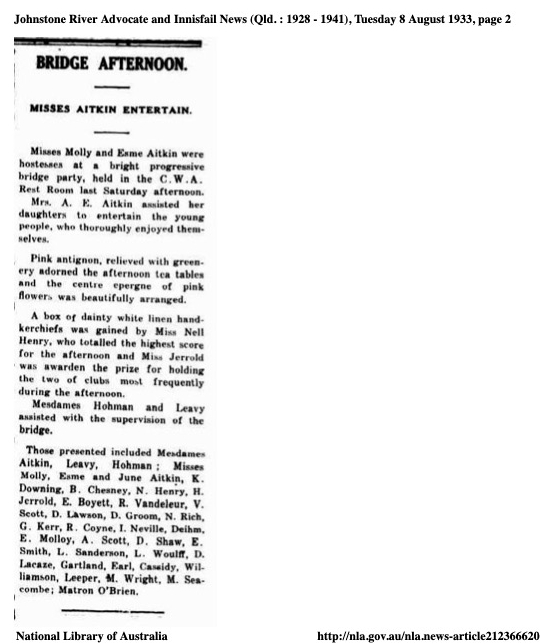
November verse 7: Misses Aitkin Entertain

I searched on my father’s surname (Shaw) and my mother’s pre-marriage surname (Aitkin) on Trove. Only two items showed up: an account of their wedding, which was pretty much a description of the wedding dress and veil with the wedding as vague context, and the short piece below, which inspired today’s stanza. Esme, then 18 years old, was to marry my father two years later.

The third last line refers to a common observation of the time that Innisfail was the most cosmopolitan town in Australia, as in this item in The News (Adelaide) in January 1934.

November verse 7: Misses Aitkin Entertain
Johnstone River Advocate and Innisfail News, 8 August 1933

On page two, thirty Misses gather,
plus one Matron, three Mesdames.
The Misses Aitkin, helped by mother,
play joint hostess to the games.
BRIDGE AFTERNOON, there in the rest room,
safe from work and men: asylum.
Highest score wins, not a purse,
but linen hankies, white of course. 
Antigonon adorns the tables,
pinker than each player's cheeks.
On other pages, murder, strikes,
and conversation rich as Babel.
This room's genteel, all-English, safe,
a place we know well, sunlit cave. 

November verse 6.5: Found words

I don’t know if this is a thing, but I thought it would be interesting to see what I got if I made a poem from the words seen on a morning walk. I took photos, not of every word – I deliberately left out proper names and words on number plates. I didn’t include here every word I snapped in the resulting poem – that is to say, this is a curated list. But the words here are strictly in order of my meeting them.

The walk to King Street, Newtown
School Zone
_______ROKES
Caution: Vehicles reversing
_______Sneak
Single day bed mattress in good condition
_______PRISMO SKU ACAB FTP
_____e
_____a
_____r
_____s
WARNING: Automatic Moving Device. 
___Do not extend
___limbs or objects
___through or between
___spaces in this
___door or gate
To report faulty sign operation please phone
_______TEEGEE
Destroy the patriarchy not the planet
Eating animals is bad karma
_______ASPIRE
Energy
_______One man's trash
Comingled recycling
We'll avenge all our imprisoned siblings
Save our coral reef
_______Homeys
Main switchboard & electrical meters located within
All power to the people
Live free
_______Crisp
Have hope
Fin

About line 6: I know that ACAB stands for ‘All Cops are Bastards’ and FTP stands for ‘Fight the Power’. If you know what PRISMO and SKU stand for, feel free to enlighten me in the comments.

About line 24: That’s the actual spelling on the skip, not a transcription error on my part.

November verse 6: After the COP

I don’t think this one needs any explanation, but just in case you really haven’t been paying attention, or are reading this far into my future, here’s a link.

November verse 5: After the COP
Now the COP is done and dusted,
should we kiss our bums goodbye?
The weak goals are already rusted,
weasel words from men of high
position: coal is for down-phasing,
future tech will be amazing.
Leaders now aren't tragic Lears,
but – deadly farce – white marketeers
who think no further than tomorrow.
Worst, there is none. Three degrees
seems certain if we trust in these.
But could some Second Coming sorrow
rouse us from our stony sleep
or are they right who call us sheep?