Just in case there’s anyone who reads my blog who doesn’t read Neil Gaiman’s here’s a wonderful Christmas song for you
Sadly I don’t imagine it will ever make it as a carol.

Just in case there’s anyone who reads my blog who doesn’t read Neil Gaiman’s here’s a wonderful Christmas song for you
Sadly I don’t imagine it will ever make it as a carol.
… by a commenter, let me direct your attention to Your Big Break, in which a New Zealand tourist organisation is running a competition for the best three minute film pronoting New Zealand. On the basis of online submissions, a number of finalists will be flown to New Zealand in January to make their films with a budget of up to $100 000. A winner will be selected by New Zealand’s most famous director of blockbuster movies, and the film will be aired in the US. If this looks like the Big Break you’ve been waiting for, have a go.
You can look at the entries here. In particular, you can look at Alex Ryan’s entry here. There’s a little teaser and a draft script (if you don’t have a lot of time, the teaser is very short, and you can scroll to the end of the script to see how it pans out). Feel free to vote for him. Your vote counts.
Robin Gerster, Travels in atomic sunshine: Australia and the occupation of Japan (Scribe 2008)
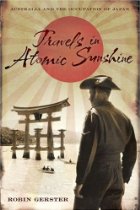
Thousands of Australian soldiers and their families were part of the Occupation of Japan from February 1946 until early 1952. They formed the bulk of the British Commonwealth Occupation Force, generally overlooked in the shadow of the much larger and better equipped US occupation forces. While the US occupiers, with headquarters and amenities in Tokyo, set about imposing democracy by decree and using military might to change a militaristic culture to a peaceful one, insisting on freedom of the press except for stories that might make trouble for the occupiers, the Australians – whose generals led the BCOF – were stationed near the devastation of Hiroshima and seem to have managed without any sense of themselves as Liberators. They are scarcely mentioned by any of our otherwise zealous military historians, and barely appear in the Canberra War Memorial. Sneered at by the British, discounted by the US, at home they are ‘the forgotten Force’.
At the time, thanks to reports of atrocities in the Burma–Siam Railway and Changi Prison as well as the bizarre White Australia Policy, anti-Japanese sentiment was fierce in Australia, and the occupationnaires were in a bind. If they enacted the home sentiment, as many did, they were likely to be brutal, even criminal, in their dealings with the already shattered population, and there are plenty of stories of rape, sexual exploitation, black marketeering (‘wogging’) and careless disregard for human life. If they were open to Japanese culture and the humanity of the people, as again many were, they were likely to be shunned as ‘Jap-lovers’: there were plenty of headlines at home to that effect, and when people returned it was to even less acknowledgement than the troops who served in Vietnam. Governments still deny that their high incidence of cancer might be connected to the time they spent at nuclear ‘Ground Zero’.
If someone wanted to make a serious war movie, they could do a lot worse than mining this book. The movie would run very little chance of feeding adrenaline addiction the way so many well-intentioned anti-war movies do. It would have trouble being read as a tale of Good vs Evil. It would leave a number of received True Stories looking decidedly tatty. After so many movies about the horrors of the Japanese prisoner of war camps, how refreshing to show those liberated Aussies as occupiers of post-War Japan – some acting out their racism-boosted vengefulness on the civilian survivors of Hiroshima, others coming to appreciate the culture and even falling in love. The book seethes with potential story lines. Here’s the tale of the young Australian signalman, John Henderson:
In early 1948, immigration minister Arthur Calwell had reasserted the government’s position that no Japanese woman would be permitted to enter Australia, irrespective of whether she was he wife or fiancée of an Australian serviceman … Henderson had married a young university graduate, Mary Kasahi Abe, by Shinto rites. With his wife pregnant, and worried about the legality of the Shinto ceremony, he sought to be married by the battalion chaplain, the well-known BCOF identity Padre Laing. Laing’s duty was to inform military command, and Henderson was peremptorily repatriated. The officer given the task of putting the order into effect related, 40 years later, that someone at BCOF HQ had decided to make an example of him. This was easily achieved, as he was a low-ranking, demoralised youngster of no consequence. A ‘thin, frail-looking lad’, Henderson was reduced to tears upon hearing the news. Accompanied by the padre and two MPs, he was put on the Kanimbla and locked in the brig to be returned to Australia, the father of a baby daughter whom he never got to see.
… During the debacle, and while his family was receiving abusive anonymous mail for supporting their son, the papers were full of photographs of radiantly smiling British migrant families arriving in Sydney … [Immigration minister] Arthur Calwell played to the crowd, stating that, while there were living relatives of the men who suffered at the hands of the Japanese, ‘it would be the grossest act of public indecency to permit a Japanese of either sex to pollute Australia or Australian-controlled shores’. What an irony: John Henderson had himself suffered, directly and not vicariously, from Japanese wartime brutality. He had laboured on the Burma–Thailand Railway, no less, and later in the coal mines in Japan. There, he had been befriended by a guard who handed him food, including small gifts from his sister, treats such as sweets, and rice cakes. The very reason Henderson decided to volunteer to BCOF after the war was that he wanted to meet his benefactress. He did, they became strongly attached, and they married – and now his own government had decided that her presence would ‘pollute’ Australia.
… Despite his promises, Henderson never returned to his Japanese family. He had asked a couple of his army mates remaining in Japan to keep a friendly eye on his wife in his absence; in the meantime, his parcels and letters stopped after some months. Years later, in late 1953 or early 1954, one of them returned to Kure after completing his service in Korea, and met the woman, by chance, downtown near the railway. She was with her pimp, having been reduced to prostitution, with a mixed-race child, in order to survive.
Travels in Atomic Sunshine won the 2009 NSW Premier’s History Award. It should also have a chance in the Literary Awards.
Posted in Books
Tagged history, Japan, NSW Premier's History Awards, racism, Robin Gerster, World War 2
My elder son has put snippets of his film work up on Vimeo. Have a look.
The nursing home, which is run by a church organisation, has a number of celebratory events at this time of year. Last Tuesday was carols evening, attended by residents from all the organisation’s nursing homes in the region. The home’s vast garage is hung with tinsel; there’s a gigantic throne for when Santa makes an appearance, and a number of life-sized Santa statues. A troupe of school children sing carols (some of the same ones that have been piped in from a CD player as the masses assemble. A chaplain (or ‘Director of Pastoral Services’) gives a brief talk about ‘the true meaning of Christmas’, which apparently is that her allocated time is far too short. There’s ice cream and cupcakes and softdrink. Mollie joined in the applause and waved her cup of lemonade in time to the singing, and that makes the event a success. Personally I’d rather have teeth pulled, or even listen to Bob Dylan’s latest album.
On the weekend it was the residents’ Christmas party: more softdrinks and carols, though this time sung by a crooner with a finely developed sense of his audience, and mingled with other less single-minded tunes. There were lots of visiting relatives, including young ones, and a genuinely convivial mood. The dining room was cheerfully alive.
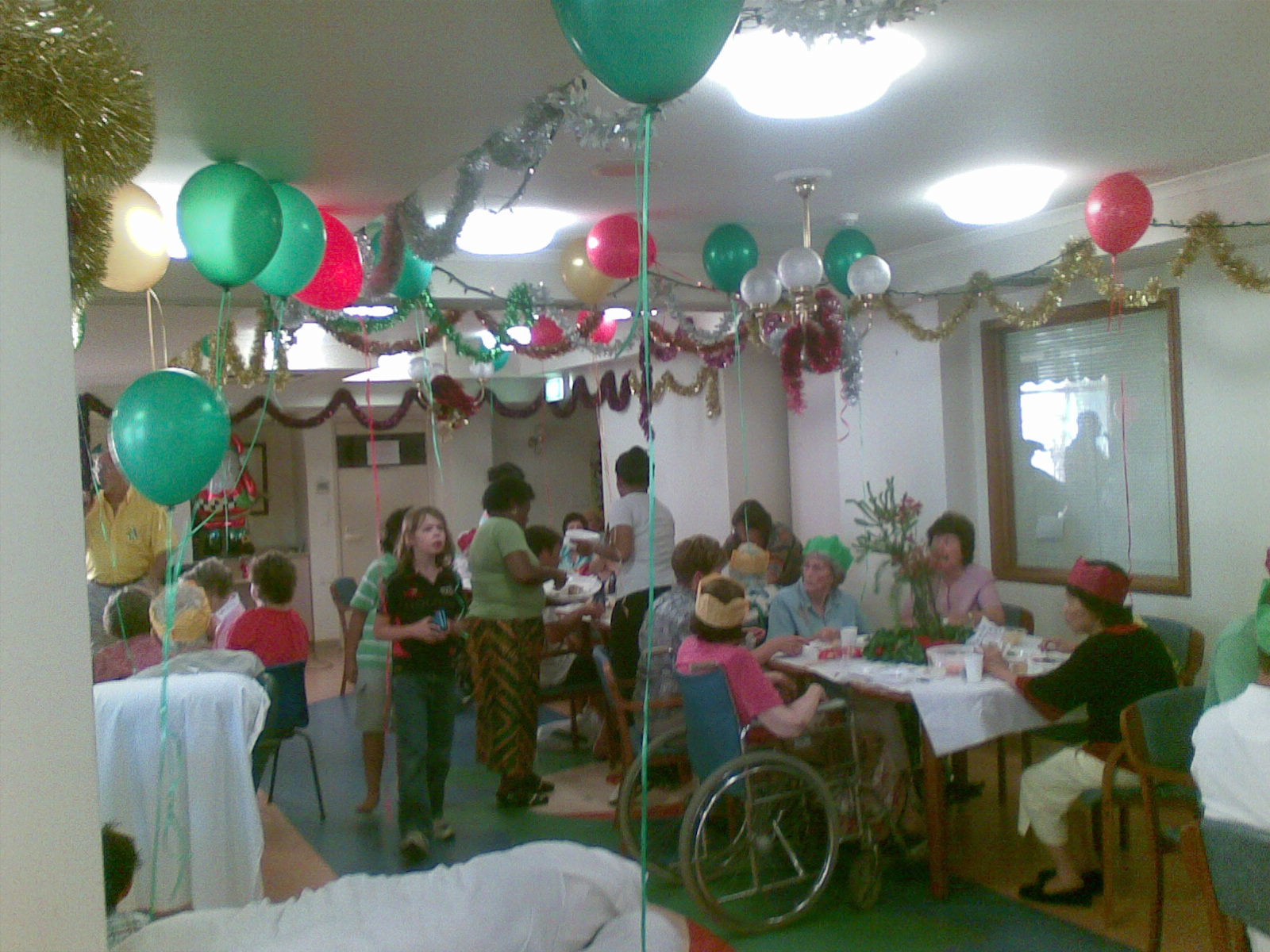
And yesterday morning Penny decided we should experiment with taking Mollie out. She’s been pretty much living a wheelchair for a couple of months now, which has its own disadvantages, but paradoxically creates opportunities for greater mobility. When Mollie used a walker, her progress was so painful that to walk any further than the small outside garden would have been an ordeal. Yesterday, we dared to wheel her out – through the front doors into the astonishingly bright sunlight, down the short street with its occasional rose pushing through a cast-iron fence, across Balmain Road, and to the ultra-cool DiVi Cafe, where Mollie drank a cup of not-too-hot hot chocolate and watched a number of small children playing on playground equipment. She smiled and nodded (language has pretty much deserted her) and I realised that the simple, basic pleasure of being around small children is something that nursing-home residents have very little of. Those couple of minutes sitting in the sun, feeling the light breeze, sipping a lukewarm milky drink and watching a little girl play on a slide and a little boy try to give his father a fright had an awful lot of joy in them.
Q: What does it mean, “Russian garlic”?
A: It’s like Maori children born in Australia.
Richard Brautigan, Revenge of the Lawn (1972, Picador 1974 – with British spelling!)
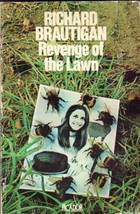 A Book Group member was given a copy of this book by his son, and thought it would be a good quick read for our December meeting, when there are so many competing demands on our time. None of the nearby libraries had copies, and I may have got the last one listed in Australia at AbeBooks. Other members of the Group made do with PDFs. So I was feeling pleased with myself when I opened my slightly stained book, formerly the possession of one Kerry Thomson. That pleasure had pretty much evaporated 50 pages later. It was only corps d’esprit that kept me going: if David and Keith had persevered with the Coetzee book in spite of finding nothing there to interest or please them, surely I could hack another hundred or so pages of underdeveloped twaddle – reminiscence, dream fragments, quirky observations – snapped up by a publisher confident it would sell on the coattails of Trout Fishing in America, published about a decade earlier. That was my state of mind after reading 12 of the book’s 62 pieces.
Things improved at about page 60. It was probably the piercing nostalgia for childhood games in ‘The Ghost Children of Tacoma’ that dispelled my irritated boredom. After that, I was drawn in mainly by pieces capturing (or perhaps re-imagining) moments from his childhood: ‘Blackberry Motorist’, in which he discovers an abandoned car under a high tangle of blackberries; ‘The Post Offices of Eastern Oregon’, a kind of Lake Wobegon horror story; ‘One Afternoon in 1939’, in which he tells a story his little daughter loves to hear, and ends beautifully, ‘I think she uses this story as a Christopher Columbus door to the discovery of her father when he was a child and her contemporary’; ‘A Complete History of German and Japan’, which would be great without the nudging of the terrible title.
After another 50 pages or so, the whimsical observations of life in San Francisco bars, buses, streets, bedrooms and bookshops became the dominant mode, and I lost interest again.
I came across a thoroughgoing web site devoted to all things Brautigan, and found a page giving the place of first publication of these stories. A good number first appeared in Rolling Stone and I’m sure they sat comfortably with the dope and psychedelia of its pages. Mostly they haven’t travelled well. And I haven’t even mentioned the casual sexism.
—–
I wrote that a couple of weeks ago when I’d just read the book. Tonight the Group met, at a very expensive Japanese restaurant, where we managed to have an interesting conversation about the book before ranging off in a hundred other directions. There was genral agreement that the quality was patchy, but my impression is that other people enjoyed the book as a whole much more than I did. One guy had read it in the 70s, so this reading was partly an exercise in nostalgia. The frequent quirky similes, which irritated me, gave delight to others. One comment was that the prose generally left a lot of room for the reader to fill out the picture, in contrast to a lot of recent writing that corrals your response leaving you nowhere to go but where the writer decides. I didn’t understand what he meant until he said that the reading made him think back to his own childhood – and I realised that for me that was a good part of the childhood stories’ the appeal: some of them, at least, triggered a mood of reminiscence, of reflection on my own childhood with a kind of openness to wonder. And of course it was worth ploughing through a fair amount of unaffecting stuff to have that.
Years ago, things were tense in Leichhardt. It seemed that the growing population of dog-owners and could never be friends with their dogless neighbours. The dogless objected to having their environment fouled; the dog owners wished everyone would just get used to being part of nature.
Peace broke out years ago, with a major cultural change among dog people. For years now it’s been rare for a companion human to step out without a supply of plastic bags, and the parks are dotted with regularly replenished rolls of degradable bags provided by the Council.
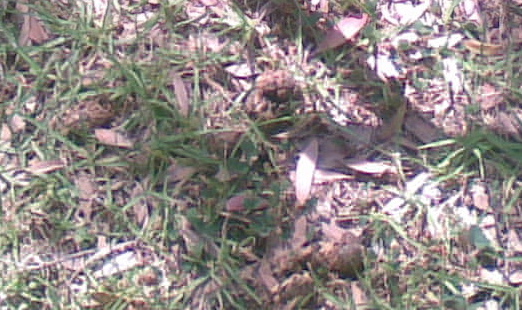
 There’s peace, but it’s an uneasy one. dog owner vigilance is not perfect, and lapses aren’t always tolerated with good grace. Take this sign, for instance. In case you can’t see the photo, it shows a neatly printed A4 sheet stapled to a wooden stake: “Please pick up your dog’s poo / Small children about / Thanks”. At first glance you might take this for a courteous request that we all think about hygiene. But a close look reveals that it is nothing of the sort.
Clustered around the bottom of the stake, and around another identical sign roughly five yards away, is a scattering of drying dog turds. So the sign isn’t addressed to dog owners in general, but to a particular person, the one whose animal left this specific offering. Without the sign, the shit would have been invisible, but still capable of sticking to the sole of a shoe or attracting a small person interested in novel smells and tastes.
It occurs to me, though, that the ‘think of the children’ appeal is disingenuous, as it often is in other contexts. Surely if you thought small children, or even one small child, was endangered by something lying on the verge outside your house, you would remove the dangerous object rather than carefully manufacturing a sign asking someone else to do it? Clearly someone actually thought child safety less important than their impulse to advertise their (justifiable) irritation.
I confess that, like the maker of the sign, I decided this particular pile of poo was someone else’s business and walked on by.
On Friday at Luna Park, AFTRS had its first whole-school graduation ceremony. As you’d expect, there was plenty of multimedia, and also as you’d expect it was beset by technical SNAFUs – but came through in the end. It was a nice touch to have a new cohort of media professionals being released on the world in a large room with the Harbour resplendent outside one set of windows and fairground machinery spinning outside the other. Peter Garrett gave a ministerial speech and left. Sandra Levy gave a CEO speech and shook the hand or kissed the cheek of every graduate, except one or two who accepted their testamurs and walked past her, oblivious.
Then yesterday we spent the afternoon at the Entertainment Quarter watching the fabulous AFTRS graduate screenings: five hours, 17 directors, 17 short movies. We would have stayed on for the Graduate documentaries (1 hour, 24 even shorter films) but we hadn’t checked out the program thoroughly enough in advance and had made other plans. What we did get was terrific. Here are some of my favourites, so when they turn up at a festival near you you’ll be able to say you read about them somewhere ages ago.
Added later: Alex told me that some of his fellow graduates already have established bodies of work. I’ve added links.
Posted in Diary
Tagged AFTRS, Alex Ryan, C J Johnson, Craig Boreham, Lucy Gaffy, Martha Goddard, Maziar Lahooti, Tresa Ponnor
 Currently reading & watching


 Me fail? I fly!