Monthly Archives: May 2011

SWF 2011: A Good Leader is Hard to Find

The reason I am not a politician is that I want to understand.

That’s what the French political scientist Raymond Aron said when asked why he hadn’t gone into politics. The remark came to mind when I saw the number of politicians and ex-politicians in this year’s Sydney Writers’ Festival line-up. Maybe there’s room for a separate Sydney Politicians’ Festival, or a Sydney Politicians’ and Political Journalists’ Festival.

Whatever misgivings I might have had, I turned up with 1600 or so others at the Town Hall last night to hear Lenore Taylor, Bob Ellis, George Megalogenis, Bob Carr, Barrie Cassidy and Kerry O’Brien chat under the heading, ‘A Good Leader Is Hard to Find’. Kerry O’B was moderator, and the first thing he did, whether deliberately or not, was to reframe the discussion. He announced the title as ‘Good Leadership Is Hard to Find’. I breathed a tiny sigh of relief, as the shift away from the personal made it a bit less likely that we’d be treated to misogyny-flavoured wit at Julia Gillard’s expense.

The composition of the panel – four political journalists, five if you count Bob ‘Sui Generis’ Ellis, and a former politician who was also once a journalist – made it inevitable that the discussion would focus on the relationship between politicians and the media. There seemed to be consensus that we lack effective or convincing leadership in the Australian parliament, that the interplay between the politicians and the relentless 24-hour news cycle is partly to blame, and that the attention both of them pay to opinion polls adds toxin to the brew. Our leaders are so busy feeding the media beast they don’t have time to think. They’re reduced to selling a message rather than advocating a case, performing rather than communicating. Political coverage is dominated by opinion polls, leadership challenges and early election speculation, with not a lot of room forin depth analytic conversation. Gone are the days when the Prime Minister would chat with journalists at the end of a long day and explain his/her thinking about proposed legislation – when Paul Keating would say to Lenore Taylor, ‘Love, this is what you need to know. The discussion was refreshingly free of blame: the way the media works has changed, and neither the politicians nor the journalists have figured out how to deal with the new reality.

There were no revelatory insights, but it was an interesting evening. Ellis and Carr stood out as phrase-makers, Carr describing himself as an amateur historian, Ellis enacting his familiar contrarian persona. For example, Carr:

In a democracy the normal relationship between people and their elected representatives is mistrust and dissatisfaction. It’s the job of the people to be disillusioned. It’s the job of politicians to disillusion.

Ellis, when asked why the ALP doesn’t adopt what he had just described as an obvious strategy

They do research instead of thinking.

It’s not that the others lacked flair, but as working journalists perhaps they were a little more willing to let the facts get in the way of a good story. So after Bob C made his fourth or fifth remark on the theme that things may be bad but they’ve been ever thus, George M said, ‘I’ve followed many election campaigns but this was the first one where the main candidates feared the electorate.’ And when Ellis spoke of the minority government as ushering in a new era of negotiation and persuasion in parliament, Lenore challenged him: ‘And you’ve seen this happen with which piece of legislation?’

The journoes have their own unrealities. George M told us how his faith in the electorate had been restored when ‘they’ decided to choose neither side of politics at the last election, but to have a hung parliament. No one on the panel said, ‘George, you’re talking nonsense. No one made that decision. All the millions of actual deciders chose one or the other. There was no “Neither” option on the ballot paper.’

There was half an hour of questions. Only one person mistook the microphone for a soapbox.
Overland 202

Jeff Sparrow, editor, Overland 202, Autumn 2011

I have one major complaint about this issue of Overland: it won’t be read by enough people. It gets classified, correctly, as of the left, and so there’s an assumption that only people who identify as left-wing should read it. It gets marginalised, when item after item in it deserves the widest readership and engagement. Rather than saying too much, here are a couple of excerpts.

From Guy Rundle’s ‘Open-eyed conspiracy his time doth take‘, a look at the theory and practice (‘praxis’) of Julian Assange and WikiLeaks:

In Assange’s model, the failure of the anti-globalisation movement to challenge the governmental conspiracies that emerged post-September 11 resulted from the very dispersal that they celebrated […] WikiLeaks, in that respect, represents a dialectical development: recognition that a counter-conspiracy,  to  be effective, must decisively reject openness  in favour of an ultra-conspiracy. […]
WikiLeaks’ massive category-shifting leaking is not intended to dissolve governance but to uncouple governance and conspiracy, to make it impossible for governments to fall back on conspiracy as a mode of action.

From Rjurik Davidson ‘s ‘Imagining New Worlds‘ on ‘New Wave’ science fiction of the 1960s and after:

The New Wave [demonstrates] that approaching culture politically (in the broad sense of the term) does not necessarily result in the production of dour and didactic texts. On the contrary, political interventions underpin many of the greatest formal
 revolutions, the most experimental and original work.

From Bob Gosford’s ‘They took our culture – now there is no law‘, one of three pieces on the Northern Territory under the Intervention:

[A] Northern Territory judge who in 2009 considered the effect of the changes to the Emergency Response Act 2007 noted that: ‘the precise mischief that [the section] is intended to remedy is unclear’. He went on to argue that because the legislation precluded consideration of a range of previously acceptable and relevant issues, it ‘distorts [the] well established sentencing principle of proportionality, and may result in … disproportionate sentences’.

From Alexis Wright’s ‘Talking About Tomorrow‘, an open letter to Bob Brown and Rachel Stewart:

I cannot believe that the Intervention can be  justified  when   families  are  leaving their
traditional lands – the lands where they have lived and that they have taken care of for tens of thousands of years – unable to endure the heaviness of government controls over their lives. They are becoming the new gypsies, vilified by residents of Australian towns and cities opposed to having them as neighbours.

She goes on to argue that ‘the only way forward is through treaty-making with individual nations and regions in northern Australia. in particular in the Northern Territory ‘.

From Patricia Gillespie’s ‘[In]Dignity‘, which is largely a graphic account of her elderly mother’s experience with the health system:

From a medical perspective, the treatment for her congestive heart failure – the reason for her admission to hospital – was a success. She was no longer ‘dying’ or ‘drowning’ in fluid. But Marie inherited […] problems such as vitamin deficiencies, suicide ideation, muscular weakness and mobility issues, chronic rash, a bleeding tongue, bedsores and ulcers, which made a mockery of the notion ‘do no harm’.

There are eight wonderful pages of images and pensées from Sean Tan. There’s poetry, including K A Nelson’s ‘Chorus of Crows‘ (winner of the 2010 Overland Judith Wright Poetry Prize, and another angle on the NT Intervention) and  Jennifer Compton’s sweet celebration of the quotidian, ‘I Came Home with the Shopping‘.

Almost teh whole lot is up on line. Have a look.

Gallery

NSWPLA Dinner, a report from the trenchers

Last year a woman premier presented the NSW Premier’s Literary Awards at the Art Gallery. Tonight a non-Labor premier, just as rare a beast in the 10 of these dinners I’ve been to, did it at the Opera Point Marquee, … Continue reading

A launch

Ursula Dubosarsky’s new book, The Golden Day, was launched yesterday with a suitable sense of occasion. I’d spent the morning as an extra in a rap video clip (about which I may blog some other time), but no one at the launch seemed to notice that my usually shiny forehead was sporting a light dusting of make-up.

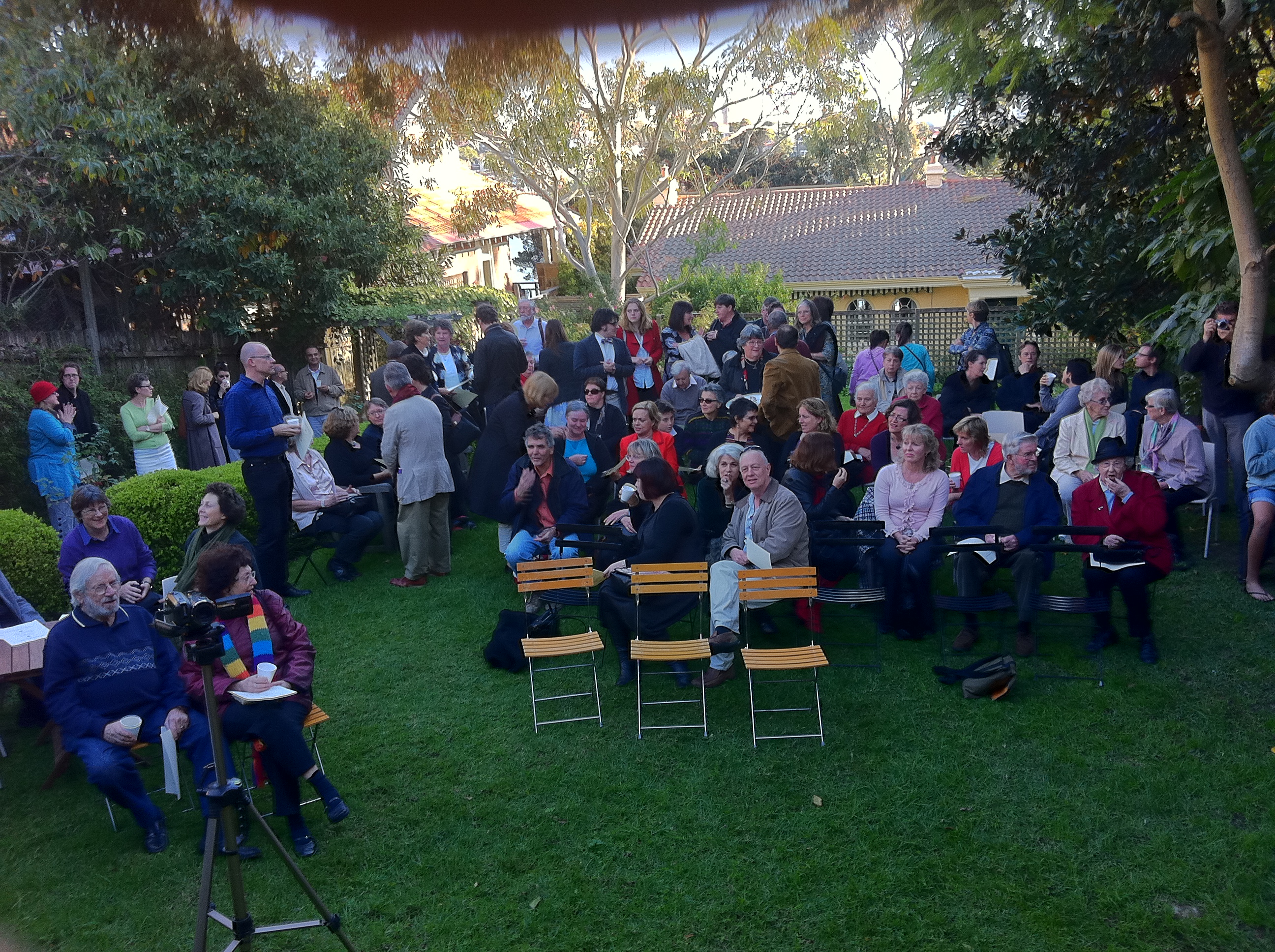
We were at Nutcote Cottage, home of May Gibbs, a lovely site for a launch. The golden light of a fine Sydney autumn afternoon, tiny muffins, cupcakes and Lamington slices would have made the mood celebratory even without a subject. As you see from the pic a new Dubosarsky book draws quite a crowd: from the publishing world, family, writers (not just for children), artists and illustrators, colleagues, Marrickville dwellers, the wife of a former Federal Minister, former students of SCEGGS Darlinghurst and even some of the book’s target audience, that is to say, children.

The Nutcote lawn

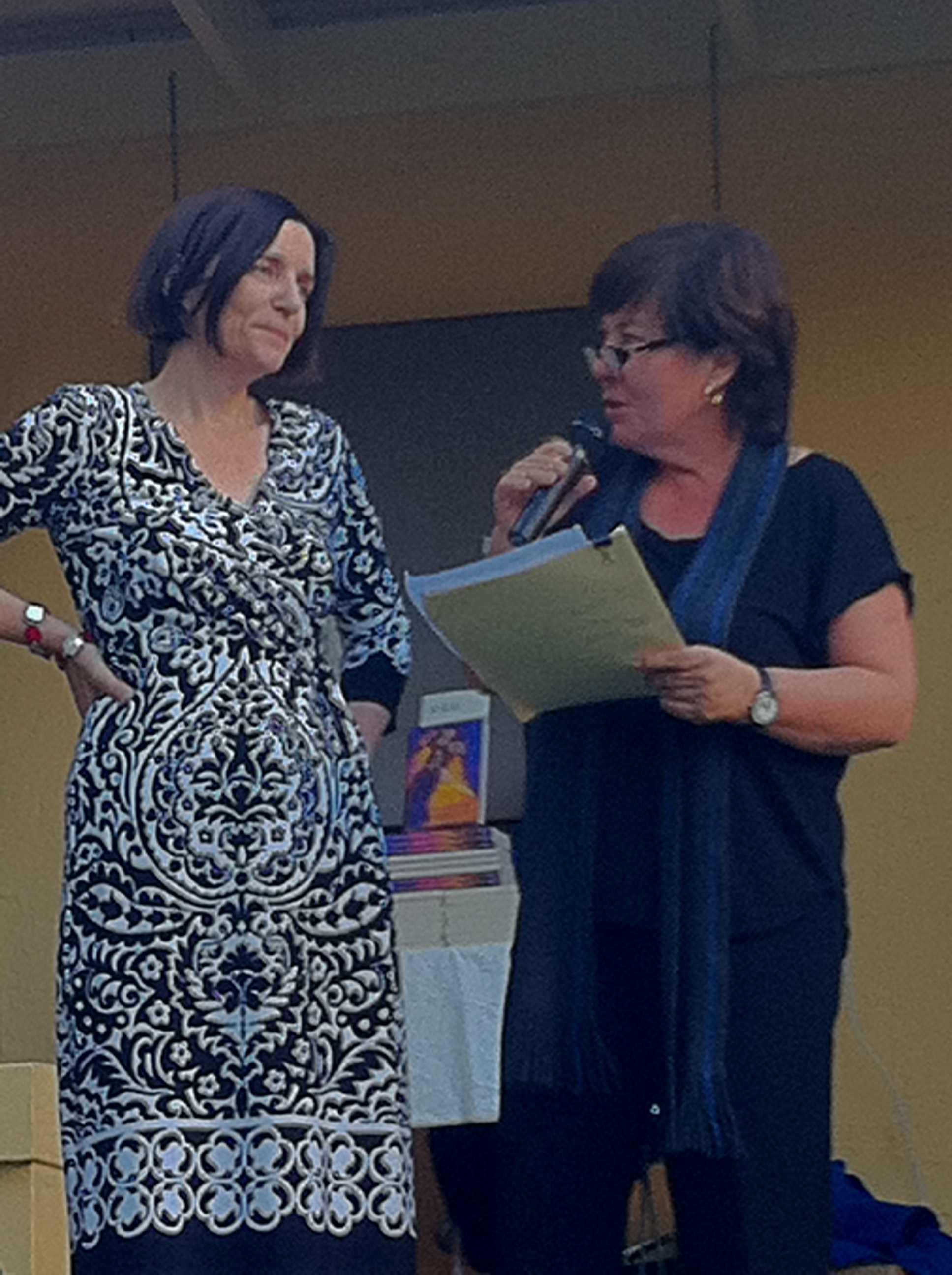
Julie McCrossin presided. Drawing on her experience as radio interviewer and stand-up comedian, she put Ursula through her paces, quizzing her about her inspiration for the book. It’s set in a genteel girls church school in the inner eastern suburbs of Sydney, a school that evidently bears an uncanny resemblance to SCEGGS Darlinghurst, of which both Julie and Ursula are alumnae. Calling on contributions from other Old Girls, they evoked a startling picture of uniformed schoolgirls making their way from the bus stop to the school gates though filthy streets where junkies and prostitutes hung out. One member of the class of ’78 was coaxed by Julie into saying that she didn’t remember much out of the ordinary, apart from an occasional flasher and the naked woman who appeared in a doorway one morning asking her to get help.

‘There are myriad kinds of writers,’ Ursula said, responding to Julie’s pressing her for the meaning of some of the incidents in the book. ‘I’m the kind of writer who lets herself go to the dream.’ I quote this because it rings so very true of Ursula’s work, but also because just a few moments later Julie referred to the ‘ ‘myriad of influences’ she detected in the book (Picnic at Hanging Rock, classical myth, etc), thereby adding a little fuel to the fire of a conversation I’ve been having recently about usage: Ursula the classicist uses ‘myriad’ as I do; Julie the journalist agrees with my journalist friend. (Are you reading this, L–?)

Julie: Might I suggest that there's an underlying theme of sexual awakening? Ursula: Oh, that's what my book's about!

Michael Moore on the killing of OBL

Michael Moore may get a bit too smart-arsey in his movies, but this piece on the killing of Osama Bin Laden is worth reading.

Perhaps there was no way to bring him back alive – I sure as hell wouldn’t want to be in that dark house trying to make that snap decision. But if the execution was ordered in advance, then I say we should be told that now, and we can like it or not like it.

I recommend the whole thing.

Pretty as a picture

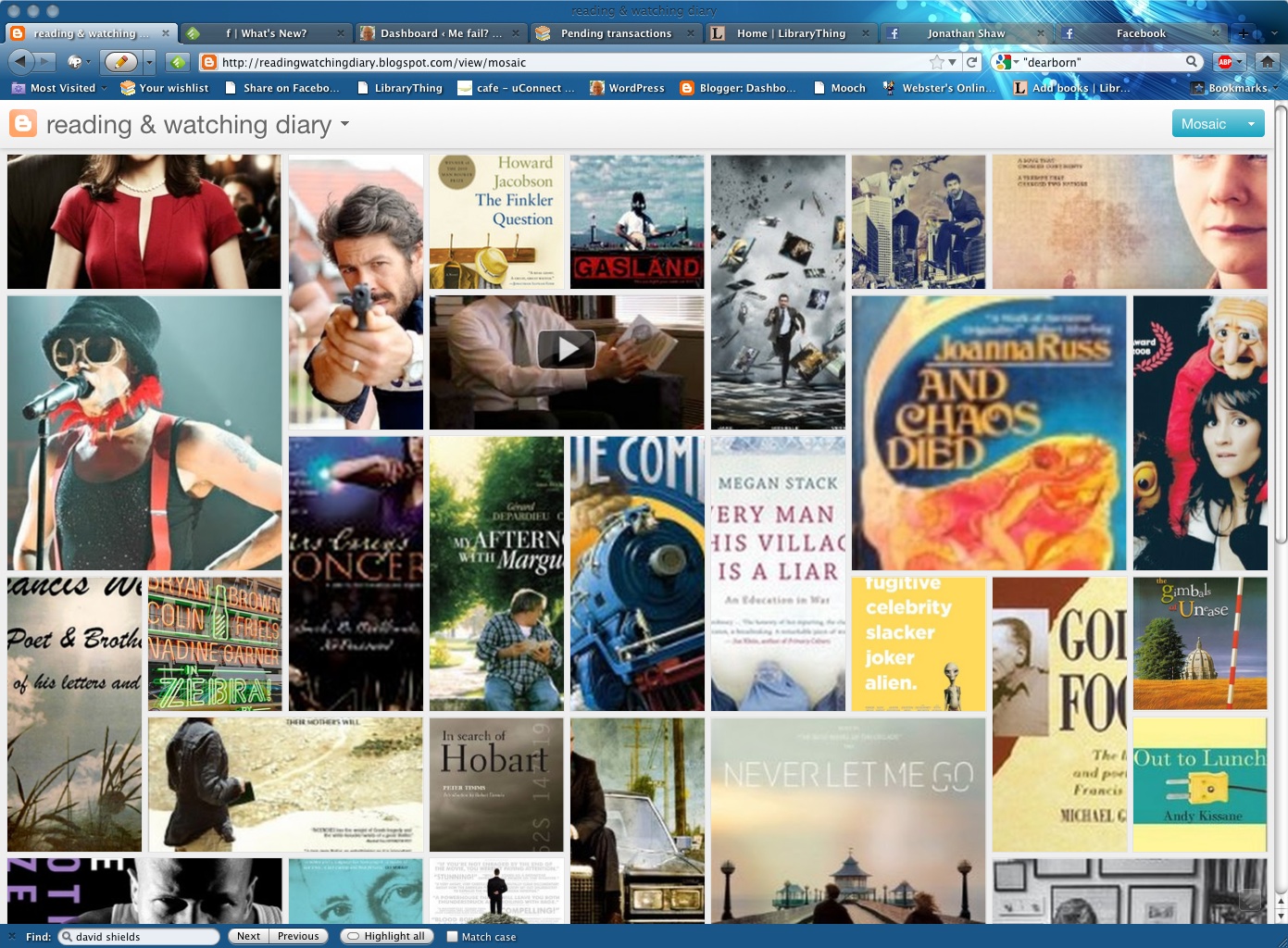
I love the way Blogger can display its blog in a number of ‘views’. In particular, I love the Mosaic view of my ‘Reading and Watching Diary’ blog, which exists mainly so I can have that list of books, movies and so on over in the right hand column of this blog.

Rhyll McMaster at Sappho’s

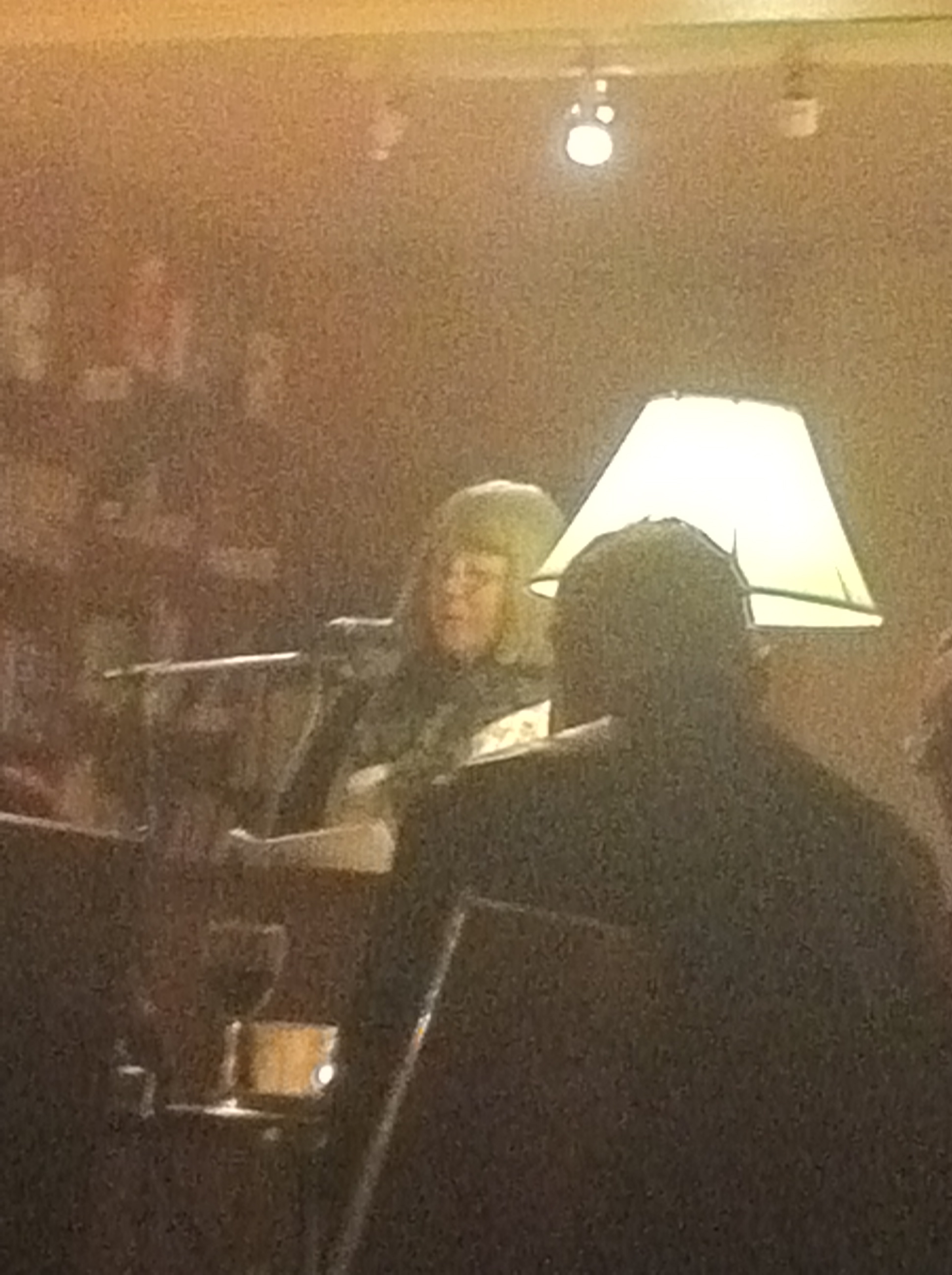
Next door to Gleebooks, Sappho’s Book Shop stages monthly poetry readings. Last night Rhyll McMaster read from her next book – she’s writing poetry again after years engaged one way or another with the novel Feather Man.

No one was smoking in Sappho’s courtyard, but I like the way this phone photo suggests the classic smoke-filled ambience for poetry reading.

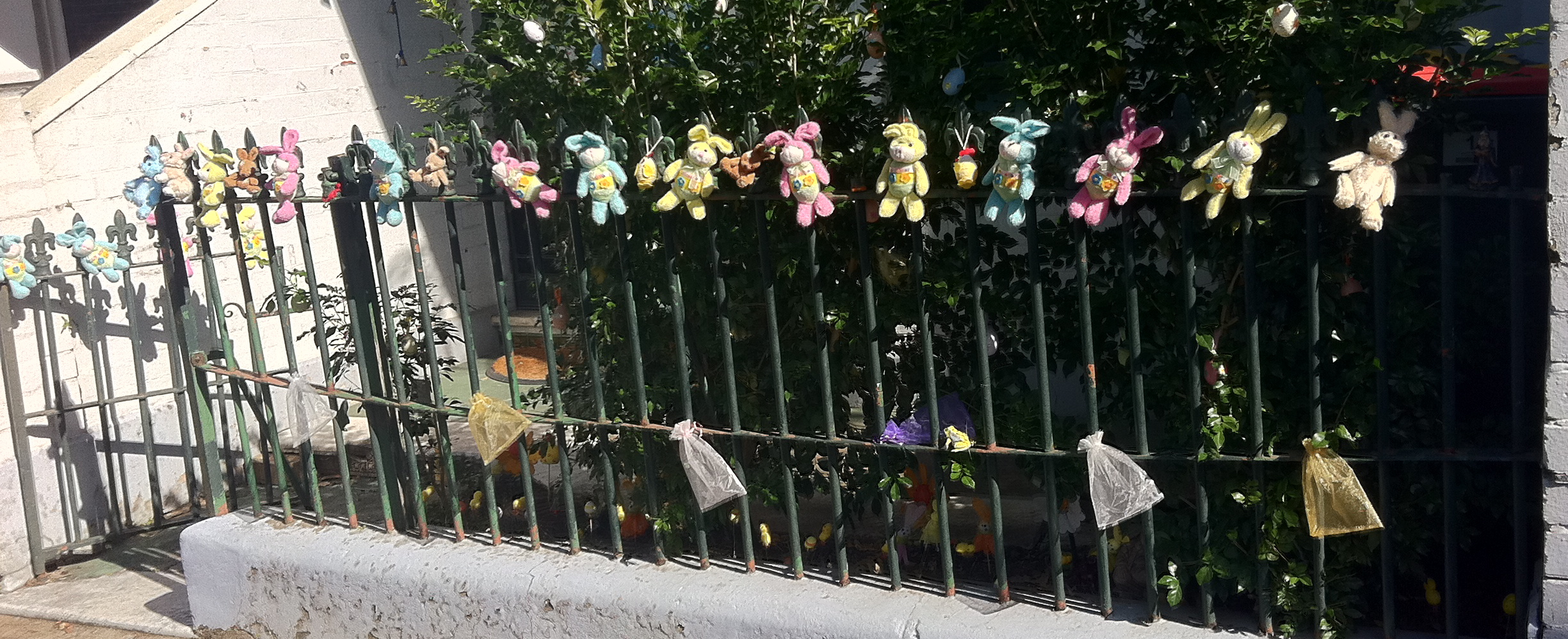
Not the rabbit-proof fence

… although maybe these all got impaled when they tried to get into the property at Easter

Joanna Russ And Chaos Died

Joanna Russ, And Chaos Died (1970,Berkley Books 2009 )

Joanna Russ died on 29 April. This book has been beside my bed for a while now and I decided to read it as my small personal obsequies. It might have been better to reread The Female Man or read How to Suppress Women’s Writing for the first time, these being the books usually seen as marking her place in the history of Science Fiction, but I don’t have copies of either of them. The New York Times obituary doesn’t mention And Chaos Died, which was first published five and 13 years respectively before those books.

A lot of the time it’s hard to tell what’s going on in this book, though it does become slightly less bewildering after the first 20-page section. The main reason for the bewilderment is that the main character, Jai Vedh, having crash-landed on an alien planet, encounters people there who communicate mentally, reading each other’s feelings and thoughts but also perceiving the world at a molecular level and communing with plants (a wise daisy plays a crucial role) and even inanimate objects. When they communicate with ‘visuals’, their words are oddly elliptical, responding to things the others aren’t quite aware they’ve even thought or felt, let alone expressed, and drawing on the others’ vocabularies (‘I’m not used to talking this at all,’ is one of the first sentences he hears spoken). Nothing is explained; the reader, if anything, understands even less than Jai Vedh.

Jai Vedh identifies as homosexual in the early pages, but he becomes sexually and psychically involved with a woman of the planet and soon is telepathing and teleporting with the best of them. He’s captured and taken back to ‘Old Earth’, a late 60s nightmare of overpopulation, pollution, corrupt authoritarian government, and psychedelic licentiousness, where he escapes death many times, befriends a boy who tries to kill him, and so on. Through all this he uses his mental skills without ever gaining complete control of them, so that he often isn’t at all sure whose thoughts and feelings he’s experiencing and has trouble seeing what’s physically in front of his eyes because other aspects of reality, whether microscopic or purely psychic, are claiming his attention – and the prose takes us along with him. It’s hard to pick a representative passage, because the writing keeps changing with Jai Vedh’s level of competence and the mind/mood-altering agents he encounters. But this might give some idea – he’s collapsed into an exhausted sleep on a California beach, and this is his waking up:

He thought he had been taken inside by someone. They were going to fight over his body. He was on the floor or on the sand, sprawled asleep part of a ritual like a piece of wood, the thought: hold him, hold him, hold him, and somebody holding his head and saying (over and over) ‘Sleep, torn man, sleep. Yang only. Sleep, torn man, sleep. Yin only.’ The lights passed over his closed eyes with exaggerated slowness, vanishing off his chin: purple, green, blue, red, yellow, white, with pictures, too, a very old-fashioned and silly piece of stuff. Last year’s. He was lying in a woman’s lap, in some sort of barn with a lot of smoke around and people shuffling. Jingle-bonk. And could not open his eyes. Jingle-jingle-bonk. Foolishness. It occurred to him that he must have been drugged, for the naked woman whose lap he was in had as much mind or as much sex as a puppet, though he could smell her strongly. That is, she had been drugged. (I’ve been drugged!) Although he did not think that he usually thought that way. … There was a small, irritated, hopping-mad part of her mind, too, somewhere; he noted that with interest. He guessed it was the smoke and began to fend it away from him – big, bumbling molecules, as complicated as antique steamships – to let through the little, keen, live ones.

According to Samuel Delaney, The Female Man was written partly as a critique of this novel. You can download the whole book as a PDF.

Five audiences

The Art Student doesn’t blog, except by remote control, as in saying to me, ‘You should write on your blog about…’ This is one of those posts.

In the last week, in spite of my otherwise debilitating head cold, we’ve been to five cultural outings. This is a brief review of the audiences. (Distances in brackets are from our house to the theatre.)

1. The Drama Theatre of the Opera House: Nina Conti’s Talk to the Hand (7.9 km)
We got a pretty good look at the front row of this youngish, well-heeled crowd, as Nina and her monkey held them up to ridicule one after another. The foul-mouthed monkey made a series of outrageous remarks, shocking sweet, well-bred Nina. ‘Are you married to her?’ the monkey asked one man, indicating the woman next to him. ‘Sometimes,’ the man said, which I think you’ll agree is a pretty good response. ‘What do you mean, sometimes?’ Nina asked. ‘Well, at other times she’s [insert your own misogynist end to sentence].’ Even the monkey was taken aback, and moved on quickly. The joke was in danger of failing as the audience promised to be even more obnoxious than the monkey. The same man called out further insults about his wife later in the evening. Of course, it would be wrong to tar the whole audience with his brush, but whenever Ms Conti or one of her dummies called for suggestions, the replies were mostly sex- or bum-themed. The show was fabulous, but the audience had a significantly vocal leavening of misogyny and middle-class yobbery.

2. Gleebooks: Gerard Windsor and Giulia Giuffrè in conversation about the latter’s book, Primavera (3.7 km)
The smallest, most serious and most mature of the five audiences. When we arrived, the two performers were mingling with the audience-to-be. Someone asked me, ‘How do you fit in?’ and told me Giulia had commented with pleasure when she saw some strangers arrive. (I probably count as a stranger: I met Giulia a couple of times in the early 70s, but she didn’t remember me.) Someone from Gleebooks  introduced the event in 10 seconds flat (‘perfunctory’ doesn’t begin to cover it), leaving Gerry to say who he was. This only deepened the sense that we were at an intimate gathering – friends, family (Giulia’s 20-something daughter was there, and spoke briefly), colleagues.

3. Seymour Centre: iOTA’s Smoke & Mirrors (3 km)
In many respects similar to the Nina Conti audience, this crowd were hip rather than heeled. An older woman in the front row opposite us kept her face fixed in a scowl the whole time except for one brief smile. She applauded politely at the end of most items, and winced when the stage lights fell on her, as they did often. But the great bulk of the audience applauded enthusiastically not only the songs, acrobatics and magic tricks, but also iOTA’s sexually ambiguous clown-crying-on-the-outside musical performance. When the lyrics got, as they say, explicit, the crowd was unfazed, but when a decorous striptease ended with the unveiling of the stripper’s beard there was no noisy clamour for more intimate exposure. This audience, with nothing to prove, seemed happy to be entertained and challenged.

4. Dendy Cinema Newtown: special advance screening of Sunshine and Oranges (1.6 km)
This was a 6.30 screening for Club Dendy members, of a movie about Margaret Humphries exposing the secretive deportation of 130 000 children from the UK to Australia. There was a lot of silver hair in this packed house and, at least near us, a smattering of English accents. The Art Student thought there was a preponderance of women, not young, but not yet of a certain age, who could have been social workers. I was struck by the number of phone screens that stayed lit up until the last possible moment, by which I mean several seconds after the film began.

5. The Factory: Fear of a Brown Planet Attacks (.7 km)
Another packed house. My guess is that the vast majority of the audience were young Muslim Indians or Pakistanis.Here we were definitely in the minority, as white people and also as people over 40. There were plenty of hijabs and other headscarfs, but I didn’t see any older women in saris or salwar kameez. Aamer Rahman’s performance of a Bollywood song in (I’m guessing) Hindi provoked a lot of recognising laughter. And when Nazeem Hussain, the other half of Fear of a Brown Planet, did a caustic impersonation of a white Australian calling him ‘Zeemo’, ‘Nazzer’ and so on, he had the audience right there with him. Racism was mocked. A child ran about noisily at the back of the large auditorium for most of the show’s second half, and no one got into a state about it. Perhaps the White People were a little more subdued than usual as we left, but my impression is we were among people who not only had been entertained but also had had significant issues named out loud.

All but the first of the events happened within walking distance of our house. It’s as if we live at the junction of different worlds. Ah, city life!