Monthly Archives: Nov 2017

November Verse 6

Verse 6: On leaving at interval
We pays our subs and takes our chances.
Support the arts, put bums on seats,
and if the play’s a dud, well, cancer’s
worse and nothing really beats
the sense of risk when new creations
meet an audience: ovations
(standing)? or polite applause?
Will these two hours throw wide the doors
of hell and heaven? Last night neither.
We all worked hard: director, cast,
designer, writer, punters. Vast
good will drained away and by the
midpoint: ‘Who cares how this ends?’
we said, ‘Let’s go and eat with friends.’

At least we waited until the interval, unlike the occasion in 2010 that prompted the following (here’s a link to the original post):

This is just to say
We walked out of your play last night
from front row seats. We’d hung in there
for five whole scenes. The script was tight,
each actor sound, the set though spare
was spot on, and the vocal coach
had nailed the accents – no reproach
on that score. All these things were fine
but almost from the opening line
I couldn’t, couldn’t feel a thing.
I’d pay to watch two monkeys fart
if done with two boards and a heart.
Last night had timing, lines that sing
and sting. It’s heart that wasn’t there.
Sometimes a pause is just dead air.

November Verse 5

I phoned Peter Dutton’s ministerial office (02 6277 7860) to plead for a change of heart on the men currently in dire circumstances on Manus Island. The person I spoke to heard me out and thanked me for my input. I asked if he’d written it down. Silence. I asked if any of my concerns would be passed on to the Minister. He said, ‘I have listened to you and know what you said. I won’t comment on the internal workings of this office.’ Democracy in action.

I do feel for the people who have to face the public on Peter Dutton’s behalf and hear repeatedly that their boss is committing crimes against humanity. I also feel for the members of the cabinet who are obliged to go out and spout cruel absurdities in support of their party line on this and other subjects, as in this clip from the Today Show in 10 November. Here’s a little verse in response:

Verse 5: Christopher Pyne on the TV
‘Those men on Manus now are squatters,’
he said, face straight as his can be.
‘Our government aren’t beastly rotters.
That squalid camp we now can see
has been closed down. The men have choices.
If they ignored the lefty voices
they’d pack their bags and quietly go
back home or to East Lorengau,
or to the US. World’s their oyster.
Their fate’s no longer up to us,
so, bleeding hearts, please stop your fuss.’
A saintly monk, safe in his cloister,
recites the creed, averts his eyes,
and shuts his heart, acts unco wise.

November Verse 4

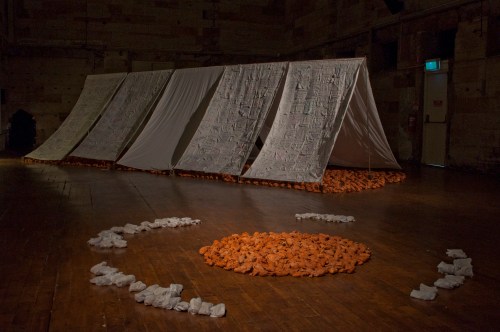
full tentsm.jpg

Penny Ryan, InTent. Photo by Penny Ryan

Verse 4: At the National Art School MFA exhibition
(For the Emerging Artist)
Ten years ago no one fled faster
out a gallery’s exit door.
No Op, no Pop, no Flemish master,
none could make her stay for more
than half an hour. A Rubens cupid
left her feeling bored and stupid.
But shut out from the world of art,
she’d given it her secret heart.
Now her two thousand terracotta
hearts invite the passers-by
to stop, look, think, perhaps to cry
and write for Manus men. She’s shot a
film and made a giant heart.
She’s now a Master of Fine Art.

That’s for my project of 14 stanzas in November. Here’s one I made earlier inspired by the same art project:

2 July 2016
This tiny heart of terracotta
cold and fragile fills my hand,
shaped by hand of one-day potter,
marked, incised, a one-off brand:
‘Heavy’. Hand to hand is calling.
Feel the weight of the appalling
suffering of those unseen,
untouched, unheard, of those who’ve been
detained by governments so callous
they kill all hope to garner votes
and glibly boast they’ve stopped the boats.
Unwrapped, this heart confronts that malice:
our beating hearts can face our fear –
Close down those camps, bring those hearts here.

The Book Group and Svetlana Alexievich’s Chernobyl Prayer

Svetlana Alexievich, Chernobyl Prayer (1997, trans Anna Gunin & Arch Tait Penguin Classics 2016)

chernobyl.jpegFrom post revolutionary China in Madeleine Thien’s Do Not Say We Have Nothing back to the Russian Revolution in China Miéville’s October, and now forward to post-Soviet Belarus: the book group has lit on a theme.

Before the meeting:
Knowing that Chernobyl Prayer is essentially a series of monologues about the aftermath of the 1986 Chernobyl nuclear disaster, I expected it to be a gruelling read, so I rationed it. I worked out how I would need to read seventeen pages a day to finish the book before the Group met, and set that as a schedule. Of course it didn’t work out like that, but it was a good strategy.

As Studs Terkel’s Working did for working people in the USA, or Wendy Loewenstein’s Weevils in the Flour for the 1930s Depression in Australia, this book provides a platform for scores of witnesses who otherwise would be largely ignored or – as a number of Alexievich’s interviewees tell us – treated as specimens. There are peasants and nuclear physicists, loyal Communists and embittered cynics, ancient women and nine year olds, poets, playwrights and journalists. There’s operatic intensity, fatalistic heroism, jokes that are terrible in both meanings of the word. The cultivated and forested land around Chernobyl is lovingly evoked, along with the invisible horror of nuclear radiation. The monologues that pretty much begin and end the book, each titled ‘A lone human voice’, are long, passionate, heartbreaking stories of love and bereavement, one from the widow of a fireman who was among what we now call the first responders, the other from the widow of a clean-up worker who was conscripted for the job six months later.

Here’s an excerpt from the author’s interview with herself early in the book:

This is not a book on Chernobyl, but on the world of Chernobyl. … what I’m concerned with is what I would call the ‘missing history’, the invisible imprint of our stay on earth and in time. I paint and collect mundane feelings, thoughts and words. I am trying to capture the life of the soul. A day in the life of ordinary people. Here, though, everything was extraordinary: both the event itself and the people, as they settled into the new space. How many times has art rehearsed the apocalypse, offered different technological versions of doomsday? Now, though, we can be assured that life is infinitely more fantastical. … Chernobyl is a mystery that we have yet to unravel. An undeciphered sign. A mystery, perhaps, for the twenty-first century; a challenge for it. What has become clear is that, besides the challenges of Communism, nationalism and nascent religion which we are living with and dealing with, other challenges lie ahead: challenges more fiendish and all-embracing, although still hidden from view. Yet, after Chernobyl, something had cracked open.

I’ve responded to works by other Nobel Prize laureates with a kind of compliant respect, ‘I can see why this person was given the Nobel Prize, and I guess my horizons have been expanded by reading this book.’ In the case of Chernobyl Prayer I am deeply grateful that the Norwegians brought it to my attention (and to the Book Group for prompting me to read it). In illuminating the ‘missing history’ of Chernobyl, it reminds us of the disasters, past and in the making, that we so easily turn our heads away from: Hiroshima, Nagasaki, Maralinga, Fukushima, and the overarching threat of climate change. In this way it is like Maralinga: the An̲angu story by the Yalata Aboriginal Community with Christobel Mattingley, or Yhonnie Scarce’s beautiful and unsettling installation Death Zephyr (click for an image). It would be impossible for a reasonably well informed Australian to read this book, especially the sections dealing with the way political pragmatism trumped the laws of physics, without thinking of the pronouncements on coal from Tony Abbott and his ilk.

The meeting: I hosted the meeting this time. I let people know in advance that I had made an enormous amount of marmalade from our cumquat tree this year. One of the chaps emailed on the weekend, ‘The prospect of marmalade is the only thing getting me through this miserable book!’ Others echoed the sentiment.

It turned out that the conversation was so animated that all thought of marmalade vanished from our minds. It’s a perfect book-club book. There is so much detail that the conversation bounced around from one alarming moment to another, as we reminded each other of what we’d read. We were in awe of the author’s skill in getting such poetry down on the page from her interlocutors’ testimonies.

And now a hasty fourteen lines, written before the group met:

November Verse 3: After reading Svetlana Alexievich’s Chernobyl Prayer
(‘I realise now that terrible things in life happen unspectacularly and naturally‘)
Good Soviets, good peasants trusted
authorities that reassured,
a lifetime’s mental habit rusted
on. To keep that Party Card,
to serve the people, serve the nation,
be not afeared of radiation:
in spring the wood’s still gently green,
roengtens, curies can’t be seen.
We have our own insanity
three decades on: the planet warms,
brings bushfires, catastrophic storms,
but ‘Coal’s good for humanity’
wins votes. With luck in time we’ll learn
so millions more don’t have to burn.

T G H Strehlow’s Journey to Horseshoe Bend & November verse 2

T G H Strehlow, Journey to Horseshoe Bend (©1969, Giramondo 2015)

horseshoe

The name Strehlow may not be quite well enough known to feature in a pub quiz question about whitefellas in Central Australia, but it comes close. Wikipedia describes Carl Strehlow (1871–1922) as a ‘linguist, anthropologist, genealogist, collector of natural history specimens, missionary and translator’ who ‘served on two Lutheran missions in inland Australia from May 1892 to October 1922, a total of thirty years’. T G H (Ted) Strehlow (1908–1978), his son, spent his childhood on the Hermannsburg Mission and achieved fame as an anthropologist and linguist, especially for his Songs of Central Australia, ‘a monumental study of the ceremonial poetry of the Arrernte’ (Wikipedia again).

Journey to Horseshoe Bend is Ted Strehlow’s account of his father’s last days, when Ted was fourteen years old. Written four decades after the event, and now reissued by Giramondo more than four decades after first publication, it’s an extraordinary time machine of a book, consisting of at least four distinct strands:

The main narrative: In October 1922 Carl Strehlow, Lutheran pastor of Hermannsburg Mission in Central Australia, is extremely ill, and the only chance to get desperately needed medical attention is to take him by horse and buggy to the nearest settlement that can be reached by a doctor in a car. He has dropsy (that is, most of his body is painfully swollen with retained fluid) and suffers terribly from the jolting journey in the intense summer heat. It’s no spoiler to say that he reaches the settlement of Horseshoe Bend, but dies before a doctor can reach him, and the burial ceremony is described in painful detail. His wife Frieda travels with him, and Hezekiel, an Arrernte man, drives the buggy. Their son Theo – referred to in the third person throughout – travels separately on a cruder, even joltier wagon driven by the Arrernte man Titus.

Arrernte stories: As the vehicles move through country, we are told the stories (here called ‘myths’) of the ancestral beings who created its features, and some of the pre-settlement history of internecine conflict. It seems unlikely that the fourteen year old Theo would have known all these stories, but he had  grown up among Arrernte people (here called ‘Aranda’ or ‘dark people’) and though he was never initiated he had a deep sense of belonging to the Arrernte and to that country. Certainly the respectful matter of factness of his storytelling has an insider feel to it.

Settler history and anthropology: As the small party travels down the Finke River, they are given hospitality by a number of settlers along the way. Strehlow gives a brief history of each stopping-place, and casts a dispassionate anthropologist’s eye over them, particularly their sexual mores. At least, his tone is dispassionate: it’s hard to imagine that anyone could describe without a quiver of indignation moments like the one where a new white wife arrives and insists that the children who have been born to her new husband by an Arrernte woman should no longer have his name. Some pages aim to reproduce the language of the settler patriarch of Horseshoe Bend, and even though its full-blown colonialism is certainly not endorsed by the book, a trigger warning for its liberal use of the N word wouldn’t be out of place.

The elder Strehlow’s spiritual struggle: There’s quite a bit of Biblical exegesis, particularly of the Book of Job and Christ’s anguished cry, ‘Thy will be done,’ and some bitter reflections on the contrast between institutional religion and the religion of the spirit. Although, as Philip Jones comments in his excellent afterword, Strehlow’s bitter blaming of the Lutheran authorities for his father’s suffering may well be a projection of his own feelings towards his university employers, all the same there’s some profound meditation here.

The younger Strehlow’s coming of age story:  Theo leaves his childhood home for the first time, and his father’s death marks a decisive turning point – he had expected to go to Germany to finish his education, but now he decides he belongs in Australia. In other ways too, the ordeal changes his sense of himself in the world: for the first time he meets with people who are neither Arrernte nor devout European Christian: his journey to Horseshoe Bend is his first encounter with ‘the outside world’. Though the terrible ordeal of the elder Strehlow is made painfully tangible, we are not made privy to the emotional upheaval it must have caused his son. When we are told what is going on in Theo’s mind, it is mostly his response to the country and then in the final pages his decision to stay in Australia.

I don’t suppose anyone would claim that Journey to Horseshoe Bend is a great literary work. Philip Jones’s Afterword describes in some detail how Strehlow resisted his editors’ suggestions on many fronts: the dialogue is generally wooden, the religious reflections repetitive, the recriminations shrill. But I have to say that it has changed – deepened, expanded, transformed – my sense of what it is to be a settler Australian.

I am grateful to Giramondo for my complimentary copy.

[Added later: Lisa Hill has an excellent review of this book at ANZ LItLover’s LitBlog]

And now, because it’s November:

November Verse 2:
(riffing on Journey to Horseshoe Bend pages 262–265) 
Lill had three sons and a daughter.
She was the wife of Gus the boss
of Horseshoe Bend. Well, kinda, sorta.
A wife would not have borne the loss
of stolen fair-skinned daughter Millie.
Her sons would have been heirs – that's Jimmy,
Bert and Sonny, stockman all;
her wife-pride would have had no fall.
But then a girl bride joined the station,
said, 'Lill's sons can't have your name,
so give them hers.' She had no shame.
A decade later, commendation:
'I'd not have coped with life up here
without Lill's help. She's such a dear.'

November’s here

Aargh! It’s November already, which means that this blog has to produce 14 poems over the next 30 days, and apart from exceptional circumstances each poem has to be an Onegin stanza – that it, it has to have 14 lines with a strict rhyme scheme. As with National Novel Writing Month (NaNoWriMo), quality isn’t at a premium, but I hope the poems make some minimum grade. I originally called this Local Sonnet Rhyming Month – LoSoRhyMo – and I’m keeping that as a tag, even though these poems aren’t strictly sonnets and the joke wore thin pretty fast anyhow. Here goes (click on the links if you need to know what’s being referred to):

November Verse 1: On the 8.37 M30
One scowls at three twits on a river
trip (ignore the dog). One nears
the end of stolen dreams, no shiver
breaks her calm. One boldly peers
into a mirror, lays on shadow.
One head-phones to a mate in Paddo.
Chernobyl monologues are my
companions – one long end-times cry.
Books, screens, mirror, phones connect to
friends imagined / absent / dead.
We laugh, weep, murmur, quake with dread
ignoring bodies that we’re next to.
Then off to work, school, shopping, play,
a hundred live friends missed today.