Getting 14 stanzas done this November is going to be hard: moving house gets in the way of rhyme, and we’ve been very busy getting ready for the big move, which happens tomorrow. In the meantime, though, the corner of my brain that still can scan (almost) and rhyme (just) has managed this:
November verse 6:
My Twitter feed was full of Bunnings’
sausage sizzle safety scare,
of mock alarm and gleeful punning.
I’ve never bought a sausage there
or been assaulted by fried onions.
Bunnings is the place that summons
me when I need pipes or screws,
drill bits, mulch or kangaroos’
paws. Temple of the DIYers,
initiates there wear high viz
or paint-streaked shorts. The glad fact is
I don’t go there for silk-clad choirs
or poetry, or barbied snags,
Who asked Ikea for hot dogs?
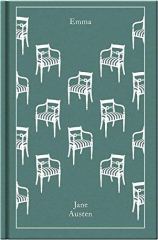
Jane Austen, Emma (1815)
Before the meeting:
I’m not much of a rereader, so reading Emma for the second time for the Book Group is a bit of an event. Please indulge me in some autobiographical reflection.
I first read Jane Austen novels, including Emma (but shamefully not Pride and Prejudice), as part of my exhilarating six years at Sydney University – 1967–1972 – when the Englit canon swept me away like a giant rip. Not just Englit: there was also Auslit and Amlit, as well as French, Italian and Latin lit. And movies. And even some visual art.
There was a problematic side to this exhilaration. The notion, which I think came from Thomas Arnold in the 19th century and received a big boost from F R Leavis in the twentieth, was that we should study ‘the best that has been thought and said in the world’, but in practice that meant what had been thought and said by white people in Europe, mainly England, and, in some electives, the USA. A lot was said about universal human truths, but that was for values of universal that excluded people of colour, colonised peoples, and settler peoples, among others. Not a terribly satisfactory education by today’s standards.
As a white boy from tropical North Queensland I was enough outside the magic circle of people who were purportedly capable of ‘the best’ that I had it confirmed that my life experience, my actual social and physical environment, was not the kind of thing great art could be made of, that I could see myself in ‘the best’ writing only at several removes, and conversely that any art that did talk about people and places I recognised was ipso facto not among the best. (It was a thrilling exception to see Paul Morel’s miner father disrupt a ladies’ afternoon tea in Sons and Lovers in just the way my cane-farmer father disrupted at least one of my mother’s gatherings, though without my father’s sense of fun.)
Emma was part of that centre-to-periphery invalidation. Mind you, that didn’t stop me from loving it with a passion.
I read differently now. I’m more aware of what I believe is called my positionality as a white, middle-class member of settler society, beneficiary of colonialism. Among other things, I’ve read Edward Said’s Culture and Imperialism, which includes a chapter on Austen’s Mansfield Park, and does a stunning job of explicating how West Indian slavery figures in that book.
Coming back to Emma now, the main thing I have to say is that I love it again. It’s full of marvellous sentences, often wreathed in irony. There’s a constant sense that Austen is laughing her head off with a straight face, that she loves her characters, especially Emma herself, with an indulgent love, and at the same time has a clear-eyed sense of their failings and limitations.
My Said-influenced antennae were alert for any unobtrusive reference to the big political issues of Austen’s day. But the one explicit reference to politics is a moment when the men are talking about politics so Emma has to find something else to talk about. And as Emma turns away from ‘serious’ talk, so does Austen. Mr Knightley might be describing her when he says of Emma’s friend Harriet:
She will give you all the minute particulars, which only women’s language can make interesting. – In our communications we deal only in the great.
His ‘we’ is, of course, men. But you know, the book does give us the minute particulars of women’s lives, in language that makes them interesting – and in doing so challenges the assumption that women’s concerns are trivial. I confess that in my twenties I almost missed Emma’s big moment, when she insults Miss Bates. Now, that moment carries a huge emotional charge. Austen makes sure we know how irritating Miss Bates is, by giving us pages of her inane nattering, but she also makes us see her dreadful lot in life, unmarried, carer to her aged mother and almost completely dependent on other people’s kindness, yet completely without malice. When Emma, with all her privilege, insults her so rudely, it’s devastating. The other character who highlights the lot of women is Jane Fairfax – and there’s a breathtaking moment when Jane draws an analogy between her having to farm herself out as a governess and that of people who are enslaved: ‘the sale – not quite of human flesh – but of human intellect’.
Emma was a revelation to me. On first reading it was part of the Great Tradition, which I as a boy from the canefields was meant to be in awe of (and I was). Now I read it as an assault on the canon of its time: cunningly, ironically, genially (in both sense of the word) it makes a space for what at least some women think and say. And a lot of her barbs still strike home.
After the meeting: We had a vey animated discussion. There were many points of view, many different levels of engagement with the book. One man had done extra reading – A Truth Universally Acknowledged: 33 Great Writers on Why We Read Jane Austen – and shared snippets. A number of us had rewatched Clueless – one said he needed it to find his bearings amid the 200-year-old wordiness. Another, actually one of our most astute readers – said he just couldn’t find a way into it – though he said the group’s conversation opened the book up for him. One just couldn’t stand the narrow class content. Another was surprised at how funny he found it, that he laughed out loud a number of times. And so on. We challenged each other, disagreed a little, and had a great time, spending most of the evening on the book.
Unusually, a number of us read out favourite sentences. I had counting on this, which is why I didn’t go hunting for examples in my Before the Meeting section. Here are some that got read out, for my readers’ pleasure.
From Chapter 9, when Emma has an idle moment:
Mr Perry walking hastily by, Mr William Cox letting himself in at the office-door, Mr Cole’s carriage-horses returning from exercise, or a stray letter-boy on an obstinate mule, were the liveliest objects she could presume to expect; and when her eyes fell only on the butcher with his tray, a tidy old woman travelling homewards from shop with her full basket, two curs quarrelling over a dirty bone, and a string of dawdling children round the baker’s little bow-window eyeing the gingerbread, she knew she had no reason to complain, and was amused enough; quite enough still to stand at the door. A mind lively and at ease, can do with seeing nothing, and can see nothing that does not answer.
From Chapter 7, one of the bits that some read as irritatingly snobbish, others as mocking the snobbery, but I think all agreed to be marvellously deft:
The Coles had been settled some years in Highbury, and were very good sort of people – friendly, liberal, and unpretending; but, on the other hand, they were of low origin, in trade, and only moderately genteel.
From Chapter 14, something that he who read it to us said he had experienced many times:
Some change of countenance was necessary for each gentleman as they walked into Mrs Weston’s drawing-room; – Mr Elton must compose his joyous looks, and Mr John Knightley disperse his ill-humour. Mr Elton must smile less, and Mr John Knightley more, to fit them for the place.—Emma only might be as nature prompted, and shew herself just as happy as she was.
And this from Chapter 4, a single sentence:
The charming Augusta Hawkins, in addition to all the usual advantages of perfect beauty and merit, was in possession of an independent fortune, of so many thousands as would always be called ten; a point of some dignity, as well as some convenience: the story told well; he had not thrown himself away – he had gained a woman of 10,000 £ or thereabouts; and he had gained her with such delightful rapidity – the first hour of introduction had been so very soon followed by distinguishing notice; the history which he had to give Mrs Cole of the rise and progress of the affair was so glorious – the steps so quick, from the accidental rencontre, to the dinner at Mr Green’s, and the party at Mrs Brown’s – smiles and blushes rising in importance – with consciousness and agitation richly scattered – the lady had been so easily impressed – so sweetly disposed – had in short, to use a most intelligible phrase, been so very ready to have him, that vanity and prudence were equally contented.
Verse 5: To be done
Moving home’s no roller-coaster,
no painful climb up, screaming down,
just daily questions like ‘New toaster?’
(answered ‘Yes’, though with a frown)
and wrap the artwork up in bubbles,
smash failed ceramics into rubbles,
organise a picture rail,
fix a redirect for mail,
fill a box with medications,
give away our potted lime,
dump the clock that’s lost its chime,
breathe slow when there’s palpitations
and so nothing will be missed
sit and write a to-do list.
Verse 4: Our new home, soon
Friday: day to take possession
(under licence) of our flat.
We got the key and in procession
took two chairs there. That was that
or so we thought. About 12.30
emails from the lawyers curtly
told us that we had no right
unless we paid before that night
a thousand bucks, and emailed paper
work we simply didn’t know
we had to have. To and fro
the calls and emails flew all day for
Friday. Solved by five! On Sun-
day twenty-box transfer is done.
And if that verse seems tortured to you, then all I can say is it reflects the process at least a little. In case it’s not clear, twenty boxes is just a beginning.
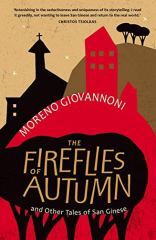
The Fireflies of Autumn begins with a bang. To be more precise, one of its first stories is a tall tale involving a vast explosion and enormous quantities of excrement – the kind of story that you feel you ought to have heard a thousand times, but which is actually completely new to you. or at least to me.
The book announces itself as a collection of tales told by Ugo Giovannoni, who migrated to Australia in 1957 – stories about the tiny Tuscan village of San Ginese that he left behind. These tales include folk versions of the distant past (as in the explosive one already mentioned), lore about Ugo’s forebears and relatives (much of it scurrilous), tales of the village during the Fascist era and World War Two (including the marvellous title story, in which the whole village decamps to a forest glade to avoid being caught in the crossfire between the Americans and the retreating Germans), and a little historical documentation.
I was reminded often of Fellini’s masterpiece of nostalgia, Amacord. The celebration of community, the occasional bawdiness (see my versification below), the indignation at the repressive role of the Church, all feel a little Felliniesque. But these tellings differ from Fellini’s in being told, not just from a different time, but also from a different place, in the diaspora.
Migration to America, Australia and occasionally Argentina is a dominant theme. Over the decades, those who leave often return once they have earned enough money to buy some land, or perhaps when the longing for home becomes too much to bear. As well as the wonderful, possibly romanticised evocation of village life, there is some fine writing about the effects of dislocation from migration:
And they would go to America and become lost over there, and when they returned to San Ginese they would still be lost, as if they could not find the place they had left, but kept looking for it, anywhere, somewhere, but it was always elsewhere – on top of a hill, along the walking paths between the villages, in a field, inside a stable or a pig-sty, inside a woman, a wife, a neighbour’s wife. You could see the men wandering about in the courtyards and between the houses, aimlessly at first, and then slowly they would give the appearance of settling into their lives again, but remained as sad as trees that have had half their roots hacked off. Such trees can barely feed and water themselves and are in danger of toppling over in the gentlest breezes.
In a way this collection of stories is itself a symbolic return, as a telling and reclaiming of the stories that had to be left behind. Ugo’s introduction tells us that he wrote the tales in Italian and sought out ‘a translator expert in the writing of immigrants’ to render it into English. That translator is of course the actual author, Ugo’s son Moreno, who came to Australia as a child in 1957. Some of the later stories in particular make it clear that, though Ugo may be the source of many of the tales, Moreno has drained many other tongues and done his own wandering about. The painful melancholy that is never far beneath the surface of these tales is his as much as Ugo’s.
After reading excerpts in Southerly a couple of years back (blog entries here), I was looking forward to the book’s publication. I wasn’t disappointed. It’s never boring, I smiled constantly and laughed often. Then in the final chapters, possibly affected by Altitude Adjusted Lacrimosity Syndrome as I read them on a plane, I wept copiously.
I recommend Lisa Hill’s review for a beautiful account of the book.
Because it’s November, and my blog has to include 14 14-line poems in the month, here’s a versification of a tiny story in the brilliant long chapter about the villagers in wartime:
November verse 3: The widow Pasquina
No one noticed when Bucchione
vanished as the sun went down,
gone to visit la Pasquina,
wealthy widow of that town.
She’d come out, no need for knocking,
ask you in (now is this shocking?),
offer you a bowl of wine
and several more till, feeling fine,
you told your troubles, like confession,
she’d strip you, take you to her bed,
then later make sure you were fed
and bathed beside the fire, refreshing
limbs and mind. In those hard days
she did this service for no pay.
November poem 2: Time’s arrow
The unforgiving fourth dimension
points one way, no turning back.
A single moment’s inattention
cycling on the Riesling track
going 20 k or faster
courts an imminent disaster.
Do not gaze at grazing sheep
or rocks thrust up from ancient deep:
you’ll clip the wheel you follow after,
hit the ground hard, skin your knee,
be run over, then all three
lie about in helpless laughter,
bloodied, bruised and now quite sure
to feature large in family lore.
In the middle of moving house, I’m currently in South Australia to celebrate a sister’s 70th birthday and a niece’s 30th, with any number of other siren calls on my attention. But November is LoSoRhyMo (Local Sonnet Rhyming Month), and I am obliged to produce 14 x 14-line poems over these 30 days. Rhyming is essential and quantity matters more than quality. (The fact that I’m the sole LoSoRhyMo-ist doesn’t render the obligation any less binding.) So here goes:
The Second of November: Memories of a Catholic childhood
On All Souls’ Day, each church visit
sets a suffering sinner free
from Purgatory. How could we miss it?
Duck inside and bend a knee,
Our Father, then a Hail and Glory
Be, and out. Repeat the story.
Girls held hankies to their hair.
No time to sit and think and stare.
Yet this cuckoo-clock palaver
held coding from a long-gone day
like amber that traps DNA.
Now I learn from calaveras
that those acts then, inside my head,
built friendly shrines to all my dead.
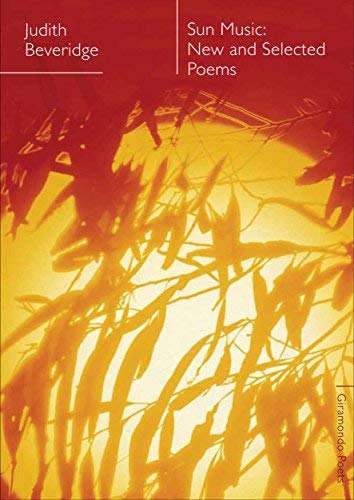
tl;dr: I love this book. Judith Beveridge writes a great self-introduction, and she is the queen of similes.
The six-page Author’s Note at the start of Judith Beveridge’s Sun Music is a class act. She begins by talking about her ‘pathological shyness’ as a child, adolescent and adult, seeing in it a partial explanation for why nature features ‘as an abiding source of connection’ in her poems, and for her turning to literature and the written word as a source of intense pleasure and a means of communication.
She goes on to describe the kind of poet she is – mainly lyrical, she says, rather than having ‘an over-heated experimental or exploratory approach’, deriving ‘idiosyncrasies of rhythm, music, voice, sensual knowledge, syntactical deportment, emotion and ideas’ from the body. She also acknowledges that she is a dramatic poet, particularly in two long sequences centred on the life of Siddhatta Gotama the Buddha (not included in this selection but promised as two thirds of a future book), and ‘Driftground’, about a group of fishermen, which account for 27 marvellous pages here.
She discusses influences and aspirations, and generally provides an excellent orientation to the 103 poems that follow. One sentence stood out for me:
It’s the challenge of trying to write a good poem rather than feeling that I have something unique to say that motivates me.
That sentence prepares one for the way her poetry is marvellously open to its subjects. She never comes wielding an agenda, but pays attention with tremendous humility, often to breathtaking effect.
I loved reading Sun Music, and came away resolved to keep my eyes and ears more open to the world, especially but not only to the birds and animals in my life.
When I wrote a blog post about Beveridge’s book Wolf Notes seven years ago I quoted lines about the moon from a number of poems. Looking back, I realise I was trying to communicate my awe at her use of similes. That awe deepened as I read this volume. Some random examples: ‘an egret posed like a too-slim / model in the glossy light’ (‘Sun Music’), or ‘On the headland motels light up / like bright perfume bottles’ (‘Resort Town’), or ‘bluebottles are cast up in clusters / of varicose knots’ (‘Spittle Beach’), or (from ‘Lighthouse Beach’):
________________________________________a lighthouse
stands still as an altarpiece, then for a moment,
sea-misted, it looks like a whale's spout
about to give way to wind and waves.
Occasionally there’s some showing off – as in ‘The Harbour’, where everything in the poem is seen as something to do with food or its preparation or consumption (the Opera House like an ‘arrangement of prim serviettes’). But it almost always feels as if Beveridge’s similes arise from the quality of attention she has paid to the thing she sees (or hears) – as if it gives her words to describe it, words that she then passes on to us.
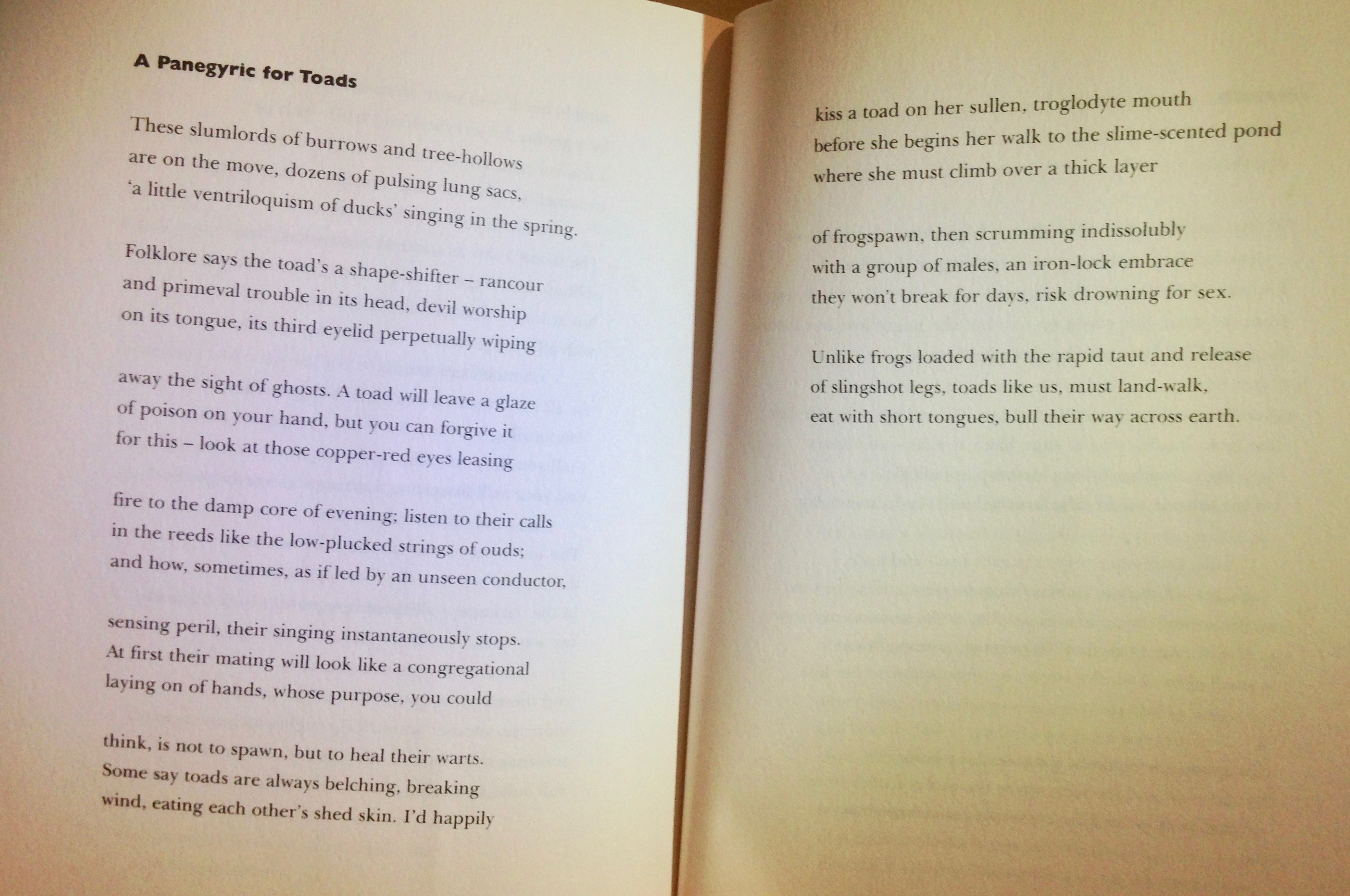
I generally try to single out just one poem I connect with when I blog about a book of poetry. There are so many to choose from here, but I’ve settled on ‘Panegyric for Toads’, one of the thirty-three new poems on the final section – because I’ve been thinking about my North Queensland childhood recently, and this poem restored memory of the ubiquitous cane toads, and captures something of the secret affection I had for them as a child. Here’s the poem (click to enlarge):
The beginning – ‘These slumlords of burrows and tree-hollows / are on the move’ – evokes an image of toads – squat and repugnant as cartoon slum landlords, then after the line break they are ‘on the move’. This is not a panegyric to a single toad, and not to toads in general, but to a particular set of toads, dozens of them, part of the pestilential spread of their species across vast tracts of Australia. The general point isn’t laboured, it may not even be intended, but it’s strongly there, and the poem goes back to beautifully concise description of their appearance and sound.
The rest of the poem moves back and forth between general cultural and scientific knowledge about toads and precise, felt observation. There’s the folklore, the glaze of poison (we had a dog that tried to eat a toad and got very sick), the mating . All pretty yuck, really. But
__________look at those copper-red eyes leasing

fire to the damp core of evening; listen to their calls
in the reeds like the low-plucked strings of  ouds;
and how, sometimes, as if led by an unseen conductor,

sensing peril, their singing instantaneously stops.
Well, yes, one has to concede, there is that. But then she goes for the most grotesque aspect of these creatures, their mating (here’s a link to a video in case you need to refresh your memory). There’s a marvellous reversal of the expected order here: there is description of the grotesquerie, the female
____________________scrumming indissolubly
with a group of males, an iron-lock embrace
they won't break for days, risk drowning for sex.
But that comes after the process has been described as ‘like a congregational / laying on of hands’, whose purpose is to heal their warts. And it comes after the poem’s genuinely shocking moment:
Some say toads are always belching, breaking
wind, eating each other's shed skin. I'd happily

kiss a toad on her sullen, troglodyte mouth
It’s hard to know what to make of that, apart from to be revolted. The fairytale reference suggests that some transformation might result: it could be that the poet would happily kiss the toad to spare her from the ordeal of the mating scrum, but I don’t think that’s it. Maybe there is a transformation here, though: the poet has seen past the belching, farting, dead-skin eating, sullen wartiness to what is wonderful about these creatures and her response to them has been transformed into something like love. Certainly, coming where they do in the poem, the lines about indissoluble scrumming and risking drowning for sex are celebratory more than anything.
The last three lines, after evoking the beauty of frogs, end with an assertion of fellow-feeling. Maybe we like to think of ourselves as agile, smooth-skinned frogs, but really, warts and all, we’re like toads.
The poem was included in Black Inc’s The Best Australian Poems 2016 edited by Sarah Holland-Batt. A reviewer in in The Australian (link here, not behind pay wall) wrote:
Judith Beveridge’s ‘A Panegyric for Toads‘ is a breathtaking piece that conflates the behaviour of toads with our reckless treatment of the environment.
I’m not saying that’s wrong, but I just don’t see it. I don’t think the toads here represent anything. Sometimes a toad is just a toad.



 Me fail? I fly!