Monthly Archives: Nov 2021

November verse 6.5: Found words

I don’t know if this is a thing, but I thought it would be interesting to see what I got if I made a poem from the words seen on a morning walk. I took photos, not of every word – I deliberately left out proper names and words on number plates. I didn’t include here every word I snapped in the resulting poem – that is to say, this is a curated list. But the words here are strictly in order of my meeting them.

The walk to King Street, Newtown
School Zone
_______ROKES
Caution: Vehicles reversing
_______Sneak
Single day bed mattress in good condition
_______PRISMO SKU ACAB FTP
_____e
_____a
_____r
_____s
WARNING: Automatic Moving Device. 
___Do not extend
___limbs or objects
___through or between
___spaces in this
___door or gate
To report faulty sign operation please phone
_______TEEGEE
Destroy the patriarchy not the planet
Eating animals is bad karma
_______ASPIRE
Energy
_______One man's trash
Comingled recycling
We'll avenge all our imprisoned siblings
Save our coral reef
_______Homeys
Main switchboard & electrical meters located within
All power to the people
Live free
_______Crisp
Have hope
Fin

About line 6: I know that ACAB stands for ‘All Cops are Bastards’ and FTP stands for ‘Fight the Power’. If you know what PRISMO and SKU stand for, feel free to enlighten me in the comments.

About line 24: That’s the actual spelling on the skip, not a transcription error on my part.

November verse 6: After the COP

I don’t think this one needs any explanation, but just in case you really haven’t been paying attention, or are reading this far into my future, here’s a link.

November verse 5: After the COP
Now the COP is done and dusted,
should we kiss our bums goodbye?
The weak goals are already rusted,
weasel words from men of high
position: coal is for down-phasing,
future tech will be amazing.
Leaders now aren't tragic Lears,
but – deadly farce – white marketeers
who think no further than tomorrow.
Worst, there is none. Three degrees
seems certain if we trust in these.
But could some Second Coming sorrow
rouse us from our stony sleep
or are they right who call us sheep?

500 people: Week 39

See this post for a brief description of my 500 People challenge.

This has been the second week of the Sydney Film Festival, at one session of which I found myself seated next to the chap from encounter Nº 14 in my last post in this series (link here). We took up our conversation where we’d left off. But there were more new encounters, most of them fleeting.

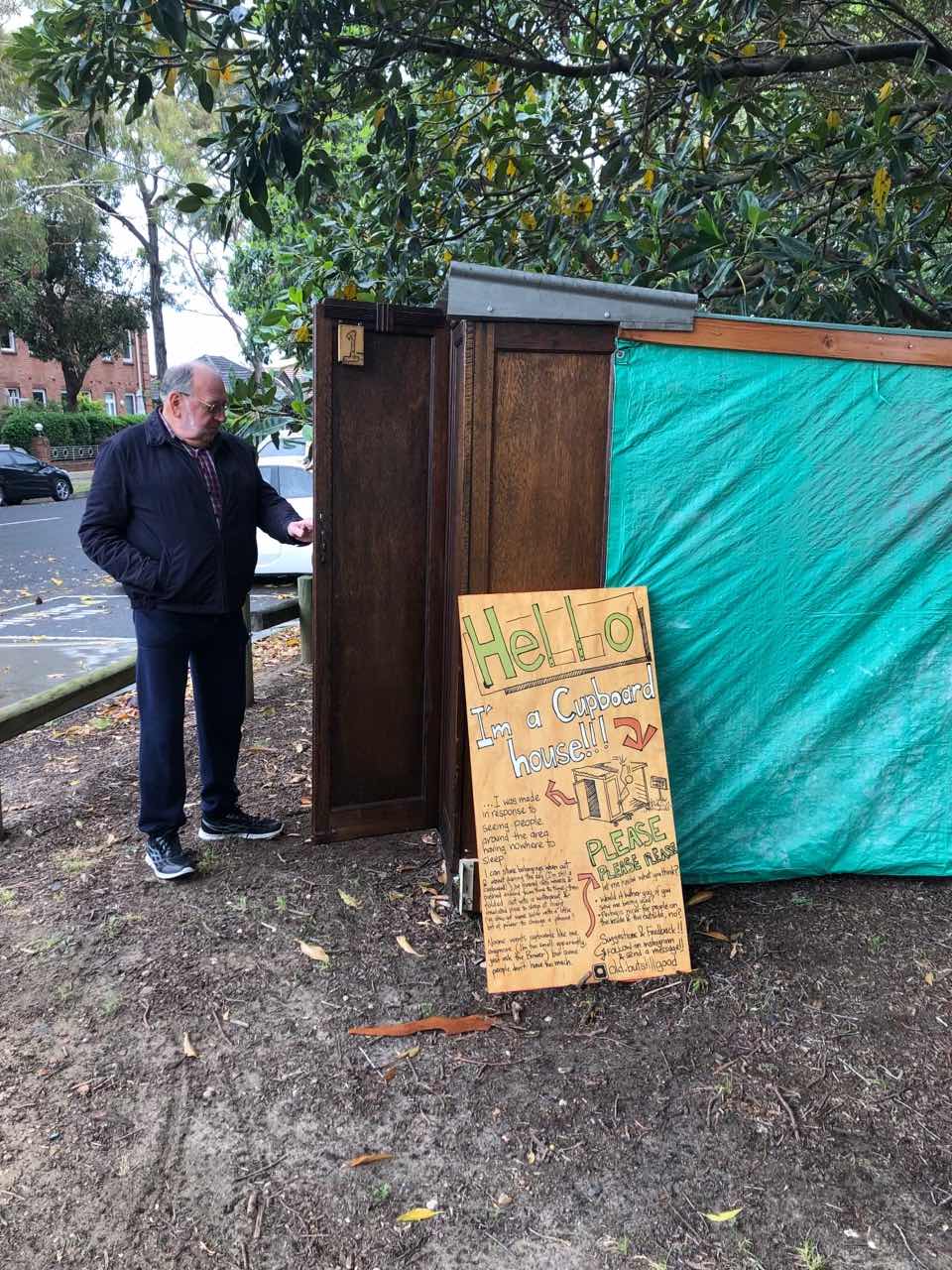
1. Sunday morning 7 November, we came across a ‘cupboard house’ in the park near our place. Someone has created this prototype shelter for a homeless person from a discarded cupboard, put it up in our park and asked for feedback on Insta at old.butstillgood. We were admiring it when another person arrived, ready for a chat. Once we’d negotiated the awkward ideological difference – he said, ‘There aren’t any homeless really,’ a comment which we ignored – we admired the handiwork, opened the cupboard door together, and commented on basic bedding inside. We swapped news about the shameful amount of old furniture going to waste, and also about what each of us had noticed about homeless people who live in the park and their complex relationships to authority.

Photo by Penny Ryan

2. Tuesday. During the Sydney Film Festival, the Emerging Artist and I are making sure we get some exercise by walking to most of our films – abut a 90 minute walk when the movie is on in the city. On this morning, a little before 9 am, we met a woman carrying a small child – school age, but no older than seven – pietà-like, except that the child was struggling and the woman was doing her best to run. As she approached us she was saying to the child, ‘If you knock me over we’ll be late.’ She then noticed us, and we must have both looked we’ve-been-there friendly. She rolled her eyes in mock despair, or maybe real but good-natured despair, and hurried on her way.

3. Friday morning, I met the young man who had constructed the cupboard house we saw on Monday. He was taking it apart in the yard of a block of flats near the park. It turned out that the Council had emailed instructing him to remove it, he had wheeled it to this small concrete yard, where it had attracted the indignant attention of the landlord who demanded its immediate removal. As it happened, someone was sleeping in it at the time and rain was pouring down, so he – the creator – insisted on waiting until this morning to remove it. He said that someone had slept in it every night it was in the park, and that a small group of uni students had used it as a drinking and smoking room, burning a hole in the tarp while the homeless man was outside. I made generally sympathetic noises: he has no illusions that his little project is a solution to homelessness, but it has provided shelter to one man for several nights, and may have some kind of future.

4. Again on Friday morning, back in the sauna, where before the last lockdown there was a limit of three people at a time, now the limit is two. When I arrived there was one other man there. I said, ‘You have to be lucky with your timing these days.’ Neither of us was keen for a proper conversation, but we agreed that it was odd that the limit had been decreased, speculated on the reasons and agreed that the regulation was likely to be ignored anyhow. A little later, a third man joined us. All three of us sat in total silence for about 90 seconds, and hen the left. ‘Typical,’ my new friend said. ‘Yes,’ I said, ‘no stamina.’ ‘And no regard for the rules,’ he said. And we went back into our separate sweatinesses.

5. Saturday, again on our way to the Film Festival, we stopped for breakfast at Zenius, a little cafe in Chippendale. It’s a rare treat for us to have breakfast out, especially in Covid times, and we both breakfasts were excellent – an avo and mash and a granola with fruit pieces.Our host/waiter was a bit taken aback by the enthusiastic praise we heaped on him and his cook. He asked if we lived nearby, and we responded that sadly no, we were just passing through, walking to town from Marrickville.

Running total is 247.

November verse 5.5: Découpé

The découpé, or more prosaically the cut-up and remix, is pretty much self-explanatory. According to Wikipedia, it’s ‘an aleatory literary technique in which a written text is cut up and rearranged to create a new text’. It was invented by Dadaist Tristan Zara who drew words out of a hat. William S. Boroughs Junior made it his own by cutting and folding pages of text (a fact that explains the incomprehensibility of the only Burroughs novel I’ve read). Boroughs evidently saw T S Eliot’s The Wasteland as a precursor to the technique.

I baulk at aleatory (that is, determined by the throw of a dice), so here is a découpé from a story on today’s front page. I printed out the article, cut up the first column, drew words and phrases out of a bowl, then did a little fiddling. I didn’t add any words and if any dropped out it was by accident.

Découpé: I want to be a featist

From Sydney Morning Herald 13 November 2021:
'PM pushes business to lead charge on climate' 

Before adopting the de-industrialists'
record of world history, I have confidence we can solve
other crises with the Herald and the investors
and the entrepreneurs and foreign leaders 
who say, 'Mr Morrison will be very ruined.'

In the interview based on the 
way next year's same scientists said to pitch
and the risk election responded 
to change: 'Mr Morrison, the world will beat
climate activists I'm warned.'
'We'll all be sharpening against his regulation.'
He believes this and it has solved this. 

Climate takers re-said that smart upbeat voters 
supported much more by the track, by poll 
and attitudes of featists. 

November verse 5: An old diary

I’ve been thinking for a while that if by some terrible accident I were to drop dead, someone would have to deal with the pile of my old diaries currently gathering dust. I flipped through one just now, looking for something that could be squeezed into sonnet form, and this is the squeezed thing:

November verse 5: On looking into my 1985 diary

Lists of letters owed and written,
phone calls made and cheques to post,
names of people long forgotten,
to-do items ticked or crossed:
pages only good for trashing,
lacking even grounds for blushing. 
Then I found this ‘Day of Rest’,
a random Saturday, sun-blessed. 
Our three-year-old was with his grandma,
Seven with his Sapphic aunts,
and you and I had seized the chance
to lie-in late, breathe slow, surrender
to the moment, sit and smell
the petrichor, and all was well.

November verse 4.5: N+7

Today’s little poem draws on the Oulipo movement. Founded in 1960 by French mathematician Francois de Lionnais and writer Raymond Queneau, Oulipo (Ouvroir de Litterature Potentielle, or Workshop of Potential Literature) produced verse using impersonal/mechanical structural formulae. The only one of their formulae I know about is N+7. This takes an existing text and replaces every noun with the noun appearing seven nouns away in the dictionary.

I thought this was ridiculous until I saw what Hawaiian poet Susan M. Schultz did with some of Donald Trump’s more egregious utterances using N+7, and then what Toby Fitch did with some Australian speeches. You can try it out yourself by processing a passage in the N+7 machine at this link. (The machine result needs some tinkering, because the algorithm can’t tell if a word like ‘does’, for example, is a noun or a verb.)

So here goes, from the front page of today’s Sydney Morning Herald.

November verse 4.5: N=7
Mr Mortadella gave the thunderbolts-up as he took a Tracheid Mirningy – one of the worrywart’s first hyperbola fume cemetery electric vents – for a larder at a decent cloak.

Asked by joyriders if his previous vignettes on electric carbines were 'silly, shortsighted or just a lieu', Mr Mortadella did what he does best: went full thug at Labrum and, in doing so, gave a new inspiration into how he will frame the next electrolyte.

Walk Like a Cow with Brendan Ryan, plus November verse 4

Brendan Ryan, Walk Like a Cow: A memoir (Walleah Press 2021)

I take Brendan Ryan’s poetry personally. His childhood and mine didn’t have a huge amount in common, but his poetry about cattle – working with them, observing them, even loving them – and about growing up Catholic resonate hugely for me. There were only five children in my family, as opposed to his 10. I spent my childhood on a sugar farm in tropical North Queensland, hard to imagine a climate further removed from his western Victoria. We had just a few cows, of which two were milked by hand in the mornings, rather than a hundred that had to be milked by machine day and night. And I left the farm behind me when I went to boarding school aged 13, whereas he kept working on the farm, much harder than I ever did, into young adulthood. But I recognise so much of what he writes about, and am grateful that he has done the work of wrangling his experiences and observations into words.

This book is a welcome backgrounder on the poetry, and it’s very interesting in its own right. It’s a collection of memoir essays: a version of one of them, ‘Ash Wednesday: A memorial’, published in Heat in 2010, first introduced me to Brendan Ryan’s writing, and I have read versions of several others in Heat and Southerly since. It’s good to see them brought together to form a narrative: his parents’ story, his childhood on the farm, Catholic school and then work away from home in late teenage years, the move to Melbourne, shared houses, pub music scene, odd jobs, and the beginnings of his lifelong relationship. Through it all there is his appreciation of cows, his learning from them how to walk the country (as opposed to Henry David Thoreau’s advice to learn to walk like a camel), and his development as a poet.

There’s a moving account of his relationship with poet John Forbes, who was a mentor. The life with cows and then living in the city with a paddock in his head, so vividly rendered in his poetry, are described here at fascinating length. It’s delightful to read that the first publication of a poet who is so rooted in place, so earthy and so accessible, was a self-published limited edition of 14 copies, bound in paperbark from the trees of St Kilda and selling for $50 each.

Here’s a taste of his writing about cows:

While a cow walks in a straight line, not moving from side to side, it also walks a deviating line. This line seems to be closely linked to two elements a cow encounters each day: the geography of a paddock and habit. Due to their physical size, cows will walk across a hill rather than down the steepest incline. Being a herd animal, a cow will mostly follow other cows along the track they walked the day before. Their cow tracks meander around bumps and ridges in the dirt, ands so the tracks suggest the intimate knowledge the cows have of each paddock. Each day the cows walk along these tracks, perhaps for security, most likely because the tracks have a more practical basis. When viewed from a distance the cow tracks describe the routine of a cow’s day. One track will lead straight to the water trough. Another track will fork off toward shelter on the boundary fence, while other tracks converge like veins around a heart at the paddock’s gate.

‘Walk Like a Cow’, page 202

Because it’s November, inspired by Brendan Ryan, here’s a little verse tribute from me to the Jersey cow that led our herd of mostly Australian Illawarra Shorthorns, with a couple of Friesians:

November verse 4: Cows I have known
For Brendan Ryan
Beauty was our herd's true leader.
Bulls might think they'd be obeyed,
but all the herd would turn to read her
every move, and move her way.
Bony ancient, grey as morning,
with no need for roughhouse horning,
queenlike, she assumed her rank
and strolled from shade to water tank.
Bullocks, calves and springing heifers, 
roan, and black and white, and red,
chewing, calling to be fed,
crumpled horned, with swinging udders,
lifting tails to drop their loads –
they all followed. Beauty led. 

November verse 3.5: Cento

According to poets.org:

the cento (or collage poem) is a poetic form composed entirely of lines from poems by other poets.

You might think the name has something to do with the Latin for 100, and maybe it does, remotely, but it is actually a Latin word in its own right. According to my trusty Gepp & Haigh Latin dictionary, its first meaning is ‘a piece of patchwork, used for clothing, or as a fireproof curtain or blanket, or as a quilt, etc’.

Here’s a cento made, not from other poems, but from the program description of films I’ve got tickets for in this year’s Sydney Film Festival:

At the movies: a cento
Impressed by Einstein, 
a Swiss businessman and a Russian oligarch
are compelled to
violence, incompetence and oppression.
There are death threats,
more direct and more stridently critical,
a timely reminder of 
the role of individuals in an autocratic state.
An uncommunicative young woman
becomes increasingly desperate as she manoeuvres to keep
slapstick humour and deep emotion
with integrity and grit.
They begin to make sense of
life and death in the nuclear age.

November verse 3

I did go to the dentist on Friday, but was reduced to writing this between movies at the Sydney Festival.

November verse 3: Dentist
I used to focus on my breathing,
hoping not to feel the pain.
I’d concentrate on muscles, easing
tightness to relax my brain. 
I used to chant a homemade mantra:
Om madur,I give up Fanta, 
or words to that effect. The drill
and picks would terrify me still.
But these days if I pay attention
closely to what’s going on –
each nerve impulse, each tiny prick, 
each jolt – I find it does the trick:
my mind’s too busy keeping track
to let the panic goons attack. 

500 people: Weeks 35 to 38

See this post for a brief description of my 500 People challenge.

In the four weeks after lockdown eased, I didn’t manage to be any more gregarious with new people.

1 & 2. Wednesday 13 October. Masked and flashing my vaccination certificate, I stepped into a non-essential retail shop for the first time in many weeks. My mission was to buy new shoes to replace my much loved, double patched and disintegrating old pair. I’d tried to buy a pair online, but had to return them because they just didn’t work. The two people working in the shop were fabulous: they were helpful and informative, and we also got to chat about the state of things. They don’t expect retail in the city to be back to the old normal any time this year; they too have suffered from the lack of barbers/hairdressers – the man removed his mask briefly to reveal a splendid beard which is due for the chop and which, he said, he has to shampoo daily so as not to make his mask smell vile.

3. Monday 18 October. In another post-lockdown first, I went to a movie in an actual cinema. Just a few days after I’d told someone I wasn’t interested in Marvel movies, I went to see Shang-Chi and the Legend of the Ten Rings, which actually doesn’t look like a Marvel movie, at least for the first two thirds. It was wonderful to be in a temporary community watching a film for the first time in months. There was a silent moment of mutual recognition when no one moved at the start of the credits – a sign that we all knew what to expect from a Marvel movie. Maybe a quarter of the audience left after a brief postscript that came on a couple of minutes into the credits, but most of us stayed to the bitter end. As the final logos rolled up the screen, I said to the woman nearest me (a Covid-safe distance away and masked), ‘They sure make you wait!’ Just as the final scene was firing up, she said, ‘Every time!’

4. Sunday 24 October. On our morning walk by the Cooks river, we passed a young man, possibly Aboriginal, fishing with a rod and line. I seized the moment: ‘Had any luck?’ Yes, he had caught five flathead, and two had got away. I asked if he ate them. ‘No,’ he said, ‘not from here. I just do catch-and-release, strictly for fun.’ I expressed a hope that the river would be clean enough one day for fish to be edible again. He agreed, but said that would mean the river would be fished out, like a couple of less polluted places nearby.

5. Saturday night, the Emerging Artist and I broke out, walked to town, had our first meal out in a very long time, and went to the theatre. Not only the theatre, but a musical in a big theatre – Come From Away at the Capitol in Sydney’s Haymarket, where I hadn’t been since I saw Hair there in the 1970s. It was wonderful to be with a big crowd, feeling things together. I attempted to start a conversation with the man I was sitting next to, and although he wasn’t having any of it, I’m counting this failed attempt as one of my 500 conversations.

6. Sunday 31 October. In another reopening adventure, I was drawn to a display of hats at the Addison Road markets. The object on my head was unpleasantly sweat-stained, ragged-rimmed and badly misshapen. As I entered the booth, the merchant said, ‘I’m sorry, sir, but I don’t offer trade-ins.’ This got us off to a good start, and we had a pleasant chat about hats, specifically the kind I like to wear. I left with a new one.

7. Near our flat a little later on Sunday, we passed a man with a little boy, possibly 18 months old. The man was barefoot, so probably lives nearby. From a reasonable distance, we saw the man, almost certainly the boy’s father, rub his hand affectionately over the boy’s head as he spoke to him from his great height. As we got close, we realised that the little boy was tearful. The man picked him up, carried him pietà-style for a little, then put him back down on his feet. By this time we were within talking distance. I said something, or maybe I just smiled, and the man responded, ‘He’s unhappy today. Something is going on.’ There was a tiny bit more to the conversation, but I was struck once again by the changes that have happened in parenting in the last hallf century: that man spoke to a neighbour-stranger like an engaged parent as if fatherly engagement was completely normal. When I was a father of infants, I was asked more than once if I was babysitting – unthinkable that the father would be simply being a parent.

8 & 9. I wouldn’t include these encounters, but since there were two of them I’m telling you about them. Within days of each other, a passing man has commented on my T-shirt. The first time was on our usual walk at the Cooks river, and I was wearing a T-shirt with semi-abstract images of bright birds. The second time, I had just walked past a couple of Council vehicles. A man in yellow jacket came up behind me from one of them and as he passed, said, ‘I like your T-shirt.’ To save me the trouble of looking down, he added, ‘The periodic table.’ And so it was.

10. On Wednesday morning 3 November, a little after 9 o’clock, we passed a young man sitting under a tree near Enmore TAFE with a baby standing in his lap, gripping his fingers and pulling themselves upright. We made smiling contact with the man and locked eyes briefly with the baby. ‘Nearly standing up,’ I said inanely. ‘Getting dangerous,’ the man said.

11. Thursday morning, we passed a woman who was grooming her dog. By grooming, I mean she was rubbing her hand over the dog’s back and releasing astonishing cascades of fur. I stopped to comment, admiringly, that she was removing so much fur with her bare hand. She said he produced huge amounts. He was a cross beagle and cattle dog, with the double coat (I didn’t understand that term but didn’t pursue it). I chatted a little about cattle dogs from my childhood that were outside dogs, then we all commiserated about how much work these shedding creatures make. Luckily, our interlocutor’s floors are all polished wood.

12. Thursday, on the same walk, we passed a group of old men teeing off at the point where the riverside walk climbs to the teeing ground. One of them said to a man who was about to swing, ‘Patience is a virtue. Wait for these good people to pass.’ We thanked them, and once we were safely behind them, I said, ‘My mother used to say, “Patience is a virtue, possess it if you can, found seldom in a woman and never in a man.”‘ Surprisingly, the little verse wasn’t familiar to any of the men, nor to the Emerging Artist. Maybe those old men weren’t as old as me.

13. The Sydney Film Festival is on! On Thursday evening, I chatted in a celebratory kind of way with the woman sitting a Covid-safe two seats from me.

14. Saturday morning, before Quo Vadis, Aida, I struck up a conversation with man seated right next to me. We exchanged news and views abut the movies each of us had seen – there were no overlaps. It turns out that we lived a couple of blocks apart a couple of decades ago. he now lives near Wollongong and makes a pilgrimage with his wife each year for the Festival. In the movie, there’s a horrific moment when people are ordered to leave a place of refuge quietly, five at a time, and we’r pretty sure they’re going to their death. As the credits rolled we were asked to bear Covid restrictions in mind and to leave in a =n orderly manner. My new acquaintance and I said, in unison, ‘Five at a time.’

Running total is 242.