Yearly Archives: 2021

A slam poem by Alicia Payne MP

In case you missed it, here’s the splendid text of a slam poem performed at the beginning of this month by Alicia Payne, the Federal Member for Canberra in the Australian House of Representatives. Video below.

I rise today to talk about some of the reasons that we need to vote the Morrison Government out. 
'I don't hold a hose, mate'
forced handshakes of fire victims
pledging billions for recovery funds but spending none
a three year wait for the promised federal ICAC
gagging debate in this place at literally every opportunity 
hundreds of questions on notice not answered 
FOI refusals 
anonymous one million dollar donations
Watergate, Grassgate, Sports Rorts, Pork n Ride, regional rorts
The Member for Fadden's giant Internet bills 
visas for au pairs, no visas for Afghan interpreters
the Biloela family 
'Electric vehicles will end the weekend'
birthing lanes on the Barton highway
fossil fuel executives deciding government policy on the Covid commission 
the prosecution of Bernard Collaery and Witness K 
raiding a journalist's home
interference, intimidation and cuts to the ABC 
Senator Cash tipping off media to a secret AFP investigation 
Robodebt, aged-care, hotel quarantine, front of the vaccine queue
'It's not a race'
Senators Rennick, Canavan and the Member for Dawson's constant anti-vax social media posting
signing up to international agreements and walking away from them a day later 
attempts to block the Great Barrier Reef being placed on a list of endangered world heritage sites
Brittany Higgins 
the Prime Minister attacking journalists in press conferences
telling us we're lucky we weren't being shot at
'Think of it as a father' 
40,000 university jobs lost 
the Ruby Princess 
paying $30 million for land worth $3 million
spending millions on a Covid app that doesn't work
Christine Holgate 
leaking diplomatic messages

The member's time has expired

I was just getting started.

The Book Group and The GrandMasters #Sh*tf*ckery

The Book Group had our end of year meeting last night. I wasn’t going to blog about it as there was no book to discuss, but things happened to change my mind.

We had our now-traditional ‘gentlemen’s picnic’ – which is to say, everyone brought food. We had dumplings, barbecued prawns, delicious roast potatoes with rosemary and garlic, Portuguese chicken, plus a bowl of peas so we’d have some greens, followed by a fruit platter, pastéis de nata and mince pies, all accompanied by excellent conversation and much laughter.

Then down to work. Instead of a book, in what may become a tradition, we each brought a poem and read it aloud. The poems ranged from Les Murray’s ‘An Absolutely Ordinary Rainbow‘, read to us beautifully by a man to whom Les Murray had read it as a student audience of one, to a completely foul Rodney Rude limerick. Between those extremes were Janet Frame, David Malouf, Barbara Vernon (the fabulous opening stage direction to her 1957 play The Multicoloured Umbrella), Raymond Carver, Adrian Wiggins, anonymous children’s versifiers, and Naomi Shihab Nye. Readings were punctuated by wonderful anecdotes about complex intimacies, the sound of rain on an iron roof, 9th century Japanese poetics, student life in times past, father–son connections and more.

Finally, the Kris Kringle. We each brought a book from our shelves, suitably wrapped and given out at random. Once the books were unwrapped we all looked happy with what we’d got, though the one who’d scored three folded pieces of waxed cloth looked a little mystified and his happy appearance may have been a little strained. (He found out later in the evening that the giver had brought the wrong one of two identically wrapped parcels from home, and will get the book to him soon.) I’m delighted by my book, and because it’s a very quick read, I get to do this blog post:

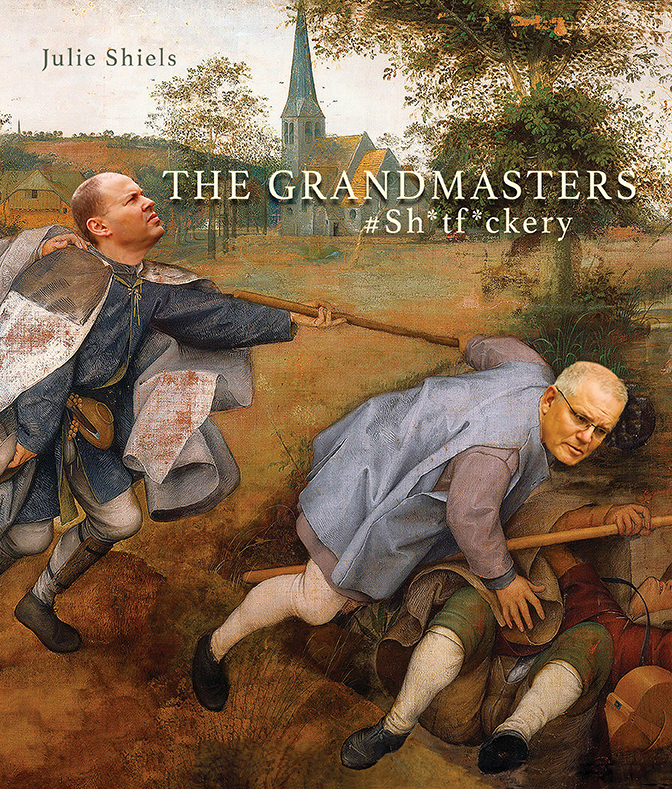
Julie Shiels, The GrandMasters #Sh*tf*ckery (M.33 2021)

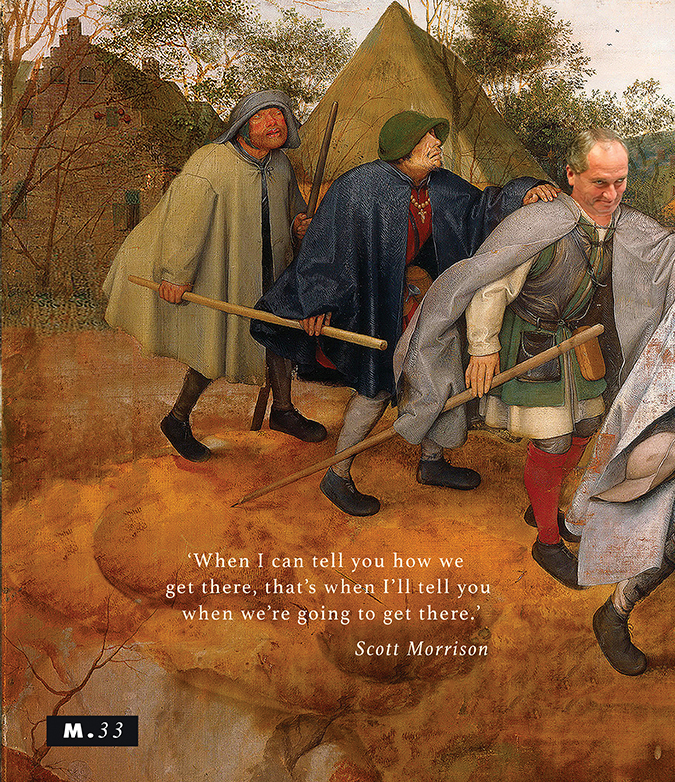
Julie Shiels is a Melbourne artist who created a series of digital collages, starting during the Great Covid–19 Lockdown of 2020. She took a number of paintings by old masters, gave some of their personages the faces of contemporary Australian political leaders, and added pointed captions. For example, the dustjacket (left) has The Parable of the Blind Leading the Blind by Pieter Bruegel the Elder featuring Scott Morrison, Josh Frydenberg and Barnaby Joyce. The satirical point would be clear enough, but then there’s the caption, a quote from the Prime Minister: ‘When I can tell you how we get there, that’s when I’ll tell you when we’re going to get there.’

The book simmers with rage, as it covers Robodebt, the federal government’s handling of the vaccine rollout, the scandal around Christian Porter, the Britney Higgins matter, climate change, Peter Dutton deciding to smile, Karen Andrews describing herself as compassionate, the abandonment of Australia’s Afghan friends, and so on.

I laughed out loud at the title page, which has a smirking Morrison standing by the woman’s corpse in Jerome Preudhomme’s The Death of Lucretia, while Michaelia Cash and Marise Payne play other roles – the caption: ‘Blokes don’t get it right all the time.’ Other pages – including but not limited to variations on the rape of Lucretia – are too horrible to be funny, but horrible in a bracing way. Some images land only in the general vicinity of their targets, and some – such as Scott Morrison as Aeneas carrying his ailing father in Pompeo Bartoni’s Aeneas Fleeing from Troy, saying ‘We are all Melburnians now’, or Dan Tehan as Rubens’ Saturn Devouring His Son – hit the bullseye.

This is an art book. The quality of the reproductions is excellent. The face-changes are mostly convincing, and where they’re not the effect is comic rather than shambolic (Julie Shiels must have trawled through millions of photographs to get the heads at just the right angle, the faces with just the right expression).

I recommend it as a gift for a politics-junkie friend who is into art. According to the M.33 website, only 300 copies were published, so you may need to be quick if you want one. The collages, being digital creations in the first place, can be see on Julie Shiels’s website at this link.


The GrandMasters #Sh*tf*ckery is the 15th book I’ve read for the Australian Women Writers Challenge 2021.

Journal Blitz 11

I’m constantly in catchup mode with my reading of literary journals. I tend to start each one with a sense of taking on a burdensome duty – after all, these journals are invariably dancing on the edge of the precipice of financial ruin. By about the third page I’m usually engrossed and remember why they’re worth supporting.


Evelyn Araluen and Jonathan Dunk (editors), Overland 241 (Summer 2020)
(The content is online at overland.org.au, and I’ve included links)

Each issue of Overland currently (that is to say, a year ago, which is where I’m up to) is a three-parter.

Taking up the first two thirds is the articles section, a platform for marginalised voices and for arguments from outside the Overton window. The stand-out article in this issue is ‘No longer malleable stuff‘ by Jeanine Leane, an uncompromising contribution to the current conversation about who has the right to tell whose stories:

Australian fictionists may and most likely will still fossick over the stolen lands of the nation but we – First Nations peoples, Peoples of Colour – are no longer the ‘malleable stuff’ of the unchecked settler imagination. Perhaps there wouldn’t be a point in talking about an author’s identity if they were all the same. But this is no longer the case. We’re not dead. And, we’re not white. We write. Our identities matter.

Also in this issue, Mammad Aidani, whose writings have been banned in his native Iran, argues that it would be wrong of him to allow his writing to be published there (‘300 words for truth‘); Sam Altman sketches the ‘wholesale collapse of Earth’s planetary systems that sustain life as we know it’ (‘Prepare for collapse‘); Lisa Stefanoff promotes the movie In My Blood it Runs (‘The Australian government is not listening: education justice and remote Indigenous futures‘); Jinghua Qian and Liz Crash promote their virtual multimedia tour of the Melbourne suburb of Footscray (‘Underfoot: history from below‘); Angelita Biscotti reflects on her work as a nude photographic model, which she has come to see as sex work, and quotes the book I haven’t read whose ideas fascinate me most, The Managed Heart by Arlie Russell Hochschild (‘On the fantasy work that makes life bearable‘).

Second, there’s the 12-page poetry section, edited by Toby Fitch. From a strong and varied field, it’s again a first Nations voice that grabs me: ‘Mnemonic 2020‘ by Yeena Kirkbright walks us in 13 sections, each named for a colour, through the rough year that has just been (this issue was published at the end of 2020). Here’s section 8:

8. _______Purple
After the Jacaranda blooms we go into lockdown.
We are locked in together on Gadigal land. 
I work from my bedroom and feel more trapped than ever.
A manager tells me she heard an Aboriginal woman 
on Sky News say blak breathlessness isn't a problem. 
Not in Australia.
I am livid. I can't argue. I need to pay bills.

Third, the fiction section, edited by Claire Corbett, comprises four short stories, all terrific. ‘Frog song‘ by Magdalena McGuire has a mother and small child in sweltering Darwin weather: ‘It shocks them to discover the sun is not a thing of beauty.’ In ‘Smoke and mirrors‘, poet Samuel Wagan Watson tells a story of loss and grief with a (spoiler alert) twist I didn’t see coming. ‘The white sea‘ by Alistair Kitchen is an unsettling fable in which the sea turns white ‘in the way milk is white – thick and full and opaque’. With Jane Turner Goldsmith’s ‘Smoke road‘, we’re back in naturalistic mode with a taut, understated tale of leaving an abusive relationship.

It looks as if the print edition of Overland no longer publishes the results of the literary competitions listed on the website. This seems to have resulted in a cleaner through-line for each issue. The absence of regular columns has a similar effect, but I do miss the cameo appearances of Alison Croggon, Tony Birch, Giovanni Tiso et al.


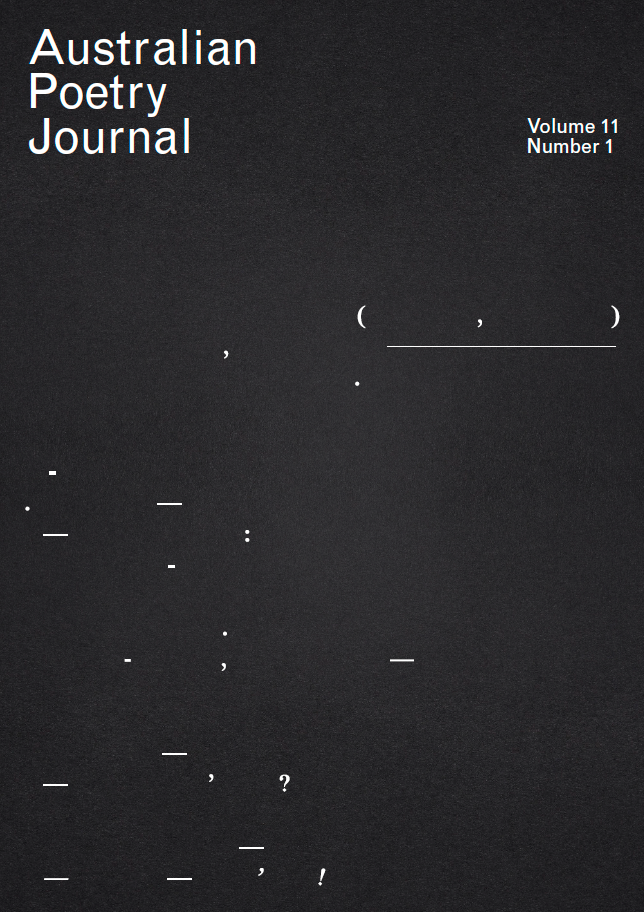
Stuart Barnes & Claire Gaskin (guest editors), Australian Poetry Journal Volume 11, Number 1: local, attention (2021)

As promised, this issue of APJ includes a further instalment of Jacinta LePlastrier’s ‘New Series’, which pairs poems with commentary. But first there are 60 pages of poems that reflect the theme ‘local, attention’. The guest editors’ Foreword quotes Mary Oliver: ‘Attention is the beginning of devotion.’ They’re suggesting, perhaps that this collection of poems that pay attention to the local in as many ways as there are poems might be seen as a post-religious devotional book.

It’s a nice thought, and I can’t tell you it’s wrong.

I turned down the corners of four pages. This doesn’t mean the poems on those pages are somehow superior to the others or even that they struck me more strongly – it’s just that I remembered to mark them at the moment of first reading them. They are:

‘Falling’ by Gavin Yuan Gao, which starts out observing that

____+++++++___ despite years of dogged 
____++practice, English is still the slick
winged serpent the dull flute of my tongue
has failed to charm

and develops, by way of a consideration of the use of ‘fall’ when ‘you mean to say you’re in or out of love’, into a celebration of first love.

‘Quantum Vacuum Noise’ by Alicia Sometimes, in which life with small children in lockdown is seen as problematic for quantum computers (I think):

We have been creating in this space
forts on top of desks on top of kitchens

the fluctuating energy of us laughing would
distort any signals or information encoded

I probably marked ‘Slowly, Here in Esssaouira’ by Matt Hetherington because it’s pretty much a sonnet. It evokes a state of lassitude which, the title informs me via DuckDuckGo, is happening in a town in Tangiers:

a peace is descending upon me
the noisy children don't bother me so much
and things get done, one at a time

‘The Ibises’ by Greg Page won me because I’m fond of those birds and quietly resent their ‘bin chicken’ nickname. Greg Page is a First Nations man, and the poem’s serious turn is a delightful surprise:

Hated, like us Kooris
Told they don't belong
Moved on from their homes
Making do on the fringe

There are eight poem–commentary pairs in the ‘New Series’ section. Though every pairing is interesting and instructive, I was especially interested in two where the commentator is the English translator. Both Dong Li (on Song Lin’s ‘Near) and Stephanie Smee (on Joseph Ponthus’ ’31. from “Part two”, On the line’) shed brilliant light on a translator’s relationship to the original work and its author.


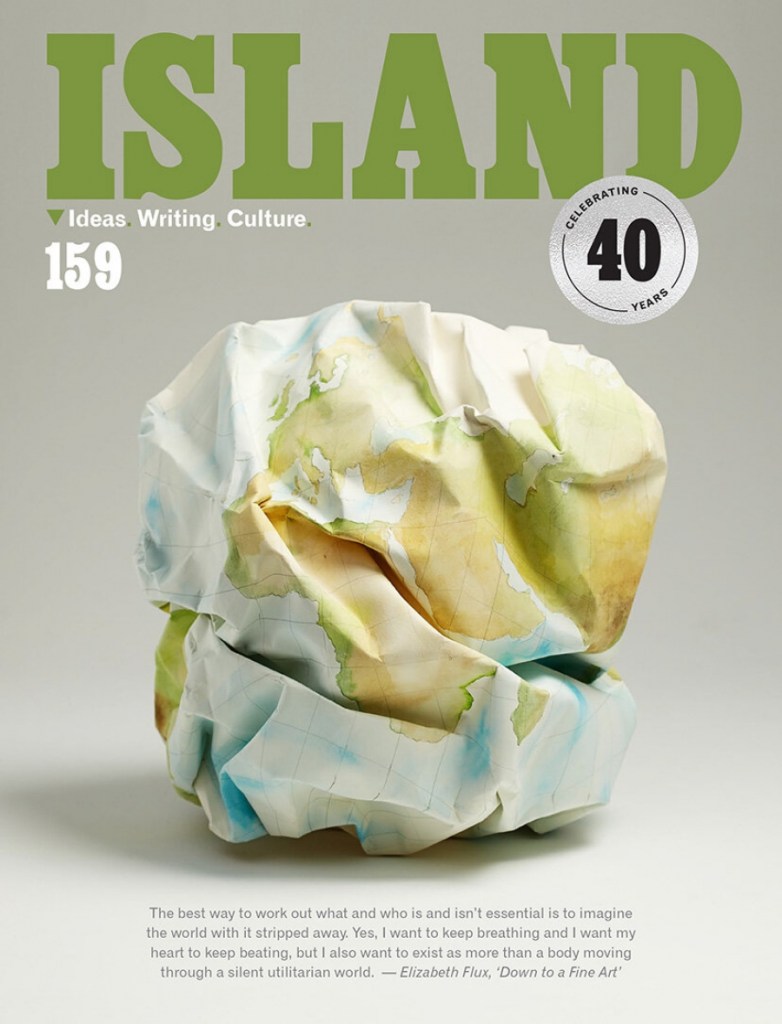
Vern Field (editor) Island 159 (2019)

This issue of Island is upfront about financial difficulties. In 2019, according note from Geoff Heriot, Chair of the Island Board, the journal managed three issues instead of the usual four – but it ended the year in the black so they managed ‘to keep the doors open’.

Elsewhere, the sense of struggle recedes. There are four interweaving elements: nonfiction edited by Anna Spargo-Ryan, fiction edited by Ben Walter, poetry edited by Lisa Gorton, and arts features edited by Judith Abell.

The arts features are beautifully illustrated essays on works by three Tasmanian artists – Lucienne Rickard’s Extinction Studies, Julie Gough’s Tense Past and Selena de Carvalho’s Beware of Imposters (the secret life of flowers) – that bear witness to the island’s vital art scene.

Ten poems are interspersed among the other contents. The poem that spoke most directly to me is ‘Ash in Sydney‘ by Jake Goetz. It’s a wonderful evocation of the experience of being in Sydney during the bushfires of summer 2019–2020, which begins:

ash in falling on the Lidcombe line
on Carriageworks and Regents Park
it's falling on planes of closed-up houses 
where Greg thinks his summer's fucked 
and it's blowing in from morning westerlies 
and it's blown back by arvo southerlies

You can read it and a number of other poems from this issue on the Island website at this link.

There are five pieces of fiction whose subjects range from international adultery to futuristic crime thriller. If I have to single out one, it’s Pip Smith’s ‘Starter Culture’, in which the 70-year-old narrator endures the slights that come her way from her granddaughters and other young women, and eventually wreaks satisfying vengeance (no young people being harmed in the making of said vengeance).

Among the excellent nonfiction pieces, it speaks volumes of Katerina Cosgrove’s ‘Death in the Garden‘, that I found its account of grief and resilience powerful even after it said that Epicurus ‘founded a school of thought championing the pursuit of hedonism’, which would have made my high school Latin teacher apoplectic. In ‘Principles of Permaculture‘ Sam George-Allen reflects on six months living alone on ‘a quarter-acre oblong island in a sea of golden grass, wedged between two improbable paddocks on the edge of a rundown country town’, and – though she doesn’t claim it for herself – describes a kind of solitary engagement with the earth that, through her beautiful writing about it, becomes a form of activism.


I interrupted the writing of that last paragraph to collect my mail. Sure enough, there was another literary journal hot off the press.

It’s like painting the Harbour Bridge.

November verse 14: When Paul starts strumming

Peter Jackson’s The Beatles: Get Back features many extraordinary moments, but for my money no others are equal to the couple of minutes when the song ‘Get Back’ appears as if from nowhere as Paul strums on his guitar.

November verse 14: When Paul starts strumming
Who could know when Paul starts strumming
that a song will soon emerge?
Ringo knows, he holds his drumming,
servant to the demiurge.
Did Michelangelo see David
wait in stone to be created,
pupae locked in their cocoons
whisper softly 'Soon, soon'?
When I start a 14-liner,
does some dark part of my brain
see that, while it seems in vain
I seek coherence like a miner
seeking gold in solid stone,
the last line is already known? 

And that’s my last November verse for the year. Normal transmission will resume shortly.

The Iliad: Progress report 1

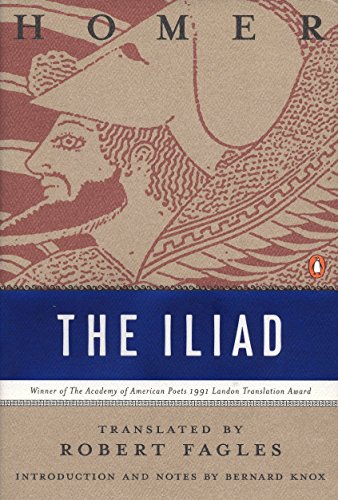
Homer, The Iliad (translated by Robert Fagles, with notes and an introduction by Bernard Knox, ©1990, Penguin 1998), from beginning to Book 3 line 190

My partner, known on this blog as the Emerging Artist, asked why I was reading The Iliad, which is surely all about men killing each other. I didn’t have a coherent answer beyond, ‘Because it’s there.’

Anyhow, after one month I’m half way through Book 3, and only one person has been killed. Apart from four or five mornings’ worth of roll call of the Greek troops and then the Trojan defenders, I’m riveted. Achilles has had a big row with Agammemnon and withdrawn from combat. The gods keep intervening in fascinating ways, including making promises they have no intention to keep. Now, as the vast armies are lined up against each other, it looks as if the war is about to be called off and replaced with a two-man fight to the death between Paris, the strikingly handsome man who abducted Helen, and Menelaus the wronged husband. I’m on the edge of my seat: I know the plan isn’t going to work, but I can’t see how.

I’m not going to do this in every monthly progress report, but I want to compare some translations. Here’s the very first death in Robert Fagles’s translation:

The veteran Protesilaus had led those troops
while he still lived, but now for many years 
the arms of the black earth had held him fast
and his wife was left behind, alone in Phylace,
both cheeks torn in grief, their house half-built. 
Just as he vaulted off his ship a Dardan killed him, 
first by far of the Argives slaughtered on the beaches.
(Book 2, lines 796–802)

Compare Alexander Pope’s translation of the same passage, published in 1715. Pope sacrificed literal translation in order to render the poem into rhyming couplets – heroic couplets. He also renders the ancient practice of tearing one’s cheeks into the more familiar breast beating.

These own’d, as chief, Protesilas the brave,
Who now lay silent in the gloomy grave:
The first who boldly touch’d the Trojan shore,
And dyed a Phrygian lance with Grecian gore;
There lies, far distant from his native plain;
Unfinish’d his proud palaces remain,
And his sad consort beats her breast in vain.
(Book 2, Lines 853–859)

Alice Oswald’s version emphasises the pathos of the moment. It’s not a literal translation, though you could argue that it feels closer to Fagles than to Pope. As she says in her introduction to Memorial (faber & faber 2011), ‘Instead of carrying the [Greek] words over into English, I use them as openings through which to see what Homer was looking at.’ This passage includes material from earlier and later lines:

The first to die was PROTESILAUS
A focused man who hurried to darkness
With forty black ships leaving the land behind
Men sailed with him from those flower-lit cliffs
Where the grass gives growth to everything 
Pyrasus   Iton    Pteleus   antron
He died in mid-air jumping to be first ashore
There was his house half-built
His wife rushed out clawing her face 
Podarcus his altogether less impressive brother 
Took over command but that was long ago
He's been in the black earth now for thousands of years

Melissa Ashley’s Bee and the Orange Tree, plus November Verse 13

Melissa Ashley, The Bee and the Orange Tree (Affirm Press 2019)

Most people know that the story of Cinderella has been told in myriad ways in many cultures, and that the version most commonly told to children in the west these days – the source of the Disney version – was written by Charles Perrault, a late 17th century Parisian. But did you know that he was part of a thriving fairy-tale publishing scene in France between 1690 and 1725, and that most of the many authors of original fairy tales of that time were women? And had you even heard of the Baroness Marie Catherine d’Aulnoy, the woman who coined the term ‘fairy tale’ (conte de fée).

Melissa Hay’s novel The Bee and the Orange Tree, set in 1699, takes place in that gap in our collective knowledge. It’s main characters are Marie Catherine, old, racked with arthritic pain and about to publish her second collection of tales; Angelina, a largely fictional character based on Marie Catherine’s youngest daughter; and Mme Nicola Tiquet, a friend of Marie Catherine who is accused of conspiracy to murder her abusive husband. Chapters are narrated from the point of view of each of these three characters in turn. The struggle to save Nicola from execution is a main narrative thread, secrets from Marie Catherine’s past are revealed, Angelina falls in love, and both Angelina and Marie Catherine reach turning points in their writing careers.

It’s a historical romance, even a bodice ripper, though rather than any bodice being ripped there’s a revelation of bound breasts and, at the novel’s steamiest, a lustful eye is cast at a décolletage. Paris of the time is vividly evoked, from the salons where ladies read their fairy tales to the huge public festive horror of an execution. Men tend to be peripheral to the story, except possibly for him of the bound breasts.

The novel has an agenda to retrieve some lost literary history, and some history of women and gender non-conforming people, and it achieves that interestingly, though I wasn’t completely convinced by the portrayal of the salons, and didn’t believe in the fairy tales included in the book. On the other hand, the sexual intrigues and the various plot revelations are pretty much determined by the genre – serviceable rather than engaging.

The part that worked best for me is the account of the execution as a public event that people feel compelled to witness, whether as sympathisers, as ghoulish entertainment seekers, or as participants. (It’s not a spoiler to tell you there is an execution – the threat of it hangs over more than one character.)


And now, because it’s November:

November verse 13: 
Three thousand sombre people gathered,
candles lit, when Ron Ryan* hanged.
By needle, bullet, stones, gas pellet,
rope, electric chair or sword,
Iran, Iraq, South Sudan, China,
Texas to South Carolina,
state killing still goes on today.
Polite, we turn our heads away
where once it was a great occasion:
come and see a life cut short,
come see how great the power of courts,
see how we'll kill, for God or nation.

Wise though we others claim to be
we'd still watch, glued to the TV.

* Ronald Ryan was the last man hanged in Australia. It was 8 am on Friday February 3 1967 in Melbourne’s Pentridge Prison. He refused a sedative so that he could write a note to his daughters. The note ended, ‘Goodbye, my darlings … Lovingly yours, Dad.’


The Bee and the Orange Tree is the 14th book I’ve read for the Australian Women Writers Challenge 2021.

November verse 12: Dinner with friends

I’ve discovered that a poem that uses the rhyme words from another poem is called a terminal. Today’s poem is a terminal taking its rhyme words, for no good reason, from Christopher Brennan’s ‘Fire in the Heavens‘, adjusting them to suit the requirements of an Onegin stanza.

November verse 12: Dinner with friends
The late-spring night outside was chilling,
rain besieged your house's stone.
Inside was warm, food rich and filling.
We weren't there for food alone.
We talked of Beatles, bugs in bedding,
how to stop the virus spreading,
Christmas past – such amplitude
of subject, such a buoyant mood,
I felt my spirits skipping, bounding –
joy of grandchild's littleness,
the climate doom we face, unless –.
Through all, the bell of friendship sounding:
eight of us, no massive throng,
I give thanks in this little song.

November verse 11: On hearing a magpie

One lovely thing about poetry is the way lines will pop into your head years after you’ve read them. When I worked at The School Magazine we’d receive a letter or phone call every month or so from someone trying to locate the source of a line of poetry, or even sometimes the author of a whole poem remembered verbatim. It was gratifying to be able to help most of the time.

The first line from James Macauley’s short poem ‘Magpie‘ often pops into my head when I hear a magpie singing. The smell of earth after rain makes me think of Les Murray’s Monthly article ‘Infinite Anthology‘ (not his poem by the same name – I looked them both up); and of a line from George Herbert’s poem ‘The Flower‘ likewise makes itself known when the sky clears after rain. Today’s stanza steals from all three, plus a bonus word from Macbeth.

November verse 11: On hearing a magpie after rain
The magpie's mood is never surly,
never glum is petrichor.
My first line comes from James McAuley –
took time out from culture wars
to sing the praise of liquid squabbles.
Line two: Les A Murray's bauble
lent to us from his great hoard
when he was in non-surly mood. 
For when the hurlyburly's over,
when the mud has all been slung
and all the war songs have been sung,
the bees still bumble in the clover,
once more we smell the dew and rain
and relish verses once again.

November verse 10: The chances

US radio journalist Robert Krulwich recently asked nonagenarian biologist E O Wilson, ‘Will we solve the crises of the next 100 years?’

Wilson said, ‘Yes, if we are honest and smart.’

November verse 10: The chances
'We have a good chance of survival
if we're honest, if we're smart.'
But look who's at our leaders' table:
quick of tongue and hard of heart,
they'll risk the world to win election,
lie, deny, lack all conviction,
build their bubbles, shift the blame,
play the man and work the game.
The psalm says not to trust in princes.
Who is smart and tells the truth?
By any measure, it's the youth
who strike, speak out, and pull no punches.
Young, you say, naïve and green!
Well, Jeanne d'Arc burned at just nineteen.
 

November verse 9: Our morning walk

I reminded myself that when I dreamed up this notion of writing fourteen 14-line poems in November, my intention was to have at least some of the poems wrangle events from my daily life into the stanza form that I seem to have fallen enduringly in love with. So here’s one about this morning’s walk. In case explanation is needed: the BOM is the Bureau of Meteorology.

November verse 9: Our morning walk 
A cool spring day, and rain's predicted.
Undeterred, our morning walk,
by Covid rules now unrestricted, 
took place just on eight o'clock.
We left our raincoats and umbrellas
in the car. The croquet fellers
played in t-shirts on their green
and clouds were few and far between.
Happy flitting wagtails, peewees,
happy dogs who strain on leads 
to sniff whatever's in the weeds,
happy walkers, far from freeways. 
Day, so cool, so calm, so bright,
the BOM can't always get it right.