Monthly Archives: Jul 2024

Me and Ray Lawler

I met Ray Lawler once. I was working for Currency Press when he came to visit, probably to talk to our managing editor, theatre critic Katharine Brisbane, about his play The Man Who Shot the Albatross. I have only the vaguest memory of him. I was probably introduced, then sat quietly in the corner or went back to my work in the adjoining room. He was soft-spoken and unassuming, a far cry from some of the more flamboyant visitors to our offices.

But my most memorable encounter with him happened much earlier, when I saw his most famous play, Summer of the Seventeenth Doll.
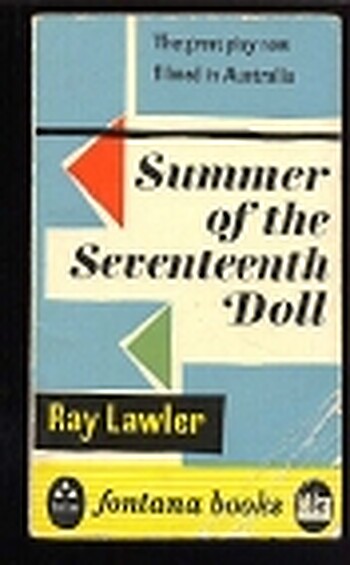
If Wikipedia gives correct dates for the New South Wales and Queensland tour, I saw the play in early 1956. It was in Innisfail’s Johnstone Shire Hall (now the Cassowary Coast Shire Hall), and I was almost exactly nine years old. My parents used to take me to every piece of live theatre that came to town – amateur productions by the Repertory Societies of Cairns and Innisfail, and the Cairns and Atherton Choral Societies. They included an annual Gilbert and Sullivan, Franz Lehar operettas, Die Fledermaus, The White Horse Inn, Harvey (source of the James Stewart movie of the same name), Arsenic and Old Lace, and a comedy about ants called Under the Sycamore Tree. The auditorium was a vast dance hall with unraked seats, so eye lines weren’t all that good. Sometimes the performers’ voices had to compete with the rustling of fans as audience members dealt with the tropical heat. It was all magic to me.

Summer of the Seventeenth Doll, a play in which a couple of men who cut cane in North Queensland come to Melbourne to spend the off-season with their regular summer girlfriends, took things to a different level. This was my first experience of professional theatre, and the actors commanded the stage in a way that was beyond magic.

Two moments stand out clearly in my memory. (‘Clearly’ doesn’t mean ‘accurately’. I haven’t checked the text.)

When Pearl, the new woman, says to Barney, ‘I didn’t know you had a family’, he says, ‘Oh, I haven’t got a family, just kids in three states.’ This got a big laugh from the audience, and from me, in a classic case of a joke working at different levels for adults and children: I thought Barney had uttered a delightful absurdity. Later, I overheard my father telling someone that he knew I knew ‘the facts of life’ because I had understood the jokes in The Doll. That may have been the beginning of my quest to discover what those facts were. A further follow-up: at the end of that year, or the following year, when invited to choose a book as a prize on the school’s Speech Night, I picked a paperback of Summer of the Seventeenth Doll, and was astonished when the teacher told me it was inappropriate for my age.

The second moment comes at the play’s climax. The men have given the women a kewpie doll each year, and the dolls have come to represent the enduring nature of their relationships. At the climax (spoiler alert), Roo, enraged by the way this summer has played out, throws the vase of dolls to the ground, smashing it and their relationships to pieces. I remember vividly how the huge bulk of a man hurled the object into the centre of the stage with tremendous physical and emotional force. I was definitely on the same page as everyone else in that moment of shock and grief. It may well be that whenever I’ve gone to the theatre since then I’ve been hoping to re-experience such a moment.

One other thing. It’s often said that this play brought Australian language and experience to the stage. (Not true, of course: but Louis Esson’s The Time Is Not Yet Ripe (1912) and Betty Roland’s A Touch of Silk (1928) were pretty much forgotten by 1956.) But Melbourne was as foreign to me then as, say, New York. What the play did for me was acknowledge the existence of North Queensland and the sugar industry. It was the first time I saw the realities of my place reflected back to me in a piece of art.

As a small child I would sometimes bring smoko to the paddock for my father and a gang of cane-cutters. I remember thinking the play had it wrong – cane-cutters in my experience were generally Italian or Maltese, not Anglo like Roo and Barney. But there was something else that I couldn’t have articulated at the time. Roo and Barney as cane-cutters are seen by the character Olive as models of heroic masculinity, flying down to Melbourne like eagles out of the sun, and I’m pretty sure there’s a description somewhere of the actual work of cutting cane as noble. I have no idea if Ray Lawler actually knew any cane-cutters, or if he’d ever been to a canefield. But, to me as a nine-year-old, this version of the work of the cane-fields offered a different perspective, an outsider’s view. It allowed me to see my world in a different light.

I’m immensely grateful for that gift, and though it would have been beyond awkward to try to say any of that to the man I met in the 1980s, I hope he knew something of the impact his work had on so many lives like mine. He died on Saturday, aged 103.


This post was written in Gadigal Wangal land, where the days are getting gradually longer, and the wind is bitter. I acknowledge the Elders past present and emerging who have care for this country for millennia, including during at least one major ice age.
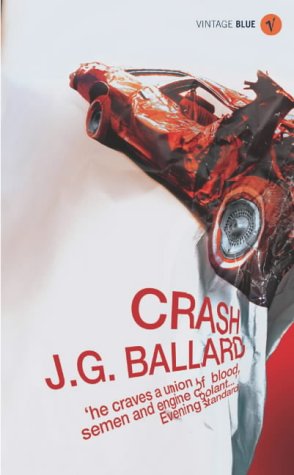
J. G Ballard’s Crash

J. G. Ballard, Crash (© 1973, Vintage Books 2005)

tl;dr: Yuk!

Having seen Crash on Tim Walters’ list of must-read science fiction / fantasy novels about 15 years ago, I got hold of a copy via Bookmooch, and it has been sitting on my To Be Read shelf ever since. I knew a David Cronenberg movie was based on it, and that it was about car accident survivors who share a sexual fetish for cars and car crashes.

Not an attractive proposition. But it’s a slim paperback, so I overrode my reluctance and packed it to read on the plane on my recent trip.

The Vintage Books edition has an Introduction written by J. G. Ballard in 1995, which includes this:

Throughout Crash I have used the car not only as a sexual image, but as a total metaphor for man’s life in today’s society. As such the novel has a political role quite apart from its sexual content, but I would still like to think that Crash is the first pornographic novel based on technology.

If pornography is something that feels you leaving just a bit less than fully human, he succeeds. If it’s something that makes you feel sexy, not so much. I’m a long way from being a connoisseur of porn, but the book this reminded me of was the one in the podcast My Dad Wrote a Porno. It has the same obsession with genitalia and sex-related bodily fluids – which in this book means pretty much all bodily fluids – but it’s not funny, even unintentionally. The patriarchal world view is overwhelming, and the sex is somehow tangled up with, or smeared or squirted on, car dashboards, crumpled metal, and terribly scarred bodies. The book is not for the faint-hearted, and I include myself in that category. In case that makes it sound titillating, I should add that it’s not for the easily ignored either: it goes on and on with unerotic sex scenes that are described in clinical, mechanical language (I won’t inflict examples on you) but still manage to be anatomically/mechanically confusing..

It’s not that I was clutching my pearls. I read the whole thing in the hope that it would deliver on the ‘total metaphor for man’s life’ etc. There’s a whiff of a promise that it would shed light on our society’s widespread fascination with car crashes, or the frisson produced by famous road deaths (Jane Mansfield, Albert Camus and James Dean are mentioned). But no more than a whiff. The opening paragraph foreshadows a near escape by ‘the film actress Elizabeth Taylor’ (whose Cleopatra appeared in the year the book was published), but she pretty much remains an abstraction.

Suffice to say I’m not rushing out to see the movie.


I wrote this blog post on the unceded land of the Gadigal and Wangal clans of the Eora Nation, where the earth has been reshaped over the last century to accommodate the needs of motor vehicles. I acknowledge their Elders past and present, with gratitude for their care of the land over millennia, and hope that the rest of us can learn from them in time.

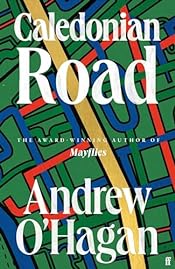
Andrew O’Hagan on Caledonian Road with the book club

Andrew O’Hagan, Caledonian Road (Faber 2024)

Before the meeting: Caledonian Road has a brilliant epigraph from Robert Louis Stevenson’s 1881 essay about ageing, ‘Aes Triplex’:

After a certain distance, every step we take in life we find the ice growing thinner and thinner below our feet, and all around us and behind us we see our contemporaries going through.

This quote struck a powerful chord with me, as the ice is definitely growing thinner below my feet, and I’m seeing my contemporaries ‘going through’ with increasing frequency.

Disappointingly, however, the book isn’t about courage and resilience in the face of ageing. It’s both more ambitious and less engaging than that.

Caledonian Road is a portrait of modern Britain, where criminality and corruption are the order of the day, and complicity is universal. Ranging from a Russian oligarch to a bystander at a backstreet knifing, with a distinguished art critic, a number of parliamentarians and a huge cast of characters in between, no one in the book can claim complete innocence.

The book’s first sentence introduces the main character and hints broadly at what is to happen:

Tall and sharp at fifty-two, Campbell Flynn was a tinderbox in a Savile Row suit, a man who believed his childhood was so far behind him that all its threats had vanished.

Campbell is a successful academic and art critic who dabbles in writing copy for fashion shows. He has written an essay that aims to puncture the complacency of the art world. He’s also dashed off a self-help book called Why Men Cry in Cars for which he plans to hire a handsome young actor to claim authorship and do signing tours. In the year covered Caledonian Road – in four parts named for the seasons, plus a fifth part titled ‘Realisation’ – his plans go (predictably) awry, and his own complacency is shattered. He falls under the spell of a young black student, Milo, who challenges his liberal world view and introduces him to the dubious pleasures of the dark web. Campbell’s comfortable life unravels and all around him and Milo as the outright and criminality of their friends, families and associates is laid bare.

The narrative takes us into many corners of UK society – a private gentlemen’s club, the tiny front parlour of a bereaved working class Scotswoman, a disastrous fashion shoot, a marijuana farm, a lorry full of illegal immigrants, the office of a tabloid newspaper. And weaponised social media is everywhere.

If it was a television series, I’m pretty sure I’d be addicted. As a novel, it’s not my cup of tea. There are many wonderful things in it, but the narrative just doesn’t sing, at least not to me. For instance, this is the opening of Chapter 10, which was a turning point, not in the plot, but in my non-enjoyment:

When he wasn’t in the country or at their mansion in Holland Park, the Duke was often at his old bachelor set at Albany, Piccadilly. His rooms were halfway down the rope-walk, opposite Admiral FitzRoy’s storm barometer, which that day indicated a fair wind. For some time there had been work going on above him, an ‘Oedipal struggle’, the porter said, between the young playboy Ralph Trench and his father, the decorator Hartley Trench, who had made his name, and his family ill, via a lifetime’s association with Sibyl Colefax and the Prince of Wales.

The Duke is one of the book’s main characters, but no one else in that paragraph is ever mentioned again. For an ignorant colonial commoner like me, none of the named places, things or people means anything. Google isn’t much help with Admiral Fitzroy and his storm barometer; I’m guessing the Trenches are inventions; for those in the know there’s probably a witty observation about fashion or the lifestyles of the rich and famous in the mention of Sybil Colefax and the prince. It feels as if Andrew O’Hagan worked hard at getting the details right here. And that’s so for the whole book – details for fashionistas, marijuana growers, people-smugglers and art dealers as much as for the aristocracy. And it feels like work for the reader too, with too little pleasure or enlightenment to show for it.

Andrew O’Hagan spoke with Richard Fidler about Caledonian Road at the Melbourne Writers Festival (here’s a link). He talked an excellent book.

After the meeting: We discussed the book along with Daniel Mason’s North Woods. We found a lot more to talk about in this one.

Someone brought along a book on Joan Eardley, one of whose paintings hangs in Campbell Flynn’s house. We found a painting that most fitted the description in the book, and were reminded of a feature of Flynn’s character that I’ve omitted in the earlier parts of this post: his childhood was in a poor part of Scotland, and he occasionally reflected on the disparity between his present comfort and past deprivation.

I read out the passage about Admiral FitzRoy’s storm barometer. Possibly in response to that, someone said they had read somewhere that London is a character in the book. Maybe so, was my thought, if you already know London.

Someone recognised a syndrome (my word) in Campbell’s relationship with Milo: an ageing academic who feels his grip on the zeitgeist loosening sees the prospect for continuing relevance in latching on to a student and, under the appearance of supporting the student, in effect plagiarises their work. In Campbell’s case, he employs Milo as his research assistant for a significant public lecture and, though like much else in the book this is never quite explicit, Milo in effect writes the lecture for him. When one or two scholars from outside Campbell’s comfortable British liberal arts environment dismiss the lecture as derivative, the narrator leaves it to the reader to judge whether this is just academic snark or whether something substantial is being said. We know that Milo is waging a kind of guerrilla class warfare as a hacker; is he also doing it by messing with Campbell academically?

We argued abut Campbell’s financial worries. Though his psychiatrist wife and he live pretty luxuriously, he considers himself to be in trouble – but won’t tell her about. Some of us believed he really was in trouble. Others thought it was all in his mind. Typically, the narrative voice leaves it up to the reader to figure it out.

I think we generally agreed that there is too much happening in the book. Things just happen, mostly offstage, and the action moves on. Things are generally treated superficially, so that there only a couple of moments, involving minor characters, where real emotion is being captured. In particular, the treatment of the younger characters – Campbell’s DJ son, the profligate son of the Russian oligarch, the Black gang members – is unconvincing.

This is the Book Club where we used to just swap books, with no more than 30 consecutive seconds of discussion allowed on any book. We’ve now met five times and are getting the hang of the Club’s new incarnation. Astonishingly, Trump and Biden hardly got a mention until quite late in the evening, when one who may or may not have inside knowledge predicted that Biden would withdraw from the race on Monday our time. She was right.

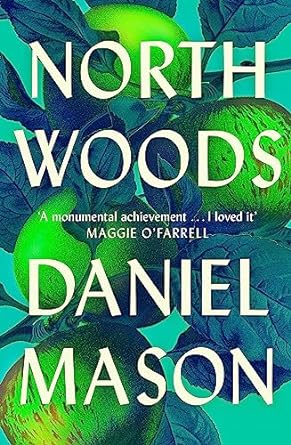
Daniel Mason’s North Woods and the book club

Daniel Mason, North Woods (John Murray 2023)

Before the meeting: If my experience is anything to go by, your heart may sink as you read the first pages of North Woods. It looks as if it’s going to be one of those historical novels written in a strained imitation of late 17th century semi-literate English. But be of good cheer – the passionate young couple who have fled into the forest from a Puritan settlement in Western Massachusetts don’t last long: the book is about the place they flee to. Each chapter moves to a new set of characters, descended from or otherwise related to the previous set, and we move through the decades and centuries up to the indefinite future of the final chapter.

It’s almost, but not quite, a collection of short stories in different modes, set in different time periods. There are ghost stories, stories of unrequited love, a tragic gay story, family sagas, a psychological horror story. There’s a persistent attention to what happens to the woods in question as an area is cleared for an apple orchard, which is turn is partly destroyed then overgrown, as various blights and diseases wipe out some of the splendid native species. Between the chapters there are sections that are presented as found documents: a story written in the margins of a family Bible, a True Crime article from the 1950s, a speech written for a local amateur historical society meeting. There are ballads written by one set of characters (which I found mostly unreadable), and photographs of the woods in its many stages.

Yes, it’s a terrifically inventive work, with US history of the last three hundred years as its backdrop.

But, well, meh!

I’m mostly left cold. It mostly feels like a writerly exercise with no deeper necessity. That would be fine if it was fun, but it’s not fun. What may be meant as magic realism just feels contrived and arbitrary. Lyrical descriptions of natural processes are laboured – more than anything, they made me want to reread Richard Powers’ Overstory (link to my blog post). Because nothing outweighed it, what might have been a niggle at the back of my mind became a constant unease: First Nations people are only glancingly present and mostly consigned to the unknowable past; tribal names are mentioned a number of times with due respect, and a wise Elder makes an appearance in an early chapter, but that’s it. I don’t know that a similar book could be written in Australia, possibly because colonisation is so much more recent here. For this Australian reader, this virtual absence meant the book felt hollow at its heart.

After the meeting: We discussed this book along with Andrew O’Hagan’s Caledonian Road. That book took up most of the discussion time, though it’s probably true that the excellent Indian meal and catch-up conversation took up more than both combined.

I think there was a consensus that the book worked as a collection of short stories. The over-all concept was impressive but didn’t quite come off, and the ghost stories worked least well of all. Someone else mentioned the Richard Powers novel as a comparison that didn’t reflect well on this book. The stories / chapters that received most honourable mentions were a long interstitial piece, the Johnny-Appleseed-like memoir of the man who planted the orchard, and Chapter Three, in which his daughters Alice and Mary are inseparable, until they’re not, with a creepy Gothic twist at the end.


I wrote this blog post on the unceded land of the Gadigal and Wangal clans of the Eora Nation, which has seen many changes in the last 236 years, but has never ceased being cared for by these First Nations people. I am very happy to acknowledge their elders past and present.

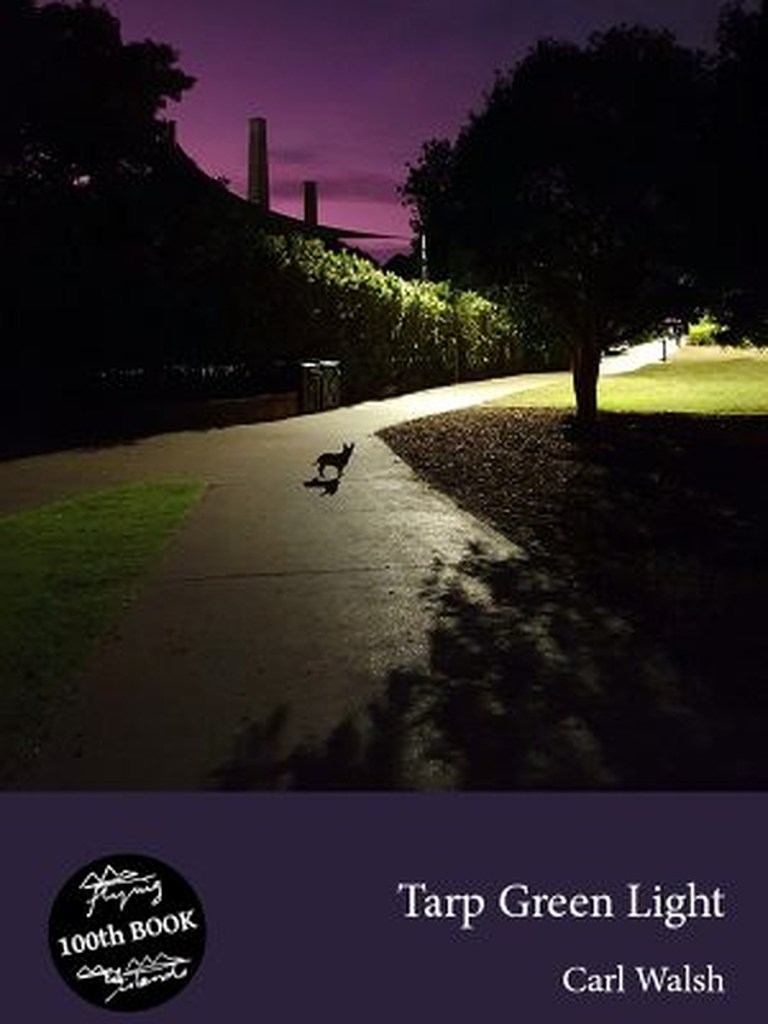
Carl Walsh’s Tarp Green Light, page 77

Carl Walsh, Tarp Green Light (Flying Island Books 2023)

Of recent years the emerging Artist and I have travelled north for a couple of weeks each winter. In last year’s fortnight on Yunbenun (Magnetic Island) I read and subsequently blogged about nine books, eight of which were in Flying Island’s Pocket Poets series.

This year we have come further north, and I’ve read a lot less. Tarp Green Light is the first of four Pocket Poets I’ve read.

The Note on the Author tells us:

Originally a tradie, Carl snuck into uni in his mid-twenties, after two years volunteering in PNG. He’s almost always written poetry – some poems in this book had their genesis in notebooks while backpacking in 1997.

Those backpacking notebooks have borne wonderful fruit. There are fine poems on other subjects – Linnaean categories, the Old Norse alphabet (I think), childhood memories, family history, and more. But it’s the poems that evoke particular places that create the strongest impression. The places include Papua New Guinea, Ireland, rural Australia, a number of European countries, and Japan.

The book’s title comes from one of the PNG poems, ‘Sepik Wara’. The poem is hard to quote from, as it’s laid out with text on either side of a broad winding river of white space, but here’s an attempt:

_________________________ _____________ we eye
rush of black clouds____________ __ _ pooling
in the sky; unfold ______________plastic tarps
to array over_______________________ our heads
as rain sheets________________ down we breathe
the close_______________ air and laugh at each
other__________________ in the tarp green light

At least one poem, ‘Idiot Fruit’, visits the Daintree, where I have recently spent a day:

Is it cassowary plums that lay 
as blue/grey eggs on the ground?

My blogging practice is to focus on page 77 (at least until I turn 78). In books like this, the practice saves me the impossible task of choosing one poem to represent them all. ‘Niseko miso’, on this book’s page 77, is one of the very few prose poems in the book, but in other ways is a fine example of how Carl Walsh can evoke a place::

Niseko miso
The cloudiness of my miso is reflected in
afternoon sky with dark seaweed stretches of
kombu cloud and strips of white tofu. But this sky
is perforated with peaks. Active in their inactivity
– three thousand years just a nap. How old I
am in their years? My head hurts at the maths.
Perhaps I should get Isabelle to calculate it? Some
are wild for ten thousand years. Even resting,
prone to throwing unexpected parties. I glance
at Mt Yōtei, its dark bulk everywhere. Hope it's
content with its sleeping. That Kagu-tsuchi-no-
kami
, the fire-spirit, is happy. I stir my miso – and
the clouds burst with rain.

Like many travel poems, this becomes more enjoyable when you know something about the places it names. A quick bit of browsing told me that Niseko is a ski resort area in Hokkaido; kombu is the kind of seaweed you might find floating in a bowl of miso soup; Mt Yōtei is a volcano, one of the hundred famous mountains of Japan, and popular for backcountry skiing expeditions; and Kagu-tsuchi-no-kami is, as the poem implies, a fire spirit whose rages are to be feared. Mt Yōtei last erupted about 3000 years ago but it is still active.

The poem deftly conjures up a situation: the speaker is drinking miso soup one afternoon in the foothills of Mt Yōtei, probably at a resort of some kind (his mind goes to wild parties as a synonym for volcanic eruption). He may be alone while drinking soup and composing the poem, but he has a female companion, Isabelle, who is probably travelling with him, certainly within easy communication distance.

The speaker idly/playfully notices a similarity between the appearance of the sky and that of his soup: clouds and seaweed allow sky and soup to be synonyms for each other.

Then there’s a but, a word I’m coming to love in poetry as signifying a turn of some kind. Here the speaker notices the major flaw in his synonym: the soup has no equivalent to the mountain peaks that pierce the clouds. The mountains dominate the rest of the poem, prompting thoughts about geological time. The tone is still playful – volcanic activity is described as wild partying, prolonged or brief and unexpected – but there are quiet hints of awe in the presence of the sublime.

In the two sentences before the last one, another dimension of the place of the poem comes into play. These mountains have had stories told about them for millennia. The speaker acknowledges this, by naming the fire spirit Kagu-tsuchi-no-kami, at the same time expressing anxiety about a potential eruption. (Maybe it’s just me but that seems to be a very Australian response, given how very extinct our volcanoes seem to be.)

Then in the last sentence, the poem comes down to earth, and attention returns to the soup and the clouds. There’s a hint of sympathetic magic – did stirring the soup make the rain come? – but the main effect is to pull back from vast, fearsome, mythological thoughts to the present moment, the place where the poem started.


I read this book near the mountains of Yidinji land and finished writing the blog post on Gadigal–Wangal land, where the sky is brilliant blue and the wind is chill. I acknowledge the Elders past and present of both peoples.

Andrew O’Hagan’s Atlantic Ocean

Andrew O’Hagan, The Atlantic Ocean: Essays on Britain and America (Faber 2008)

This book was my gift in a Book Group Kris Kringle years ago, and has been languishing on my top shelf ever since. I was prompted to read it by Caledonian Road, Andrew O’Hagan’s most recent novel – which I’ve just read for my other Book Club (blog post to come after the next meeting).

These 23 essays were first published between March 1993 (‘The Killing of James Bulger’) and February 2008 (‘Brothers’). That’s not so long ago, but the book feels as if it comes from another, ancient era. Michael Jackson was alive. 9/11 (and England’s 7/7), the Iraq War, Hurricane Katrina and George W. Bush were in the headlines. Donald J Trump was barely a reality TV star; Brexit wasn’t a cloud on the horizon; a global pandemic was predicted, but with no sense of urgency.

Most of the essays were first published in the London Review of Books, many of them as book reviews. We are told the month and year of first publication, but not the details, or sometimes even the name, of the books being reviewed. We’re invited to read them as stand-alone essays, and for the most part they succeed – as memoir, literary journalism, social commentary, a general reflections on literature. There are pieces of serious long-form journalism, like ‘On Begging’ (November 1993), in which 25-year-old O’Hagan joins the beggars of London with a tape recorder in his pocket, or ‘Brothers’, the book’s final essay, in which he visits the people left behind by the deaths of two servicemen in the Iraq War, one from each of England and the USA.

Three essays illustrate the range of O’Hagan’s subject matter and the variety of his approaches:

‘The Killing of James Bulger’. In the north of England in 1993, two 10-year-old boys abducted, tortured and killed two-year-old James Bulger. The great Gitta Sereny wrote about the murder, probing the boys’ motives and challenging the vengefulness of the press, the courts, and the crowds that gathered to demand the death sentence. O’Hagan’s essay has a similar impetus but, strikingly, his starting point is to identify with the killers. He describes in unsettling detail the way, as a child in Glasgow, he and a girl friend mistreated a much younger child, and expands from there to the general normalisation of cruelty in his part of Scotland. (Shades of Douglas Sewart’s Shuggie Bain or Jimmy Barnes’s memoir Working CLass Boy. It’s a challengingly personal essay that is shamefully relevant to the place I’m in just now, as Queensland’s Liberal National Party is pushing an ‘Adult crime, adult time’ policy.

‘On the End of British Farming’ (March 2001), one of the longest essays, is a brilliant piece of investigative journalism. O’Hagan visits a number of small farmers, and gives shocking statistics on the economic pressures they are up against. Most shockingly, perhaps, is what happens when he follows up a claim by a Sainsbury representative that the retail chain has an excellent relationship with a dairy farm in Devon. On visiting the ‘farm’, he finds that in order to survive (and then thrive), the couple who run it have got rid of all their cows. Their enterprise is now is in effect a yoghurt and ice cream factory, buying milk at just above the unsustainable going rate from neighbouring farms. The essay sees the source of the problem in the subsidy policies after the Second World War. There is some discussion of the role of the EU (real, but not major, he argues). It’s one of the many moments when I would love to see an update: did Brexit improve things?

‘After Hurricane Katrina’ (October 2005). O’Hagan saw online that two men from another state were driving to New Orleans to help in the aftermath of Hurricane Katrina. He contacted them and asked to travel with them. The essay is a literary equivalent of a fly on the wall documentary: the writer is all but invisible, making no overt judgement, authorial comment or explanation, but allowing the story to unfold mainly through the dialogue of the two men. They are rowdy, spectacularly sexist, uncareful about racism (one of them is African-American), and a weird combination of generosity and self-absorption. It reads a bit like a Carl Hiaasen novel. I could only wish that Caledonian Road had as much exuberant life.

Page 77 occurs in ‘Tony and the Queen’ (November 2006), which is part a reflection on the Stephen Frears/Peter Morgan Movie, The Queen – long since superseded in our minds by the TV series The Crown (also largely written by Peter Morgan). The page happens to include one of the passages where O’Hagan notes the influence of US culture on Britain’s. He is discussing the moment in the film and in real life when the Queen was slow to grieve publically after the death of Lady Diana:

Obviously, the elder royals and their familiars had completely missed out on the Oprah-isation of the universe. If they hadn’t, they might have learned the new first rule of successful leadership: enjoy your inscrutability if you must, but don’t ever stand in the way of a confessional heroine. If stopping Diana was something of a thankless task while she was alive, the effort would come to seem suicidal for the British monarchy in the summer of 1997, after Diana died in that Paris tunnel. William Shakespeare himself could scarcely have imagined, in the days after the crash, a royal household with more out-of-touch advisers than the Windsors had on twenty-four-hour call, each of them sharing a gigantic unawareness of the difference between a pest and a mass phenomenon. But it is said that much of the intransigence was coming from the Queen herself, who, despite all her experience, disported herself that summer like a person lumbering in a dark cave. She was somehow unable to see what the infants and the dogs in the street could see, that the old style was unsuited to the virulent new mood – and that if something had to give, or someone, it was most likely going to be the woman whose head appears ready-severed on Britain’s postage stamps.

An astute observation at the time, and probably accurate about the changing times, but it fails to imagine – and how could it – the powerful impact of the image of that same inscrutable queen sitting alone at the funeral of her husband. Inscrutability itself, evidently, can find favour in the ‘virulent new mood’, and O’Hagan’s ominous hints of decapitation to come (inspired no doubt by Scottish wishful thinking) fell very wide of the mark.


I finished writing this blog post in Ma:Mu country. My father, my siblings and I were born on this country, and I’m very happy to belatedly acknowledge the Ma:Mu Elders past and present who have cared for this prodigally beautiful land for millennia, and continue to do so..


* My blogging practice for some time has been to focus arbitrarily on the page of a book or journal that coincides with my age, which currently is 77.

Journal Catch-up 24

As I have mentioned before, I once had a substantial collection of Meanjins. I parted company with them in the course of moving house, probably forty years ago or so, and I haven’t kept up with Meanjin‘s changing identity since. In 2021 I toyed with the idea of resubscribing, but I may have been daunted by the sheer size of each issue. I have now bitten the bullet.


Esther Anatolitis (ediitor), Meanjin Vol 83 Nº 1 (Autumn 2024)
(links are to the Meanjin website: some but not all of them are available to non-subscribers)

This issue is a doozie!

It’s as engaged with current social and political issues as Overland. There are a number of essays on aspects of the Israeli invasion of Gaza, including Sarah M Saleh’s brilliant argument for the importance of Palestinian solidarity movements to the political wellbeing of Australia as a whole. There’s a concise summary article by father and daughter team Stephen Charles and Lucy Hamilton on the role of lies and disinformation in the Voice referendum. There’s a portrait by Jack Nicholls of eco-warrior CoCo Violet. There’s Amy Remeikis on the significance of the (first) Bruce Lehrmann rape case. And more.

It’s as culturally diverse as Heat in its heyday. Editor Esther Anatolitis (Σταθία Ανατολίτη) interviews Peter Polites. André Dao gives the 2023 State of the (Writing) Nation Oration. And more.

It’s as academically challenging as Southerly. See Dan Disney’s esoteric discussion of a Korean verse form and the fraughtness (impossibility?) of translating it, or imitating it, without subsuming it into the linguistic dominance of the English language; or Ianto Ware’s account of the challenges he fac ed in writing about his mother’s life and death.

First Nations writing has a strong presence. Among other things, ‘Ilkakelheme akngakelheme—resisting assimilation‘, a powerful essay by Theresa Penangke Alice, has pride of place before the contents page, and the new poetry editor is Wiradjuri woman Janine Leane.

I learned a lot – from Renata Grossi about the law concerning wills and what happens when they are contested; from Tom Doig about the long shadow of the 2014 Hazelwood disaster; from Marcus Westbury about the possibilities of something like a Universal Basic Income.

There are memoirs, including a brief snippet by Clare Wright, which starts out from an elaborate piece of costumery in the Powerhouse Museum and takes the reader to an unexpected ugly teenage encounter.

There are book reviews, and poetry. I was delighted to read, ‘Thread‘ a new poem by Eileen Chong. Two very different poems, ‘Oomarri—coming home‘ by Traudl Tan with Kwini Elder Ambrose Mungala Chalarimeri, and ‘Dreaming in Bourke‘ Paul Magee, talk to each other across the pages about the importance of country for First Nations people.

I picked up a couple of new words. My favourite is::

  • pipikism, a term coined by Philip Roth, who defined it as ‘the antitragic force that deconsequentalises everything – farcicalises everything, trivialises everything, superficialises everything’. Naomi Klein revisits the term in Doppelganger, her book reviewed in this Meanjin by Sam Elkin.

I’ll give the last word of this post to Peter Polities, whose words on page 77* in some ways speak to the journal as a whole:

I remember when I was in art school … this guy said to me: ‘I’m not political.’ And I was like: What did you say?!?’ I was just so shocked the first time I heard it, but then by the second time, I was so sarcastic: I said, ‘Yeah, what’s political about making goods for a luxury market?’ So this is what these kids wanted to be: to create work that you hang above a fucking couch for rich people. My interest in art is as a site for intervention, a site for politics, and culture is one of the most political things that we have.


I finished writing this blog post in stunningly beautiful Kuku Yalanji country, to the tune of parrots, curlews and the calls of other birds I don’t recognise.


* My blogging practice for some time has been to focus arbitrarily on the page of a book or journal that coincides with my age.

The Essays of Montaigne, progress report 4

Michel de Montaigne, The Complete Essays (Penguin Classics 1991, translated by M. A. Screech)
from Book 2 Essay 7, ‘On rewards for honour’ to part way through Book 2 Essay 12, “An apology for Raymond Sebond’

Three months in and I’m loving my morning chats with Montaigne. Not so much a progress report this month, as I’m poised to fly to warmer climes any second and am squeezing this post in among house-cleaning and similar chores.

Usually as I make my way through these essays I ignore the notes and references, as I’m not making a study of Montaigne, just reading him and living with my sometime incomprehension. For the current essay, ‘ An Apology for Raymond Sebond’, I read 24 pages of M. A. Screech’s introduction to the book, and listened to a podcast from David Runciman’s ‘Past Present Future’ series (a fascinating account of the essay, which you can find here).

It’s a serious argument, tackling the relationship between revealed truth as understood in 16th century Christianity and knowledge that can be acquired by observation and reason. It’s serious, and intricate. In the passages I’ve just been reading, which is all I’m going to talk about here, it’s something else.

In this part of the essay, Montaigne is arguing against human exceptionalism. Animals (he doesn’t quite bring himself to say ‘other animals’) give signs of being able to reason, to be loyal, seek justice, have compassion, grieve, do basic arithmetic, follow the movements of the stars. In many ways, we learn from the animals, even while we believe ourselves to be infinitely superior. He notes in passing that ‘you can see some male animals falling for males of their own kind’. He tells the story that I know as ‘Androcles and the lion’ in some detail, calling the human character ‘Androdes’. He piles on example after example – mostly from antiquity and in particular Plutarch.

For the sake of his argument, just a couple of examples would have been enough, but Montaigne is like a child in a lolly shop: there are so many stories old and new, verifiable and fantastical, it’s as if he can’t bear to leave any of them out. Today’s reading ends with this (on page 534):

As for greatness of spirit, it would be hard to express it more clearly than that great dog did which was sent to King Alexander from India. It was first presented with a stag, next with a boar, then with a bear: it did not deign to come out and fight them, but as soon as it saw a lion it leaped to its feet, clearly showing that it thought such an animal was indeed worthy of the privilege of fighting against it.

Montaigne had fought in battle, and the religious wars of the 16th century were raging around him as he wrote the Essays. His casual acceptance of violence, as in this paragraph, is one of the places where we feel how different his times were from ours. But his insistence at such length on the dignity of animals has a surprisingly modern feel.

Ok, that’s all I have time for. I have a plane to catch and warmer climes to visit.


This blog post, was written on Gadigal-Wangal land in between bouts of heavy rain, which enables the ibises and magpies in the park across the road to have a great time fossicking in the soft soil. I acknowledge the Elders past, present and emerging of the Gadigal and Wangal Nations.