Monthly Archives: Aug 2024

Ali Cobby Eckermann, She Is the Earth

Ali Cobby Eckermann, She Is the Earth: a verse novel (Magabala Books 2023)
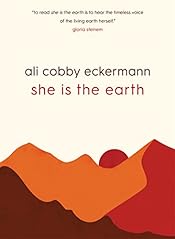
Ali Cobby Eckermann is a Yankunytjatjara woman. Her mother and grandmother were taken from their families when very young as part of the government policy. She herself was also taken. Raised by a loving German-heritage family, she found her way back to her First Nations family as an adult, after years of searching.

I first met her poetry in Black Inc’s Best Australian Poems 2009, edited by the late Bob Adamson. In his introduction, Adamson said of her wonderful dramatic monologue ‘Intervention Pay Back’ that it made ‘a new shift in what a poem might say or be’. You can read it in the Cordite Review at this link. Two poems by her, also dramatic monologues, were included in the special Australian issue of the Chicago-based Poetry journal in May 2016. They can be read on the Poetry Foundation website: ‘Black Deaths in Custody’ here and ‘Thunder Raining Poison’ (on the effects of the Maralinga atomic tests on traditional APY lands ) here.

I haven’t read her memoir, Too Afraid to Cry (Ilura Press 2013), or her first verse novel, His Father’s Eyes (OUP 2011). But I can tell you that her second verse novel, Ruby Moonlight (Magabala Books 2012), which deals with the aftermath of massacre, is brilliant (my blog post here). Of her verse I have read the chapbook Kami (Vagabond Books 2010) and Inside My Mother (Giramondo 2015, my blog post here), which are both filled with the intensities of re-uniting with her Yankunytjatjara kin and culture, and the loss of her birth mother soon after finding her.

All of this work has enormous power, and has garnered many awards in Australia and elsewhere.

She Is the Earth, which arrived eight years after her previous book, is a different kind of writing.

It’s described on the title page as a verse novel. There are no characters apart from an unnamed narrator, and no clear events apart from her meandering through an Australian landscape. Any movement is internal. But the book is meant to be read as a single text rather than a collection of short, untitled poems.

At first, I thought it was an imagined story of pre-birth existence, in which the narrator moves towards being born, taking on substance in the world. But that didn’t seem to work and in the end, I gave up on trying to find a narrative, and just went with the flow.

The flow is far from terrible, and the language is never less than gripping, but I don’t know what to say about the book as a whole. I can refer you to better minds than mine.

Here is part of what the judges had to say when the book won the Indigenous Writers’ Prize at the 2024 NSW Premier’s Literary Awards (go to this link for their full comments):

Ali Cobby Eckermann writes in a poetics of self-emergence in which the spectral is made solid through an eloquent economy of language and lifeforms. Each word of this verse novel is deeply considered and rich with meaning, forming as a whole a narrative which is sometimes gentle and sometimes sharp, both beautiful and terrible, and always profound in its exploration of healing, hope and the earth. Each word reads as a gift to the reader.

I recommend Aidan Coleman’s review in The Conversation (at this link). He discusses the book as an example of minimalism, and says interesting things about its recurring images, and even about the developing narrative:

The speaker in these poems is both child and mother, pupil and teacher. References to children and motherhood abound. Initial images of disconnection, anxiety and trauma give way, in later sections, to wholeness and calm.

But the journey is not linear: hope is present from the earliest sections and trauma haunts the closing pages. Healing is presented as an ongoing process that is projected beyond the poem.

[Added later in response to Kim’s comment: Kim on reading Matters had a very different, and more attuned response than mine. You can read her blog post at this link.

Page 77* occurs toward the end – there are 90 pages in the book. Piggybacking on Aidan Coleman’s reading, I can see it as a moment of consolidation, of identity firming up in the landscape:
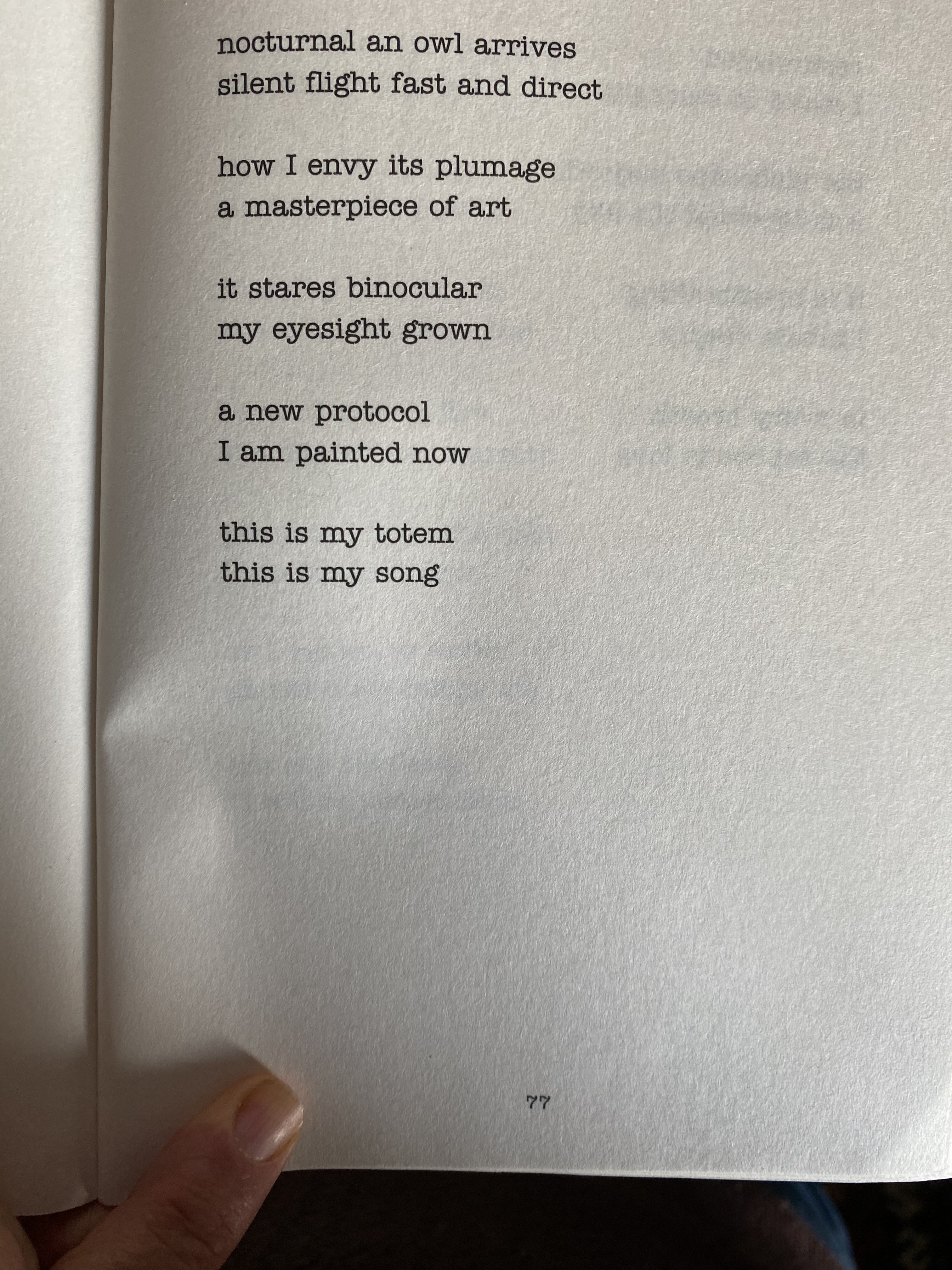
The pleasure of these lines doesn’t depend on their function in the broader narrative. The owl arrives; the narrator admires it; their eyes meet, and there is a moment of identification with the bird; the ‘masterpiece of art’ of the bird’s plumage somehow transfers so that the narrator is painted. The final couplet pulls all that together.

In the wider scheme, that last couplet resolves more than the preceding eight lines. Up to now, the narrator has been full of yearning and unease. Here she seems to find peace:

this is my totem 
this is my song

‘Totem’ takes the hint of identification in the comparison of eyes a step further. There’s something about finding a place of belonging, of deep affinity, of being at home in the world. Once that’s found, there’s the possibility of singing, of having one’s own song.

The first word on the next page is ‘resurrected’, and a couple of pages further on my favourite lines in the book:

I am a solo candle
inside a chandelier

this is the wisdom
I need to succeed.

I still can’t say I understand what’s going on at any given moment in this book. But maybe that’s OK.


I wrote this blog post in Gadigal Wangal country, where it is my great joy to live. I acknowledge Elders past, present and emerging for their continuing custodianship of this land.


* My blogging practice, especially with books of poetry, is to focus on the page that coincides with my age, currently 77.
Sou Vai Keng’s art of ignorance

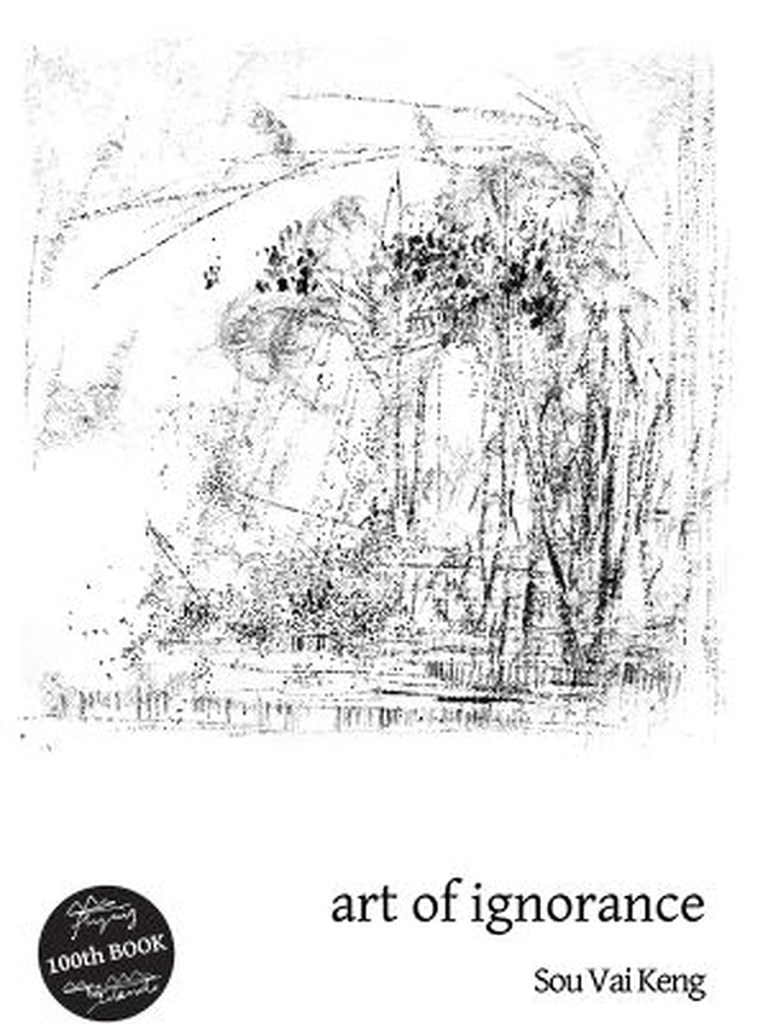
Sou Vai Keng, art of ignorance(Flying Island Books 2023)

art of ignorance is the last of the small but substantial books I took with me on my recent fortnight in North Queensland. Like the others, it’s part of the Flying Island Pocket Poets series.

It’s a bilingual book – that is, each poem appears first in English then in Chinese. As there is no mention of a translator, I assume Sou Vai Keng wrote both versions. She also created the generous number of elegant drawings that intensify the book’s relaxed, contemplative feel.

A note tells us that all the poems were written in mountain areas in Germany and Switzerland between 2014 and 2018. Reading the book felt like sharing the experience of immersion in those mountains with someone with sharp eyes and a seriously playful mind – there’s not a lot of explicit description, things are seen in close-up, sometimes with a touch of surrealism, there are tiny fables and fantasies.

The opening line of the title poem could stand as an eight-word statement of the book’s prevailing mood:

the butterfly does not know the French call it papillon

Page 77* is a good example of how the book works: English on the left, Chinese on the right, with a delicate drawing in the middle (I’m sorry my tech skills aren’t up to showing the drawing without it being sliced in half by the gutter):

The poem starts with sweet whimsy:

she believes she is a tree

The rest of the first stanza elaborates: to be a tree is to ‘live on blessings from heaven’ in the form of rain and dew, and not to need anything else. A different poem might have mentioned roots and connection with other trees by way of the complex underground tangle of fungi. It might have mentioned birds’ nests, or arboreal animals, or fruits and flowers. But not this one. Here the character, like certain ascetics in the early Christian tradition, and in Chinese tradition as well I think, is opting out of active social life, choosing solitude and passivity in relation to a world she assumes to be benign.

But society intervenes. If she was ‘mean and nasty’, she could vanish, but her version of opting out is ‘a lovely idea’. It’s an idea that, by implication, the passers-by find attractive but not permitted. It’s ‘lunacy’. The poem is a parable of sorts, in which a character indulges for a moment a yearning to be stable and self-sufficient like a tree, only to be drawn back gently to the reality of human connectedness and instability:

out of sympathy and solidarity 
people drag her away from where
trees stand firm and strong
and from now on she has to
roam and rove around
together with other
rootless nuts

The final word, far from offering a neat resolution of the poem’s conflict, raises more questions. What does it mean to equate humans with nuts? Nuts as opposed to sane, stable beings; nuts as fruits, insubstantial compared to the tree; nuts as bearing the possibility if one day taking root and developing into something more like trees? She is dragged away from her wistful belief, but at the very last moment the poem opens up to the possibility of her fantasy somehow becoming real.

It’s a fine example of the way Sou Vai Veng’s poem’s twist and turn beneath apparent simplicity. I enjoyed the book a lot.


I wrote this blog post in Gadigal Wangal country, as the days are warming up, the worms are fat and busy in the earth, the adolescent magpies are developing their adult colours. I acknowledge Elders past, present and emerging for their continuing custodianship of this land.


My blogging practice, especially with books of poetry, is to focus on the page that coincides with my age, currently 77.
The Essays of Montaigne, progress report 5

Michel de Montaigne, The Complete Essays (Penguin Classics 1991, translated by M. A. Screech)
– part of Book 2 Essay 12, “An apology for Raymond Sebond’

Since my last Montaigne report, I’ve been faithful to my four pages of Montaigne each morning except for two breaks – one for a fortnight and the other just a weekend. The book is too heavy to take on a plane, and travel tends to disrupt routines like this one.

Five weeks ago, I had just started reading the longest essay in the collection, ‘An apology for Raymond Sebond’. Today I still have 60 odd pages of that essay to go. As I have only the vaguest idea of who Raymond Sebond was, or in what way Montaigne is attempting an apology, I’ll spare you any attempt at a summary, and just give a couple of snapshots.

Having declared himself to be a sceptic (as opposed to a dogmatist), Montaigne sets out to establish the limits of human reason. He piles on example after example of ancient philosophical versions of God, products of the ‘fierce desire to scan the divine through human eyes’. Arguing that if reason were able to determine the nature of God, then these versions would tend to some kind of agreement. Having established that this isn’t what happened, he (at least in M. A. Screech’s translation) drops his dignified mode of discourse altogether and exclaims:

So much din from so many philosophical brainboxes! Trust in your philosophy now! Boast that you are the one who has found the lucky bean in your festive pudding!

That’s on page 577. I’ve now reached page 625. In those 48 pages he has explored (and deplored) the limitations of reason in understanding even the world of nature or the human mind itself, and has been cheerfully insulting of many ancient writers whom he clearly admires enormously (including describing Plato as sometimes ‘silly’). Now he is going on about how philosophers can’t reach any agreement about the immortality or otherwise of the soul. He has reached the transmigration of souls:

the received opinion … that our souls, when they depart from us, go the rounds from one body to another, from a lion, say, to a horse; from a horse, to a king, ceaselessly driven from one abode to another.

And he’s having quite a lot of fun with it, citing the Epicureans’ objection:

What order could be maintained if the crowds of the dying proved greater than the number being born? The souls turned out of house and home would all be jostling each other, trying to be first to get into their new containers! They also ask how souls would spend their time while waiting for their new lodgings to be got ready.

Having added some lines of Latin poetry, he then goes on:

Others make our souls remain in the body after death, so as to animate the snakes, worms and other creatures which are said to be produced by spontaneous generation in our rotting flesh or even from our ashes.

In short, I’m enjoying this essay as a kind of romp in the history of philosophy. As a settled atheist who thinks my mind is a function of my body, I have a kind of museum-piece interest in a lot of the arguments. I was taught at school that until a certain point in European history people relied on the authority of, I think it was Aristotle, for their knowledge of the world. We knew from Aristotle how many teeth a human had, and only at a certain stage did it occur to people to look in each other’s mouths and count for themselves. As I read this essay, it feels as if I’m seeing that change happen before my very eyes, and it’s riveting. (Mind you, I think the essay itself is going to end with a declaration that Christian revelation is the ultimate source of Truth, but both things can be happening at once.)

To be continued.


This blog post was written on Gadigal-Wangal land, where understandings of the universe beyond Montaigne’s imaginings were developed millennia before the Ancients he discusses. It’s raining again, and my compost bin is alive with worms. I acknowledge the Elders past, present and emerging of the Gadigal and Wangal Nations,.

The 2024 Francis Webb reading

For some years now, Toby Davidson has been organising an annual reading from the works of Australian poet Francis Webb.

This year it’s on again:

Saturday 31 August
2.00–4.00pm
Chatswood Library
409 Victoria Ave
Chatswood

It’s a free event, but you can go to eventbrite to reserve a place.

Here’s what the Willoughby Council website has to say::

Come along to hear how this ‘poet’s poet’ astonished his own generation and many more since.
You’re invited to join MC Dr Toby Davidson, editor of Webb’s Collected Poems, for an afternoon celebrating the works of North Sydney poet Francis Webb (1925-1973) who spent some of his early years in Willoughby.

This annual gathering sees poets, scholars, community members and representatives from Webb’s former schools St Pius X College and CBHS Lewisham read and discuss their favourite poems by this local prodigy who combined his visionary talent with an eye for social justice. Gwen Harwood once wrote ‘I think Webb is unmatched … wonderful Webb!’

Come along to hear how this ‘poet’s poet’ astonished his own generation and many more since

I am one of the poets, scholars and community members. I’d love to see some of my regular – or even one-off – readers there!

Rebecca F. Kuang’s Yellowface and the book group

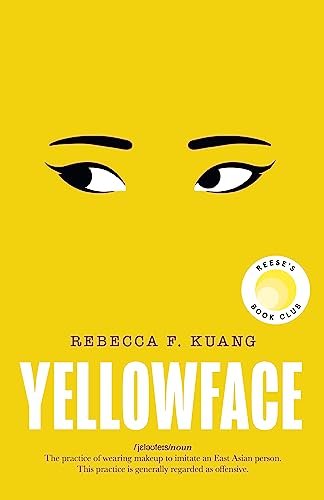
Rebecca F. Kuang, Yellowface (The Borough Press 2023)

Before the meeting: It’s a thing: books – and movies – that deal with questions of authorship. The protagonist of Siri Hustvedt’s The Blazing World (2014) presents a young male artist as the creator of her sculptures. In Cord Jefferson’s movie American Fiction (2023, based on Percival Everett’s Erasure (2001), which I haven’t read), an African-American novelist writes a trashy novel full of the stereotypes he despises, and presents its author as a fugitive from justice. I won’t do a spoiler on Björn Runge’s movie The Wife (2017, based on a 2003 novel by Meg Wolitzer). In Caledonian Road, Campbell Flynn knocks off a self-help book for men and has a photogenic young actor pose as the author. And that’s just some relatively recent ones that come to mind.

Yellowface is an entertaining addition to that list.

June Hayward, a young white woman whose first novel has done poorly, has an uneasy friendship with Chinese-American Athena Liu, a fabulously successful one-book novelist. When Athena dies suddenly with June as the only witness, June gets hold of her unfinished manuscript, which deals with aspects of Chinese immigrant life in North America. She sets about editing the manuscript and completing the story, telling herself that she is doing it to honour Athena. She gradually comes to think of the novel as primarily her own work and sends it to her agent over her name.

The novel is a publishing sensation and, without actually claiming Chinese heritage, June allows herself to be seen as Chinese. Her Hippie parents had given her ‘Song’ as a middle name, so – she rationalises – it’s not actually lying when she adopts the Chinese-sounding pen name of June Song and lets people make their own assumptions. Anyhow, Athena’s research consisted of extracting stories from other people, so they were already stolen property. And other rationalisations.

Needless to say, things go very wrong. Right up until the last movement I was having a great time. There’s a marvellous scene where June is invited to do a reading to a local Chinese community, where her hosts – including one elderly man whose experiences are similar to those narrated in the novel – are genuinely shocked when they realise she is not Chinese, but remain icily courteous. Social media users are infinitely less restrained.

We see it all from June’s point of view. We sorta-kinda believe the stories she tells herself, and even when she crosses the line into outright deception, we sympathise – until we don’t. June may acknowledge that she hasn’t been completely honest, but she continues to see herself as the victim of unfair attacks until the end of the book. But somewhere along the line, and I imagine the precise point differs from reader to reader, she loses our allegiance. So at the end, where she comes up with a way to redeem herself in the eyes of the publishing and reading world, we are led to believe that it will probably work, but are disgusted by a world where that is the case.

It’s cleverly done. The introduction of some unconvincing horror tropes spoiled the big climax, but I can forgive that.

Page 77* is a nice example of one of the strengths of the book. If you’re going to write a satire of identity politics in the publishing industry, you’d better make your version of the industry seem real. Kuang does that. June’s conversations with her agent and editor, her meeting with the marketing executives, the closing of ranks among authors, followed by the shunning once the scandal becomes too much: all feel real. The description of publication day on page 77 is surely taken from life:

Months become weeks become days, and then the book is out.
Last time, I learned the hard way that for most writers, the day your book goes on sale is a day of abject disappointment. The week beforehand feels like it should be the countdown to something grand, that there will be fanfare and immediate critical acclaim, that your book will skyrocket to the top of all the sales rankings and stay there. But in truth, it’s all a massive letdown. It’s fun to walk into bookstores and see your name on the shelves, that’s true (unless you’re not a major front-list release, and your book is buried in between other titles without so much as a face out, or even worse, not even carried by most stores). But other than that, there’s no immediate feedback. The people who bought the book haven’t had time to finish reading it yet. Most sales happen in preorders, so there’s no real movement on Amazon or Goodreads or any of the other sites you’ve been checking like a maniac the whole month prior.

According to Wikipedia, Rebecca F. Kuang’s first novel, The Poppy War, was a big success, but I am pretty confident that its 22-year-old author had exactly such a ‘day of abject disappointment’.

After the meeting: As usual, our meeting was convivial, and people had a range of responses. I was a bit of an outlier in feeling generally positive about the book, but I wasn’t the only one to derive at least mild enjoyment from the meta stuff: the Asian woman writing in the first person as a white woman pretending to be Asian. Someone wondered out loud how James would have been received if the author was revealed to be white, Helen Demidenko/Darville/Dale and The Hand the Signed the Paper was mentioned. But I don’t think anyone else just enjoyed Yellowface as a light satirical tale.

At least one other chap couldn’t for the life of him see what there was to enjoy. From memory, he was something like, ‘Yes, I get what you’re saying about identity politics and the publishing industry, and maybe even that there’s satire happening, but it’s not funny, there are no real characters, and nothing interesting happens. June, the protagonist, doesn’t develop and we don’t learn anything about her beyond the superficial.’

There were a number of positions in between. The extreme implausibility of the big climactic scene was something we could all agree on. Someone said that the effect staged there would have taken the resources of a Taylor Swift concert to pull off. I couldn’t disagree.

But we had an excellent time together, enjoyed the food and the fleeting visit from a teenager who lives in the flat, shared stories (including some tales of school reunions, of which the outstanding one was the 40th reunion of a former Australian Prime Minister who had been bullied at school and continued to be bullied 40 years later), laughed a lot, had peanut-flavoured ice cream, and didn’t feel at all competitive with (something I found out about recently) the all-male Book Group that has been meeting for 25 years in Melbourne.


I pressed ‘Publish’ for this blog post on Gundungurra land, where the creeks are flowing and the air grows cold as soon as the sun goes down. I read the book on Gadigal Wangal land, and brooded on it in Yidinji country and the many lands I have flown over or driven through in the meantime. I acknowledge the Elders past and present who have cared for these lands for millennia, and continue to do so.


My blogging practice is to focus on the page of a book or journal that coincides with my age, which currently is 77.

Anastasia Radievska’s City of the Sun

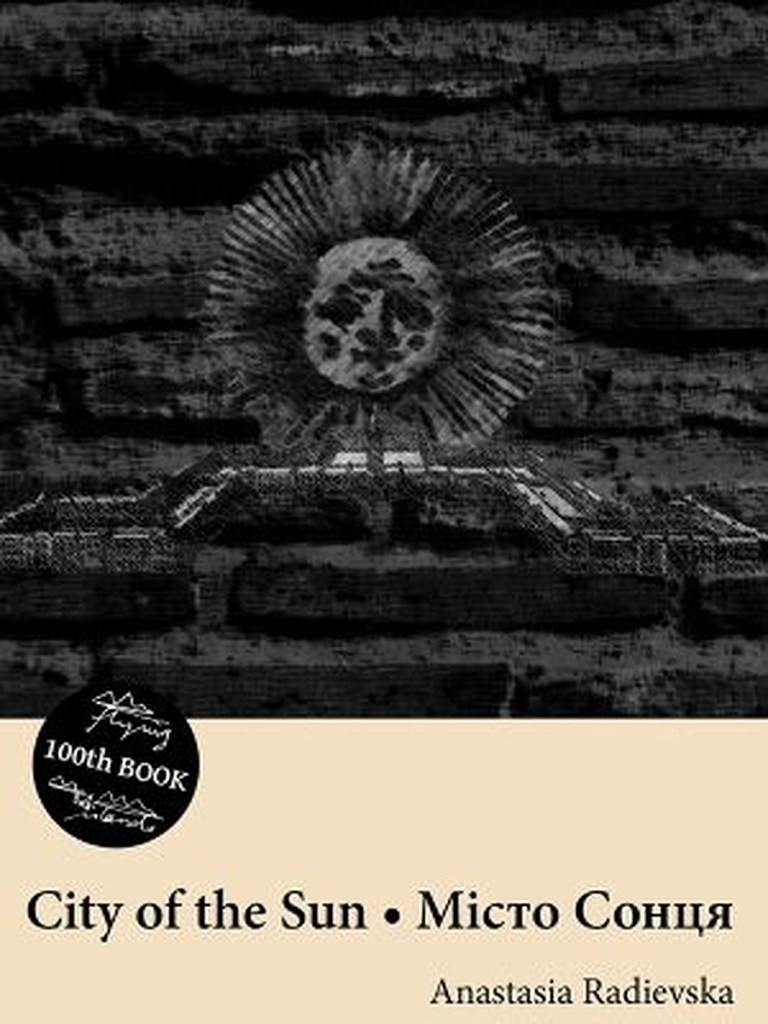
Anastasia Radievska, City of the Sun / Місто Сонця (Flying Island Books 2024)

This is Ukrainian-Australian poet and artist Anastasia Radievska’s first book of poems. It’s a rich, complex creation.

There are poems in English and Ukrainian, which means that almost half the book’s contents remain enigmatic and even unpronounceable to readers like me who can’t read Ukrainian script – but beautiful to look at.

The book takes its title from The City of the Sun, an early 17th century philosophical work by Tommaso Campanella, which according to Wikipedia is an important early Utopian work. Campanella’s city is protected by a series of walls, and this book’s sections are named for six of those walls. Each section is introduced with what I assume to be a quote from Campanella describing the images painted on its wall – followed by a double-spread illustration, a semi-abstract painting that mostly relates to that description.

For example, ‘The Fifth Wall’ is introduced by this paragraph:

On the fifth interior they have all the larger animals of the earth, as many in number as would astonish you. We indeed know not the thousandth part of them, for on the exterior wall also a great many of immense size are also portrayed.

For a casual reader like me, this framing has a pleasingly decorative effect, but as with the beautiful characters of the Ukrainian alphabet I expect that a more serious approach would make the reading experience much richer. More serious readers, please speak to us in the comments.

Page 77* includes neither Ukrainian text, quotation from Campanella, nor illustration. It’s ‘instructions for lunchtime’, one of six English poems in the ‘The Fifth Wall’ (which also includes six Ukrainian poems). As you would expect from the section’s introduction above, the poem features some of ‘the larger animals of the earth’.

instructions for lunchtime

always remember
dogs are beautiful for having been engineered
and well-loved
to engineer us back

the gaze turned inward
towards something worthy –
finally – of looking back at

and an entire piece of ginger in the mouth
doesn't say otherwise

but thinks of course
of racing horses
with ginger in the sacrum
a culinary cruelty
somebody's paying to have
done to them

and on a Monday
I would too if hadn't thrown away
a fortune on tom kha soup
in little brown bowls
and a seat by the window

watching the dog wag its tail at the Lime bike
like it might be relevant to it
as a conspirator or fellow thing
to answer our doubts with –
throw in the river
– price – chase
at fleece rabbits –
does it not breed, breed, breed?

As with Radievska’s poems generally, part of the pleasure here lies in the poem’s difficulty. It’s not that there’s a puzzle to be deciphered; what the poem asks for is a little patience – understanding will come.

The poem starts with an abstract consideration about dogs, goes to the sensation of ginger in the mouth, then to a memory of cruelty to horses. Only at about the fifteenth line, you get to see some coherence. As advised in the title, it’s a lunch poem: the speaker is having her customary tom kha soup in a Thai eatery. Just as she sees a dog in the street outside the window wagging its tail at a hire bike, she finds she has put a whole piece of ginger into her mouth and her mind wanders to something she has heard about a use of ginger in horse-racing. Her attention returns from the ginger and horses to what she is seeing in the street, and she indulges some fanciful imaginings about the dog and the bike.

That’s the narrative.

There’s a lot else happening. The opening injunction, ‘Always remember…’, is a nice reminder of something we all know: we find dogs beautiful because we have bred (‘engineered’) them to be that way, but they have their own subjectivity and have changed us in turn. It’s not the standard joke about how dogs have made us their servants – bringing them food, throwing balls for them, cleaning up their messes, etc. It something about the dogs’ gaze: meeting a dog’s eyes can make you feel (‘finally’) that you are worth looking at (unlike the often indifferent or critical gaze of other human beings).

The piece of ginger in the mouth introduces a different human–animal relationship – a piece of ‘culinary cruelty’ in the racing industry. I don’t know what ‘ginger in the sacrum’ is and couldn’t find anything in a quick online search, but I’ll trust the poem that it’s a thing.

someone is paying 
to have done to them

The cruelty to horses is a comparatively malevolent, profit-driven parallel to the engineering of dogs.

But this isn’t a poem of indignation or protest:

and on a Monday
I would too

At first glance this seems to be condoning cruelty to racehorses, but it’s worth spending time on the convoluted syntax to realise that it’s actually a little joke, playing perhaps on the ambiguity of ‘them’ in the previous line – callous about the horses, perhaps, but only because not keeping them in mind. A paraphrase might be: ‘When I have to drag myself to work on a Monday, I’d happily pay someone to do something similar to me …’

I would too if hadn’t thrown away
a fortune on tom kha soup

And with this mock-lament at having spent money on soup rather than self-torture, we’re back by the restaurant window, or in the reader’s case, realising for the first time that that’s where we are, watching with idle amusement as a dog confronts a hire bike (Lime bikes are everywhere in my part of town).

The thoughts projected onto the dog pick up on the poem’s opening lines: dogs are bred to please us but they look back and have an effect on us. Can a bike do the same? The answer isn’t as obvious as we’d like. Sure, a bike can be thrown in the river, the cash transaction is front and centre, and (we know, even if the dog doesn’t) that a bike won’t play with a soft toy. But the final line introduces some doubt:

does it not breed, breed, breed? 

On the surface, this is a version of the joke about the discarded hire bikes that litter some parts of our cities – they’re breeding like rabbits. The dog asks if that’s literally so. But there are further possibilities: there may be something about capitalism as a creature that has got out of hand, but what strikes me is a suggestion that as artificial intelligence develops, perhaps objects like this bike will, like dogs, develop agency of their own, and if they haven’t already changed the way we see ourselves (with ‘the gaze turned inward’), that may be just a few generations of breeding/engineering away. Dogs and horses are among the ‘larger animals’; the poem asks if bicycles also belong in that category, or will some day.

Not bad for a poem that presents as capturing the idle play of mind during a lunch break.


I finished writing this blog post on Gadigal Wangal country, where the days are growing longer, and some wattle trees are in exuberant flower. I acknowledge Elders past, present and emerging for their continuing custodianship of this land.


My blogging practice, especially with books of poetry, is to focus on the page that coincides with my age, currently 77.
Mark Mahemoff’s Beautiful Flames

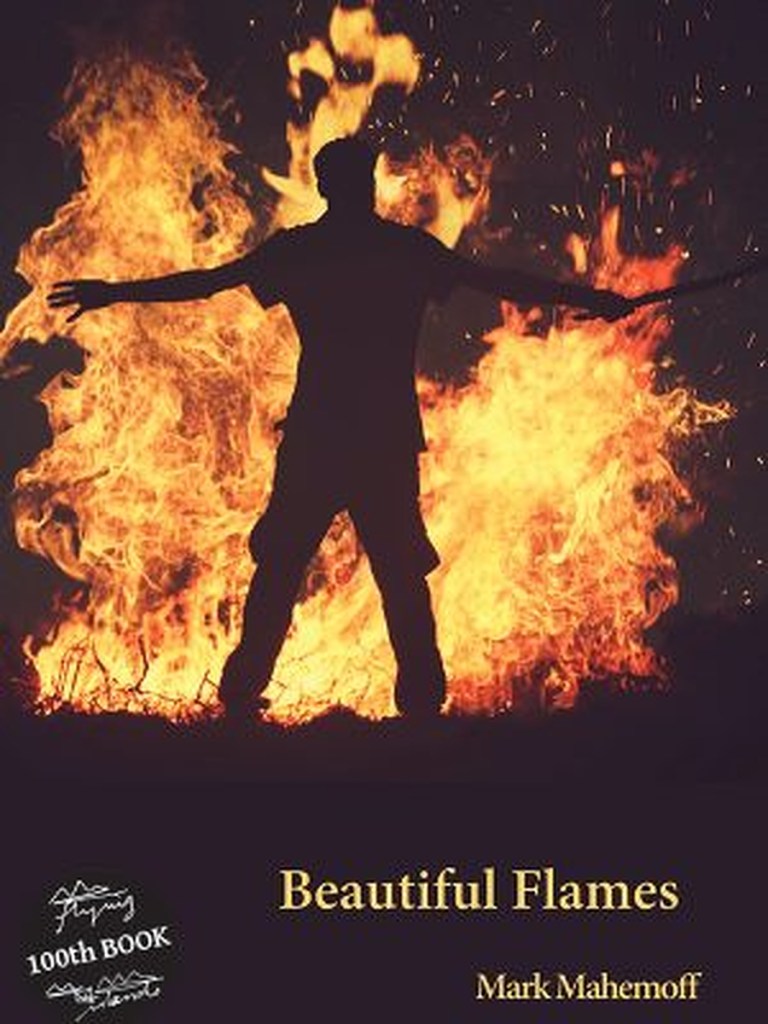
Mark Mahemoff, Beautiful Flames (Flying Island Books 2024)

This is another pocket-sized book I took with me on my recent trip to North Queensland. It’s Mark Mahemoff’s sixth book, a modest, user-friendly poetry collection in four sections.

The first section, ‘Chronicles’, mostly includes brief stories taken from life – family events, losses, a school reunion, the process of leaving home. From ‘Leaving’ (page 20):

Because childhood is a country
no one escapes unscathed
we haul it like a suitcase
stuffed full of unwashed clothes.

The second section, ‘Observations’ is what it says on the lid, observations on life’s passing parade. The titles of its poems generally tell you what to expect: ‘Kookaburras’, ‘Night Train’, ‘A Mediation’, ‘Bar Sport’, ‘Professional Development’.

The main pleasure of these first two sections is like what can get from a photograph of something ordinary – not claiming that it’s anything other than ordinary, but inviting us to pay attention to it for a moment. I generally try not to quote the final lines of poems – it’s too much like revealing the punchline of a joke – but the last stanza of ‘Nasturtiums’ (page 53) is too good an example of what I mean. Having described the large patch of these flowers on a lawn ‘somewhere in Haberfield’, and wondered whether they count as ‘weeds, food or flours’, the poem concludes:

But just devour them with your eyes
and you'll find that's enough
when you're walking beside someone
or alone
in sunlight.

That might seem banal but there’s some subtle, even self-effacing complexity. Mahemoff isn’t just talking about his own walk, but gently and elliptically inviting us to go on a walk of our own, to see for ourselves, and the last two line breaks create an unsettling effect. (What if it’s an overcast day, will it be enough then? If not, is it because the flowers look drab without the sun on them? Or is the sunlight a kind of companion?) The poem isn’t tied off in a neat bow.

The third section, ‘Travelogue’, comprises six poems in the form of notes from visits to, respectively, Western Australia, New Zealand, Melbourne, two unnamed places (one of which has a river and the other cactus plants), and Texas. The last-mentioned (‘Dallas in January’, page 84) forms a nice companion piece to Andrew O’Hagan’s essay ‘The American Dream of Lee Harvey Oswald’ in The Atlantic Ocean, which I read a couple of weeks ago: O’Hagan and Mahemoff describe the same museum, and have similar responses.

Page 77* contains two of the nine short poems that make up ‘New Zealand Snaps’.

The first is ‘Lower Shotover’:

Lower Shotover
Cool in the shade.
Singeing in the sun.
'The ozone layer is thinner here,'
she said.
You watch washing flap
while jets cruise past mountains.
How does one manage
this surfeit of beauty?
A bee falters
from flower to flower.

I had to look Lower Shotover up, but even without seeing images online (here are some if you’re interested), I knew from the poem the kind of place it is. And that’s without any of the kind of writing you might find in a tourist brochure or a poem that trusted its readers less.

It’s a thing in some contemporary poetry to plonk one thing down after another – an image, a quote, an aphorism – and call on readers to make their own connections. The poem becomes a collaboration between writer and reader. ‘Lower Shotover’ does a version of that, giving us a two-line observation about the temperature, a snippet of dialogue, images of washing on a line and jets in the sky, an abstract question, an image of a bee. We’re not left entirely to our own devices. We know from the title that the disparate items all refer to a place, but it’s up to us, for example, to imagine who speaks the third line (I think it’s the host at a tourism spot, but you might think it’s a visiting climate scientist), or whose washing flaps in the fifth line. But what is definitely there is the way the poem moves from bodily sensations in the first lines, to human connection in the third and fourth, to attention first to things seen and heard in close-up and then things seen and heard heard far-off . Only then, in the seventh and eight lines, is there an oblique reference to the reason the poem exists: the beauty of the place. But instead of trying to describe the beauty, the poem in effect confesses itself inadequate to the task. The image of the bee in the last two lines brings a nice meta touch – the poem itself has been faltering from one thing to another.

The second poem, unlike most of the poems in this book has a strict form. Each of its stanzas consists of 17 syllables – 5 in the first and third lines and 7 in the middle line. Yes, they are haiku, as we have come to understand that form in the English-speaking world.

Fox Glacier
Mountains demand awe.
We whisper in their presence,
take snapshots, and leave.

It rains ceaselessly.
A single set of headlights
burns through the distance.

Haiku, like sonnets, have a turn. In these examples, the turn has a visual quality: in the first, our gaze rotates (literally turns!) from the mountains to the tourists; in the second, there’s a change of focus from wide to narrow. I’m not sure that the rules of haiku, strictly speaking, allow words like ‘I’ and ‘we’, but the point of this ‘we’ here is that the human presence is tiny, and temporary, barely there at all.

Having written that, I have just read in Mark Mahemoff’s bio at the back of the book that his poetry

is chiefly concerned with framing, reimagining and memorialising commonplace moments, primarily in an urban setting.

Which makes me notice one more thing about these haiku: the Fox Glacier is about as far from an ‘urban setting’ as you can get, yet both haiku have industrial elements – snapshots and headlights – that make their (momentarily puny) demands on our attention.


I finished writing this blog post on Gadigal Wangal country, where I’ve noticed leaf-curling spiders waiting patiently in their rain-spangled webs. I acknowledge Elders past, present and emerging for their continuing custodianship of this land.


My blogging practice is to focus on the page of a book that coincides with my age, currently 77.