
Annie Ernaux, Une femme (Editions Gallimard 1987)
—–, A Woman’s Story (translated by Tanya Leslie 1991, Fitzcarraldo Editions 2024)
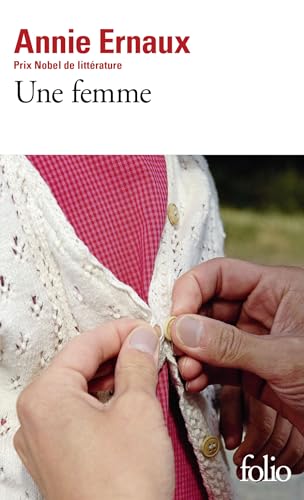
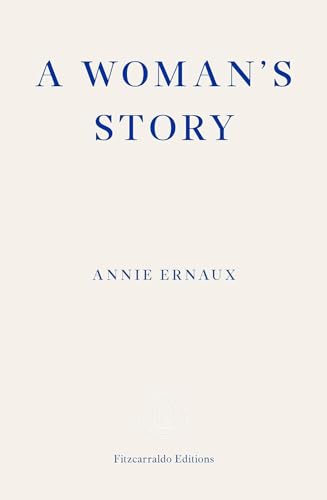
Before the meeting: The press release announcing that Annie Ernaux had won the Nobel Prize in Literature spoke of:
the courage and clinical acuity with which she uncovers the roots, estrangements and collective restraints of personal memory.
Every word of that is well chosen. Ernaux revisits her own life story in every book, pitting her ‘personal memory’ against what she finds in old photographs and diary entries, constantly questioning and challenging herself. She makes most other autobiographies / memoirs seem at least a little glib and self-serving.
I read Une femme / A Woman’s Story in both French and English. I could do this because it’s a short book – 60 pages in English, 95 in French. Apart from an opportunity to flex my rusty French, I was motivated by the way the English title departs from the original. Une femme is literally ‘A woman’. Calling it A Woman’s Story is a tiny change, but it significantly shifts the meaning. I wondered if similar shifts happened in the body of the book. (I think they do, and I apologise in advance for the way this blog post gets bogged down in the details of translation – fascinating to me, but maybe not to you!)
A Woman’s Story / Une femme does tell the story of a woman: Ernaux’s mother. But actually there are three stories. There’s Ernaux’s reconstruction of her mother’s life: her youth, her time as a shopkeeper in an impoverished part of France, her marriage, her ageing, and at last her dementia and death. There’s the story of Ernaux’s relationship with her, including the times that she lived with her and her family, and at the very end a brilliantly concise statement of what, after the initial intense grief, her mother’s death meant for her. And there’s the story of writing the book, begun in April 1986, very soon after her mother’s death, and finished in February the following year. This is a book in which une femme writes about une femme, and either could lay claim to the book’s French title.
I love this book. It reaches tendrils into parts of my own life that could do with a bit of ‘courage and clinical acuity’. I find Ernaux’s sheer dogged determination to find truthful words completely engrossing. In one of several moments when she steps in to tell us about the process of writing, she says:
When I speak of her, my first impulse is to ‘freeze’ her in a series of images unrelated to time – ‘she had a violent temper’, ‘she was intense in everything she did’ – and to recall random scenes in which she was present. This brings back only the fantasy woman, the one who has recently appeared in my dreams, alive once more, drifting ageless through a tense world reminiscent of psychological thrillers. I would also like to capture the real woman, the one who existed independently from me, born on the outskirts of a small Normandy town, and who died in the geriatric ward of a hospital in the suburbs of Paris. The more objective aspect of my writing will probably involve a cross between family history and sociology, reality and fiction [la jointure du familial et du social, du mythe et de l’histoire] … I would like to remain a cut below literature.
(Page 17)
That is to say, don’t look for fine writing here. Look for a serious attempt to see the reality of this woman’s life and how it was interwoven with Ernaux’s own.
My practice of looking at page 77 is a good way of giving you a flavour of the book, and of some of the issues that must have faced Tanya Leslie, the translator.
On page 77 of the French edition, page 51 of the English, it’s the early 1970s. Ernaux’s mother, now a widow, has sold her business and abandoned her life as a shopkeeper. She has moved to Annecy at the other end of France to live with Ernaux and her young family. She isn’t thrilled with her new life: she is no longer a significant part of a community. Her life has shrunk. ‘Now she felt she was a nobody’ / ‘Elle ne se sentait plus rien.’ She was proud of the life Annie had made for herself, but felt uneasy with the middle-class life that now surrounded her.
I ought to say that after my partner’s father died, her widowed mother became a much bigger presence in our lives, after a time spending a couple of nights a week living with us and then moving in full time. We didn’t have the class difference that Ernaux describes, but this page resonates powerfully, and I am in awe of the way the writing reaches for a deeply respectful understanding of the mother’s point of view:
Living with us was like living in a world that welcomed her and rejected her at the same time. One day she said angrily, ‘I don’t think I belong here.’
The transition from the generalised to the particular in those two sentences is typical Ernaux. In the French, it’s slightly different:
C’était vivre à l’intérieur d’un monde qui l’accueillait d’un côté et l’excluait d’un autre. Un jour, avec colère: « Je ne fais pas bien dans le tableau. »
There are three departures from a literal, word for word translation. First, there is no ‘us’: it’s all about the mother. Second, the English has tidied up the second sentence and given it a verb – ‘she said’ – which is not there in the French. There’s a lot of that in the book. The French text sometimes reads like quick notes: no need to spell out who was speaking etc. The English tidies it up, with the effect that what in French feels rough and raw becomes in English a more polished, considered text. And third, what the mother says has been softened: the tentativeness of ‘I don’t think’ is an insertion, where the French just has an angry statement of fact: ‘I don’t belong here.’
The rest of the page, in English:
And so she wouldn’t answer the phone when it rang next to her. If her son-in-law was watching football on television, she would make a point of knocking on the door before entering the living room. She was always asking for work – ‘Well, if there’s nothing to do, I might as well leave then’ – adding with a touch of irony, ‘After all, I’ve got to earn my keep!’ The two of us would argue about her attitude and I blamed her for deliberately humiliating herself. It took me a long time to realise that the feeling of unease my mother experienced in my own house was no different from what I had felt as a teenager when I was introduced to people ‘a cut above us’. (As if only the ‘lower classes’ suffered from inequalities which others choose to ignore.) I also realised that the cultural supremacy my husband and I enjoyed – reading Le Monde, listening to Bach – was distorted by my mother into a form of economic supremacy, based on the exploitation of labour: putting herself in the position of an employee was her way of rebelling.
And in French:
Donc elle ne répondait pas au téléphone quand il sonnait près d’elle, frappait d’une manière ostensible avant de pénétrer dans le salon où son gendre regardait un match à la télé, réclamait sans cesse du travail, « si on ne me donne rien à faire, je n’ai plus qu’a m’en aller» et, en riant à moitié, « il faut bien que je paye ma place!». Nous avions des scènes toutes les deux à propos de cette attitude, je lui reprochais de s’humilier exprès. J’ai mis longtemps à comprendre que ma mère ressentait dans ma propre maison le malaise qui avait été le mien, adolescente, dans les « milieux mieux que nous » (comme s’il n’était donné qu’aux « inférieurs » de souffrir de différences que les autres estiment sans importance). Et qu’en feignant de se considérer comme une employée, elle transformait instinctivement la domination cultureIle, réelle, de ses enfants lisant Le Monde ou écoutant Bach, en une domination économique, imaginaire, de patron à ouvrier: une façon de révolter.
You can see what the translator had to wrestle with. She breaks two long sentences into shorter ones. I can’t tell if this is her way of making the text more elegant, or if it’s a difference in the way the languages work. And domination must have given her nightmares: ‘supremacy’ isn’t a dictionary equivalent, but it’s surely eccentric to describe reading Le Monde as an act of domination. Yet maybe that eccentricity is exactly what Ernaux intended – certainly ‘economic supremacy’ makes less sense than ‘economic domination’.
This is one place where I was happy I had read the French as well as the English. I didn’t understand the bit in brackets about the ‘lower classes’ until I read the French, where, rather than the ‘others’ choosing to ignore inequalities, they consider some différences to be unimportant (and yes, différences translates as ‘differences’, no inequality necessarily implied). Le Monde is just a newspaper to Ernaux and her husband, and Bach is pleasant to listen to. For the mother, they are markers of cultural superiority. A smaller oddity of the translation is that whereas the French insists that the ‘cultural supremacy’ / domination culturelle is real (réelle) and that the ‘economic supremacy’ / domination économique is imaginary (imaginaire), the English lets the word ‘distorted’ carry that distinction. On top of that, leaving out the word instinctivement, it seems to me, makes the mother seem much more calculating, and perhaps makes Ernaux less patronising. I don’t think Ernaux wants to blame her mother, or spare herself, in this way.
After I’d written that last sentence I noticed a moment in the previous paragraph that struck a chord with me. One of the things Ernaux’s mother has to do to conform to the household’s lifestyle is, in English:
‘observing personal hygiene’ (blowing the boys’ noses on a clean handkerchief).
That’s unremarkable, just one more detail in the list of things she has to adapt to. The original French is:
avoir de l’« hygiène » (ne pas moucher les enfants avec son propre mouchoir).
A literal translation of the phrase in brackets is, ‘not to blow the children’s noses with her own handkerchief’. They say a translation can never be complete, but still I allow myself to mourn the loss of this tiny, graphic image of grandparent–grandchild intimacy forgone in the name of upward mobility, and lost to the English text for who knows what reason: perhaps handkerchiefs themselves are so repugnant to modern Anglo sensibilities that sharing them is unspeakable.
After the meeting: In the Book Club, we traditionally discuss two books. This book was paired with Abdulrazak Gurnah’s Paradise (link to come added later). I think the reason for the pairing was that they’re both by Nobel laureates. At the start of our discussion, an astute person pointed out that they both feature shops (the mother’s shop in Ernaux’s book, and two different shops where Gurnah’s protagonist worked). That’s about where the similarities began and ended. Our evening – or at least that part of it not taken up with excellent food and even more excellent conversation about life, physical afflictions, travel plans and so on – was split neatly into two parts.
As you’d expect, my having read the book in both languages was met with eye rolls, but there was general recognition that the difference was substantial between blowing a child’s nose on a clean handkerchief and not blowing it on one’s own handkerchief.
We had a very interesting discussion of a passage where Ernaux describes her aim as to set aside her own emotional memories about her mother (how she felt when she was angry etc) and tell the story from her mother’s point of view, but says that she finds those emotions breaking through anyway. I think we agreed that this, far from being a failure, is one of the things that makes the book so rich.
One person out of the five of us didn’t care for the book. Reading it, she couldn’t see any reason why Annie Ernaux would have been given the Nobel. Those of us who had read a number of her books tried to articulate our reasons for holding her in high esteem, but maybe it’s a matter of taste. What I/we saw as minimalism, for example, she saw as sketchiness.
One person spoke of the way the book had inspired her to try to write about her own childhood, focusing on specifics rather than a broad narrative. The exercise had led to interesting insights into her early life. We had a brief but interesting conversation about how for ‘our generation’ in Australia (we range from a couple of weeks short of 70 to a couple of years beyond 80), as for Annie Ernaux, there was a shift in class – ‘upward mobility’ – that hadn’t been so widespread in previous generations. This shift was due in part to increased access to education – so we did the Australian equivalent of listening to Bach and reading Le Monde.
It might seem that that conversation was of the same order as travel plans and medical reports, but I think it’s a quality of Ernaux’s books – not just this one – that they prompt readers to reflect on their own lives.
Next: Paradise.


 Me fail? I fly!
Well described, JS. Especially your comments on the original when compared with the English translation…
LikeLiked by 1 person
Thanks, Jim
LikeLike
Fascinating Jonathan. I’m always interested in translations and translating, but my comparisons have usually been between different English translations – often of Russian works – rather than what you’ve done. I like it when translators provide a note on their translation decisions with a particular work. My French is rusty but I could understand most of the examples you provided. Some interesting decisions were made.
I have not read Ernaux yet but I keep reading blog posts on her that tell me I should.
BTW that generational class difference issue is interesting. I’d have to discuss it in my group but my sense is that my parents and the few whose parents I know well enough were middle class like us, their offspring. Many hadn’t been to university though a few had but their lives were comfortable enough that they had “middle class” interests in, say, reading, museum/gallery attendance, concert going, travel. Does that make sense? My group ranges in age from 67 to 77 so just a little bit younger than yours. Our average age is probably 70-71.
LikeLiked by 1 person
Oops where did that extra “u” come from!
LikeLike
I don’t know about ‘should’, but I think you’ll be glad when you do get to read her.
Generational class difference! Yes, it’s such a complex matter. My own parents both left school at 15 or so, but did read a lot and, as far as I know, went to every bit of live theatre in our town. It was when my much older brother went to university that classical music came into hour house (mainly Tchaickowsky, though come to think of it we had a record of the Waltz of the Flowers with a narrative over it when I was small, so there was an openness to ‘high culture’). My uni student brother gave them a print of a Blackman painting that took pride of place on the kitchen wall.
(Typo fixed. It’s the least we can do for each other.)
LikeLiked by 1 person
And thanks re the typo!
LikeLiked by 1 person
Fascinating! It is intriguing to compare translations with the original, I’ve only done that with bits and pieces of Zola when I’ve felt instinctively that something was not quite right in the English. And curiously, the excerpts when I’ve done this have always been to do with class. Maybe, as with the handkerchief, it’s because class markers can be so subtle and culturally specific?
*chuckle* Yes, it is easy to provoke eye-rolling from our monolingual friends…
I don’t think there is anything English can do to deal with the subtleties of tu/vous, and I remember being thoroughly engaged by a translator’s choice of what to use and why when confronted by ‘maman’ as a form of address: Mother, Mum, Mom, Mummy, Mater. All of these invoke class and cultural differences, and the choice influences how we read the text.
LikeLiked by 1 person
That’s interesting about class and language, Lisa. It’s why I’m tentative about my ‘fault-finding’ with this translation. It may well be that what looks to me like gentrification is actually avoiding using English that is much less polite than the French is. I think of ‘espèce de con’!
I find the whole tu/vous thing fascinating – in movies, every now and then I notice that a whole dimension of relationships is conveyed in that usage that simply isn’t there in the subtitles.
LikeLiked by 1 person
Fascinating comment Jonathan. I always love your observations about translation, and how the decisions a translator makes can seem small but be so consequential. I haven’t read Ernaux, but would like to. The little excerpt here about the mother’s passive-aggressive interaction with the family was very revealing, and struck a chord with me. Thank you!
LikeLiked by 1 person
Thanks, Kathy. I think you’ve got a treat in store. Maybe start with The Years.
LikeLike
yes, The New Yorker ran a feature on her some years back and ran one of her stories; I really enjoyed it —
LikeLiked by 1 person
Thanks Jonathan. My mum went to Sub-Senior in QLD but her father wouldn’t support her going further – she had to do secretarial studies that year but she did English as well. That was around 1945/6. She went to University about 1975 (with my younger brother) – the best thing she ever did. Before that, she did do amateur theatre. Dad finished high school but then got a job in the bank which became his career. Classical music was in our family a little more because his baby sister, born 1930, went to the Con. But it wasn’t our main music fair – that was musical theatre!
LikeLiked by 1 person