
Elif Shafak, There Are Rivers in the Sky (Penguin 2024)
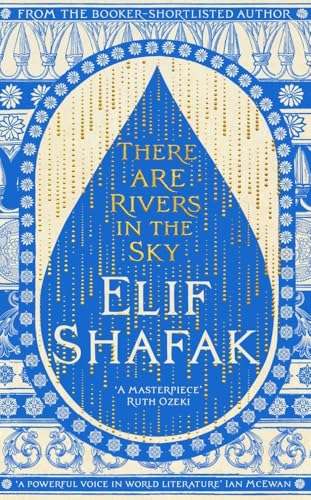
Before the meeting: I’m glad I read this novel. I am much better informed now on the history of the Yazidi people, and about the unearthing of the Epic of Gilgamesh in the mid 19th century.
After a short opening chapter featuring the tyrant Ashurbanipal in ancient Nineveh, the narrative follows three distinct threads, which remain separate until the final, very short chapter.
There’s Arthur, full name Arthur King of the Sewers and Slums, a fanciful version of the amazing George Smith who decoded the cuneiform script of ancient Mesopotamia, translated the Epic of Gilgamesh and travelled to Nineveh in the mid 19th century. There’s Narin, nine years old at the start, living in south-east Turkey in 2014, child of a shrinking and beleaguered Yazidi family. And there’s Zaleekhah, a 30-something hydrologist in the throes of a break-up in 2018, who we first see renting a houseboat on the Thames.
A number of motifs occur in each of the stories, so that they resonate with each other even there is no evident narrative connection: images of lamassus, the protective spirits of ancient Nineveh who have bearded human heads and lions’ bodies; pieces of lapis lazuli; cuneiform script, on clay tablets or in tattoos; references to The Epic of Gilgamesh; and above all water. The book begins:
Later, when the storm has passed, everyone will talk about the destruction it left behind, though no one, not even the king himself, will remember that it al began with a single raindrop.
That raindrop has no causal impact on events, but the identical drop, having lain dormant in the water table, floated in the ocean, wafted about in clouds, turns up again at crucial moments of each narrative, as a snowflake or ocean spray or another raindrop. That conceit, and the way the narrative frequently pauses for mini-lectures – on hidden rivers, the industrial revolution, Yazidi culture, Napoleonic archaeology, etc etc – meant I spent a lot of time being irritated. The fourth wall is forever being broken, either by a mention of water (at least four times there are sweating necks, or a character introduces herself by saying her name is short for an Irish word for water) or by what reads like a piece of undigested research.
Page 77*, it turns out, has some fine examples. Zahleekha has just stepped into her houseboat for the first time. First there’s the water, with heavy-handed metaphorical significance. She drinks a mug of water ‘in one draught’, and:
It tastes earthy and slightly metallic, with an aftertaste of iron. The flavour has less to do with its intrinsic qualities than with its biophysical environment, the set of conditions that brought it about. Water hardens in adverse circumstances, not unlike the human heart.
Then comes the lecture, preceded by a moment of backstory:
Out of nowhere a memory surfaces – the words Uncle Malek uttered the day she had graduated from university with honours. I’m so proud of you, habibti. I want you to be very successful. Remember, people like us cannot afford to fail.
‘People like us’ … immigrants, exiles, refugees, newcomers, outsiders … Too many words for a shared, recognisable sentiment that, no matter how often described, remains largely undefined.
Children of uprooted parents are born into the memory tribe. Both their present and their future are forever shaped by their ancestral past, regardless of whether they have any knowledge of it. If they flourish and prosper, their achievements will be attributed to a whole community; and, in the same way, their failures will be chalked up to something bigger and older than themselves, be it family, religion or ethnicity.
Then, after a little more along the same lines, Zahleekhah sits down and after a moment starts to cry. But rather than allow the reader space for empathy, the narrator sweeps in with her insistence on water as ubiquitous and rich with symbolic meanings:
A tear falls on the back of her hand. Lacrimal fluid, composed of intricate patterns of crystallised salt invisible to the eye. This drop, water from her own body, containing a trace of her DNA, was a snowflake once upon a time or a wisp of steam, perhaps here or many kilometres away, repeatedly mutating from liquid to solid to vapour and back again, yet retaining its molecular essence. It remained hidden under the fossil-filled earth for tens if not thousands of years, climbed up to the skies and returned to earth in mist, fog, monsoon or hailstorm, perpetually displaced and re-located. Water is the consummate immigrant, trapped in transit, never able to settle.
Again, I’m glad I read this book. But I was annoyed a lot of the time while reading it.
After the meeting: We read There Are Rivers in the Sky along with The Heaven and Earth Grocery Store by James McBride. There were five of us, well-fed by the time we got to the books. We began with confessions: only one person hadn’t read either book, and she had read ‘about 35%’ of this one. She spoke eloquently about what she liked in what she had read – mainly the evocation of polluted, foul-smelling mid-19th century London – which makes me think it’s probably a good idea to have someone in any group who hasn’t finished the book.
Of those who had read to the end, we had a range of responses. One enjoyed it, only peripherally put off by the telling-not-showing and heavy-handed deployment of the leitmotifs. Onehad been enthusiastic abut the book because she hoped it would have interesting things to say about Gilgamesh and appreciated much about it, but was disappointed and disliked being lectured at. And the other just found the book tedious, would rather have read a non-fiction treatment of the history and persecution of the Yazidi, couldn’t feel any of the characters as more than made-up figures to allow the plot to move. And there was me (see above).
We all agreed that the most interesting thing in the book was the character of Arthur. Born in abject poverty, his photographic memory and a series of Dickensian coincidences (one of them featuring Charles Dickens) led him to interesting places, and fixation on a book about Nineveh as a way of dealing with the pain of brutal beating led to a grand obsession that gave The Epic of Gilgamesh to the modern world. I now want to find out more about the real-world George Smith, but I’m very happy to have Arthur in my mental world as distinct from him.
I wrote this blog post in Gadigal Wangal country, in a place where wetlands have been drained, but the river is recovering health, is home to a marvellous variety of birds, and is a great place for catch and release fishing (one day the fish may be edible again). I acknowledge Elders past, present and emerging for their continuing custodianship of this land.
* My blogging practice is to focus on the page that coincides with my age, currently 77.


 Me fail? I fly!
I like Elif Shafak, and I’ve got three on hers on the TBR. (Why haven’t I read them, eh?)
I think I might pass on this one…
LikeLiked by 1 person
This is the first of hers I’ve read. I do seem to differ wildly from the consensus, so don’t be too influenced by me, Lisa
LikeLike
I hear you, but I think I should read what I’ve got first…
LikeLiked by 1 person
My book group read The Island of Missing Trees last year and my response was very similar to yours here. So thanks, I will pass in this & focus on reading the two earlier books of hers I have in my tbr instead.
LikeLike