Monthly Archives: Dec 2024

Rodney Hall’s Vortex

Rodney Hall, Vortex (Picador 2024)

I haven’t read anything by Rodney Hall since the early 70s, and then it was just one book of poetry and one novella. Since then he has had thirteen more novels published, as well as ten more poetry collections, a collection of short fictions, two biographies – and non-fiction, an opera libretto and radio plays (not an exhaustive list), not to mention that he has won any number of prestigious prizes and accolades.

So it may be because I’m coming late to his writing that Vortex had me feeling off kilter pretty much from start to finish. On any page there’s something to enjoy, appreciate, puzzle over or be wowed by. But I don’t think I ever had a sense of the book as a whole.

There’s Brisbane in 1954: the Queen’s visit, a spectacular water-weed infestation, an exhibition of Tollund Man in the museum, a cyclone, the aftermath of the US army’s stay there in World War Two, the beginnings of ASIO domestic spying. Vladimir Petrov makes a cameo appearance. Entertaining endnotes underline the historicity of some of these features and events, even while asserting that the book is fiction.

And there’s 1954 beyond Brisbane: the Mau Mau in Kenya, the Royal Charter for North Borneo, the battle of Dien Bien Phu in Vietnam, and a boatload of refugees.

There’s Compton Gillespie, a young, bookish working-class teenager who befriends Beckmann, a German man, formerly a member of the Hitler Youth, possibly homosexual, who dances with women for money. Any sexual tension in the novel is between these characters.

There’s Paloma, a Spanish countess who presides over a table of European migrants and refugees at the Colony Club, where the conversation is witty, urbane, and mildly satirical of the host culture.

Paloma’s husband, a crude member of the public service with aspirations to gentility, is involved in cloak and dagger intrigue with the Americans while playing some kind of role in making sure the Queen’s visit goes well.

Vassily Bogdanovich Hmelnitsky, ‘thirty years a homeless vagrant’, wanders the streets of Brisbane.

There are flash-forwards. John Howard’s ‘We will decide’ speech, or near enough, turns up in the dialogue. Scott Morrison is a mysterious presence in someone’s dream.

These narrative strands intersect: the boy takes a photo of the countess; the vagrant takes shelter in the Colony Club during a downpour; the queen speaks to the boy’s mother on her hospital visit. And there’s a fairly improbable tying up of at least some threads at the end. But it’s hard for the mind to find purchase.

And maybe that’s the point. Apart from the first, each chapter and subsection of a chapter begins in mid-sentence without a capital letter: ‘or how to kill so much time?’ (Chapter 2); ‘and because none of Professor Antal Bródy’s three doctorates is recognized by the University of Queensland’ (Chapter 3); ‘because the night is warm and splendid with stars’ (Chapter 6); and so on. Similarly, they all (including the final one) end mid-sentence and without a full stop. There’s a constant sense that we aren’t getting the full story: we are seeing and hearing only moments from a great, complex, uncontainable whole.

The received version of 1950s Australia is that it was boring, monocultural, conformist. This book challenges that view. Its sympathetic characters are all in one way or another non-conformist and questioning, and its Brisbane is part of the great movement of people around the globe that began after World War Two and continues until now. I think that’s the vortex of the title. Here’s a paragraph from page 230:

from an observation balloon the vast seething mass of displaced persons is caught and processed by still photographs. From a thousand feet up an aerial platform provides intelligence pinpointing any breakouts in the movement of the desperate massed figures below. Unseen analysts make their scrupulous adjustments

This paragraph is typically complex.

First, it wrenches our attention from its immediate context, in which Beckmann is being challenged about his relationship with Compton, to the general question of refugees. There’s a suggestion that the same thing happens at different scales: Beckmann’s roommate questions him, the unseen analysts do their work. This movement from Brisbane to international scenes happens regularly in the novel.

Second, it draws attention to the time-specific nature of the book: in 2024, readers are used to surveillance – in 1954, this paragraph insists, it was already a thing, but it was much more primitive, depending on still photographs rather than video streams, and observation balloons rather than satellites or even spy planes.

Third – and this is how I first read it – it suggests something about the book itself. Its true subject is ‘the vast seething mass of displaced persons’, but it captures and processes it, not by still photographs, but by word sketches, anecdotes, scraps of dialogue, fractures narrative arcs. It does it, not from a distance of a thousand feet, but in close-up, paying attention to the details of people’s lives.

I can see that, and respect it, but in the reading I was mostly unengaged.
Journal Catch-up 27: Overland Nº254

Evelyn Araluen and Jonathan Dunk (editors), Overland Nº 254 (Summer 2023)
(Only the editorial is online at the time of writing – so I haven’t included links, sorry!)

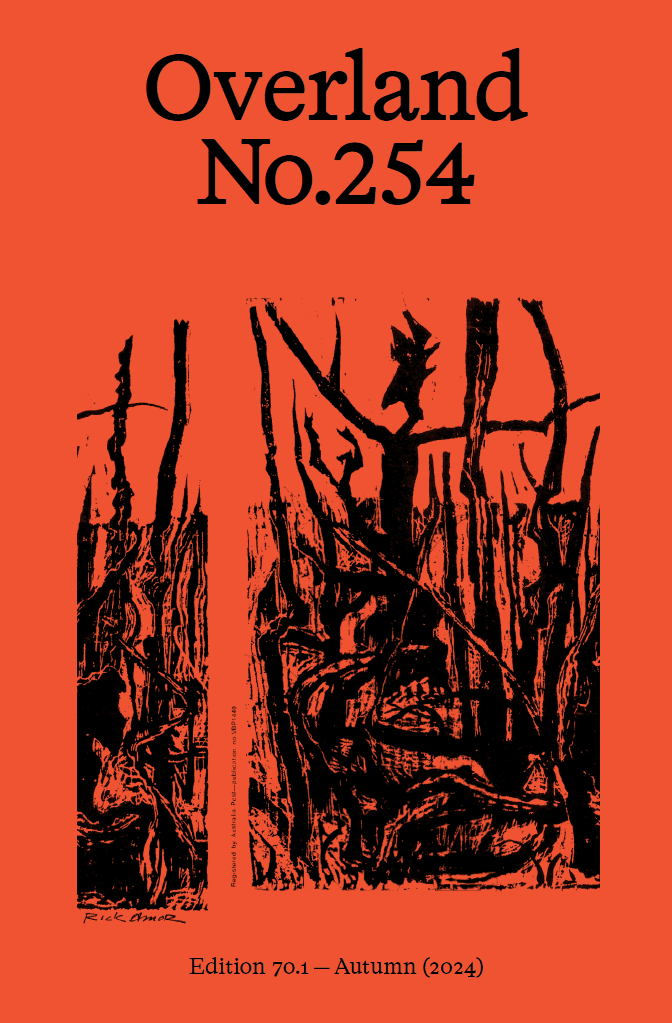
The first thing you notice about this issue of Overland is its design – an austere black and red cover and monochrome throughout, a smaller format, and surely the paper stock is cheaper than we’ve become used to. Could this be a sign of a funding crisis?

Of course there may be a funding crisis – this is an Australian literary journal after all. But there’s a definite retro aesthetic to the new look. Editors Evelyn Araluen and Jonathan Dunk call it an ‘archivally informed design’, and explain that it’s the first of four issues to mark Overland‘s seventieth year of publication. The internal illustrations are all from the archives, and include stunning ink drawings by Noel Counihan from the 1970s and Rick Amor from the late 80s and early 90s. Fabulously, page 128 features a Bruce Petty cartoon from 1976.

The nostalgia stops with the look. The words are all 2024.

I recommend the whole issue, but want to single out two articles that make me sorry so little of this content has made it to Overland‘s website. They are ‘“A State of Waste”: Myall Creek, the Sydney Herald and the Foundations of Australian Capitalism’ by Jeff Sparrow, and the anonymous essay, ‘Writing after … October 7’.

I’ve recently read how the 16th century Papal ‘Doctrine of Discovery’ (Wikipedia entry here) was explicitly invoked to justify dispossession and genocide of Indigenous people in the Americas and elsewhere well into the 19th century. Jeff Sparrow’s magisterial essay offers a very different account of how similar acts were justified in Australia. It’s a clear and cogent history of how the closing of the commons in 18th century Britain led to a new understanding of ‘ownership’ of land, which was applied ruthlessly by the settlers in Australia. The content may not be startlingly new, but Sparrow’s copious quotation from the Sydney Herald in the first part of the 19th century is, for me at least, revelatory. It’s not that the way First Nations people related to the land was strange to the settlers. It was all too familiar:

Like the British commoners, Indigenous people clearly did ‘make use’ of the land. They lived in a use-value society, tending their country to encourage the animals and plants they required. The Herald, however, understood ‘productivity’ in capitalist terms, with use values significant only insofar as they generated profit. (Page 67)

The essay spells out the way this thinking leads shockingly, but logically to the minds of the Sydney Herald editors, to justification of massacres.

What can I say? If you get a chance, read this essay.

The author of the other stand-out essay is a person of Arab background, writing in the context of conversations with Arab and Palestinian friends who work in academic or cultural contexts. They describe how they have always held in their mind the history of Palestine as ‘a bustling site of plurality and coexistence’. The establishment of the state of Israel in the nakba put an end to that condition but it has remained as a vision of possibility.

Jews worldwide were shaken by the visceral hatred shown for them in the Hamas attacks on 7 October last year. Palestinians and Arabs have been no less shaken by the hatred and disregard for them that subsequent events have demonstrated. The multi-religious and plural world of pre-1948 is now unthinkable. ‘We had not realised until this carnage started,’ the author writes, ‘how dehumanised Palestinians and Arabs are in the eyes of most Israelis.

There’s more. Back here, well-intended and well-informed colleagues have been carefully ‘balanced’ when discussing the situation of Palestinians in Israel, in large part because of not wanting to be seen as antisemitic. The author and friends have believed that if a point came when Israel unleashed its full fury on Palestinians their colleagues would take a stand. But it has happened, and many have not changed their stance:

It is not hyperbole to say we are grieving as we watch our kin annihilated on an hourly basis … We feel neglected, betrayed and discarded. We have always stood in solidarity with the causes these colleagues are most passionate about because those causes are ours too. Why isn’t Palestine their cause? (Page 49)

There’s another fine Palestine-related essay – providing devastating perspective on the brouhaha over three actors wearing a keffiyah at a preview of The Seagull in Sydney last year. But it’s the anonymous writer’s cry from the heart that strikes home.

There’s poetry – including the winners of the 2023 Judith Wright Poetry Prize and an excerpt from Nam Le’s 36 Ways of Writing a Vietnamese Poem.

There are short stories, of which my favourite is ‘Who Rattles the Night’ by Annie Zhang, a comic ghost story that won the Neilma Sidney Fiction Prize.


I finished writing this blog post in the land of the Bidjigal and Gadigal clans of the Eora nation, overlooking the ocean and surrounded by birdsong. I gratefully acknowledge the Elders past and present who have cared for this beautiful country for millennia.

Reading with the grandies 34: Wings of Fire, Tabby McTat, Dog Man

It’s been a while since I’ve blogged about my grandchildren’s reading. Both do quite a lot.

I’ll write about the four-year-old another time. For now, I’ll just say that he loves Tabby McTat by Julia Donaldson and Axel Scheffler, which I blogged about four years ago, when his big sister was also enamoured of it.

Our newly-turned-seven-year-old has become a comics reader. Unlike the Donald Ducks and Phantoms of my childhood, her comics are little books, and seem to be mainly adapted from series of non-graphic novels. Partly as dutiful grandfather and partly (mostly?) as committed reader of comics, I’ve read two books from her current obsessions. (I did dip into a Babysitters’ Club title, but couldn’t make myself read the whole thing.)


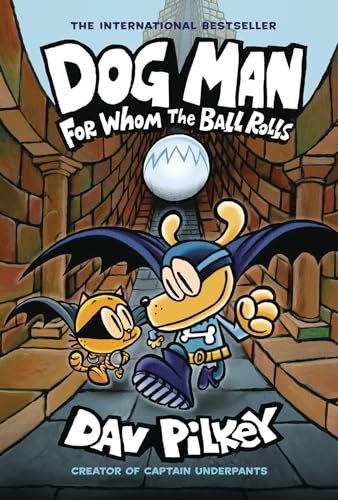
Dav Pilkey, Dog Man: For Whom the Ball Rolls (Graphix 2019)

I’d heard of Dav Pilkey’s Captain Underpants, but had no idea until I looked him up on Wikipedia that he had received the prestigious Caldecott Honor Award (in 1997, for The Paperboy) or that he had been named Comics Industry Person of the Year in 2019. His first name, I also learned there, doesn’t come from a non-Anglo heritage but from a misspelled name tag at a fast food outlet.

This is the seventh of the Dog Man books. It’s good fun.

The first pages explain that the hero has had a head transplant. His new head came from a dog, and now as he continues with his work as a police officer, his doggy abilities and instincts often come in handy. Sadly, and hilariously, they also cause problems.

In this book, whenever Dog Man comes close to making an arrest, the bad guy throws a ball and he is compelled to chase after it.

Having written that much, I realise that I didn’t actually finish reading the book. In an increasinglty rare treat for both of us, I read it to my granddaughter until life made other demands. I enjoyed what I did read, and will try to sneak a further look if I can find it among the chaos of books in their bedroom.


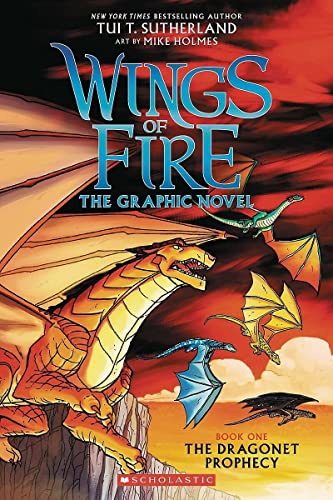
Tui T. Sutherland, Barry Deutsch, Mike Holmes & Maarta Laiho, Wings of Fire: The Dragonet Prophecy, the graphic novel (Graphix, an imprint of Scholastic, 2018)

Tui T. Sutherland’s Wings of Fire series is a major phenomenon in YA fantasy. The first (non-graphic) novel, The Dragonet Prophecy, was published in 2012, and has been followed by fourteen more, plus two stand-alones, a number of novellas (‘Winglets’), and other spin-offs. The series is currently being adapted into ‘graphic novels’ (I prefer to call them comics) by Barry Deutsch, with art by Mike Holmes and colour by Maarta Laiho. Evidently the sequential art version makes the stories accessible to a younger readership, as my granddaughter has devoured the first six volumes. I have just read the first.

In the world of this novel, intelligent dragons are the dominant species. There are at last six dragon nations / subspecies, each with its own powers. A war has been raging for twenty years – a war of succession, sparked by the death of a queen at the hands of a Scavenger (a creature we recognise as human). There is a prophecy that five dragons ‘who hatch at brightest night’ will end the war and bring about peace.

The story begins with the hatching of those five baby dragons (‘dragonets’). They spend their early years imprisoned in a cave, protected from the outside violence and trained for their future task by formidable adult dragons, the Talons of Peace, who don’t much like them. They bicker like siblings, study the history of the war, and test their diverse powers. Like many institutionalised children, they form powerful bonds of affection and are fiercely loyal to each other. As you’d expect, they escape from the cave and adventures ensue.

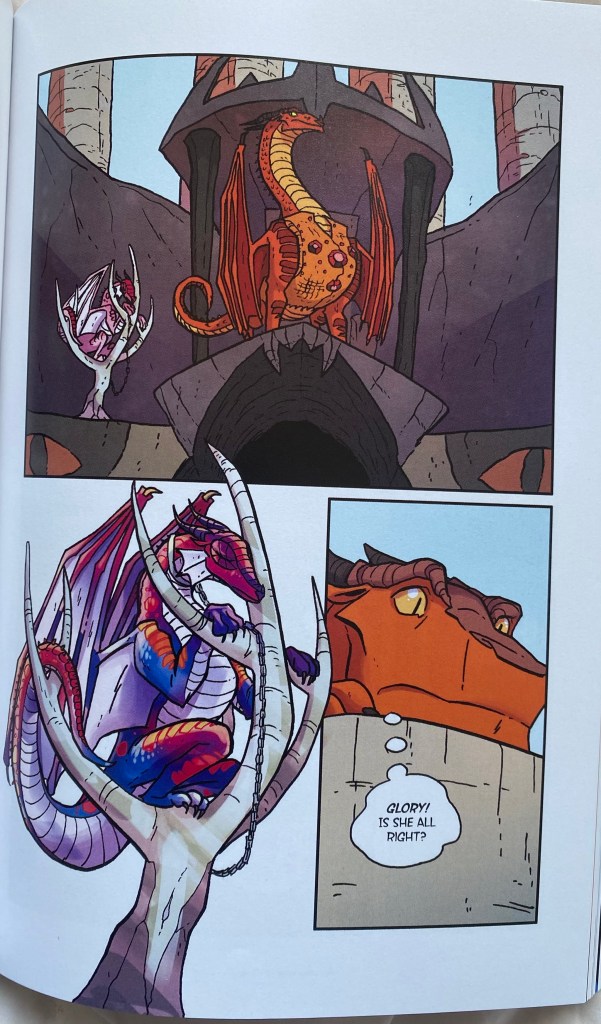
Rather than give more detailed summary, I’ll stick to my practice of looking at page 77:

It would be interesting to compare this with the equivalent section of the original novel. Certainly it would take a lot of words (three thousand for these three pictures?) to convey as much information about character and to move the plot along so far. (The next page does include aquite a bit more explanatory dialogue.)

The large dragon at the top is Scarlet, one of the powerful queens who not only wages war but is committed to keeping it going for its own sake. She knows of the prophecy and, having captured the dragonets, is out to humiliate and destroy them. She stands on a platform that overlooks an arena where, for her own entertainment, she stages fights to the death between dragons who have been taken prisoner.

The small, brightly coloured dragon in the intricate cage is Glory, one of the five dragonets. She is a rain dragon, despised by everyone except her companions as beautiful but lazy and generally useless. Scarlet has not condemned her to gladiatorial combat, but has arranged her as an artwork. In keeping with her reputation, she is apparently sleeping (no spoiler to tell you that she is actually wide awake, biding her time).

The square-snouted character at bottom right is Clay, a mud dragon, another dragonet and this book’s central character. He is currently chained to the top of a pillar overlooking the arena with his wings constrained, destined to fight and, Scarlet expects, die violently. So much of his character is revealed in this one frame: though he has just discovered his own precarious situation, his attention goes completely to Glory – alarmed at her vulnerability but also with sibling irritation at her passivity.

To tell the truth, part of my reason for reading this book was what an unsympathetic observer might call moral panic: I had heard my granddaughter exclaim from the seat of the car, ‘Why is there so much blood in this book?’ This is a girl who recoils from even the mention of blood in real life. Having read the book, I’m guessing that this young reader is in there for the story and at worst puts up with the so far extremely stylised violence and gore, at best uses it to work through some of her own fears and anxieties.

I don’t know if I’ll read on, but I’m tempted.

Montaigne progress report 9

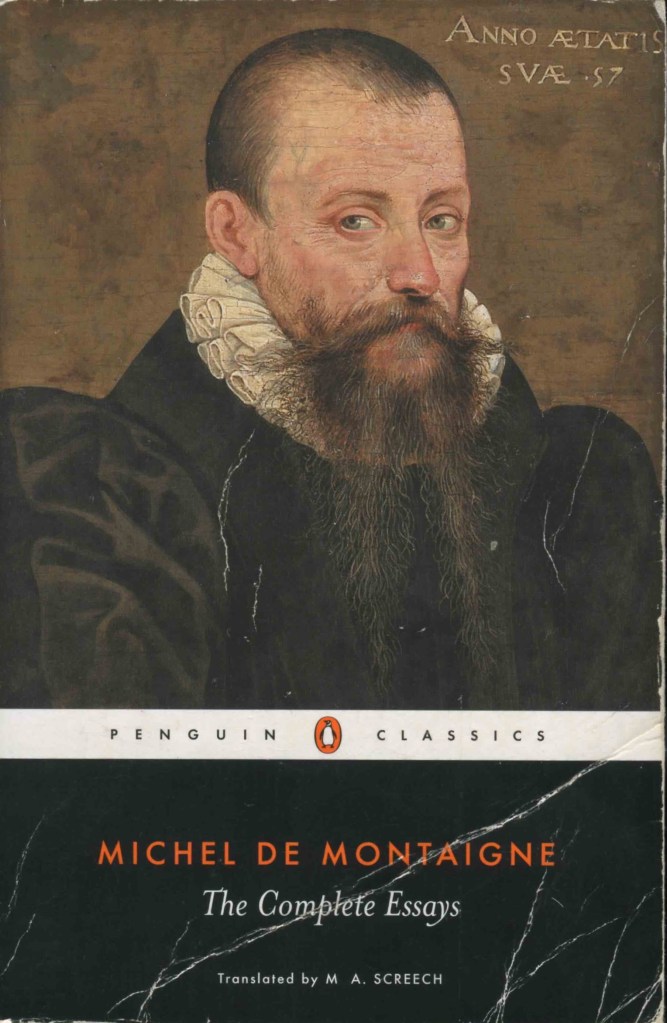
Michel de Montaigne, The Complete Essays (Penguin Classics 1991, translated by M. A. Screech)
– part way through Book 3, essay 5, ‘On Some lines from Virgil’ to part way through Book 3, essay 10, ‘On restraining your will’

This post was due more than a week ago, but life in general made other plans for me. With a couple of lapses, though, I have consistently read four or five pages of Montaigne’s Essays each morning.

I won’t even try to summarise what I’ve read in the last six weeks. I’ll just mention that ‘On some lines from Virgil’ continued to be fascinating on the subject of sex and gender; in a piece with the innocuous title ‘On coaches’ Montaigne denounces the atrocities of the Spanish colonisation of Central and South America; in ‘On the disadvantages of high rank’ he pities those whose social position means no one will disagree with them, because they are deprived of the joys of conversation.

And then there’s ‘On vanity’, a long essay that made me fear age-related cognitive decline was catching up with me. As with many of the essays, ‘On some lines from Virgil’ being a prime example, this one’s title gives you no idea of its true subject. But in this case, I couldn’t tell if it even had a main subject. He writes about travel, about death (a lot about death), about how much he loves Rome. He explains why he’s glad he has no sons. He quotes at length from the document granting him Roman citizenship. He’s like a dog snapping – in slow motion – at whatever fly of an idea crosses his mental line of vision. But in the middle of it all, he has one of the passages that remind you that he is inventing the form of the personal essay – and k ows exactly what he’s doing:

There are works of Plutarch in which he forgets his theme, or in which the subject is treated only incidentally, since they are entirely padded out with extraneous matter … My God! what beauty there is in such flights of fancy and in such variation, especially when they appear fortuitous and casual. It is the undiligent reader who loses my subject, not I. In a corner somewhere you can always find a word or two on my topic, adequate despite being squeezed in tight. I change subject violently and chaotically. My pen and my mind both go a-roaming. If you do not want more dullness you must accept a touch of madness.

‘It is the undiligent reader who loses my subject, not I.’ I’ve been put in my place.

He defends his lack of coherence by applying to himself Plato’s description of a poet as someone who:

pours out in rapture, like the gargoyle of a fountain, all that comes to his lips, without weighing it or chewing it; from him there escape things of diverse hue, contrasting substance and jolting motion.

I don’t know that anyone seriously thinks that’s what poets do, but the idea that a reader needs to be ‘diligent’ to do justice to some writing has still got a lot of life in it, probably even more than it did in Montaigne’s day. He goes on to say he doesn’t stitch things together ‘for the benefit of weak and inattentive ears’:

Where is the author who would rather not be read at all than to be dozed through or dashed through? … If taking up books were to mean taking them in; if glancing at them were to mean seeing into them; and skipping through them to mean grasping them: then I would be wrong to make myself out to be quite so totally ignorant as I am. Since I cannot hold my reader’s attention by my weight, manco male [it is no bad thing] if I manage to do so by my muddle.

So, just as he’s getting tetchy with us for being lazy, he acknowledges that he’s a pretty lazy reader himself. And having claimed that his apparent incoherence is actually poetic brilliance, he now calls it a muddle.

Oh, and in the middle of all that charming back-and-forth between grumpiness and self-deprecation, there’s this lovely, enigmatic line:

Poetry is the original language of the gods.

I’m not sorry I gave up French Honours in 1968 because I found Montaigne almost as unreadable as Rabelais. I’m enjoying reading him now, in translation, much more than I possibly could have in the original when I was 22.


This blog post was written on Gadigal-Wangal land, where the days are getting hotter and more humid. I acknowledge the Elders past, present and emerging of Gadigal and Wangal of the Eora Nation.

Don Watson’s High Noon

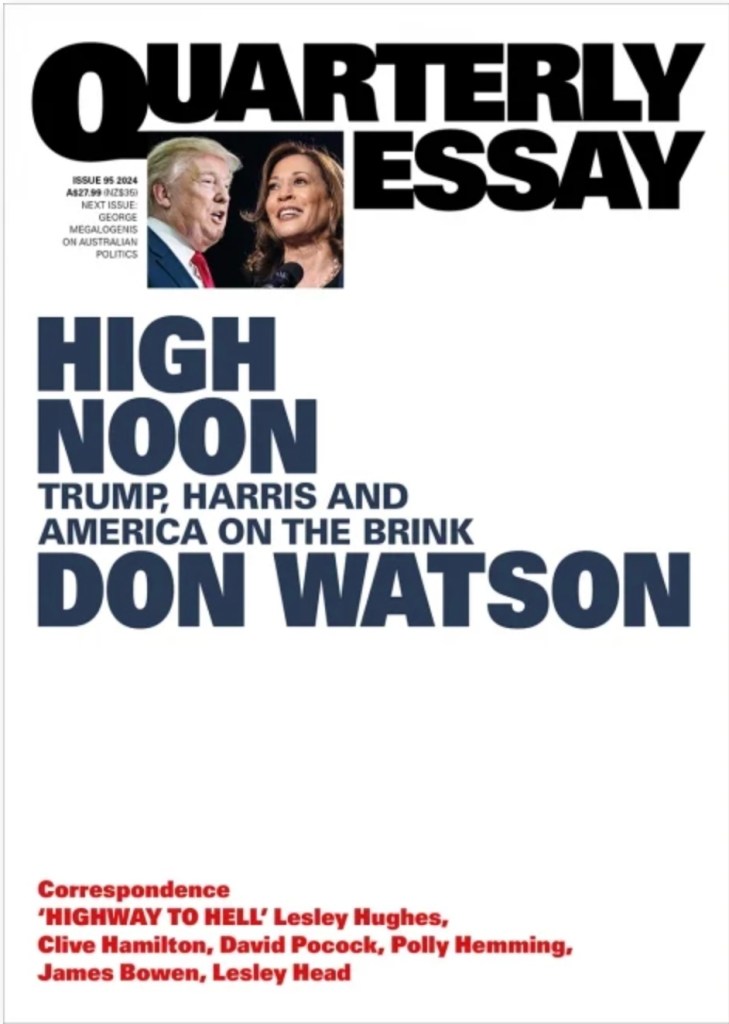
Don Watson,  High Noon: Trump, Harris and America on the brink (Quarterly Essay 95, September 2024)

Eight years ago Don Watson reported on the presidential election face-off between Donald Trump and Hilary Clinton. According to my blog post, his Quarterly Essay 63, The Enemy Within: American politics in the time of Trump dwelled on Bernie Sanders as belonging to ‘a much assailed and greatly debilitated, but unbroken American tradition of democratic socialism’, and expanded his point by focusing on the history of the state of Wisconsin.

In this Quarterly Essay, as Trump is once again up against a female opponent, Watson doesn’t have a third option to discuss but he again goes local, and gives fascinating brief histories of two US cities, Detroit and Kalamazoo. These snapshots, plus his reports on conversations with Trump supporters, make the essay worth reading even though its journalistic moment is past. Maybe it’s even more readable now, because its resistance to the temptation to predict outcomes might have frustrated his readers three months ago.

The fifteen pages on Detroit are excellent: Watson traces the city’s history from the first half of the twentieth century when:

White folk from the economically depressed regions of the United States, especially Appalachia and the South; Black folk from the South and east-coast cities where wages were low and jobs hard for Blacks to get; Poles, Greeks, Irish, Italians, Germans, and people from the Middle East and the countries of Central America were all drawn to Detroit by the unstoppable car industry and the promise of five dollars a day.

In 1960 it had a population of 1.8 million. Since then ‘the city that gave the world the Ford Mustang and Stevie Wonder’ has fallen on hard times as the motor industry collapsed. Corruption, racism, predatory lending, the destruction of unions had their effects:

Detroit became a shrinking city of the poor, the poorly educated, the unemployed and the unskilled. A city of crime: corrupt in its high places, its streets plagued with violence, theft, arson, prostitution, drug dealing and addiction.

Detroit, Watson writes, ‘was the definitive American city … For a city like Detroit to fail was more than a disaster, it was a humiliation.’ Yet, his strategy of focusing on this one city, and then the contrasting city of Kalamazoo, brings home the immense diversity of the United States. It’s not a country where one story covers all.

There are insightful discussions of Trump and Harris, but you know, though I’m as mesmerised by the Trump phenomenon as anyone could be, I can’t bear to say much about that here.

The essay ends with the date: 23 August 2024. It was written after Joe Biden withdrew from the presidential race, after the Democratic Convention, but before the ‘They’re eating the dawgs’ debate.

Even the Correspondence in the following Quarterly Essay was written before the election results were known.


In the correspondence, Tom Keneally, lively as ever, contrasts Australian and US politics but doesn’t engage with Watson’s essay in any detail. David Smith, who did his PhD in Detroit, makes fascinating additions to Watson’s account of that city, including more examples of how unhinged US public life can be. Bruce Wolpe, senior fellow at the US Studies Centre, does a nice job of validating and amplifying Watson’s points. And Paul Kane, among other things former director of the Mildura Literary Festival, praises Watson for his ‘adroit outsider’s perspective’, and, in a lovely three and a half pages, manages to include references to or quotes from Raph Waldo Emerson, Alexis de Tocqueville, Robert Penn Warren (All the King;’s Men, 1946), Father Charles Coughlin (a whiff from my Catholic childhood), Woody Guthrie, Plato, John Stuart Mill, Wordsworth, and Barry Hill. He concludes with Benjamin Franklin’s reply when asked if the Constitution had established a monarchy or a republic: ‘A republic, if you can keep it.’

Both Don Watson’s essay and the responses to it are full of the pleasures of language. The subject is grim, and even grimmer when read after the event, but the telling of it is a joy to behold


I wrote this blog post on land of Gadigal and Wangal of the Eora Nation, where we have had very heavy rain and are now sweltering in great humidity and heat. Cicadas are deafening. I acknowledge the Elders past and present who have cared for this land for millennia.

The Book Group and Samantha Harvey’s Orbital

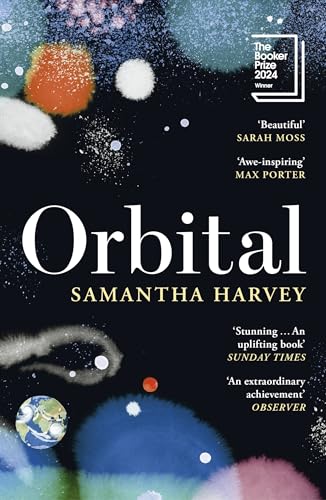
Samantha Harvey, Orbital (2023)

Before the meeting: We picked this book as our next title the day before it won the Booker Prize. Smart us!

Four men and two women on a space station orbit the Earth sixteen times in twenty-four hours. They eat, they monitor experiments with plants and mice, they do strenuous exercise to counteract the bodily effects of living in low-gravity, they maintain their environment and monitor their own vital signs, they report back to ground control, they exchange messages and images with their loved ones at home, they occasionally have weirdly unreal conversations with complete strangers on Earth, and they look out with wonder at the planet below them and at the vastness of space.

That’s the plot.

A writer less sure of herself might have developed a plot where the relationships among the travellers create conflict or titillation. There would be plenty of possibilities in the crew consisting of two Russian men, an Irish woman, a Japanese woman, a Christian man from the USA, and a Latino man with connections in the Philippines. But the subject of this novel is the humans’ relationship to the planet, and beyond that to the universe, from a perspective that makes the conflicts that dominate human life in general seem absurd.

At the front of the book there’s a diagram showing the pathway of the spacecraft’s orbit over the day. The craft flies / falls in a straight line, but the rotation of the planet beneath it means that it crisscrosses the land and ocean below. I kept flipping back to the diagram as chapter by chapter, one for each of the sixteen Earth orbits in the day, describes in lyrical language what can be seen below.

This book is ideal for my blogging practice of singling out a particular page, currently page 77, because though there is a narrative of sorts it’s not the kind that means one has to be wary about spoilers. Part of what makes this book a worthy winner of the Booker is its brilliance at the sentence level.

Page 77 is in the chapter ‘Orbit 8, ascending’. Though the craft is over the south-west of the USA, the narrative departs, as it does occasionally, from what lies below to describe what is happening on the other side of the planet:

Over there, in tomorrow, the typhoon summons winds of a hundred and eighty miles per hour. It’s rampaging through the Mariana Islands. The sea levels off the islands’ coasts have already risen with the expansion of the warmer water, and now, where the winds push the sea toward the westward edges of its basin, the sea rises more and a five-metre storm surge engulfs the inlands of Tinian and Saipan. It’s as though the islands are hit with cluster bombs – windows blown out, walls buckling, furniture flying, trees splicing.

There follows a little more description of the typhoon from a meteorological perspective. Its growth is the book’s one central narrative thread. In later chapters, the crew see it as spectacle – contrasted with the terrifying reality on land, especially as it affects a poor family who once offered hospitality to one of them.

But for now, the daily routine asserts itself:

The crew go on with the last of their tasks. Anton eats an energy bar to fight off late afternoon drowsiness. Shaun removes the four fasteners on the bracket of the smoke detector that needs replacing. Chie inspects the bacteria filters. Their path now ups and overs and exits America where the Atlantic is ancient, the placid silver-grey of a dug-up brooch. Calm suffuses this hemisphere. And with no ceremony they complete another lap of the lonely planet. They top out some three hundred miles off the Irish coast.

And then there’s this:

ln passing through the lab, Nell looks out and sees the promise of Europe on the watery horizon. She feels somehow speechless. Speechless at the fact of her loved ones being down there on that stately and resplendent sphere, as if she’s just discovered they’ve been living all along in the palace of a king or queen. People live there, she thinks. I live there. This seems improbable to her today.

This intermingling of more or less objective observations of the Earth as seen from orbit, the daily routines of life in the space station, moments of lyrical reflection is maintained, with miraculous poise, through the whole book.

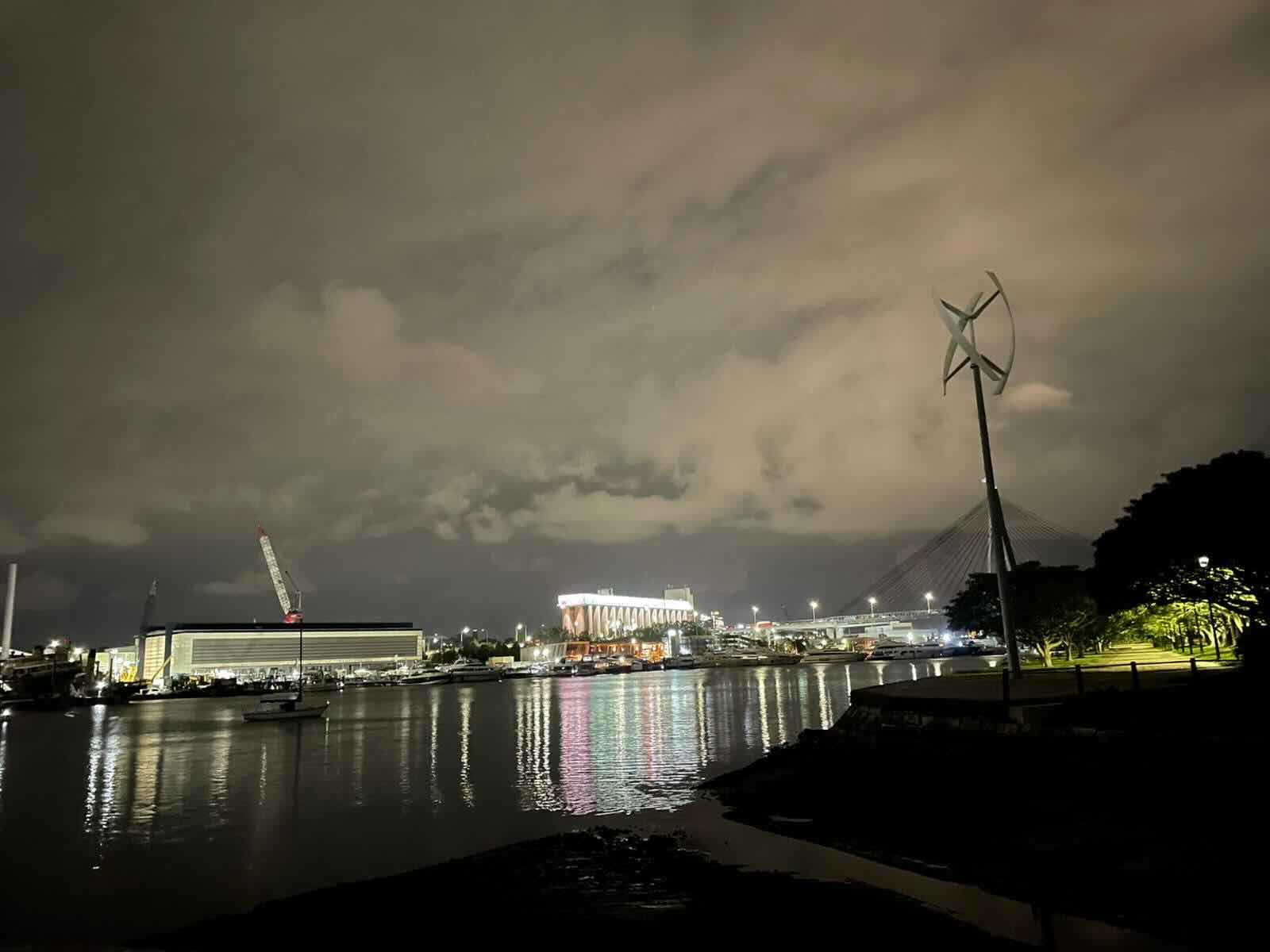
The meeting: We’ve been calling our bring-a-plate meetings gentlemen’s picnics. This one was an actual picnic, in Bicentennial Park on the shores of Blackwattle Bay, Gadigal land. Pavlova, quiche, dumplings, barbecued sausages eaten to a backdrop of birdsong and practising dragon boats beneath a three-quarter moon. We were interrupted briefly by what seemed to be a gay bashing – eight men of certain ages tried to look imposing as we lumbered towards the scene, but it seemed to vanish before we reached it. We conferred with a couple of men who were dossing down in the Esther Abrahams pavilion, and with a cluster of hefty teenage boys, and decided there was nothing further any of us could do.

It was our final meeting for the year, so we swapped gift-wrapped books (I scored a Zadie Smith) and most of us read a poem: David Malouf, Robert Frost, me and John Levy (it was unclear whether I’d broken a rule by reading one of my own, but it was excused because my poem was there to illuminate John’s), Brecht, James Baldwin.

In the middle of this mostly joyous occasion, we managed to talk about the book. The first thing said could have been a paraphrase of my fourth paragraph above: what a relief that Samantha Harvey didn’t go down the track of having big conflicts among the crew. My sense is that everyone enjoyed the book a lot.

We reminded each other of ‘good bits’: the lab mice learning to live in low gravity, the tear drop that has to be caught and disposed of because free-floating liquid can’t be tolerated, the nose pressed against a stomach as two characters squeeze past each other … Someone mentioned what should have been obvious: though the crew sees sixteen sunrises, they all happen on the same day – I took that in my stride while reading the book, but when it’s put like that it leaves me gasping.

One person found a lot of the book tedious and repetitive, but later, driving in the car, he realised that the repetition was partly the point, these people were caught in a continuous loop.

The closest we came to disagreement was when someone said the absence of ordinary, everyday irritations and conflicts among the crew strained his credulity. In real life, people living together in such close quarters would inevitably grate on each other at best. Two arguments were offered to counter this view. First, on the level of verisimilitude, the crew are disciplined – they can live with an itch in a space suit for hours without scratching, surely they can put personal irritations aside. Second, yes it’s unrealistic, but to pay attention to such matters would have cluttered the book or even taken it to a different, less interesting place. (One of us has spent some months in a hut in the Antarctic, so could vouch for the likelihood of conflict – though he was the one who argued most strongly that these are disciplined space travellers.)

It was a terrific end to another Book Group year.

Photo by Steve Kennedy, used with permission

Andrew Burke’s Historic Present

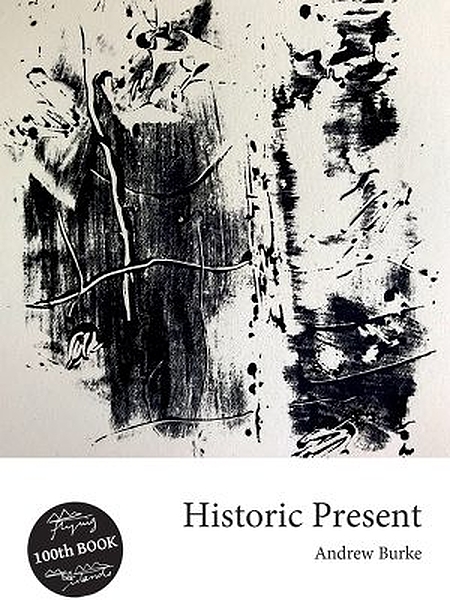
Andrew Burke, Historic Present (Flying Island Pocket Poets 2023)

The ‘About the author’ paragraph at the back of this book begins ‘Andrew Burke was an Australian author’ – and you realise that the Acknowledgements two pages earlier were written very soon before the writer’s death in his 79th year (as confirmed by his Wikipedia entry), and that one of the last things Andrew Burke wrote was this tiny love note:

The many moods of this collection were suffered in partnership with my wife, Jeanette – so thanks for discussions over blueberries and porridge.

The preceding ninety pages of poetry do reflect and capture many moods, and it’s not hard to imagine the man who wrote them enjoying a quiet chat over blueberries and porridge – not just with his wife but with a community of poets living and dead. Many of those poets find their ways into the verse, either by name or by quotation, very occasionally in a way that made me go googling, but mostly as a way of invoking a community, of readers as well as writers of poetry.

There are poems of travel and childhood memory, poems marking the death of a friend, poems that seem above all to be recording a passing moment. They don’t strive for effect or makes a song and dance of their emotional content or insights, but quietly do their work and are gone.

‘Testicular Check-up’, for example, begins:

I fell in love with my balls
all over again when
they were endangered. 

(You’ve got to love those line breaks!) What follows is a good humoured conversation with the ‘lady’ scanning his testicles. He doesn’t spell out the emotional content of the moment. Enough to say that amid the chat and the matter-of-fact handling, first of his penis then of each testicle, he feigns comfort and indifference, the repetition of the word ‘feigning’ lying like a blanket over what is left unsaid.

Page 77* falls in the middle of the book’s longest poem, ‘Lone Patrol: Darlington 1991’. Again looking to Wikipedia, I find that Darlington is a small community some distance east of Perth frequented by artists. The speaker of this poem is living in someone else’s cottage, perhaps an Airbnb (or the 1991 equivalent) or a writerly retreat, or just to take a break from a difficult time on his life. He chats with a visitor, attends an AA meeting, writes, listens to Jack Kerouac, reflects on his life, enjoys the surroundings.

The poem is in 23 sections, and reads like notes on his time in the cottage. These lines, from page 78, referring to work he is doing on another poem, shed light on the nature of this poem:

'Triplog' poem edited
___________ down to 15 pages
but what to do
with such an
________idiosyncratic poem ...

‘Log’ isn’t a bad description of the current poem – ‘staylog’ perhaps, part journal, part jottings of observations and reflection. And it’s not hard to imagine that it has been edited down from copious daily notes to its 14 pages. I usually look for an overarching narrative in long poems, but here I couldn’t see anything other than a string of moments – and I’m happy with that.

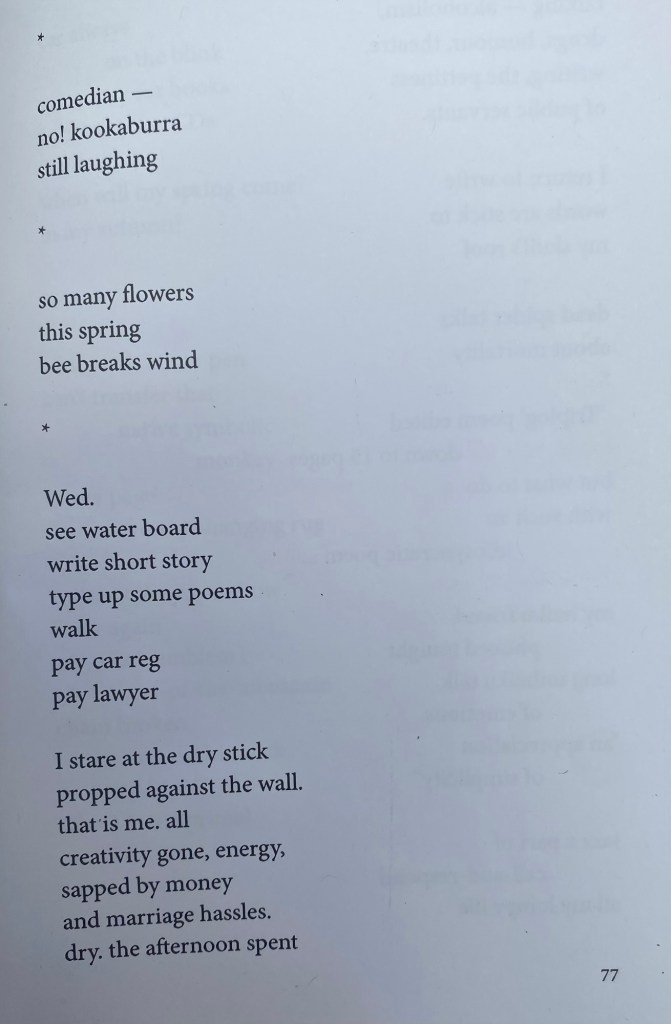
Page 77:

The first two sections are short haiku- or senryu-like poems.

The first, as I read it, juxtaposes the speaker’s grim mood (‘Comedian – / no!’) with the cheerfulness of the natural world, represented by kookaburra’s laughter. Whether the laughter is derisory (the kookaburra is laughing at the poem’s speaker) or simply indifferent (the kookaburra is just laughing without reference to him) is left open.

The second is less successful. I googled ‘Do bees fart?’ Apparently it’s an age-old question, and they sort of do but not really. My sense is that the poem doesn’t care about that. It catches itself in a cliche celebration of flowers in the spring, and throws in a bit of vulgarity to shake the image up. (It does make me want to echo the earlier lines: ‘Comedian – no!’, but in a friendly way.) You might enjoy the way ‘break wind’ has a second, more literal meaning – the bee interrupts the flow of the breeze. If so I’m happy for you.

The third section starts out as a prosaic to do list, then in the second stanza that prosaicness finds what in my distant university days was called an ‘objective correlative’ – an embodiment of the underlying emotion:

I stare at the dry stick
propped against the wall

The narrative behind the matter-of-fact notes ‘pay car reg / pay lawyer’ comes more fully into view – there may be a divorce in the mix:

_________ all
creativity gone, energy,
sapped by money
and marriage hassles.
dry.

The section goes on, to describe an afternoon of talking, and then of trying to write. It ends, taking the image of the dry stick one step further:

dead spider talks
about mortality

Unlike the kookaburra, the dead spider (on a windowsill?) reminds him of his mortality; or perhaps he himself, dead-spider-like, can’t write of anything but death.

The poem is a staylog, and also a pretty matter-of-fact account of what a more egotistical person might have called a Dark Night of the Soul. In 1991, the poet was approaching 50. Perhaps the matter-of-factness was there at the time, or perhaps the poem got to its present form much more recently, and the matter-of-factness comes from the thirty-plus intervening years.

It’s a bitter-sweet thing to meet a poet only after he has died. But it is sweet.


I wrote this blog post on Gade / Wane. I acknowledge the Gadigal and Wangal elders past present and emerging, and gratefully acknowledge their care for this land for millennia.


* My blogging practice is to focus on page 77 (at least until I turn 78). In books like this, the practice saves me the impossible task of choosing one poem to represent them all.