
Niall Williams, Time of the Child (Bloomsbury 2024)
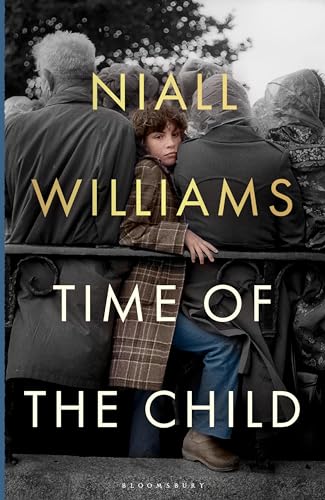
Before the meeting: As I was reading the first couple of chapters of this book, I had ringing in my ears something that a Book Group member had said about a different book, perhaps one of Niall Williams’s earlier novels, A History of the Rain or This Is Happiness: ‘It’s a beautifully written Irish novel, but I’m not sure the world needs yet another beautifully written Irish novel.’
The first chapters, in fact almost the first half of the book, are brilliant descriptions of life in 1962 in the fictional West Ireland village of Faha, the village we know from those previous books. The rain is still incessant and the village still slowly sinking into the river. The heart broken in This Is Happiness is still broken. Life is still dominated by the Catholic Church. Gossip is still the lifeblood of the community. Most houses now have electricity.
The first chapter begins with a wonderful setpiece, a parish Mass where the beloved parish priest stalls mid-sermon in the first major sign of dementia. Things are seen from the point of view of Jack Troy, the village’s general practitioner whose face and manner give away nothing of his inner feelings as his role in the community means he must always be available, including to people who will never ask for a doctor’s attention on their own behalf. After Sunday Mass he is regularly approached by people who indicate with a nod and a wink that his services are needed at such and such a house.
The second chapter revolves around another magnificent setpiece: the Christmas fair in which farmers bring their cattle to town to sell, and hawkers and traders come from elsewhere. Here, twelve-year-old Jude Quinlan, son of a drunkard farmer, carries the narrative burden.
Through both of these chapters, we are teased by hints that something big is going to happen. It’s as if the narrator is saying to his readers, ‘Yes yes, I know you’re here for a story, but first let me tell you about the place it happened in and the people who live there.’ At the end of the second chapter, more than a third of the way into the narrative, there’s this:
But it was here, at the back wall of the church in the village of Faha, on the night of the Christmas Fair 1962, that Jude Quinlan found the child.
Ah! The titular child has arrived! Then the third chapter continues to tease us. It takes us back a couple of days in the life of Ronnie Troy, Jack’s long-suffering dutiful daughter. After 16 pages in which we come to know and (speaking at least for myself) love her, she responds to a late-night knock on the door and at last the story begins.
Given that it happens so late in the book, I’m reluctant to say much more about it, except that though my Group member may be right that the world doesn’t need another book like this, I certainly do. Maybe it’s because I spent my 1950s childhood as part of the Irish diaspora in north Queensland, and I respond with little gasps of recognition to little throwaway lines about the Sacred Heart, the ‘Hail Holy Queen’, the smiling pope, or to the way the priest says Mass with his back to the church while the congregation’s more or less devout members goes about their own business. That is to say, maybe there’s a hefty dose of nostalgia in my response to the book. But if so, that nostalgia serves a serious purpose.
This is a time and place when the Church dominated Irish society. It was the time of the Magdalen laundries, covered-up clerical sexual abuse of children, pitiless laws against abortion and condemnation of most forms of birth control. None of this is foregrounded in the book, but oppressive Church–State authority looms large, mostly unspoken, over the second half of the book. On the one hand, a handful of people sinking to their knees to say the Rosary can be an exhilarating manifestation of something fine beyond words (though Niall Williams finds the words); on the other a priest with a form letter mouths deadly phrases like ‘For his own good’ and ‘Preserving his dignity’.
Just as much as, say, Sebastian Barry’s Old God’s Time or Claire Keegan’s Small Things Like These, this book is about decent humanity – individuals and communities – resisting the monolithic, repressive authority of Church and State. Like them, it revels in musical language. More than them it’s funny. I did cry, twice, but I laughed a lot.
Page 77* includes a micro example of the resistance. In the absence of a fairground, Faha’s monthly fair is a chaotic mess, and the church gates, ‘with their splayed look of welcome in the centre of the village’, are a main centre of trade. The curate, Father Coffey, representing the Church’s authority, asks the farmers not to stand their cattle there:
As it happened, the curate’s appeal fell on deaf ears, but he took some satisfaction when he was able to negotiate a treaty whereby Mick Lynch promised a rope corridor to let the daily Mass-goers through. As a goodwill gesture, Lynch said, the farmers would take their dung with them when they left, which Father Coffey reported back to the Canon, unaware it was a joke until the older priest put the hand across his laugh to stop his teeth flying.
With such jokes, in which the older priest colludes, the people of Faha keep the authority of the Church in its place.
Most of page 77 is taken up wth one of Niall Williams’s bravura character sketches:
Mick Lynch had the walk of a man who owned his own bull. Short and broad, he carried a blackthorn, wore a frieze coat and low hat with red feather in the band. That hat never came off his head outside of church. He wore it at the counter in Ryan’s, in the spartan confines of his iron bed, and when he went to wring the necks of geese. From victories in cards or trade, Lynch took a deal of pleasure. With a contrary nature, his cheeks were where the most of his hair grew, furred sideburns made key-shaped by the shaving of his chin which gave him a jailor’s look. Lynch had the reputation of being what Faha called a right cool man, a designation that pre-dated refrigeration, meant he could not be hurried or ruffled, and once, when asked by a dealer, ‘What are you looking for in a horse, boss?’ had delivered the incontestable answer, ‘Leg in each corner.’ He had not married. For women he hadn’t the handbook, he said, and children nothing but hosts to headlice and worms.
Remember, nothing has really happened in this book so far. That is, we’re a quarter of the way into it but we haven’t yet had what the movies call the inciting incident. But the narrator refuses to be hurried. There is too much to enjoy at any moment in the life of Faha, so though this is Mick Lynch’s only appearance, we’re going to take a moment, just for the fun of it, to savour him. I especially like that ‘outside of church’: whatever else he may be or do, it wouldn’t occur to Mick Lynch to defy the custom of men going bare-headed in church.
After the meeting: Unusually, this book was the subject of quite a lot of WhatsApp discussion before the meeting, mainly from people who couldn’t make it on the night. A number of us had wept, prompting one to ask whether we were ‘silly old men getting emotional about a baby and family relationships’. He who had made the remark about beautifully written Irish novels confounded my expectations by loving tis one, and wrote a thoughtful email on the theme of ‘the soul’. Another sounded a mildly dissenting note, having read only 80 percent and found it slow going; he reacted against the religion’s hold on people, and used the word ‘silly’ about a main character’s attempt to take charge of the situation (all of which are completely reasonable responses). Yet another quoted a number of favourite passages, and said he loved the way Catholicism co-existed with pishogues, which he noted was an excellent new word to him (as it is to me – definition at this link if you’re interested).
On the night there were just five of us. Among other things, we ate baked potatoes. Almost as soon as we arrived, those of us with Catholic backgrounds – a slim majority – were reminiscing about, of all things, our Confirmations. Not directly on topic, but certainly book-adjacent. We had an animated discussion. More than one said that the book took its own sweet time to get to the point – one said he almost stopped reading, but others (me included) thought it was a feature rather than a bug. Someone quoted a passage to the effect that Irish story-telling never goes in a straight line.
Someone said, on WhatsApp and then again on the night, that the book was an Irish Catholic equivalent to Marilynne Robinson’s Home. I don’t quite see that, though it’s an interesting thought. I had a go at articulating some of what I see the book as saying about Catholicism in Ireland then and now – which I won’t go into here because it would be spoilerish.
Interestingly, no one thought to say out loud that this is a Christmas story, even a kind of second-coming story. And, though someone had looked up Niall Williams on the internet, no one wondered aloud if he became a grandfather somewhere on the way to writing this book.
As for the rest of the conversation, I can’t do better than quote (with permission) from one chap’s report on WhatsApp. Conversation ranged, he wrote:
from John Cage and the Necks to motor bike accidents, playing golf, Parkinson’s disease and then the realities of being Bilbo Baggins.
I wrote this blog post on land of the Gadigal and Wangal clans of the Eora Nation. I was born in MaMu country, though as a small child I was confused about whether I lived there or in ‘Erin’s green valleys’. I acknowledge the Elders past and present of both countries, never ceded.
* My blogging practice is focus arbitrarily on the page of a book that coincides with my age, currently page 77.


 Me fail? I fly!
Ah, ‘pishogues‘.
I learned this word from my mother, who was like a magpie with languages, and had varying levels of competence with seven of them. She would use it thus:
‘I hope I haven’t put pishogues on it’, meaning that saying something out loud, was to tempt fate.
LikeLiked by 1 person
That’s interesting, Lisa. So it’s not just a western Irish thing!
LikeLike
I don’t really know. My mother’s Irishness was more a case of an English family living in Ireland. Like my father’s antecedents, some of whom were born in Wales, because the English father happened to be stationed there at the time. If I wanted to be a hyphenated Australian, I could be English-Irish-Welsh-French-Belgian-Australian but it is too hard to remember what order to put it in. But the Irish birth certificate could come in handy if I ever wanted to resurrect EU citizenship which I lost because of Brexit.
OTOH it could be a problem if I decided to make a late run for parliament.
PS I forgot to say that she always used the expression ironically, because she didn’t believe in Irish superstitions or anything else. Somehow she wangled a Catholic education for us, so that there would be some consistency in our education as we travelled, but none of us were Catholics unless some random Catholic secretly baptised us in the bath or a laundry trough. I have a sweet photo of myself making my confirmation in a long white frock and the family tiara, but I have no baptismal certificate and if I ever made a first holy communion, surely I would remember it because of the dressing up if nothing else. LOL I suspect that some Mortal Sins may have been committed…
LikeLike
That’s fascinating, Lisa. I didn’t know about your Irish antecedents / origins. what a complex cultural inheritance you have! My Catholic soul recoils at the idea of Confirmation without Baptism first, but my post-Catholic sensibility is kind of glad you got away with it
LikeLike
Of course I didn’t know anything about this …um… ‘flexibility’ until much, much later.
LikeLiked by 1 person
Oh how lovely it would be to discover that one’s parents played against the rules!
LikeLiked by 1 person
I loved this post Jonathan. Sebastian Barry is my new favourite writer and I’ll take whatever Irish writers I can find.
Libby Xx
LikeLiked by 1 person
Thanks, Libby. Niall Williams is a very different writer, but in my opinion just as wonderful as Sebastian barry
LikeLike
this is what I love about this bookclub. Your summary of the book and its place in the groups reading history is superb. I learn even more things about us and the novel we’ve just read . Even though we shared the same evening , in fact sat side by side , your observations make my C reflection on the night richer.
Now we just need the next book.
LikeLiked by 1 person
Thanks, Keith.I’m ambivalent about posting an=bout the group meetings because what happens in the group stays in the group and all that. i’m always open to having someone tell me to take something out … so I’m extra glad you enjoy it
LikeLike
From a reader who doesn’t have access to WordPress comments:
I am so glad you read The Year of the Child. I am so glad you blogged about it. You wrote about it with the care and insight and intelligent appreciation it deserves and I nodded at many of your comments about that crazy pacing that works so well and all the nuances and fabulous characters. I heard Niall on ABC radio talking about this book and describing how his own joyful advent into grandparenthood inspiring the creation of this wonderful chapter in the life of this little town. K
LikeLiked by 1 person
Thanks, K. I thought he must have become a grandparent. The descriptions of how a baby transforms sober Jack Troy into a dancing, singing figure are so wonderful they have to come from life, from lived experience as they say these days.
LikeLike
You may also be pleased to learn that Williams is planning to write more stories set in Faha.
The interview is here – https://www.abc.net.au/listen/programs/the-book-show/niall-williams-nick-harkaway/104452996
LikeLike
Yes, someone at the Group told us that. I hope he can keep it up
LikeLiked by 1 person