Monthly Archives: Sep 2025

Susan Choi’s Flashlight at the Book Club

Susan Choi, Flashlight (Jonathan Cape 2025)
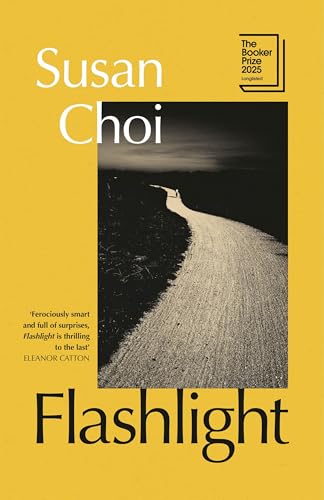
Be warned: the back cover blurb of this novel reveals something that the novel itself only begins to hint at at about the midpoint. Luckily I didn’t read the blurb until after I’d reached that hint – but thanks a lot, Jonathan Cape!

Before the meeting: I’ll avoid spoilers here, and just say the novel becomes something quite different from what you might expect from the first hundred pages or so. But when you go back and reread the start, you find that the writer has played fair. Sharper and better-informed minds than mine may well have understood the broad shape of the story from the beginning.

As in many novels these days, each chapter takes up the story from the point of view of a different character.

There’s Louisa, whom we first meet as an intelligent, uncooperative child in a therapy session: she has lost her father, presumed drowned, a loss that hangs over the whole book.

Seok, Louisa’s father, was born in Japan just before World War 2 to Korean parents. When the war ends he is shocked to discover that he isn’t in fact Japanese. His parents emigrate to North Korea, but he refuses to join them and goes instead to the USA where, now known as Serk, he gets a job at a provincial college, marries, has a daughter (Louisa) and lives as much of the American dream as is allowed to a Korean green card holder in the 1960s and 1970s.

Serk’s white wife, Anne, escapes from the thrall of a charismatic religious leader, garners an education by doing secretarial work for a literary scholar, and marries Serk. She’s dramatically unhappy in the marriage, especially when she accompanies him on a temporary posting in Japan. By the time of his disappearance at the beach, she is almost completely disabled by alienation from Japanese society and what turns out to be multiple sclerosis.

As well as those three main characters, there’s Tobias, Anne’s child by the charismatic religious leader, whom she gave up to be adopted at birth. He comes back into her life as a troubled teenager and continues to play a role over the decades. And one other character, a South Korean named Ji-hoon, has a chapter to himself late in the book.

So it’s a family story, and the family is fractious. Mother and daughter don’t have a single conversation over the decades that remains affectionate or even cordial for more than a minute. Before he disappears, Seok/Serk is abrasive both to his family and to pretty much anyone who tries to get close to him, especially other Koreans. Tobias is charming and kind, but loopy. And, the miracle of it, we like and care about them all as one small family being crushed under the weight of geopolitics.

Page 78* is in one of Serk’s chapters.

A lot is happening on this page. Serk meditates on his connection with his daughter, on her brilliance and creativity. He briefly acknowledges to himself that his bursts of rage are beyond his control.

Only five and six years old when she’d created these things; her mind was always at work, it amazed him. He was trying to make her a present as well, and nights he didn’t feel compelled to leave the house, blown on a gust that he couldn’t control, he worked on the gift in their basement, and entered a rare sort of peace from using only his hands, not his mind.

And he tackles correspondence with his sister Soonja, the only family member who has stayed in Japan. In a typically tangential way the narrative acknowledges the racism in the background of the action that happens in the USA (there is racism in Japan too, similarly backgrounded for the most part).

He had a letter in progress that he extracted, as well as the series of received letters. It bothered him that their glaringly foreign airmail sheets, outweighed by their numerous conspicuous stamps, arrived so often at his office, despite such exoticism being, as he knew, almost expected of him, as the only foreigner on the permanent teaching staff. That he was using his college letterhead and not an airmail sheet himself was pure vanity for which he’d pay with the stamps.

Then we are shown a little of the content of the correspondence. Here, late at night and alone, he is able to engage with his Korean life, of which his US family and colleagues are completely unaware.

Running his eyes over his characters, he read, where he’d left off, ‘I cannot even begin to consider this without having confirmation in hand,’ and then he had to go back to the most recent letter to refamiliarise himself with Soonja’s latest equivocation. Or perhaps it was confusion, or ill-founded conviction, or just a function of her wretched written Japanese, arrested at the level of a child; she’d never had a scientific mind in the first place, her emotionalism often caused her to misrepresent supposition as fact, and being obliged to write him in her poor Japanese because his written Korean was undeniably worse likely added resentment to the other counterfactual tendencies in her personality; they might have last seen each other almost twenty years before, but he was still her elder brother. He still remembered all her shortcomings.

‘The permits are certain, the time is not certain, it cannot be made certain until you because for just a short length so you are the problem as I said in my letter before. Should I tell our parents you say NO?’

If that doesn’t make sense to you out of context, be reassured. It’s close to incomprehensible when you do have the full context. Later, Serk meets up with Soonja in person, but we never get a clear idea of what she is asking of him. What we know is that Seok, now Serk, feels a tremendous gravitational pull of eldest-son responsibility for his family, and that he resists this pull. We can’t tell what it is that they want from him. Around about this page, I started to wonder if he didn’t drown a year or so after this scene, but somehow deserted his beloved Louisa to go to North Korea. (That’s not a spoiler, I’m not saying if I was right, just that there’s a growing sense of unease about what happened.)

After the meeting: We all enjoyed this novel. Its acknowledgements list fifteen books about Koreans in Japan and the historical events that impinge on Serk and his families. Some of us had never heard of these events (I’m in that group). Others knew of them, and so weren’t completely surprised by the revelation that arrives soon after the halfway mark. One person thought they were urban myths but she was reassured when we looked up Wikipedia.

The discussion brought to light a feature of the book that I hadn’t focused on: many narrative strands are simply not resolved. For instance, there is one other Asian staff member at Serk’s college, known as Tom. He is also Korean, though Serk does his best to keep him at arm’s length and at one stage has a blazing row with him when he believes, wrongly, that he is a North Korean sympathiser. Tom disappears and soon after so does his distraught wife. We never learn what happened to them. For another instance, Louisa as a young adult marries a young man she meets on a bus – he is unwashed and smelly, and we understand that she finds this comforting because in that way he is similar to her older half-brother Tobias who was kind to her after Serk’s disappearance. She marries him, and then he pretty much disappears from the story except as an offstage character – wealthy, entitled and abusive (though we don’t learn any details). Another: when she’s old and living as a grumpy isolate in a community of old people, Anne develops a relationship with a man named Walter. The beginnings of this connection are beautifully realised as Walter is cheerfully unfazed by Anne’s prickliness. But then, as years pass with the turn of a page, he’s not there any more. As someone pointed out, given that the book’s central event is a disappearance, it’s only right that there are many subsidiary vanishings.

Perhaps related to that, one person felt that the shift of narrative focus with each new chapter was frustrating. Balls were left in the air and by the time we came back to that person the balls had landed and the person’s life had moved on. I certainly felt a kind of whiplash, especially in the final third, when time passes quickly, but I wasn’t frustrated so much as energised.

We discussed this book along with Michelle Johnston’s The Revisionists. Both books deal with significant historical events of the past half century. Reading The Revisionists I felt like a FIFO western observer. Flashlight is more like a deeply intimate conversation.


The group met on the land of Gadigal and Wangal of the Eora Nation, where I have also written this blog post. I was born on MaMu land, and spent formative years on the Gundungurra and D’harawal land. I acknowledge Elders past and present of all those clans, and welcome any First Nations readers.


My blogging practice is to focus on the page that coincides with my age, currently 78.
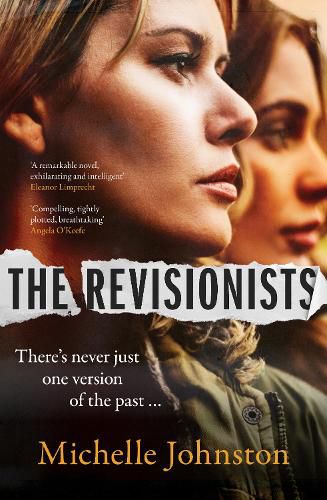
Michelle Johnston’s Revisionists and the Book Club

Michelle Johnston, The Revisionists (Fourth Estate 2025)

Before the meeting: Michelle Johnston’s day job is in emergency medicine. According to a 2023 interview on ABC Perth, she had written a draft of this novel when she decided that she had to go to Dagestan, a small republic in south of Russia where most of the novel’s action takes place, because ‘if you’re going to write somebody else’s story, you’ve got to respect it by going there and trying to understand it from the ground level up’. It was risky – DFAT advised against going and the Smart Traveller website warned of possible terrorist attacks – but she went out of dedication to the integrity of her writing, and in fact ‘had the most beautiful trip’.

The novel’s main character, Christine Campbell, doesn’t have such a beautiful trip, though the book captures the physical beauty of the place and the wonderful hospitality of its people. Christine is a journalist. Disenchanted with what Western Australia has to offer including an implausible level of sexism in Perth’s newsroom, she decides to travel to Dagestan to join Frankie, her best friend from schooldays who is a doctor working in a clinic in a tiny village there. Christine is there to help – she organises supplies and teaches first aid to local women – but she harbours an ambition to publish a groundbreaking piece of journalism about the possible outbreak of war.

It’s an odd set-up. We know from the beginning that Christine’s ambitions outstrip her abilities, and that her journalistic ethics are shaky. She intuits that the women of the village know that war is coming, but she can’t get them to say it outright. In fact everyone knows there’s a serious risk of war. It’s 1999: the war in neighbouring Chechnya ended in 1996, armed Islamist groups are forming everywhere, Russia is determined to fight them off, and the place, as Christine keeps saying, is a ‘tinderbox’. But she’s determined to write a feminist-leaning piece in which she gives voice to the women of the village saying what she just knows they would say if only they would say it. Her article will be titled ‘The Cassandras of the Caucasus’, because she believes the classical allusion will lend it class. (And the samples we see of her over-egged writing are consonant with that kind of thinking.) Frankie hints that she might expose the women to the danger of reprisals. She meets a famous journalist who gives her some Journalism 101 advice that seems to be news to her: if you’re out to get information from people, tell them up front that you’re a journalist.

The book opens in Manhattan 25 years later, in 2023, with Christine watching a TV documentary about herself and the one article that made her famous. A little later, Frankie turns up at her door, and challenges her about the untruths she told in the documentary and in the famous article. As the book proceeds, alternating between the two time periods, we learn the full story of how the article came to be written, and the fate of the Dagestan village. Revelation follows revelation. Christine’s ethics are a lot worse than shaky.

The book tackles important subjects: journalist ethics, the nature of memory, the role of ‘helpful’ but insensitive Westerners, the question of who owns a story. There’s a strong sense of place, not only in the austere beauty of Dagestan, but also in London where Christine and her friends have a brief respite, and Manhattan where she spends more than two decades in guilt, luxury and inertia.There’s a tumultuous affair with a man that we know is up to something, and a painfully real portrait of an unhappy marriage

On the strength of all that, you’d think I would have been engrossed. But I struggled with it, and it’s not easy to say why. It turns out that a close-ish look at page 78* suggests a possible reason.

Sarija is a teacher of English from a nearby village who has attended Christine’s first-aid classes, and even acted as her assistant. Here, the two women are chatting, leaning against the dusty haunches of Sarija’s horse. Sarija suggests that Christine might visit her village to talk to her students about writing:

‘You can ride on the back of my horse.’
‘I’d love that,’ Christine tells Sarija. She imagines cantering over mountain passes and through villages, swooping up stories and interviews as though she were playing investigative polo.

This is an example of many similar moments. I would have said it hits a false note: why would Christine, formerly Crystal from the WA wheat belt, think of polo? Surely the forced simile is an awkward writerly intrusion? On rereading, I see it differently. What’s happening is that the narrative voice, while technically telling the story from Christine’s point of view, looking over her shoulder as it were, actually undermines her, mocks her as callow, exploitative, self-serving, in effect accusing Christine of thinking of her journalistic quest as a jolly sporting venture.

There are more examples even in this one page of dialogue.

‘They say you ask a lot of questions,’ Sarija says.
‘It’s what journalists do,’ Christine replies. ‘And, since we’re talking, I’d be interested to know how the conflicts around here have affected you and your family.’

This is a woman who has been uncomplainingly lugging boxes around the clinic, winning the trust of the local women as she teaches them first aid. As soon as she thinks of herself as a journalist she becomes patronising (‘It’s what journalists do’) and would-be exploitative (‘Since we’re talking…’).

Sarija opens up to her anyway. Again, Christine makes a small gesture of sympathy, but her mind goes to the juicy turn of phrase:

It is hard to imagine the violence in that one image. A brother as a human bullet.

‘I want to tell your story. Don’t you want somebody to account for the atrocities? For the rest of the world to know?’
Sarija continues to shake her head while she responds. ‘The rest of the world is not interested. They are too busy with their own savagery. Our story is buried now. But, Christine, you need to know this: you don’t find answers here by asking questions.’ She pauses. ‘You find the answers by being quiet.’

To which this reader, led by the narrative voice, wants to shout, ‘Yair, Christine. Be quiet.’

Later, when Christine is frustrated at the lack of usable quotes from the women, she thinks back to this conversation and sees Sarija as her likeliest source of good copy. There may be some truth to this portrait of journalism in the field, but when she’s being a journalist Christine is almost completely unlikeable. Later, when she manages an interview with a self-styled warlord, she castigates herself for doing something terrible with what she has been told. The narrative voice holds back from condemning her, so even when she’s hard on herself, she is seen to be missing the point. She does commit one major journalistic sin, and in that case goes from self-deception about the gravity of her offence to wallowing in shame and remorse.

Though Christine goes on to make amends in some respects, I get the impression that Michelle Johnston doesn’t like her main character – and that makes a book hard to read.

Other people like this book a lot more than I do. Lisa Hill’s review is definitely worth reading.

Just before the meeting: We read two books at each meeting of the Book Club. The Revisionists was paired with Susan Choi’s Flashlight, and the comparison wasn’t kind to The Revisionists. For just one thing, both books deal with terrible historical events. In her acknowledgements, Susan Choi lists fifteen books of fiction and non-fiction about her subject so the reader can check how closely her fiction sticks to known facts. Michelle Johnston tells us nothing about her sources. This might not have mattered, but when there is an unreliable central character, it would be good to know if two atrocities in particular were invented for the horror of it or were documented events.

After the meeting: We were pretty unanimous in not caring for this book. Not everyone agreed that the author didn’t like her central character – what I saw as criticism of her as callow and exploitative, others saw as ironic highlighting of her naivety. But none of us much liked her anyway. One person went so far as to say the book shouldn’t have been published. Someone who has visited New York City quite a lot was exasperated that when Christine decides to sell a Rothko that has come into her possession, she takes it to a local gallery. ‘I’m sorry,’ she said, ‘if you have a Rothko to sell you go uptown to Christie’s or Sotheby’s.’ Rookie error, I guess.

We pondered the meaning of the book’s title. Perhaps it refers to the way Christine altered some key facts in her famous article. Perhaps it highlights an otherwise inconsequential moment in the last pages when Frankie and Christine realise they have completely different memories of how Christine came to be in Dagestan. We also pondered the meaning of the cover image: two women in profile, both with the abstracted air of models. None of us could see how it related to the actual novel.

On the other hand we had culturally eclectic creations from Tokyo Lamington for dessert, and Flashlight (blog post to come) is an excellent book that provoked interesting conversation.


The group met on the land of Gadigal and Wangal of the Eora Nation, where I have also written this blog post. The days are getting longer, and warmer, and I’ve been encountering a beautiful, satiny crow near my home. I acknowledge Elders past and present, and welcome any First Nations readers.


My blogging practice is to focus on the page that coincides with my age, currently 78.
Limbering up for November

As regular readers know, in November I set out to write fourteen 14-line poems. With November just over the horizon, I’ve been feeling the need to get in shape. So when, as I was heading for a seat at the back of a bus today, another passenger’s unexpected gesture handed me a chance to limber up a little. Here’s the result for your consideration:

To the man who gave me the finger on the 423

Is it my whiteness that offends you?
Class, entitlement, grey hair?
Not my t-shirt, glasses, sandshoe!
Why this cold, unyielding glare?
Do I remind you of some vicious
thief who stole your cold, delicious
breakfast plums? Or is it just
that one day we will both be dust?
Oh, was your gesture then fraternal:
This central thing is true, I’m sorry,
sit on this, memento mori.
Life is good but not eternal.
My blank gaze and hairless head
remind you: don’t forget the dead.

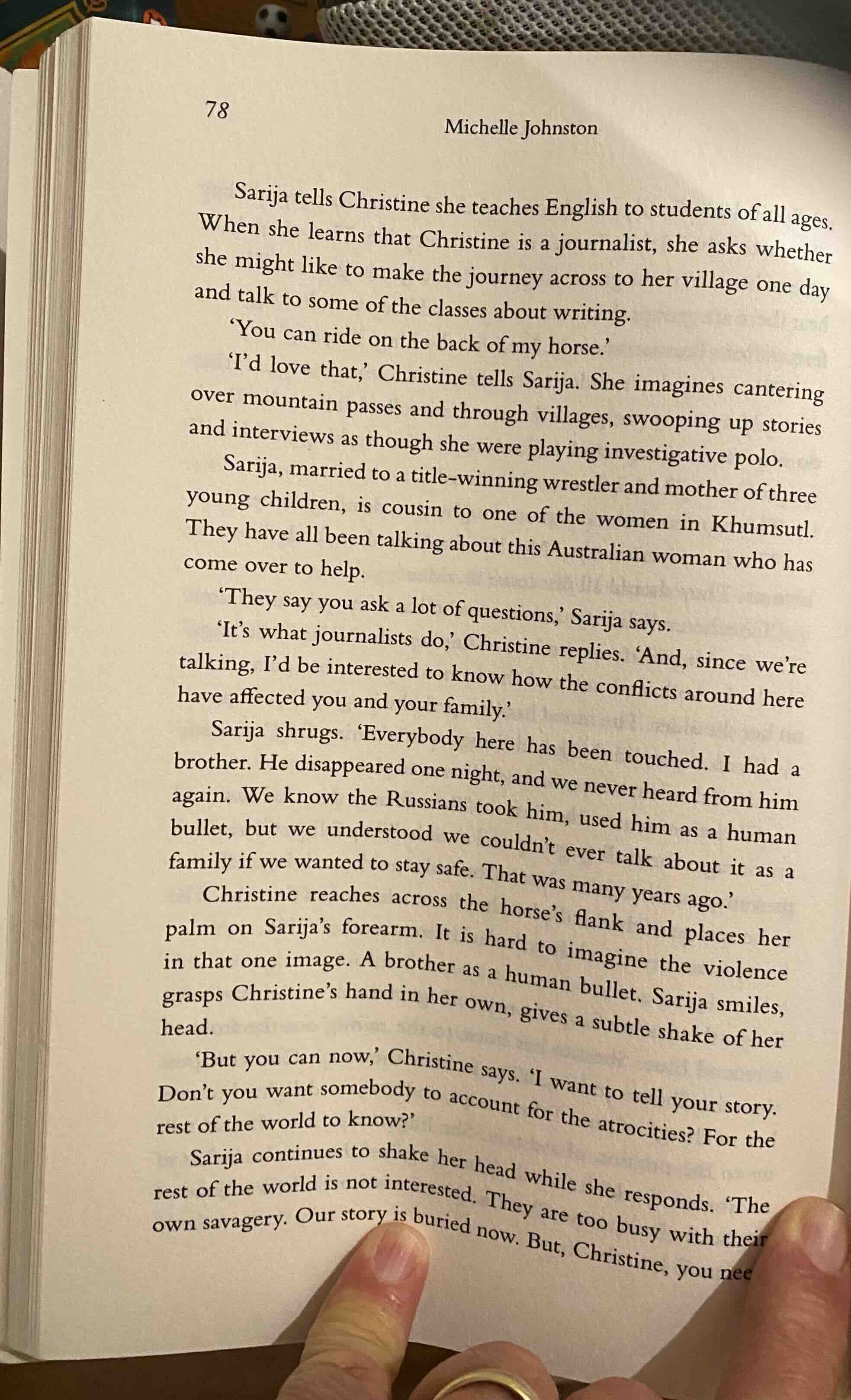
Hugh White’s Hard New World

Hugh White, Hard New World: Our Post-American Future (Quarterly Essay 98, 2025)
– plus correspondence in Quarterly Essay 99

This is Hugh White’s fourth Quarterly Essay. As the titles, and especially subtitles, of his essays demonstrate, he has been on the same track for fifteen years (links are to my blog posts):

The gaps between essays, like those between major bushfires, have been getting shorter, and his argument more pressing. The US isolationism of Trump’s second coming, the genocidal war crimes of the US ally Israel, and what looks like Vladimir Putin’s unending war on Ukraine all make his argument more cogent and persuasive.

In a nutshell, he argues that after the end of the Cold War in which two superpowers were in uneasy stand-off, and the period since then when there was just the one, we are now and have for some time been in a multipolar world. The USA no longer has the resources to dominate the globe, and nor does it have sound reasons to do it. In the past, when a single power could potentially dominate the whole of Eurasia, the USA had reason to be concerned for its own security. And when no other power hcould match the US’s economic heft, the US had the resources to do something about it. Now, as China’s economy is by key indicators larger than that of the US, it at the same time shows no sign of becoming a dominant force in the rest of Asia or Europe – India is a rising power, Indonesia isn’t far off, Russia would be a problem, and likewise Europe can if provoked present a united front. The US has neither the resources nor strategic reason to continue to invest in the security of the Asia pacific region. It no longer makes sense for Australia to depend on the US for its security.

There’s a lot more to his argument.

Something I found refreshing is the way, having made it clear that he considers Donald Trump to be sociopathic, he considers his approaches to global politics as being erratic and weird, but in essence correct as he ‘rejects the whole idea of America as the global leader, upholding and enforcing international order and promoting American values for the good of the world as a whole’. Specifically, he’s not going to take on China, and nor would it make sense to do so. To quote page 47*:

There is no evidence that Trump cares much, if at all, about the strategic contest with China in Asia. On the contrary, a lot of evidence points the other way. It suggests that Trump is happy to deal with China in the same way he deals with Russia, as a fellow great power in a multipolar world. That means conceding China’s right to an exclusive sphere of influence in its own backyard, just as he insists on America’s right to dominate the Western Hemisphere.
So, in strategic questions, Trump really isn’t a China hawk … He dislikes America’s Asian allies and has often dismissed the idea that America should defend Taiwan.

Xi Jinping’s great parade to celebrate the end of World War Two, with its attendant photos of Xi, Putin Kim Jong Un and Modi in cheerful togetherness hadn’t happened when this essay was written, but Trump’s Truth Social message to Xi, ‘Please give my warmest regards to Vladimir Putin, and Kim Jong Un, as you conspire against The United States of America,’ looks more like posturing for his base than any substantial evidence that Hugh White is wrong.

The essay ends with a draft speech for an Australia leader to communicate a necessary shift in policy. A few speeches like it, he says, ‘could start the national conversation we need to have, but which we have so far done our best to avoid’. The speech includes this:

In these very different circumstances we cannot expect America to keep playing the same role as hitherto in the security of our region and as Australia’s ally. That old order cannot be preserved by war or the threat of war. Our focus instead must be to help create a new order in Asia which fits the new distribution of power and best protects our core national interests, and to do whatever we can to help ensure a peaceful transition from the old order to the new. Then we must prepare Australia to survive and thrive in this new order. That starts by accepting that our relationship with America will change. It will remain an important relationship, but it will become less central to our security in the years to come as America’s laters and role in Asia change. We will rely more on our relations with our neighbours to help keep the region peaceful and minimise any threats, and we will rely more on our own forces to defend us from any threats that do arise.
All this will be demanding. The new world we face will be harder than the one we have known for so long. But there is no choice.

I’m well outside my comfort zone on the subject of international relations, defence, security, war and threats of war, but I found this essay compelling.


Correspondence on White’s previous Quarterly Essays included a number that dismissed him as simply wrong, a winner-take-all debater, selective with his facts and using little reason. I quoted a number of them in my post on QE 86. Perhaps it’s just that current and former prime ministers no longer engage in this kind of forum, but the correspondence on this one, published in QE 98, mainly from academics in relevant fields, is generally supportive of its central thesis.


I wrote the blog post on the land of Gadigal and Wangal of the Eora Nation at the moment the sky is clear but the ground is sodden with recent rain. I acknowledge Elders past and present, and welcome any First Nations readers.


My blogging practice is to focus on the page that coincides with my age, currently 78.
We Solve Murders with Richard Osman and the Book Group

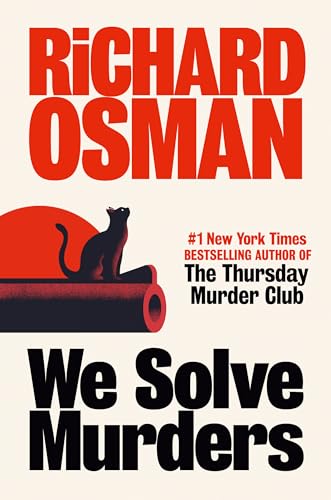
Richard Osman, We Solve Murders (Viking 2024)

Before the meeting: As a boy I read a lot of British crime fiction. When I was 13, I put a brown paper cover on the conveniently-sized novel I had to read for school (Booran by M. J. Unwin – trigger warning for 1950s colonialist attitudes), then transferred the cover to book after book by Agatha Christie and Ngaio Marsh over the course of the year. My parents were impressed that I appeared to read Booran so many times. For my father’s birthday in April, I gave him a pile of ten pre-read paperbacks, and for Christmas another twenty. It didn’t occur to me that my pretence might be transparent.

This means that on the cusp of teenagehood I read enough ‘cosy mysteries’ to last a lifetime. I can still enjoy the odd Agatha Christie on TV or at the movies, but I have no desire to reread the books. Not even The Murder of Roger Ackroyd.

Reading We Solve Murders felt like an enforced return to that territory. It’s a cosy mystery mixed with a comedy action thriller, written with amiable wit in elegant prose, with a plot that features many exotic locales, influencers being murdered and a villain who uses generative AI to disguise their identity. (Incidentally, it’s a bold move in a genre novel written in the style of a friendly English gentleman to have the villain’s chapters preceded by a Chat GPT prompt to render text ‘in the style of a friendly English gentleman’. I can’t be the only one to think Richard Osman is having a little joke at his own expense.)

This is explicitly intended to be the first book in a series, like Osman’s first series The Thursday Murder Club, and we can probably expect a TV movie, hopefully less mediocre than the recent TMC movie. There are moments where I would laugh if I saw them on screen. Just one example, from page 244. Amy, the hard-boiled heroine is talking to Nelson, who may be about to kill her:

‘It’s just you don’t seem like an assassin?’ says Amy. ‘And I know a lot of assassins.’
‘I am not an assassin,’ says Nelson, his tone very reasonable. ‘I’m just, you know, a regular criminal and politician.’

Boom tish!

The story rattles along at a good pace. The characters are an amusingly diverse bunch of types. There are twists and turns and plenty of travel. It is what it is and it’s terrific at it. I was entertained, but it took many more hours than a movie would.

After the meeting: It was a small group, not for lack of interest in the book but because of family birthdays, travel commitments, viruses – and our current policy of sticking to our designated dates no matter what. Not for us the practice of that group who don’t decide on a date until everyone has read the book. Still, the four of us enjoyed each other’s company until well after my watch announced it was my bedtime. Among many things, including the colourful career of one us, we did talk about the book.

One chap put it nicely: Richard Osman works in popular entertainment, having devised and presented a number of successful game shows. He knows what works with audiences and has brought that knowledge to the new (to him) field of novel writing. I’m pretty sure someone said that there’s a big overlap between his target readership and people who go on cruises. (We had an interesting digression into the sociology of cruise ships.)

When it was observed that when Australian comics try to replicate those British game shows they don’t always come up with a winner, we realised that their Englishness is at the heart of their charm. And that is also true of this book. Our one English-born and bred group member spoke eloquently on this point. There’s a character who can be relied on to give details of which roads he takes to get from one village to another: this, our group member assured us, has the ring of authenticity. The book is firmly rooted in a particular place – a village in the New Forest. Another chap who lived for some time in an English village testified that, just as in the book, in a two-pub village most pub-goers were loyal to one establishment and wouldn’t dream of visiting the other. What I read as cosiness is also a celebration of something distinctively English. And they did say ‘English’, not ‘British’.

Someone asked, ‘Did you laugh?’ No one said yes. On the page, the book is often funny but not laugh-out-loud. We shared stories of books that did make us laugh out loud – a Georgette Heyer regency romance and the The Traveller’s Tool by Sir Les Patterson were mentioned. (There was another interesting digression about Barrie Humphries.) But we had a sense that a movie, or preferably a TV series, might be on the way.

One of the non-attendees summed it up well in a WhatsApp post: ‘No thinking, just chorkling. The goodies win / the baddies get their come-uppence. Very English.’


The Book Group met, and I wrote this blog post, on the land of Gadigal and Wangal of the Eora Nation as the days are growing suddenly warmer. I acknowledge Elders past and present, and welcome any First Nations readers.

Jock Serong’s Rules of Backyard Cricket

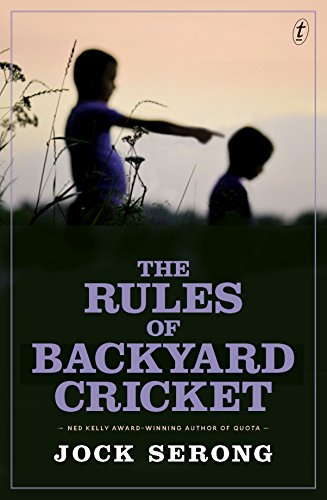
Jock Serong, The Rules of Backyard Cricket (Text 2017)

I was given The Rules of Backyard Cricket as a gift some years ago. Friends had told me it was excellent, but I knew nothing about it. The cover illustration, which shows two small boys in silhouette, one of them pretending to shoot the other in the back of the head, suggested that it might be less benign than the ‘Cricket’ episode of Bluey.

The opening chapters have a lot in common with that episode. Two brothers in the suburbs spend endless hours playing cricket with makeshift equipment and their own idiosyncratic rules. Like Bluey‘s Rusty they become excellent and go on to bat for Australia.

But that’s where the similarity ends: the brothers, Darren and Wally Keefe, are locked in vicious mutual combat even while their brotherly bond is strong, which puts the book in a long tradition of stories about quarrelling brothers: think Cain and Abel, Jacob and Esau, Romulus and Remus, William and Harry. As they come to prominence in the cricketing world, Darren, the younger brother, attracts headlines for his off-pitch misbehaviour with drugs and chaotic relationships, and a terrible hand injury excludes him from cricketing heights. Wally becomes captain of the Australian team and can be depended on to present the ideal face of professional sport, though his personal life suffers under the strain. They typecast themselves: ‘Wally as responsible, grave: a leader. [Darren] a force of nature: a talented freak with no mooring.’ (Page 73)

In the background is the world of organised crime, match-fixing and corruption – embodied in Craig, their friend from teenage years who now lives a shadowy criminal life. Also in the background is their single mother, whose unfailing belief in both of them has been crucial to their success, and their long-suffering women partners, where I choose the word ‘suffering’ deliberately.

At the start of the novel, Darren is locked in the boot of a car, on the way to an unknown destination where, he assumes, he is about to be killed. He’s not sure who is going to kill him or why, and as he tries to work his way free he thinks back over his life, and in so doing narrates the book. Each chapter begins with a brief report on what’s happening in that boot, a device that both reassures readers that the story is something other than a biography of two fictional sportsmen, and challenges us to spot the moment when Darren falls foul of someone murderous.

I’m not a cricket fan, but I can follow a conversation about it (unlike the AFL in Helen Garner’s The Season). I loved the descriptions of cricket matches here – the fast bowling, the sledging, the many technicalities. Some readers will need to skim those bits. I’m with them in not getting most of the references to famous cricketers, but it didn’t worry me.

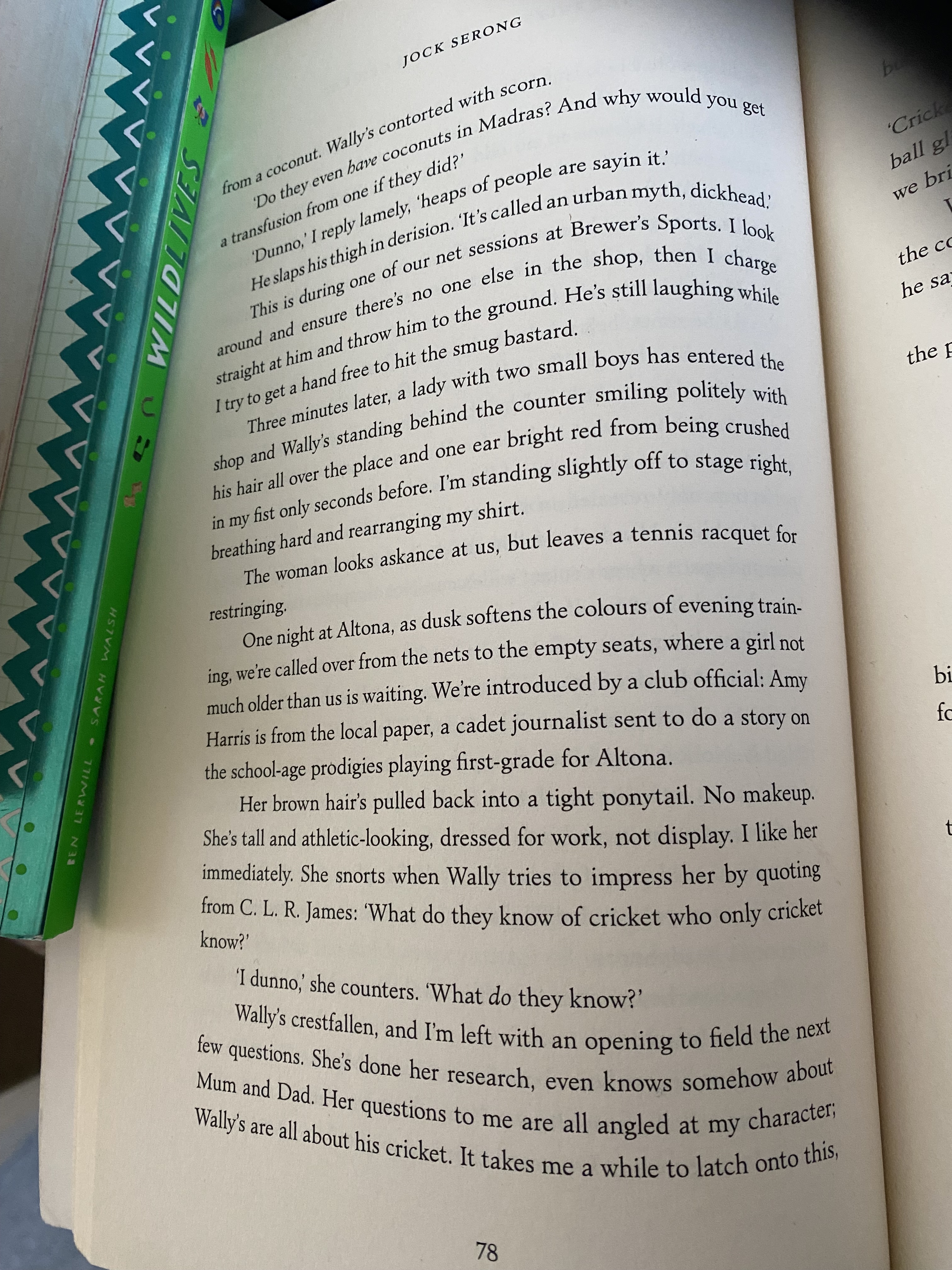
On page 78*, about a quarter into the book, the teenaged brothers have recently moved out of home. Wally is being recognised as a cricketer of ‘phenomenal self discipline’ but, according to Darren, when they play in the back yard he’s still ‘vengeful, savage and petulant’. They are in a sports-gear shop where Wally has a job, and where Darren visits to play with the cricket gear.

Two things happen on this page, one to do with the boys’ relationship and the other introducing a character who will play a crucial role. First, Wally sneers at Darren for believing an improbable story about a Test cricketer being given a transfusion ‘from a coconut’:

I look around and ensure there’s no one else in the shop, then I charge straight at him and throw him to the ground. He’s still laughing while I try to get a hand free to hit the smug bastard.
Three minutes later, a lady with two small boys has entered the shop and Wally’s standing behind the counter smiling politely with his hair all over the place and one ear bright red from being crushed in my fist only seconds before. I’m standing slightly off to stage right, breathing hard and rearranging my shirt.
The woman looks askance at us, but leaves a tennis racquet for restringing.

There’s comedy in the way the brothers fight compulsively like much younger children. But there’s something unnerving about the way Wally laughs and recovers quickly to present a polite face to the world. By referencing stage directions – ‘slightly off to stage right’ – Darren invites us to visualise the scene: one brother stands centre stage as far as the world is concerned, while the other is a dishevelled and disreputable support actor. This is the story as seen by the latter, and the scene is emblematic of their relationship.

Then:

One night at Altona, as dusk softens the colours of evening training, were called over from the nets to the empty seats, where a girl not much older than us is waiting. We’re introduced by a club official: Amy Harris is from the local paper, a cadet journalist sent to do a story on the school-age prodigies playing first-grade for Altona.
Her brown hair’s pulled back into a tight ponytail. No makeup.
She’s tall and athletic-looking, dressed for work, not display. I like her immediately. She snorts when Wally tries to impress her by quoting from C. L. R. James: ‘What do they know of cricket who only cricket know?’
‘I dunno,’ she counters. ‘What do they know?’
Wally’s crestfallen, and I’m left with an opening to field the next few questions. She’s done her research, even knows somehow about Mum and Dad. Her questions to me are all angled at my character; Wally’s are all about his cricket. It takes me a while to latch onto this, but like an idiot I play extravagantly into her hands.

Darren’s extravagance gives Amy her headline when he says that he and Wally bring people what they want from cricket now, drama and action: ‘Bradman is dead.’ It’s one of Darren’s rare victories in their lifelong rivalry – and like all his victories it’s a bit on the nose.

If you don’t know who Bradman was, you’d be pretty lost in this book. But you don’t necessarily have to know about C. L. R. James. In fact, it feels as if Jock Serong is speaking directly here, as it seems unlikely that Darren would have read the work of Trinidadian Marxist intellectual C. L. R. James, even if he had heard James’s riff on Kipling’s, ‘What do they know of England who only England know?’ Whether Amy knows where the quote comes from doesn’t matter. She sees it for what it is, a bit of misjudged pretension on Wally’s part. She’s out for a juicy headline. She’ll continue to be out for juicy stories for the rest of the book.

Like the fighting between the brothers, the headlines get darker as time goes by. So yes, the book is about cricket – backyard, community, state, international test and one-day varieties. It’s also about the corrupting effects of capitalism on sport, about masculinity toxic and otherwise, about the damaging effects of celebrity, about the role of the media. And it moves at a ripping pace.


I wrote the blog post on the land of Gadigal and Wangal of the Eora Nation where the days may be be growing warmer and lorikeets are starting to make their presence known. I acknowledge Elders past and present, and welcome any First Nations readers.


My blogging practice is to focus on the page that coincides with my age, currently 78.