This morning we managed to get to the beach. We got there before the Nippers.
November verse 14: A swim at Clovelly

Seven thirty, from Clovelly
Road, the sea's a silver sheet.
Once there, rub sunscreen on the belly,
back and shoulders, then the sweet
and icy plunge. Today no gropers
show themselves to interlopers
such as us, but one bold gull
dive-bomb swoops us, for the thrill.
And now the beach is full of nippers,
energetic, pink-clad, young,
reminding us that we belong
to boundless life. Ah, flat-white sippers,
once more dry and clothed, we sing
our farewell to another spring.
I have written this blog post on the land of Gadigal and Wangal of the Eora nation, after visiting Bidjigal land and water. I acknowledge Elders past and present of all those clans, and welcome any First Nations readers.
We were reminiscing about the good old days before plastic when one of my weekly jobs was to burn household rubbish at the bottom of our back yard. I confessed how I was fascinted then by the way books burned – they needed a lot of help. My niece, fabulous writing workshop leader Edwina Shaw, said, ‘That’s a poem.’ And indeed it is:
November verse 13:My Fahrenheit 451 For Edwina
A boy, I loved to watch the pages curl, turn black then red, ignite. I'd sit beside the flames for ages poking while the sparks took flight. A book is not an easy burner – someone needs to play page-turner. Of all the jobs they gave this boy, the rubbish-burning was his joy and phone directories delighted. I know they say that if you start by burning books, then like a cart behind a horse, you'll soon be sighted burning people. It's not true. At least, I pledge, I'll not burn you.
I have written this blog post on the land of Gadigal and Wangal of the Eora nation. I acknowledge Elders past and present of all those clans, and welcome any First Nations readers.
Aargh! It’s the 26th November and I’ve only written 11 stanzas. That means I have to write three stanzas in the next four days. The Emerging Artist says it doesn’t matter because it’s just a self-imposed deadline. But she wouldn’t say that if she had an exhibition looming. So here goes (with links).
November verse 12:Getting it done
Of course I've plenty of excuses: dental work and days of pain, books to read, a brace of nieces come to stay (like welcome rain), a partner with a foot disabled needing help from couch to table, launches, lunches, work for pay, dishwasher broken, games to play, and all those podcasts to attend to – Lydon, Runciman, Aly and Scott, Prokhovnik, LRB. A partial list that's mostly see-through. Mass distraction rules our age. Make that my subject. Fill the page.
Now that wasn’t so hard, was it?
I have written this blog post on the land of Gadigal and Wangal of the Eora nation. I acknowledge Elders past and present of all those clans, and welcome any First Nations readers.
I’m currently reading The Melancholy of Resistance by the 2025 Nobel Proze in Literature laureate, László Krasznahorkai, in a brilliantly readable translation by George Szirtes. I expect I’ll write about it some time next month, after my Book Group meets. For now, I just want to say that I’m loving it, and I want to make one of my November stanzas from a passage in it. Mr Eszter is an old man who has given up on life, rarely leaves his house or even his bed. My stanza is taken from a splendid passage where he goes on at misanthropic, nihilistic length.
November verse 11:After László Krasznahorkai
The world will always disappoint you. Full of banging, screeching noise, the sounds of struggle all about you. Barracks for unruly boys, uninsulated, draughty, dreary – no rest for the sad or weary. That's our lot. Sweetness and light are just a distant dream, all right? We're masters of the self-deceiving endless fever-burn of hope though all the evidence says Nope. Faith's just a matter of believing there could be another state – and music's just an opiate.
It’s funnier in Krasznahorkai’s prose. If you’re interested in the source material, it’s on page 121 of the 2016 Tuskan Rock Press edition. Here it is in small type:
The world consisted merely of ‘an indifferent power which offered disappointment at every turn’; its various concerns were too incompatible and it was too full of the noises of banging, screeching and crowing, noises that were simply the the discordant and refracted sounds of struggle and that this was all there was to the world if we but realized it. But ‘his fellow human beings’, who also happened to find themselves in the draughty uninsulated barracks but could on no account bear their exclusion from some notion of a distant state of sweetness and light, were condemned to burn forever in a fever of anticipation, waiting for something they couldn’t even begin to define, hoping for it despite the fact that all the available evidence, which every day continued to accumulate, pointed against its very existence, thereby demonstrating the utter pointlessness of their waiting. Faith, thought Eszter, recognising his own stupidity, is not a matter of believing something, but believing somehow things could be different; in the same way, music was not the articulation of some better part of ourselves, or a reference to some notion of a better world, but a disguising of the fact of our irredeemable selves and the sorry state of the world, but no, not merely a disguising but a complete, twisted denial of such facts: it was a cure that did not work, a barbiturate that functioned as an opiate.
I have written this blog post on the land of Gadigal and Wangal of the Eora nation. I acknowledge Elders past and present of all those clans, and welcome any First Nations readers.
On Friday I had a wisdom tooth removed. Then I had an extreme reaction to the antibiotics my dentist prescribed (don’t ask!). Early this morning, the dentist being closed and my regular GP not available, I made my way down the street to the medical centre at our local supermarket.
November verse 10: At the Marrickville Metro Medical and Dental Centre
We wait our turns and while we’re waiting
Wallabies up on the wall
are playing France. The wait's frustrating:
phones and earbuds keep us all
connected elsewhere – seeing, hearing
things that aren't the thing we're sharing.
One man tells a joke in Greek.
His friend laughs but she doesn't speak.
I've hardly slept, my face is aching,
reading hurts, my phone is dead,
and so I'm rhyming in my head.
No one's dying, no one's making
scenes the  movies would applaud.
We each wait til our name is called.
I was seen after an hour or so, the doctor was sympathetic and efficient, I was bulk billed and the replacement antibiotic has produced no ill effects.
Find your bag and water-bottle, remind them you don’t have a hat. Holding Poppa’s hand, ask what’ll happen if a pussy cat does battle with a lion or cheetah, what do you think would be sweeter, toast with honey and baked beans or ice cream made on submarines? In the car to get your sister, watermelon yes, peach no, swimming lessons – 'I won't go!' Then a confidential whisper: 'Will I see my mummy soon?' A normal Wednesday afternoon
I have written this blog post on the land of Gadigal and Wangal of the Eora nation. I acknowledge Elders past and present of all those clans, and welcome any First Nations readers.
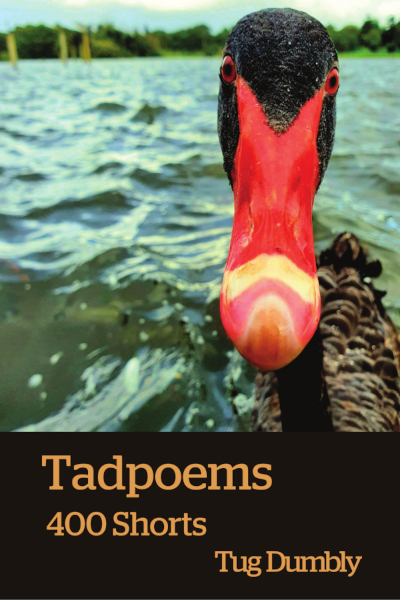
Tug Dumbly, Tadpoems: 400 Shorts (Flying Island Books 2024)
Most poetry books are at least a little intimidating to most people. Tadpoems is not one of them.
In an introductory note, Tug Dumbly (offstage name Geoff Forrester) calls the poems ‘little squibs’ and explains that many of them were born on walks, his mind ‘conversing with whatever it passes at the moment … or maybe just playing with words’. Most of them first appeared on Facebook. ‘A few,’ the note continues, ‘are shameless life-support systems for dad jokes’. It’s rare for a book of poetry to include such a clear and unassuming account of itself.
In addition to the 400 tiny poems, there are more than 40 photos, many of water scenes around Sydney, and close-ups of insects, birds and plants. The book is not only accessible fun, it’s also gorgeous.
It’s a book to be dipped into, enjoyed a moment at a time.
Many of the poems nudge the dad joke genre towards something satirical of even at times profound. One of my favourites:
After too much talk in the cultural hub
it's good to wing home over a bay
of beautiful banality.
I like this too:
Recycle.
Be re-astounded
by the same dear things.
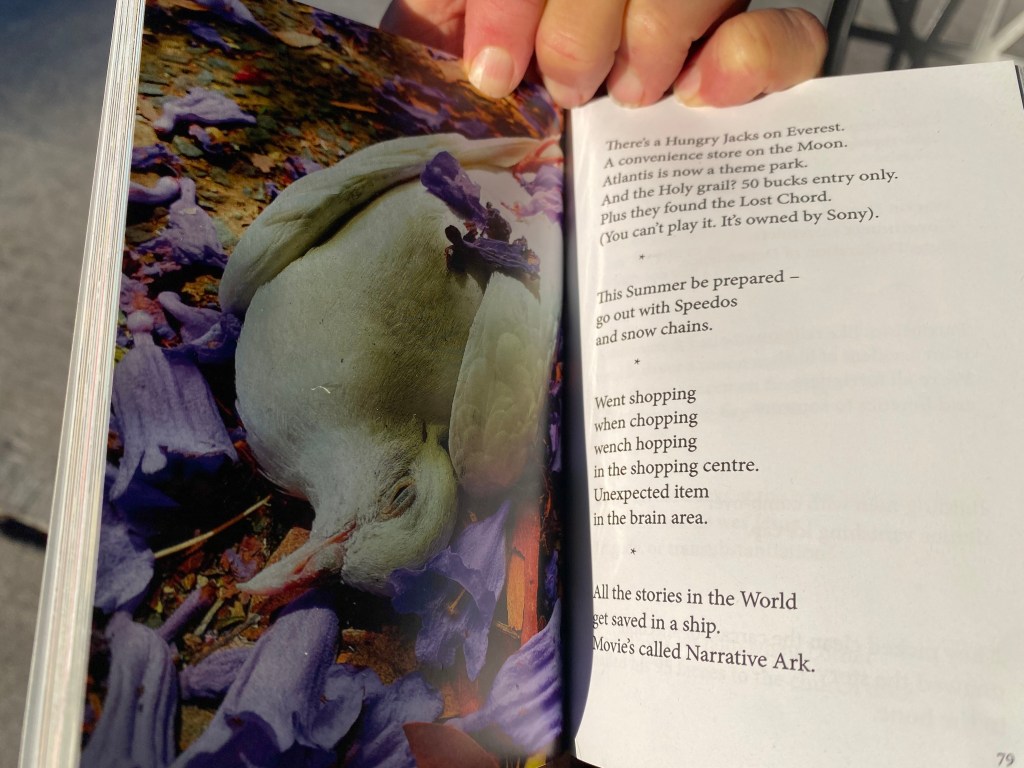
Page 78* is a striking photo of a dead seagull among fallen jacaranda blossoms – a very Sydney image, and not at all typical of the abundant life in most of the book’s images. There are four ‘tadpoems’ opposite:
The poems include a throwaway, bitter criticism of the commodification of everything, ending with a mildly erudite reference to Arthur Sullivan’s song ‘The Lost Chord’:
Plus they found the Lost Chord.
(You can't play it. It's owned by Sony.)
There’s a not-quite-successful joke about changeable weather, and a pun on lit crit terminology. I wouldn’t mind seeing the movie Narrative Ark
And a bit of wordplay that is exactly the kind of thing you can imagine happening in a wordy person’s mind as they go walking:
Went shopping
when chopping
wench hopping
in the shopping centre.
Unexpected item
in the brain area.
It’s silly and makes no claims for itself, but something sticks. The last two lines could refer back to the first three. A paraphrase would be, ‘That discovery of homophones that just popped into my head is unexpected.’ A humourless discussion of the poem might use terms like metapoetic or recursive. One nerdy person might see a reference to shopping malls as pickup locales (I just googled “shopping mall pickup” and sure enough it’s a porn trope). Another might see the poem as enacting an important non-linear mode of mental activity. I think they’d be right, but I’d be too busy moving on to the next ‘squib’ to join the conversation.
It’s a friendly, unpretentious book. Reading it is a bit like going for a walk with someone who points out interesting things in the environment, and who shares his thought bubbles. He’s good company.
I have written this blog post on the land of Gadigal and Wangal of the Eora nation. I acknowledge Elders past and present of all those clans, and welcome any First Nations readers.
* My blogging practice is to focus on the page that coincides with my age, currently 78.
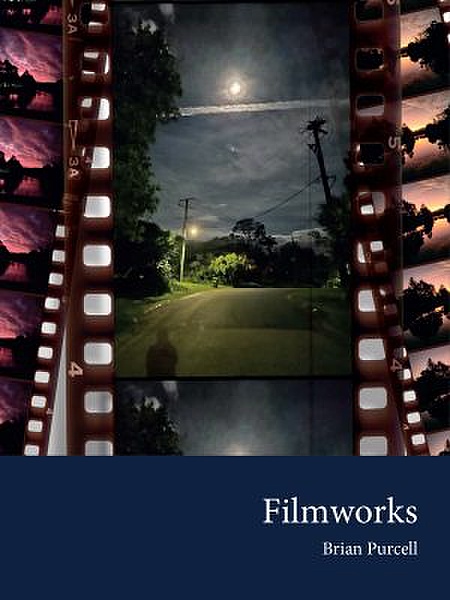
Inspired by Filmworks, Brian Purcell’s book of poems about movies, here’s a little verse responding to Kathryn Bigelow’s recent movie, which was written brilliantly by Noah Oppenheim:
November verse 8: A House of Dynamite

Someone's screen reveals a missile
armed and launched from who knows where.
The world could end in eighteen minutes.
Can we stop it in the air,
find the lever, aim and pull it,
hit that bullet with a bullet?
Missed! The dot moves on the screen
towards Chicago. Better phone
your loved ones with a dire warning.
Only question now, too late,
is, how should we retaliate?
Idris Elba holds, that morning,
codings that could kill us all.
One day that could be Donald's call.
Sorry!
I have written this blog post on the land of Gadigal and Wangal of the Eora nation. I acknowledge Elders past and present of all those clans, and welcome any First Nations readers.
Brian Purcell is a painter as well as a poet. He was lyricist and singer with the rock band Distant Locust, which gets a consistent rating of four stars (out of five) on rateyourmusic.com. He’s been involved in community literature for decades – in 2010 he founded the Bellingen Readers and Writers Festival, which celebrated ’15 years of storytelling magic’ in June this year.
Filmworks is a collection of 41 poems, all but one of them named with film titles. The exception, ‘Reason’, has the subtitle ‘Man Ray’s films of the 1920s’, so it’s barely an exception at all.
Here’s a random selection of opening lines to give you an idea of the range of movies that make the cut and the range of poetic responses to them.
An autobiographic note in the first poem in the book, ‘2001’:
A small boy beneath a big screen
that begins to split, somersault, explode
at the beginning of an infinite journey.
Notice the lower case ‘depression’ in ‘Top Hat’, so that it can signify both the context of the movie’s creation and a mental state that it may help with:
A parallel universe
where depression does not exist
High level showbiz gossip in ‘The Misfits’:
Her husband wrote the part for her
as a farewell gift.
Details of the movie are evoked vividly in ‘Blue Velvet’, though this is not how I remember the film beginning, probably another example of my unreliable memory:
The crushed blue velvet gently moving
at the beginning of the film
hangs down like an enchanted sea
or a field where fabulous creatures roam.
In ‘The Imitation Game’ – dedicated, of course, to Alan Turing – the film is a springboard for a poem on our attention economy:
Secrets
we all have them
and they kill us.
I love this book. It feels like an extended conversation with another film lover, a conversation that can go anywhere, and does. And not a Marvel Universe blockbuster in sight. It makes me want to do a similar collection of poems about my own favourite movies.
I have written this blog post on the land of Gadigal and Wangal of the Eora nation . I acknowledge Elders past and present of all those clans, and welcome any First Nations readers.
This post first appeared on 25 August 2004. I’ve retrieved it from the earlier version of this blog because I’ve just written a little stanza recording my wildly inaccurate memory of the incident it describes.
In Balmain after work tonight, I witnessed an impromptu performance by Colin Friels.
A traffic cop was strolling along Darling Street checking the parking meters, notebook in hand. I had just seen a woman illegally parked outside Oportos toot her horn to alert her chicken-buying companion, and then back out just as the notebook-bearer was making his shark-like approach.
About ten metres further along, I walked past the talented Mr Friels at the exact moment he spotted danger. He turned to the little girl beside him, say eight years old, and said, in rich theatrical tones that reminded me of The Children’s Hour of the 1950s: ‘Come on. There’s a man with a yellow coat, and he’s going to do dreadful things.’ And the two of them set off in a modified sprint, plastic bags swinging.
As far as I could tell they made it to their car in time – the last I saw of them they were dodging around a large truck that was turning into one of those narrow streets that run off Darling, easily overtaking their public-revenue-collecting nemesis. ‘And no paparazzi in sight,’ I said to the smiling woman who was inserting coins in a meter near me.



 Me fail? I fly!