
Andrew Miller, The Land in Winter (Sceptre 2024)
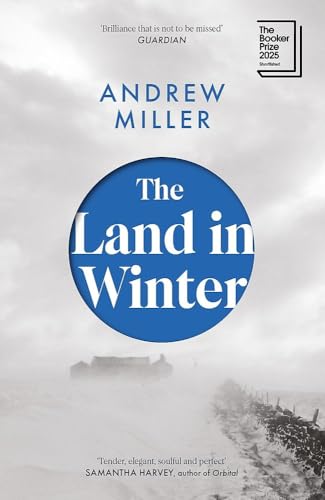
Before the meeting: The Land in Winter was shortlisted for the 2025 Booker Prize. The judges described it like this:
In the depths of Britain’s coldest winter, two neighbouring women forge a friendship in the countryside. It’s 1962 and they have both just become pregnant. Around them, the men are struggling <snip>. As a winter storm wreaks havoc on their lives, these characters become pivotal figures in a community precariously balanced between history and future <snip>. In beautifully atmospheric prose, Andrew Miller brings suspense and mystery to this seemingly inconsequential chapter in British history.
For me the one word that stands out from that is ‘inconsequential’. I never got on the book’s wavelength. I couldn’t find any reason to be interested in the characters, and couldn’t tell why the author was interested in them. Adultery, mental illness, patriarchy, the lingering effects of World War Two, the shady world of strip clubs and escort agencies, organised crime lurking in the background, a nuanced play of class, a solid evocation of a snowbound English countryside: there’s plenty there, but I mostly failed to care or be amused. Nobody is happy, everybody has a complicated past, terrible things happen to each of the main characters, some expected, some self-inflicted, some as arbitrary as a car accident. The prose is fine, but I would describe it as functional rather than atmospheric. The book doesn’t sing.
Page 78* occurs in chapter 7. The ‘two neighbouring women’, Rita and Irene, have met for the first time when Rita has brought eggs from her farm as a gift to Irene, the doctor’s wife.
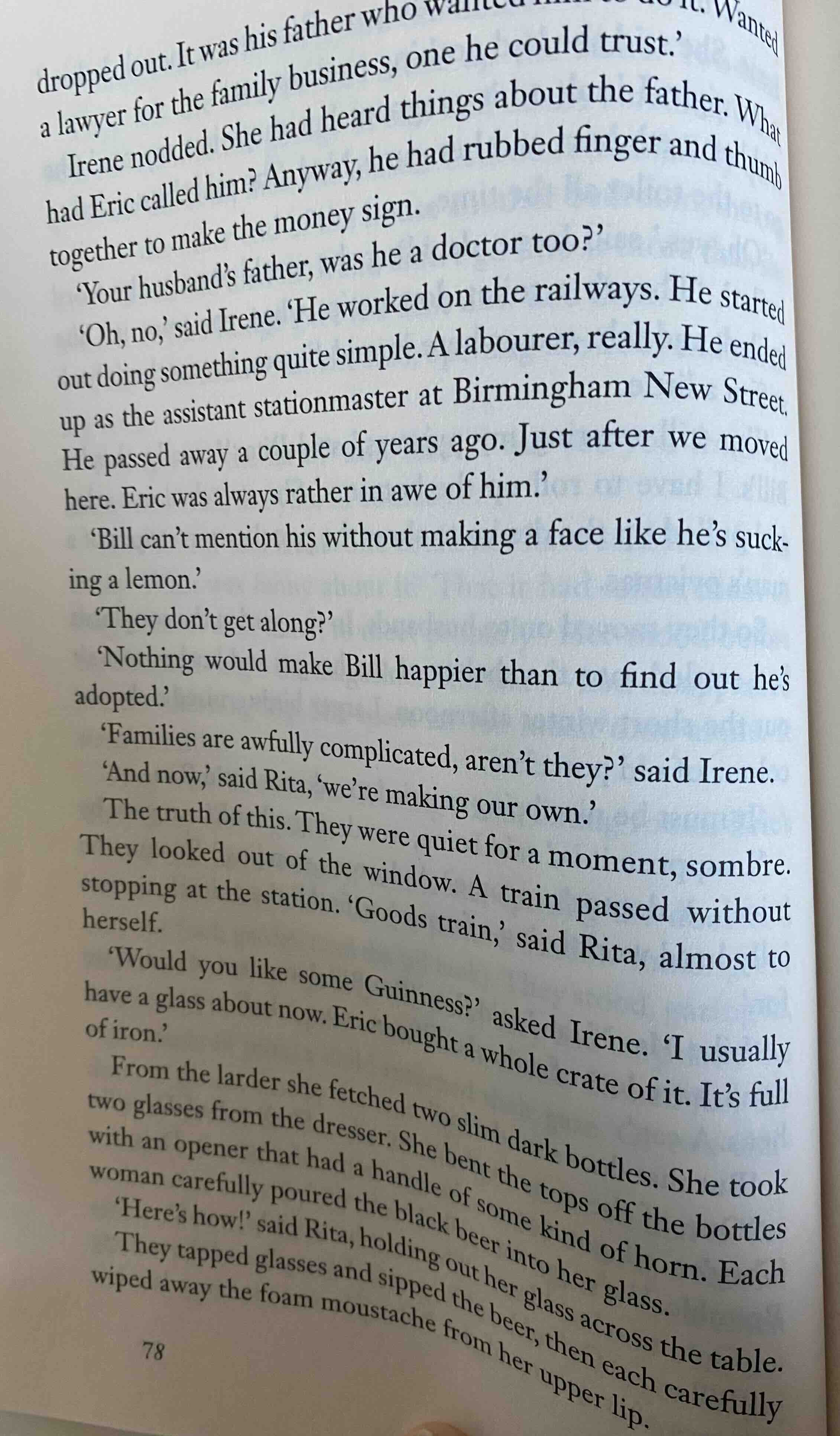
As the women converse, they fill each other in on their husbands’ backgrounds. That is to say, this is mainly a page of exposition. But then, a lot of the book feels to me like exposition.
‘Bill was at Oxford,’ said Rita, as if that explained the naming of cows after queens of the Nile. ‘He was studying law but dropped out. It was his father who wanted him to do it. Wanted a lawyer for the family business, one he could trust.’
Irene nodded. She had heard things about the father. What had Eric called him? Anyway, he had rubbed finger and thumb together to make the money sign.
<snip>
‘Bill can’t mention his [father] without making a face like he’s sucking a lemon.’
‘They don’t get along?’
‘Nothing would make Bill happier than to find out he’s adopted.’
In the midst of that background briefing, one detail stands out. Irene’s doctor husband ‘had rubbed finger and thumb together to make a money sign’. So Bill’s father, we understand, is a Jew. There’s more about that later when we meet Bill’s family, but the antisemitism of Eric’s remembered gesture never leads to anything. This did make me wonder if the narrative was seeded with many such signals that I missed. A character will see an unexplained light in the distance, and there are moments of surreal weirdness, but the narrative closes over them and it’s as if they were never there.
After their expository chat, the two women – both newly pregnant – move on.
‘Would you like some Guinness?’ asked Irene. ‘I usually have a glass about now. Eric bought a whole crate of it. It’s full of iron.’
From the larder she fetched two slim dark bottles. She took two glasses from the dresser. She bent the tops off the bottles with an opener that had a handle of some kind of horn. Each woman carefully poured the black beer into her glass.
‘Here’s how!’ said Rita, holding out her glass across the table.
They tapped glasses and sipped the beer, then each carefully wiped away the foam moustache from her upper lip.
Ah, thinks the reader, Andrew Miller has done his research. Way back then in 1962, not only did women drink alcohol when they were pregnant, but doctors as likely as not recommended that they drink stout as an iron supplement. It may be that the horn handle of the bottle opener and the slim bottles are period details. That would explain the slightly laboured feel of the writing, detail apparently for detail’s sake.
You might think that page 78 is unrepresentative of the book as a whole. Or it might whet your appetite for more. But to my mind it’s dull, expository, laboured, and as such typical of the whole book.
For Andrew Miller’s sake, I’m glad that my view seems to be in the minority.
After the meeting: My view was broadly shared by the entire Book Group. After exchanging end-of-year book gifts (I scored Clear by Carys Davies), and enjoying the first parts of an excellent meal in a Manly restaurant, we had a generally unenthusiastic conversation about the book. The most memorable contribution came from someone who said she hadn’t reached the good bits. “What?’ someone said, ‘you didn’t read the whole thing?’ ‘Yes, I did,’ she said, ‘but when I said how boring it was S– told me it got better, and I was still waiting for tht to happen when I reached the end.’
We all agreed that the bitter winter was brillintly evoked. Someone thought the quality of the prose was a kind of correlative of that confining weather. We hunted around for why it has been so well received by critics. Maybe you had to be English, someone said. Maybe there’s a lot of subtlety, especially about class, that went right over our collective head.
There was so much else to talk about. So we did, and enjoyed the rest of our meal.
The Book Group met on Gayamagal land, and I have written this blog post on the land of Gadigal and Wangal of the Eora nation. I acknowledge Elders past and present of those clans, and welcome any First Nations readers.
* My blogging practice is to focus on the page that coincides with my age, currently 78.


 Me fail? I fly!