
Christopher Reid (editor), The Letters of Seamus Heaney (Faber & Faber 2023)
– pages 1– 389
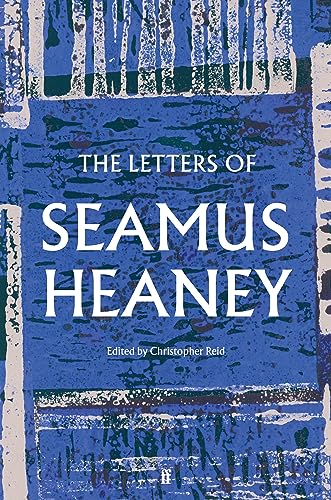
In early December when I announced that I was embarking on a slow read of this book, I promised a progress report ‘in a month or so’. Given that so many of Heaney’s letters begin with some version of ‘Forgive me for not writing before now,’ maybe it’s appropriate that I’m more than a month late with this blog post.
In these two months, seven or eight pages a day, Heaney has aged from 25 in 1964 to 53 in 1992. He has married (to Marie, constantly referred to in the letters) and his two children have grown to adulthood. He has progressed from earning a living as a school teacher to being Poetry Professor at Oxford, and being in demand for lectures, readings and appearances in Ireland, the UK, the USA and occasionally in Europe. He has a number of books of poetry published, distinguished critics have engaged with his work, and he has won prizes. He has collaborated with Ted Hughes in editing two anthologies for children. He is part of Field Day, a Dublin organisation that presents plays and publishes pamphlets and books. He has become Famous Seamus – I phrase I got from the late Les Murray. He has been deeply embarrassed by being included in an anthology of contemporary British poets. He has fought off well-meaning attempts to, as he sees it, ‘commodify’ his early life. He has been been criticised by feminists and Irish nationalists.
Editor Christopher Reid has a brief head note at the beginning of each year, and follows most letters with brief explanatory notes (for example, on page 236, ‘”Frank” was the Faber editor Frank Pike (b. 1936)’). These minimal interventions allow the letters to tell their own story. What results is an intimate self-portrait and a partial, impressionistic autobiography. I’m enjoying it immensely, and I imagine that readers who are familiar with Heaney’s poetry – and that of his contemporaries and near-contemporaries – would enjoy it even more.
Today I have reached the half-way point, where eight pages of photographs bisect a 1992 letter to Ted Hughes – one of the photos being Heaney with Carol Hughes at Ted’s funeral in 1999.
The letter is one of the longer ones in the collection, and is a good illustration of why the letters make such good reading.
First he invites Hughes to visit him and Marie in their cottage in County Wicklow, which he describes as a refuge::
All you commended to me a year ago about gathering towards the focal point of self and surety and fate comes through as a breathing truth when I’m down here on my own. I’m by now like one of those hens that ‘laid away’ – the nest is out under the nettles, not in the orange-box compartments in the henhouse.
After that charming image of himself as a wayward chook, he writes, ‘But I digress,’ and writes a couple of paragraphs about poetic matters: mainly about how Hugh MacDiarmid is a good example of something Hughes had written recently (Christopher Reid makes an educated guess at what piece of writing he refers to.) I haven’r read any of MacDiarmid’s poetry or Hughes’s criticism so this mostly sails past me, except for the fabulously unguarded description of some of MacDiarmid’s verse as ‘the looney embrace of the Tolstoyan do-goodery combined with the McGonagallish tendency in the natural run of his speech’. (Reid lets the McGonagall reference go unexplained – if you need to know here’s a link to the Wikipedia page about his most famous poem.)
But it’s a personal letter, and after engaging with Hughes’s recent work, he sympathises with him over recent criticisms of him to do with ‘Sylvia’. It’s not clear what he’s referring to, but at this time (1992), Hughes was publishing poems about his relationship with Sylvia Plath, and reinforcing the view of him in some circles as responsible for her tragic suicide. Heaney is unambiguously supportive and characterises the criticisms as:
obtuseness and hostility and galvanised vindictiveness combined helplessly at first and then proceeded wilfully against you.
That’s all very well, and can be read as old white men banding together. But then, most interestingly, he refers to his own, lesser feminism-related tribulations. An anthology of Irish poetry recently published by Field Day, the organisation on whose board Heaney sits, has been roundly criticised. Heaney is remarkably undefensive:
the book sins indefensibly in many areas: no women editors, no ‘feminist discourse’ section …; too much ‘non-revisionist’ historical perspective.
Acknowledging this, he can tell Hughes that the criticism has nevertheless rocked him:
Vah! But I am more alive than before to the immense rage which man-speak, or even men speaking, now produces, The historical tide is running against almost every anchor I can throw towards what I took to be the holding places.
These letters aren’t written for publication. This isn’t a statement of position, but something said to a friend.
And he encloses a poem. Christopher Reid can tell us which poem it was, and I can look it up and enjoy it.
Page after page this book gives such privileged glimpses of the life, work and times of a very fine poet. In the next couple of years, he gets the Nobel Prize. I imagine his time out under the nettles gets even more precious.
I have written this blog post on the land of Gadigal and Wangal of the Eora nation. I acknowledge Elders past and present of those clans, and welcome any First Nations readers.


 Me fail? I fly!