
Evelyn Araluen, The Rot (University of Queensland Press 2025)
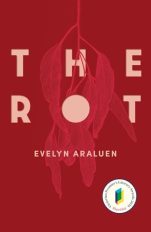
This is a brilliant follow-up to Evelyn Araluen’s first book, Dropbear. It’s passionately raw, intellectually challenging, and full of rabbit-holes. Araluen says in her acknowledgements, ‘In most ways this is a book for girls.’ She goes on to say, ‘A girl is so many things. Everything, really.’ It’s pretty safe to say that I’m not a girl. But as an oldish man of settler heritage I was swept away.
Alison Croggon in the Guardian (at this link) called it ‘a hurricane of a book’ and says (among other things):
The Rot is an experiential plunge into the nightmare of the present moment, as seen through two centuries of colonisation on this continent. Dark though it is – as dark as our times – it is not hopeless. The book is dedicated to ‘my girls, and the world you will make’: Araluen looks to the ‘Long Future’, a term coined by the Unangax̂ scholar Professor Eve Tuck, for what can be imagined for those who survive colonisation – contingent and elusive as that future might be. At the core of this collection’s bitter truths beats a sublime tenderness.
[In case you need a footnote: Unangax̂ are the Indigenous people of the Aleutian islands. Some of the most powerful moments in Rot come when Araluen wrestles with the implications of Eve Tuck’s thinking. You don’t have to go down this tempting rabbit-hole to feel the full force of the poems.]
Araluen was recently interviewed by Sian Cain for the Guardian (at this link) when she won the 2026 Victorian Premier’s Literary Awards. Here’s a snippet:
She worked on The Rot ‘after work, after dinner, in the bath’ for months, though she now admits that such prolonged focus on such a traumatic subject was ‘irresponsible of me’.
‘I do not recommend drinking wine in the bath and listening to Mitski and crying and calling that a writing practice,’ she added.
The Rot reflects ‘a really panicked, distressed window of a time that I hope we all look back on with horror and despair and a real sense of regret,’ Araluen said.
[Mitski, another of the book’s many potential rabbit-holes, is a Japanese-American singer whose music has been described as a ‘wry running commentary on twentysomething angst, raw desire, and often unrequited love’ (link to Wikipedia article here).]
These quotes give an idea of the book’s tone and its scope, though there’s a lot that they don’t mention. For instance, the genocide in Gaza is a pervasive presence. I recommend that you read both the review and the article in full – and then I hope you’ll decide to read the book.
There’s so much to take in, so much to say, such complexity and intensity to untangle, so many rabbit-holes to be profitably explored. I’ll just offer a small note, keeping to my resolve to focus on one page.
Page 78* is the beginning of ‘What You Can Do with Your Hands’:
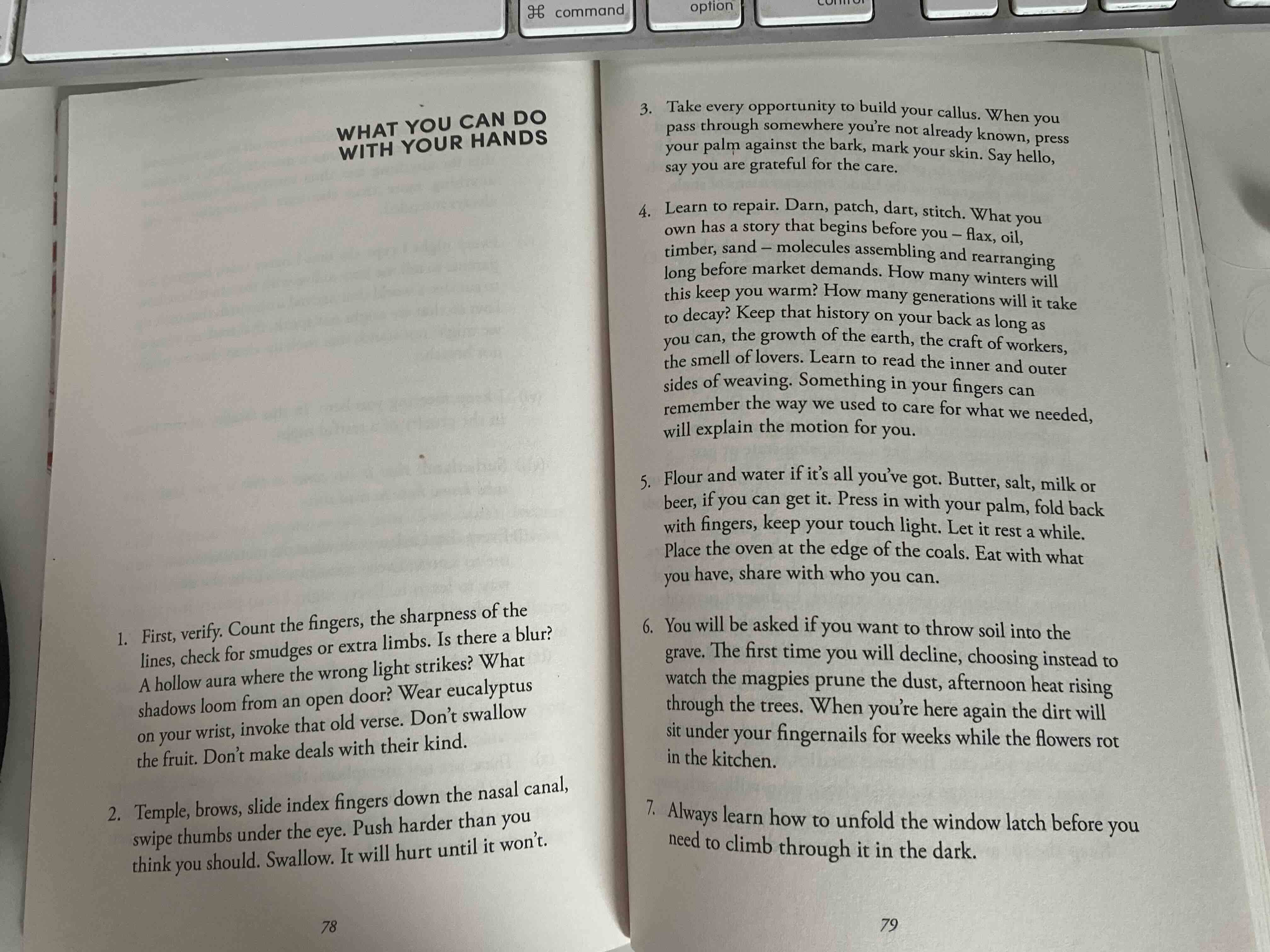
Before looking at the poem itself, it’s worth considering it in context. It’s title suggests that it is a direct response to an earlier poem. ‘You’ (page 25) ends:
no less human than yourself. Around us the
world sways, sometimes crumbles. It's not that
you think you can change this, but you need
something to do with your hands.
The hands motif turns up again in ‘Analysis Act Three’ (page 76), which launches itself with a quote from J H Prynne (from his 2022 lecture ‘Mental Ears and Poetic Work‘, another potential rabbit-hole).
Prynne: no poet has or can have clean hands, because
clean hands are themselves a fundamental contradiction.
Clean hands do no worthwhile work.
Sections viii and ix have this: (Apologies, but my WordPress theme doesn’t allow me to include section numbers as they ought to appear.)
Every day I ask myself what the machine doesn't want
me to know. Every tomorrow will be the day I find a
way to learn it. Every night I read poetry just to give
my hands something to do.

Refusal, resistance, disavowal and survivance are
tenors of a liveable life. In action they are compromised,
bloody-handed, in the world and of it.
The book is full of theory, grief and rage. But the motif of hands beings it down to earth: thinking and feeling are not enough. We need to work, to engage. Reading poetry can be work. So are ‘refusal, resistance, disavowal and survivance’.
‘What You Can Do with Your Hands’ responds in the form of an instructional poem in 15 sections’. Page 78 has just the first two instructions:
First, verify. Count the fingers, the sharpness of the
lines, check for smudges or extra limbs. Is there a blur?
A hollow aura where the wrong light strikes? What
shadows loom from an open door? Wear eucalyptus
on your wrist, invoke that old verse. Don't swallow
the fruit. Don't make deals with their kind.

Temple, brows, slide index fingers down the nasal canal,
swipe thumbs under the eye. Push harder than you think you
should. Swallow. It will hurt until it won't.
A quick and dirty summary of these sections would be something like: first, pay attention to your actual hands, and second, use them to become aware of yourself as physically present.
But this is poetry. The words matter. And they introduce an element of the uncanny, something that disturbs the prose meaning. ‘Check for smudges,’ Ok. I can do that, and it is an injunction to self-reflection: smudges – of ink, dirt, foodstuff – will show what I’ve been doing. But ‘check for extra limbs’? The mind goes wandering, and who knows where? Then the questions about light and shade ask the reader to notice their actual context, recognise that they are in a place, in relationship to whatever creates a looming shadow. (In my case right now, the shadows on my hands are cast by light from an open window.)
‘Wear eucalyptus’: fair enough. But what is the old verse we are to invoke? I lay that aside as another of the book’s potential rabbit-holes. If you have an idea, please say in the comments.
‘Don’t swallow the fruit’: I read this as referring to the tale where a person taken to a fairy land must not eat anything if they want to avoid being trapped there forever. That and the final sentence, ‘Don’t make deals with their kind,’ are warnings to keep one’s own integrity against the tide of disinformation and distraction that we live in – ‘Don’t drink the kool aid.’ Already the poem has moved quite a way from literal hands.
The second section comes back to the literal. It insists that the reader notice they are a body: that they push hard to make contact with their own physical existence.
I won’t discuss the rest in detail – the remaining sections cover how to acknowledge place; how to repair; how to cook; how to throw soil into a grave. They cover self-defence, self-care, first-aid, violence, tenderness, and finally connection. Section by section, the instruction form opens up possibilities, creates small and large riddles, resonates. Even Section 12, the shortest, ‘Pick up your fucking litter,’ repays a moment’s attention: the tone shifts and the speaker of the poem becomes for a moment an irritable Auntie. But the comic irritation doesn’t detract from the importance of the advice. Section 14, the second shortest section, is, among other things, a gloss on Section 2: ‘Remove your grip from your own throat.’ It’s one thing to push hard with your thumbs under your eyes until it hurts; it’s a different thing altogether to do violence against yourself, to stifle your own voice. I love Section 15, but it’s against my religion to quote the final line of a poem.
Do read the book if you get a chance.
I wrote this blog post on the land of Gadigal and Wangal of the Eora Nation. I acknowledge Elders past and present, and welcome any First Nations readers.
* My blogging practice is to focus on the page that coincides with my age, currently 78.


 Me fail? I fly!
I have this down as a surely certain Stella longlistee tomorrow night. I heard her speak twice at the CWF last year and bought the book then but haven’t properly grappled with it. It feels fiercer than Dropbear – which is fine – and yes I gathered she was particularly focused on young women. I worry though when poetry has too many rabbitholes for me. Is that being lazy?
LikeLike
Pingback: Stella Prize 2026 Longlist announced | Whispering Gums
Pingback: Stella Prize 2026 Shortlist announced | Whispering Gums