Category Archives: Books

Winter reads 7: Two bilingual poetry books

This is my seventh post on books I took with me on my escape from Sydney’s winter, focusing as usual on page 76 (or page 47 when there is no 76): two very different bilingual books from Flying Island.

Yannis Rentzos, Divertente and other poems, translated by Anna Couani (Flying Island Books 2023)
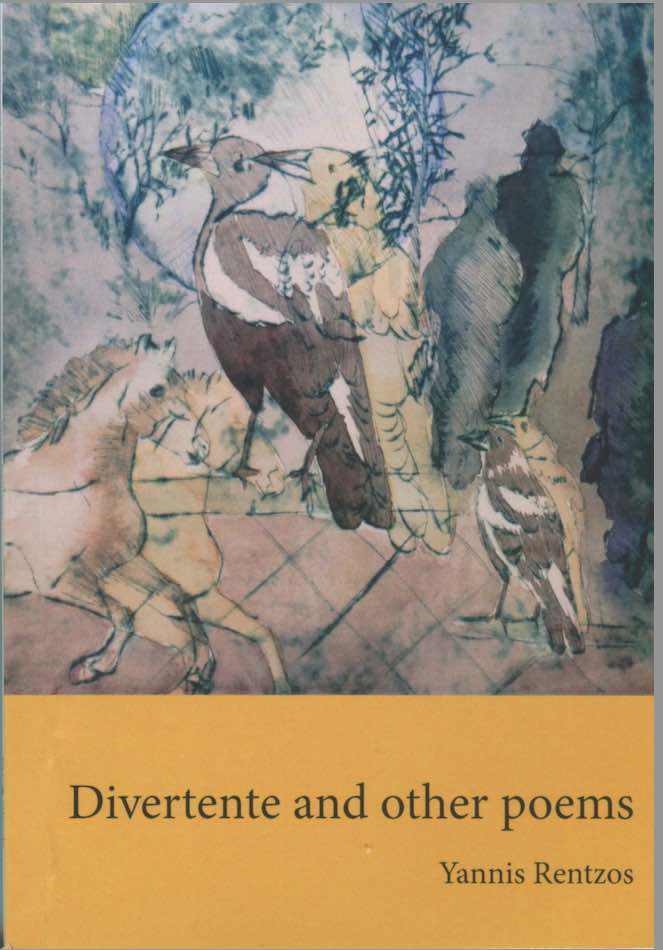
Yannis Rentzos was born in Crete and has been living in Australia since 2006. His poems bear witness to his European roots as well as his antipodean present. The poetry is elliptical. I kept feeling that if I had been able to read the original Greek I would understand them better – not necessarily the evasive meaning, but perhaps something in the sound that is inevitably lost in translation.

For example, I particularly liked the poem ‘I know you are coming’, which seems to be about the death of a man, perhaps the poet’s father, whom he has ambivalent feelings about. Here are a couple of lines that suggest with wonderful economy that the man has spent time in prison, hint at violence, but remain opaque – in this way they are typical of much of the poetry:

In your first years on the outside
a plate, a glass

A suit hung unworn.
The cops knew, they turned a blind eye

Were the plate and glass smashed, as suggested by mentions of violence in surrounding stanzas? Why was the suit unworn? Did the cops turn a blind eye to the broken stuff, or to the unworn suit? If the latter, does that mean the suit was stolen? So many unanswered questions. But the plate, the glass, the suit are there in the poem and in the man’s past, radiating meaning – it’s just that we readers don’t know what that meaning is.

The final third or so of the book is devoted to a single sequence titled ‘Walk in Waverley’. Instead of Greek text on each right-hand page, there is a photo. In effect it’s a poetic-photo-essay on Sydney’s wonderful Waverley Cemetery.

Page 47 is on the second spread of the sequence, the first that includes text:
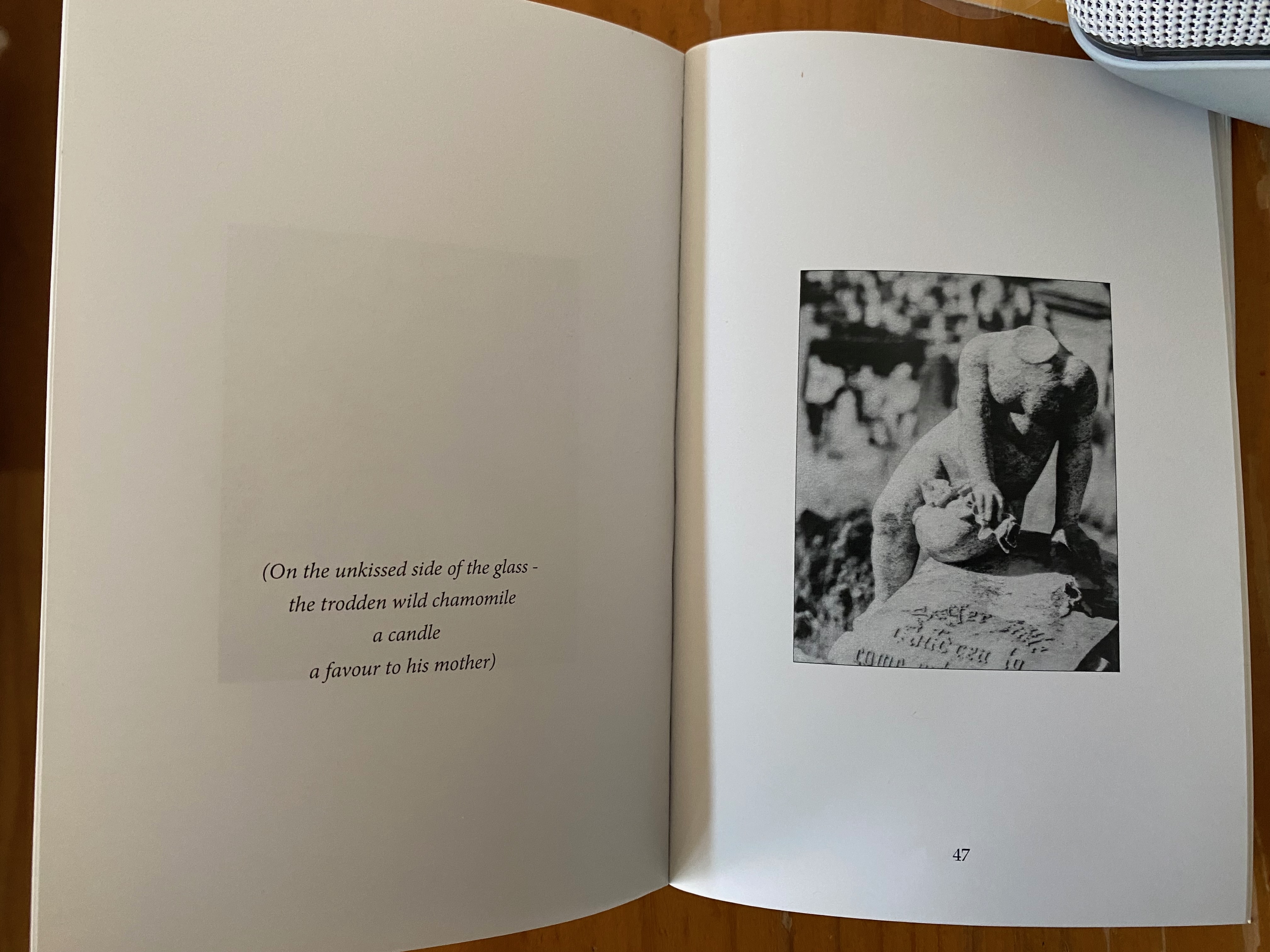
This gives you some idea of the way text and image relate to each other throughout. They don’t illustrate each other explicitly, but as the text – mostly a single line per page after this – evokes thoughts of death and transience, the images suggest a walk among the graves, disturbing the crows that live there. On this page, the text –

(On the unkissed side of the glass - 
the trodden wild chamomile 
a candle
a favour to his mother)

– is a preamble to the walk that takes up the next ten spreads. It suggests a different style of grave from the one pictured – one with a glass-enclosed shrine. The man referred to in the fourth line maybe the person taking the walk through among the graves, starting at his mother’s grave. Perhaps these lines are a kind of dedication: ‘favour’ here meaning not so much as kindness as a token of affection or remembrance. You’ll notice that I say ‘perhaps’: nothing in this books is absolutely explicit.


Vaughan Rapatahana, te pāhikahikatanga/ incommensurabilty (Flying Island Books 2023)
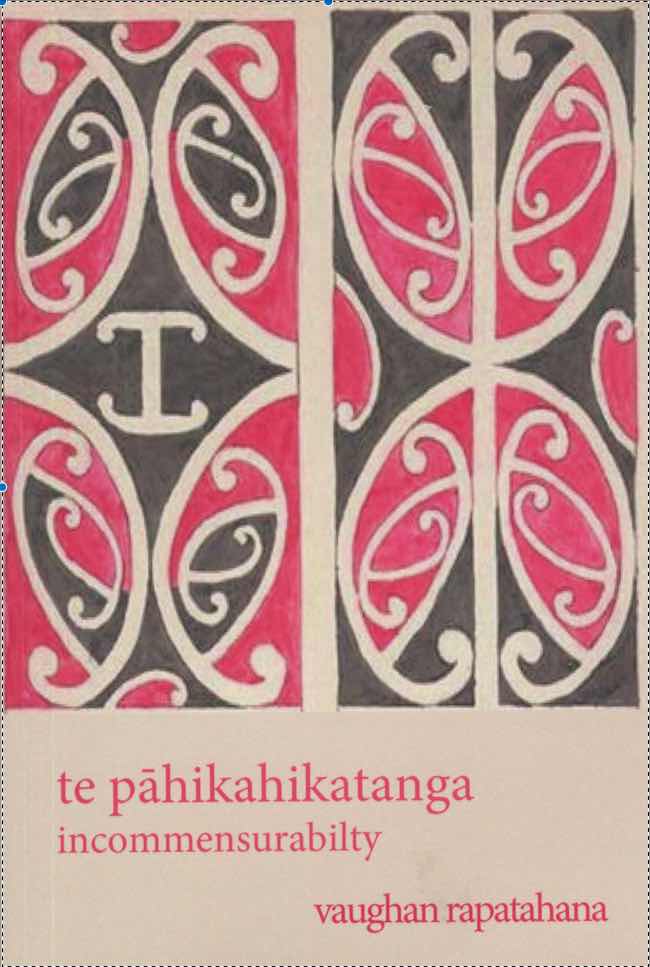
According to his author’s biog, Vaughan Rapatahana is one of the few World authors who consistently write in and are published in te reo Māori (the Māori language).

As well as a rich collection of poems rooted in Māori experience, this book includes a powerful essay on how important it is for Māori and other colonised peoples to learn and use their mother tongues.

The English language is one that historically and contemporaneously is all-too-often a deleterious influence on the languages of other cultures, in that its agents superimpose English with its inherent ‘cultural baggage’, on them. … The solution? To write in one’s indigenous language as much as practicable and to hope, to expect, that readers and listeners aspire to learn it too.

(Page 124–125)

Elsewhere:

I now write in my first language, the Māori language. Why? Because I want to fully express everything in my mind, in my heart, in my soul.
I cannot express myself fully in another language. For example, the English language is crammed full of the subject matter and cultural customs of the lands of Britain. The words of that tongue are inappropriate.

(Page 9)

The book is not just a bilingual book of poetry; it’s also a book about bilingualism. The incommensurability of its title refers to the impossibility of a ‘perfect’ translation. Anyone for whom the issues of translation matter will be interested. Likewise anyone interested in the long work of undoing the damage done by colonisation – to colonisers as well as colonised.

As a native speaker of the colonising language (with Irish and Scots Gaelic lost several generations ago), I’m reluctant to quote a whole poem, but here are a couple of lines from the English of ‘it is time for a big change’ on page 76:

there are many youths suiciding,
________________________-__ too many Māori youths
there are many women as victims of domestic violence
___________________________ too many Māori women
there is the ongoing issue of racism also,
__________________________ remember Christchurch.

And the original te reo Māori:

ko nui ngā rangatahi e mate whakamomori;
___________ he nui rawa atu ngā rangatahi Mãori
ko nui ngā wāhine ki ngā patunga o te whakarekereke ā-whare;
___________ he nui rawa atu ngā wāhine Māori
ko te take moroki o aukati iwi hoki;
___________  e mahara Õtautahi.

You don’t have to know much Māori language to immediately see some things lost in translation: in Māori, the lines mostly rhyme; in Māori, the second and fourth lines can end with the word ‘Māori’, whereas in English, the word is in a less emphatic position; and where the English translation has ‘Christchurch’, the Māori original has ‘Õtautahi’. The first and second of these differences are about the music of the poem. The third is a small illustration of the principles I quoted earlier: the English name inevitably carries connotations of England, of the Englsh Christian tradition; the Māori name makes it that much easier to remember that the victims of that mass shooting were Muslim.


I’m grateful to Flying Islands Books for my copies of Divertente and other poems and te pāhikahikatanga/ incommensurabilty.

Winter reads 5: Nicholson Baker’s Anthologist, page 76

This is my fifth post on books I’ve brought with me on my escape from Sydney’s winter, focusing as usual on page 76. Most of the books have been physically tiny books of poetry. This is the second novel.

Nicholson Baker, The Anthologist (Simon & Schuster 2009)

One of the men from my Book Group handed a copy of The Anthologist to me with a knowing look. ‘You’ll love this,’ he said.

He was right.

Paul Chowder is a minor US poet. He has had poems in The New Yorker and is on nodding terms with eminent literary figures. When the book opens he’s running spectacularly late with his introduction to an anthology he has edited, of rhyming poetry. His girlfriend, Roz, has found his procrastination unbearable and moved out. Over the next couple of weeks and almost 250 pages, he ruminates on what he wants to say in the introduction, does a half-hearted clean-up of his house and workspace, makes feeble attempts to win Roz back, and reflects on his own failings as a poet and a human being.

That’s it. It’s not exactly nail-biting stuff. I loved it.

The guts of the book is Chowder’s mind playing over the things he wants to say in the introduction. He has theories about metre that fly in the face of standard accounts, but are far from ridiculous. He spells them out in detail, with many examples. He considers the last century or so of ‘free verse’ to have been a mistake, though he admits some excellent poems have been written without rhyme. He detests enjambment. He dishes the goss about great poets of the past, and has plenty to say about key poets – especially Swinburne (too much of a good thing), Marinetti (bad), Elizabeth Bishop (good), Ezra Pound (very bad). He takes several pages to rip into Pound – the man himself and those who protect his legacy. His opening salvo gives you the general gist:

Pound … was by nature a blustering bigot – a humourless jokester – a talentless pasticheur – a confidence man.

(Page 92)

This may make it sound like a series of lit-crit essays strung together on a flimsy narrative. But that’s not so at all. It really feels that we are spending time inside the hand of a man almost totally preoccupied with matters poetical. If we learn something, that’s a side benefit. If we disagree with him, all the better. You may have to be interested in poetry to be interested in Paul Chowder: there’s no exuberant sex as in Alejandro’s Zambra’s The Chilean Poet, another excellent novel about poetry. The stakes are pretty low – will he get back with Roz, will he ever write his introduction, will he ever write a poem he thinks is any good? But I for one enjoyed it from cover to cover.

Spending a little time on page 76, I realise that we learn a lot more about Paul than I have indicated so far. The page begins with memories of his father, who used to recite two poems ‘with his fists clenched’ – ‘John Masefield’s “Cargoes” and E. E. Cummings’s poem about the watersmooth silver stallion. I had to look the latter poem up (it’s here if you’re interested): Paul Chowder’s father was more sophisticated than my parents, who sang ‘The Rose of Tralee’ and recited part of ‘The Hound of Heaven’ respectively; my older brother used to recite E. E. Cummings’s poem with ‘mudluscious’ in it.

He says in passing that he misses his parents every day – a note that is struck a number of times without further elaboration. Then his mind moves on, first to Tennyson:

Tennyson’s father was a beast. He was a violent alcoholic and an epileptic, and he was horrible to his sons. From the age of twelve on, Alfred Tennyson was home-schooled by his fierce, crazy father. When Tennyson Senior was drunk, he threatened to stab people in the jugular vein with a knife. And to shoot them. And he retreated to his room with a gun. A bad man. And eventually he died. Tennyson was liberated, and he began writing stupendous poems.

Characteristically, having made a huge value judgement, he pulls back from it:

Were they stupendous? Or were they only good? Or were they in fact not good at all? I’m not sure.

None of this may make it into the Introduction, but a constant process of drafting and redrafting is under way.

But his mind won’t stay there for long:

Last night I watched two episodes of Dirty Jobs and then went upstairs to bed after thinking that my poetry was not for shit, frankly. If I may be pardoned the expression. I got in bed, and I realised that what I wanted was to have some Mary Oliver next to me. If I had some Mary Oliver I would be saved

Now, the second most visited post on my blog is about a book by Mary Oliver, so whether by calculation or otherwise, Paul’s wanting her book next to him will strike a chord with many readers (it does with me). She was alive when the book was written, and I hope she would have been chuffed that he turned to her for salvation, even though she doesn’t use rhyme or strict metre.

If you picked up The Anthologist in a bookshop and flipped to page 76, you’d get a fair idea of what the book is: a kind of stream of consciousness of a man who is steeped in poetry and feels himself to be part of a great community of poets living and dead – a poet himself, a passionate reader, a teacher of sorts, a mind that’s alive.

I hear that Nicholson Baker has written a second book about Paul Chowder. I can’t imagine it.

Winter reads 4: Jill McKeowen’s Sunday morning, here

This is my fourth post on books I’ve brought with me on my escape from Sydney’s winter, focusing as usual on page 76.

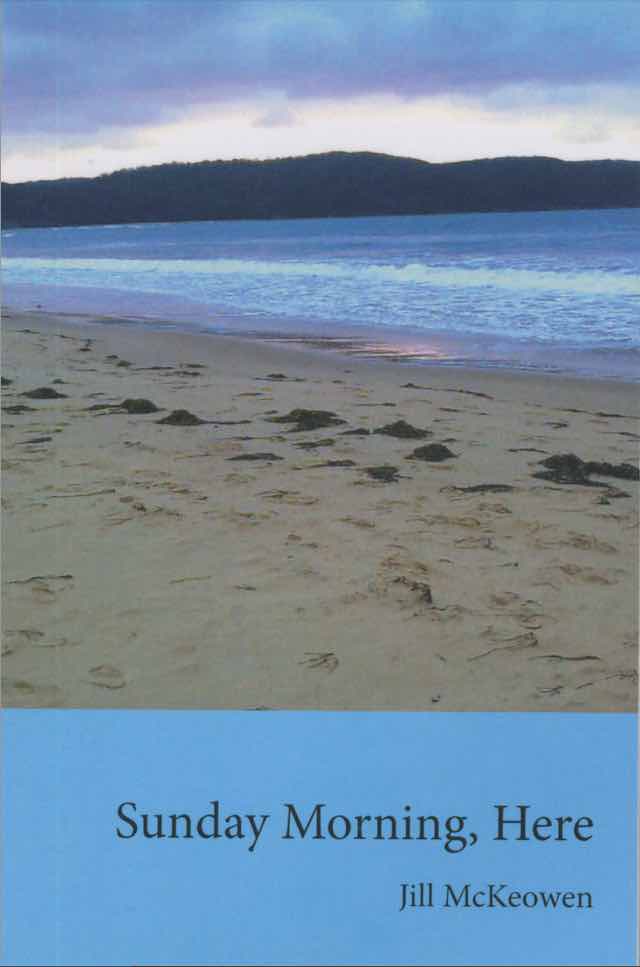
Jill McKeowen, Sunday Morning, Here (Flying Island Books 2023)

Sunday Morning, Here is another book in Flying Island’s hand-sized poetry series. Jill McKeowen’s bio tells us that, among many other things, she has been a regular reader at Newcastle Poetry in the Pub, and that this slim volume is her first book of poetry. I hope there will be many more.

It’s the kind of book that opens a window into the poet’s life: daily observations of life around her home on NSW’s mid-north coast, and on her travels up the coast and across the continent; some splendid poems about cockatoos; a whole section dealing with her father’s death and its aftermath; a section on her childhood family, then and now. Some poems suggest a disciplined practice of writing for an hour each morning. The poems are warm and genial, sometimes playing with form (there’s a nifty and heartfelt homage to Elisabeth Bishop’s The Art of Losing).

The title poem, ‘Sunday Morning, Here’, is partly a response to a Wallace Stevens poem, ‘Sunday Morning’, signalling that McKeowen expects to be read in conversation with other poets. Its first line, ‘Here there’s no complacency, but ease’, echoes the first word of the Stevens poem (‘Complacencies’), at the same time highlighting a recurring theme: the poet’s life is in the main comfortable and pleasant, but it includes an awareness of privilege: ease, but not complacency.

Serendipitously, the poem on page 76, ‘It’s still dark’, embodies many of these general characteristics.

It's Still Dark
I nudge the doona back, unwrap 
my sleep to the cold, and drift 
consoled in fleecy gown, pocket 
feet into slippers, feel
my way on hushed carpet, spark 
the gas heater to flame, flick 
the bathroom into light, give 
thanks for this convenience;

I fill the kettle from the tap, 
strike a match to more gas, 
slice ginger into boiled water, 
put my night-dried dishes away, 
sip the tea by fire glow, 
watch the rising-falling breath 
of curled cat, and write 
a reckless page of adjectives.

A woman wakes by the road 
close to a border town, her body 
warmth still wrapped around 
her sleeping child,
unseen
by armed militia.
She must look for water
while the dawn is pinned with stars.

Serendipitously, as I’m typing this I have on the table beside me a glass of ginger tea made from slices of ginger. I don’t wear slippers, my holiday rental has tiled floors, there is no cat, but the sense of simple luxury conveyed in the first two stanzas communicates beautifully. The four beat lines move smoothy, and the relaxed suggestions of rhyme (pocket/drift, spark/flick) and alliteration (water/away) hold the lines together, contributing to the sense of ease.

But not complacency.

The flow is disrupted in the second-last line of the second stanza, after the ultimate image of laziness – the ‘curled cat’ – comes a midline break in the sense, the first in the poem, and the line ends on just three beats, so that ‘write’ takes on a different, less indolent feel. Things are still easy but there’s a sense of purpose. Then ‘reckless’ confirms the change in mood. What is this reckless undertaking? It’s a writing exercise, perhaps a warm-up for something more challenging. Elsewhere in the book there’s a suggestion that McKeowen has a regular practice of writing in this way.

The third stanza takes the poem somewhere else altogether. It’s as if the act of putting words on paper ‘recklessly’ her mind is dragged from its early-morning drowsiness to awareness that her ease and comfort are an extraordinary privilege. The image of the woman who does not share her privilege bursts into the poem in lines of uneven length, with line breaks that do violence to natural phrasing (body / warmth, unseen / by armed militia). The other woman too has to find water, but in radically different, more precarious circumstances. We don’t need specifics of what country she is from: there are plenty to choose from.

I’m sure someone has said that good literature doesn’t provide solutions to problems, but helps to understand them. That’s certainly true of this poem. It gives us an unsettled and unsettling juxtaposition of two early-morning awakenings. A lesser poet might have gone on to spell out how the juxtaposition affected her – inspiring feelings of helpless guilt, say, or a decision to increase her regular donation to UNICEF. But that would have let the reader off the hook.

What we are left with is the final image of the dawn ‘pinned with stars’. As in those classical Chinese poems where the moon can be seen by the exiled poet and also by those who are far away, both women in this poem can see the stars. It’s a reminder of their shared humanity, and of ours.


I’m grateful to Flying Islands Books for my copy of Sunday Morning, Here.

Winter reads 6: Kevin Smith’s Another Day

This is my sixth post on books I took with me on my escape from Sydney’s winter, focusing as usual on page 76.

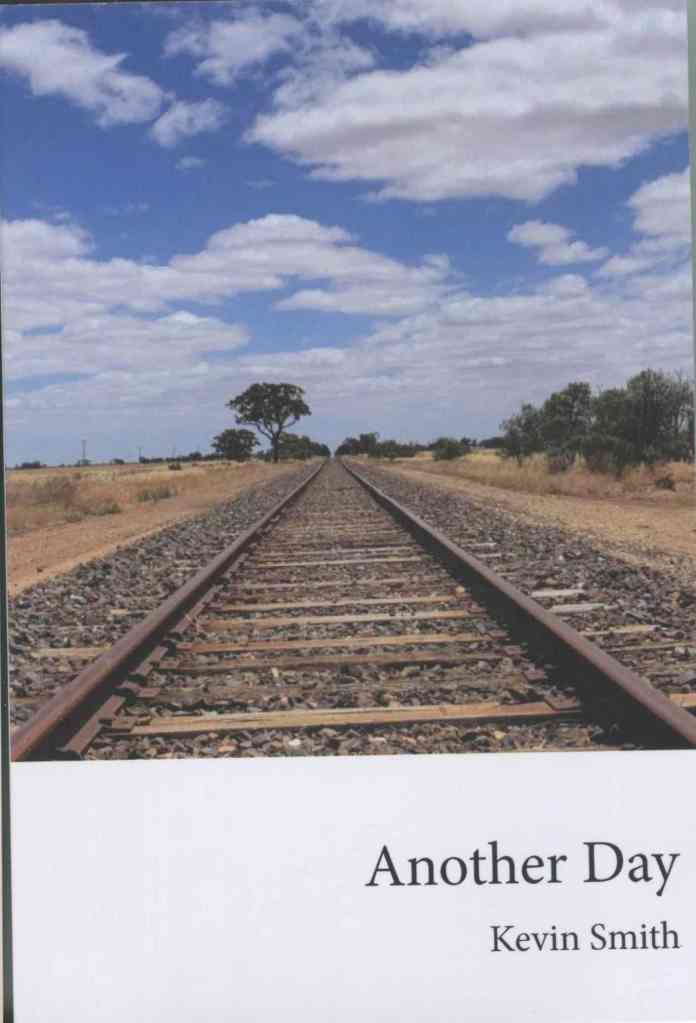
Kevin Smith, Another Day (Flying Islands Books 2023)

It was exquisitely bad timing that I read Another Day concurrently with Nicholson Baker’s novel The Anthologist. Baker’s protagonist Paul Chowder detests enjambment, even in such hallowed places as the opening lines of Keats’s ‘Ode to a Nightingale’, and Kevin Smith’s poems fairly bristle with enjambments.

But the poetry got me over that hump fairly easily.

It’s a collection of 38 poems, many of which have been long- or short-listed for literary prizes in Australia and elsewhere. There are enjoyable travel poems and people-watching moments; sex, birth, fatherhood and grandfatherhood. If I had to pick one poem that put unexpected words to experience similar to my own it would be ‘At Once Father and Son’, in which the poet speaks to his son who has just become a father himself. These lines also, incidentally, illustrate the poet’s attachment to enjambment:

And when I watch you look
___into his face – your own face –
full of wonder that you

and he were meant to be –
___so it was I used to think
that this would never end.

But time – travelling on 
___a one-way ticket –
won't return. And so we've drifted.

You've grown into a man 
___as I had done – as surely
as your son will do. And my hands,

empty of you all these years,
___tell my time has passed,
my station done.

One striking thing about the collection as a whole is the powerful poems about the cancer treatment and eventual death of a loved one. These are scattered through the book, with the disconcerting effect that these terrible things are somehow just part of life – just another day, perhaps – until they come to a grim conclusion in the final pages

Page 76 is parts 3 and 4 of the book’s only prose poem, ‘More Soft Than Water’. It’s a narrative – a short short story. In the first two parts the narrator recalls how as a young man he accompanied his sisters on their volunteer nights at an unidentified institution. A baby girl is placed in his arms, with skin ‘more soft than water’.

3.
Each week, I came back to her and walked the 
corridors again. Through a window, she caught
the light at play among the eucalyptus leaves 
brought to life by a breeze; her eyes fixed on 
them as I cradled her in my arms. Then some-
one told me she was dying. Her mother had to 
let her go, they said, or her husband would have 
left her too. So she became a ward of state. Some 
weeks later, I stood outside the facility door and, 
despite the cold, I could not make myself go in.
On the way home my sisters fixed their eyes on 
the road.

So much in so few words! According to the ‘About the author’ at the back of the book, Kevin Smith ‘has worked primarily in drama and theatre, as actor and writer’. I think a reader might have deduced that from these lines. The narrative beats are so clear: his slow bonding with the baby in the first two sentences. The seven-word bombshell. A quick backflash in the next two sentences, then the main action of the poem: the young narrator’s failure. And his sisters’ implied condemnation of his cowardice.

All the narrator’s emotion is conveyed by action and objects. We see the baby’s face as she watches the leaves. The bald statement of her expected death is left without commentary. There’s no judgement on mother’s past decision. We’re left to make our own interpretation of the narrator’s inability to enter the facility and of his sisters’ fixed gaze. This is letting the actions tell the story; it also creates a sense that the emotion of the moment is still too painful, possibly too shameful, to name.

4
For a long time I wondered if you'd died, and 
when. Sometimes I imagine I'm still standing at 
the door – the wind like a knife in my back – as 
I remember how comfortably you fitted into my 
arms. Once, you looked at me, and galaxies of 
stars kindled in the darker regions of my heart.

In the end, the poem isn’t concerned with a possible moral reading of the incident, but with an opportunity missed. There are probably hundreds of poems about what happens when you look into the eyes of a small baby. I think of Francis Webb’s sublime ‘Five Days Old’, though the echo here of these lines doesn’t mean Kevin Smith was necessarily thinking of them:

The tiny, not the immense
Will teach our groping eyes
So the absorbed skies
Bleed stars of innocence

The poem is full of regret, but also gratitude. If that young man had moved away from the wind’s knife, perhaps the baby’s look would have kindled more than stars.

You can find out more about Kevin Smith at his website, https://www.kevinsmithpoetry.com/.


I’m grateful to Flying Islands Books for my copy of Another Day.

Winter reads 3: Tony Birch’s The White Girl

This is my third post on books I’ve brought with me on my escape from Sydney’s winter, focusing as usual on page 76.

Tony Birch, The White Girl (UQP 2020)

Tony Birch has turned up in my blog fairly frequently as a contributor to Overland, winner of awards and speaker at writers’ festivals (link here). The White Girl the first novel of his that I’ve read, and it has been burning a hole on my bookshelf for years.

A friend told me she gave up on it after about 20 pages because it was full of stereotypes and it signalled crudely what was going to happen – she’d rather read non-fictional accounts of the terrible things done to First Nations families by white justice and so-called welfare, rather than something filtered through a more or less didactic imagination.

She was wrong. Many expectations are set up in the first part of the book, many disasters foreshadowed. But the expectations are more often than not overturned.

It’s the early 1950s. Odette Brown lives in the now near-deserted part of an Australian country town that once was home to a sizeable Aboriginal community. Now there’s just her, her fair-skinned, blonde-haired, twelve-year-old granddaughter Sissy, and at some distance her oldest friend Millie. Both Odette and Sissy have run-ins with a loutish young man who carries a gun and drives a dangerous truck. The local police offer no protection, and – worse – there’s a new officer in charge who takes his role as ‘Guardian’ of all Aboriginal children seriously. He is biding his time to take Sissy into ‘care’. Add to that, Odette has increasingly frequent spasms of pain in her side and a doctor has told her she absolutely must have surgery – surgery which she can’t afford, even if she was willing to leave Sissy unprotected while she was in hospital.

So the set-up ticks a lot of boxes: apart from the above, there’s a retired Afghan cameleer, a Polish teenager on the run from immigration officials, a Holocaust survivor with a tattooed number on his arm, a brain-damaged white man who runs a junkyard, a posh white woman who buys art from Odette and sells it with a bogus tribal attribution.

But, probably at about the place where my friend gave up, the story takes off. The focus is on Odette’s courage and ingenuity. Allies turn up in unexpected places. Sissy’s white appearance becomes an asset as well as a vulnerability. Other Aboriginal people tell their stories to Odette. Partly one feels that these stories serve a didactic purpose, making sure we know that terrible things were happening to First Nations people in the real world. But they also remind us how high the stakes are, right up to a climactic scene where the evil policeman (yes, he is pretty two-dimensional) makes his final play.

Page 76 is one of two moments when a First Nations character enters a rundown settler dwelling. In the other moment, Odette finds the decrepit old man, father of the young man with the gun and the truck. In this one, Sissy is testing the limits of her freedom on a day when Odette won’t be home until late. She wanders into an abandoned white farmhouse, knowing she could be in trouble, and the scene takes on an Mrs-Haversham eeriness:

Sissy opened the door of an ornately carved wardrobe. It was full of women’s dresses, scarves and coats. She reached out and touched the sleeve of a red velvet dress pitted with moth holes. The material fell apart in her hands. In the mirror in the centre of the wardrobe, Sissy could see the fireplace and mantle behind her. A large gilded portrait sat above the mantle. She walked across the room and stood in front of the frame. It was a photograph of a white family, standing in front of the house. The men in the photograph wore suits, the women dresses and straw hats. Children sat in front of the adults. The girls had beautiful long hair and wore white dresses. Sissy put a finger to the glass and imagined herself wearing such a fine dress. On the edge of the group, at a slight distance from the family, stood two Aboriginal women. The older woman had her arms crossed over her breasts and looked sternly into the camera. The younger woman refused the lens completely, looking off to one side.

What can I say? My friend gave up too soon.

Winter reads 2: D G Lloyd’s alive in Dubbo

This is my second post on books I’ve brought with me on my escape from Sydney’s winter, focusing as usual on page 76.

D G Lloyd was born in Dubbo in the late 70s. After spending some time in coastal cities as a young adult, he lives in Dubbo once again. This book is a celebration, of sorts, of his hometown.

It opens with an epigraph from one of Dubbo’s most notorious daughters, Kate Leigh, who is described politely by the Australian Dictionary of Biography as ‘a crime entrepreneur’. The epigraph reads, ominously, ‘Better dead than alive in Dubbo.’

Roughly speaking there are three kinds of poems in the book: incidents from childhood or more recent times, impressionistic images of places, and character sketches. There’s poverty and various kinds of desperation, churches and a brothel, heroin and alcohol, First Nations and settlers (I read D G Lloyd as non-Indigenous), locusts and PTSD. A portrait of the town emerges that’s unlikely to attract tourists, but it rings true – as if the poet has set out regularly with a verbal equivalent of a sketch book and come back with its pages full.

Page 76 chimes beautifully with the epigraph, being the book’s only poem dedicated to the dead:

Old Dubbo Cemetery
Uncared for, a grassy verge and 
artificial roses decorating headstones 
fallen in;
corroded shards and etchings, tilted obelisks,
a cobweb and an orb-weaver in between

the dirt and the gravel, 
oleanders,
a baby's grave marked by a small iron cross; 
the stone angel. Eyeless.
Sullen lips speckled with mould, petals 
drifting from outstretched fingers onto brown earth.

A council worker stands behind hakea wattle 
scraping his boot against the water meter. Cicadas 
chant (endless);
one of the monuments is missing an arm.
A blue-tongued lizard lies motionless beneath, 
bathing in sunlight
against a tawny, heart-shaped tombstone.

The conjures up an image of the cemetery, without editorialising or sentiment. Like most of the book, it feels artless: no rhyme to speak of, no metrical effects, no striking metaphors. Yet it holds the attention – I’ve now read it a dozen times and I’m not tired of it.

Here’s what I’ve noticed. There’s no full verb in the first two stanzas, but a past participle on almost every line: Uncared for, fallen in, corroded, tilted, marked, speckled, outstretched. All movement is in the past. What life there is, in grass, orb-weaver, oleanders and mould, doesn’t disrupt the lifelessness. The first of the two present participles in these stanzas – decorating – is as static as the headstones it refers to. At last in the eleventh line, there’s some movement with a second present participle – drifting.

As if the spell has been broken, the third stanza is full of life and action: a council worker scrapes his boots, a wattle grows, cicadas chant, a blue-tongued lizard sunbathes. The water meter, by implication, ticks. That the cicadas’ chant is endless suggests that in some way life goes on and will keep going on. One of the statues now has a full verb – ‘is missing’ – so even there there’s a hint of agency.

The final image of the lizard, the sunlight and the tombstone is already full of life, when the description of the tombstone as tawny, heart-shaped takes it to another level. The unexpected ‘tawny’ describes the the tombstone as a rich brown, weathered colour rather than the dull grey that dominates most cemeteries, but the vital associations from its usual use – of wild animals and birds, or port wine – hover around it.

Finally, the stone is heart-shaped. It would be pushing it to see a reference to the famous last line of Philip Larkin’s ‘An Arundel Tomb‘, ‘What will survive of us is love,’ but that is presumably the hope that led to the tombstone being shaped that way. Here the love has not survived, but its emblem, the’ tawny heart-shaped tombstone’, is part of the life that continues.


I’m grateful to Flying Islands Books for my copy of Alive in Dubbo.

Winter reads 1: Angie Contini’s fierCe

I’m away from home for two weeks to escape the worst of Sydney’s winter, and have brought a number of physically small books with me. I’ll blog briefly about each of them, focusing as usual on page 76. Here’s the first.

Angie Contini, fierCe (Flying Island Books, Pocket Poets Series 20023)

fierCe is part of Flying Islands’ series of more than 90 hand-sized books of poetry. It’s a striking little book – its poems are accompanied on almost every page by exuberant collages.

The collaged images come mostly from the vegetable kingdom and from classic and Renaissance art. I recognise, for example, the ancient Greek statue of Laocoön wrestling the snake, some Hieronymus Bosch, some Botticelli. The overall effect is of decorative tumult, with plenty of naked bodies and flourishing mushrooms, as in the cover (to the left), which sadly is the only one in colour.

The poems are also tumultuous, but here the nakedness is emotional, evoking what a note on the inside front cover calls eco-despair, plunging into dark places and, in the final sections, emerging from them. The four sections are: ‘eCo-propheCieS’, ‘dISencHantMEnt’, ‘rEsiliEnce’, ‘timE’, ‘Re-enChantmeNt’ and ‘tranSformations’. (The unorthodox use of capitals is restricted to these headings and the book’s title. As far as I can tell, it’s arbitrary, a generally unsettling device, perhaps echoing the tumult of the collages.)

There are many wonderful things in the book, especially the poem ’body’ in the final section, which looks back at the ‘rabid waltz’ of an eating disorder.

My plan to focus on page 76 hit an obstacle: the page is blank. Page 77 is also blank, except for the word ‘Re-enChantmeNt’, the title of the fifth, second-last section. So, on to page 78.

Beneath a row of what I take to be dancers on an ancient Greek frieze, there’s this small poem:

old soul
come with your wind 
into this wake
wearing thistles and gauze 
make me a feeler again

The poem is a turning point in the book. Having emerged from ‘the bleakness of ‘timE’, we pivot towards ‘Re-enChantmeNt’, that is, a recovery of magic and meaning. This poem is an invocation opening the section. It could almost be a response to the old Anglican hymn:

Breathe on me, breath of God,
fill me with life anew.

Both hymn and poem use the metaphor of wind/breath for inspiration. But where the hymn addresses the Christian God and asks for new life, drawing on the scriptural sense of new life in the spirit, the poem has to define, or at least suggest, the object and purpose of its invocation.

I take the ‘old soul’ to be a kind of Jungian Self, one’s deeply unified humanity, transcending the circumstances and accidents of time and place. It manifests here ‘wearing thistles and gauze’. Once I got past the image of James Thurber’s ‘I come from haunts of coot and hern‘ cartoon thrown up by my recalcitrant mind, I realised that this line brings into focus the relationship between the book’s images and words. ‘Gauze’ signifies the clothes of the classic dancing figures, and ‘thistles’ stand in for the natural world, not always comfortable but sometimes beautiful: so the line, and the images, suggest a reaching for stability in nature and in the long history of art. [Added later: I asked a couple of friends who hadn’t read the book, or this poem, what the phrase ‘thistles and gauze’ suggested to them: thistles, they said, are likely to sting, and gauze can be used as a bandage. Fair enough, I thought, the old soul is aligned with nature that can both hurt and help recover. That works too.]

There are two more words that stand out: wake and feeler.

Without the context of the book as a whole, wake is open to two meanings. It could place the poet in the disturbed aftermath of something, metaphorically the passage of a large vessel. Or the poet could be about to sing at an event held after a death. In context, the latter feels more likely: there have been poems of depression and anxiety, of despair: this word powerfully suggests that those states have led to a kind of death.

Re-enchantment is to be a kind of resurrection: ‘Make me a feeler again.’ I love that line. It reminds me of the wonderful lines from George Herbert’s ‘The Flower‘:

After so many deaths I live and write;
         I once more smell the dew and rain,
And relish versing.  

Angie Contini is calling on her old soul to restore her to that condition. The opposite of despair isn’t hope, but feelingness, aliveness. On a day when the premier of New South Wales has announced that measures to reduce this state’s emissions won’t work, when we’re told that the Gulf Stream may be about to fail, and the Antarctic ice has failed to regenerate this winter, the temptation to go numb is strong – this little poem is timely as a reminder of the emotional work that needs to be done.


I’m grateful to Flying Islands Books for my copy of fierCe.

Journal Catch-up 20

My current practice of focusing on page 76 when blogging about books serves me well when the subject is journals. It helps to resist the pull to go on at tedious length about the whole contents.


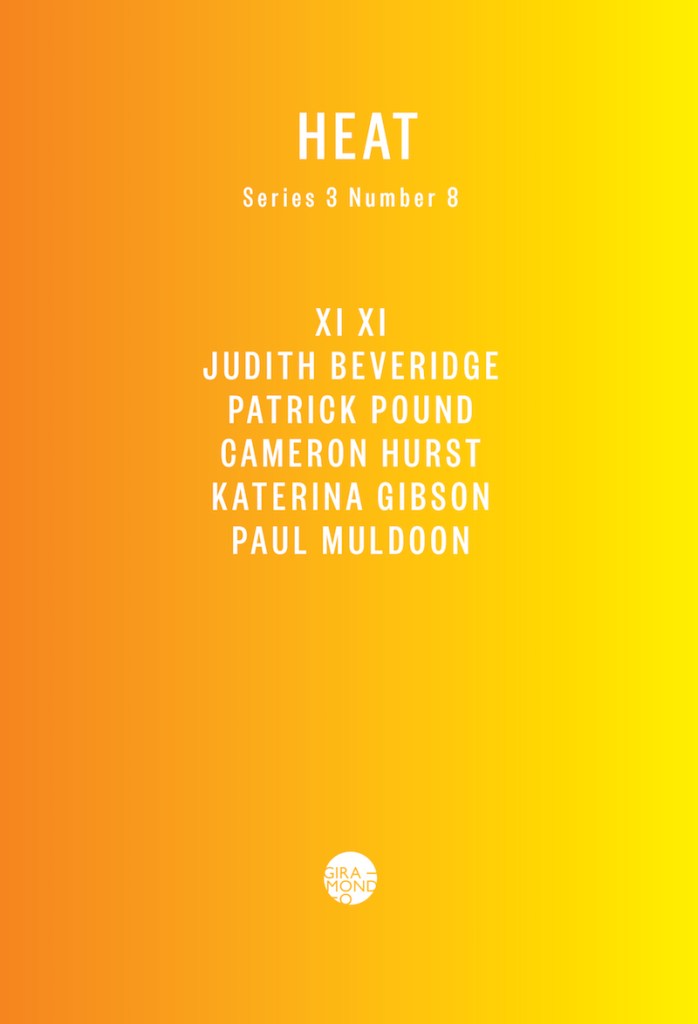
Alexandra Christie (editor), Heat Series 3 Nº 8 (Giramondo 2023)

This is a fabulous issue of Heat. A clutch of ‘animal poems’ by Judith Beveridge would have justified the cost of the magazine. ‘Mourning a Breast’ by the late Hong Kong writer Xi Xi, translated by Jennifer Feeley, is an excerpt from a yet-to-be-published novel that includes, among other things, a gruelling account of breast surgery and some fascinating reflections on different Chinese and English translations of Madame Bovary. Send Me a Sign? is a charming essay on Henry Handel Richardson and spiritualism by Cameron Hurst (this one can be read on the Heat website).

Page 76 occurs in the short story ‘Shopping’ by Katerina Gibson, whose collection, Women I Know, won the Christina Stead prize this year. Like Xi Xi’s narrator, the protagonist of this story is interested in translation. She works at a writers’ centre where she is in love with her boss. The story is like an elegant tapestry of twenty-something lostness and finding a way: her work; her relationships, both those at work and her initially unromantic sex life; her compulsive overspending on clothes and her general angst/anomie. I loved it, especially for a key turning point where she reveals her compulsion to a friend and instead of running a mile he laughs and says, ‘But you don’t seem crazy at all.’ (Sorry for the spoiler!)

This seems an appropriate place to mention Giramondo’s promising new online initiative, Re:Heat. It’s a bi-monthly newsletter in which a current contributor to Heat Series 3 encounters an item from the archives. The first of the newsletters features an article by Josephine Rowe on ‘Alive in Ant and Bee’ by Gillian Mears, which was published in Series 2 Number 13, in 2007. You can read Gillian Mears’ piece here, and Josephine Rowe’s response here.


Evelyn Araluen and Jonathan Dunk (editors), Overland 250 (Summer 2022)
(Some of the content – less than in the past – is online at the revamped Overland website, and I’ve included links)

Great editors think alike. Overland is also launching a series in which current writers respond to items from the archives, in their case as part of the print journal. Jordana Silverstein kicks it off with a response to a 1988 story by Lily Brett, which is republished in the journal. Neither piece in online yet, but both are interesting.

At the other end of a readability spectrum is the issue’s first article, ‘Structures don’t go out onto the streets? Notes on John Tranter’s radical pastiche‘ by Louis Armand, which must be the ultimate in poetry insider talk, making no concessions to readers who don’t know their Jacques Lacan from their Ern Malley. Definitely for the spectacularly well read.

Other articles are more accessible and, to me at least, infinitely more interesting: Dallas Rogers on early colonial maps as instruments of colonialism, Jeff Sparrow on elite capture of identity politics, Fiannuala Morgan on colonial literature and bushfires are all worth reading. That’s all before we get to the poetry and fiction sections.

The twelve pages of poetry include the runners-up in the 2022 Judith Wright Poetry Prize (the winner was published in the previous issue). Of these, ‘Camperdown grief junk’ by Wiradjuri poet Yeena Kirkbright spoke most to me in its tour of the Camperdown Cemetery, so beloved of poets. Cameron Lowe’s prose poem ‘Ribbons’ ten pages later also spoke to me. Having just gone on about line breaks in a recent post, I found this phrase just a little squirm-making:

in the rear view mirror there were the back slappers, as usual, jerking off over line breaks.

I’ve been told.

There are 23 pages of fiction, ranging from grim to dystopian, all interesting. The story beginning on page 76, ‘Song and dance’ by Sik Chuan Pua is at the grim end of the spectrum, taking us inside the mind of Clara O’Brien, once a celebrated pianist who is now struggling with physical and mental incoherence in an institution of some kind. Right from the start, the story deftly maintains a double perspective: what Clara sees and what the reader understands in play with each other. It’s no spoiler to say that the story builds towards the word ‘Parkinson’s’. That condition, or something close to it, is there in the first non-bold sentence of this:

She was forty-seven when it began
Her head is locked towards the timber casement windows. Beyond the glass, a lake spreads out. A breeze rattles the shutters. It could be morning. Or late afternoon.
Look, a mysterious orange hue appears. What a hoax, for lakes should be blue as ink. Someone has been up to mischief. Someone has dumped such obnoxious colour, contaminating the lake, transforming beauty into farce. Will someone please restore the lake to its natural colour?

This is Overland‘s 250th issue. Long may it thrive.

Anthony Joseph’s Sonnets for Albert: page 76

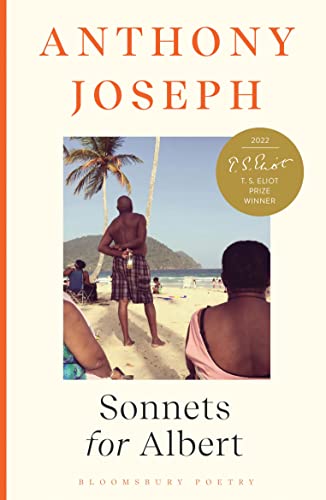
Anthony Joseph, Sonnets for Albert (Bloomsbury Poetry 2022)

I bought a copy of Sonnets for Albert after hearing Anthony Joseph’s brilliant chat with Felicity Plunkett at the Sydney Writers’ Festival earlier this year. The Albert of the title is the poet’s father who was mostly an absence during his childhood in Trinidad, where he was raised by Albert’s mother, who loved both of them. My blog post (here) on the Festival conversation gives some of the detail – and also some of Joseph’s interesting observations about the sonnet form and the relationship of Caribbean writers to the English language.

Almost every poem in the book is a sonnet. They don’t constitute a biography in verse, but skip about chronologically, from a childhood memory, to Albert’s final illness and death, to his period in New York City as a reverend. Some have a rich Caribbean music to them. Others are in effect prose poems, though they preserve the sonnet’s 14 lines with a turn in the middle.

It’s a terrific book. Albert emerges as a fascinating, charming rogue. The poet’s complex feelings for him, including deep affection, and grief at his death, are alive and contagious on the page.

Anthony Joseph lives in the UK, and the book is shot through with the expat’s love of his homeland. When I heard that he was from Trinidad, I mentally adjusted that to the nation’s name, Trinidad and Tobago. But the poems themselves are clear: he comes from Trinidad; Tobago is a different island and to have one’s father live there is to have an absent father.

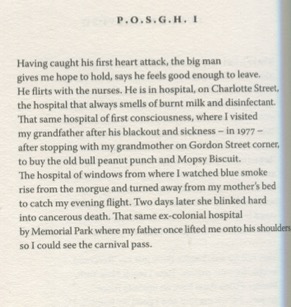
Page 76 is ‘P.O.S.G.H. I’, the first of two poems whose titles are the initials of the Port of Spain General Hospital (so it’s not just Sydney people who refer to hospitals by their initials – I live in walking distance of R.P.A.H.):

Shakespeare or Petrarch might not have recognised this as a sonnet. There’s no rhyme scheme, no formal metre, not even an obvious division into eight- and six-line sections. But it has its own music, which becomes clear if you read it aloud: in the first couple of lines, for instance, the echoing sounds in ‘hope to hold’ and ‘flirts with the nurses’ demand to be read slowly and liltingly. And the effect of the long lines becomes clearer when you read this poem alongside ‘P. O. S. G. H. II’ on the facing page. I won’t push the publisher’s tolerance by quoting that poem as well, but it deals with a later, more ominous hospital experience with Albert (called ‘the big man’ in both poems) and is made up of short lines, with dialogue, and a suggestion of Creole – ‘He eat up all the joy’.

There’s a leisurely, reflective feel to this poem, and emotive suggestions emanate from its long lines like smoke. A whole web of family relationships is evoked.

It begins with Albert:

Having caught his first heart attack, the big man 
gives me hope to hold, says he feels good enough to leave.
He flirts with the nurses. He is in hospital, on Charlotte Street,

A lot is conveyed and suggested in that first line. That it was his first heart attack means that others were to follow, and though heart attacks aren’t contagious, the word ‘caught’ suggests that this one made ‘the big man’ vulnerable to more. As the sentence continues over the line break, the second line pulls back from these grim implications: there’s hope.

When my own father – a very different man from Albert – was close to death, a nurse came each day to wash him and make him comfortable. He too flirted – he joked about the lengths he’d had to go to to have a beautiful woman scrub his back: it’s a thing between men of a certain age and generation and women who care for them. It may not mean the man has recovered, but it’s a sign that he’s in good spirits. In the context of the rest of the book, we know that for Albert (unlike my father) it’s also a sign that he’s back to his disreputable normal, and there’s a hint that the poet’s relief is mixed with exasperation at the flirtiness. Attention turns away from Albert, to the hospital and the memories it evokes:

the hospital that always smells of burnt milk and disinfectant.
That same hospital of first consciousness, where I visited 
my grandfather after his blackout and sickness - in 1977 - 
after stopping with my grandmother on Gordon Street corner, 
to buy the old bull peanut punch and Mopsy Biscuit.

That ‘always’ tells us a lot. This is a familiar place, as the rest of the poem spells out. ‘First consciousness’ could mean many things – perhaps even birth – but it certainly implies that the hospital has always been part of the poet’s world. In a beautifully compressed way, this line and what follows evoke key points of his family story. ‘My grandfather’ appearing after a line break enacts a kind of swerve away from the present to a moment in the past, to another sick man. It’s implied that his grandfather’s illness had some of the same unstated emotional impact as his father’s current illness, an implication reinforced by the way ‘the old bull’ echoes ‘the big man’.

My web search didn’t tell me anything about Mopsy Biscuit, and peanut punch may be either a popular Guinness-based drink for adults with rumoured aphrodisiac qualities (hmm, ‘the old bull’?), or a children’s drink, depending on where you look. Either way, the memory is essentially benign – the poet was 11 in 1977 and buying treats is what stands out in his memory of that event.

Right on cue at the end of line eight, the sonnet turns. The hospital is not always a place of healing or relatively carefree visits:

The hospital of windows from where I watched blue smoke 
rise from the morgue and turned away from my mother's bed 
to catch my evening flight. Two days later she blinked hard 
into cancerous death.

I try not to use words like enjambment and caesura, but wow, cop the enjambments and caesuras in these lines! That is to say, notice how the sense flows over the line breaks, and breaks sharply in the middle of lines, and how the echoing hard D sounds at the end of the second and third lines intensify those effects.

Another, heavier memory is stirred. The poet is older, visiting from elsewhere (Anthony Joseph moved to the UK in his early 20s). His mother is barely a presence, and when he turns away from her it’s with a bleak premonition of death in the blue smoke. There’s no hope to hold this time, and though both the flight and the death occur midline, they both have a feel of finality.

But the poem continues:

into cancerous death. That same ex-colonial hospital 
by Memorial Park where my father once lifted me onto his shoulders, 
so I could see the carnival pass.

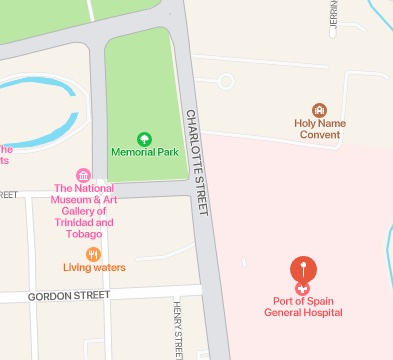
I love the way this poem is so firmly rooted in a place. The word ‘hospital’ rings like a chime – five times in 14 lines. The hospital is precisely situated, on Charlotte Street, opposite the corner of Gordon Street, by Memorial Park, and its architecture and history are evoked in the one word ‘ex-colonial’.

The poem ends with another turn, a kind of equivalent to the couplet that ends a classic sonnet. It’s as if after going on a short tour of the family – grandfather, grandmother, mother – we come back to Albert and can remember him, without the distancing irony of ‘the big man’, as ‘my father’. Loss is prefigured by the first heart attack, but there’s also a loss that happened long ago: the ‘once’ when his father lifted the poet on his shoulders is gone. It’s no coincidence that Memorial Park is mentioned here: this last moment of the poem has an elegiac feel to it. He was alive. He was my father. He lifted me on his shoulders. The carnival is over.

The Confessions of Saint Augustine, first report

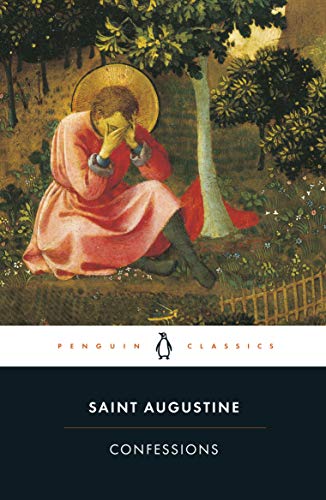
Saint Augustine, Confessions (approx 400 CE, translated by R S Pine-Coffin 1961, Penguin Classics edition): pages 1–110, from beginning to end of Book V

If St Augustine invented the literary form of autobiography, he did it by accident. The impression I have so far is that in Confessions he is telling the story of his life as a teaching device. The message seems to be that humans depend on the mercy of God for everything, from mother’s milk to the ability to read. Secondary to that, humans are born sinful. So far at least, quite a lot of his ink is spilled in arguing with the Manichees, and a lot of that argument is pretty opaque to the casual reader, by which I mean me.

Still, it’s quite a thing to spend 10 minutes or so each morning in contact with a mind that was alive nearly two millennia ago. Two moments grabbed me in the very early chapters.

In writing about his early schooling, even while saying he was a wicked child (for wanting to play rather than study!), he argues against against harsh physical punishment as a teaching tool. After saying he hates Greek but likes Latin, he explains that he learned Latin from his mother and nurses, and Greek from his stern school teachers. He generalises:

This clearly shows that we learn better in a free spirit of curiosity than under fear and compulsion.
hinc satis elucet maiorem habere vim ad discenda ista liberam curiositatem quam meticulosam necessitatem.

(1:14)

A little further on, after arguing that the innocence of childhood is a myth, he comes face to face with Jesus’ apparently contradictory view in Matthew’s Gospel, and offers this bit of ingenious argumentation:

It was, then, simply because they are small that you used children to symbolise humility when, as our King, you commended it by saying that the kingdom of heaven belongs to such as these.
humilitatis ergo signum in statura pueritiae, rex noster, probasti, cum aisti: talium est regnum caelorum

(1:19)

If I’m just going to quote the bits that stood out for me from amid the theologising, I can’t go past this wonderful paragraph about friendship:

We could talk and laugh together and exchange small acts of kindness. We could join in the pleasure that books can give. We could be grave or gay together. If we sometimes disagreed, it was without spite, as a man night differ with himself, and the rare occasions of dispute were the very spice to season our usual accord. Each of us had something to learn from the others and something to teach in return. If any were away, we missed them with regret and gladly welcomed them when they came home. Such things as these are heartfelt tokens of affection between friends. They are signs to be read on the face and in the eyes, spoken by the tongue and displayed in countless acts of kindness. They can kindle a blaze to melt our hearts and weld them into one.

(3:2)

I had expected confessions to loose living. So far, the main wickedness he confesses to is his adherence to the Manichean heresy. He does mentions a de facto wife, but when he goes from Carthage to Rome, he doesn’t tell us if she comes with him.

This morning, his career as a teacher of literature has led him to Milan, where he is deeply impressed by the lectures of (Saint) Ambrose. He finally makes a break from the Manichees. He’s impressed by ‘the academics’, but doesn’t throw in his lot with them. Nor does he embrace the Catholic Church (which is R S Pine-Coffin’s translation of catholica ecclesia, and fair enough, though the capital letters may be a bit misleading), but he becomes a catechumen, which I understand to mean he sees himself as under instruction.

To be continued.