Category Archives: Books

Looking Gift Horses in the Mouth

Morgan Parker, Other People’s Comfort Keeps Me Up at Night (Switchback Books 2015)
Mindy Nettifee, Sleepyhead Assassins (Moon Tide Press 2006)
Mindy Nettifee, Rise of the Trust Fall (Write Bloody Publishing 2010)

These three books don’t have a lot in common besides being written by young US women and having been given to me as gifts. They do have a lot going for them, but I’m not their ideal reviewer: my experience of reading each of them wasn’t a million miles away from how I felt recently when I was almost completely unamused by a French rom com in a theatre full of laughing people. Horses for courses.

The equivalents of the laughing cinema-goers were the books’ extravagant blurb-writers.

0986187615.jpg

Other People’s Comfort Keeps Me Up at Night was a gift from a Book Group member who had just spent a couple of weeks in Brooklyn. On its back cover Eileen Myles (on whom the formidable poet character in Transparent is based) says of Morgan Parker’s poems, in part:

They make me high and think like this: Her mind and her thoughts can go anywhere in a poem. She pulls us up short, and when she says ‘the sky the sky’ I feel that expanse … I start taking notes: She is making a map of what human can be … she’s raucous and engaged … indeterminate, visceral … collisions … these are full adventures in scale. There are piles of masterpieces here.

Um, you might be less enthusiastic than Eileen Myles if you’ve never watched an episode of Real Housewives of Anywhere or followed a Miss Black America competition with or without hipster irony, and aren’t titillated by titles like ‘How to Piss in Public and Maintain Femininity’ or ‘On Children, How I Hate Them and Want to Corrupt Them, How You Know I Hate Them, and What That Could Mean’. But the book is alive and vigorous and smart, with plenty of sharp observations about sexism and racism (Morgan Parker is African American). It’s coolly literate, with reference points including Gwendolyn Brooks, Bill Murray, Roy Lichtenstein, Jay Z, and Jean-Michel Basquiat. My impression is that the poems are meant for performance rather than for the page.

I went searching for some lines to give you a taste, and wanted do do it with no expletives or references to drugs or alcohol. Not that there’s anything wrong with that, but it was interesting to notice how hard it was, and then I gave up. The shortest poem in the book, with its echo of Nina Simone, hints at an urge to break out of the dominant mode:

Young, Sassy and Black
I use these words
to distract you.

1424316928.jpg

The two Mindy Nettifee books were given to me by a niece who loved them (though evidently not enough to keep them). Sleepyhead Assassins features some of the most extreme blurbs you’re likely ever to encounter, presumably written by Nettifee’s friends before Donald Trump gave hyperbole a really bad name. Amélie Frank, for example, writes:

She’s poetry’s fierce guardian angel and every poseur’s worst nightmare. She’s goddess energy built for speed. […] Reading her work will give your soul a jump start that will smart for weeks. Prepare to have your molecules rearranged.

I don’t suppose any book could deliver on that promise, so it’s no disgrace that this one doesn’t. These poems are definitely meant for the stage rather than the page: they bristle with bravado and bravura, with striking similes and clever turns of phrase, evoking a clicking audience rather than a solitary reflective reader. The poems that most appeal to me are a little more reflective, especially the ones about Nettifee’s father, who we learn had a tragic life. In ‘The Time Machine Paradox’ she imagines travelling back in time to visit his mother:

i want to give her black stockings and rust red lipstick.
i want to loose her curls and numb her better judgment.
i want to say, Audrey, and show her how it could sound.

maybe, if she could have lived her life, just for a night,
i wouldn’t be here. my father wouldn’t suffer.
none of us would feel this way. instead i would be

just a possibility, a ghost, gathered with other ghosts
at the Armageddon lemonade stand.
i’d be the one that remembered the sugar.

That doesn’t rearranges my molecules, but it does linger after I turn the page.

0984251596.jpg

Rise of the Trust Fall comes with more sober but no less Trumpian recommendations. The LA litzine Poetic Diversity says simply:

Mindy Nettifee is destined to be the next Dorothy Parker.

Of course it’s no shame not to be Dorothy Parker. Hardly anybody ever has been. Mindy Nettifee isn’t, and I don’t think she aspires to be: too loquacious, too earnest beneath the veneer of cool, and no rhymes; nothing anything like Parker’s sublime ‘Resumé’ (do look it up).

The poetry in this book is boldly self-revealing: alcohol, recreational and prescription drugs, plenty of sex, nightmares, pop music, childhood memories, heartbreak, bodily functions, all are there along with an occasional touch of epigram (‘Every woman’s closet is a museum of her insecurities’). It’s unfailingly sharp and inventive, sometimes shocking: sure to be a hit at a Spoken Word event. For me though, reading it was more like reading a screenplay than seeing a movie.

There are moments where the words connect. For example, in ‘The Connection between God and Nature Beats Me over the Head with its Earthy Mallet’ (what is it with these long titles?) the city-dweller misses the stars. She chooses the city:

It’s a choice that makes itself for me
every time I am rescued by the warm clotted glow of art galleries;
by the imitation of Django Reinhardt that is really not that bad,
strumming rakishly out of the mood lit punk bar;
by the David Bowie juke-boxing the punchy patrons
at the cheaper bar down the street.

In the absence of starlight
you start looking for the shine in everything.

I can easily imagine Morgan Parker and Mindy Nettifee being sensational presence at Spoken Word events, each in her own way. On the page they’re both a bit too shouty and/or sweary for me. 
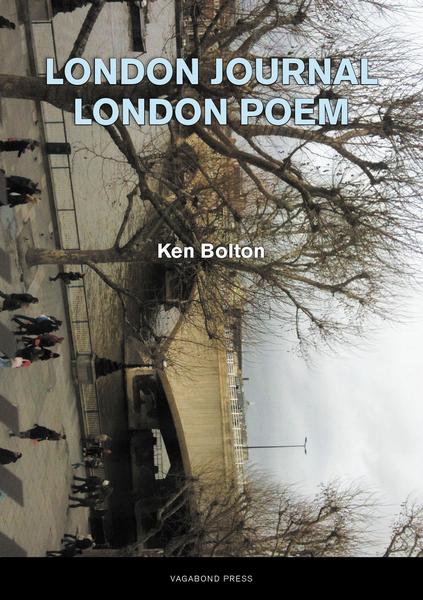
Ken Bolton’s London Journal London Poem

Ken Bolton, London Journal: London Poem (Vagabond  Press 2015)

ljlp.jpg

There are just two poems in this book. In the first, ‘London Postcard – A Quiet Morning at the Wapping Project’, which is 24 lines long, the speaker describes the image of a woman on a postcard advertising what may be a film, and ruminates:

'The fictive life of the tourist'? Or would
I feel this way about this image
anywhere?

The italics seem to signify that the phrase is a quote, but quote or not, it’s a nice way of naming a habit of mind common among tourists – a tendency to make up stories about things you see while passing through, or to see patterns in them. A couple of lines later the speaker rephrases that idea:

I attend to her in the idle moment.

The second poem, ‘London Journal’, begins with a reference to the first poem:

I have an intuition, that maybe that
particular poem – very short –
could serve to hang this – or anyway ‘a’ –
longer poem from. And this is by way
of being that long poem.

I’ll rush in where a proper critic might fear to tread, and say that this longer poem (more than 200 five-line stanzas) enacts touristic fictivity (if that’s a word): it attends to many details in a time that, however busy, could be described as an extended idle moment, a time spent being a tourist.

The speaker and his partner Cath are visiting her son Gabe and Gabe’s partner Stacey in London, with excursions to Berlin and Barcelona. Tourist destinations  – the Brandenburg Gate, for example, or the Miro Museum – are mentioned, but so are tiny particularities of the travelling life: an odd show on television (Pointless as it happens); the book you’re reading; a quest for a strange place someone has told you about, and the anticlimax when you finally find it (a ‘fanatics’ ping-pong club’ in East Berlin); street signs and advertisements that are unsettlingly unfamiliar; evidence of poverty and the problematic status of immigrants; restaurants and bars; encounters with locals; information about the work life of one’s host (in this case, Gabe); lots of people-watching; pieces of a giant puzzle that are fun to play with but are unlikely ever to form a unified image. There are poetry readings, and an occasional moment when Bolton’s colonial status is made clear to him – maybe. The travellers go to museums and art galleries. It doesn’t take a lot of websearching to find out that Bolton is an art historian, but one doesn’t feel obliged to understand all his ruminations on the art he sees – enough for me at least to enjoy the way his experience as tourist connects with his abiding interests.

There’s a scattering of photographs, some of them blurry, as if to emphasise that this is a journal. And a scattering  of lines refer to the process of writing the poem, wondering if it will come together – yes, it’s also a poem.

Scanning for something to quote to give you a taste, I keep coming back to this at Canary Wharf:

of power and judgement. Shopping, food, all take place
underground: no one seen outside. At lunchtime
vast crowds are disgorged below, moving at speed

to their destinations – all very much suited (men and women),
largely under 35, dressed in black for the most part: very
Brave New World, and much whiter than the general population
(only 45% of London identify as white anglosaxon).
We go with Gabe to a Jamie's Italian. Good food.

Very noisy. In the toilets I come across a middle-aged,
middle-management type, seemingly doing an Al Jolson
'Mammy' impersonation, to the hand-dryer – down on one knee,
both hands smacking his chest, then flung out – Drying
his shirt front, he tells me. I think for a moment

of joining him – 'Mammy, how I loves ya, how I loves ya!'
etcetera. I nod encouragement.

In an excellent review in Cordite Poetry Review, Cameron Lowe suggests that ‘London Journal’ is a parody of a travel poem. He may be right, but ‘parody’ suggests a kind of formal imitation and/or mockery. There’s plenty of self consciousness about form and plenty of humour – like the photograph described as ‘Stacey with the author’, which appears to include only a solitary young woman, until you see half an arm almost lost in the page’s gutter. But I had no sense of a ‘proper’ travel poem that this was referring to. It’s just good fun, and interesting, in its own right.

In his elegant speech at the launch of Puncher & Wattman’s Contemporary Australian Poetry, David Malouf observed that while the poetry scene in Australia is extraordinarily vibrant in terms of the amount and quality of poetry being published, at the same time what he calls common readers have been turning away from poetry as if it is a foreign land, possibly because poetry has been turning away from them.

I think of myself as a common reader. And I want to say to other common readers: you can pick up this book without fear of being snubbed or made to feel somehow lacking. Cameron Lowe put it very well:

The poems here – as in Bolton’s other work – appear to imply that the process of writing poetry is an everyday activity (even while on holiday).

Hannah Kent’s Burial Rites at the Book Group & November Verse 14

Hannah Kent, Burial Rites (Picador 2013)

burial-rites.jpg

Before the meeting: This book is based on the real story of the last woman to be executed in Iceland, an event that happened in 1830. My knowledge of Iceland, which comes mainly from photographs of stark, beautiful, treeless landscapes and Grímur Hákonarson’s movie Rams, led me to expect that any novel set there would be grim. So a novel culminating an execution could only be more so.

Grim or not, I loved it. I’ve raved about it to people met in the park, and barely restrained myself from reading bits aloud to the Emerging Artist (now known as the Heart Lady, but that’s another story).

At the beginning Agnes, convicted of brutally murdering her employer, is being transferred from one place of imprisonment to another. She is filthy, malodorous and barely able to speak. (Interestingly, her condition at the beginning of the novel bears a striking resemblance to that of the women towards the end of Charlottte Wood’s The Natural Way of Things, which I imagine was being written at the same time as this.) While awaiting execution, she is sent as a cost-saving measure to live with the family of a local official who lives near the planned place of execution.

The main narrative follows Agnes’ developing relationships with members of the host family: father, mother and two young adult daughters. At first the family are convincingly and reasonably horrified that they will have to share their house with this monster, though right from their first encounter the mother of the household is even more horrified at the way Agnes has been treated. A young trainee clergyman is assigned to attend to Agnes’ spiritual needs. Against the advice and instructions of his superiors, he refrains from preaching sternly at her and instead encourages her to talk to him. Because of the size of their dwelling and the bitter Icelandic winter, the family hear much of what passes between them, and we learn her story along with them. As you’d expect from the set-up, in the process they come to see her not as a monster but as a fellow human – more a servant than a prisoner.

All of that is beautifully done, though the story Agnes tells, a story of love betrayed, is less compelling than the circumstances of its telling. And then there is the narration told direct to the reader from Agnes’ point of view. This is where we learn Agnes’ inner story – the erotic experiences that she can’t speak of, and her emotional life. In these sections Hannah Kent’s writing, never less than elegant elsewhere, is rich and poetic without being hi-falultin, so that I for one was completely drawn in. I don’t remember ever being so caught up by a deft use of similes. Here’s a passage from fairly early on, when Agnes has begun to work again,  trusted to use a scythe:

I let my body fall into a rhythm. I sway back and forth and let gravity bring the scythe down and through the grass, until I rock steadily. Until I feel that I am not moving myself, and that the sun is driving me. Until I am a puppet of the wind, and of the scythe, and of the long, slow strokes that propel my body forward. Until I couldn’t stop if I wanted to.

It’s a good feeling, not quite being in control. Of being gently swung back and forth, until I forget what it is to be still. Like being with Natan in the first months when my heartbeat shuddered through me and I could have died, I was so happy to be desired.

The book’s power has something to do with the strong sense of a particular time and place. The world-building, to borrow a term from SF/F discourse, is extraordinarily convincing. In her acknowledgements, Hannah Kent says she set out to write a ‘dark love letter to Iceland’. She has succeeded in spades.

The meeting: As it was the last meeting of the year, we ate at the new (to most of us) Tramsheds in Glebe, and gave each other gift-wrapped books from our shelves. As always in restaurants, the background noise was a dampener in general conversation. But we all enjoyed the book. Someone compared it unfavourably to Halldór Laxness’s Independent People, saying that at times Burial Rites broke free of its early 19th Century Icelandic setting and resorted to tropes from 20th century romance fiction. Specifically, if I understood him correctly, Agnes’s internalised sense of the master–servant relationship vanished too easily and was replaced by an anachronistic expectation of romantic love and fidelity. In general we could see what he meant. Likewise, we all agreed when someone said that it was obvious what was going to happen from the very beginning: the family would soften towards Agnes, and her story as it emerged would reveal either innocence or major extenuating circumstances. Neither of these criticisms dampened the general enthusiasm for the book.

There were some mostly audible, goosebump-inducing readings of passages our Post-it warrior had marked.

Then we cheerfully turned away from the spartan, claustrophobic and bitterly cold world of the novel and enjoyed a meat-heavy meal in a flash new restaurant whose menu names the farms that provide the animals they serve up to their customers.

The verse, my last for this November: 

November Verse 14: The Book Group Chooses What to Read Next
 Ben stands and says he must be going:
 'Shall we decide the next book now?'
 'No time for all the to and fro-ing
 before you leave,' says Ian. That's how
 just seven of us made the vital
 choice of our next Book Group title.
 Not Watson's Bush, that's far too long,
 not more Houellebecq, that's just wrong.
 No to Solnits, Coetzee, Gorton.
 Steve says, 'How about Don Juan?
 I mean Quixote. That's a yarn
 I'd like to read.' That one caught on.
 And after complex back and forth
 we lit on Shakespeare's Henry Fourth.
AWW2016

Burial Rites is the fourteenth book I’ve read for the 2016 Australian Women Writers Challenge.

Vaughan & Guerra’s Y: The Last Man Books 3–5 and my November Verse 13

Brian K Vaughan & Pia Guerra, Y: The Last Man Book 3 (2004, 2005, this edition 2010)
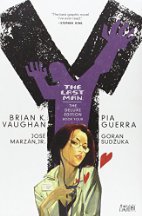
—, Y: The Last Man Book 4 (2005, 2006, this edition 2010)
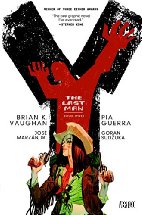
—, Y: The Last Man Book 5 (2006–2008, this edition 2011)

Previously in Y: Yorick, a 23 year old New Yorker escape artist, and Ampersand, a trainee-companion monkey, are the only two male mammals on earth to have survived a mysterious plague. They have teamed up with the woman known only as 355, who is a member of the Culper Ring, a mysterious organisation, and Dr Alison Mann, who has ben experimenting with clone technology and so has a good chance of ensuring a future for humankind. Dr Mann’s New York lab is blown up by Israeli operatives, and the three of them travel across the US to her West Coast lab where her back-up data is safe, encountering an assortment of female post-apocalyptic enemies and allies: the Israelis, a Russian operative, survivalists, escaped convicts making a new life, an astronaut, paranoid cowgirls. Yorick’s sister, Hero, has meanwhile joined a group of neo-Amazons who are fanatically and violently determined to erase all vestiges of the patriarchy. And Yorick has a personal mission, to meet up with his girlfriend Beth, who was in Australian when the plague hit and has since been out of contact.

1401258808.jpg

The adventure continues in Book 3 with plenty of violence, and a modicum of sex. It turns out that the Australian navy had women active in submarines where the US did not. As a result a fully armed and dangerous Collins Class sub intercepts the ship taking our little band across the Pacific. Australia also comes to the fore as we get some of Beth’s story. There’s some deeply worrisome representations of Warlpiri culture (though you have to give Brian Vaughan credit for actually naming a people rather than giving us generic mystical ‘Aborigines’ like the ones in Werner Herzog’s Green Ant Dreaming).

Goran Sudžuka joins Pia Guerra in the pencilling, and to my untrained eye the seams are invisible.

y4

In Book 4, Yorick, Dr Mann and agent 335 reach Australia, which isn’t a happy place, though there’s plenty of amusing US attempts at Australian slang, and some cheerful sex and one bit of comic full frontal male nudity (poor Yorick is drawn looking all heroic on the covers, but doesn’t fare so well in the actual stories).

We also get the back stories of a number of characters, and lectures on the status of women that in any other context might be tediously didactic, but here have a certain charm. For example, there’s a key plot point when two capuchin monkeys escape from their cages in an airport. This is how we see it:

equal pay.jpg

And the reader responds by secretly cheering for the ‘gendercide’ that is to come. Similar moments, such as a short debate about whether the mistreatment of women in the Catholic Church was perpetrated solely by men, or whether women might have been pretty bad as well, turn out to be important to the plot.

y5

Then in Book 5 it all comes together – or apart, depending on your point of view. Yorick finds Beth and their reunion turns out pretty much as the discerning reader might have expected. There’s another romance that also turns out pretty much as expected, though in a way that surprised and, yes, shocked me. In fact, the working out of all the plot strands is almost at the level of Shakespearean comedy. Of the many hypotheses that have been floated about the cause of the catastrophe, the one that is finally given may not be realistic but it fits the world of the story better than any other: at least grounds have been laid for it.

It all ends happily for the human race, though almost literally up in the air for Yorick himself.

One more note: It seems that if it is to succeed commercially, a comic series is required to have a certain amount of sex and violence. Y does that. It also manages to be witty, literate and occasionally instructive. Yorick and his sister Hero were named after Shakespearean characters by their nerdy parents. When it seems one woman is going to have to spend time in hospital, Yorick draws up a reading list for her – Margaret Atwood’s The Handmaid’s Tale is at the top of the list. It’s similarly refreshing that one of the characters becomes President in the final pages but not, it turns out, of the USA: in this US comic, other countries exist.

And let me burst into verse, for the second last time this November. Extra points for readers who spot the Bill Haley reference.

November Verse 13: On Reading Y: The Last Man
Alas poor Yorick, last man standing!
Two male mammals left alive
on earth, just him and Ampersand, an
ape, his kind-of pet. These five
thick comic books by Vaughan and Guerra,
amuse and tease, prompt pity, terror.
A single man left on the ground,
three billion women all around.
But here’s no superhero fiction,
no Bacchanal or things more blue,
no Warhol shooter’s dream come true,
no earnest SF clone prediction,
just good fun: the men are dead,
that’s sad, but what a watershed!

Antigone Kefala’s Fragments, and my Verse 11

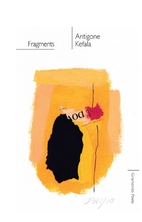
Antigone Kefala, Fragments (Giramondo 2016)

frag.jpg

The final issue of Ivor Indyk’s literary journal Heat, published an astonishing 6 years ago, included an interview of Antigone Kefala by Amanda Simons. The conversation ranges widely, from Kefala’s ‘scribbling’ in her childhood home in Romania before World War 2, over the role her mother played in her creative life, to the critical isolation that comes from being classified as an ‘ethnic’ writer. She says this about poetry:

It is a medium that has its own directions. It comes when it wants to come, doesn’t come when it doesn’t want to come. You can never force it, you have to wait for it.

Fragments is a collection of 61 poems that feel absolutely unforced in that way, almost as if each poem catches an unbidden thought, or dream, or observation, or burst of emotion, and finds a precise form of words for it. If they are fragments of some greater unity, the book is not concerned to find that unity, or to explain contexts, but invites us to focus on each fragment in its own right. Take the first poem:

The Voice
At the sound
I turned
my veins full of ice
that travelled
at high speed
releasing fire.

This return
the past attacking
unexpectedly
in the familiar streets.

The speaker hears a voice from her past. Perhaps it’s associated with a terrible memory, or it might remind her of the voice of a loved one who has died. The poem isn’t interested in the specifics, nor in what happened next. Did the speaker approach the owner of the voice, did she go about her day as if nothing had happened or was she shaken to the core? The poem doesn’t go anywhere near these questions. It focuses tightly on the moment of hearing, and renders it with wonderful precision and complexity: there are the explicit images of ice and fire, and possibly an implied reference to the kinds of warfare that turns city streets into war zones. It’s not ‘difficult’ poetry, but it rewards you for time spent in its company.

The poems, only a handful of them much longer than the first, are divided into five sections. Here’s my guess at their organising principles:

  1. a thematic introduction: poems of memory and loss, dream renderings, observations of social life, dark love poems
  2. evocations of places, mainly Australian, including a scene from the movie Wake in Fright
  3. poems of grief, loss and impending loss
  4. dreams and visions, surrealism and metaphysics
  5. social poems – quick character sketches, satirical jabs, laments, a little politics.

In the Heat interview, Antigone Kefala observes that ‘we ethnics are constantly being compared to other ethnics, but not to Australian writers’, and asks if her interviewer has ever seen a comparison between her work and that of Les Murray. Well, perhaps with that quote working at the back of my mind, I found myself making just such a comparison. Here’s her poem ‘Weapons’ – I hope it’s OK to quote it in full:

Weapons
Ruins
corpses in the sun
men moving cautiously
in the abandoned streets
close to the scarred walls.
Men on top of houses, hills,
coming from dark undergrounds,
men holding on, hugging
these metal erections
firing them
a spray of semen
rushing with velocity
to breed another race of killers.

The evocation of the battle-zone is followed by what at first looks like crude, even trite feminist anti-war rhetoric – the gun as phallic symbol – which becomes almost shockingly explicit with the ‘spray of semen’, and then is brought home in the powerful last line: this isn’t just emotive rhetoric, there’s a strong idea here.

The poem reminded me of Les Murray’s ‘I wrote a Little Haiku‘, which similarly compares bullets to semen. In Murray’s poem, the molten bullets drip from a burning farm rail, and he sees the drip as ‘the size of wasted semen / it had annulled before’. It’s the visual image that counts: one’s response is to admire the poet’s mental agility in seeing such a comparison: the notion that the bullets had ‘annulled’ real semen when they were fired in the past – that is, they had killed young men and so prevented them from fathering children – is almost a melancholy afterthought. In Kefala, the visual image matters, but the force of the poem is in its idea. We’re not invited to admire her cleverness, so much as to dwell on what she has unearthed.

Oddly, the comparisons that came to mind most strongly as I read this book are with Bob Dylan and Leonard Cohen, both of whom have grappled with ageing in their recent work – Dylan’s ‘Mississippi’ for example, or Cohen’s heartbreaking ‘I’m Leaving the Table’. Kefala too brings a ruthless eye to the experience of ageing, and at the same time, like those two writers (in other ways very different from her), conveys a deep joy in living and creating. I love the bitter-sweet final lines of the book’s last poem, ‘Metro Cellist’:

we were floating on sound.
The earth was singing,
singing in an exuberance
of youth.

AWW2016Fragments is the thirteenth book I’ve read as part of the 2016 Australian Women Writers Challenge. I am grateful to Giramondo for my free copy.
—–
As my regular readers will know, I have a self-imposed task of writing fourteen 14-line verses each November and putting them up on my blog. I was going to let this post go by to avoid putting any of my verse on the same page as Antigone Kefala’s infinitely superior work, but then I read her saying in the Heat interview that she could not write a sonnet: ‘You know how writers do exercises in terms of poetic forms; I have never been able to do that.’ Perhaps one day I’ll outgrow my attachment to the form of the Onegin stanza, but for now, here’s one more, an attempt to explain the joys of this attachment:

November Verse 11: 
A turn of phrase, a half idea:
that’s enough for my first lines.
The path ahead is far from clear
but through mind’s muddle somehow shines
an argument. Then, as I’m seeking
rhymes and scans, the sense starts leaking
into somewhere unforeseen
and who knows what line eight will mean?
Six lines to go, and now I’m counting.
So much that I wish I’d said,
not on the page, still in my head!
Its all a mess. The panic’s mounting.
With luck I end my little song
as if I meant it all along.

Southerly 76/1 & November Verse 7

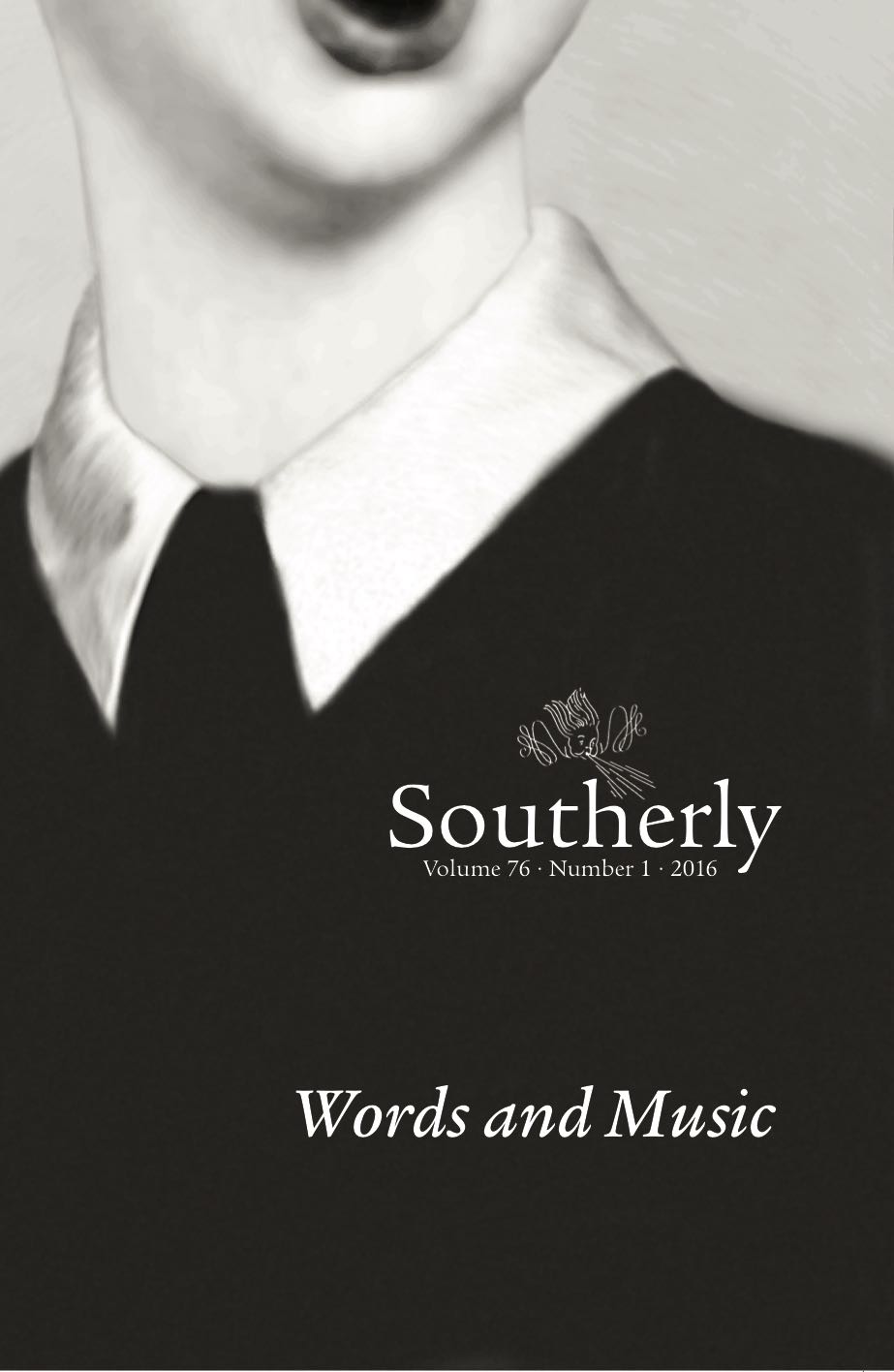
Elizabeth McMahon, (nominally) David Brooks and (actually) Hannah Fink (editors), Southerly Vol 76 No 1 2016: Words and Music

s761.jpgSoutherly is the journal of the English Association, Sydney. It generally includes a number of articles of interest to the semi-mythical ‘general reader’ as well as refereed papers meant mainly for academics. This music-themed issue is happily skewed toward those of us who identify with the semi-mythical.

The guest editor, arts writer Hannah Fink, has prevailed on a number of music professionals to write about their art and craft, and their relaxed and illuminating essays form the heart of the journal. Lyricist Hilary Bell’s ‘My Life in Lyrics’ starts out as a charming showbiz memoir and develops into a lucid communications of lessons she has learned about writing lyrics for musical theatre, winning points from me by referring to Stephen Sondheim’s magisterial Finishing the HatComposer Phillip Johnston’s ‘Wordless! Music for Comics and Graphic Novels Turns Time Into Space (and back again)’ may go into too much detail about the creation of a collaborative work with comix artist Art Spiegelman but I for one certainly hope to see the work some day. Jazz player and radio program host Dick Hughes, in ‘Jazz at the Pearly Gates’, imagines a number of brilliant jazz performances that might have happened, and allows us painless enjoyment of his great erudition.

Among the other non-fiction, there’s much to enjoy. David Brooks in ‘Herd Music’ speculates that music may have its deep origins in sounds like those a flock of grazing sheep might make. Joseph Toltz gives us a glimpse of compassionate research with Jewsih Holocaust survivors, in a number of anecdotes about the first music a number of people remember hearing after liberation.

There are short stories. Gareth Hipwell’s ‘Whatever Was Eating Whatever It Is That’s Eating The Trees’ is a brief celebration of a the way a man of an older generation has with the language. Colin Varney, whom I think of as a writer for children, definitely has mature readers in mind in ‘Zigazig-uh’, in which the narrator is a love song keeping a slightly snarky eye on the effect it has on a select group of humans.

And there’s poetry by Jill Jones (‘The Glass’), Matthew Wallman (two poems from ‘Inland Sea Poems’, a sequence about explorer Charles Sturt), Partrick Jones (‘Buladelah-Boomerang Point holiday song cycle’, whose odd typography has the welcome effect of slows one’s reading right down), Luke Fischer (the ekphrastic ‘Madonna of the Goldfinch’), and a wealth of others.

I usually skip reviews of books I haven’t read, but those of Toby Fitch’s The Blooming Notions of Other & Beau and Chris Edwards’s’s Sonata , books of deliberate mistranslation from French and German respectively, inspired me for today’s November verse: a ‘translation’ of a stanza chosen at random from Pushkin’s Eugene Onegin, which is in Russian, which I can’t read even though I’ve happily been attempting to write Onegin stanzas for years now. It turns out to be harder and more fun than I expected. Here is what I’ve managed, a nonsensical shadow of the achievement of those books and others like them:

November Verse 7: Worse than Google Translate
Go near me, freshen my loo, charm me.
Soak crusty gore, use a cigar.
Speak sharply, mutiny, rush army.
Nah! Ptoo! Play on your guitar.
You Lib boy – yes, no! – you prop-odour,
Squeeze on, stretch it, you true goader.
See nigh a blush – cute? Nay, bizarre.
Eschew the prozac. No lay star
Brought cake to puke-home-selling – eye it!
Chill as I darn your pulley, boy;
let it upskill your foxy toy.
Do line your socket, pests will try it.
Tada! Shoe, mat and solo way
You spell. Be small VE, not Che.

For anyone interested and/or capable of reading Russian, here’s the original, Book 7, Stanza 1 (and you can click here for more):

Гоними вешними лучами,
С окрестных гор уже снега
Сбежали мутными русьями
На потоплённые луга.
Улыбкой ясною природа
Сквозь сон встречает утро года;
Синея блещут небеса.
Ещё прозрачные, леса
Как будто пухом зеленеют.
Пчела за данью полевой
Летит из кельи восковой.
Долины сохнут и пестреют;
Стада шумят, и соловей
Уж пел в безмолвии ночей.

Saga 6 & November Verse 6

Fiona Staples (artist) and Brian K Vaughan (writer), Saga Volume Six (Image Comics 2016)

163215711X.jpgThe continuing adventures of bi-speci-al Hazel and her family.
Hazel is now in kindergarten in prison, with her wings bound so she can pass as a purebred member of her father’s horned species. Her parents are reunited and searching for her. Her grandmother is taking to prison life with gusto, getting tattooed and making friends. The cute but lethal Ghüs and Friendo are protecting the exiled former Prince and his little son. The Will is hallucinating and out to avenge his arachnid lover’s death.

There are a pair of web-footed closet gay journalists, Petrichor the glamorous horned trans woman prisoner, and innumerable extras.

Vaughan and Staples spin a great yarn, and the series benefits from being the work of a single artist. We don’t have to constantly adjust to different renditions of the characters, and can enjoy small felicities such as the sense that furry little Ghüs has wandered in out of a different comic.

The sex and violence continues to put the series in the Adults-Only category, though the nudity and sex scenes are a lot less grotesque and more joyful  than in previous instalments. It’s painful to think it’s likely to be a year before Volume 7 arrives.

And because it’s November here’s a little verse (with a link to information on Fredrick Wertham’s Seduction of the Innocent, which made alarming assertions about the dangers of comics in 1954):

November Verse 6: On a frame from Chapter 32 of Staples and Vaughan’s Saga
Ghost Who Walks, friend of Bandar,
pirates’ foe, Diana’s love,
some say racist propaganda:
back then I treasured you above
all other comics. I was seven
when a nun intent on heaven
and panicked by Fred Wertham’s book,
took my Phantom ‘for a look’.
She gave it back a full week later
embarrassed that she couldn’t tell
how it might pave my way to hell.
Her ghost today might well berate her
younger self. She would not bless
this bare post-coital tenderness.

Overland 224 and November Verse 4

Jacinda Woodhead (editor), Overland 224 (Winter 2016)

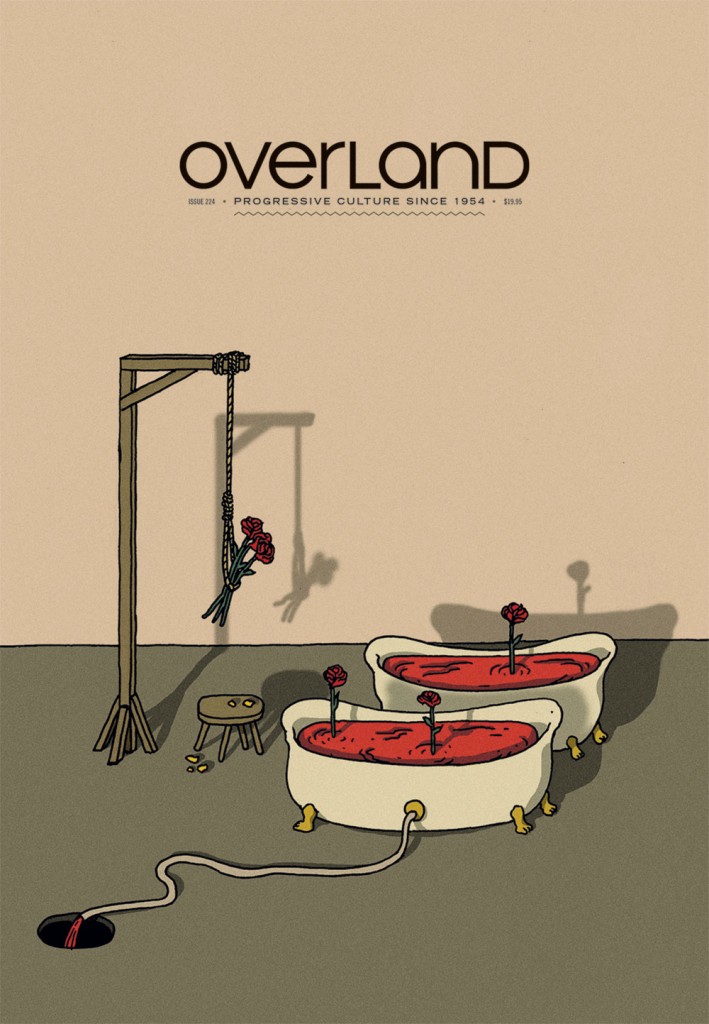
o224.jpg Overland is always a stimulating read. Among this issue’s offerings I am particularly grateful for:

  • Jeremy and the jeremiads by Richard Seymour, which discusses the ruthless and blatantly dishonest treatment of Jeremy Corbyn, the first radical socialist leader in the Labour Party’s history, by the British press – and not just its reactionary bits. As Seymour says, ‘the Corbyn moment has shown us … just how openly interventionist the majority of the media becomes when official opposition threatens to become a force for more radical change.’ Not just the Murdoch press, then.
  • The limits of compassion by Gerhard Hoffstaedter, which explores Malaysia’s response to the flood of people seeking asylum. It’s not that Malaysia is a beacon of light in this matter, but the scale of the problem there makes the panic and harshness here look even more shameful.
  • ‘Just violations’ by Alex Griffin (not online yet), which offers a historical context for Australia’s offshore detention centres. Japanese prisoners were held on Manus until 1953, and an Australian war crimes courts sat there, implementing the dubious War Crimes Act, in 1950 and 1951: ‘Australia could satisfy domestic interest, escape serious censure from its allies and strengthen its position in the Pacific, all while using the bodies of foreign nationals as bargaining chips in a oerverted and heavily weighted judicial situation.’

There’s also Alison Croggon’s column on her personal experience of depression, Ben Eltham spelling out how out of touch Australia’s political class is with the realities of most people’s lives, Giovanni Tiso on the pitfalls of using social media and the Web in general for political organising, with some interesting history for those who don’t remember Usenet.

No issue of Overland would be complete without the finalists of at least one prize. This one gives us the Victoria University Short Story Prize. The winner, Broad Hatchet by Julia Tulloh Harper, is a convincing bush tale with a neat gender twist.

There’s a poetry section. A new overall design means that the poetry is no longer printed in a light colour on a light background, and as a result can be enjoyed without eye strain. Zoë Barnard’s chilling ‘Impulse’ and Michael Farrell’s weird ‘Solve a problem and it grows two heads’ are the two poems that grabbed me the most.

And because it’s November, a verse. It may not be great but it rhymes:

November Verse 4: To Overland and their ilk on Eight-eleven
Unhappy land that needs a hero.
Duterte, Hitler, Donald Trump,
elected (unlike Stalin, Nero)
masters of the campaign stump
who feed on people’s desperation,
fan the myths of race and nation,
harness hate, despair and fear.
A heedless will for change is here.
We do need change. The seas are rising.
The profit motive hurts us all
and holds our governments in thrall.
I’m grateful for the organising,
analysing work you do.
It gives me hope we’ll make it through. 

Helen Garner’s Everywhere I Look and November Verse 3

Helen Garner, Everywhere I Look (Text 2016)

1925355365.jpgI’ve recently been surprised to hear a number of people refer to Helen Garner as ‘one of our great writers’. My surprise doesn’t come from disagreement. It’s just that hers isn’t writing that invites one to bow down in the presence of greatness. She’s less a Great Dane (or Grande Dame) making magisterial pronouncements than a terrier who keeps on at her subject until it yields some truth, her truth. She passes judgement often enough, and definitely enough, but not dogmatically, and not looking for a stoush either, but ready in case one comes along. A striking feature of Sotiris Dounoukos’ movie of Joe Cinque’s Consolation is the absence of the book’s persistent questioning – so when the end titles announce that, against the strongly implied judgement of the previous 90 minutes, one of the real-world characters was exonerated by a real-world jury, one tends to simply distrust the movie. When the book calls that verdict into question, you can disagree, but you can’t honestly dismiss it out of hand: the judgement has been honestly, and I would say humbly, worked for. (Perhaps its relevant that some of the harshest critics of Garner’s The First Stone refused to read it, or so I’ve been told.)

One of the pieces in this collection is titled ‘While Not Writing a Book’. That could have been a working title for the collection as a whole. It and a couple of others, including ‘Before Whatever Else Happens’, are presented as excerpts from the writer’s diaries/notebooks: overheard snippets, chance encounters, family moments, brief reflections. Another writer might have called them flash fictions or prose poems. Other pieces are more sustained: the product of a week locked away with CDs of Russell Crowe movies; reviews; sketches from the courts; wonderful pieces on her friendships with Jacob Rosenberg, Tim Winton and Elizabeth Jolly; glimpses of family life with grandchildren and, once, a dog; a revisit to her relationship with her mother; reflections on the ukulele, the ballet, suburban life; and more, enough to keep her readers interested between This House of Grief and whatever big thing may happen next.

Everywhere she looks and listens, from conversations about farting with small children to a teenager who has bashed her newborn baby to death, Garner finds stuff for her mind to grapple with, and she knows how to communicate the grappling with grace and vigour.

And now, because it’s November, a versification of one of the diary entries (see page 85 for the original):

Verse 3: At a conference
Supreme Court Judge and Helen Garner
chatted over tea and dip.
‘My home,’ the judge said to the yarner,
‘was once the scene of Monkey Grip,
your novel, and we’re renovating.’
‘My novel, and some devastating
and elating life. But how
do those old rooms look to you now.’
He listed them: ‘… and one so dinky
my daughter’s desk was there before.
It’s soon a bathroom, nothing more.’
‘The one with wooden shutters?’ Inky
flash from hippie days divine:
‘That tiny room was [humbly] mine.’

AWW2016Everywhere I Look is the twelfth book I’ve read as part of the 2016 Australian Women Writers Challenge.

Vaughan & Pia Guerra’s Y: The Last Man Book 2

Brian K Vaughan & Pia Guerra, Y: The Last Man, Book 2 (2003, 2004, this Deluxe Edition 2009)

1401222358.jpg

In Book 1, all mammals with a Y chromosome except two died in a mysterious plague. We were introduced to the two survivors, Yorick Brown and his companion monkey Ampersand; their nemesis, Yorick’s younger sister Hero; their protector, a secret organisation operative named 355; and Dr  Mann (get it?) who seems to be the world’s best chance of understanding the plague and securing a future for humanity.

At the end of Book 1, our main characters had set off from New York to San Francisco, to Dr Mann’s backed up research, her main lab having been torched by Israeli soldiers. And on its last page we had glimpsed a trio of astronauts, two male and one female, who are about to return to earth.

Book 2 is the equivalent of a road movie. As in all good road movies, we learn a lot more about our three main characters: 355’s organisation comes slightly more clearly into view; Dr Mann may not be the great scientist she’s cracked up to be; and young Yorick reveals depths and vulnerabilities, that is to say he becomes more interesting. The astronauts land, with predictable and unpredictable results. The Israeli soldiers become a serious problem. There’s a paranoid states-rights militia, a group of travelling players, a shadowy ninja-like character who seems to be working for the government, pistol-toting cowgirls, a kick-ass Russian agent, a tragic dominatrix (or is she?), and a host of interesting single-page characters.  There’s plenty of violence and PG sex, though (possible spoiler) Yorick manages to remain faithful to his girlfriend who is still in Australia.

The story zings along. Yorick’s major in English Literature allows literary references to be pulled off: a bizarre form of therapy, we are told, was developed in a secret meeting between Benjamin Franklin and the Marquis de Sade (Brian K Vaughan’s invention, I think); Mary Shelley wrote a novel called The Last Man set in the 21st century (true); there’s explicit homage to Nathanael West’s The Day of the Locust. Pia Guerra does most of the pencilling but is joined in this issue by Goran Parlov for three  of the original 13 issues and Paul Chadwick for two – for a non-expert reader like me the transitions are seamless.

I read this on an evening when I had intended to go to the movies. Nothing I wanted to see was on at a convenient time, so I hopped on a bus, got to Kinokuniya just as it was closing, and read this pretty much in the time a movie would have taken and with at least as much enjoyment.

Just as I was about to hit Publish I read on the jacket-flap what purports to be a summary of Y‘s set-up but is in fact a statement of just how male-dominated the world is at the start of the 21st century. As a result of the mysterious plague, ‘495 of the Fortune 500 CEOs are now dead, as are 99% of the world’s landowners … Worldwide, 85% of all government representatives are now dead … as are 100% of Catholic priests, Muslim imams, and Orthodox Jewish rabbis’. The book is fun, but it’s having its fun in a seriously fraught place.