Category Archives: Reading with the grandies

Reading with the grandies 34: Wings of Fire, Tabby McTat, Dog Man

It’s been a while since I’ve blogged about my grandchildren’s reading. Both do quite a lot.

I’ll write about the four-year-old another time. For now, I’ll just say that he loves Tabby McTat by Julia Donaldson and Axel Scheffler, which I blogged about four years ago, when his big sister was also enamoured of it.

Our newly-turned-seven-year-old has become a comics reader. Unlike the Donald Ducks and Phantoms of my childhood, her comics are little books, and seem to be mainly adapted from series of non-graphic novels. Partly as dutiful grandfather and partly (mostly?) as committed reader of comics, I’ve read two books from her current obsessions. (I did dip into a Babysitters’ Club title, but couldn’t make myself read the whole thing.)


Dav Pilkey, Dog Man: For Whom the Ball Rolls (Graphix 2019)
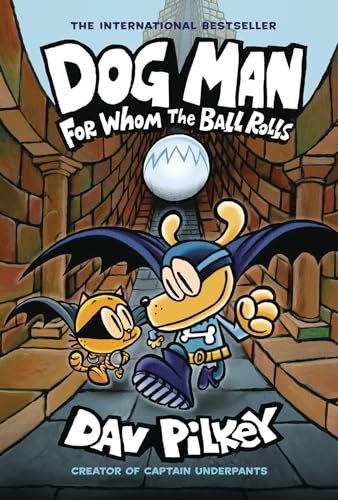
I’d heard of Dav Pilkey’s Captain Underpants, but had no idea until I looked him up on Wikipedia that he had received the prestigious Caldecott Honor Award (in 1997, for The Paperboy) or that he had been named Comics Industry Person of the Year in 2019. His first name, I also learned there, doesn’t come from a non-Anglo heritage but from a misspelled name tag at a fast food outlet.

This is the seventh of the Dog Man books. It’s good fun.

The first pages explain that the hero has had a head transplant. His new head came from a dog, and now as he continues with his work as a police officer, his doggy abilities and instincts often come in handy. Sadly, and hilariously, they also cause problems.

In this book, whenever Dog Man comes close to making an arrest, the bad guy throws a ball and he is compelled to chase after it.

Having written that much, I realise that I didn’t actually finish reading the book. In an increasinglty rare treat for both of us, I read it to my granddaughter until life made other demands. I enjoyed what I did read, and will try to sneak a further look if I can find it among the chaos of books in their bedroom.


Tui T. Sutherland, Barry Deutsch, Mike Holmes & Maarta Laiho, Wings of Fire: The Dragonet Prophecy, the graphic novel (Graphix, an imprint of Scholastic, 2018)
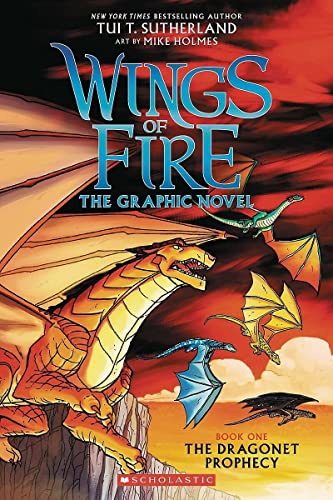
Tui T. Sutherland’s Wings of Fire series is a major phenomenon in YA fantasy. The first (non-graphic) novel, The Dragonet Prophecy, was published in 2012, and has been followed by fourteen more, plus two stand-alones, a number of novellas (‘Winglets’), and other spin-offs. The series is currently being adapted into ‘graphic novels’ (I prefer to call them comics) by Barry Deutsch, with art by Mike Holmes and colour by Maarta Laiho. Evidently the sequential art version makes the stories accessible to a younger readership, as my granddaughter has devoured the first six volumes. I have just read the first.

In the world of this novel, intelligent dragons are the dominant species. There are at last six dragon nations / subspecies, each with its own powers. A war has been raging for twenty years – a war of succession, sparked by the death of a queen at the hands of a Scavenger (a creature we recognise as human). There is a prophecy that five dragons ‘who hatch at brightest night’ will end the war and bring about peace.

The story begins with the hatching of those five baby dragons (‘dragonets’). They spend their early years imprisoned in a cave, protected from the outside violence and trained for their future task by formidable adult dragons, the Talons of Peace, who don’t much like them. They bicker like siblings, study the history of the war, and test their diverse powers. Like many institutionalised children, they form powerful bonds of affection and are fiercely loyal to each other. As you’d expect, they escape from the cave and adventures ensue.

Rather than give more detailed summary, I’ll stick to my practice of looking at page 77:
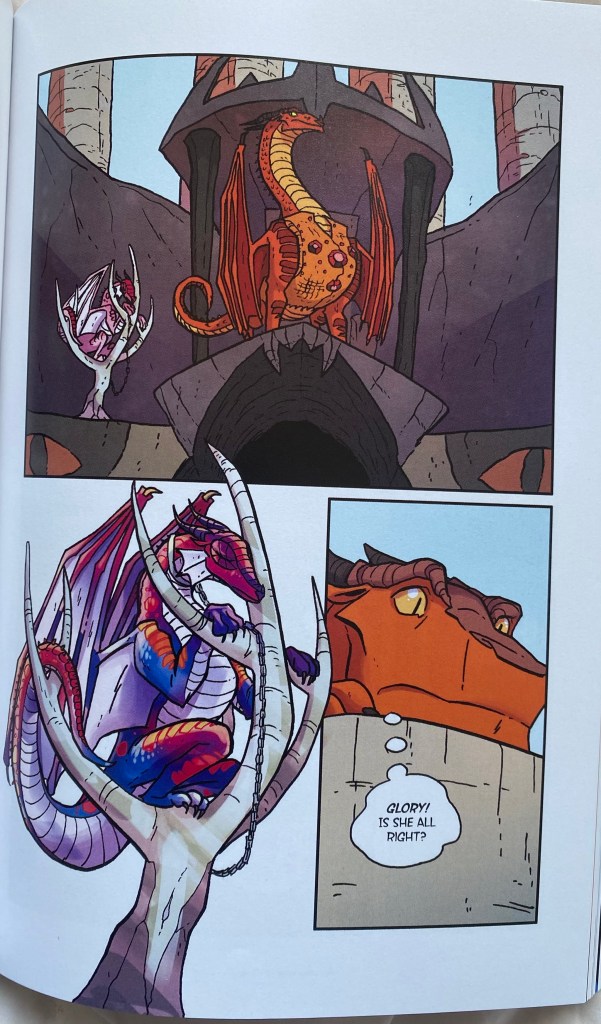
It would be interesting to compare this with the equivalent section of the original novel. Certainly it would take a lot of words (three thousand for these three pictures?) to convey as much information about character and to move the plot along so far. (The next page does include aquite a bit more explanatory dialogue.)

The large dragon at the top is Scarlet, one of the powerful queens who not only wages war but is committed to keeping it going for its own sake. She knows of the prophecy and, having captured the dragonets, is out to humiliate and destroy them. She stands on a platform that overlooks an arena where, for her own entertainment, she stages fights to the death between dragons who have been taken prisoner.

The small, brightly coloured dragon in the intricate cage is Glory, one of the five dragonets. She is a rain dragon, despised by everyone except her companions as beautiful but lazy and generally useless. Scarlet has not condemned her to gladiatorial combat, but has arranged her as an artwork. In keeping with her reputation, she is apparently sleeping (no spoiler to tell you that she is actually wide awake, biding her time).

The square-snouted character at bottom right is Clay, a mud dragon, another dragonet and this book’s central character. He is currently chained to the top of a pillar overlooking the arena with his wings constrained, destined to fight and, Scarlet expects, die violently. So much of his character is revealed in this one frame: though he has just discovered his own precarious situation, his attention goes completely to Glory – alarmed at her vulnerability but also with sibling irritation at her passivity.

To tell the truth, part of my reason for reading this book was what an unsympathetic observer might call moral panic: I had heard my granddaughter exclaim from the seat of the car, ‘Why is there so much blood in this book?’ This is a girl who recoils from even the mention of blood in real life. Having read the book, I’m guessing that this young reader is in there for the story and at worst puts up with the so far extremely stylised violence and gore, at best uses it to work through some of her own fears and anxieties.

I don’t know if I’ll read on, but I’m tempted.
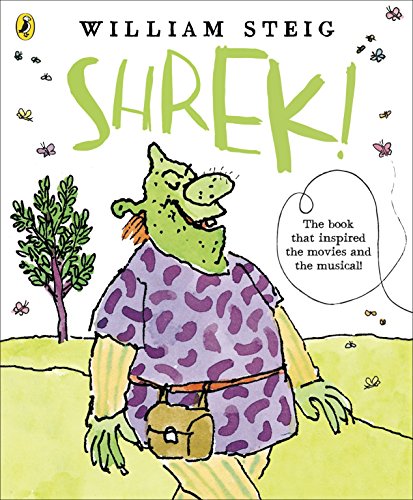
William Steig’s Shrek!

William Steig, Shrek! (©1990, Puffin 2017)

We recently watched the original Shrek movie with our grandchildren, and all four of us enjoyed it. Both our children were adults in 2001 when it was made, and grandchildren were a long way off, so I hadn’t seen the movie before, though though I’d seen clips. Nor had I been drawn into the rest of the Shrek franchise – half a dozen movies, a Broadway musical, a theme park beside the Thames. But I was aware that behind it all was a book by the great children’s author-illustrator William Steig.

When we told our six-year-old, a voracious reader, about the book she was interested, so we borrowed a copy from the library.

The six-year-old read it, said she had enjoyed it, then put it aside. I read it to the four-year-old, he said he enjoyed it, but didn’t demand an immediate reread.

I think it’s a case of the movie adaptation of a book making the book unreadable – not in the sense that it’s a difficult or unpleasant experience, but that the much broader, louder, and sentimental effects of the movie make the sly, deadpan humour and linguistic charm of the original almost impossible to discern. For example, in the movie, Shrek’s love interest starts out as a stereotypically beautiful princess, and when (spoiler alert!) she turns into an ogre she still has a degree of feminine cuteness. The love interest in the book is hideous on first encounter and remains hideous: we are never invited to see past her or Shrek’s surface ugliness to their inner beauty and goodness. Steig’s book doesn’t lose its nerve. The central joke, that the hero and then his love interest have no redeeming qualities, holds firm, and the book trusts its readers to get it. We quite like that they are pleased with themselves and each other, but we don’t have to like them at all.

That reversal of conventions and the absence of reassurance are what make the book fun.

The pages of our library copy aren’t numbered, but by my count, this is page 7:

As you can see, William Steig’s Shrek has none of the movie Shrek’s gross charm. He’s just gross.

A witch has sent Shrek on a quest to find the princess he will wed. On the previous page he has encountered a peasant scything a field. The peasant has uttered a few lines of verse about his unconsidered life, and now this.

The rhyming wordplay – Pheasant, peasant … pleasant present – is typical of the joyful use of language throughout the book. The unconscious peasant, blue in the face where on the previous page he was a healthy pink, didn’t cause any evident distress in our young readers. I think they got the joke. It’s typical of Steig’s respect for young readers that he doesn’t spell out how the peasant lost consciousness. (We love Steig’s Doctor De Soto and Sylvester and the Magic Pebble for their similar tact.)


I wrote this blog post in Gadigal Wangal country. I acknowledge Elders past, present and emerging for their continuing custodianship of this land, over which their sovereignty has never been ceded.


My blogging practice is generally to focus on the page that coincides with my age, currently 77. For short books like Shrek, I am stuck with page 7.

Miraculous: a book

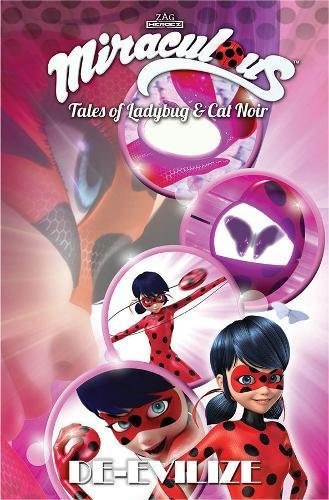
Miraculous: Tales of Ladybug and Cat Noir: De-Evilize (Volume 7?)

I was in Kinokuniya, the place I usually go for comics, and I thought it might be nice to seek out the book version of Miraculous, a TV show my six-year-old granddaughter enjoys.

What can I say? In short, if you’re interested in reading a Miraculous comic, I recommend that you look at the fine print above the bar code on the back cover and hope for a line that includes the text, ‘Volume 1 TPB’. I didn’t know to do that.

I’m not a librarian, but I do generally look on the title page of a book for its official title, and on the imprint page for publication details. This book has neither. By reading the fine print – some of it very fine – and consulting Duck Duck Go, I found out that:

  • Miraculous: Tales of Ladybug and Cat Noir is a series title
  • This volume, De-evilize, collects numbers 19 to 21 of the comic series, and is the seventh such collection
  • The three comics were published in 2017
  • I imagine that each comic issue represents one episode in the TV show. The episodes, named for the featured super-villains, were ‘Kung Food’, ‘Gamer’ and ‘Reflektra’
  • The show appears to have originated in France, though Korea was the first country to screen it
  • There is no indication on the book that this is a translation from a French text, although the action takes place in Paris, and street signs are in French
  • •Nowhere does the book mention its country of origin. It was printed in Canada but, as far as I could tell from Duck Duck Go, the publisher Action Lab Entertainment is a US company
  • Naming the author/s of this book is a complex matter: the series creator is Thomas Astruc; comics adaptation is by Nicole D’Andria; each of the three ‘chapters’ is written by a different pair of writers.

Starting in Book 7, you’re thrown into the middle of bewildering adventures in which two French teenagers (Marinette and Adrien) become superheroes (Ladybug and Cat Noir) through the agency of tiny supernatural creatures. There are magic gadgets called Miraculouses. There’s a bad guy named Hawk Moth who has little pet moths called akumas which he uses to turn disgruntled people into supervillains. Ladybug and Cat Noir do battle with the supervillains, eventually extract the akumas and restore order. The de-akumatised supervillains return to being the friends or benign relatives of Marinette and Adrien. There’s pleasantly complex teenage romantic tension, and familiar high school politics.

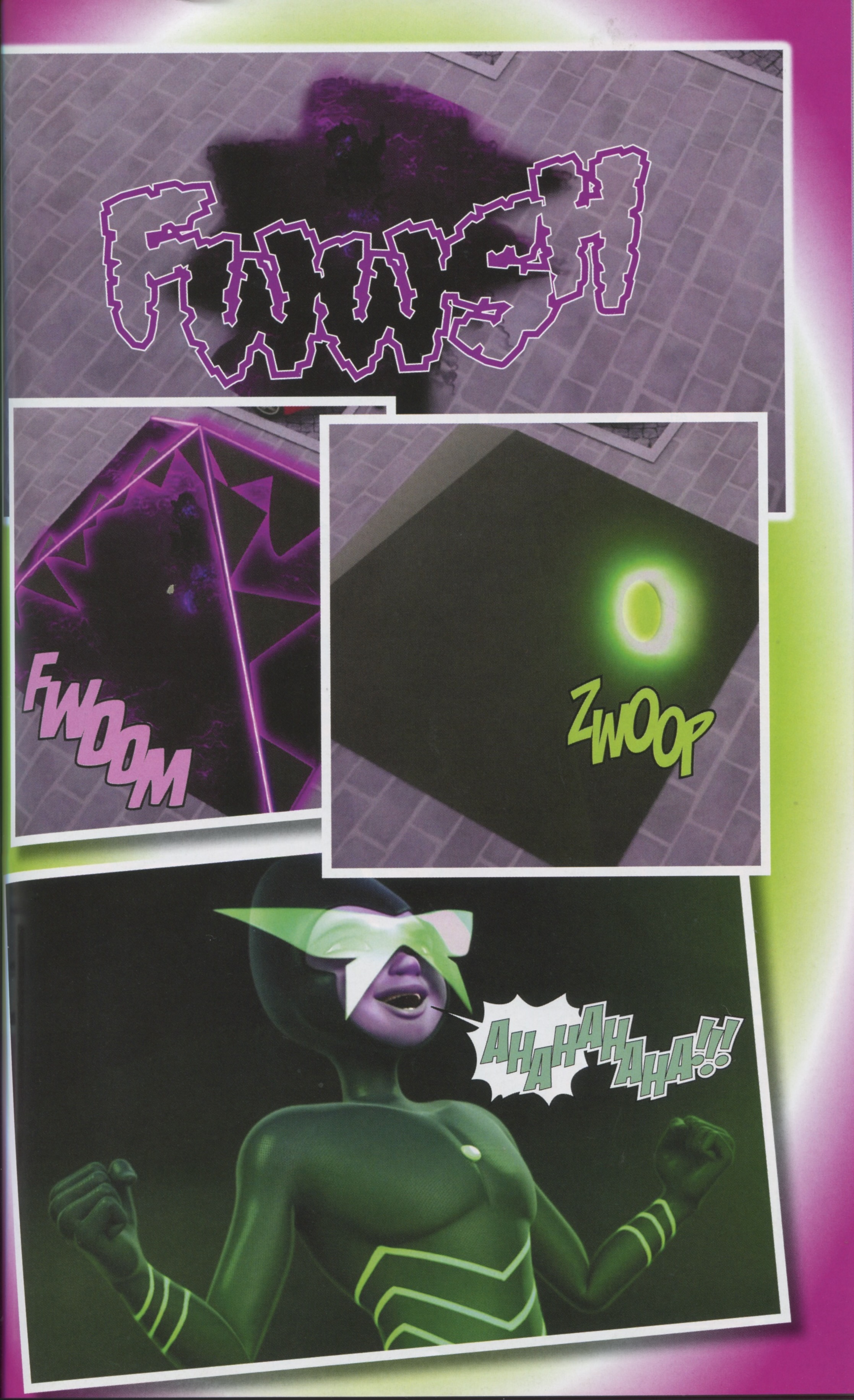
In this volume it’s pretty much exact the same story three times, so by the end of the second story I had got the general gist, even though, especially in the fight scenes, I couldn’t tell from the images what was actually going on. And I didn’t much like the computer-generated images. I ought to give you a little taste Here’s page 77*, in which the gentle boy Max is transformed into supervillain Gamer:

I haven’t read this book with either grandchild, but I’ve had fun dropping the catch cries ‘Spots on!’, ‘Claws out!’, ‘Lucky charm!’ and ‘Cataclysm!’ into the conversation.


I wrote this blog post in Gadigal Wangal country, where it is my great joy to live, where the days are getting warmer and the winds are strong. I acknowledge Elders past, present and emerging for their continuing custodianship of this land.


My blogging practice is to focus on the page that coincides with my age, currently 77.

Reading with the grandies 33: The Skull and Madeline

This blog couldn’t possibly keep up with my grandchildren’s reading. The other day, the six-year-old pleaded to go to the library, and in the very small time we had there she chose a book about a girl called Paris who visits Paris. A little later a friend saw this book and offered to lend us her Madeline compendium. After I’d calmed down from reciting the first 10 pages or so of Madeline (which the Emerging Artist claims never to have heard of, so who knows how, when and where I got to know most of it off by heart), we accepted her offer.

Meanwhile, the grandies’ father brought home a new book by Jon Klassen, a writer and ilustrator of a very different kind.


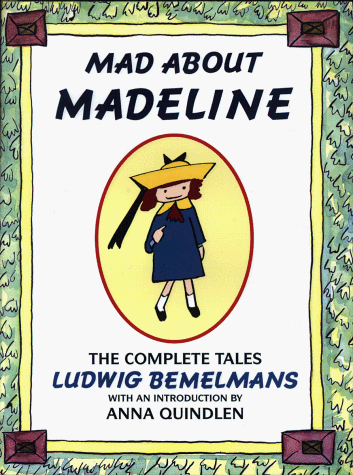
Ludwig Bemelmans, Mad about Madeline: The complete tales (Viking 1993)

This huge volume includes all six Madeline books, in order of appearance here:

  • Madeline (© 1939)
  • Madeline and the Bad Hat (©1956)
  • Madeline’s Rescue (©1951, 1953)
  • Madeline and the Gypsies (©1958, 1959)
  • Madeline in London (©1961)
  • Madeline’s Christmas (©1956)

We read the first story to the three-year-old. The six-year-old was interested in other things, but her ears pricked up in the course of the reading – it may have been the insistent rhymes, or the sense of danger (‘To the tiger in the zoo / Madeline just said pooh-pooh’), but she joined us and then asked for that story to be read two, or maybe three, more times right then. She listened with intense concentration. Her little brother was interested in why Madeline said ‘pooh-pooh’, but her focus was a lot less scrutable.

In case you don’t know, Madeline is the youngest and boldest of 12 little girls (‘in two straight lines’) who lead a regimented life in an old house in Paris all covered in vines. In just a few lines of verse per beautifully illustrated page the story unfolds of her having her appendix out. When the other girls see the treats she receives in hospital, and the scar, they want to have theirs out too. The illustrations, meanwhile, amount to a guided tour of Paris’s famous sites. (The three year old didn’t care about Montmartre or the Eiffel Tower, but he loved the ambulance every time.)

That’s the first book. Of the others, I most enjoyed Madeline’s Rescue, where Madeline falls into the Seine. In the first book, the text ‘Nobody knew so well / How to frighten Miss Clavell’ accompanies an image of Madeline balancing precariously on a wall above the river. That’s repeated in Madeline’s Rescue, but the facing page image shows her falling, with the text, ‘Until the day she slipped and fell.’ She is saved by a dog, who then goes home with the little girls. There’s a riot in the dormitory over who the dog will sleep with. In the end, the dog, whose name is Genevieve, has twelve puppies and everyone is happy.

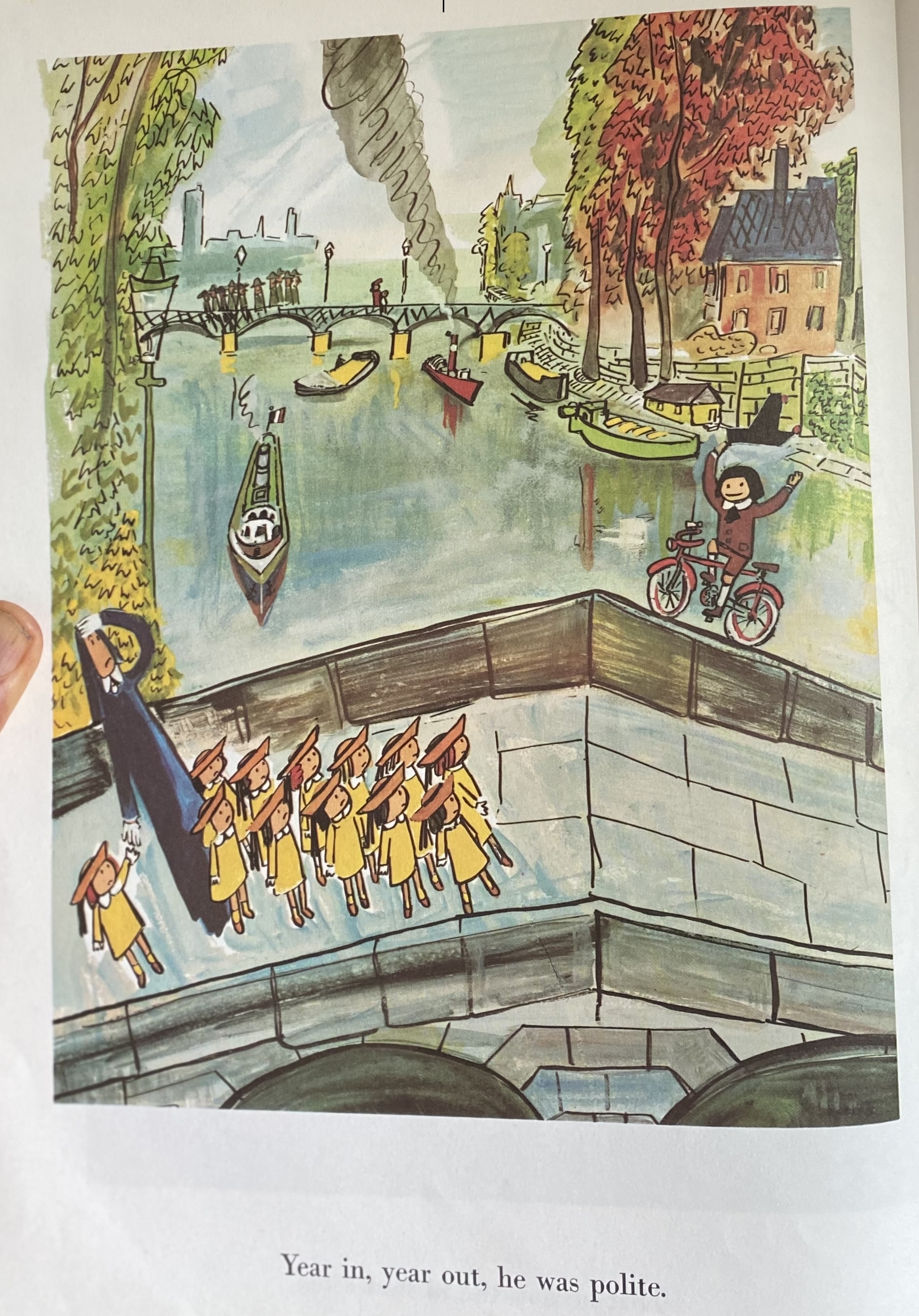
Page 76 falls in my least favourite of the books, Madeline and the Bad Hat, in which Pepito, who lives next door to the girls, behaves abominably. He is cured of his wicked ways in the end, but we didn’t get there in our group reading, as the six-year-old didn’t see why she should persist with the tale of misbehaviour – and the three-year-old had his own reasons for not being interested in someone else’s bad choices (a phrase heard too often at his childcare centre). But page 76 is a lovely example of Ludwig Betelmans’ artwork (click to enlarge), and the way it plays with the text:

Pepito is riding dangerously on the edge of the bridge, causing Miss Clavell to clutch her brow (she does a lot of that, and she is often seen slightly off balance as she is here, holding Madeline’s hand) and alarming the little girls. However, as the text points out, he is raising his hat politely. Most of his bad behaviour, in fact, is seen in the images but either ignored or downplayed in the text – so we know he is sneakily bad, and mostly avoids adult retribution. On the next page, for example, the text reads, ‘He was sure and quick on ice,’ and we see him running rings around all the little girls at a skating rink, knocking them off balance. I begin to understand my granddaughter’s concentrated attention.

That’s all happening in the foreground. The background (gouache, I think) is where the charm of these books lies: the bridge itself, of course, is beautiful, then there is the other bridge across the Seine, the boats and the trees with their autumn colours.

This is one from the past that has survived the passage of time brilliantly.


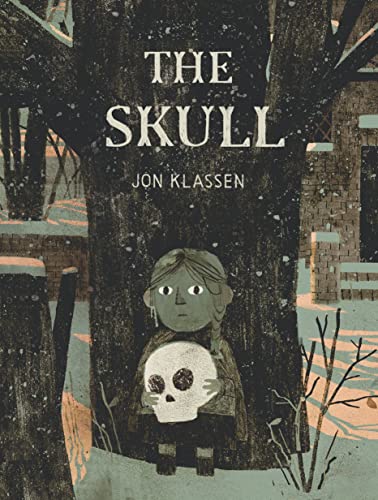
Jon Klassen, The Skull: A Tyrolean Folktale (Walker Books 2023)

John Klassen is a favourite in our family. See, if you like, my blog posts on I want My Hat Back (2011), This Is Not My Hat (2012) and We Found a Hat (2016).

This book is less minimalist than those earlier ones, but just as grimly comic. In the folktale that it’s based on, a little girl befriends a skull, and a headless skeleton demands that she hand it over. In Klassen’s version the girl, whose name is Otilla, refuses to surrender the skull, manages to outwit the skeleton and dispose of it in a gruesome way that ensures it will never return. She and the skull, it is implied, live happily ever after.

I wasn’t at alI sure how suitable this story was for my squeamish granddaughter and vulnerable grandson. I read it with them once, and moved on as quickly as I could. I can only assume that their father and/or mother read it to them a number of times before we next saw each other, because they both started chanting, ‘Give me my skull. I want my skull,’ and then roared with laughter when, on the fourth or fifth repetition, they fell silent after ‘my’. In the book, that’s the moment when the skeleton falls off the castle wall and is broken up. I guess Jon Klassen is a better judge than I am of what children will enjoy.

Page 76 is blank, before the start of a new chapter, so here’s the preceding spread, to give you an idea of the storytelling:

This is just after the terrifying encounter with the skeleton that ends with it falling off the wall. Otilla is about to gather up its bones, smash them, burn them and throw them into a bottomless pit. But first there is this still, intimate moment. The tenderness of the text – Otilla carries the skull quietly and pats it gently – is beautifully realised in the warmth of the candlelight, the way the blanket covers the skull’s mouth, Otilla’s calm expression.

These books are unlikely blogfellows, but there’s an unexpected echo of Madeline on this page from The Skull. Aficinados will recall the final moment of the first Madeline book:

And she turned out the light –
and closed the door –
and that's all there is –
there isn't any more.

November verse 7

7. On reading Burglar Bill for something 
like the thousandth time
Everything he owned was stolen:
bed, beans, teapot, teacup, tea,
the grate he heaped his stolen coal in,
helmet, handsaw, got for free
on his nightly torchlit outing,
in at windows, gaily shouting,
'That's a nice –––, I'll have that!'
(A question: Did he steal his cat?)
Then along came Burglar Betty:
being burgled isn't fun.
Betty's baby (daughter? son?)
turned them both from crime and yet he
now – a timid reader prays –
recalls with joy his wicked days.

If you’ve never read Burglar Bill, by Janet and Allen Ahlberg, you’ve got a treat in store. I probably haven’t actually read it a thousand times, but these days I can be asked to read it three times in a row. Like Maurice Sendak’s Where the Wild Things Are or Margaret Mahy’s A Lion in the Meadow, it never gets boring.

Reading with the Grandies 32: Digger, Digger and Despereaux

The world has changed since my last post about grandparental reading. Our granddaughter has started school, which means that her little brother now goes to Day Care without her reassuring presence. They both still like to be read to. Here are some of the titles that now have a look-in among the established favourites such as Catwings, Grug, Mrs Wobble the Waitress or Fantastic Mr Fox.


Sally Sutton, illustrated by Brian Lovelock, Dig, Dump, Roll (Walker Books Australia 2018)

For a brief time, our grandparentng days included the reading time at our nearest bricks and mortar bookshop, Harry Hartog’s in the Marrickville Metro. On one of our attendances we asked the brilliant ukulele-playing book reader to include a book about diggers as a treat for our two-year-old grandson. She obliged, and made a sale for which we are immensely grateful.

It’s a simple book, first published in Australia but now available from Candlewick in the USA and Walker in the UK. It’s structured as a series of riddles: What’s that making that noise? Here’s a hint … [Turn the page] … machinery revealed. The book’s refrain has now entered permanently into the vocabulary of the two year old and the five year old as well as their grandparents: ‘Digger digger coming through!’

An added topical bonus is that we discover at the end that all the machinery and the builders have been constructing a school: ‘You can learn and play here too.’


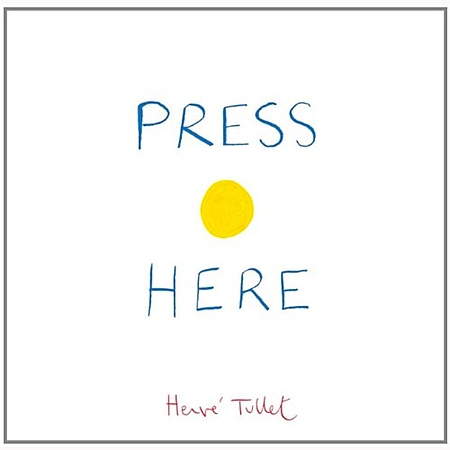
Hervé Tullet, Press Here (Allen & Unwin, first published in France as Un Livre by Bayard Editions 2010)

This is a terrific piece of design. One spread presents an image of one or more coloured dots with an instruction (‘Press here and turn the page’, ‘Tilt the page to the left’, and so on). The next spread reveals the result of your action. The dots multiply, change colour, move around the page, get bigger and smaller. It’s a wonderful book to read and be read to, and I’ve seen people of various ages having a nice time with it.

The English translator isn’t named. It may have been designer Hervé Tullet himself. Whoever it was did a magnificent job.


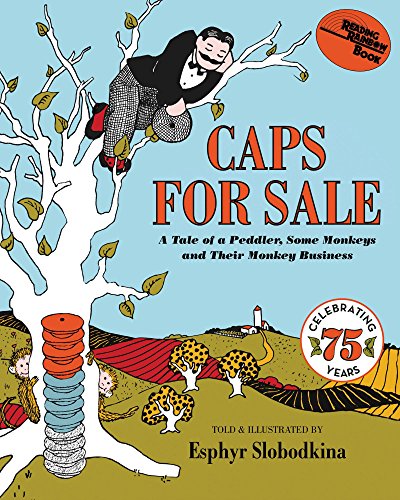
Esphyr Slobodkina, Caps for Sale (©1940)

We may have a copy of this in a box somewhere. I remember enjoying it with our children, and now it’s been read to us by the marvellous Lisa at Balmain Library Storytime.

A troupe of monkeys steal a pedlar’s caps from his head while he’s asleep. He tries everything he can think of to get his caps back, and in the end manages it in an unexpected way. The language is wonderfully incantatory, and apart from sheer enjoyment value, there’s plenty to exercise young minds – the range of colours, numbers, and of course the overarching problem to be solved.

Esphyr Slobodkina was a Russian-born avant garde artist and feminist, and this is brilliant.


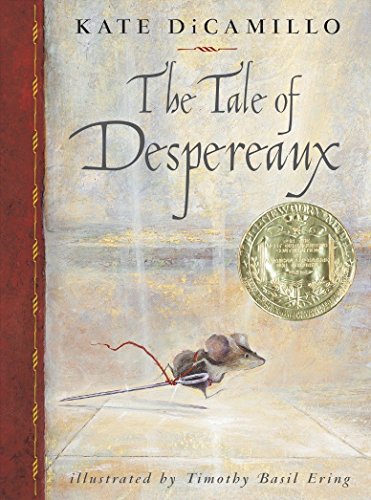
Kate diCamillo, The Tale of Despereaux (Being the Story of a Mouse, a Princess, Some Soup, and a Spool of Thread) (Walker Books 2003)

I may be posting about this prematurely, as we’re only a couple of chapters in – it’s a big chapter book. But both Nana / the Emerging Artist and I are enjoying it immensely, and Granddaughter listened wide-eyed.

I did read parts of this decades ago, but it’s brilliantly fresh this time around.

The princess, known as Pea, isn’t all that keen on the business of choosing a suitor, but is very taken by a little mouse, the Despereaux of the book’s title, who is entranced by her beauty. The mouse breaks some of the most sacred rules of mousekind by first letting humans see him, then letting one of them (Pea) touch him, and then – oh horror! – speaking to them. But what are you gong to do when the most beautiful creature you’ve ever seen doesn’t think you’re an ugly, big-eared runt, but thinks you’re cute, with cute ears?


We do a lot of reading. Small amounts of Paw Patrol, My Little Pony, Peppa Pig. These blog posts are selective.

Reading with the Grandies 31: Roald Dahl, Grug and the Bus Book

In the months since I last posted about Ruby’s reading, she has discovered Roald Dahl, and her little brother has started asking to be read to from what he calls the ‘Bus Book’.

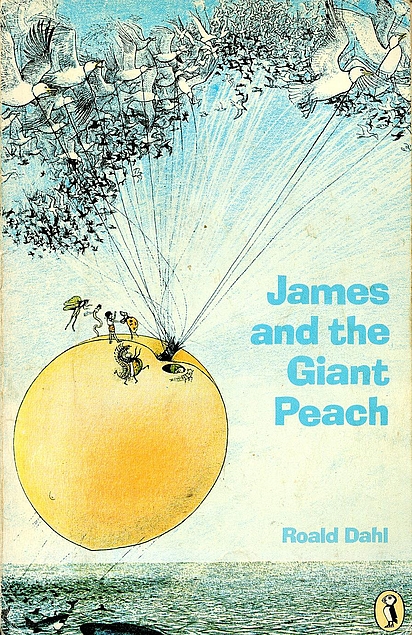
Roald Dahl, James and the Giant Peach (© 1961, illustrations © Quentin Blake 1995, Penguin Random House 2016)
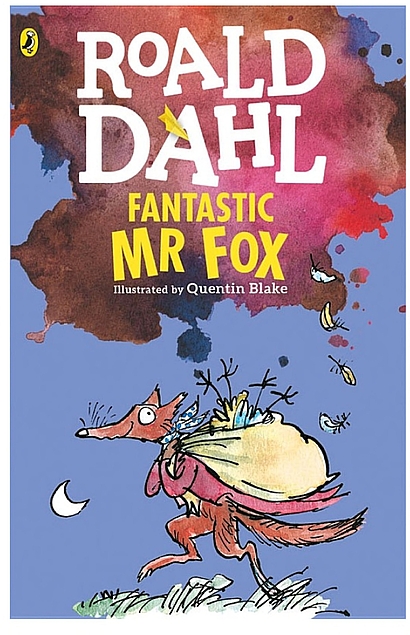
—–, Fantastic Mr Fox (© 1970, illustrations © Quentin Blake 1996, Penguin Random House 2016)
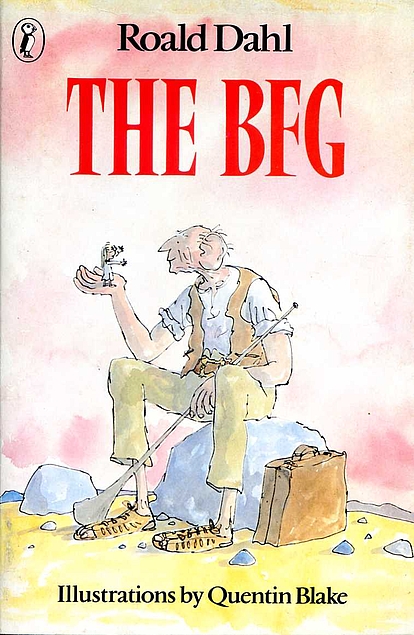
—–. The BFG (© 1982, illustrations © Quentin Blake 1982, Puffin 1985)

Whatever else you might think about Roald Dahl (and I know there are people would keep him away from young children because of what they see as cruelty), his sentences are a joy to read aloud, and evidently a joy to hear, while his plots are full to bursting with vividly imagined incidents. We’ve read James and the Giant Peach more than once, a couple of pages at a time. We’ve reached page 54 or so of The BFG, in one sitting, but will probably take a while to return to it because something about it is too scary.

Fantastic Mr Fox has been an amazing success. Currently we see Ruby for a couple of hours in the afternoon two days a week. On half a dozen successive Nanna-and-Poppa afternoons, she has asked for Fantastic Mr Fox, and listened to the whole book in a single sitting. Once or twice she has agreed to have something else as an appetiser, but this is the book she wants, and she wants it all. At first, she would cover her ears to mute the bits she found scary, but by the most recent reading she stayed for everything. As the non-reading grandparent, it’s wonderful to watch her absorption in the story, and her intent study of Quentin Blake’s illustrations.

I hope we can keep Wes Andersen’s travesty of a film out of the picture until it’s too late for it to spoil anything. And I expect Charlie and the Chocolate Factory, which I loathe for its, well, cruelty as well as its racism and gooiness, can’t be too far away. But for now, we’re having a ball.


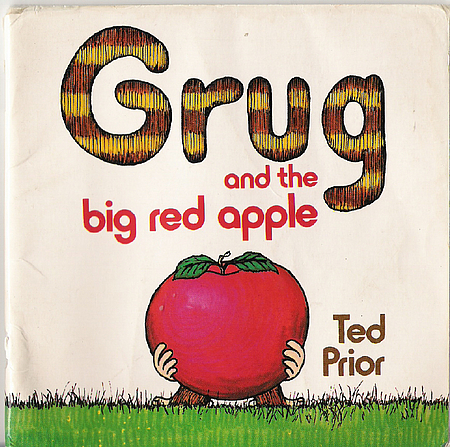
Ted Prior, Grug and the Big Red Apple (1979)
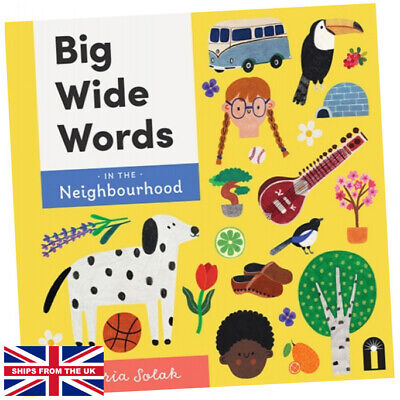
Daria Solak, Big Wide Words in the Neighbourhood (Hardie Grant 2022)
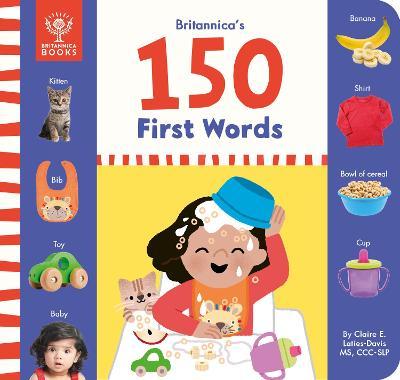
Claire Laties-Davis (text), Kazia Dudziuk (illustrations), Britannica’s First 150 Words (Britannica Books 2021)

As Charlie’s second birthday approaches, his interest in story isn’t as intense as his big sister’s. He loves spreads where we name an object and he finds it. The pages he comes back to again and again, and then is reluctant to leave, have pictures of buses, cars and especially TRUCKS. These two books, with illustrations by Daria Solak and Kazia Dudziuk respectively, stand out for their surprising choices of words, and unconventional illustrations.

Grug and the Big Red Apple, on the other hand, is a story that does the trick. The introductory bits where Grug, the mysteriously animate scrap of Australian flora, finds the apple, and the bit where Clara the carpet snake coils around the apple in order to move it – all that’s well and good, but we all love the last few spreads where the apple looms larger and larger in the foreground while Grug looks hungrier and hungrier beside it, and then, turn the page and all that’s left is a tiny core and a sated Grug. Yay for story!

Ruby Reads 30: Billie B Brown

Sally Rippin (writer) and Aki Fukuoka (illustrator), Billie B Brown: The Bad Butterfly (Hardie Grant Children’s Publishing 2010) [Nº 1]
––––, Billie B Brown: The Perfect Present (2010) [Nº 7]
––––, Billie B Brown: The Birthday Mix-up (2011) [Nº 10]
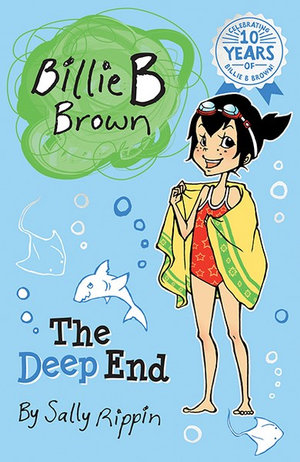
––––, Billie B Brown: The Deep End (2012) [Nº 17]
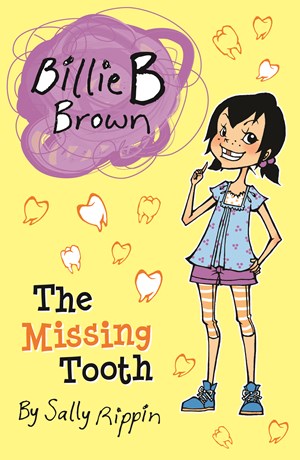
––––, Billie B Brown: The Missing Tooth (2020) [Nº 19]
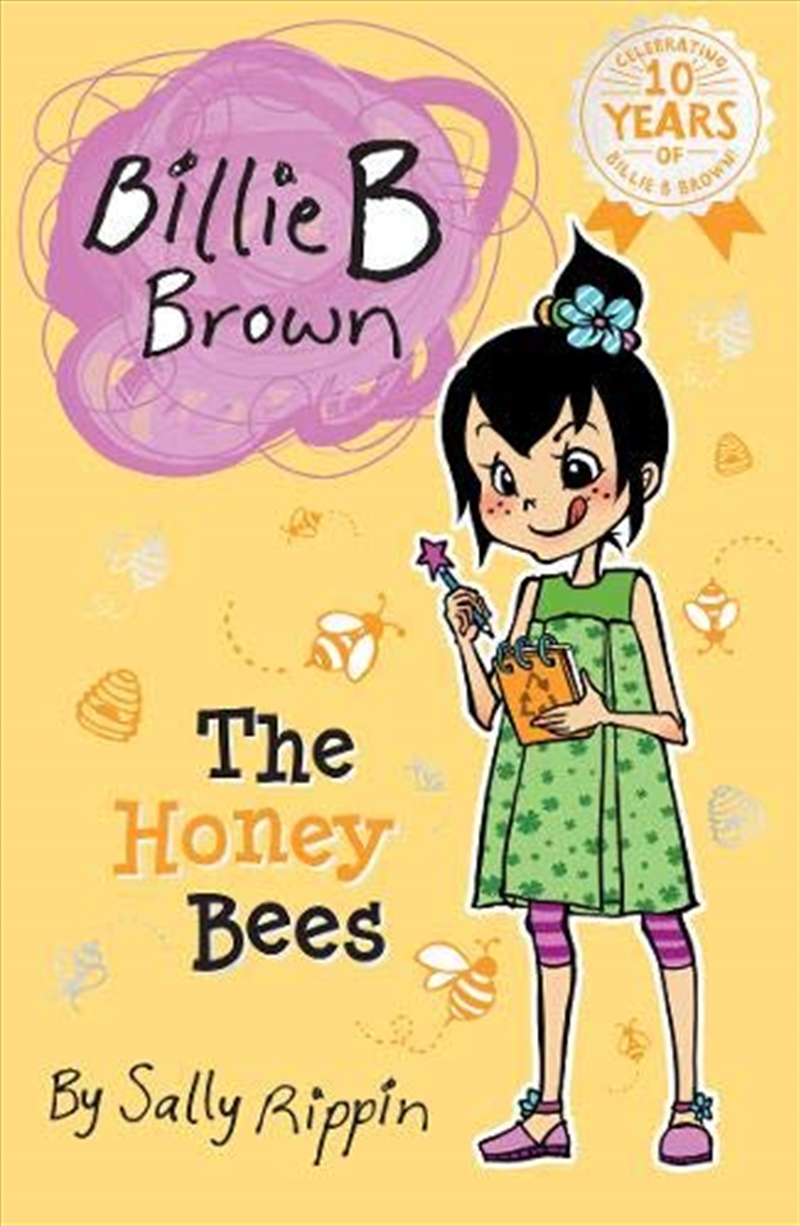
––––, Billie B Brown: The Honey Bees (2020) [Nº 23]
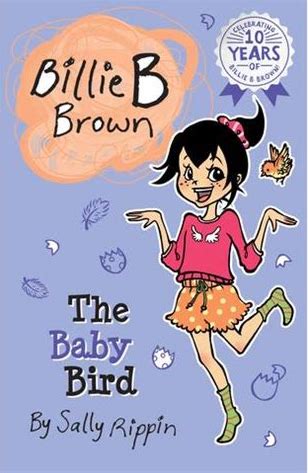
––––, Billie B Brown: The Baby Bird (2021) [Nº 24]

I used to be fairly knowledgeable about children’s literature, but that was a while ago. Until two months ago I hadn’t heard of Australia’s top-selling female author Sally Rippin or her Billie B Brown series, which Goodreads says has sold more than 4.5 million copies in 14 languages.

On advice from a salesperson at Gleebooks, Ruby’s local bricks and mortar bookshop, we bought four titles, then another three a couple of weeks later.

They’re chapter books, intended mainly for six-year-old readers but Ruby, who is still 4, loves them. It’s living evidence that children often enjoy books meant for readers who are older than themselves.

In each book, Billie B Brown – the middle B stands for something different every time – meets an age-appropriate challenge. In book Nº 1, The Bad Butterfly, she and her best friend, Jack from next door, go to ballet classes and discover that Jack excels at the dainty butterfly dance while Billie does better as a stomping troll – and (spoiler alert) they tell the teacher that Billie will dance a boy’s part (a troll) and Jack a girl’s (a butterfly). This is done quietly, without flag-waving or defiance, just two young people solving a problem, and only incidentally evoking a sigh of relief from the adult reader who was bristling at the dance school’s gender stereotyping.

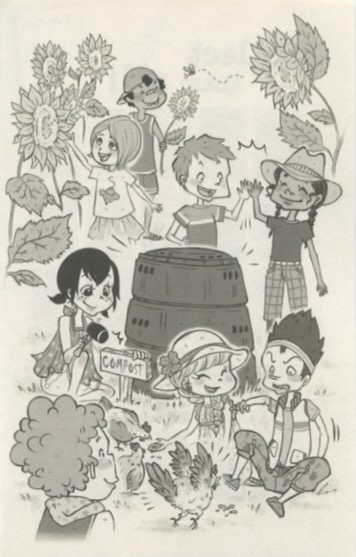
And so it goes. In The Perfect Present, Billie (the B is for Bursting) is excited then disappointed about Christmas; in The Birthday Mix-up, she has a party and it looks as if no one is coming; she is painfully anxious about swimming in the deep end of the pool; she loses a tooth, but not completely according to plan; she learns about bee-sting allergy, and is distraught about an abandoned baby bird. The story generally goes how you would expect: the guests arrive; the tooth fairy delivers; the baby bird is OK; relationships with other children are realistically fraught, and reassuringly resolved. But there’s nothing stale about the tellings, and Aki Fukuoka’s manga-ish drawings add to the freshness. Here’s her full-page drawing that ends The Honey Bees (which she discusses on YouTube, here):

It’s uncanny how many of Ruby’s concerns are taken up explicitly in these books – birthdays, Christmas, the danger posed by bees, friendships, swimming, ballerinas, letters and numbers, little brothers, and more. I doubt if Billie would have been quite as much appeal to either of my sons. But Sally Rippin and Aki Fukuoka have another series, Hey Jack! Maybe that will still be there when my other grandchild is thirsty for chapter books.

PS: In his memoir Tell Me Why, Archie Roach calls his grandchildren grandies. I haven’t seen the word in a dictionary, but I love it, and I’m using it. As Ruby’s little brother is just beginning to enjoy being read to, I’m changing the name of this series of posts to Reading with the grandies.

Ruby Reads 29: Gift

It’s the time of year when Ruby comes into possession of many new books, first for her birthday, and then for Christmas. This is one I gave her, and which she took time to enjoy in the midst of things. (I love it.)


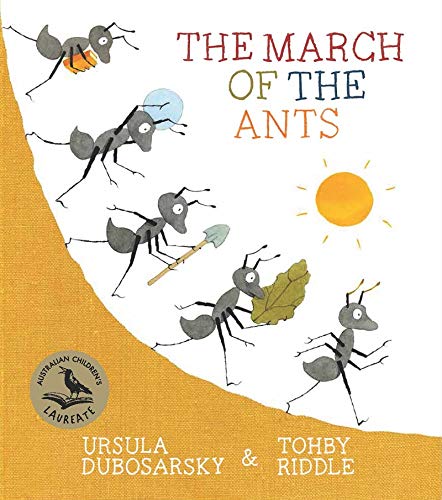
Ursula Dubosarsky and Tohby Riddle, The March of the Ants (Book Trail 2021)

Full disclosure: Ursula Dubosarsky and Tohby Riddle are friends of mine.

They’re also both geniuses, who have collaborated on a number of books for children. This gorgeous picture book is the latest. The text was read by Ursula at her launch as Australian Children’s Laureate in February 2020. Neither she nor Tohby could have known that its message about the importance of story had a prophetic relevance for the two years that lay ahead.

A group of ants set out on an excursion. Every one of them carries something important for the enterprise. When one little ant shows up with just a book, there is much mockery. But the little ant persists. Later when all the others are tired from their exertions and the food and drink have run out, the little ant reads to the others, and they are revived by the story.

Tohby’s images are masterly, full of odd details without being at all crowded.

Here’s a video of a laurel-crowned Ursula reading the book, from the Australian Children’s Laureate Foundation webpage


The March of the Ants is the 15th and final book I’ve read for the Australian Women Writers Challenge 2021.

Ruby Reads 28: Mostly William Steig

A good friend who has a vast library of children’s books decided it might be time for Ruby to meet William Steig, one of the greats of US children’s literature. Shrek is his best known book, but wasn’t among the swag she lent us. The four books in our swag have been read many times by many children over the decades, and needed to be treated with great care. After we read them to Ruby, we decided to get hold of copies we could keep and manhandle. It turned out that none of the three public libraries I belong to have copies; I’ve ordered them from bookshops, but it will take months for them to arrive from ‘suppliers’.


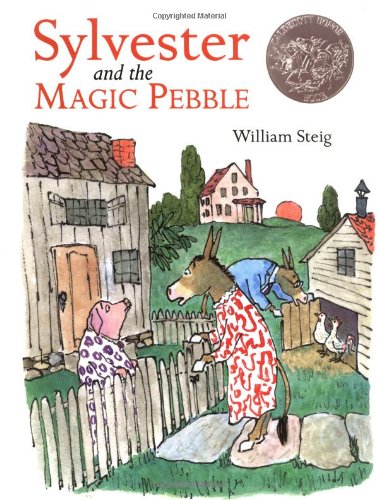
William Steig, Sylvester and the Magic Pebble (©1969, Simon & Schuster 2005)

Sylvester is a donkey who finds a pebble that grants his wishes. As you’d expect, one of his wishes goes terribly wrong. The wonder of this book is that the wrongness isn’t Sylvester’s fault: his wish is a clever response to a real threat, so the pickle it lands him in isn’t a punishment. All the same, the bulk of the book has poor Sylvester trapped and immobile, while his parents search for him desperately.

The suspense is terrible. All the more, because z– not to give anything away – the reader can see just how close Sylvester is to a solution to his problem. Yet the happy end, when it comes, is a huge relief.

We’ve only read this once, but it feels as if it will be part of Ruby’s repertoire for a while. We had to play a game based on it, but Ruby instructed us to make up our own wishes. So the appeal of th story so far seems to be in the idea of a tiny red stone with magic powers.


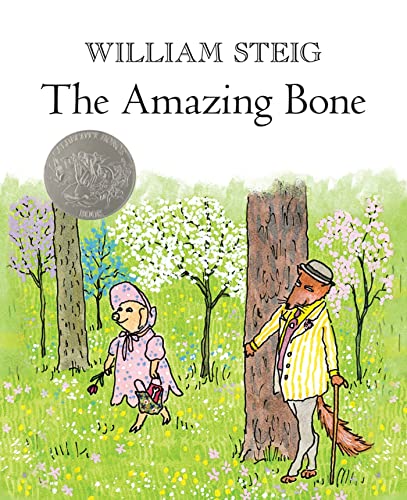
William Steig, The Amazing Bone (©1976, Puffin 1981)

Pearl is a pig who dresses in pink (always a winner with Ruby: ‘Did you know my favourite colour is pink, Poppa?’ ‘Yes, I had gathered that somehow’). One day, relaxing in the woods, she discovers and befriends a magical talking bone.

The bone is much more active than the pebble in the earlier book, and the dangers that Pearl faces are more dramatic: first some masked bandits, and then a suave and hungry fox. The bone scares the bandits off without breaking a sweat, but the fox is another matter.

Needless to say, Pearl and the bone escape the fox and, like Sylvester, Pearl returns to her parents. But whereas the pebble was locked in a safe out of harm’s way, the bone lives on in pride of place in Perl’s household.

I’d hesitated to read this to Ruby because she tends not to like scary stories. But she loved it


William Steig, Doctor De Soto (Farrar Straus & Giroux 1982)

Doctor De Soto is a mouse who is also an excellent dentist. For work health and safety reasons, dangerous animals such as cats are banned from his practice. One day, however, a dapper fox who is in extreme pain from toothache pleads for his help. Doctor De Soto and his wife, who is also his able assistant, reluctantly take pity on the wretched creature and remove the troublesome tooth. But they know, and we know, that the fox is still a fox and will eat them both once he is relieved of his pain. (Spoiler alert: Doctor de Soto and his wife outsmart the fox and stay safe.)

There are comic-terrifying images of the mouse-dentist actually going inside the fox’s mouth, with its huge sharp teeth. Ruby kept her hands at the ready to clamp over her ears each time this happened, but decided over and over to let the story continue: ‘I think they’ll escape,’ she said. I think she had the crocodile’s jaws in Jonny Lambert’s Let’s All Creep Through Crocodile Creek (see below) as a reference point, and so was prepared to trust the story teller not to hand her a steaming pile of tragedy.

As for me, I love Doctor and Mrs De Soto for their courage, compassion, and quick-wittedness. I also love the dapper and unscrupulous fox, who may actually be the same fox who troubled Pearl and the bone, now recovered from what they did to him.


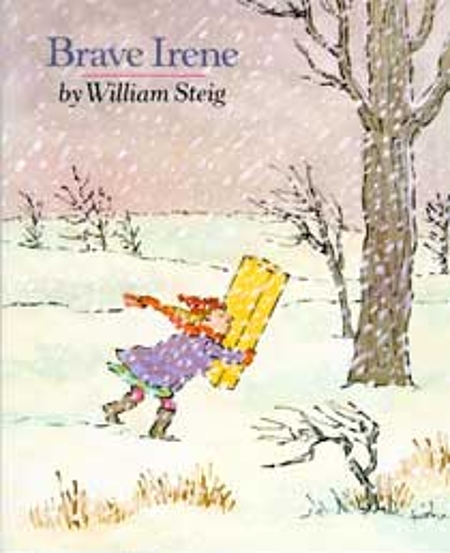
William Steig, Brave Irene (©1986, Victor Gollancz Ltd 1987)

Irene is a young human. Her mother has made a dress for the Duchess, but is taken ill and can’t deliver it in time for the ball. When Irene offers to deliver it for her, the mother can see no other option and reluctantly agrees. So brave Irene struggles on through page after page of blizzard. She rides on the dress’s package like a sled, and when the wind snatches the beautiful dress from her, she struggles on anyway because it would be even harder to return home.

It all turns out well in the end.

I’m not sure Ruby quite got this book, but I’m hoping it will grow on her. Irene is no Disney princess, which is a plus from my point of view, but not so much from Ruby’s.


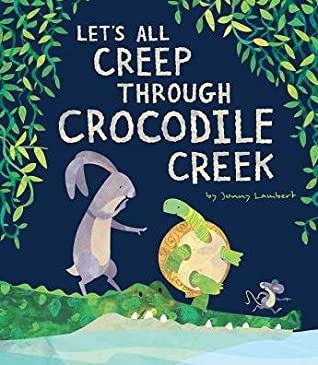
Jonny Lambert, Let’s All Creep Through Crocodile Creek (Little Tiger Press 2019)

I had to read this book to myself in order to understand what I had to do when Ruby said, ‘I’m the mouse, you’re the rabbit and Nanna is the turtle.’

Three animals take a short cut across a creek. The mouse is the leader who knows it’s safe because they have never seen a crocodile in this creek. The turtle is a little bit thick and has to have everything explained to her/him: ‘What does a crocodile look like?’ and so on. The rabbit is all too aware of the dangers and preaches caution.

As they cross the creek, the three adventurers keep seeing things that match up to the mouse’s description of crocodiles: from bumpy, scaly backs to big eyes and very sharp teeth. The mouse pooh poohs the similarities, the turtle asks more questions, and the rabbit understands the danger they are in all too well but her/his cries fall on deaf ears.

It’s a lot of fun. Thanks to the interplay of text and image, we understand what is going on so much better than the characters, so the pleasures of the unreliable narrator can begin at an early age. And in our case, the book is perfect for re-enactments if you have two willing collaborators. It may seem odd to write about this in the same blog post as the William Steig books, but the link is there in the scary teeth.