Tag Archives: William Steig

Ann Patchett’s Whistler at the Book Club

Ann Patchett, Whistler (Bloomsbury 2026)
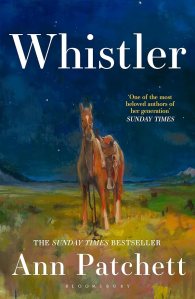
Before the meeting: This is a story about a web of relationships among middle class people in north-eastern USA. It starts when the narrator, 54 year old school-teacher Daphne Fuller, is wandering through the Metropolitan Museum of Art. Her hospital administrator husband, Jonathan (excellent name, correctly spelled) notices that an older man has been surreptitiously following them. They charge through gallery after gallery to shake him off, but he catches up and reveals that he is Eddie, Daphne’s stepfather. But her stepfather’s name is Lucas. Then in a flash she remembers that her mother married twice after her first marriage ended, and she has completely forgotten Eddie, her first stepfather.

She has forgotten him, but in his brief time in the father role, she loved him with a passion. As the novel unfolds we come to know Eddie as a universally loved book editor, we learn the story of his marriage to Daphne’s mother and, crucially, Daphne remembers and tells for the first time the story of a road accident in which she and Eddie were involved when she was nine years old and he was 32.

It’s an enjoyable read, with a smooth New York wit and a gallery of pleasantly interesting characters. I wasn’t bored but I found myself wondering if there was any point to it. Then, towards the end, Daphne happens on a moment of tenderness between two other characters:

I wondered what anyone ever knows about another person’s relationship.

Looking at these two men leaning against one another in the middle of the room like a couple of support beams, one of them too tired to even go and sit down, I realized the answer was nothing. I knew nothing at all.

I think that comes close to naming the book’s central theme. There are any number of relationships that are easy to sum up in a word or two. But look just a little bit closer and they are full of surprises. And, unlike in the familiar Long Day’s Journey kinto Night structure, it usually turns out that people are kinder, braver, more generous that they seem. Which may be exactly what many of us need in a book just now.

One little note: I wonder if anyone else found echoes of the children’s writing of William Steig in Eddie’s witty dialogue, and in particular of Brave Irene (link is to my blog post) in young Daphne’s blizzard adventure. Please say in the comments.

At the meeting: No one else was much interested in my Brave Irene reference, though in reflecting about our discussion I think it is to the point.

Generally people felt that the book stayed on the surface of characters. But as we talked, it emerged, at least in my mind, that there’s a lot going on that you could easily skim over – much in the way a child can read something like Brave Irene without worrying about any deep themes. For instance, when one person said she was unconvinced by Daphne’s mother’s break-up with Eddy we did a group effort of teasing out her motivations. Someone else raised the question of whether there was something sexual going on between the adult Eddie and child Daphne trapped overnight in a crashed car in the book’s main event: I don’t think so, though it was certainly intimate and bonding, but the question was there. Or again, Daphne loved Eddie when he was her stepfather, which surely has something to sdo with her marrying a man 15 years older than her – if so, the book doesn’t make a point of it, and no one cares. Then there’s the delicious irony, which again is there without signposting, that the only character who is thoroughly negative is a man who once made a fortune from a series of books promoting positivity. (The irony of his negativity as opposed his fame resting on positivity is explicit, but not the meta-irony that he is the book’s beacon of negativity.)

That is to say, I was onto something. I await the opinion of my children’s literature–savvy readers.

The Book Club always discusses two books. Our companion to Whistler was The Nights Are Quiet in Tehran by Shida Bazyar, about which I plan to blog tomorrow. A very different book.

We ate an excellent dinner of fish and kipfler potatoes, followed by a lemon delicious pudding cooked from a TinEats recipe. After our book discussion we did a little karaoke using our hostess’s new toy.


I read Whistler and wrote the first pat of this post on Wulgurukaba country, the beautiful island of Yunbenun. The Book Club’s five members, all of settler heritage, met on Gadigal land, and I wrote the rest of the blog post on Wangal and Gadigal land. I gratefully acknowledge the Elders past and present of all those Nations who have cared for this country for millennia, and welcome any First Nations readers of this blog.
William Steig’s Shrek!

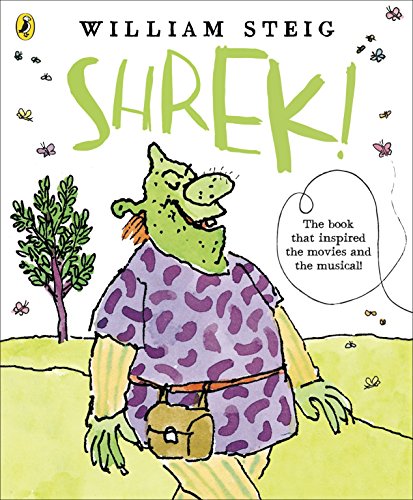
William Steig, Shrek! (©1990, Puffin 2017)

We recently watched the original Shrek movie with our grandchildren, and all four of us enjoyed it. Both our children were adults in 2001 when it was made, and grandchildren were a long way off, so I hadn’t seen the movie before, though though I’d seen clips. Nor had I been drawn into the rest of the Shrek franchise – half a dozen movies, a Broadway musical, a theme park beside the Thames. But I was aware that behind it all was a book by the great children’s author-illustrator William Steig.

When we told our six-year-old, a voracious reader, about the book she was interested, so we borrowed a copy from the library.

The six-year-old read it, said she had enjoyed it, then put it aside. I read it to the four-year-old, he said he enjoyed it, but didn’t demand an immediate reread.

I think it’s a case of the movie adaptation of a book making the book unreadable – not in the sense that it’s a difficult or unpleasant experience, but that the much broader, louder, and sentimental effects of the movie make the sly, deadpan humour and linguistic charm of the original almost impossible to discern. For example, in the movie, Shrek’s love interest starts out as a stereotypically beautiful princess, and when (spoiler alert!) she turns into an ogre she still has a degree of feminine cuteness. The love interest in the book is hideous on first encounter and remains hideous: we are never invited to see past her or Shrek’s surface ugliness to their inner beauty and goodness. Steig’s book doesn’t lose its nerve. The central joke, that the hero and then his love interest have no redeeming qualities, holds firm, and the book trusts its readers to get it. We quite like that they are pleased with themselves and each other, but we don’t have to like them at all.

That reversal of conventions and the absence of reassurance are what make the book fun.

The pages of our library copy aren’t numbered, but by my count, this is page 7:

As you can see, William Steig’s Shrek has none of the movie Shrek’s gross charm. He’s just gross.

A witch has sent Shrek on a quest to find the princess he will wed. On the previous page he has encountered a peasant scything a field. The peasant has uttered a few lines of verse about his unconsidered life, and now this.

The rhyming wordplay – Pheasant, peasant … pleasant present – is typical of the joyful use of language throughout the book. The unconscious peasant, blue in the face where on the previous page he was a healthy pink, didn’t cause any evident distress in our young readers. I think they got the joke. It’s typical of Steig’s respect for young readers that he doesn’t spell out how the peasant lost consciousness. (We love Steig’s Doctor De Soto and Sylvester and the Magic Pebble for their similar tact.)


I wrote this blog post in Gadigal Wangal country. I acknowledge Elders past, present and emerging for their continuing custodianship of this land, over which their sovereignty has never been ceded.


* My blogging practice is generally to focus on the page that coincides with my age, currently 77. For short books like Shrek, I am stuck with page 7.

Ruby Reads 28: Mostly William Steig

A good friend who has a vast library of children’s books decided it might be time for Ruby to meet William Steig, one of the greats of US children’s literature. Shrek is his best known book, but wasn’t among the swag she lent us. The four books in our swag have been read many times by many children over the decades, and needed to be treated with great care. After we read them to Ruby, we decided to get hold of copies we could keep and manhandle. It turned out that none of the three public libraries I belong to have copies; I’ve ordered them from bookshops, but it will take months for them to arrive from ‘suppliers’.


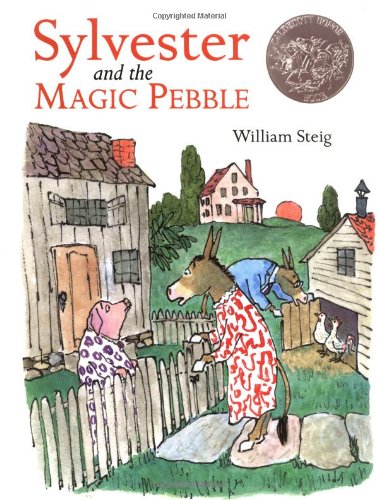
William Steig, Sylvester and the Magic Pebble (©1969, Simon & Schuster 2005)

Sylvester is a donkey who finds a pebble that grants his wishes. As you’d expect, one of his wishes goes terribly wrong. The wonder of this book is that the wrongness isn’t Sylvester’s fault: his wish is a clever response to a real threat, so the pickle it lands him in isn’t a punishment. All the same, the bulk of the book has poor Sylvester trapped and immobile, while his parents search for him desperately.

The suspense is terrible. All the more, because z– not to give anything away – the reader can see just how close Sylvester is to a solution to his problem. Yet the happy end, when it comes, is a huge relief.

We’ve only read this once, but it feels as if it will be part of Ruby’s repertoire for a while. We had to play a game based on it, but Ruby instructed us to make up our own wishes. So the appeal of th story so far seems to be in the idea of a tiny red stone with magic powers.


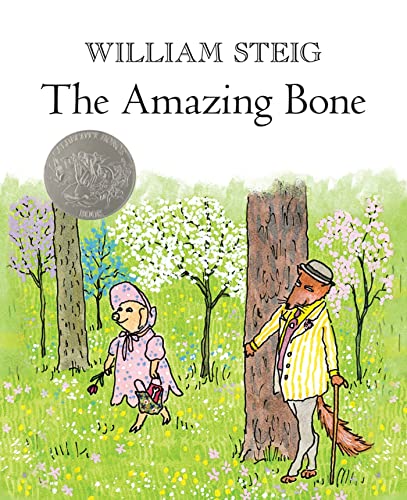
William Steig, The Amazing Bone (©1976, Puffin 1981)

Pearl is a pig who dresses in pink (always a winner with Ruby: ‘Did you know my favourite colour is pink, Poppa?’ ‘Yes, I had gathered that somehow’). One day, relaxing in the woods, she discovers and befriends a magical talking bone.

The bone is much more active than the pebble in the earlier book, and the dangers that Pearl faces are more dramatic: first some masked bandits, and then a suave and hungry fox. The bone scares the bandits off without breaking a sweat, but the fox is another matter.

Needless to say, Pearl and the bone escape the fox and, like Sylvester, Pearl returns to her parents. But whereas the pebble was locked in a safe out of harm’s way, the bone lives on in pride of place in Perl’s household.

I’d hesitated to read this to Ruby because she tends not to like scary stories. But she loved it


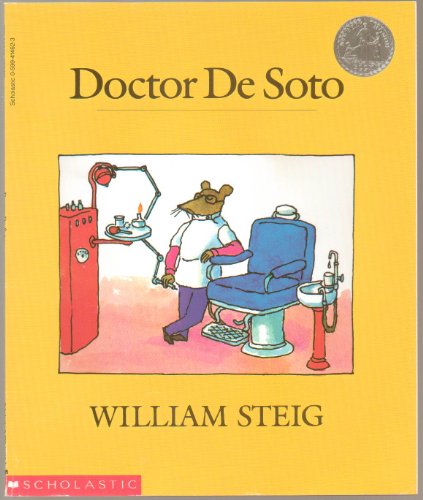
William Steig, Doctor De Soto (Farrar Straus & Giroux 1982)

Doctor De Soto is a mouse who is also an excellent dentist. For work health and safety reasons, dangerous animals such as cats are banned from his practice. One day, however, a dapper fox who is in extreme pain from toothache pleads for his help. Doctor De Soto and his wife, who is also his able assistant, reluctantly take pity on the wretched creature and remove the troublesome tooth. But they know, and we know, that the fox is still a fox and will eat them both once he is relieved of his pain. (Spoiler alert: Doctor de Soto and his wife outsmart the fox and stay safe.)

There are comic-terrifying images of the mouse-dentist actually going inside the fox’s mouth, with its huge sharp teeth. Ruby kept her hands at the ready to clamp over her ears each time this happened, but decided over and over to let the story continue: ‘I think they’ll escape,’ she said. I think she had the crocodile’s jaws in Jonny Lambert’s Let’s All Creep Through Crocodile Creek (see below) as a reference point, and so was prepared to trust the story teller not to hand her a steaming pile of tragedy.

As for me, I love Doctor and Mrs De Soto for their courage, compassion, and quick-wittedness. I also love the dapper and unscrupulous fox, who may actually be the same fox who troubled Pearl and the bone, now recovered from what they did to him.


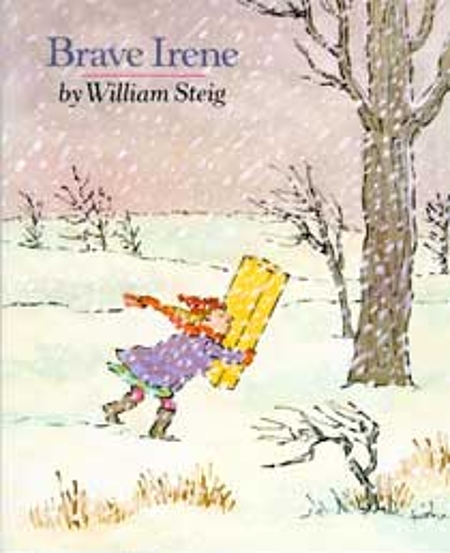
William Steig, Brave Irene (©1986, Victor Gollancz Ltd 1987)

Irene is a young human. Her mother has made a dress for the Duchess, but is taken ill and can’t deliver it in time for the ball. When Irene offers to deliver it for her, the mother can see no other option and reluctantly agrees. So brave Irene struggles on through page after page of blizzard. She rides on the dress’s package like a sled, and when the wind snatches the beautiful dress from her, she struggles on anyway because it would be even harder to return home.

It all turns out well in the end.

I’m not sure Ruby quite got this book, but I’m hoping it will grow on her. Irene is no Disney princess, which is a plus from my point of view, but not so much from Ruby’s.


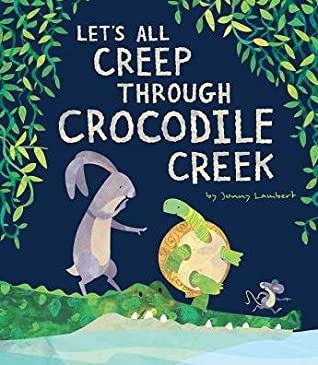
Jonny Lambert, Let’s All Creep Through Crocodile Creek (Little Tiger Press 2019)

I had to read this book to myself in order to understand what I had to do when Ruby said, ‘I’m the mouse, you’re the rabbit and Nanna is the turtle.’

Three animals take a short cut across a creek. The mouse is the leader who knows it’s safe because they have never seen a crocodile in this creek. The turtle is a little bit thick and has to have everything explained to her/him: ‘What does a crocodile look like?’ and so on. The rabbit is all too aware of the dangers and preaches caution.

As they cross the creek, the three adventurers keep seeing things that match up to the mouse’s description of crocodiles: from bumpy, scaly backs to big eyes and very sharp teeth. The mouse pooh poohs the similarities, the turtle asks more questions, and the rabbit understands the danger they are in all too well but her/his cries fall on deaf ears.

It’s a lot of fun. Thanks to the interplay of text and image, we understand what is going on so much better than the characters, so the pleasures of the unreliable narrator can begin at an early age. And in our case, the book is perfect for re-enactments if you have two willing collaborators. It may seem odd to write about this in the same blog post as the William Steig books, but the link is there in the scary teeth.