Category Archives: Page 7

William Steig’s Shrek!

William Steig, Shrek! (©1990, Puffin 2017)
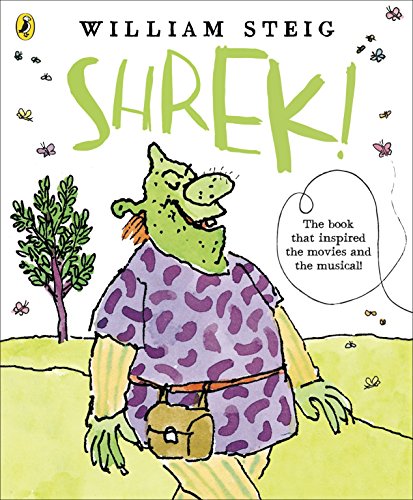
We recently watched the original Shrek movie with our grandchildren, and all four of us enjoyed it. Both our children were adults in 2001 when it was made, and grandchildren were a long way off, so I hadn’t seen the movie before, though though I’d seen clips. Nor had I been drawn into the rest of the Shrek franchise – half a dozen movies, a Broadway musical, a theme park beside the Thames. But I was aware that behind it all was a book by the great children’s author-illustrator William Steig.

When we told our six-year-old, a voracious reader, about the book she was interested, so we borrowed a copy from the library.

The six-year-old read it, said she had enjoyed it, then put it aside. I read it to the four-year-old, he said he enjoyed it, but didn’t demand an immediate reread.

I think it’s a case of the movie adaptation of a book making the book unreadable – not in the sense that it’s a difficult or unpleasant experience, but that the much broader, louder, and sentimental effects of the movie make the sly, deadpan humour and linguistic charm of the original almost impossible to discern. For example, in the movie, Shrek’s love interest starts out as a stereotypically beautiful princess, and when (spoiler alert!) she turns into an ogre she still has a degree of feminine cuteness. The love interest in the book is hideous on first encounter and remains hideous: we are never invited to see past her or Shrek’s surface ugliness to their inner beauty and goodness. Steig’s book doesn’t lose its nerve. The central joke, that the hero and then his love interest have no redeeming qualities, holds firm, and the book trusts its readers to get it. We quite like that they are pleased with themselves and each other, but we don’t have to like them at all.

That reversal of conventions and the absence of reassurance are what make the book fun.

The pages of our library copy aren’t numbered, but by my count, this is page 7:

As you can see, William Steig’s Shrek has none of the movie Shrek’s gross charm. He’s just gross.

A witch has sent Shrek on a quest to find the princess he will wed. On the previous page he has encountered a peasant scything a field. The peasant has uttered a few lines of verse about his unconsidered life, and now this.

The rhyming wordplay – Pheasant, peasant … pleasant present – is typical of the joyful use of language throughout the book. The unconscious peasant, blue in the face where on the previous page he was a healthy pink, didn’t cause any evident distress in our young readers. I think they got the joke. It’s typical of Steig’s respect for young readers that he doesn’t spell out how the peasant lost consciousness. (We love Steig’s Doctor De Soto and Sylvester and the Magic Pebble for their similar tact.)


I wrote this blog post in Gadigal Wangal country. I acknowledge Elders past, present and emerging for their continuing custodianship of this land, over which their sovereignty has never been ceded.


* My blogging practice is generally to focus on the page that coincides with my age, currently 77. For short books like Shrek, I am stuck with page 7.
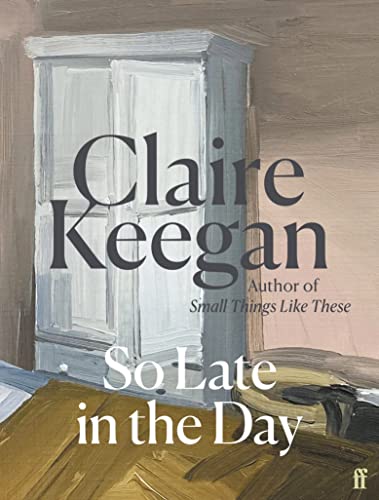
Claire Keegan’s So late in the day

Claire Keegan, So Late in the Day (Faber & Faber 2023)

This book consists of a single short story by Claire Keegan. The story appeared in The New Yorker in February 2020. It was one of four short stories that made up the collection So Late in the Day: Stories of Women and Men (February 2022). Keegan’s French publisher first issued it in standalone form in May 2022 under the title Misogynie. Faber followed suit in 2023 with this attractive little front-counter hardback, perfect for a small gift – and it came into my possession as such a gift.

The story follows its protagonist, Cathal, through a lacklustre afternoon at work in an office in Dublin, the bus journey home, and an evening alone (not counting the cat) with his thoughts and memories, or avoiding them, in front of whatever happens to be on the television (mainly a documentary on Diana Spencer), eating whatever happens to be in the fridge. It’s a picture of desolation, the cause of which gradually emerges. It’s a self-inflicted disaster brought on by habitual and socially endorsed – not a spoiler because the French title gives it away – misogyny.

This isn’t the only fiction created by a woman that purports take us inside the head of a man behaves in ways that enrage women, but few can have done it so elegantly. Claire Keegan does a brilliant job of leaving her own rage out of the picture. (‘The first rule of writing fiction,’ Sebastian Barry said at the Sydney Writers’ Festival on the weekend, ‘is don’t write angry.’) Even the rage of the main female character is left to be deduced from what Cathal remembers of conversations with her. He catches a fleeting glimpse of where he has gone wrong, and even surmises how things might have been different back in his teenage years. Whether that glimpse and that surmise will lead anywhere or sink back into the deadly routine of work and television is a question the story doesn’t go into.

On page 7*:

Cathal is on his way home from work in a bus and all we’ve had is hints that he’s not happy. He sits next to a large woman who slides closer to the window to give him room. She’s on for a chat about the weather, opening brightly, ‘Wasn’t that some day.’ On second reading we know how painful that sentence is for Cathal, but all we get on the surface is, ‘ “Yeah,” Cathal said.’ Each for their own reason, neither Cathal not Claire Keegan needs to spell out the undercurrents.

Further down the page:

‘How about you?’ she said. ‘Any plans for the long weekend?’
‘I’m just going to take it easy,’ Cathal said, threading the speech into a corner, where it might go no further.

He’s civil, and well versed in avoiding real communication. And the unobtrusive metaphor sewing metaphor reminds us that the narrator is seeing more here than the character is showing. The story is full of such quiet, sharply observed moments.

You can hear Claire Keegan reading the story on the New Yorker website. Click here if you’re interested. She reads it beautifully, and it only takes 45 minutes.


I wrote this post on the unceded land of Gadigal and Wangal of the Eora Nation, finishing it on a day when the lorikeets in the gums nearby are still rowdily celebrating the dawn at 8 o’clock in the morning.


* My arbitrary blogging practice is to focus on the page of a book that coincides with my age, currently page 77, or for books with fewer pages than that, on the year of my birth, 47. This book ends on page 47 and it would be a bit bad to give away the last lines, so I’m picking page 7.

Two very slim volumes by Annie Ernaux

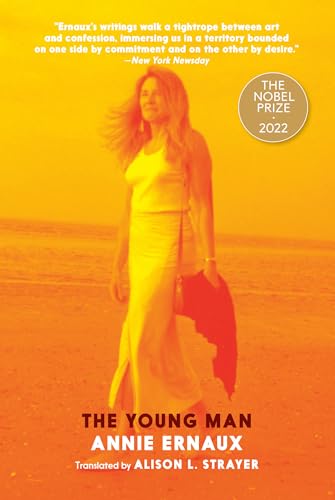
My family still give each other far too many presents at Christmas, but I’m not complaining. Among the many thoughtful gifts I received recently were these two tiny books by Annie Ernaux. The first is the story of a sexual relationship the writer had with a much younger man when she was in her mid 50s; the second is the text of her Nobel Lecture, delivered in Stockholm in December 2022. Each of them includes about 20 pages of supplementary material, with a lot of overlap between the books: photographs, a ten-page self-written biography, praise for Ernaux’s other books. They’re clearly designed to catch impulse buyers at the till, but they are written by the incomparable Annie Ernaux and I love them.

Neither book has a page 76, or even a page 47, so my usual arbitrary blogging practice is stymied.


The Young Man (Le jeune homme © 2022, translated by Alison L Strayer, Seven Stories Press 2023)

Page 7 of The Young Man is its epigraph:

If I don’t write things down, they
haven’t been carried through to completion,
they have only been lived.

Which captures perfectly the nature of this book. It serves to complete a strangely inconclusive episode in the writer’s life.

Dates at the end of the text indicate that it was written over a span of time, from 1998 to 2000, perhaps immediately after the relationship ended, and then prepared for publication – rewritten? – in 2022. It shows the signs of both dates. There’s the freshness of description of, say, sleeping together in his cold student flat, or of feeling the gaze of other people when they lie on the beach together, a gaze that neither of them would have attracted solo. And then there are reflections that have had time to mature:

In more than one domain – literature, theatre, bourgeois customs – I was his initiator, but the things I experienced because of him were also initiatory. My main reason for wanting our story to continue was that, in a sense, it was already over and I was a fictional character within it.

(page 28)

After that last comment, she continues: ‘I was aware that this entailed a kind of cruelty towards this younger man who was doing things for the first time.’

There are at least two high-profile fictional works around at the moment in which an older woman has a sexual ‘affair’ with a boy, Ian McEwan’s novel The Lessons and Todd Haynes’s movie May December. This is not that. This unnamed young man was in his twenties, and Annie Ernaux was not his teacher. There is no question of criminality, but some of the same ethical issues arise. She was an admired cultural figure to whom he could barely speak when they first met in person. She does not spare herself in the writing, but nor does she rush to judgement. As that tiny excerpt illustrates, class is always an issue, and there is a constant sense of the feedback loop between her life and her art.

The copious photos that the publishers have included to make up a decent number of pages attest to the fact that she was, and is, gorgeous. The young man didn’t love her just to learn bourgeois customs.


I will write to avenge my people (©2023, translated by Alison L Strayer, Fitzcarraldo Press 2023)

The title of Ernaux’s Nobel lecture comes from something she wrote in her diary in her early 20s: ‘J’écrirai pour venger ma race.‘ She expands on this sentence in the lecture:

I proudly and naively believed that writing books, becoming a writer, as the last in a line of landless labourers, factory workers and shopkeepers, people despised for their manners, their accent, their lack of education, would be enough to redress the social injustice linked to social class at birth.

(page 12)

The lecture traces the way she moved away from this goal, until she was brought back to it ‘through byroads that were unseen and proximate’. And it explains beautifully her central preoccupation with telling intimate stories from her own life (The Young Man among them):

This is how I conceived my commitment to writing, which does not consist of writing ‘for’ a category of readers, but in writing ‘from’ my experience as a woman and an immigrant of the interior; and from my longer and longer memory of the years I have lived, and from the present, an endless provider of the images and words of others. This commitment through which I pledge myself in writing is supported by the belief, which has become a certainty, that a book can contribute to change in private life, help to shatter the loneliness of experiences endured and repressed, and enable beings to reimagine themselves.
When the unspeakable is brought to light, it is political.

(pages 19-20)

(Alison L Strayer has rendered both this lecture and The Young Man into impeccable English. I do wonder, though, whether ‘internal migrant’ might have been better than ‘immigrant of the interior’. I haven’t read the original, but I believe Ernaux is referring to her ‘migration’ from rural working class to the lettered bourgeoisie as opposed to migration between countries.)

There’s a lot more. If you see this little book on the front counter as you’re leaving a bookshop, let yourself be tempted.

José Saramago’s Tale of the Unknown Island

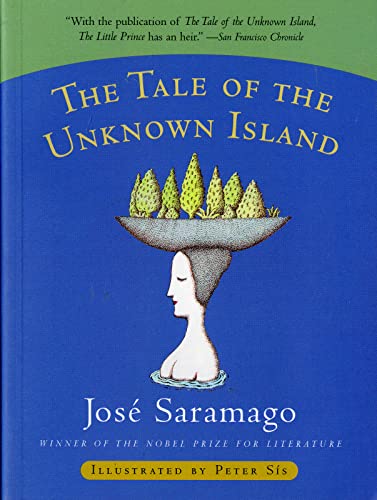
José Saramago, The Tale of the Unknown Island (translated by Margaret Jull Costa, illustrated by Peter Sís 1999)

This is one of those tiny, beautifully designed books that sit at the front of bookshelves offering themselves as last-minute birthday gifts. At least, that’s how I think it came to be sitting on my to-be-read bookshelf for years, possibly decades. I don’t remember who gave it to me, but I’m glad they did.

José Saramago published this very short, parable-like story in 1997 in Portuguese with the title O conto da ilha desconhecida. This version, translated into crystal clear fairy-tale English by Margaret Jill Costa and illustrated by the brilliant children’s illustrator Peter Sís, followed two years later.

In 2017 the story was adapted for the stage by Ellen McDougall and Clare Slater and performed at the Gate theatre in London with the title The Unknown Island (the Guardian‘s enthusiastic review here).

It’s not a children’s book, but it builds on conventions of children’s literature. A man appears at a gate of the king’s castle and asks for a boat. He refuses to be sent away, and the story goes from there. He wants the boat in order to set sail to find the unknown island. Everyone, from the king to the cleaning lady, tells him that there are no more unknown islands, but he persists, first in his request and then, when (not a spoiler really) the king gives him a boat, in persuading other people to help on the quest.

It’s a parable about creativity, or perhaps about scientific enquiry. Certainly it resonates against the kinds of things that reactionary politicians say regularly about university research grants (as in this example from almost exactly a year ago). But it twists and turns, slipping out from under such neat encapsulations. Naive readers like me will be surprised and delighted by how it turns out.

The book was perfect for reading in the sauna, and I read it there in two sessions, both of them with quite a lot of chat eating into potential reading time. Sadly the glue holding my beautiful little book together couldn’t withstand the heat, so now I need to handle it with great care.

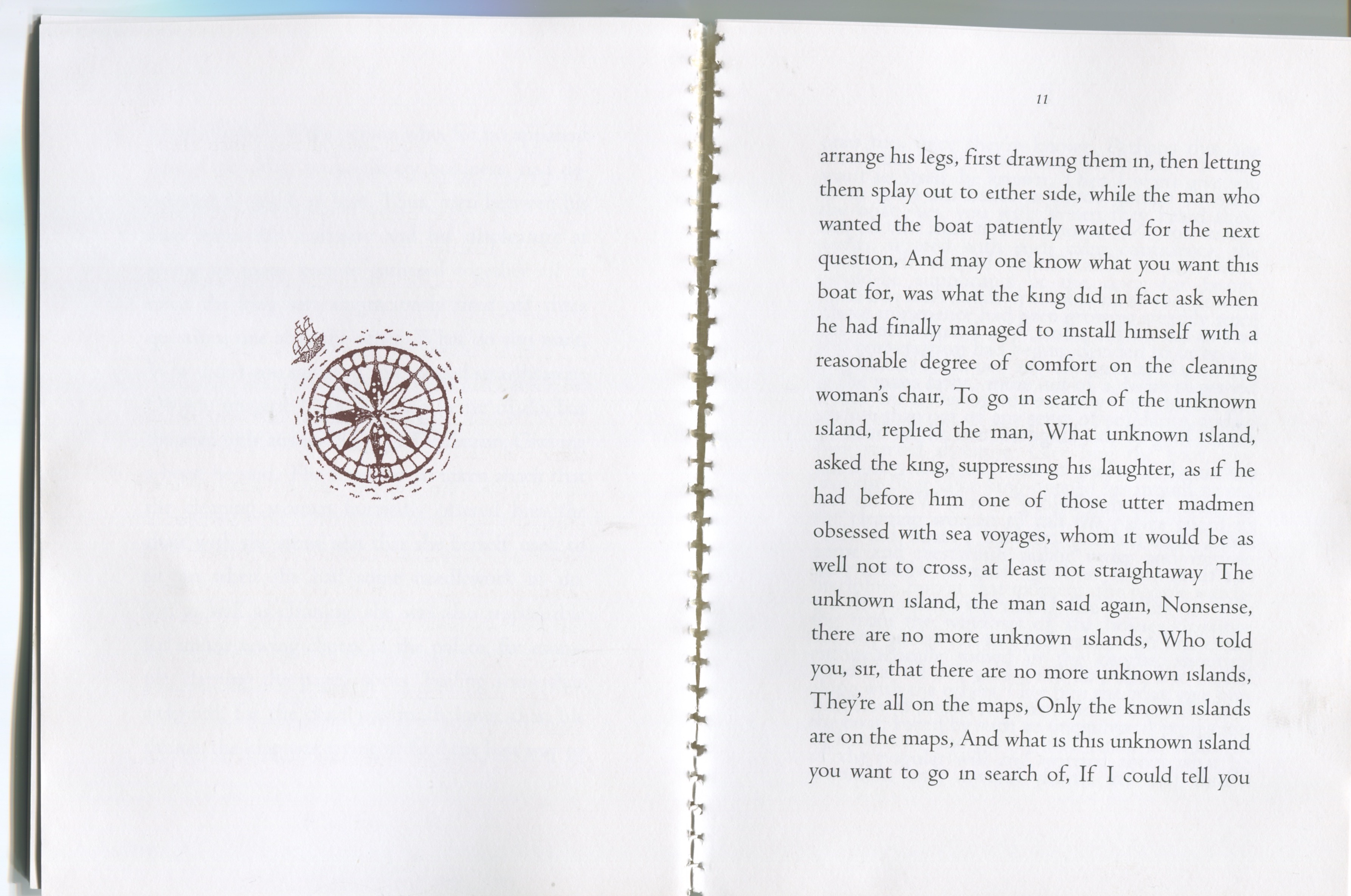
For a closer look, I can’t take a snapshot of page 75*, because there are only 51 pages. Assuming that page 75 is usually about a fifth of the way through a novel, I’ll focus instead on pages 10 and 11. Here they are, heat damage and all, at the beginning of the king’s encounter with the man who wants a boat:

Peter Sís’s compass sits in the middle of the left hand page, silently endorsing the man who wants a boat. All his illustrations have a similar simplicity of line, and make similar luxurious use of white space, though some of them, like the cover image above, have a weird, surrealist quality.

This is early in the book. The king has condescended to meet the man at the door for petitions, a door he rarely visits in person, and his discomfort manifests as awkwardness in the only chair available, which belongs to the cleaning woman (who is to feature prominently in the rest of the story).

Characteristically, the narrative isn’t broken up with a paragraph for each speaker, and sometimes the transition from one speaker to another doesn’t even merit a full stop. Commas will do, suggesting that we don’t need to pause over the king’s questions, because the man will answer them easily – whether he is indeed ‘one of those utter madmen’ or not. (He’s not. But though his insistence that unknown islands still exist is impeccably logical, he’s not what any conservative arts fund would consider a sound prospect either.) So on the one hand there’s a fine, childlike simplicity to the narrative, but on the other there’s an unsettling edge to its presentation. That unsettling quality becomes more marked as the story progresses.

José Saramago received Nobel Prize for Literature in 1998. The press release accompanying the announcement described him as a writer ‘who with parables sustained by imagination, compassion and irony continually enables us once again to apprehend an elusory reality’. This little book with its hugely resonant tale is my excellent introduction to his riting.


* Currently when blogging about books I take a closer look, arbitrarily, at page 75 – moving on to page 76 at my next birthday if the idea works well enough.