
Jo Langdon, Delivery (Vagabond Press 2026)
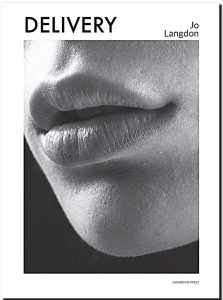
I’ve read and enjoyed a number of Jo Langdon’s short stories in literary journals over the years, and her name has cropped up on this blog more than once (at this link if you’re interested). When she wrote me a gracious email offering a copy of her new book of poetry, I was delighted. I was also apprehensive: her stories deal with dark subjects including schoolgirls’ cruelty, entitled misogyny, and the shadow of family violence.
As it turned out, I loved the book from the very first poem, ‘Tend’, which is one of a number of poems dealing with what the back-cover blurb calls the postpartum experience. I don’t want to say more about it here – an earlier draft of this blog post went on at great length without saying much besides that it’s a terrific poem. If you want to read it, you can find it at this link, on the website of Island, where it was first published. (Trigger warning: it’s a postpartum poem that mentions the perineum and stitches.)
The thing is, the poems about childbearing, powerful though they are, feel like a sideshow to the book’s main event. The third poem in the book, ‘Disambiguate’, declares:
She never wanted to write
birth poems.
The poems she did want to write, evidently, are those that make up more than half of the book, devoted to the life and work of Alina Szapocznikov (1926–1973), Polish sculptor and Holocaust survivor. I hadn’t heard of Szapocznikov. It’s a sign of the poetry’s effectiveness that I have now spent far too much time looking at her work online. It’s an engrossing process: read the poem, look at the sculpture it names, read the poem again with different eyes.
For example, these lines from ‘Indexicality’, which may have inspired the book’s cover, describe a sculpture:
The Bachelor's Ashtray
– cast from the artist's own

mouth, chin and neck (each doubled) –
into which are embedded real cigarette butts
When you see the actual work (at this link or this one), the horror of the lines comes into clearer focus, and Langdon’s gloss – ‘cast from the artist’s own’ – adds an extra frisson.
A long poem, ‘Body of Work, or Outline’, which gives a brief version of Szapocznikov’s life story, includes a brilliant analogy for the poet’s fascination with her:
body burdensome, a load. Perhaps the writer is
(I am, in this) the nuisance ghost, reaching, imposing
textual expression – language in which Szapocznikov lives

(but) for too short a time –
The book’s third section, ‘Thesamealina’ (the quote marks are part of the title), is one long poetic sequence. Having learned that with contemporary poetry the author’s notes can provide invaluable help to the reader, I checked the endnotes. ‘Thesamealina’, I learned, is found poetry comprising textual fragments taken from Szapocznikov’s letters to Ryszard Stanisławski. The latter, I learned elsewhere, was her first husband, an art historian and museum director. The poems aren’t concerned with the particulars of time and place, or relationship. Some are from letters written in hospital, others seem to come from the midst of a working artist’s life; some imply marital intimacy, others feel more like words an artist might address to a friendly gallery owner. That Stanisławski was Szapocznikov’s husband I learned from Wikipedia rather than from the poems themselves.
My first impulse with this sequence was to try to extract a story: where is Szapocznikov writing from, why is she apart from her husband, what does she mean when she refers to his ‘ladies’ and her men, what insights can be gleaned into her art, her political and cultural milieux? The poem has a documentary dimension, so it makes sense to ask these questions, to want to know more about its subject. And there is an overarching story. But at the same time, it is poetry, so it’s important to attend to the words on the page, to not give over completely to the extractive impulse. Interestingly, only when I set about describing the poem here did I actually go to Wikipedia.
So, here’s page 79*, part of ‘Thesamealina’:
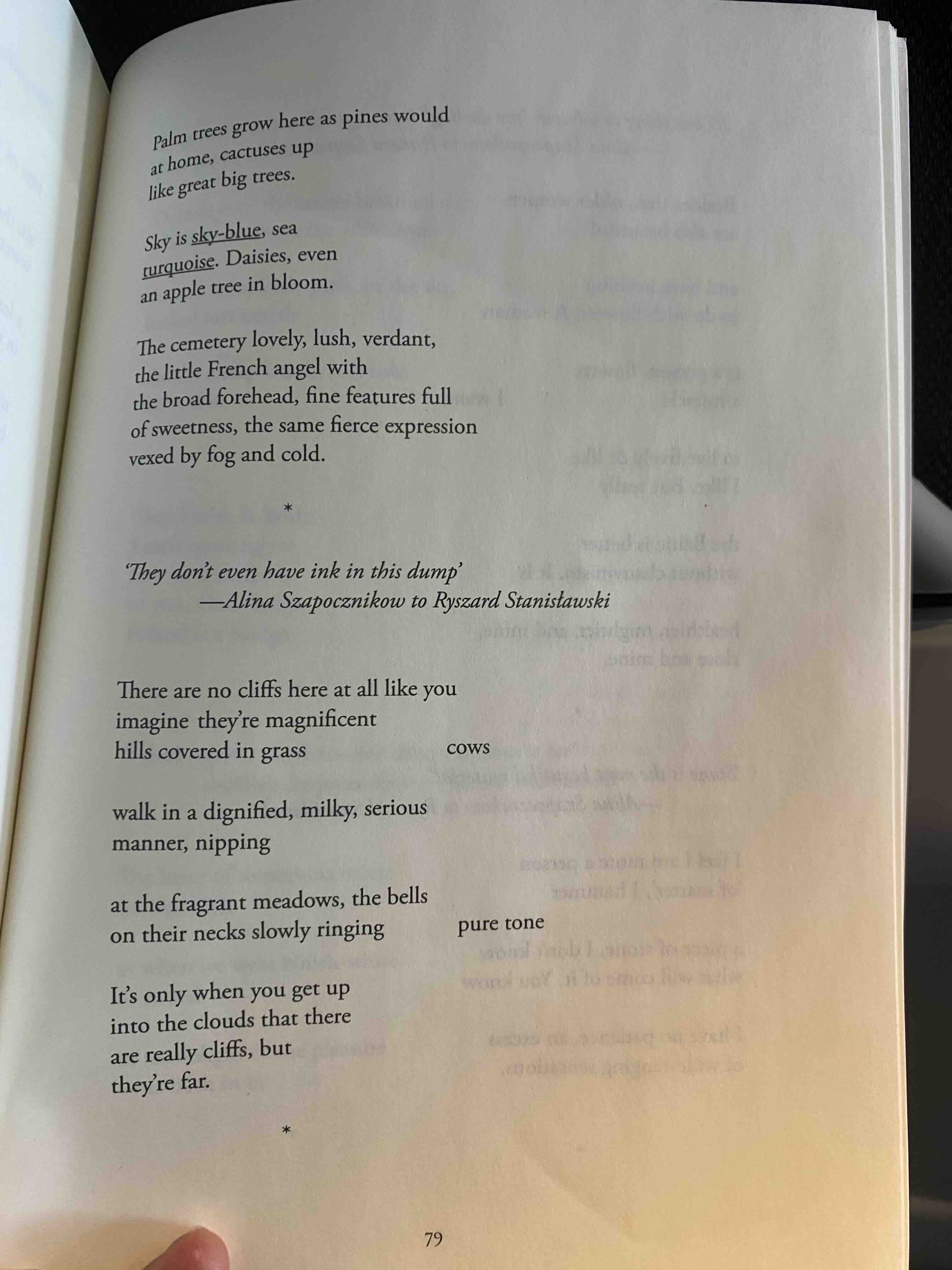
Perhaps these are just passages copied directly from letters with added line breaks, and the poetry is mainly in the selection. Perhaps text has been omitted, reassembled, or otherwise tailored. As readers, we don’t know, and don’t need to know. It’s enough that this is Szapocznikov’s voice, filtered to us by Langdon. We are reading Langdon’s reading of Szapocznikov. The underlining draws our attention to the text’s origins in a handwritten letter, clearly a letter home from somewhere that is not Poland. (My Wikipedia research doesn’t offer any suggestions of a place that has palm trees and cactus.)
Palm trees grow here as pines would
at home, cactuses up
like great big trees.

Sky is sky-blue, sea
turquoise. Daisies, even
an apple tree in bloom.

The cemetery lovely, lush, verdant,
the little French angel with
the broad forehead, fine features full
of sweetness, the same fierce expression
vexed by fog and cold.
Just as you think it’s a matter-of-fact traveller’s letter, that sweet little angel in the ‘lovely, lush, verdant’ cemetery brings a note of fierce vexation. And the sound of the words emphasise the change – after all the flowing language, the three one-syllable words in the last line bring one up short.
'They don't even have ink in this dump'
—Alina Szapocznikow to Ryszard Stanisławski
The sequence is punctuated by ten one-liners like this. All but one of them are attributed: ‘Alina Szapocznikow to Ryszard Stanisławski’; the other is from him to her. They don’t have direct bearing on the poems that follow, except perhaps to ground them in actual letters, in this case to clarify that the letters are written from some kind of exile, perhaps in the Jura mountains.
There are no cliffs here at all like you
imagine they're magnificent
hills covered in grass_________________ cows

walk in a dignified, milky, serious
manner, nipping

at the fragrant meadows, the bells
on their necks slowly ringing_______ pure tone

It's only when you get up
into the clouds that there
are really cliffs, but
they're far.
It’s another letter home. I’m a sucker for cows in poetry. I love that space before and after cows – it conjures up a landscape dotted with cows, and then moving in to closeup so we see their ‘dignified, milky, serious / manner’. I don’t care who came up with that string of adjectives: if it was Szapocznikow, I’m glad Langdon put this frame on it. Then, like the top part of the page, there’s an unsettling note in the last lines. The poem moves from ‘There are no cliffs’ to ‘there / are really cliffs’. The resonances and possible impicatiuons are legion.
Again, we are reading Langdon’s reading of Szapocznikov, an interesting, complex, tantalising business.
If you’re reading this and have read the book, or even part of it, I’d love to hear your take on it.
My copy of Delivery is a gift from the author.
I am a man of settler heritage living on Gadigal Wangal country, where spiders are everywhere and teh bogong moths have mostly come and gone. I acknowledge Elders past, present and emerging for their continuing custodianship of this land, and welcome any First Nations readers.
* My blogging practice is to focus on the page that coincides with my age, currently 79.


