
Helen Garner, How to End a Story: Collected Diaries 1978–1998 (Text Publishing 2025)
– page 693 to the end, all in 1998.
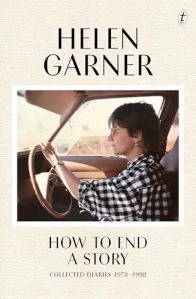
It has taken me six months to read Helen Garner’s diaries. It took her 20 years to write the first draft and who knows how long to get them into publishable shape another 20 years later.
The last 80 pages are largely anticlimax. Helen has finally realised the extent of V’s deception of her and had her massive, destructive tantrum. Then there have been attempts on both parts to see if the marriage can continue. V calls it ‘an enormous bloody blip’ and talks about ‘having another crack’, ‘blowing on the embers’. Helen goes on a trip to Antarctica, and writes notes in a separate notebook from ‘this book of shit and misery’. A rat in the apartment provides a novelistic metaphor – as does a blue sofa in the basement of David Jones in the city. V goes to England for seven weeks to do publicity for his book, and Helen gets a taste of living happily alone, able to have her daughter to stay. Helen has a long phone conversation with ‘X the painter’ in which they compare notes and realise how much V has lied to each of them about the other. At last Helen decides it’s over, and moves out. One of the removal men asks if that’s her ex in there, and when she says it is, he says, ‘His loss.’
It’s incredibly painful.
Then on the second last page they make the equivalent of end-of-marriage vows. On the last page she buys the blue sofa, and the final words of the book are ‘wordless rapture’.
It reads like a novel. I had to keep reminding myself it’s not. It doesn’t claim to be an accurate account of events, but a minimally cleaned-up version of what Garner wrote in the thick of things. Soon after I finished reading it, I heard a podcast interview with Kerrie Lumbewe, a psychologist who specialises in relationship counselling. She spoke of a ‘distance and pursuer’ dynamic in which one person, usually a man, hides his emotions and another, usually a woman, hounds him to express them. She said she saw the look on her husband’s face when they were caught up in this dynamic and realised he was suffering. And it came to me that even as Garner is describes her terrible rows with V, she records his facial expressions, his body language, the words he uses, and so she leaves space for a reader to see things differently from her. And even at her most enraged, she struggles to identify how much of the mess is her responsibility.
When I read The Spare Room, I felt it was important to distinguish between Helen the character and Helen the writer, the latter being a not wholly uncritical teller of the former’s inner life. The same is true here.
Here’s a footnote to end with. Over many of the years covered by these diaries, Helen’s life is seriously curtailed because V needs the space to write a novel: she agrees to live without a garden, without being able to have her daughter to stay, without being in the flat during the day most days. The novel is published to great acclaim as the marriage is disintegrating, and V thinks the sacrifices were worth it. There’s a grim satisfaction to be had from noting that Murray Bail’s novel Eucalyptus (1998) came in 83rd in the ABC’s Top 100 Australian Books (full list at this link), while three of Helen Garner’s books ranked higher: Monkey Grip (1977), and two that were written after the marriage ended, Joe Cinque’s Consolations (2004), and This House of Grief (2014).
I am a man of settler heritage. I wrote this blog post on Gadigal and Wangal land. I acknowledge their Elders past and present and welcome any First Nations readers.


