Tag Archives: Ann Patchett

Ann Patchett’s Whistler at the Book Club

Ann Patchett, Whistler (Bloomsbury 2026)
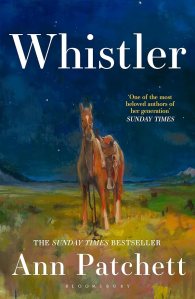
Before the meeting: This is a story about a web of relationships among middle class people in north-eastern USA. It starts when the narrator, 54 year old school-teacher Daphne Fuller, is wandering through the Metropolitan Museum of Art. Her hospital administrator husband, Jonathan (excellent name, correctly spelled) notices that an older man has been surreptitiously following them. They charge through gallery after gallery to shake him off, but he catches up and reveals that he is Eddie, Daphne’s stepfather. But her stepfather’s name is Lucas. Then in a flash she remembers that her mother married twice after her first marriage ended, and she has completely forgotten Eddie, her first stepfather.

She has forgotten him, but in his brief time in the father role, she loved him with a passion. As the novel unfolds we come to know Eddie as a universally loved book editor, we learn the story of his marriage to Daphne’s mother and, crucially, Daphne remembers and tells for the first time the story of a road accident in which she and Eddie were involved when she was nine years old and he was 32.

It’s an enjoyable read, with a smooth New York wit and a gallery of pleasantly interesting characters. I wasn’t bored but I found myself wondering if there was any point to it. Then, towards the end, Daphne happens on a moment of tenderness between two other characters:

I wondered what anyone ever knows about another person’s relationship.

Looking at these two men leaning against one another in the middle of the room like a couple of support beams, one of them too tired to even go and sit down, I realized the answer was nothing. I knew nothing at all.

I think that comes close to naming the book’s central theme. There are any number of relationships that are easy to sum up in a word or two. But look just a little bit closer and they are full of surprises. And, unlike in the familiar Long Day’s Journey kinto Night structure, it usually turns out that people are kinder, braver, more generous that they seem. Which may be exactly what many of us need in a book just now.

One little note: I wonder if anyone else found echoes of the children’s writing of William Steig in Eddie’s witty dialogue, and in particular of Brave Irene (link is to my blog post) in young Daphne’s blizzard adventure. Please say in the comments.

At the meeting: No one else was much interested in my Brave Irene reference, though in reflecting about our discussion I think it is to the point.

Generally people felt that the book stayed on the surface of characters. But as we talked, it emerged, at least in my mind, that there’s a lot going on that you could easily skim over – much in the way a child can read something like Brave Irene without worrying about any deep themes. For instance, when one person said she was unconvinced by Daphne’s mother’s break-up with Eddy we did a group effort of teasing out her motivations. Someone else raised the question of whether there was something sexual going on between the adult Eddie and child Daphne trapped overnight in a crashed car in the book’s main event: I don’t think so, though it was certainly intimate and bonding, but the question was there. Or again, Daphne loved Eddie when he was her stepfather, which surely has something to sdo with her marrying a man 15 years older than her – if so, the book doesn’t make a point of it, and no one cares. Then there’s the delicious irony, which again is there without signposting, that the only character who is thoroughly negative is a man who once made a fortune from a series of books promoting positivity. (The irony of his negativity as opposed his fame resting on positivity is explicit, but not the meta-irony that he is the book’s beacon of negativity.)

That is to say, I was onto something. I await the opinion of my children’s literature–savvy readers.

The Book Club always discusses two books. Our companion to Whistler was The Nights Are Quiet in Tehran by Shida Bazyar, about which I plan to blog tomorrow. A very different book.

We ate an excellent dinner of fish and kipfler potatoes, followed by a lemon delicious pudding cooked from a TinEats recipe. After our book discussion we did a little karaoke using our hostess’s new toy.


I read Whistler and wrote the first pat of this post on Wulgurukaba country, the beautiful island of Yunbenun. The Book Club’s five members, all of settler heritage, met on Gadigal land, and I wrote the rest of the blog post on Wangal and Gadigal land. I gratefully acknowledge the Elders past and present of all those Nations who have cared for this country for millennia, and welcome any First Nations readers of this blog.

SWF 2020 Day One

This year, because of viral matters, the Sydney Writers’ Festival has gone virtual. According to its website, more than 50 re-imagined sessions from the 2020 program will be presented as podcasts over the next few months. I don’t usually blog about podcasts, but since I’ve been blogging about the Sydney Writers’ Festival for 16 years off and mostly on, why not? I’ve made a monetary donation to help the festival through this crisis (and you can too, at this link). Here’s my bloggetary one, hopefully the first of several.

The first six podcasts were uploaded last Friday, all excellent. Here they are in my listening order, plus an earlier one that’s technically part of the Festival. The titles of the sessions here are linked to the Festival website where you can find the podcast..

Alison Whittaker: Opening Night Address: Alison Whittaker, described on the Festival website as ‘Gomeroi poet, essayist and legal scholar’, evoked the isolated condition in which she recorded her talk. She said her brief included a request to avoid talking about Covid-19 if it was possible, but she couldn’t find a way to avoid it. The theme of the Festival is Almost Midnight: she suggested that it’s now a minute past midnight, that we are living in apocalyptic times, but that First Nations Peoples have been doing that for 250 years. It’s a salutary talk, in which Whittaker pays tribute to many other First Nations writers who were scheduled to appear at the Festival.

Ann Patchett and Kevin Wilson: A Conversation with Friends: A free-ranging conversations between two US writers. Wilson first met Pratchett when he was beginning his postgraduate studies. She asked him to look after her dog for a time, and in that time she kept giving him books to read, which they would discuss, and it sounds as if they’ve been talking about the books they read ever since. It’s a warm, entertaining conversation with a lot of insight into how each of them approaches writing. I haven’t read any of his books, and just two of hers., but both were equally interesting to me.

Rebecca Giggs: Fathoms: I knew nothing about Rebecca Giggs’s book Fathom: The World in the Whale before listening to this. Nor had I heard of Sweaty City, an independent magazine about climate change and urban ecology, whose co-founding editor Angus Dalton is her interlocutor on this podcast. I learnt a lot about whales that I didn’t know I wanted to know. For example parts of whales’ bodies were used to make things and perform functions that are now being made or done using plastics, so the reason for the wholesale slaughter of whales in the nineteenth and early twentieth centuries; but now, in a terrible irony, many whales are dying because of the plastic that is polluting the oceans and ending up in their intestines.

Jess Hill: See What You Made Me Do: Jess Hill’s book about domestic and family violence won this year’s Stella Prize. Before listening to this I thought I might make myself read it in order to Be Good. It turns out that when Jess Hill was commissioned to write a long article on the subject many years ago she accepted without a lot of enthusiasm, but felt that she couldn’t let ‘the sisterhood’ down. As I listened to her describe in this conversation with fellow feminist writer and journalist Georgie Dent how her enthusiasm for the subject grew with her understanding of its complexity, I was similarly enthused. This is a terrific conversation.

Miranda Tapsell: Top End Girl: Miranda Tapsell talks with Daniel Browning from the ABC’s Awaye! about her memoir Top End Girl. Another terrific conversation. Mind you, I’d be delighted to listen to Miranda Tapsell talk about anything or nothing for as long as she wanted. How does a 31 year old women get to write a memoir? She says it’s because when she read memoirs by, for example, Judi Dench or Michael Caine, she was struck by how they struggled to remember details of their youth, so she decided to write about her youth while it was still fresh in her mind. But that’s just a typical bit of charming self-deprecation: in the course of the conversation, it turns out that the book is also something of a manifesto (DB’s term) for diversity of representation and acknowledgement of the presence of Aboriginal people in all aspects of the arts, in particular film. They discussed the movie Top End Wedding, and the process of getting cultural permissions. I especially loved that at the very end, Browning asked about the episode of Get Krack!n when she and Nakkiah Lui took over the stage, and she spoke of the huge privilege she was given there of speaking in a ‘raw, unfiltered’ way while also exercising her ‘comedy chops’ to the full. That was one of my Great Moments of Television, and I was delighted to hear that they both thought so too.

Return of the Sweatshop Women: Sweatshop is a Western Sydney Literacy Movement. Its Sweatshop Women is an anthology of short stories, essays and poems produced entirely by women of colour. This podcast, shorter than the others, consists of readings by five of its contributors: Phoebe Grainer, Sara Saleh, Sydnye Allen, Janette Chen and Maryam Azam. One of the joys of the Festival is being read to, and another is hearing from voices that are usually marginalised if not completely silenced. This podcast provides both joys. The readings are introduced by Winnie Dunn, general manager of Sweatshop.

If I was attending this Festival at somewhere like the Carriageworks (currently in dire straits thanks to governments’ decision that the arts aren’t eligible for Covid–related help) or Walsh Bay (currently being ‘redeveloped’), I’d be in the company of hundreds of other silver heads, and I’d skip more sessions than I attended. So I have any misgivings about not listening to Malcolm Turnbull in Conversation with Annabel Crabb, but there’s the link of you’re interested. (Full disclosure: I did listen to the first 20 minutes of this conversation, and MT’s urbanity and AC’s apparently genuine affection for him are seductive.)

I miss those hundreds of other bodies, the unexpected questions at the end of sessions, the catching up with old friends, Gleebooks’s groaning trestles, the coming out blinking into the sunlight after being taken to a whole new view of things. But in the absence of all that, I’m grateful for the existence of podcasts.

Ann Patchett’s Bel Canto

Ann Patchett, Bel Canto (Fourth Estate 2002)

belcanto.jpgThe logical book to read after Ann Patchett’s Truth and Beauty would have been Lucy Grealy’s Autobiography of a Face. But travellers can’t always be choosers, and Bel Canto was in our luggage.

I knew nothing about the book except the little Ann Patchett said about it in Truth and Beauty, namely that it was her breakthrough book. I hadn’t even read the back cover blurb. If you plan to read it, I recommend that you do likewise. I’ll try to give as little way as possible in this blog post.

As the book opens, a world famous opera singer has just finished singing and, members of the audience believe, her accompanist has risen to kiss her, when all the lights in the room, including candles, are extinguished. The performance is in the home of the vice president of a small unnamed Latin American country, part of a birthday dinner for a Japanese businessman, a prospective investor in the country. The sudden darkness is caused by a group of guerrillas who are there to kidnap the country’s president. A hostage situation ensues.

If, like me, you come to this narrative with a real siege in mind – like the one in Martin Place where two hostages were killed – you may find the subtly comic tone uncomfortable. Luckily, some way into reading the book I watched the first Die Hard movie on TV, and this turned out to be a much better context for my reading experience. Set against Bruce Willis’s heroics and Alan Rickman’s urbane, ruthless villainy, there’s something wonderful about Patchett’s focus on the unheroic, unvillainous, and mostly un-urbane relationships within the besieged building. It’s not exactly a humanised case of multiple Stockholm Syndrome, nor is it a benign reimagining of Luis Buñuel’s The Exterminating Angel, but it has elements of both those, as well as a meditation on the role of art, a multi-dimensional love story, a political tragedy and many other things.

It completely won me over.

Ann Patchett’s Truth and Beauty

Ann Patchett, Truth and Beauty: A Friendship (2004)

truth.jpgI probably wouldn’t have read this if not for the exigencies of travel. Because we both find reading books on screen unsatisfying (though the Emerging Artist can read what she calls junk), we’ve done the old fashioned thing on this trip – taken books we both wanted to read. When the EA was browsing in a fabulous London bookshop and spotted two Ann Patchett books she hadn’t been able to find at home, they were more or less automatically added to my To Be Read list. This is the first.

It’s a memoir about Patchett’s friendship with writer Lucy Grealy. Lucy had a rare form of cancer when she was very young, and had her jaw surgically removed. A good bit of her life from then on was dominated by seemingly endless rounds of reconstructive surgery, most of it experimental and none of it completely successful. Apart from anything else, Truth and Beauty is a persuasive recommendation of Lucy’s 1994 memoir, Autobiography of a Face, which is now on my To Be Read list. Truth and Beauty is in fact much more than that: it’s the story of an intimate friendship between women; of a relationship between writers (Ann and Lucy met at the Iowa Writers’ workshop, and their careers – as a poet and a fiction writer respectively – progressed in close parallel); of a brilliant woman living with tremendous gusto, and at the same time battling the sense of unlovability and ugliness internalised from the social response to her appearance; of women friends rallying around someone’s crisis; and a lot more. It’s rich, passionate, intimate – especially so through the inclusion of a number of Lucy’s letters to Ann, which enable us to hear her own unmediated voice.

Lucy’s sister Suellen Grealy wrote an article for the Guardian excoriating the book soon after it was published – in 2004, two years after Lucy’s death from an accidental heroin overdose. At this distance, it’s clear that the real subject of the article is the way the family’s grief is complicated and in some ways intensified by their sister’s public profile – in a painful echo of the way Lucy herself had to deal all her life with people who felt they knew her, first because of her appearance and later for her creative achievements.

Especially in the book’s last quarter, as Lucy’s life is clearly heading for tragedy, I was reminded of Helen Garner’s The Spare Room, not in any of its particulars, but in the way both books capture something about women caring for each other in crisis.