Category Archives: Travel

My trip to Turkey 4: Pamukkale

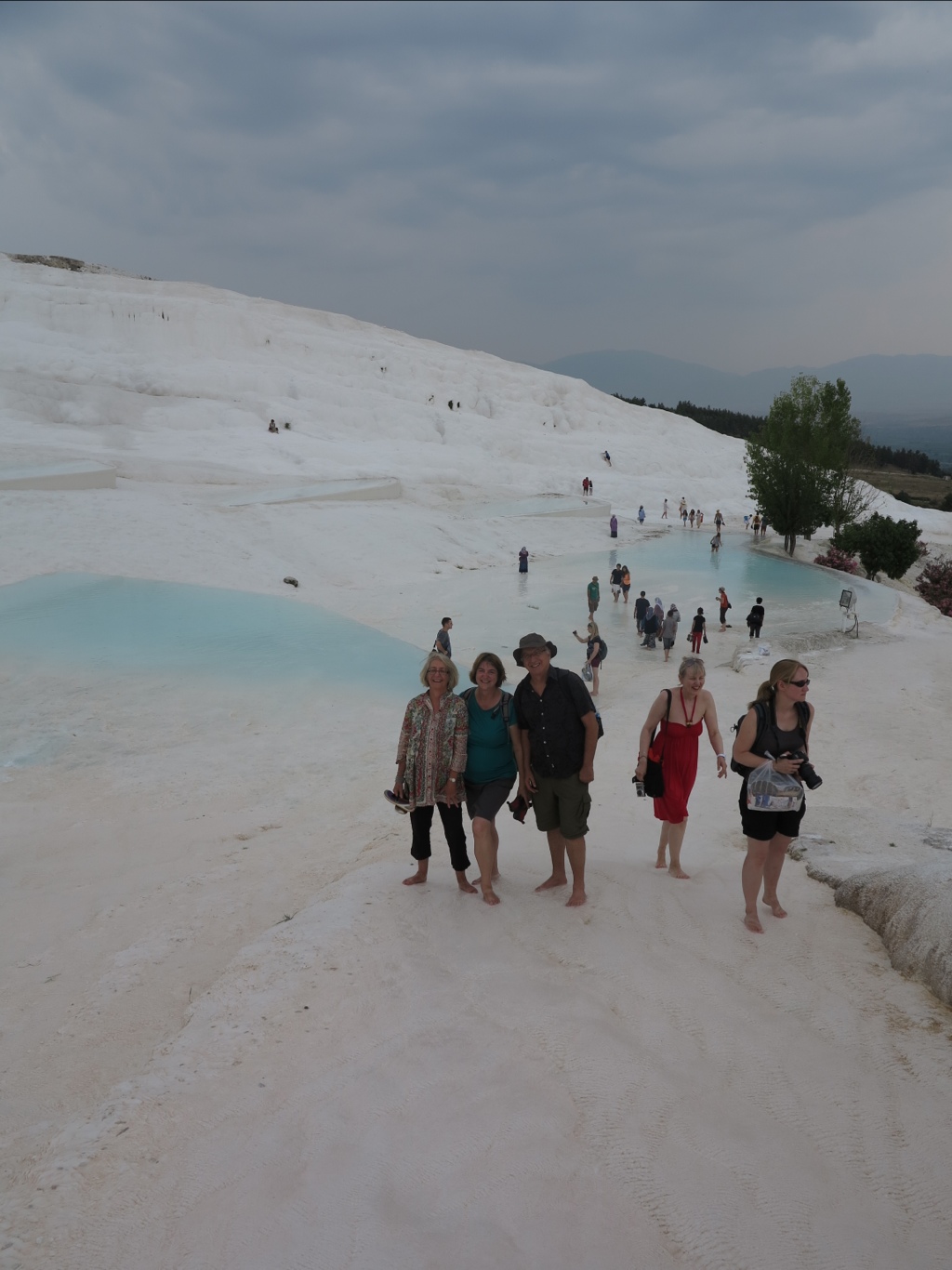
Until yesterday, I thought travertine was a pattern for kitchen benchtops. The little Turkish town of Pamukkale put me right. Its two main attractions are the ruins of the city of Hieropolis on the hill overlooking it and the travertine terraces down the side of the hill. The ruins are interesting enough – a theatre, a small temple, a ‘plutonium’ where oracles entered a volcanic vent and came back with gnomic advice from the Underworld (the plutonium is bricked up except for a small hole, but you can hear the sounds of water if you listen at the hole). It’s the travertine that led one of our group to remark, ‘I can’t go on saying it everyday, but I’ve never seen anything like this.’

Travertine, according to Wikipedia, is a form of limestone deposited by mineral springs, especially hot springs. I understand the process to be similar to what happens in limestone caves. Calcium carbonate deposits, let me tell you, can be magical.

Here’s what it looks like up close. Note the bare foot: even though our body oils have a destructive effect, the potential damage caused by the thousands of tourists is reduced by a no-shoes rule and strict limits on where we are allowed to walk. The surface is completely hard, and the ridges mean it’s not the slightest bit slippery, even when wet, as the path up the hill mostly is.

foot

walking up

The rules weren’t enforced for dogs, and this little pack of strays had a fabulous time as the sun was about to set.

dogs

By the time the terraces looked like this the dogs had sniffed out the chips and bikkies we were eating and had abandoned their frolics to turn a charm offensive on us, with a shameful degree of success.

sunset

My trip to Turkey 3: Selçuk and Ephesus

Ephesus – Efe in Turkish – is pretty much all,about antiquity. We arrived in nearby Selçuk the evening and went for a stroll to a huge field strewn with pediments, capitals and an occasional intact column, with a pool of stagnant water taking up perhaps a third of the area. This was once the Temple of Artemis, one of wonders of the ancient world. A solitary man trailed us, repeatedly offering a Jacob’s ladder of postcards for one Turkish lira. The stroll also took in the fort-like church of St John. The story is that it was here that St John the Evangelist brought the Virgin Mary, and here that her Assumption into Heaven (if you’re a Catholic) or Dormition (if you’re Orthodox) happened. This was all of interest, but my interest, and I don’t think I was the only one of our predominantly Australian group, was more immediately engaged by the storks nesting on pillars and the remains of an ancient aqueduct. We’ve all seen plenty of ruins but storks are fairytale creatures.

A short ride in a van took us to Ephesus early next morning, where we wandered among the best preserved ancient city in Turkey, one group among many being treated to a tourist-rated version of the history. It was odd wandering through these streets, making our way through the roofed and enclosed terrace houses being painstakingly restored by Austrian archaeologists, of what was once an actual town, and realising that this was the local habitation of cultural phenomena that have always been pretty much abstractions to this colonial mind: Diana of Ephesus, the Ephesians of Paul’s epistle, the Amazons, even reputedly the Virgin Mary in old age.

It was incredibly hot among all the marble of Ephesus, and that afternoon we snoozed in our air-conditioned rooms or went to a swimming pool with, I’m told, a fabulous view. I struggled up after a couple of hours to visit the Archaeological Museum, for more wandering among antiquities, among them three statues of the Artemis of Ephesus – that’s the one whose most striking feature is her large number of grapelike breasts, but who also has the signs of the Zodiac around her neck and strings of creatures on her legs. She’s a weird figure, all the weirder for being surrounded by marble statues that are clearly rpresent actual individuals, from a huge head of Emperor Domitian to life-sized busts labelled ‘A man’.

Am I right in thinking that this was the place where the cult of the Virgin Mary had its beginnings? When the Artemis-worshippers arrived here they blended their virginal hunter goddess with the local fertility goddess (Cybele?), so that only here is Artemis /Diana seen as a fertility goddess. Then when Christianity arrived, she transmogrified into the new virgin-mother figure, so the converts to the new religion found ways not to abandon the female principle that had such meaning or them. These are the ruminations of one who was pretty devoted to the Blessed Virgin Mary as a Catholic child in Queensland. Them Ephesians sure cast a long shadow.

Of course I’m not the only one to notice that divine women are big in Ephesus. Here’s a snap of an array of them on a stall next to one selling ‘authentic fake watches’ just outside the city exit:

female deities

That night, in the comparative cool, we drove to the hill town Sirinçe for dinner. This was a Greek village until the mid 20s ‘population exchange’ in which, as part of a peace settlement after Greece invaded Turkey, something like 1.3 million Greeks and half a million Turks were uprooted and (cough!) returned to their own country. So we visited the remains of the Orthodox Church of St John the Baptist, which is in the process of restoration by a US organisation. The current population inherited vineyards and olive orchards and had to learn from scratch how to tend them. They seem to have done brilliantly – copious. olive oil and brightly labelled wine was for sale.

We had a pleasant dinner. Perhaps it was no coincidence that conversation at my end of the table turned to gender studies. And as we rode down the hill in the dark our driver turned the radio up loud for a Turkish version of Whitney Spears singing ‘I will always love you’.

iPadded on the train to our next destination.

My trip to Turkey 2: Bursa

Bursa was besieged by nomadic Turks led by Oman Gazi, founder of the Ottoman lineage, in 1315. Eleven years later the starving city surrendered to Osman’s son, and the Ottoman Empire was born. Our little group of temporary nomads got there yesterday by ferry and bus, and there was very little starving going on, this being the birthplace of Iskender kebab. It was at the end of the Silk Road at one time, and even today there’s a lot of astonishingly cheap ‘100 percent silk’ scarfs on sale in the Silk Markets, which a number of us found irresistible. Also irresistible to most of us was the famous hamam at Çekirge mineral baths, which I’m told is luxurious with marble, very hot and not at all the punishing experience that a bath and massage is in some places.

According to the schedule we were to be guests at a Dervish Lodge in the evening, with the possibility of ‘dinner with our hosts’. Our host turned out to be a flute player from the Lodge, who couldn’t dine with us but instead gave us a long explanation of Sufism that included rich poetry about everything whirling, from subatomic particles to the vastest nebulae, familiar punitive moralism (if you don’t belong to a religion you will pay the bill when you die), and philosophical reflections on the shortness of life, the smallness of human concerns in the immensity of the universe (‘I am nothing’). Wonderfully, he excused himself three times in the course of the talk to answer his mobile phone – when he returned the third time, he turned it into a teachable moment: ‘You see, I think I am very important. It is hard to remember that I am nothing.’

We were mostly a little ambivalent about the talk, and had some misgivings as we followed him out into the evening. But he took us to the back room of a teahouse where some of the locals were singing and playing Turkish folk music. The room was big enough to accommodate around its walls the musicians, the thirteen of us, and four or five others. Glasses of tea were brought, and what followed was an hour, or possibly two, of joy all round. Our flute-playing friend left after playing beautifully for quite a spell. Drummers came and went – a Turkish man on the way home from work who tapped out a basic rhythm, two young men whose finger work was brilliant. Two middle aged men who sang and played the sas (I can’t look it up, it’s like a balalaika with the hole at the bottom rather than under the strings) seemed to be in charge, and enjoyed each other, the other players, and us to a spectacular degree. They sang and played. Four young Japanese men came for a while and left. One by one we were cajoled into dancing. One of our younger women had clearly learned Turkish belly dancing and did herself proud. The five men of our group got up together, shook our hips and bumped shoulders. We joined in singing on a couple of simple refrains. Eventually, the instruments were returned to their hooks on the wall, and after much handshaking and kissing on both cheeks, we filed out, paying one Turkish lira each for the tea. We’d been told that there was no charge for watching dervishes whirl because it was a spiritual practice, not a performance. Perhaps the same could be said of this event.

We dispersed, found dinner where we could – my small group found it in a kebab house that turned out to have a Turkish pop duo drowning out any conversation, but giving a kind of musical completeness to the evening. We reconvened and walked to the Dervish Lodge.

The Lodge’s crowded grounds were dominated by the video image of a bearded man sitting crosslegged and holding forth – the sermon had already started. There was a festive air all the same, not inattentive, but not exactly hushed. We were escorted into a front parlour and offered the now familiar strong black tea. The sermon went on for an hour. This was not fun, though Burak, our leader, took the opportunity to give us his version of Sufism and the origins of whirling: the man known in the West as Rumi had a dear friend and comrade named Shem; when Shem was killed words were not adequate to express the great poet’s yearning for his lost friend and he began to whirl; his followers saw him do it and imitated him.

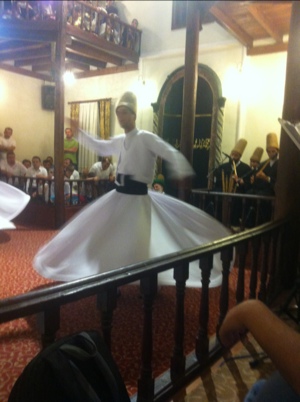
At last the sermon, which had sounded at times like a Downfall soundtrack and had been in part about the evils of Facebook, came to an end, and we were ushered into the crowded viewing areas of the whirling room (click here for a virtual tour), women upstairs, men downstairs and children wherever. The man who had given the sermon sat at one end of the room, the six dervishes in their felt tombstone hats and white skirts came in opposite him, one by one, each bowing solemnly to the one after him, before he began whirling. My guess of the age range is 30 to eight years old. Once they were all started, each in his own space, the music started, hypnotic, vigorous, beautiful. And they whirled for what seemed like forever, both hands raised or one up one down, head at an angle, eyes sometimes closed, progressing around the room and never coming even close to a collision.
20120624-084245.jpg

It was an incredible physical feat, but that was almost beside the point. People in the audience (or should I say congregation?) swayed where they sat, and some wept. After a long time, the bearded man and the man in a black robe who played some kind of leadership role joined in, rotating more slowly, the older man with tears streaming down his face. Then they stopped, stood for a moment, sat upright and motionless on the mat for a long, impassioned call-and-response prayer, sweat dripping from their faces. It must say something about my mental state that I thought the repeated response was habib. (The Art Student assures me it was nothing of the sort.) It was a huge privilege to be a guest here.

Next morning, we paid a quick visit to the Ulu Cami (High Mosque), which was built for an emperor long before the conquest of Constantinople. The biggest piece of calligraphy was the emperor’s name. There’s a pool for ablutions in the mosque itself, and a very beautiful wooden pulpit made of 66,666 pieces with no nails or glue. Burak explained enough of the calligraphy that I can now recognise the name of Allah, the mystic syllable hu and the character wow (pronounced v) which has mystic significance because it curls back on itself like a foetus or a traditionally buried corpse.
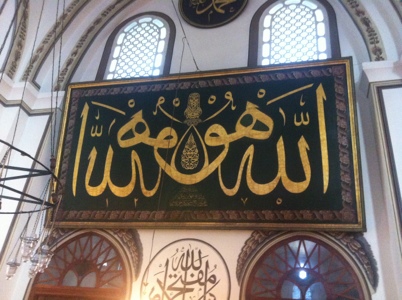
20120624-095407.jpg

I’ve iPadded this almost entirely on the six hour bus ride to Selçuk near Ephesus.

My Trip to Turkey 1: Istanbul

Having a great time in Istanbul. Wish you were here!

I’ll be doing occasional blogs over the next couple of weeks mainly so I have a record of where I’ve been and what I’ve seen. It never feels like I’ll forget things while I’m there but bitter experience has taught me otherwise. For example, I know I’ve been to Fatehpur Sikri in India, but every detail of it that comes to mind turns out in reality to be a memory of the Red Fort in Delhi. So here goes on my couple of days in Istanbul.

As the Turkish Airlines plane touched down at Ataturk Airport there was a round of applause, of the ‘Nice job’ rather than the ‘Thank God’ variety. If this moment of collective grace was a good omen, it was soon followed by another: a young woman in rimless glasses, a stylish black full-length coat and a pale blue scarf over her hair, took a moment from her extraordinarily calm parenting of two very active little boys to wish us – in Turkish – a pleasant trip, and then explain in gestures what she meant.

That was on Wednesday night. We reached our hotel – the excellent two-star Best Town Palace Hotel – close to midnight. On Thursday, after a wonderfully eclectic breakfast (borek, cereal, hardboiled egg, olives and salad meat, meze dips etc) we headed out for a morning of art galleries and other exhibitions. In Singapore we’d seen a Miro, a Warhol and stunning art from Papunya Tula and Yuendemu; in Istanbul it was Leonardo and Goya, but we did also find some contemporary Turkish work. The most interesting show was a photographic exhibition about the Village Institute Program, in which promising young people from poor villages were educated in boarding schools and returned home to spread their learning – a powerful strategy for remedying the endemic rural illiteracy that was the legacy of the Ottoman Empire, and cultivating an informed democracy. (I’ve just found out from Wikipedia that the program was attacked by reactionaries who used the moral panic tactics – the Institutes included girls – and accusations of Communism. The exhibition didn’t do the opposition the honour of mentioning them.)

This morning, our small group tourism experience began in Ernest with a four-hour walk, taking in:

  • the Hippodrome
  • the Blue Mosque, which is extraordinarily beautiful but felt cold and showy to me
  • a tea house, where the eight women of our group were the only women but there didn’t seem to be any awkwardness
  • the Grand Bazaar, which is not, as I expected, a chaotic scene of makeshift stalls filled with the sound of bargaining and a thousand smells, but a vast, orderly shopping arcade, perhaps the world’s oldest mall
  • the Suleymaniye mosque, full of light and air, a totally different experience. It’s the work of the architect Sinan, who seems to have a status in Turkish history not unlike Shakespeare’s in English. His modest türbe (look at me, using Turkish words) is just around the corner
  • the Rustum Pasha mosque, also by Sinan, decorated with fabulous tiles, with a sense of light like the Suleymaniye mosque, but intimate. Even as ignorant as I am, you get a sense of why Sinan is a rockstar.
  • the Spice Bazaar, more what I had expected, only clean. Insert here the olfactory equivalent of spectacular.
  • .

    In true Intrepid Tour style, we were then cut loose for the ret of the day. My little trio had lunch that was like no lamb kebab I’ve ever had, then went to Hagiya Sophia / Aya Sofya. Apart from the sheer awesomeness of the building, there’s a delicious irony in this piece of Christian triumphalism being conquered by a triumphant Islam, and now it’s a museum.

    We’re being called to,our ride to the ferry, so that’s all you get.

    John Freely’s Istanbul

    John Freely, Istanbul: Imperial City ( 1996, Penguin 1998)

    20120617-184203.jpgOn a friend’s recommendation, I borrowed this from the library as preparation for our trip to Turkey. As it became clear I wasn’t going to finish it in time, I also bought an eBook, which I finished on the plane. I’m jabbing this entry on the iPad keyboard in the air.

    The book is a bit of a hybrid – a biography of the city from 658 BCE to 1995, and a guide to the monuments and relics of that long history. It doesn’t aim to make sense of the history so much as to help reader–travellers understand what they are seeing. Istanbul is not the capital of modern Turkey, but it was an imperial capital for many centuries, so perhaps it’s inevitable that the book’s backbone is a chronology of a series of rulers – of Greek and then Roman antiquity, Christian Nova Roma / Constantinople, the Ottoman Empire and finally the Turkish Republic. We are told the name of each new Augustus/Sultan, how many relatives he killed on his way to power or after getting there (one new Sultan killed a record nineteen younger brothers), his age, and what monuments he left. Court intrigue, exile, mutilation, assassination and heroic exploits in war may make for high drama in close up, but in a narrative that covers more than 1500 years in 300 or so pages, they become a bit of a slog. Freely does his best to keep it lively. The quotes from contemporaries over the ages bring welcome insight into the look and feel of Byzantium/Constantinople/Istanbul at a given time, in particular the substantial passages from the fabulous seventeenth century writer Evliya Çelebi are just fabulous.

    I’m glad to have read it and I’ve probably retained enough to enrich my impending visit, but I found myself constantly asking why – why did the populace sometimes support an invading leader, and why did they often turn against him soon after his coronation, how come a section of the army could just decide to make their leader the emperor, and so on. I would have appreciated a little discussion of, say, the relationship between secular and religious authorities in both Christian and Muslim empires, or the status of women, or the lives of everyday people. Without such discussion, a lot was left mysterious.There are plenty of events that raise questions about these issues. For example, though Turkey had its first woman prime minister when the book was being written, the Byzantine Empire had more than one Augusta and some women seem to have wielded enormous powered behind the Ottoman throne.

    So I’m not sure I’d recommend the book but I wouldn’t recommend against it. Now our German pilot is telling us to prepare for landing, so I’ll stop poking at keys and switch off my electronic equipment.

    Notes from a Tidy Town

    The Art Student and I have just spent a couple of days in Singapore en route to Turkey. Apart from the fabulously welcome heat and the pleasure of walking about in an unfamiliar place, I’ve noticed:

  • the absence of graffiti, to the extent that an installation in the Singapore Art Museum was accompanied by a note saying that even though graffiti was awfully antisocial it could sometimes inspire artworks (though we did see a couple of lonely tags under a bridge near some equally rare skateboarders).
  • excellent, cheap underground rail, with a ticketing system that’s cumbersome for blow-ins like us who just want single-trip tickets, who have to pay a refundable deposit of a dollar on each ticket (the tickets are plastic – an anti-littering strategy?), reclaim able only from a machine at the other end
  • ‘Do Not’ signs that indicate customary practices: I only saw one ‘pedestrians must use crossing’, and it was in one of the few places where they mostly didn’t; ‘Do not lean on door’ was on the wall above two young men engrossed in their phones and leaning as if there was no other way to ride the subway; and my favourite, ‘$1000 fine for riding here’, failed to deter the gentleman who came zooming past us, who looked as if he wouldn’t have managed a fine of a tenth that size.
  • a definite child-friendly feel to the art galleries: Sakarin Krue-on’s installation ‘Cloud Nine’ in the Contemporary Asian Art exhibition at the Singapore Art Gallery featured stray dogs with beautiful wings that reminded me of S. D. Schindler’s magical illustrations for Ursula Le Guin’s Catwings; more substantially, we caught the tail end of a city-wide Children’s Season in museums – a whole building of the SAG was given over to interactive works that invited children’s participation, real works that made me want to join in, and a video art room that showed excellent children’s cartoons.
  • a system of pricing in which things aren’t always what they seem: if for instance you bought Dr Dre earphones for your iPad for $430 ( very cheap, it turns out, probably because they’re fake) you might find yourself paying more than $500 because of the 7 per cent GST, and if you challenged the maths of that, you might discover there was a government levy on credit card transactions. Not all of this is swift talking by clever salespeople – I saw a price tag on a Tiger beer tower (don’t ask) that read ‘$68 + +’.
  • It’s a terrific city. We walked a lot above ground and a lot below ground. We ate Indian, Japanese, Chinese, and ice cream. We discovered deep fried cereal prawns, which we ate but didn’t understand. Today as we swam upstream in Bugis Street against a current consisting almost entirely of cheerful young people, I thought to myself, ‘This is no country for old men.’ in a couple of hours we’ll be flying to Byzantium, those dolphin-torn, those gong-tormented seas.

    Dungog

    We drove up to Dungog on Saturday – Penny, her brother Chris and I – to visit a nonagenarian second cousin of theirs. We stayed at one of the Dungog Country Apartments, which was inexpensive (by Sydney standards), light and airy, with a roomy kitchen, pleasant furniture, a balcony with a view of the pub, and Norman Lindsay cheek by jowl with Norman Rockwell on the wall.

    There was weather, so we didn’t go for the walk we’d planned on Saturday afternoon. And none of the town’s recommended eateries was open, so we ate some huge steaks at ‘the top pub’ (which must make the hotel opposite our apartment the bottom pub) before striding off to the James Theatre, Australia’s oldest still running purpose built cinema, just in time for the evening session of Flickerfest.

    Flickerfest has been an annual event at Bondi for 19 years now, but I’ve never been to it. The prospect of several days of short movies just hasn’t had enough drawing power. In fact, just about the only short-film programs I’ve seen have been ones where a friend or offspring had made one of the films. But we were in Dungog, and apart from the trivia quiz at the Menshed and billiards and jukebok at the top pub there wasn’t a lot else on, so we were quite pleased that there is now a travelling, pocket-sized Flickerfest, that Dungog is among the 24 venues it visits around the country, and that Saturday was Dungog’s day.

    I’m not a convert to short-film nights. Bring back the days when there was a short before the main feature, I say. In that context, almost any one of the films we saw – the Best of Australian Shorts – would have been perfectly adequate, and some would have been hard acts to follow. One, Miracle Fish by Luke Doolan, was not only nominated for an Academy Award this year but also was shot in the primary school my sons attended, so had a certain holding power (though it was far too long). Maziar Lahooti’s Crossroads stood out for me, partly for a beautiful moment of inarticulate masculinity after a display of heroic competence (that’s the second short film of his I’ve seen and loved), and Dominic Allen’s Two Men, all four minutes of it, is perfect – translating a 160-word piece by Kafka into Aboriginal English and setting it in a remote community with absolute sureness of touch.

    The Dungog Film Festival is in May. For four days, as Penny’s second-cousin-once-removed told us on Sunday, black-clad movie lovers turn the main street of Dungog into little Newtown. It might be just the thing for disgruntled ex-Sydney Film Festival goers.

    Ma rentrée

    Having witnessed the cultural phenomenon of la rentrée in France, in which the populace returns en masse from their vacances, shops open, streets and markets come alive, Paris is reinhabited by  fabulously arrogant Parisien(ne)s, and posters and TV commercials abound recommending ways to make the great return douce or moins chère, having felt just a little of the excitement of all that, I’m facing my own pale shadow, my re-entry. But before girding my loins, here’s a blog post of snippets.

    • In Manhattan you can buy eyelash extensions.

    • There’s a hamburger place opposite the Port Authority Terminal in New York that boasts that it’s the only one with its name, that it was founded in 2008, and it has served fewer than a billion burgers (so far).

    • In Lyon, I was approached in the street by an unkempt man speaking in rapid (and therefore incomprehensible to me) French, holding up a euro coin in one hand and extending his other palm empty to the passers-by. I dipped into my pocket and gave him a couple of coins – it could have been anything from 50 centimes to 2 euro – and walked on. He called after me: ‘Monsieur! C’est pour manger ou pour boire?’ It sounded like a serious question: he was asking me to tell him whether the money was for food or drink. I called back, ‘Pour manger!’ ‘Pas d’alcool?’ he called back, like a little boy making sure his papa was really forbidding something he knew he shouldn’t have. ‘Pas d’alcool, oui,’ I said, then added by way of mitigating this sternness something that probably translates as ‘Me no myself drink any alcohol.’

    • I know everyone goes on about the different light in Europe, but when I walked the dog this morning I kept wondering why everything looked so clear, the greens so brilliant and the sky such a sharp blue. Then I realised I was back in Sydney, in spring and this light that the first settlers thought so harsh and unforgiving is for me the light of home.

    • A visit to Paris at the end of summer makes it much clearer what all the fuss is about than a visit in March, when all the trees are like dark, mutilated skeletons.

    • The Eiffel Tower sparkles all over at 10 o’clock at night.

    • M Eiffel built a kilometre long bridge to carry a canal over the Loire at Briare, and it’s a very pretty thing.

    • It’s illegal to sell cheese made with unpasteurised milk in Australia, which means we miss out on some fabulous, richly stinky delights.

    • In certain lights, the power lines to the southeast of Saint-Gervais (Gard) appear to be supported by an army of Hello Kitty silhouettes coming over the hills.

    • One of the main delights of travel for me is being in an environment where the language is different from at home. I get far too much pleasure from deciphering untranslatable puns in shop names, like the bookshops Mona Lisait, or the restaurant (or resto) in Rue Mouffetard that’s called the Mouffe’tôt Mouffe’tard. This delight is just as strong in places where the language is English. In Brooklyn, for instance, a car full of young dreadlocked men drew alongside my taxi with its radio turned up loud, and instead of the undifferentiated bass beat I expected I was treated to a crystal-clear rendition of ‘No Woman No Cry’, and the next day, a car pulled into the street where I was staying and the whole small block was filed with Aretha Franklin. I know that’s not strictly language, but it’s communication.

    • The prayer ‘Give us this day our daily bread’ must feel completely different in a place where the custom is to go out each morning and buy just enough fresh bread for that day, from where you buy a sliced loaf on the weekend and eat slightly mouldy toast on Friday.

    Jet lag has been intense this time, but I’m feeling almost human this morning after two nights’ sleep. Normal broadcasting may resume shortly.

    NY Post geography

    On page 14 of today’s New York Post, Jane Campion is quoted: ‘I have a two-room hut in a remote part of New Zealand, the south island, an hour’s drive outside Queensland.’ She clearly drives a very fast amphibian vehicle.
    Right! No more painful pseudo tweets from my phone. I get my fixed computer back any hour now.

    4.30 am NYC

    Because of frequent flier stuff I’m flying home from Paris via New York, while Penny is doing the sensible thing, flying via Hong Kong and getting home 36 hours before me. At least that was the plan. She’s just texted that her Air France plane was leaking oil and has been diverted to Manila. I’m wide awake in the city that never sleeps posting to my clog from my not-an-iPhone. 24 channels, nothing worth watching except a senate enquiry into contractors (ie for profit armies) and moron Girls Gone Wild