Category Archives: LoSoRhyMo

November rhyme # 14

Better late than never. At least the event that inspired this happened in November:

Rhyme #14: Dinner 
From canapes to mango cheesecake
conversation didn’t flag.
(Two teenage boys sat mute – like, please make
this weird food go. It makes me gag.)
A window shows the inner working
of lab mice. There’s no one smirking
that a boyfriend in North Bay
was hit by two cars. Who can stray
down George Street in a hypo stupor
or drop unconscious in a pool
while holding baby? The Art School
exhibition’s still on – super!
Records from ASIO. Oh my!
Too much man sex in London Spy.

And so ends my task of 14 rhymes for November for 2015. I told the emerging Artist (formerly the Art Student) that I was thinking of keeping the doggerel  up, if at a slower rate, as a regular thing in the blog. Tactfully, she said people really like my prose. So normal functioning will resume shortly.

November Rhyme #13

OK, this is a fridge door poem I made earlier, but since the object it describes is once again being exhibited I’m passing it off as done today

as+for+living+II+web

As for Living III, by Penny Ryan. Photo by Kate Scott

Rhyme # 13: Piece in an exhibition
A broken ribcage from some broken
evolutionary line?
But these  aren’t bones – too glibly spoken!
That’s no knotted ridge of spine.
This work displayed in art school stairway
is not by some apprentice Yahweh,
nor did the wondrous Burgess Shale
a woven life like this unveil.
And yet it speaks of some great sorrow,
something beautiful that’s lost,
A world bereft, left with a ghost.
Perhaps a warning for tomorrow
unless we act, lives we hold dear
will be as if they never were.

Rumi in Strathfield and November Rhyme #12

IMG_1447

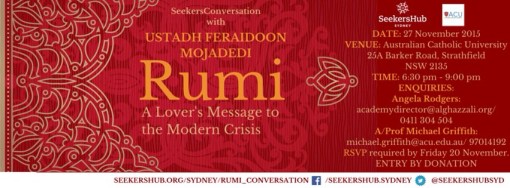
On Friday evening at the Australian Catholic University, two Muslim scholars sat with an audience and discussed the great 13th century Persian poet Mevlana Rumi.

Ustadh Feraidoon Mojadedi, an Afghani scholar who now lives in the USA, was in conversation with Imam Afroz Ali, of the Sydney Seekers’ Hub, a place of Islamic learning.

They spoke of Rumi as a great spiritual teacher, not just for Muslims, but for all humanity. Ustadh Feraidoon Mojadedi wears his enormous erudition lightly, and had us laughing even as he explained the complexity and depth of Rumi’s vision. He argued that what non-Persian readers need is more, better commentary rather than translation, because all translation is misleading. There’s much more to Rumi than you would gather from the quotes you see on Facebook.

I went along for a number of reasons, but mainly because a friend gave me a copy of The Essential Rumi decades ago which has remained, literally, a closed book. I’m also aware that my ignorance of Islam can’t be a good thing in the age of Corey Bernardi and Donald Trump.

Well, I know a tiny bit more about Rumi, and I’m planning to go to another event next week. But possibly more significant is how the evening altered my sense of Islam.

The relaxed, affectionate  relationship of the two scholars was in sharp contrast to images I have from movies.

In question time, it was women who asked all the questions – so much for the notion that women are silenced in Islam.

And most interestingly we were all invited to join the sunset prayer part way through the event. I’m not at all religious, but I’d joined in the Our Father at an Anglican ceremony the previous day. I checked with a number of people and joined the prayers. I did a lot wrong: I hadn’t arrived in an abluted state, I didn’t take my shoes off, I joined a line that turned out to be the women’s line, and I’m pretty sure I failed to follow all the standing and kneeling correctly (though my Catholic youth and childhood was some preparation for that). And of course I didn’t understand what was being said by the prayer leader. But there is something profound in joining a group of people who humbly bow repeatedly in the face of the mystery of the universe, and I returned to the lecture with an extraordinary sense of our shared humanity. Which was also the content of much of the talk.

So I went to the event expecting a literary evening, and found something quite different.

I’ve set myself a task of writing a 14-line rhyme with each blog entry in November (originally inspired by those people who write a whole novel in November – not sweating over quality, just getting the words out). Here goes for this one:

Rhyme #12: On joining sunset prayers
I bow, I kneel, I touch my forehead
to the grass. I have no God:
no disrespect, I take these borrowed
gestures (like my childhood’s nod
at Jesus’ name, or genuflection)
not to seek some Power’s protection,
but to say: The world is vast,
my time here comes and goes so fast.
Right now I humbly pay attention
to what is deepest in my heart:
my loves, my challenges, the part
I choose to take past good intention.
We bow, we stand, we’re flesh and bone
and mind. We’re none of us alone.


November Rhyme # 11

I’m having to produce a 14-line stanza a day if I’m to meet my quota. This is a true story:

Rhyme #11: Intimations
Between the ATM and Woollies,
death brushed my shoulder, had a word.
The voice was not a schoolyard bully’s,
but soft, you’d almost say it purred:
‘You’ll lose all this, perhaps not tomorrow,
but time runs out – beg, steal or borrow
makes no difference, you’ll be gone
as silent as a babe unborn.’
A baby sucked juice from a bottle.
A tricep showed a red-inked rose.
The checkout chaps had wispy moes.
The air outside was drenched in wattle.
The dog snapped at a passing fly.
One day all this will say goodbye.

November Rhyme #10

This weekend the United Nations Climate Summit begins in Paris. The huge march through the rues and boulevards that had been planned has been cancelled because of the risk of mass murder, but all over the rest of the world people will gather in a massive display of concern about climate change. The Sydney event starts at 1 o’clock, in the Domain.

The ‘People’s Climate March team’ emailed me suggesting I share a post of theirs on social media. The post was fine, but I realised that my real challenge is to say something from my own brain. So, at the risk of seeming to trivialise the issue, Sunday’s March is the subject of today’s little rhyme. It turns out that my own brain is full of fragments of other people’s wisdom.

Rhyme #10: Three days before the People’s Climate March
There’s no such thing as a human being,
there’s only humans and everything else:
stars that pull from beyond our seeing,
myriads living in our cells.
The human race has disunited,
Earth’s love for us gone unrequited,
who favour empire, comfort, gain,
and make the whole world our domain.
Saint Francis called the fire his brother,
water his sister. Was he wrong,
or was there muscle in his song?
This time we have is like no other:
last week is gone, next year’s too late,
what we do now decides our fate.

November Rhyme # 9

A versified excerpt from a conversation (I use the term loosely, as it was a bit hard to get a word in at the time). The title is not a misprint. No prize but much admiration for the first to decipher it:

Rhyme #9: Memento Moro
‘The kids today have no idea.
You must know, you’re about my age.
They think it was all Germaine Greer,
fat Elvis, punk, glam rock – no beige.
The seventies, in these confected
histories were cool, protected
from the darkness of our times:
all showbiz, glitz and fashion crimes.
I tell them of Brigate Rosse,
Baader-Meinhoff, Patty Hearst,
the Shining Path: there was a thirst
for violence then. It wasn’t glossy.
Look, where the light of memory dims,
at Lord Mountbatten’s scattered limbs.’

Bathurst Regional Art Gallery and Rhyme #5

On Saturday we drove to Bathurst to see an exhibition John McDonald had reviewed in the previous weekend’s Sydney Morning Herald. The exhibition’s full name is guwiinyguliya yirgabiyi ngay yuwin.gu gulbalangidyal ngunhi (they made a solitude and called it peace) by Jonathan Jones, in collaboration with the Bathurst Wiradyuri and Aboriginal Community Elders, commissioned  as part of the Bathurst Bicentenary.

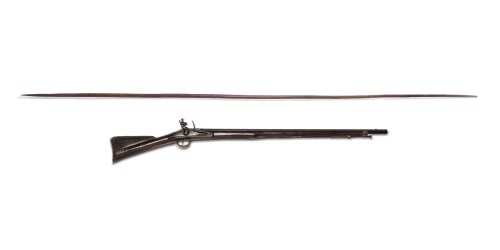
Musket_and_spearIt’s  not a vast exhibition, but its powerful. There are stunning video works – a giant screen on which the camera glides endlessly through beautiful bush, and a room with six portraits of Wiradyuri elders looking out at us from significant locations in the Bathurst area. The main room has a musket and a spear on the wall (though the image above, lifted from the BRAG website, is missing the musket’s lethal bayonet), and in front of them on the floor a circular arrangement of flint fragments and grevillea flowers: the catalogue explains that the stone is waste from a Wiradyuri and Aboriginal community stone-tool making workshop. In a second room an elegant shape on the floor, made up of mussel shells cast in bronze mixed with lead musket balls, points at a pile of dusty potatoes – again, the catalogue adds to what’s already a strong image by telling us that the Bathurst wars of the 1820s began when a Wiradyuri family was massacred over some potatoes. There’s a room with surveyors’ maps and traditional parrying shields around the wall, and another with the cadavers of six small trees painted gold. All of it is very beautiful, and all invites the viewer to find out more about the history of the Wiradyuri wars, and to meditate on that history.

If you’re interested you can download a PDF of the catalogue from the Bathurst Regional Art Gallery web site, but I recommend taking the trip to walk through the six small rooms of the exhibition in person. Apart from anything else, it’s a stunning example of work created by a very fine artist collaborating humbly with a community. In the catalogue, the Bathurst Wiradyuri and Aboriginal Community Elders say they have been working with Jonathan, ‘directing him, teaching him and supporting him’. The drive from Sydney isn’t so long. We stayed overnight because the weather was threatening, but we could have done it as a day trip.

There is one room we didn’t see. It features two possumskin cloaks, made by members of the local community and evoking a moment when Windradyne, the great warrior leader, presented a similar cloak to Governor Macquarie. It was our good fortune to visit the gallery while a weaving workshop was happening in that room, so we stayed out. (We did see the gorgeous cloaks in a room that isn’t part of the exhibition but which, on Saturday, was temporarily home to them and an array of objects woven by local people.) This was good fortune for two reasons: first because during our visit the gallery was filled with the sounds of Aboriginal people enjoying each other’s company, in effect proclaiming their resilience; and second because two elders generously absented themselves from the workshop to chat to us whitefellas about the cloaks and the woven objects, about the Wiradyuri dictionary app, about the uses of some woven objects (‘Good for carrying babies, but not much good for water. That’s why we have bottles for beer.’).

And it’s November, so here’s an attempt to say in verse what I can’t figure out how to say in prose:

Rhyme #5: An exhibition in Bathurst, November 2015
Steel v hardwood, stone and blossom,
mussel shells v musket balls,
prim English maps, cloaks of possum.
Unsmiling elders on the walls
Look out from Country. Devastation
here finds mute  commemoration.
The Romans made their solitudes
and called them peace. Such platitudes
prevail now too, the past obscuring.
But lively voices here resound,
Wiradyuri are still around. 
They greet us, chat with us, ensuring
that we whitefellas will own
that solitude, but not alone.

Rhyme #4 and Southerly 75/1

Elizabeth McMahon and David Brooks (editors), Southerly Vol 75 No 1 2015: Elemental (The Journal of the English Association, Sydney, Brandl & Schlesinger)

Rhyme #4: What's in a title (with anagrams)?
Blow the wind southerly, Southerly, southerly,
rattle our windows and slam dunny doors,
blow off the same old stuff, bring on the Otherly,
bust up the torpor that stifles these shores.
The name holds promise that the journal
challenges what seems eternal –
our bow to all that's from the North,
our faith in all it issues forth.
The title tells us what's been hidden:
a home-made tool that truly hoes
this soil, as surely hot it grows.
Shout, lyre! Play something that's forbidden.
The RSL you knew is now
A rusty hole, a sacred cow.
s152

I have a love-hate, or at least an affection-irritation relationship with Southerly.

As one who was educated before what someone in this issue calls ‘the cultural turn’, which I guess refers to the rise of Theory and cultural studies in the academy, I am often left whimpering uncomprehendingly in the dust of the more scholarly work – of which there’s a fair bit in this issue, including at least five examples of reviewers indulging in clever exegesis of a book or other work’s title (hence my rhyme above). On the other hand, there is always something that more than justifies the price of admission.

In this issue, two essays – ‘Oi Kaymeni (“The Burnt Ones”)’ by George Kouvaros and ‘Angry Waves’ by Dael Allison – are wonderful.

Kouvaros’ essay begins with his mother’s reluctance to watch the 1950s movie A Place in the Sun on TV, and fans out to tell the story of her emigration from Cyprus, then to reflect on the role played by Hollywood movies in the lives of people in peasant cultures facing rapid modernisation and sometimes massive dislocation. An excerpt:

Recounting this history helps me to understand the events that shaped my mother’s personality. It also provides an opportunity to clarify two interrelated propositions. The first is that migration is not just about a dispersal of individuals  across continents; it is also about a dispersal of the narrative details that we use to understand the people close to us.

His second proposition, which has to do with a movie’s unchangingness as opposed to that of living people, leads to the realisation that for his mother ’embedded in the film’s story was her own history as  a sixteen or seventeen year old cinemagoer’.

What he writes is specific to his mother’s life, and to the history of Cyprus, but it will resonate richly for anyone of a certain age who loves the movies.

Dael Allison writes about the impact of climate change on Kiribati (pronounced Kiribass – Kiritimati is the Kiribati spelling of Christmas) from the point of view of a westerner who has lived, worked and had friendships there for some years. As you’d expect, the picture is alarming – the brunt of climate change is and will be felt by those who have done least to cause it. Allison’s wealth of detail and observation and quotation brings the situation home sharply. For instance, the recent damage done on Kiribati, unlike that on, say, Vanuatu, is not the result of cyclones, but of tidal events which bring the angry waves of the essay’s title; unlike the damage on Vanuatu it cannot be quickly healed because coral reefs do not regenerate as forests do. There’s no cause for total panic:

Unless there is a massive global catastrophe like a melting Antarctic ice shelf sliding into the sea, Kiribati will not all become unliveable at once. But the process of relocating villages because of inundation, coastal erosion or salt contamination due to wave over-topping of the fragile freshwater lens, has already begun. Projections suggest entire atolls may become uninhabitable in the next generation. Some islanders say they will stay on their land despite that outcome.

There are other treasures: ‘Wyenondable Ashes’, Alice Bishop’s memoir of losing  her family home on Black Saturday 2009; ‘St Thomas’ Churchyard’, in which Roslyn Jolly takes a closer look at the gravestones that dot her local park, formerly a colonial cemetery; ‘A Richer Dust’, where John Stephenson finds resonance between a passage from the Aeneid he happens to be reading and a ‘sentimental conversation’ from a week earlier, and arrives at a sweet elegiac moment.

The poems that stand out for me are Dugald Williamson, ‘Caprice’; Pam Brown, ‘Twelve noon’; Stuart Cooke, ‘Old World’; Laurie Duggan, ‘After a storm, Brisbane’; David Brooks, ‘Choosing to Stay’ and ‘Silver’ (which only a vegan could have written); and Brett Dionysius, ‘American Love Poem’ (not a sonnet, not set in Queensland, but terrific).

Of the short fictions, Moreno Giovannoni’s ‘The Bones of Genesius’ make one look forward to Tales from San Ginese, the book he is writing about his birthplace; and Claire Corbett’s ‘The Trillion Pearl Choker’ is a weird tale of the forces of nature fighting back on the climate change front.

As a rule, I don’t read Southerly‘s reviews of books I haven’t read, of which there are many here. But I did dip this time. Felicity Plunkett introduces her review of a book of criticism with a selection of trenchant quotes from writers ‘writing back’ to the critics; Nicolette Stasko makes me want to read Peter Boyle’s Towns in the Great Desert; Vivian Smith and Chris Wallace-Crabbe’s grey hairs lend distinction to the review pages; Kate Livett draws attention to a timely new edition of Judith Wright’s 1971 account of a battle to save the Barrier reef, The Coral Battleground:

Weirdly, although this battle for the Reef took place from 1969 to 1975, Wright’s text initially reads as if it could be taking place today, with the ridiculous ‘postmodern’ political moves made by Bjelke-Petersen’s government, such as employing an American geologist with no knowledge of biology, let alone marine biology, to do a three-week survey on the Reef.

And now for a little grumpiness. Some of the writers here would do well to read Joseph M Williams’ Style: Lessons in Clarity and Grace. One essay in particular  veered from banal to incoherent to impenetrably technical. I persevered for a while, but threw in the towel when principle appeared as an adjective – just a typo perhaps, but in that context very dispiriting. And what’s with the US spellings throughout – harbor, jewelrymeter (as a measure of distance)? In the absence of a statement that this is policy, it creates the impression that the English Association, Sydney is made up of people who don’t care much about the language.

Rhyme #3

A rough tribute to the fabulous humans associated with Penzance Prince, winner of this year’s Melbourne Cup

#3: A hundred to one shot
Michelle Payne won one for the bookies,
said the chauvies could get stuffed
and spoke up for all women jockeys.
Latham et al huffed and puffed
and found her lacking in decorum.
Language Latham! Ipse lorem!
Like Cathy Freeman wrapped in flag
she’d won the race – not theirs to bag.
No one huffed at her big brother,
Down syndrome and cheerful as,
a strapper good enough for jazz.
Great to see them love each other:
horse, woman, man. The racing gods
gave each a win against the odds

Doris Lessing’s Ben, in the World and Sonnet #2

Doris Lessing, Ben, in the World (Flamingo 2000)

0006552293

I read quite a lot of Doris Lessing in my late twenties and early 30s. I guess I was reading what Wikipedia calls her Communist phase (the Martha Quest books), with maybe a bit of her psychological phase in The Golden Notebook (of which my main memory is a long passage where the main character mediates on the meaning of tears). I haven’t read any of her science fictional writing – until now.

Ben, in the World defies categorisation. As far as I can tell, it doesn’t even matter that it’s a sequel to another book (The Fifth Child, 1988). It starts from a ‘what if?’ premise: what if a genetic throwback to an earlier species of human was to arrive in our times? how would we cope with this person? and how would the person cope with us?

What Doris Lessing does with these questions is brilliant. Ben, the main character, is physically powerful and capable of inflicting great harm. He is eighteen years old, estranged from his family of origin, and has learned to control his violent impulses, but his weird appearance and different thought processes make him dreadfully vulnerable. When he can earn money he is cheated or robbed. His sexuality makes him simultaneously a subject of pity and terror, and I’m weirdly grateful to feminist Doris Lessing for giving him one woman who understands and doesn’t drive him away.

Ben makes a kind of life for himself thanks to the kindness of people on society’s fringes, people who can understand to some extent his profound difference. But there’s never any doubt that he’s heading for disaster. It’s a miracle of story-telling that when the inevitable happens it’s deeply satisfying, and preceded by an unexpected moment of exhilaration. What might sound from my synopsis like a cerebral exercise becomes a rich tangential celebration of what it is to be human.

And now, because it’s November:

Sonnet 2: After reading Doris Lessing’s
Ben, in the World
‘Just a little bit of finger
bone,’ he said, ‘ can tell the whole
of what a person’s been.’ Let’s linger
on that thought: it’s not the soul,
a spirit that outlives the body
it ignores. No, what that shoddy
view of science cannot own
is: no one can exist alone.
That finger bone stripped by the condors
touched when alive what cheeks, what lips,
or pointed, waggled at what quips,
or painted on a wall what wonders?
The finger’s owner wept what tears
and heard the music of what spheres?