Category Archives: LoSoRhyMo

Three books by John Levy, and November verse 10

John Levy, 54 Poems: Selected and New (Shearsman Press 2023)
––, To Assemble an Absence (above/ground press 2024)
––, Guest Book for People in My Dreams (Proper Tales Press 2024)

John Levy has commented generously a couple of times on this blog (here’s a link). When he emailed to ask if I’d like a copy of his recent book, with no expectation to blog about it, of course I said yes, provided I could send him one of mine. So we swapped books: I sent him two, he sent me three, an unequal exchange in more ways than the obvious. He has responded to my efforts with what I now know to be his characteristic generosity. And now I am blogging about his, motivated by joy, not obligation.

John’s books arrived when I was sitting down to lunch with the Emerging Artist and our grandchildren. I flipped 54 Poems open to the first page, and read out the prose poem ‘Kyoto’:

Kyoto

I'm at a temple. A young monk in black robes walks by, looks at me,
stops. He points to my long hair. Brown. Then to my goatee. Red. He
touches my armpit and looks puzzled. I point to my hair. He points to
my crotch. I point to my hair. He invites me in for green tea.

The children liked it, probably because of the crotch reference. The Emerging Artist liked it, possibly because of the colour play. I liked it for both those reasons, and also for the comedy about communication and connection that don’t need words.

These three books reminded me that poetry can be a lot of fun. It can deal with death and loss, all manner of elevated cultural matters, or issues encountered when working in a Public Defender’s office, and still be fun. It can talk to goats and spiders and be silly about words, while still being serious. It can be warm without being goopy, and self-referential without being wanky.

Naturally, I went Googling. Among other things, I found John being interviewed on the website of Touch the Donkey, a small quarterly poetry journal published by above/ground press, publishers of one of these chapbooks. In that interview, he describes his approach:

I begin writing a poem (or prose poem) without knowing what I am going to say after the first few words that I thought of to begin with. Sometimes … I begin with a friend in mind and want to write something for the friend although I usually haven’t figured out anything beyond wanting to write something to that friend.

It’s poetry impro.

No doubt these poems have been polished and revised, but they retain the feeling of immediacy, of the poet’s mind chasing associations like a distractable child in a toy shop, and then they resolve themselves as if by magic.

I’ll stick to ‘Levy’sAccordion Straps’ on page 77–78*. I apologise for the quality of these images:
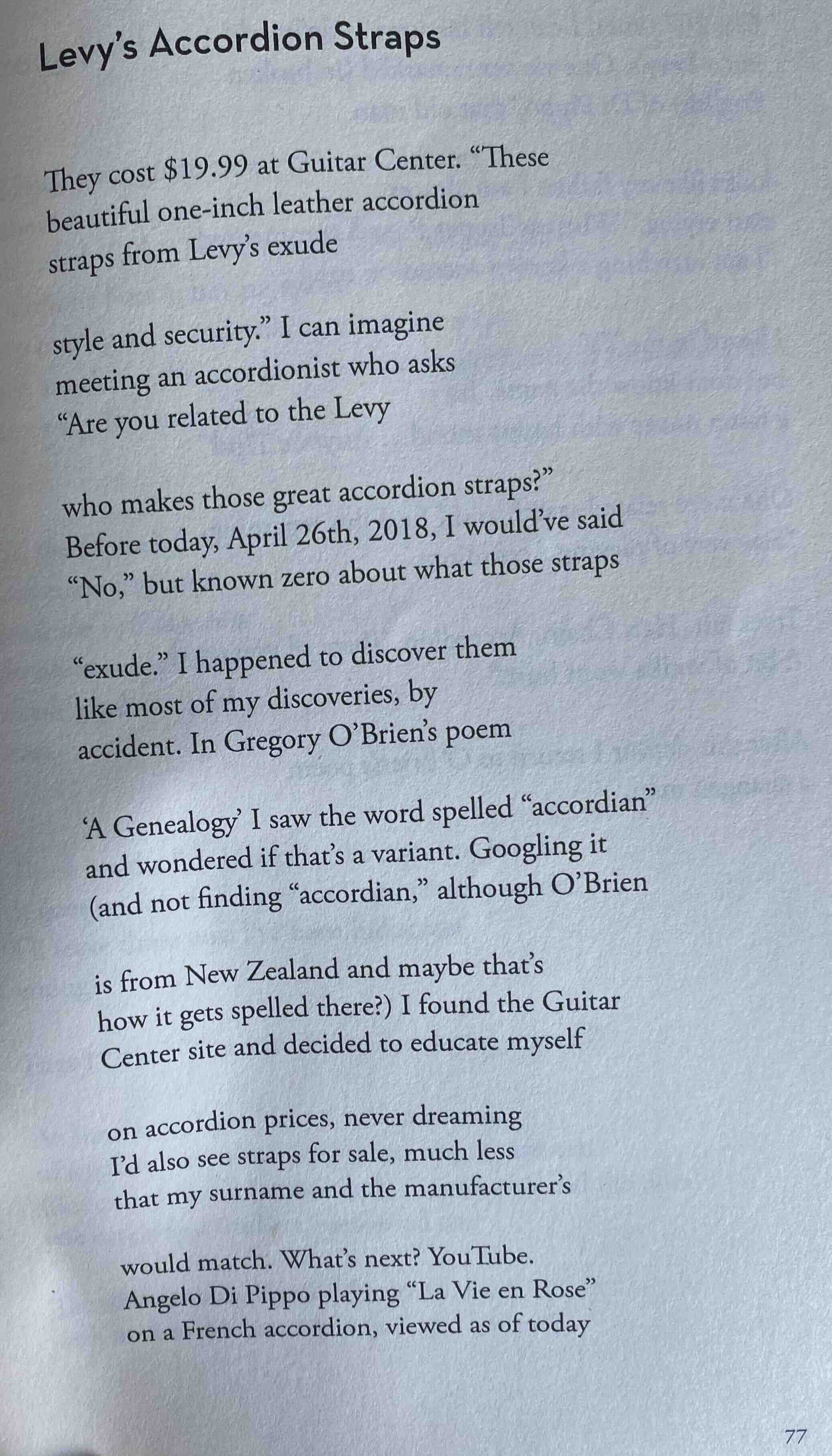
You could call this a rabbit-hole poem. It doesn’t start in exactly the way Levy describes in the interview above, but it’s in the same paddock. It’s a comic version of close reading: he takes a single word from Gregory O’Brien’s poem ‘A Genealogy’ (of which we know nothing else), and sees where it takes him. Maybe it’s the obsessive copy editor in me, but I love it that the poem starts from what turns out to be a misspelling. We tend to think of USA-ers as culturally arrogant, but Levy here has the humility to check the ‘variant’, and then stays open to the possibility that they do things differently in New Zealand. (There’s an Easter egg in line 24: Levy slips in a typo of his own, adding a space in Angelo Dipippo’s surname.)

As the poem progresses in an apparently random manner, it turns out that it features quite a bit of English as spoken/written by people not from the USA. There’s quiet humour, but not, I think, mockery. The last line made me laugh out loud. Instead of seeing the ‘detour’ as taking him away for a moment from O’Brien’s poem, he sees it as having changed the kind of attention he brings to it.

And now, because it’s November, here’s an hommage (with an advance note – Mruphy’s [sic] Law decrees, ‘If you write anything criticising editing or proofreading, there will be a fault of some kind in what you have written’):

Verse 10: Dear John

YouTube. Angelo Di Pippo
plays, you said, 'La vie en rose'.
I can’t find him (you’ve got a typo
in his surname, Mruphy knows).
I do find other Piaf splendours –
Galliano working wonders.
Music takes me in its arms,
an infant whose late night alarms
are soothed by father’s tender crooning.
Jean, who says she’s ninety-one,
comments that life then was fun.
I googled “Levy’s straps” this morning,
found them, surfed around some more,
found fancy watch straps made by Shaw.

I finished this blog post on Awabakal country, near what is now one of the biggest coal ports in the world. I acknowledge Elders past, present and emerging for their continuing custodianship of this land.


My blogging practice, especially with books of poetry, is to focus on the page that coincides with my age, currently 77.
November verse 9, 2024, and the pope

In July this year, Pope Francis issued a letter on ‘the role of literature in formation’ (you can read the whole letter here). He recommends that people in general, and especially people training to be priests, read poetry and novels. I love it that he has written things like this:

Reading, as an act of ‘discernment’, directly involves the reader as both the ‘subject’ who reads and as the ‘object’ of what is being read. In reading a novel or a work of poetry, the reader actually experiences ‘being read’ by the words that he or she is reading. 

I found an opening line for a November stanza in paragraph 27 where he quotes St Ignatius’ description of ‘desolation’, a condition Francis says can be induced by some literature. The quote from Ignatius goes like this, with my chosen iambic tetrameter in purple):

I call desolation darkness of the soul, turmoil of spirit, inclination to what is low and earthly, restlessness rising from many disturbances and temptations which lead to want of faith, want of hope, want of love. The soul is wholly slothful, tepid, sad, and separated, as it were, from its Creator and Lord

Here goes, with what turned out to be a not-quite-autobiographical reflection on ageing:

Verse 9: The soul is wholly slothful, tepid
The soul is wholly slothful, tepid,
not quite lost in darkest night
but stuck at dusk. All seems insipid,
flavourless, not worth the fight.
You’d rather watch some ancient Vera,
cheer for Marvel’s latest hero,
play sudoku, crossword, scroll –
a dreary arvo of the soul.
Where’s the rise, the roll, the carol,
the dance, the dive, the tumbling glee
that once enlivened you and me?
Let's find again the thrill of peril,
take a stand and make a fuss –
let's talk to strangers on the bus.

November verse 8, 2024, and Standing Together

Last week I went to a meeting where two members of Standing Together spoke. Standing Together is a grassroots movement of Jews and Palestinians in Israel working for peace, equality, and social and climate justice (website here).

At the meeting, organised by the recently formed Sydney Friends of Standing together, Shahd Bishara and Nadav Shofet gave personal accounts of their involvement in the movement. Shahd Bishara, a Palestinian Israeli medical practitioner, said, among other things:

The liberation of Palestine is inextricably intertwined with the security of Israelis. Two peoples both live in the land that both call our homeland. We need to fight for freedom of Palestinians and the safety of the Israeli Jews.

Nadav Shofet, an Israeli Jew, spoke of the absence of an alternative narrative to the genocidal one of perpetual war put forward by the Israeli right. Standing Together aims to fill that vacuum with a narrative that includes hope.

There’s much more to say. Standing Together has been attacked from the right in the USA and Europe, and from the left in Australia. My comments section isn’t open for that debate. The ABC covered the visit here.

Without wanting to in any way trivialise the struggle that was the subject of the meeting, I kept my ears open for an iambic tetrameter that could kick off an Onegin stanza. I got one. Nadav was referring to the narrative vacuum when he used the phrase, ‘In this environment of silence’. I have taken it somewhere else.

(The Emerging Artist says I should give links to W. B. Yeats, ‘Long-Legged Fly’ and Hopkins, ‘The Habit of Perfection’. Sadly I don’t remember the name of the Italian poet who inspired my last line.)

Verse 8: In this environment of silence

In this environment of silence
minds can move like Yeats’s fly
upon the stream, or can with violence
leave democracy to die.
Silence sings if it’s elected.
Silenced hearts by fear inflected
can’t or will not have their say –
stony, look the other way.
Silence thrives when life's unruly –
words as weapons, words as toys,
words as endless streaming noise
leave no room for words that truly
come from hearts that seek to heal
whose uvulas are made of steel.

November verse 7, 2024

My Book Group met this week to discuss Kairos, Jenny Erpenbeck’s novel set in East Berlin in the lead up to the fall of the Berlin Wall. I blogged about the book when I read it for my Book Club – link here – so I won’t repeat myself.

It was a terrific evening. Once we’d eaten we had a slide show of one chap’s recent trip to Germany. This led to a shared moment of reflection about what it must have meant for East Germans to be taken over by the West in ‘Unification’.

Having edged up on the book in that way, we then encountered what someone later on WhatsApp called a hurricane. The book has inspired one of us to unmitigated rage. It was an insult to older men, he said, hackneyed, mean spirited and at key moments completely implausible.

No one disagreed with his substantive points, though no one quite shared his rage. Some had been unable to finish the book. Some, me included, found the account of East–West relations in 1980s Germany interestingly nuanced, though oddly unrelated to the central story of a toxic sexual relationship.

Then we had birthday cake for the youngest man present.

It was, as someone said in WhatsApp later, a classic book club conversation. Which gave me my first line.

Verse 7: A classic book club conversation
A classic book club conversation –
classic chat, not classic book.
We're not averse to Tolstoy, Austen.
Nobel winners get a look,
but we choose trash as well as treasures,
low as well as highbrow pleasures.
We've read comics, Sci-Fi, crime,
and don't pick winners every time.
It’s our collaborative readings
makes the conversation soar.
A dozen lenses brought to bear
light up a text, set fire to endings.
We disagree but seldom fight,
and when there's heat there’s always light.

Journal Catch-up 26: Meanjin Winter 2024, and November verse 6

Esther Anatolitis (ediitor), Meanjin Vol 83 Nº 2 (Winter 2024)
(links are to the Meanjin website: some but not all of them are available to non-subscribers)

This Meanjin is incredibly rich and varied. I’ve carried it in my backpack for weeks, mostly reading a single article or story at a time when on public transport, in waiting rooms or queues, or occasionally – as in the days before podcasts – while walking. I have learned about:

Click on any link in that list, and you may find something instructive, challenging, entertaining or all three.

As the child of a farmer in North Queensland, where Mamu land has never been ceded and sugarcane monoculture has not been kind to the land, I was particularly moved by Katherine Wilson’s brief memoir about regenerative farming and collaboration with traditional owners, ‘Our Bog Paddock’s Understory‘.

I also want to mention ‘We, small heroes‘ by Micaela Sahhar, a short reflection on what it means in the current era that Palestinian culture has hospitality as a core value.

Of the four excellent pieces of fiction, Katerina Gibson’s ‘Something Dormant‘ stands out as a complex story of young, unrequited love remembered, with an environmental twist.

One of the joys of this Meanjin is the way its nine poems are spread throughout, so each one comes as a pleasant surprise among the prose. Having just this morning read an editorial on ‘eco-poetry’ in the Guardian (poetry ‘cannot ignore global heating’), I’ll single out Caitlin Maling’s ‘Ordinary Disaster‘, a chillingly affectless account of a mass dying of fish among coral in Western Australia.

It’s my blogging custom to focus on page 77. In November, I try to include a verse stanza in each blog post. Page 77 in this issue is part of a fascinating interview with architecture critic Naomi Stead (link here). The phrase that gives me my opening line comes from this paragraph:

I don’t want to be the schoolmarm, but if people understand more about the built environment – how it’s procured, how it comes into being, how it’s not an accident, how there’s almost nothing in our cities that is not deliberately designed – then they can begin to see the role that they themselves could play. I mean we should expect more, we should demand more of our cities and buildings and built environment, but we can only do that with a degree of knowledge and education about how this came to be, and what could be.

Rather than enlarge on Professor Stead’s point, my little verse follows where the phrase takes it. That and the plane that flew over our flat as I typed the first full stop.

November verse 6: We should demand more of our cities
We should demand more of our cities.
Not more aircraft overhead.
No more oh-dears, what-a-pities –
Packer's Pecker, Jeff's Shed.
Perhaps less civil inattention,
less of what's too gross to mention,
neighbours partying till four,
Mormons knocking on the door.

Demand more? Let me try. O Sydney,
Demand more? Let me try.
O Sydney,
give me silence, show me stars,
let me breathe air free from tars.
So many things I'd have you give me.
Make your waters clear again,
and some day soon please change your name

I wrote this blog post on Gade / Wane, not far from Warrane, which some people want to give its name to the whole of Sydney. I acknowledge the Gadigal and Wangal Elders past present and emerging, and gratrefully acknowldge their care for this land for millennia.

November verse 5, 2024

David Malouf once said that the most interesting thing in the world is a three-year-old child. Today’s opening line is from any one of a hundred monologues performed recently by my four-year-old grandson.

Verse 5: BYD and all electric
'BYD and all electric,
blue triangle, no exhaust.'
This boy can read, he's not dyslectic,
logos now, words in due course.
Lexus, Mitsubishi, Honda,
Volvo, Kia, Tesla, Skoda,
Ford, Mercedes: through each sign
the world yields meaning to his mind.
For some, the first code's saints and angels:
Anthony for lost and found,
Christopher when outward bound.
Others fret at kinship tangles:
who is in, who's out, and why.
Above us all, the deep, clear sky.
Image from Car Show Logos

November verse 4 & Montaigne progress report 8

Michel de Montaigne, The Complete Essays (Penguin Classics 1991, translated by M. A. Screech)
– part way through Book 2, essay 40, ‘On the resemblance of children to their fathers’ to part way through Book 3, essay 5, ‘On Some lines from Virgil’

Montaigne’s essays become even more interesting as he ages. By Book 3, he writes about his chronic pain from ‘the stone’ and, especially in the innocuously titled ‘On some lines from Virgil’, he does some spectacular writing about sexual politics.

I expect that whole books have been written about Montaigne and sex. I won’t try to untangle any of it here. I’ll just quote the paragraph from today’s reading that has given my poem its opening line. (For those who came in late, this November I’m writing at least 14 fourteen line poems, the first line of each coming from something I’ve heard or read that day.) The paragraph will give you just a glimpse of the complexity of Montaigne’s thought:

We do not weigh the vices fairly in our estimation. Both men and women are capable of hundreds of kinds of corrupt activities more damaging than lasciviousness and more disnatured. But we make things into vices and weigh them not according to their nature but our self-interest: that is why they take on so many unfair forms. The ferocity of men’s decrees about lasciviousness makes the devotion of women to it more vicious and ferocious than its characteristics warrant, and engages it in consequences which are worse than their cause.

I think he’s saying that making sexual behaviour a major criterion for a woman’s reputation is wrong; men make the rules that condemn women’s ‘immorality’; and the punishments are much worse than the so-called crimes. Further on in the essay he says that social expectations on women to be chaste are an intolerable burden.

I don’t know if he is putting a proto-feminist case, or arguing deviously that women should be more sexually available to men. Or both. Either way, it’s fascinating to have a voice from a very different epoch wrestling with questions that aren’t exactly resolved today.

But before I leave Montaigne for my own versification, I can’t resist quoting the final paragraph from Book 2, which follows some strong opinions about the medical profession, and rings out like a beacon of rationality for our times:

I do not loathe ideas which go against my own. I am so far from shying away when others’ judgements clash with mine … that, on the contrary, just as the most general style followed by Nature is variety – even more in minds than in bodies, since minds are of a more malleable substance capable of accepting more forms – I find it much rarer to see our humours and purposes coincide. In the whole world there has never been two identical opinions, any more than two identical hairs or seeds. Their most universal characteristic is diversity.

Yay Montaigne!

But on with my verse, which takes the phrase somewhere else altogether – and you can probably see the point when news from the USA knocked the poem off its tracks:

November verse 4: We do not weigh the vices fairly
We do not weigh the vices fairly,
thumb the scales to suit our whim:
I exaggerate, quite rarely –
you tell fibs – but look at him!
His lies destroy the trust that binds us,
lead us where no truth can find us.
Crowds have wisdom, mobs can rule,
electorates can play the fool.
He's murderous and self-regarding,
incoherent, vile, inane.
He once could boast a showman's brain,
but principles are for discarding.
Lord of Misrule, theatre's Vice:
How could you choose him once, then twice?

This blog post was written on Gadigal-Wangal land, where the tiny lizards are enjoying the beginning of hot weather, and jacarandas are the land’s most spectacular guests. I acknowledge the Elders past, present and emerging of Gadigal and Wangal of the Eora Nation.

November verse 3, 2024

Today’s opening line is from the early pages of Yael van der Wouden’s novel, The Safekeep, which I’ve just read and will blog about after our Book Club meeting next month.

Verse 3: The cauliflower browned and rotting
The cauliflower browned and rotting
says it's time to clean the fridge.
The cheese is mouldy, milk is clotting,
Friday's curry's on the edge.
Outside it's the same sad story:
jacaranda's purple glory
withers, falls and clogs the drain,
the sky’s deep blue has turned to rain,
my feet hurt when I go out walking,
I may soon replace a knee,
beauty fades and pleasures flee.
Yet here I am, still happy gawking.
Now,halfway down Dulwich Street,
the mulberries are very sweet.

Some of this is nicked from the superb 19th century song, ‘Housewife’s Lament’ by Sara A Price. If you don’t know that song, I recommend that you click on this link.

Madeline Miller’s Song of Achilles and November verse 2

Madeline Miller, The Song of Achilles (HarperCollins 2011)

The first half of The Song of Achilles is in effect a Young Adult boy-meets-boy love story, as the demigod Achilles befriends our narrator Patroclus, one of his father’s many foster-sons. The friendship becomes increasingly steamy until, while the language remains as chaste as anyone could wish, the two teenage boys find rapture in each other’s arms and are soon tacitly acknowledged as a couple. ‘Patroclus is my sworn companion,’ Achilles announces at a state occasion. ‘His place is beside me.’ This is against the will of Achilles’ goddess mother, Thetis.

Most of my readers won’t need to be told that Patroclus and Achilles are key characters from The Iliad, and that the emotional heart of that epic is Achilles deep love of Patroclus and his inconsolable grief when Patroclus is killed. This novel is mainly back story. The explicit sex isn’t so much a departure from the original as a confirmation.

At about the halfway point, after spending years being trained by the centaur Chiron and an episode in which Achilles hides out dressed as a girl, the two young men arrive with the vast Greek war force at the beach near Troy. Achilles is now acclaimed as the greatest of the Greek warriors, and the second half of the book is a completely engrossing retelling of The Iliad.


Because it’s November*, I won’t linger on page 77, when teenaged Patroclus wakes up in bed next to Achilles in Chiron’s cave. Instead, I have gone to page one, and read until I came to a potential first line for an Onegin stanza. The book begins with Patroclus’ mentally incompetent mother and his own physical ineptitude (the only element in Madeline Miller’s telling that conflicts with my own reading of The Iliad – it had never occurred to me that Patroclus was less than formidable). Patroclus’ first glimpse of Achilles is when Patroclus is five years old. Achilles is among the youngest boys who compete in games hosted by Patroclus’ royal father and, being a demigod, he wins. This is in spite of being easily the youngest competitor: ‘He is shorter than the others, and still plump with childhood in a way they are not.’

In the book, this last sentence signifies that Achilles is gifted well beyond his years. When I nicked part of it for my first line, my mind went somewhere completely different, to a memory from 60+ years ago.

Verse 1: Nudgee College, 1961–1962
He is shorter than the others,
thinner too, not seen as cool.
We've all been sent here from our mothers,
to this Christian boarding school,
sons of far-flung Queensland farmers,
just four hundred teenage charmers:
ten grown men. It's no surprise
that kindness doesn't rule our days.
His nakedness provokes derision,
soapsuds sprinkled in his sheets
cause eczema, and laughter greets
his asthma. Here's my shamed admission:
terrified, I turn my back
glad it's not me they attack.

OK, maybe tomorrow will get cheerful.

Added later: Inspired by the online course in Modern and Contemporary American Poetry (ModPo) I’m currently doing, here’s a chance-based/ procedural poem created from The Song of Achilles. It begins with the book’s first word beginning with A, which is followed by the first word after that to begin with B, and so on. It took 52 pages to get to ‘Zeus’.

A built ceremony
did eye forward
glints.
He is jest kneeling
looked man
not one present quieted
raised
said things
upbringing vividness
when exile you Zeus

I wrote this blog post in Gadigal Wangal country, and am posting it as lorikeets shout to each other about the rain that is about to come down. I acknowledge Elders past, present and emerging for their continuing custodianship of this land, over which their sovereignty has never been ceded.


For the last 14 years, I have challenging myself to write fourteen 14-line poems during November. The poem may be inspired by a book I’m blogging about, or may be connected to it by the vaguest of tangents, as here.

November verse 1, 2024

This is my 15th year of challenging myself to write fourteen 14-line poems in November. You can browse past efforts here, or you could even buy one of the five little books I’ve made out of them – here. Pretty much all the poems are in the form of the Onegin stanza, so called because it was used by Alexandr Pushkin in his epic poem Eugene Onegin, which you can read in translation at this link.

This year, to make it more interesting (for me, and hopefully for my readers), I’ve added an extra constraint. The first line of the poem has to be exact words I read or overhear as I go about my day.

This morning, listening the Waleed Aly, Scott Stephens and Stan Grant on ABC’s The Minefield, I remembered to keep my ears peeled for an appropriate line, and got one almost immediately. (It’s mere coincidence that my first verse last year was also in response to the Minefield, and Stan Grant gets a mention in the comments on that post.)

Verse 1: 
The presence of a word like evil,
words like vampire, demon, troll
on streets here on All Hallows' Eve'll
titillate a sinless soul.
Bloodied bones and headless torsos,
manic laughter from the shadows,
devils, succubi, afreets:
prelude to a bag of sweets.

Then we sleep, or read the papers.
Nightmares happen, fright gets real.
Hamas,Bibi, fossil fuels,
plastic, wannabe dictators,
all that’s precious bought and sold:
words to make your blood run cold.

I’ll try for something more cheerful in Verse 2.