Christa Wolf’s City of Angels

Christa Wolf, City of Angels or, The Overcoat of Dr Freud (2010; translation from German by Damion Searls, Farrar Straus and Giroux 2014)
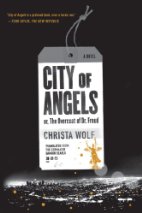
0374534292.jpg

The cover blurb describes this book as a novel, and it’s obviously so. But at the same time this is so convincingly not a made-up story that when the narrator says of an extraordinary coincidence that it wouldn’t work in fiction, the reader (this one at least) forgets to scoff at the double bluff.

The narrator, whose name we never learn, is somewhere in Germany in the early 21st century surrounded by pieces of paper that relate to several months she spent in Los Angeles as a resident scholar some fifteen years earlier. The book is what she makes out of those papers: there are moments of reflection in the present time, but mostly the book is made up of conversations, dreams, movies, news items, phone calls to home, bits of writing done – a mass of detail from her stay. There are touristic observations (the size of the portions, the relentless US cheerfulness, the surfeit of material goods), political debates, gossip about the other scholars at THE CENTRE, recollections of the narrator’s earlier life, and some fascinating history of German intellectuals living in exile in Los Angeles during the 1930s and onwards.

The narrator is from East Germany, a country that had ceased to exist at the time of her residency but was still named on her passport. She had lived through the Nazi years, been an idealistic Communist and then an outspoken critic of the Soviet and GDR regimes. She had recently seen her Stasi files and been appalled by them. All this is also true of Christa Wolf. An older friend back home had recently died and bequeathed to the narrator a bundle of letters from a woman who signed herself only as ‘L’. The narrator’s nominal project during her time in Los Angeles was to discover the identity of her friend’s correspondent. But she mainly spent her days documenting her stay in Los Angeles in meticulous detail – hence the piles of paper in the book’s present time.

The back cover blurb spoilerishly reveals that there is a further reason for her trip to the US. I advise, therefore, against reading that blurb. This other element, which emerges at about halfway mar, may not surprise people who are familiar with Christa Wolf’s life and work, but it was a huge twist for me. Without it the book is engaging enough as a detailed account of some months in another country, describing consumerist capitalism from the perspective of someone recently arrived from the Soviet bloc, reporting conversations among writers from many different nations and social contexts, exploring the complex emotional state that results when an oppressive regime one has opposed finally comes to an end, but that ending means the loss of one’s political home. It continues to engage at those levels, but now the narrator finds herself the subject of vigorous (mostly offstage) attack, and is plunged into a deep puzzlement about herself.

I was so engaged in the  diary-like elements that I didn’t much care when the mystery of ‘L’ was resolved, and though the big puzzlement was resolved to my satisfaction I can’t tell if that satisfaction is peculiar to me. I’m waiting for the Emerging Artist to finish reading the book so we can discuss it.

Perhaps because I read City of Angels just after leaving the morally clear-cut world of All the Light We Cannot See, I loved it for its complexity, its ruthless self-questioning, it’s commitment to the life of the mind. The book was published in Germany in 2010.  Christa Wolf died in 2011, aged 82. The narrator writes at one point of feeling the end approaching, and says explicitly that she means the end of life as well as the end of the book. If Christa Wolf intended the book as a farewell statement, it’s a powerful goodbye, hardly optimistic but not without hope for humanity.

A note on Damion Searls’s translation: It reads very naturally and as far as I can tell, it’s brilliant. I want to mention two clever solutions. One: because the narrator is in English-speaking Los Angeles, the original German text was sprinkled with English words and phrases  – like ‘scholar’, ‘office’, ‘How are you?’, ‘Can you spare some change?’ The English text gives these words in italics, an elegant and unobtrusive way of reminding us that we are seeing this world through a non-English-speaking lens. And Two: when she is a deeply troubled state, the narrator spends a whole night singing in her room, and several pages are taken up with a list of the songs she sings. We are given the names of the songs in German without translation. In my ignorance I recognised only a handful, but that was enough to be able to tell that her singing was a way of reaffirming her belonging to German culture – not just some small part of it, but the deep, wide history. If we’d been given the titles in English (‘A Mighty Fortress is our God’ rather than ‘Ein Feste Burg ist unser Gott’, for example), that would have been lost.
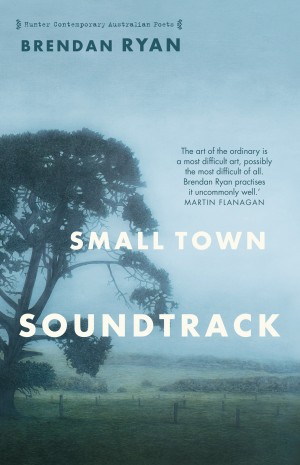
Brendan Ryan’s Small Town Soundtrack

Brendan Ryan, Small Town Soundtrack (Hunter Publishers 2015)

sts

I’ve previously read three books of Brendan Ryan’s poetry: Why I Am Not a Farmer (2000), A Paddock in His Head (2007), Travelling through the Family (2012) (the links are to my blog posts). Given the extraordinarily consistent focus of his work, I tend to repeat myself when I blog about it, so here’s something I wrote about Travelling through the Family:

Brendan Ryan’s poetry is deeply rooted in place, specifically in what this book calls blister country, in western Victoria. [He returns] again and again to his early life on a dairy farm, to what it means to live away from it as an adult, or to revisit it, even if only to drive through. It’s a rich vein that yields poetry about natural and human landscapes, about cattle and working with cattle, about living in a big Catholic family in a rural community, about masculinity as a son, a brother and a father, about memory and meaning, the powerful interplay of place and identity.

To a large extent, Small Town Soundtrack is more of the same, and the world is richer for it. There’s more of life away from the childhood environment, and a more elegiac mood, as the small farms and their communities are falling into ruin. To the ambivalence of no longer belonging to the dairy country is added the pain of seeing that it no longer exists in the same way. (A personal resonance for me: my childhood home, sold out of the family, was recently knocked down, bulldozed into a trench and buried. The farm may be about to be subdivided or become in part a retirement village.)

The book is in four sections: ‘Small Town Pastoral’ gives us what it says on the lid, a number of glimpses of small town life – character sketches, parental duties, unexpected tragedies, schoolyard politics; ‘Songs of the Clay Mound’ is a handful of poems about music and its associations – ‘every place has a song to tell / a chord that strings out desire, a glissando slide into memories that taunt’; the ten poems of ‘Towns of the Mount Noorat Football League’ celebrate the role that football competition once played in farming communities, ‘once’ being a key word there; then, with ‘Cow Words’, more than a third of the book, we are back with memories of farm life, family past and present, his relationship with his parents then and now, and – of course – cows. The cliche about not being able to take the country out of the boy is a cliche because it contains a deep truth, a truth that this poetry explores. Sometimes it does so lightly, as in ‘Cows in India’:

The first time I saw cows in India
I wanted to round them up.

Yard them, milk them, close the gate
on a paddock, watch them nod along a cattle track.

(Incidentally, it’s been said that Ryan is in the same tradition as Les Murray, but a comparison of their tourist-in-India poems highlights the huge differences between them: Ryan’s identity as a farm boy never leaves him; Murray can look at cows, camels and the Taj Mahal with no hint of his own farming background influencing his perception.)

At other times, with fascinating complexity, as in the third sonnet of ‘Succession’:

Something about a place I can’t escape to
swings like a pendulum toward me,
as if returning is the answer or the question to avoid.
I couldn’t be the farmer stammering through
conversations, red-faced with the wrong words.
I couldn’t be the farmer shouldering a load of flies.
Returning has become the ritual we have learnt
to talk about, the succession plan we had to achieve.

I walk around the farm carrying my fear of electric fences
listening to the hum inside insulators – an energy
running free. Cows remember the kick,
I remember my father catching me out
while I shifted the wire in the Rape paddock.
Letting go of land is letting go of memory.

I respond to Brendan Ryan’s poetry as a personal gift.

Martin Duwell has recently reviewed Small Town Soundtrack on his indispensable website, Australian Poetry Review.

Jeremy Massey’s Last Four Days of Paddy Buckley

Jeremy Massey, The Last Four Days of Paddy Buckley (Riverhead Books 2015)

last4days.jpg

Seven years his junior, Donal had been Vincent’s partner in crime since they were teenagers.

Now someone had plowed Donal in the dead of night and robbed him in the bargain.
—-
… forty girls from as many different countries who were quite literally real-life fantasies for the top-end clientele.

Those are all quotes from page 78 of The Last Four Days of Paddy Buckley. If, as E M Forster said, a novel is a prose narrative of some length with something wrong with it, then it’s completely fine that the maths doesn’t work: boys who are seven years apart can’t be teenagers at the same time. It’s fine that literally is quite meaningless in that context. And it would be weirdly churlish to object to US spelling in a novel set in Dublin that is, after all, published in New York. But the fact that I noticed these things is a sign that something wasn’t working.

Sex and death, out of body experiences, an evil crime boss and a sadistic ambitious underling, a scary hybrid canine: plenty of elements that should be interesting and just aren’t. However, I did read on, and and was rewarded 12 pages later by a shockingly objective account of embalming a body, which was enough to propel me through Paddy’s remaining two and a half days.

The back cover of the paperback tells us that Jeremy Massy is ‘a third-generation undertaker who worked with his father for many years at the family firm in Dublin’. He is now, the cover blurb continues, ‘a screenwriter by training’. Paddy Buckley of the book’s title is also a Dublin undertaker, and I’ll happily believe that his professional crises and dilemmas are drawn from Dublin undertaking folklore: a body arriving from another undertaker in a coffin with someone else’s name on it, a scam involving coffins and customs, the tensions of juggling multiple funerals with limited staff and vehicles, the details of what ‘ashes’ actually consist of, the effects of tissue gas setting in, even the professional jargon (I like remains, always singular when it signifies a dead body). These bits of lore are what make the novel live. The rest of it, which fails to amuse or excite on the page, may be a novelisation of a film script, and indeed it might work  well as a black comedy thriller on screen, though I doubt if Paddy’s out of body skills would be any less unconvincing when seen than when read. Maybe a producer with money will take it up.

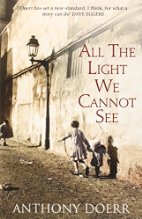
The book group has Anthony Doerr’s All the Light We Cannot See

Anthony Doerr, All the Light We Cannot See (Fourth Estate 2014)

0007548672.jpg Before the group: In short chapters that for the most part alternate between their two stories, this novel of the Second World War tells of a German orphan boy with a gift for radio technology (a geek before the word) and a blind French girl who flees Paris with her father when the Germans invade.

They finally meet in the aftermath of the Allied bombing of St Malo on the French coast in the last days of the war.  The two young people’s war experiences are vividly realised. The account of the making of dedicated Hitler Youth is chilling. The story telling is masterful, and motifs of light and darkness, touch and sound, snails and gems are woven intricately into the novel’s fabric.

But it didn’t really touch the sides. At the centre of the plot is a brilliant diamond with a fire at its heart, sought after by the Nazis and guarded unawares by the blind girl. Some readers may respond to the talk of curses and other magic that surround this jewel so that it resonates with rich symbolism, but for me it’s just a maguffin, and the novel as a whole a beautifully crafted, enjoyable diversion set in a period that has been done, and done, and done. If it has fire at its heart, the fire remained invisible to me. Soon there may well be a Spielberg movie, as flawless as Bridge of Spies.

Actually I just told a lie. There is one paragraph that snagged me. Young Werner is deeply into his work with the German armed forces when he hears on his radio receiver some music that he and his sister Jutta used to listen to back on the orphanage:

Now the piano makes a long, familiar run, the pianist playing different scales with each hand – what sounds like three hands, four – the harmonies like steadily thickening pearls on a strand, and Werner sees six-year-old Jutta lean toward him, Frau Elena kneading bread in the background, a crystal radio on his lap, the cords of his soul not yet severed.

That last phrase encapsulates brilliantly the long, corrosive years of Werner’s training to serve the Reich, and strikes a note of deep pathos. It made me glad I’d read the book.

At the meeting: Given that the book won a Pulitzer Prize and received extravagant critical praise, I was prepared to be a minority voice. But we had extraordinarily similar responses to it. Unusually though, we spent most of the evening – over a delicious tuna salad in a room with the walls folded back so we had full benefit of the warm autumn night – actually talking about the book. Spouses’ illnesses, the state of Sydney theatre, advice on how to approach local council all took a back seat.

One man had recently been to St Malo, and the book was a revelation – evidently the old town  has been restored and all signs of the WW2 devastation erased. Another had researched the school young Werner was sent to, and verified that there were many like it. Yet another wondered if the Nazis did search Europe’s natural history museums as well as its art museums. So it did stir our minds. We all agreed that the short chapters made it very easy to read, that with one or two exceptions the characters were well drawn and engaging, that the plot moved along. We all agreed that it was beautifully written: one chap said he reread some chapters just for the pleasure of it, ignoring the onward pull of the narrative. No one was keen on the fiery jewel – only one chap thought we were supposed to take its magical powers seriously.

So we kept coming back to the question: why, if it’s so good in so many ways, does it leave us largely untouched? Perhaps the short alternating chapters worked against immersion in the story. Perhaps telling the story from children’s point of view limited the possibilities for adult engagement. Perhaps the book is overworked, leaving no Leonard Cohenish cracks to let the light come in. Perhaps the relentless action means there’s too little breathing space where a reader could find an emotional way into the story? Perhaps it’s that there is no thesis, no moment where the story comes together in a revelation of some sort, or if there is it’s too subtle for us. Perhaps we’ve all just read too many novels set in the Second World War. All those possibilities were canvassed, none were agreed on.

Stan Grant’s Talking to My Country

Stan Grant, Talking to My Country (HarperCollinsAustralia 2016)

talking-to-my-country.jpg

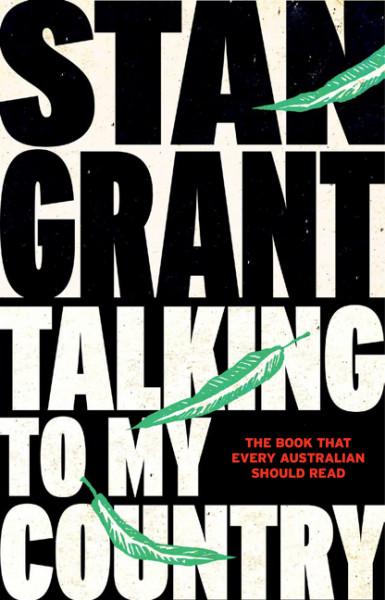
The cover of this book is great. The image on the left here may not look like much, just some bold type with a couple of gumleaves. But the actual cover held in your hands is scattered with (images of) tiny grains of sand as if the book has been out in the bush, exposed to the elements, suggesting that Stan Grant may be a journalist with an impressive international CV but you can never brush the Wiradjuri country from him.

Stan Grant appeared on Julia Zemiro’s Home Delivery this week. That’s a TV show where celebrities take us to visit places from their childhood usually with awkwardness and embarrassment. Stan Grant’s episode was an exception in not being awkward at all, because he had something to say about growing up and working as an Aboriginal person in Australia. That TV show provides an excellent easy-listening introduction to this book.

The cover tells us that this is ‘the book that every Australian should read’. I don’t know about that ‘should’, but if every Australian did read it we’d be living in a much wiser and possibly kinder world. Part memoir, part essay, inspired by James Baldwin’s The Fire Next Time and perhaps Ta Nehisi Coates’s Between the World and Me, it’s a personal account of the effects of dispossession, colonisation and racism on individual lives into the 21st century. It includes the most powerful account of a ‘mental breakdown’ I have ever read, not as a medicalised episode of ‘depression’, but as generations of pain inflicted by colonisation finally breaking through to the surface.

And it’s all told with a sense, not of complaint, but of wonder. The journalist Grant, who wants to understand the world and communicate what he learns, here turns his attention to his own story with the same curiosity and – not detachment, but concern to get it right.It’s a marvellous book.


Laura Tingle’s Political Amnesia

Laura Tingle, Political Amnesia: How we forgot how to govern (Quarterly Essay Nº 60, Black Ink 2015)

qe60.jpgAs always with the Quarterly Essay I turned to the back section of this issue for the correspondence on the previous one. The responses to David Marr’s profile of Bill Shorten aren’t argumentative – they mostly praise, summarise, amplify and contextualise. My favourite paragraph is from Michael Bachelard:

The dilemma is that, though fascinating to insiders, the grindings of Labor’s factional machine – at once impenetrable, distasteful and apparently crucial – are to outside observers dull to the point of stupor. But without understanding and accounting for the networks of influence and patronage that bind the union bosses, the branches (more accurately, the branch-stackers), the ethnic warlords and the parliamentarians, there is no explaining the Labor Party and how it identifies and promotes talent.

Marr’s ‘Response to Correspondence’ doesn’t actually respond, but reflects on the timing of the essay’s publication. Its portrait of Bill Shorten as the man who might beat Tony Abbott for the Prime Ministership lost a lot of topicality when Malcolm Turnbull did the job on the eve of publication – but, Marr says, ‘Anything can happen between now and the uncertain date at which Australia will go to an election.’

Political Amnesia asks us to turn aside for a moment from politics as soap opera or contest of personalities, and look instead for structural changes underlying our current political malaise. She argues, convincingly, that there is a growing loss of institutional memory in Australian public life. ‘Without memory,’ she argues

there is no context or continuity for the making of new decisions. We have little choice but to take these decisions at face value, as the inevitable outcome of current circumstance. The perils of this are manifest. Decisions are taken not as informed by knowledge of what has worked, or not worked, in the past, or even by a conscious analysis of what might have changed since the issue was last considered. … Rational debate about the pros and cons of an issue becomes too hard for both advocates and audience. We slip into the habit of conducting our debates in the present tense.

Or worse, three word slogans. The rot has been a long time coming, she argues, and has had complex causes, including the advent of the 24-hour news cycle, where the media beast must always be fed something new (am I the only one who finds it unnerving that even on the ABC news bulletins often tell us about announcements that will be made the next day?), the politicisation of the public service (beginning in a big way when John w Howard sacked department heads he considered politically unacceptable), the blurring of the roles of political advisers and policy advisers (perhaps beginning as early as the Whitlam government, but reaching the heights with Peta Credlin’s role in the Abbott government). She sums up the extent of the problem:

[The] institutions which have made Australia’s political system so vibrant and successful have been changing profoundly over the past few decades. These changes include the rise of unstable executive government (because it has lost the capacity to build institutional memory) at the cost of the parliament (which has also lost its memory as it struggles for relevance); the decline in the influence of the public sector (as a result of a range of forces which have robbed it of much of its institutional memory); the relative rise of the national security establishment (which retains its influence and its memory); and the transformation of the media into a channel for present-tense information, rather than a reliable repository of the historical record. In the background there has also been a nibbling away at our civil rights, as relentless incremental change has left many of us unaware how far the law has moved in the last couple of decades.

The essay has a refreshing focus on systems and structures rather than personality. It ends on a tentative note of hope, and some general suggestions for how the erosion of memory could be slowed or even reversed. Though she can’t be much more than 50, it’s clear that Laura Tingle is one of the precious vessels of memory, a journalist auntie. Much of what she describes if familiar to anyone who has worked in the public service, or really to anyone who has been paying attention. We can hope that this essay contributes towards a change for the better.

AWW2016.jpgPolitical Amnesia is the first of hopefully ten books by Australian women that I will read this year as part of the Australian Women Writers 2016 Challenge.

If not for the challenge, I might not have noticed an element of the essay that would have been unlikely to been there if the essay had been written by a man. The essay pretty much begins with a quote from the ancient Roman historian Tacitus, which describes the Roman people as seduced by Augustus Caesar into preferring ‘the safety of the present to the dangerous past’. That could easily have been done by a man, but Tingle frames the quote in a story about helping her daughter study for an Ancient History exam: so the quote slips into the reader’s mind as something that anyone’s teenage child might know, with none of the elitist baggage that quotes from the ancients – and by extension arguments about institutional memory – might otherwise carry.

Overland 221

Jacinda Woodhead (editor), Overland 221 (Spring 2015)

As usual, this Overland is well worth reading. Two articles stand out for me:

  • Transgender justice by Eliora Avraham. Noting that the mainstream media’s fascination with transgender didn’t start with Caitlin Jenner (I remember being fascinated by an article on Christine Jorgensen while my mother was under a dryer in a hairdressing salon in the mid 1950s), the essay moves on to a discussion of economic discrimination against trans people, and makes an interesting contribution to the debate about whether calling an event for women, say, ‘Pussy Power’ is oppressive to those trans women who have penises. The essay makes an excellent companion to the recent episode of the Jill Soloway’s TV series Transparent where the Jeffrey Tambor character is shattered to discover that only ‘women who were born women’ are welcome at the Wimmin’s Music Festival. Apart from occasional moments such as the bald characterisation of some disagreers as purveyors of hate speech, the case is argued carefully and respectfully all round.
  • Are Australian universities creating good artists? by Lauren Carroll Harris,  an excellent general article on the state of art education under neoliberalism in Australian universities. The writer attended the institution now known as UNSW Art and Design, and perhaps it’s an interesting product of the rivalries and snobberies the permeate the art education scene that she  fails to mention the National Art School in Sydney as a surviving studio-based tertiary art education institution. Likewise, no mention of the recent evisceration of art education in TAFE NSW.

There’s a lot more besides. Sophie Cunningham has another study of urban USA in Gold Rush, about the politics of murals in San Francisco’s Mission District. Stephen Wright’s column On male fear does a nice turn on sexism as a key concept in addressing domestic violence. Alison Croggon’s reliably elegant column defends vulgar language as often less vile than perfectly polite words (an argument that has turned up in the newspapers recently in New South Wales as prosecution of profanity is coming under question). In The excellence criterion, Ben Eltham lays out the arguments against George Brandis’s recent proposed changes to arts funding – proposals not substantially changed by Brandis’s departure from the ministry. Facebook absolution by Laurie Penny makes me seriously consider quitting facebook before it’s too late.

There are the judges’ reports and winners of two short story prizes the Victoria University Short Story Prize and the Story Wine Prize, the winner of the latter, with an 800 word limit, soon to appear on a wine label. I enjoyed all the stories but none of them took me by storm.

There’s Peter Minter’s last selection as poetry editor, with joanne burns (‘fate curves like a recycled / frisbee in search of destiny’) and  John Kinsella (‘I hear no birds at night / through thick concrete /and the lack is critical’) heading the bill.

And there’s a very welcome three-page selection of drawings by Sam Wallman from time spent recently working to support people crossing europe’s borders.

One advantage of being late to write about this issue of Overland is that most if not all of its content is now available online, hence my links


Pat Barker’s Noonday

Pat Barker, Noonday (Hamish Hamilton 2015)

noonday.jpgJust a short post on this:

Pat Barker’s Regeneration  trilogy is a magnificent work about World War One. Noonday is the final book in a different trilogy – one which began, in Life Class, before that war, and which takes its characters, those who survive, into the London of the Blitz.

I read Life Class too long ago – all I remember is the life drawing class that it opens with, in which the woman protagonist is dumped on by the instructor, and my blog entry about it explains why I didn’t go chasing after the second volume, Toby’s Room.

Noonday is worth reading for its evocation of London during the blitz. These days when the slogan’Keep Calm and Carry on’ and its parodies adorn a million mugs and tea towels, and the movie of Dad’s Army approaches with its no doubt charming and hilarious ragtag segment of the land army (not that there’s anything wrong with either phenomenon), it’s good to have this vivid reminder that it was a time of great suffering and great heroism.

But the main characters, three artists with varying degrees of success, aren’t all that interesting. Two of them are married at the start and not at the end, and it’s never very clear what happened. There’s adultery, which seems to be a big deal, at least for one of them, but I kept thinking of Bogart’s line in Casablanca: ‘It doesn’t take much to see that the problems of three little people don’t amount to a hill of beans in this crazy world.’

Then there’s a weird subplot involving a grossly overweight woman who is both a charlatan claiming to give the bereaved messages from their dead loved ones, and a genuine psychic. I didn’t know what to make of that, and in the end didn’t care.

So, at the risk of sounding as if I’m ten years old, I’d say read it for the account of London during the Blitz, but skim the talky-talky lovey-dovey bits.

Asia Literary Review 28

Martin Alexander (editor) Asia Literary Review 28, [Northern] Summer 2015

This issue of Asia Literary Review was part of a collaboration with Australia’s Griffith Review. I subscribe to ALR (actually I have a complimentary sub, for which I am grateful) but have only read one or two issues of the GR, which I guess makes me an atypical Australian reader of this joint publication.

Because the ALR is an English-language journal, every issue engages with cultural complexities: inter-generational stories, post-colonial hybridity, expat and emigrant writing, and some translation. In this issue, Australia is the non-Asian pole of much of the interaction. As always, the Asian presence is nothing if not diverse, including writing from or about mainland China, Hong Kong, India, Indonesia, Japan, Kashmir, Malaysia, Myanmar, Nepal, North Korea (a defector), the Philippines, Singapore, Thailand, and Vietnam.

Among the Australian contributors, Omar Musa – rapper from Deniliquin, spoken-worder and author of Here Come the Dogs – strikes a different tone in ‘Supernova’, a sober, reflective story about an older emigrant who has returned to Malaysia and takes part in the political process there; Ellen van Neerven’s ‘Half a Butterfly’ reports on a visit to Goa as part of a cultural exchange between Aboriginal Australian writers and Dalit writers; and Jessie Cole’s ‘The Asian Invasion’ is, among other things, a memoir of her childhood in Hippie Nimbin that challenges the received version of that community as drug-fuelled, self-indulgent and delusional, offering instead a recollections of one that was diverse, open to new experiences and other cultures.

One or two articles seem to be written with Australian readers in mind: Keane Shum’s marvellous ‘Ripple from Hong Kong’ tells a history of that island from the perspective of a Hong-Konger whose people were there long before the Chinese ceded it to Britain; in ‘All for the People, without the People’, André Dao starts from his own experience of voting in Melbourne, complete with sausage sizzle, and goes on to consider what democracy and ‘human rights’ might mean in Vietnam, a familiar subject presented through a personal prism; Miguel Syjuco’s ‘Beating Dickheads’, an argument for mockery as a form of resistance to tyranny, invites Australian readers to consider their own practice of mocking those in power (‘Every nation has its unfair share of dickheads, douchebags, dingleberries and degenerates. But my country, the Philippines, bests most in democratic tomfoolery.’); when Prodita Sabarini’s ‘Let Bygones Be Bygones‘ discusses the great Indonesian silence about the 1965 massacres, her main non-Indonesian reference point is Joshua Oppenheimer’s movies The Act of Killing and The Look of Silence – Oppenheimer is a USer, but his films have made a big splash in festivals here, as, evidently, they have in parts of Indonesia.

I don’t want to give the impression that everything is geared towards Australian readers. Far from it. The pleasure of encountering the unfamiliar, of being an invited eavesdropper, is as strong here as in any other issue. A number of pieces, for instance, discuss the role of humour, which notoriously travels poorly. Apart from ‘Beating Dickheads’, there’s Murong Xuecun unpromisingly titled ‘Chinese Thinking the Age of the Internet’. ‘If President Xi Jinping is clearheaded,’ he writes, ‘he will understand that although he may be able to seal people’s mouths, he can never stop them sniggering.’ Fair enough, one thinks, but the essay becomes really interesting when it gives examples of the subversive humour that the Internet allows to spread:

New English words with Chinese characteristics are popping up: Chinese citizens become shitizens; Chinese democracy begat democrazy; secretaries with Chinese characteristics (especially the female secretaries of high officials) are sexcretaries. Political jokes are also spreading. Here’s one I encountered recently: Xi Jinping went into the Qingfeng Dumpling Shop and asked what the fillings were. The waitress answered, ‘This one is cabbage and pork; this one is pork and cabbage; this one is pork with added cabbage. Which do you want?’ Xi thought about it for a moment and said, ‘They’re all the same, there’s no choice.’ The waitress responded, ‘Aren’t you forgetting, that’s how we chose you?’

You have to love the people who make these jokes, even if you don’t laugh. And though the essay doesn’t mention Ai Wei Wei, it changes the way one sees what some critics describe as his self-promoting poseurdom (and incidentally, I recommend the Ai Wei Wei / Andy Warhol exhibition that’s currently at the National Art Gallery of Victoria).

I also recommend Asia Literary Review. This blog post has barely skimmed the riches of this issue.

Ed Brubaker’s Fade Out

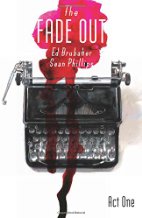
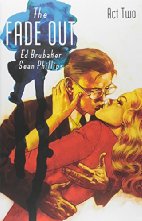
Ed Brubaker and Sean Phillips, with colours by Elizabeth Breitweiser, The Fade Out
Act One
 (Image 2015)
– Act Two 
(Image 2015)

1632151715I’ve no sooner decided that superhero comics bore me than the universe, mediated through the generosity of my sons, sends me an apparently endless stream of comics in other genres: investigative journalism, space opera, fairytale epic, domestic comedy, and now Hollywood noir.

It’s 1948. Our narrator, Charlie Parrish, is a Hollywood writer. Traumatised by his experience in World War Two he can’t write a thing, but he keeps his job by secretly taking dictation from his friend Gil, who has been blacklisted by the House Unamerican Activities Committee and so can’t get any work in his own name.

1632154471A beautiful woman is murdered in the first couple of pages, and the crime scene is altered to make it look like suicide. Charlie sets out to investigate and uncovers as much corruption, secretiveness and deranged viciousness as Philip Marlowe or Sam Spade could ever have wished for. He also gets beaten up quite a bit and gets involved with the beautiful woman who has replaced the murder victim in the film they’re all makng. He and Gil have a difficult relationship, not helped by Gil’s alcohol intake and his tendency to want to speak truth to power without regard for the consequences. Some real characters appear: Clark Gable knows Charlie from his war days, and Dashiell (‘Sam’) Hammett gives advice on how to flush out a murderer.
The plot is still thickening at the end of Act Two. Trails have been laid that may lead to interesting places – for example, will we be given the details of Charlie’s war experiences? I can’t find any information about how many more Acts are to come. Act Three is due out next month, and then who knows?

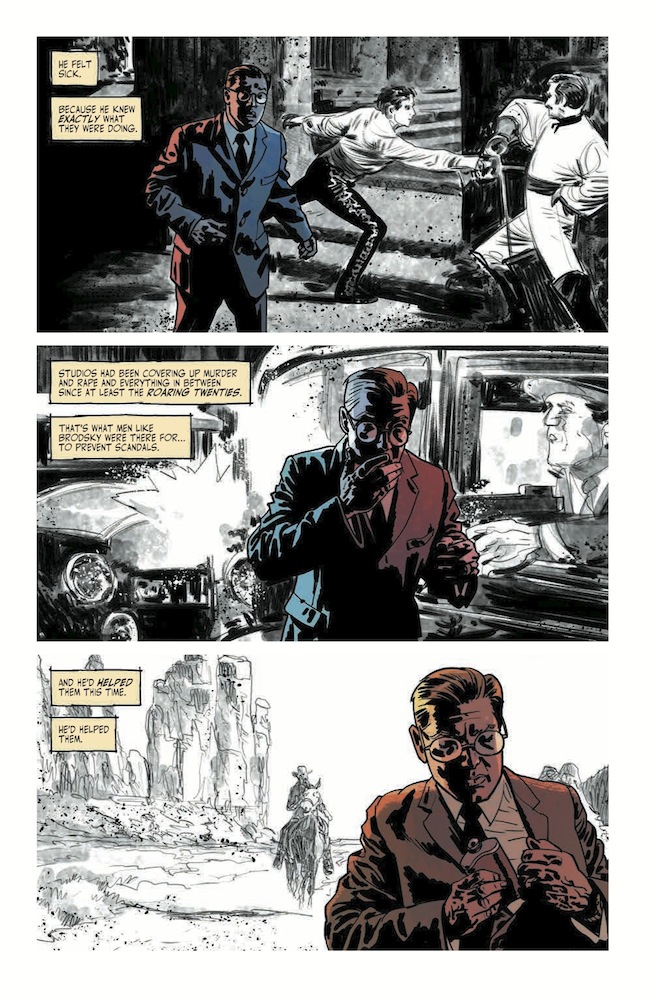
Brubaker and Phillips have been a team for more than 16 years, and the work feels seamless. Elizabeth Breitweiser’s colouring deserves a mention for its wonderfully evocative moodiness. The shadowy details of Hollywood behind the scenes may be a little hard for my ageing eyes to make out when I’m reading at night, but it’s worth the effort. Here’s a page I’ve lifted from the Image website:

FadeOut.jpg

The books, each a compilation of four original comics, are beautifully done. There’s none of the generational lossiness or iffy registration that bedevils comics from a couple of decades back, and the four original covers reproduced up the back of each book are stunning.