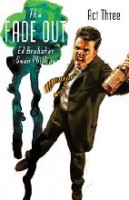
Ed Brubaker’s Fatale

Ed Brubaker and Sean Phillips, with colours by Dave Stewart, Fatale Book 1: Death Chases Me (Image 2012)

9781607065630.jpgI enjoyed Ed Brubaker and Sean Phillips’ The Fade Out immensely, so when I saw that this book of theirs was part of the ridiculously expensive pile of comics that one of my sons gave me as a birthday present (not so ridiculous, of course, when you realise that he would read them after me), I was pleased.

It’s a detective yarn combined with a Lovecraftian horror story. The telling is satisfyingly complex, shifting back and forth between two time periods and only gradually revealing the nature of the dilemmas facing the the lead characters, but laying out enough hints that when things take a turn for the bizarre there’s a sense of continuity. The artwork is consistently dramatic and serves the story well. Sex scenes are relatively tactful. Gore is over the top without being too realistic and the worst atrocity remains unseen by the reader. This is the first of five volumes (consisting of the first 5 of 24 comics), and does a great job of setting up the story, rounding out its own arc, and signalling a number of clear questions yet to be answered.

But my response was pretty meh. I guess horror’s just not my thing. The poet Martin Johnston once said that Lovecraft was a terrible writer but he gave you great nightmares. Sadly, I don’t expect even the nightmares from this.

Marlon James’s Brief History of Seven Killings

Marlon James, A Brief History of Seven Killings (OneWorld 2015)

1780746350.jpgI was reading A Brief History of Seven Killings in a cafe when I noticed that the young man at the next table was reading Oliver Twist, and the horrible thought occurred to me that Marlon James’s work might one day, like Dickens’s, be required reading in schools and universities. Assuming that its spectacular obscenity, violence and graphic sex won’t protect it from such a fate, I offer here, in lieu of a blog post, some possible essay questions:

  • ‘The book’s epigraph, “If it no go so, it go near so” implies a claim to historical truth. While the central event of the narrative, the attempted assassination of Bob Marley on 3 December 1976, is verifiable, the novel relies more on the tropes of US drugs-and-violence cinema and television than on historical research.’ Discuss.
  • James says in his acknowledgements: ‘I had a novel, and it was right in front of me all that time. Half-formed and fully formed characters, scenes out of place, hundreds of pages that needed sequence and purpose. A novel that would be driven only by voice.’ Is that an accurate description of the novel as it finally appeared? (Suggested answer: Far too modest, but kind of.)
  • ‘The novel is narrated by 12 different voices. Although most of them are Jamaican gunmen, they are brilliantly differentiated. At times, especially in the third of the book’s five sections, the sheer virtuosity of it becomes the point of the writing, and the narrative slows almost to a halt.’ Is this fair?  (Suggested answer: Yes, but the writing really is fabulous.)
  • What is the function of the many references to US popular culture? Does it differ with different characters? For example, a main gunman’s nom de guerre is Josey Wales and there are many other references to Clint Eastwood movies, while the only woman narrator refers several times to US television as a guide to how she is expected to behave. Is it necessary to be familiar with Dynasty and T. J. Hooker [whatever that is] to understand the novel?
  • Given that the book runs to nearly 700 pages, to what extent is the title ironic? Given that vastly more than seven people are killed, which are the seven referred to in the title?
  • The character known only as the Singer is definitely Bob Marley. Does the book make you want to (re)listen to all his music and read about his life? [Recommended answer: Yes]
  • Nina Burgess says in page 157: ‘The problem with a book is that you never know what it’s planning to do to you until you’re too far into it.’ Did this book tease the reader with other meta moments such as this? Were the many jibes at white men who think they know about Jamaica meant to prompt white readers of the book to check themselves for voyeuristic tendencies [or was that just me?]
  • We have become accustomed to some Hollywood movies’ preoccupation with penis size and certain sexual activities as easy metaphors for domination. Most of the characters here fall back on that rhetoric is a way that would be deadening if not for the Jamaican ‘bad chat’ elements. Does the one scene of tender sexual intimacy counterbalance this, or is it a token nod to alternative takes on sexuality?

There, that should do it.

Oh, another thing: One reason I read this book was that I had so enjoyed Andrea Levy’s Small Island, and wanted to read more from the Caribbean. Apart from the sheer exhilarating joy of the language in both, I can’t say they have much in common. But that could be the basis for one more essay question: compare and contrast.

Adrian Tomine’s Killing and Dying

Adrian Tomine, Killing and Dying (Faber & Faber 2015)

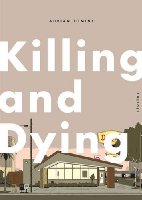
0571325149.jpgRecently in my favourite bookshop a customer asked if they had any comics. The person behind the counter replied in a tone that reminded me of one of the sterner nuns from my childhood, ‘We don’t have comics. We do have some graphic novels.’ Maybe I’m just meeting snobbery with pedantry, but if a novel is an extended work of fiction, then Killing and Dying isn’t one. Nor is Joe Sacco’s Palestine or Art Spigelman’s Maus. If those works of sequential art, which aren’t novels but which surely meet the criteria of respectability implied by that bookseller’s tone, can’t be called ‘comics’, what can we call them? I’m sticking with ‘comics’.

Killing and Dying is an excellent comic, comprising six short stories. The first story, ‘A Brief History of the Art Form Known as “Hortisculpture”‘, is a laugh-out-loud tragedy of frustrated artistic ambition. The protagonist of the second, ‘Amber Sweet’, discovers that she is a dead ringer for a famous porn star, which explains why men have been relating to her oddly. ‘Go Owls’ is a longer story about an initially hopeful relationship between two recovering alcoholics. In the title story, the teenaged protagonist has her heart set on becoming a stand-up comedian, while a whole other story plays out in the images, only elliptically referred to in the text. (The title, by the way, is to be read literally but also as in the world of entertainment.) These four stories are told in a progression of almost completely uniform small frames, only some of them in colour, creating a sense of laidback confidence: no need for visual fireworks, this story will hold the reader. And indeed it does – with extraordinary art that conceals art, each of these stories unfolds seamlessly. They may be comics but they’re quality story-telling.

The other two stories, ‘Translated, from the Japanese’ and ‘Intruders’, apart from being interesting for themselves, serve to demonstrate that Tomine is capable of different visual effects. The former has the same neat figures and impeccable lettering, but uses larger frames of varying dimensions, as befits an illustrated version of what turns out to be a letter written by a Japanese woman to her infant son, to be read much later, perhaps after her death. The latter has a rougher graphic style, a complete departure from the contained precision of the rest of the book, which matches the simmering violence of the situation.

It’s no surprise that Adrian Tomine’s work appears in the New Yorker, including a number of covers. Not that I see the New Yorker very often, but his stories have the understated economy, the decorum, the sharp wit and the slightly downbeat wryness one associates with that venerable institution.

A hundred years of The School Magazine

sm100.jpegI will probably write more about The School Magazine as its centenary year progresses, but for now I want to draw your attention to a sweet thing that happened on World Poetry Day. A number of poets wrote blog entries about their experience of being published in the magazine, and they combine to create a powerful statement of the magazine’s importance. You can see at least some of them by clicking on these links:

Jackie Hosking
Claire Saxby
Janeen Brian
Julie Thorndyke
Lorraine Marwood
Pat Simmons
Rebecca Newman
Sally Murphy
Sophie Masson
Stephen Whiteside
Yvonne Low

I was editor of the magazine for some years, and  (ahem!) am mentioned by one of these poets as a ‘great encourager’. I’m relieved that none of the poets took the opportunity to mention any of my blunders. And I’m delighted that a good number of them have begun publishing since my time.

Xanthorrhoea rising

Here’s a little Easter story.

When we moved to our current house six years ago, we transplanted our beautiful xanthorrhoea (grass tree) from the pot in which it had thrived just outside the kitchen window in our old house into the ground in our new back yard. After about two years, it was ailing. On the advice of a local nursery owner we cut it back severely, and for a time it revived, even putting out a spike for the first time ever. I blogged about it here.

But the revival was short lived. The spike fell off and then it turned very sick and brown. I followed the folk advice and set fire to a cardboard carton on its head, but to no avail. It really really died and has stood as a memorial to itself for at least two years.

And now this:
xanthorrhoea.jpg

Haec dies quam fecit dominus. Exultemus et laetemur in ea!

Southerly 75/2

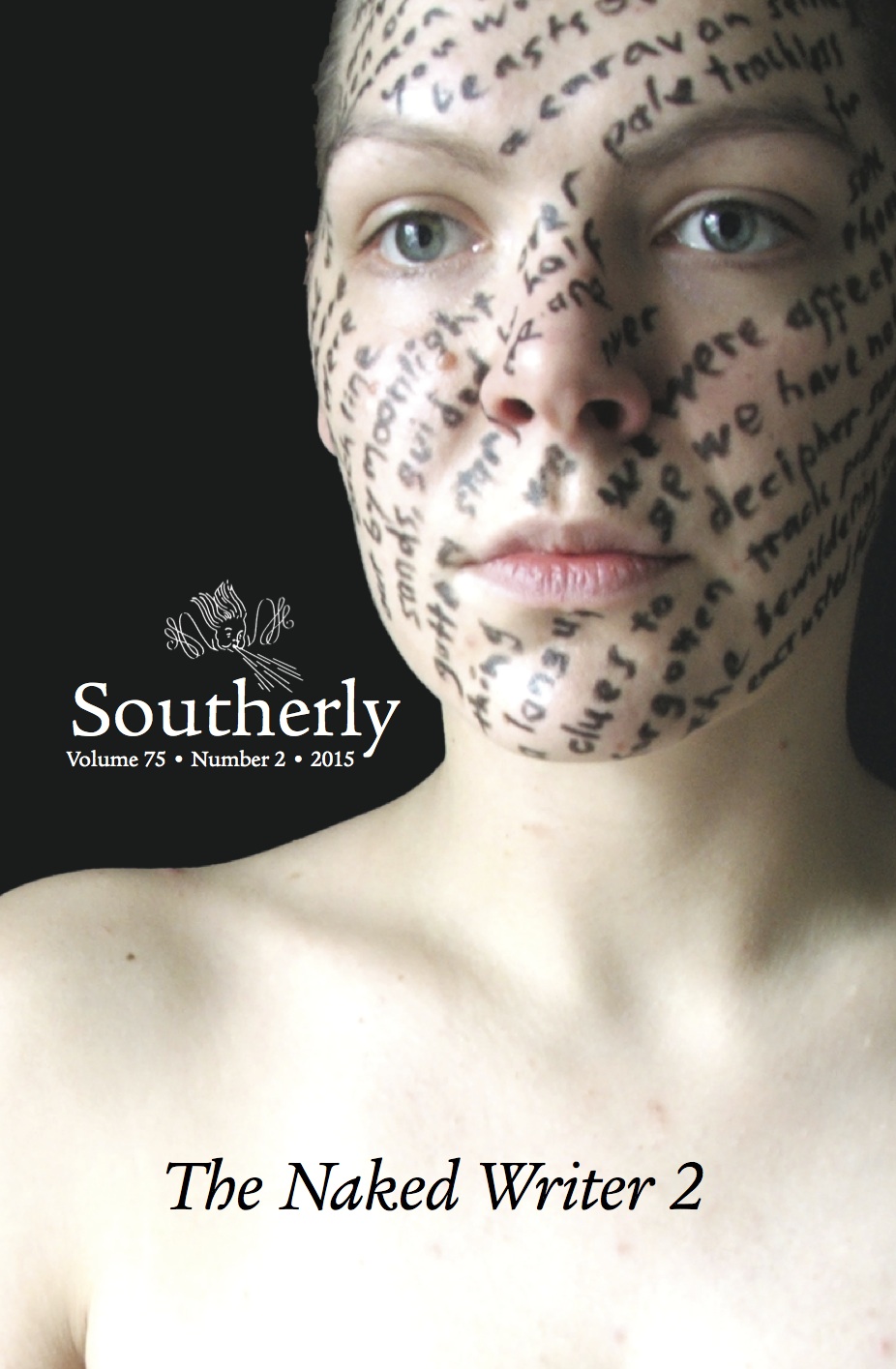
Elizabeth McMahon and David Brooks (editors), Southerly Vol 75 No 2 2015: The Naked Writer 2 (The Journal of the English Association, Sydney, Brandl & Schlesinger)

southerly752.jpg

John Kinsella and Charmaine Papertalk-Green have a collaborative poem in this Southerly. The son of an Anglo-Celtic farmer, Kinsella lived in Geraldton, Western Australia, for the last three years of high school. Papertalk-Green is a Yamaji woman who grew up in nearby Mallewa and now lives just outside Geraldton. The poem – actually a sequence of poems written by the two poets alternately – responds to the works of Western Australian religious architect Monsignor John Hawes as enduring symbols of colonisation.

In what looks like an anxious concern that readers appreciate the significance of the poem, it is embedded in an article by Kinsella, ‘Eclogue Failure or Success: the Collaborative Activism of Poetry’, which among other things spells out the back story, makes learned observations about Virgil’s Eclogues, quotes Wikipedia, throws in a few Greek words, and makes sure we don’t confuse the poem’s first-person elements with the ‘entirely self-interested and subjective’ phenomenon of the selfie. Kinsella is willing to risk being annoyingly self-important if that’s what it takes to ensure that we take him and his collaboration with Papertalk-Green seriously.

Maybe it worked, or maybe the poems would have spoken for themselves, but it’s the kind of project that makes one glad to be alive in the time that it is happening. (Of course, it’s not unique: another stunning example is My Darling Patricia’s 2011 theatrical work, Posts in the Paddock, a collaboration between descendants of Jimmy Governor and descendants of a white family he murdered. That one seems to have sunk without a trace, so maybe all such works do need a John Kinsella to tell us how important they are.)

The challenge of unsparing conversation between Aboriginal peoples and settler Australians is also the subject of Maggie Nolan’s essay ‘Shedding Clothes: Performing cross-cultural exchange through costume and writing in Kim Scott’s That Deadman Dance‘. Apart from calling to mind the pleasure of reading the novel and quoting from it generously, Nolan suggests that, though Bobby/Wabalanginy’s failure to communicate to the colonisers by means of dance may end the book, ‘perhaps his invitation remains open, and Kim Scott, through this novel, is re-extending it to his readers’. I think she’s hit the nail on the head.

There is plenty else here to exercise and delight the mind. In no particular order:

  • David Brooks bids an idiosyncratic and clearly deeply felt farewell to his friend the literary critic Veronica Brady, who died last year.
  • Fiona McFarlane’s ‘On Reading The Aunt’s Story by Patrick White’, originally a Sydney Ideas lecture, is a warmly intelligent revisiting of that novel.
  • Hayley Katzen’s personal essay ‘On Privacy’ rings the changes on the perennial theme of its title, interestingly resonating with John Kinsella’s distinction between the writerly ‘I’ and the facebook or selfie ‘I’, and also with Kim Scott’s meditations on what happens when you write things down.
  • Jill Dimond and Helen O’Reilly delve into their respective family histories, the former with an engrossing tale of failed literary aspirations, the latter with the story of the connection between her second cousin Eleanor Dark and poet Christopher Brennan.
  • Joe Dolce, whom I should be able to mention without referring to ‘Shuddupaya Face’, interviews the late Dorothy Porter about C P Cavafy and they discuss his poetry’s importance to both of them.
  • Of the wide-ranging selection of poems, I particularly enjoyed Alan Gould’s ‘The Epochs Must Go Chatterbox’ and ‘The Insistent Face to Face’, Geoff Page’s genial ‘A Drinking Song for A D Hope’, and Mark Mordue’s Sydney train journey, ‘A Letter for The Emperor’.
  • Craig Billingham’s ‘The Final Cast’ reads like a slice of wryly observed Glebe literary life, though its ‘Fiction’ label should spare embarrassment all round.
  • Nasrin Mahoutchi’s story of widowerhood, ‘Standing in the Cold’, evokes a bitter Iranian winter with just the right amount of twist at the end.
  • In the review section, A J Carruthers discusses Michael Farrell’s Cocky’s Joy and Les Murray’s Waiting for the Past, justifying this unlikely pairing by claiming both poets as ‘experimental’, and arguing that experimental poetry is mainstream in Australia now (and as I write that I realise that the four poems I have singled out above are probably the least ‘experimental’ in this Southerly – ah well, I’m now in my 70th year, so I hope I may be forgiven).
  • In The Long Paddock, the journal’s online extension, Jonathan Dunk gives what he describes as a ‘gloves off’ review of Jennifer Maiden’s Drone and Phantoms, and elicits a bare-knuckled response from Maiden. Good on you, Southerly, for putting the conversation out in the open.

I tend to skip the densely scholarly articles (the ones that use words like chronotopic), or at best dip into them. Dipping can come up with some pleasant oddities. In this issue I stumbled on a quote from one Eric Berlatsky to the effect that in some ways ‘the institution of heterosexual marriage is “always already queer”‘. How far we’ve come since William Buckley Junior caused an uproar by calling openly gay Gore Vidal a ‘queer’ on US television in 1968. Now, it seems, in academic parlance, even those ensconced in heterosexual marriages are queer.

Steve Shipps’ (Re)thinking ‘Art’

Steve Shipps, (Re)thinking ‘Art’: A guide for beginners (Blackwell 2008)
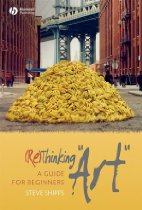
1405155639.jpgI read this book as an act of solidarity with The Emerging Artist. Thanks to a year-long series of lunchtime lecture–slideshows given by an art enthusiast in the French Department in my undergraduate years, I had a general idea of the history of Western art up to Picasso, so I could engage intelligently as she tackled assignments on Rembrandt or Watteau, but when she needed a sounding board on anything postmodern, I didn’t even know when to nod interestedly. She said she found Steve Shipps helpful.

The first sentence gave me hope: ‘This book grows out of bewilderment, skepticism and something like awe.’ Visits to contemporary art exhibitions have often enough evoked in me just that mix of emotions, plus occasionally the urge to deride. The book starts out with Doug Fishbone’s work 20,000 Bananas, which is what it says, a big pile of bananas dumped in the street, but could easily have started with Robert Gober’s  Drainsor Aleks Danko’s Trick Bricks or Sandra Nori’s amateur video of a Japanese anti-nuclear demo in the last Sydney Biennale.

Now that I’ve read the book, my bewilderment, scepticism and awe are pretty much still in place, but now they’re better informed.

It’s a short book, a guide for beginners as promised, that sheds light on a lot of contemporary discussions of art, not to mention art works themselves. There’s a terrific chapter titled ‘Pragmatics’ that describes a way to think about any given work of art – designed mainly for the student who has a paper to write, but with much broader application. But the book’s real interest is in its trickier and more provocative elements.

Shipp worked the book up from college lectures he has been giving since the 1980s, but he doesn’t patronise the teenaged student who is its imagined reader. In talking about de Saussure (Course in General Linguistics) and Danto (After the End of Art) and the Prague Linguistic Circle, he’s exemplary in his concern not to leave the reader behind, always carefully defining his terms and introducing his characters. It’s not ‘talk to me like I’m stupid’ or even ‘”art for dummies’ but it provides what the readers of such texts are looking for.

Apparently the idea of ‘art’ as we understand it today didn’t appear in the West until the Renaissance, and that the idea of art history didn’t appear until the late 18th century. ‘Art history’ traced the development of art – mainly painting and sculpture – from the Renaissance to the historian’s own time, and projected the new concept back onto works dating from cave paintings and the Venus of Willendorf. When the sculptures and plays of the ancient Greeks were created, Shipps maintains, they weren’t seen as ‘art’ in the way we have understood it for the last 600 years or so, but as what we would call craft. I have trouble getting my head around that, because surely Euripides and Praxiteles were famous for their works in their own time. But Shipps is adamant, and he backs his argument up with solid argument and lucid examples.

‘Art’ is not something that exists independently of what we call it, like a cow in a field, which is still there whether we see it as prospective food, a deity or an outsized pet. The term ‘art’ refers to disparate objects and activities, linking them in a category that exists only because of the term itself, and so it becomes hard to define. After much complex but always readable discussion, he says this on page 120:

what we seem to have come to, finally, is this: when we say ‘art’ what we mean is something  that invites – and justifies – a certain kind of attention. It seems to be that simple.

I love that, especially the word ‘justifies’. But, even given the interesting challenge of describing the kind of attention art invites, life isn’t that simple. The book goes on for another 40 pages, first arguing that we should describe as ‘art’ only those works that are created in a state of ‘flow’ and finally calling on us to stop thinking in terms of ‘art’ and ‘artists’ at all, and get on with doing for ourselves the things we have outsourced to them:

So much of the world has been described by now, and so many of those descrioptions made the more permanent for being ‘written down’ in whatever form, so much of our described experience has thus come to seem to be the way it ‘is’, that most of us are forced today to spend unprecedented amounts of time learning how things are ‘supposed to be’ and/or ‘supposed to be done’, and then doing them that way, so that our lives will proceed satisfactorily …
We are numbed by all the information through which we have to sort every day, so our experience of our experience, of ‘art’ or of anything else, becomes increasingly numbed as well … becomes, that is, increasingly anaesthetic …
We needn’t look far to see that there are things in our world today that could surely use some (re)thinking, and (re)describing. And I suspect that if we didn’t have ‘artists’ making ‘art’ to trust with doing that for us while the rest of us got on with our conventional, anaesthetic day-to-day lives, we all just might then tend to do more of it ourselves.

Margo Lanagan’s Sea Hearts

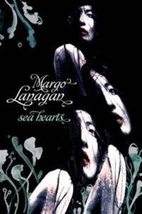
Margo Lanagan, Sea Hearts (Allen & Unwin 2012)

seahearts.jpgSome years ago I was waiting at traffic lights in Sydney’s Haymarket when I recognised Margo Lanagan walking across the street in front of me. Her slightly abstracted air could have been a sign that she was planning that night’s dinner, but I like to believe she was busily conjuring up the seal-women of Rollrock Island, imagining one standing naked and unspeakably desirable in the main street of Potshead Village, or another hurling herself desperately into the ocean, or perhaps the witch Misskaella Prout hardening her heart against the fully-human men and women who have scorned her, or someone in ‘the grunt and urge and song and flight and slump of seal-being’.

Lanagan’s previous book, Tender Morsels, was a sometimes harrowing retelling of the Grimms’ ‘Rose Red and Snow White’. In Sea Hearts she takes on selkie lore in which seals become human and take human lovers/spouses, generally with tragic results – pretty much a mirror image of Matthew Arnold’s ‘Forsaken Merman’, in which a human woman has temporarily become a mermaid.

The story unfolds in seven chapters, each told from a different point of view – man, woman and child. A long early chapter belongs to the young Misskaella Prout, who is teased because she is different. We learn along with her that she is a throwback to a time when the men of her island married women who had been magically transformed from seals. Her difference is not only in appearance, but in powers to harness magic, and having at first resisted she eventualy reaches a point where, in grief and bitter resentment, she uses her power to transform a seal into a woman with long dark hair and slender limbs, far more beautiful than the redheaded, work-worn human women of the island. The men are enchanted, and soon the island community is transformed. To the next generation of children, mothers – ‘mams’ – who ‘came from the sea’ are the norm.

But all is not well. Though their transformation includes falling compliantly in love with their human males, and though they are universally loving mothers, the seal-women never cease grieving for their lost life in the sea (none of the chapters speaks from a seal-mam’s point of view – we never see inside their heads, but we see their deep sorrow). Unless they have access to the skins they shed when first transformed they can never return to their original form, and the men make sure those skins are locked securely away.

So far, Lanagan has played very straight with the lore. Her prose is clear and fluent. Every development, every aspect of the world is revealed through action. The characters are all sympathetic: we understand the desire of the men, the rage of the human women, the compliance and the grief of the seal-women, the mixture of genuine love and underlying coercion in the families of the island, even Misskaella’s dark resolve. There are plenty of twists, but also a fairy-tale sense that these things happen as they must and consequences will follow as they are meant to. It’s a tightly-constructed, engrossing, vivid, sometimes funny, sometimes poignant retelling, with a feminist sensibility – there’s no doubt that patriarchy is alive and well on Rollrock Island, but no need to get strident about it, and in spite of it all men are not the enemy.

It’s in the long chapter told from the point of view of Daniel Mallett, son of a seal-woman, that the book shakes things up. Suddenly the children – the sons, I should say, because the daughters are a whole other, heartbreaking story – become key players. There’s a marvellous moment when Daniel, who has long been accustomed to dealing with his mother when the miseries are upon her by offering in an artificially bright voice to rub her feet or get her a cup of tea, finally understands the situation and realises that he can help, and speaks to her ‘not lightly or cheeringly’ – and everything changes.

The northern-hemisphere title of the book is The Brides of Rollrock Island. The Mams of Rollrock Island would have been better.

AWW2016.jpgSea Hearts is the second book I’ve read this year as part of the Australian Women Writers 2016 Challenge. It’s already March and only two books! I’d better get cracking.

Ed Brubaker’s Fade Out ends

Ed Brubaker and Sean Phillips, with colours by Elizabeth Breitweiser, The Fade Out, Act Three (Image 2016)

1632156296There’s a lot of old Hollywood anti-Communism around just now. On Thursday night I saw Jay Roach’s Trumbo at the movies. On Friday night we had a family birthday outing to the Coen brothers’ Hail, Caesar! On Saturday I read this birthday-present comic, the final ‘Act’ ofFade Out. All three deal with the House Un-American Activities Committee’s attack on Hollywood writers in the late 1940s and early 1950s.

Trumbo tells the story of Dalton Trumbo, probably the most famous of the black-listed authors. It’s not a documentary, but it’s firmly rooted in history, challenging our complacency with an implied warning that national security has been used in the recent past as a figleaf to cover authoritarian measures in a nominally democratic country, and no doubt will be again. That is to say, maybe it’s a bit pedestrian, but it’s serious about its subject. The Coen Brothers, by contrast, take the Communist scare as one more trope to play with in their fabulously stylish sandpit: they hold the anti-Communist fantasies up to ridicule by creating a literal version of them, but any suggestion that the beast that bore them is on heat again must come from the audience. The Fade Out lies somewhere between the two: a tremendously stylish homage to period Hollywood, but the Hollywood of film noir was already angry about injustice, and also deeply, grimly pessimistic about it. Not only is the anti-Communist scare a key element, but there is also the political corruption, sexual scandal, blackmail and violence that dark Hollywood fiction thrives on.

In this ‘Act’, the many threads of the story are tied off: the truly evil are at least privately unmasked and are punished in secret or escape scot free; one suspected villain turns out to be something other; there is tragedy, betrayal and a satisfactorily grim conclusion (think Jake Gittes’ final line, ‘It’s Chinatown,’ in Chinatown).

I don’t have anything more to add to my comments on Acts One and Two, but maybe I can slip in a couple of frames to demonstrate that the book passes theBechdel–Wallace test (just), and also to demonstrate that it inhabits the same world as Trumbo, in which Hedda Hopper (played by Helen Mirren going over the top) is a dedicated reactionary, and Hail, Caesar!, in which twin gossip columnists (played by Tilda Swinton even more so) likewise feed the anti-Communist frenzy. Dotty, on the phone here, works in publicity spinning stories about actors, and is paradoxically the most honest character in the story.

fo3.jpg

Esme the critic

My mother, Esme, left school at 14 or 15 in the mid 1920s. She married my father when she was 19 and lived on a sugar-cane farm outside Innisfail in North Queensland for the next five decades. As her five children went off to boarding school and then spread out over Queensland and beyond, she wrote letters to each of us, weekly to start with and then less frequently but still with a shaming regularity. Mostly she kept us informed on one another’s doings and home-front developments. Occasionally she would comment on literary matters.

Here are some of her passing comments on the literary scene, which I find interesting in all sorts of ways:

17 December 1971: I’ve just finished reading Thomas Keneally’s The Fear & enjoyed it more than any book I’ve read for ages. So nice & clean & sort of old-fashioned.

7 March 1972: I’ve just read [Aleksandr Solzhenitsyn’s] Cancer Ward. It’s really absorbing but very frightening really. I’m sorry I’ve finished it really. … You’ll be pleased to hear A was reading [Germaine Greer’s] The Female Eunuch. I have to own that I burnt my copy. M & N said, ‘At least you could have passed it on to us.’ Perhaps I should have saved their money as curiosity will get the better of them I’m sure.

25 July 1972: I am reading a book of yours that MA found in her box. I’m not liking it as much as The Fear. It is [Thomas Keneally’s] Bring Larks & Heroes.

28 November 1972: Thank you so much for remembering my Birthday. I’m sure I’ll enjoy the books. I’ve started [the first book I worked on in my editing job with Currency Press, David Williamson’s] The Removalists. It’s nice & easy to read. [Later in the same letter:] Having read The Removalists I’m glad it was a gift from you Jon because from you it is meant as a shocker. [It wasn’t.] From anyone else I would have a sneaky feeling that he/she might imagine I liked that sort of talk. If he’d made it a story of police brutality without the four letter words I feel sure it would have been just as big a success or even bigger.  Anyhow now I’ve started the [Gerald] Durrell one [probably Catch Me a Colobus] & it is really my pick. I’ll be able to lend it around.

25 December 1972: It was only today I learned that it was you who gave [my nieces and nephews Maurice Sendak’s] Where the wild things are. I had made a note of it to buy for [another grandchild]. It is the most read & the most cherished book in their house & yet it looks ghastly really.

24 February 1973: Of course I have not burnt The Removalists, Jon. As a matter of fact I have a waiting list of about a dozen women, as ignorant as myself, wanting to learn all about life!! seeing that M & N & E & V think that I have no ears to hear with. ‘Surely you’ve heard such talk,’ even in the street. Well I haven’t. Actually I think [youngest daughter] Liza knows more than I do but I certainly don’t feel underprivileged because of my ignorance.

28 March 1973: We have watched some of Certain Women on your recommendation Jon. I missed the name of the writer last night (not being in the habit of reading all those names, though I do notice that the writer, who should be the most important, is never so). It was the ‘model’ girl & I think it could have been Keneally as he is sort of old fashioned. I thought the Williamson one was the most – real is the word I suppose. He certainly understands today’s youth, don’t you think?

8 April 1973: Our Repertory Group put on [Richard Beynon’s ] The Shifting Heart last week. Roslyn Watt played the Italian mother & she was perfect. Seniors must have to study it this year because the night Dad & I went there was a bus load from Tully & the night E & V went there were 2 bus loads from Cairns.

9 July 1973: Last week there was a play on TV, The Cherry Orchard Chekhov [an MTC production with Frank Thring, Googie Withers, Irene Inescort] & knowing how interested [oldest son] Michael is in plays (He was in a Chekhov once) & feeling it would give me some culture, we watched it right up to the end of the first act then turned the TV off. It was played to packed houses in Melbourne for ages so the ad said. I wonder if you watched it & don’t say you enjoyed it. To me it could have been Innisfail repertory doing it for the first time. Dad stayed home from Poker to see it too which made it worse.

1 August 1973: I see [Peter Bogdanovich’s] What’s Up Doc advertised at the pictures somewhere in Sydney. Do go & see it if you can. [I did.] It’s really a scream, Makes you laugh till it really hurts – just absolutely stupid but I’m sure you couldn’t help enjoying it.

23rd October 1973 (after a visit to Sydney): I managed to get a Sat Aust(ralian) with Katharine Brisbane [my boss at the time] write up of the play [probably Rex Cramphorn’s cutting-edge production The Marsh King’s Daughter, which she mentions in a later letter] & I agree with her and the more I think back on it the more I like it really. Then today I found Jock Veitch’s write up which is downright lousy – even saying he couldn’t hear. I feel like writing & telling him to go again & wear his glasses & take along his hearing aid.

4 February 1974: Poor Mr Solzhenitsyn is having a rough time. Have you read Cancer Ward, Jon? [I had.] It is the best I’ve read. It seems queer but I think Patrick White writes much like him, so simply. I’ve read only one of his, The Tree of Man, & really enjoyed it.

March 1974: Innisfail had Godspell during the week,  packed the Shire Hall. We didn’t go, we left it to the young. The [Marist] Bros all went & raved on about it – more an experience than a show etc. They took 45 boys along so deserved a free ticket.

31 July 1974 (reporting on a time in Brisbane): We went to see [my cousin G’s] production Fetch Me a Figleaf. There were 10 of us … G sat with us so we had to say all the right things. It was rather naughty but really entertaining all about gods & goddesses on Mt Olympus.

13 October 1974: Well! we were trapped into a bit of culture last night. If we’d been at home we’d have turned it off but we were babysitting so left it on & were really sorry it had to end. It was The Misanthrope, Moliere’s play. The man who did the translation [not named on IMDB] must be a marvel & all the players were lovely. It says ABC production but I can’t believe it was. It was too good.

7 March 1975: Have you seen a book Watership Down? It’s about rabbits, all about rabbits. I’ve just read it & loved it. [I still haven’t read it.]

22 June 1975: We’re all reading The Towering Inferno, actually it’s called The Tower. Dad’s on it at the moment and doesn’t even answer when spoken to. It’s really suspenseful.

Late September 1975, from Launceston: We went to see [Roman Polanski’s] Chinatown & thought it pretty ordinary. Being overheated didn’t help. I’d put on woollen sox & extra cardigan & shed everything except the sox as the theatre was heated.

And that – when she was 61 and I was 28 – is where I stopped carefully hoarding her letters.