Bill Willingham’s Legends in Exile

Bill Willingham, Fables Vol 1: Legends in Exile (Vertigo 2002)
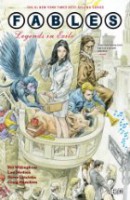
140123755XIn my former life as an editor of children’s literature, we regularly received manuscript stories and plays that rang the changes on classic fairytales – the wolf as a good guy slandered by dodgy pig developers or, far too often, a frog who is nothing but a frog but tricks a princess into kissing him anyhow.

Bill Willingham’s Fables belongs in that tradition. The many lands of fairytales have been invaded by a monstrous Adversary, seen only in flashback in this first book of the series, and the survivors of his onslaught have now lived centuries-long lives among the mundanes (that’s us) in a film-noir inflected New York City. At least, the action of this book takes place among those who live in New York – we are told that others, who can’t pass as human, live in enclaves upstate.

I expect that later volumes will tell the story of the expulsion. Here we are plunged in medias res, and the workings of the Fable community are revealed to us in the course of  a murder investigation. Rose Red has vanished and her blood is all over her apartment. Bigby Wolf, almost always human in form, is the hardboiled detective who investigates. The main suspects are Bluebeard (who is engaged to Rose Red) and Jack, of beanstalk fame (who has been her boyfriend for a long long time). Old King Cole is the figurehead mayor while Snow White does all the community’s real administrative work. Beauty and the Beast are a bickering couple with a difference – whenever she is angry with him, he starts to revert to his beastly appearance. Prince Charming is a parasitic conman. Pinocchio is a real boy, who is permanently enraged for reasons you might be able to guess.

It’s all good, knowing, M rated fun. The art, pencilled by Lan Medina and inked by Steve Leialoha and Craig Hamilton, serves the story well, tactful with the violence, restrained with the comic transmutations, moodily noir when it has to be, and just every now and then completely over the top.

Sonnet 14: Time and motion

I know the rule is that I have to post 14 sonnets in the month of November, for a very loose definition of ‘sonnet’. It’s now the 1st of December, but this sonnet offers its own justification.

Sonnet 14:Time and motion
Fourteen sonnets in November,
a poem every second day.
But here we are, it’s turned December,
Sydney’s in a summer way
and I’ve failed to meet my quota,
arrived a day late, missed the boat. Uh,
wait a sec! There’s wiggle room,
an argument against my doom.
November’s numbered days are thirty,
but that odd mid-Pacific line
meant I had only twenty-nine.
And I can claim, not playing dirty,
my first was done in New York. Quite!
In New York now it’s nine last night.


Sonnets 12 and 13

I couldn’t shoehorn this into 14 lines. It’s shoe-horned anyhow. It was a fabulous evening at the Lincoln Center.

On attending a performance of Bach’s Mass in B Minor by the American Classical Orchestra

For me, once, Mass was sacramental,
the cosmic human sacrifice
made present. Hymns were incidental,
and often bad: almost a vice
for Credo, Kyrie or Sanctus
to stand apart. A concert yanked us
from colloquy with the divine
to savouring the prayers like wine.
Now, I’m among the non-believers,
see sacrament as metaphor,
know this world’s it, there’s nothing more.
I seek no Gods, not even divas,
yet there is more than taste to art:
some sacred music scruffs my heart.

Tonight, from start to Agnus Dei
seemed one long plea for mercy. Bach
was not a happy-clappy chap, the way he
Gloria’d – whistling in the dark –
and, in the Credo, crucifixion
overshadowed resurrection
(jauntiness to make you weep
at your life’s margins). Herd the sheep
of doubt into Faith’s fragile pen, or
face the raging storm outside!
‘Who takes away the world’s sin,’ cried
a solitary counter-tenor,
‘Have mercy.’ Then all plead as one:
‘Give peace!’ This prayer is never done.

Sonnet No 11

A dependable source of pleasure when travelling is the frequent micro-moments of disorientation: for me in the US they include glimpses of cars in traffic with empty space where I expect a driver, ‘Shaw’ and ‘shore’ not rhyming, entrée as a main course. Most of these moments pass almost subliminally. I doubt if I would have noticed the one that set this poem going if I hadn’t been reading an essay on Australia’s convict period on the plane home. Speaking of micro-disorientation, I don’t suppose many of my readers – Catholic or otherwise – will know the hymn to the Immaculate Conception the poem quotes: it should be enough to know that it exists.

Sonnet No11: Let’s not call the whole thing off
We say ‘transport’, you say ‘transportation’.
At school I sang, ‘My soul today is heav’n
on earth, oh could the transport last!’ Elation,
I parsed the hymn to say when I was sev’n,
could be reached on a bus (shades of Totoro!),
a bus that might not run again tomorrow.
A moment’s puzzlement for little Shaw,
not so much pun as latent metaphor.
But ‘transportation’ told a different story:
Endeavour led to exile, chains, the lash,
a First Fleet weighed down with old England’s trash,
invasion, dispossession, death, no glory.
No wonder my town shuns the longer word,
prefers to leave those murky depths unstirred.

Sonnet No 10: At LAX

This one is self-explanatory.

Sonnet No 10: At LAX
We caught the shuttle at nine thirty
for our ten to midnight flight.
No surprise that we were shirty
when at ten to ten the bright
Los Angelene who took our cases
said, ‘Flight’s delayed till two.’ Our faces
dropped. Our bodies still on New
York time, knew two meant five, knew too
we had four hours to cool our heels in.
So here I sit in vacuum time.
I yearn for sleep and try to rhyme.
A quiet collective stupor steals in.
We read, snooze, stare, hit keys with thumbs.
The exterminating angel comes.

And I’m uploading it now courtesy of LAX’s free wifi, 4 minutes before boarding is meant to start. With any luck we’ll be home in 17 hours or so.

Elizabeth Strout’s Burgess Boys and Sonnet No 9

Elizabeth Strout, The Burgess Boys (2013, Random House 2013)

20141116-183712.jpg This was a good book to read in New York City, as the action is divided between Manhattan and a small town in Maine.

The three Burgesses, two ‘boys’ now actually men of mature years and a ‘girl’, the twin of the younger brother, live in the long shadow cast by an accident that happened when they were 8 and 4 years old – one of them released the handbrake in the family car which then rolled down a hill and killed their father. True to Maine ways, the incident is never mentioned, and each of them finds a way of functioning more or less successfully without ever dealing with the huge emotional issues they have been left with. The brothers are both lawyers in New York City; the sister and her teenage son live in quiet mutual dependence and isolation back in Maine. The tenuous equilibrium of their lives is disrupted when the teenager gets into trouble – a prank turns out to have much more serious ramifications than he has imagined, and the family dynamic is thrown out of kilter.

The book is well within the conventions of what people who are into genre fiction call litfic. It has a dysfunctional family, adultery, childhood trauma, a dubious sexual harassment charge, a wealthy uptight Connecticut character, a hint of recursiveness (the otherwise impersonal narrator introduces herself in a prologue, and a number of events from her life feature in the imagined lives of the Burgesses), and an Important Issue. I’m not saying it’s done by the numbers; it’s engrossing, we care about all the characters, and the Important Issue is done modestly but challengingly: the butt of boy’s prank is the community of Somali refugees who have settled in the whitest state of the USA (the Burgesses are white). The way the white community, including the legal system, responds to the Somalis and deals with the fall-out from the prank provides a rich background to the family story.

Today’s sonnet is based roughly on an episode in the novel. The Slessor reference is to his poem ‘William Street’.

Sonnet No 9: a Fictional visit to New York
She came from Maine to New York City.
Her brothers thought she’d have a ball.
Instead, she thought the place was shitty,
a state fairground where every stall
was huge, creating dreadful racket
(they mocked her speech, her bright red jacket),
and all the rides were underground.
The sirens’ midnight retching sound,
The mess, the homeless, lattes, bless us!
Signs and shirts may ❤NY,
she will never add her I.
I think of that refrain of Slessor’s:
you find ugly what I find
lovely. Are we both half blind?

Sonnet No 8: A tale from New York City

I’m writing this on my iPad in flight mode from New York. This is a true story, only genders and localities have been changed to fit the demands of the Onegin stanza. Both the curator who told us the story and the villager were women, and the conversation happened in an out-of-the-way part of Oaxaca in Mexico.

Sonnet No 8: A tale from New York City
 A New York Gallery curator
 in search of warmth, and needing rest,
 found more than both near the Equator.
 A villager (perhaps in jest)
 revealed to him her tribe's tradition
 (one day out in the jungle, fishin')
 that all that's living, all that is
 (forget about your Genesis)
 sprang forth from just one source, a river.
 'What river?' the curator cried.
 'What else but this one?' she replied.
 The art man's spine went all a-shiver.
 He said, 'That's not such crazy talk.
 We think the same way in New York.'

Travelling with the Art Student Part 2

This isn’t an account of our travels. It’s just a slightly shell-shocked continuation of the list of artists whose work we’ve seen in New York, Los Angeles and briefly Philadelphia.

First of all, the omissions from the list in part 1: Picasso and George Segal as mentioned in a comment on the earlier post; Object Matter, a big exhibition of Robert Heineken’s photographic work, including a very entertaining talk on his The S. S. Copyright Project: ‘On Photography; two different collections that included paintings from the late 19th and early 20th century big names; a vast exhibition of romantic photographs of nature and people who live close to nature, by Sebastião Salgado; street sculptures by Keith Haring.

And since my last post:

  • Lorraine O’Grady: Art Is …, in which she took picture frames to an African-American celebration in 1983 and photographed people and places being ‘framed’
  • Samara Golden: The Flat Side of the Knife, a huge, disorientating installation of an Escherish house with a mirrored floor that makes it seem to go down and down
  • Zero Tolerance: a huge exhibition at MoMA PS1 in Queens, that Deborah Kelly, met by chance, recommend to us. It included a poster for one of her works, Tank Man Tango. The participating artists are too many to name but they came from all over the world and taken in the aggregate presented an overwhelming image of a world in turmoil: extraordinary footage from just after Ceaucescu’s overthrow in Romania, horrific responses to a heroic Gay Rights demonstration in Romania, a cacophonous room called Democracies, with 20 video screens by Artur Żmijewski showing places of apparently intractable conflict.
  • big rooms full of David Hockney and Pablo Picasso in the same gallery – different sections
  • Ursula von Rydingsvard: Great towering works carved from cedar with a chain saw – new ones in a Chelsea gallery and an older one, in bronze, at a Brooklyn train station
  • Lorenzo Vitturi: photographs, that at first glance look like PhotoShop fantasies, but are actually of sculptures made from leftover fruit from a market in London
  • El Anatsui: a Ghanaian who makes huge, stunning tapestries from the neck-foils of discarded wine bottles – our tour guide was impressed that he started doing this because he couldn’t afford to buy materials and now sells his pieces for 7 figure sums and can employ people to scrounge the foils for him. We saw another of his pieces at the Metropolitam Museum
  • Kay Hassan: big images, mostly portraits but one landscape with football-playing figures which I loved, made by collage from paper scrounged from street posters
  • Eve Hild: lovely stonework ceramics
  • William Wegman: an photographic exhibition called ‘Cubism and other -Isms’ which featured Wegman’s very photogenic and athletic dog posed among and on top of primary colours and mainly stark geometric shapes
  • A number of women ‘sculpting animism’ at the Cavin-Morris Gallery, which quoted Doreen Kartinyeri in its handout (though sadly, no Australians, Indigenous or otherwise, were represented in the stunning ceramics and weaving on display

We went to the Met, where we were so sated we skipped the El Greco, and MoMA for the Matisse cut-outs, where the student fell in love with Cezanne. A trip to Philadelphia with US friends for the Barnes and Philadelphia Museums (more than $100 each in train fares at a Seniors discount, compared to $2.50 each from Sydney to Newcastle and back at home!) included much more Cezanne, far too much Renoir, never enough Monet. We had a fabulous visit with the same friends to the Frick Collection. We trawled once more through the galleries of Chelsea and oh my God I forgot to mention Adrián Villar Rojas’ The Evolution of God and other sculptures on the High Line … so now I’ll stop.

Sonnet No 7: Three MoMA Guards

Not one, but three of the security staff at New York’s Museum of Modern Art (MoMA) had me unsure where the art finished and the rest of life began. In two of the three cases I went back a second time, and saw that the exhibit was diminished by the absence of the guard who had been there the first time. I only visited the third room once, but the guard in question moved away and was replaced by someone who didn’t value-add in the same way.

Three Guards at MoMA: Gober, Gober, Dubuffet
Dolphin-sized, shaped from tobacco
sheafs, a fragile beached cheroot.
He’s on guard at its head. No whacko
Gets past his secret-service suit.
Wallpaper patterned with a lynching:
a thousand times a Black man hangs.
The guard is Black: without harangues
he sets us White art-lovers flinching.
Prints of dark beards, roots and gravel,
dig underground, compel, and revel
in earth, but then a high sweet tune
the guard hums lifts us to the moon.
Next day, there’s just an art brut star,
a pomo wall, a giant cigar.

The links will take you to images from the three environments referred to. (And yes, it hardly counts as a sonnet – can the volta ever come that late?)

Helen Garner’s House of Grief and my Sonnet 6

Helen Garner, This House of Grief: The Story of a Murder Trial (Text 2014)

1922079200 This is the third of Helen Garner’s courtroom books, and it’s a much tougher read than I remember the others being. Maybe that’s because this one involves a man who drove into a dam in a car that also contained his three young sons, and swam free himself. In four court hearings he is committed and tried for murder, appeals successfully against the guilty verdict, and is tried again. The aim of the legal process is to determine his guilt or otherwise. The book would be as relentlessly painful no matter what the jury finally decided.

The book is beautifully written. It’s subtle, sharp and unremitting. It conveys brilliantly the theatre of the court. It’s brave too: Helen Garner doesn’t back off from offering her own readings, her own judgments, of the many courtroom participants – witnesses, lawyers, judges, journalists, family members of the accused and of the dead children, her own young companion Louise, a bumptious school student drop-in, and at the centre of it all the man himself. I found it gruelling, and ultimately very satisfying, even while it pins a huge question mark on the tail of the whole legal system: so much raking through people’s lives and relationships, so many people put through the horrendous ordeal of cross-examination (much worse here, it seems, than in standard TV fare) – surely there must be a better way than this single-minded quest to find where to apportion blame?

It’s probably central to Garner’s power as narrator and her persuasiveness as interpreter that she dramatises her own emotional responses, so that we’re always aware that this is one person’s perspective and that it’s a perspective with flesh on its bones. She constantly reminds us that the court is dealing with profoundly human events – in this case the violent death of three children. I love the following, for example:

Was there a form of madness called court fatigue? It would have mortified me to tell Louise about the crazy magical thinking that filled my waking mind and, at night, my dreams: if only Farquharson could be found not guilty, then the boys would not be dead. Cindy would drive home from the court and find them playing kick-to-kick in the yard, or sprawled in their socks on the couch, absorbed in the cartoon channel. Bailey would run to her with his arms out. They would call for something to eat. She would open the fridge and cheerfully start rattling the pots and pans. I could not wait to get home, to haul my grandsons away from their Lego and their light sabres, to squeeze them in my arms until they squirmed. Young boys! How can such wild, vital creatures die?How can this hilarious sweetness be snuffed out forever?

Moving on to my obligatory November rhyming:

Sonnet No 5: Magical thinking?
What magic could bestow on juries
the power to undo a crime?
Guilt still would be pursued by Furies,
innocence shine forth in time,
but history, by twelve’s decision,
would undergo benign revision –
the dead would live, the maimed be whole,
and peace suffuse the tortured soul.
Real courts, alas, aren’t made for healing.
Wounds heal elsewhere, if at all.
What magic thinking has us call
to public scrutiny dark feeling –
grief, hate, regret, long festered strife?
No verdict can restore a life.

This House of Grief is the eighth book I’ve read as part of the 2014 Australian Women Writers Challenge.

Added 18 June 2015: Helen Garner appeared at the 2015 Sydney Writers’ Festival. Her riveting talk about her inspirations for This House of Grief was recorded and is available as a podcast.