Blogging from New Caledonia 2

Today we were meant to be going on a tour of the Parc Provinciale de la Rivière Bleue, which was declared a World Heritage Site just two days ago. As most of our attempts to organise ourselves onto tours have been thwarted, we were both looking forward to the day, despite or perhaps partly because of advice to wear dark clothes because the day involved contact with a lot of dirt.

But it was not to be. The rain came bucketing down in the night and was still bucketing when we were due to be setting off. The Man at Caledonia Tours (MCT, who incidentally speaks excellent English and has a sense of humour that communicates across the language divide) didn’t hold out a lot of hope, but the tour may yet happen before we leave for home on Friday.

In a lull in the downpour this morning, I went for a stroll around the neighbourhood, enjoying the vegetation that is so reminiscent of Queensland, stickybeaking at the houses, trying to remember which way to look when crossing the streets, and getting a stupid amount of enjoyment from the street names: Verlaine ran into Rimbaud; Baudelaire isn’t far from Jules Verne; Mallarmé, where we’re staying, crosses du Bellay and Heredia; and so on. My enjoyment was all the greater because when I had phoned to organise the tour that hasn’t happened, MCT asked where we were so he could pick us up, but said street names were no use because no one in New Caledonia knows them. As it was useless to invoke Symbolist and Renaissance poets, I had to give him the Majestic corner shop and the statue of the petite vierge (Our Lady of the Pacific) to steer by.

Luckily, Sunday was a spectacularly beautiful day. Just as well, because we’d paid a spectacularly large sum to go on a day cruise to the Ilôt Amédée ‘Where the weather is always nicer’, and where the first iron lighthouse to be constructed in France now stands. The weather was indeed very nice, the lighthouse was remarkable (though we didn’t climb it), the all-you-can-eat lunch was delicious. We cringed just a little at the traditional Polynesian dance performance. We saw turtles, a striped snake, large number of charming sea-birds about half the size of seagulls (so much more interesting than the unhappy caged birds at the Parc Forestier). We swam, lay about, people-watched, read our books. The Art Student drew and did watercolours. We met some people who were even nicer than the weather, and who invited us to dinner chez eux last night.

Although our hosts were European – a young Frenchwoman who has been here for two or three years and her Belgian mother and aunt over for a six-month visit – they had explored the local cuisine and treated us to nuts from the Solomon Islands, poingo bananas, and other delicacies, and were able to satisfy our curiosity about much of what we’d seen and heard, and about the political landscape as a vote on independence approaches over the next couple of years. It was fun navigating the language divide, though bilingual skills were much stronger on their side. They confirmed my impression that people here generally tutoient each other – that is, they use the tu form of address that was reserved for children, social inferiors and people you want to insult in the French I learned at school. ‘They’re not being insulting,’ our host said. ‘It’s kind of nice. But I don’t do it.’ They gave us some plump mangoes and drove us the significant distance home. It was such a pleasure to receive such warm hospitality – it’s not as if we’d been finding New Caledonia unwelcoming up to that point, but we now feel that we have been very cordially welcomed.

Now we’re cooped up, staring out at the rain, wondering if it will be possible to go out to dinner, and hoping that tomorrow we’ll visit the Blue River and perhaps see New Caledonia’s distinctive native bird, the kagu, in the wild.
Joshua Santospirito’s Craig San Roque’s Long Weekend in Alice Springs

Craig San Roque, The Long Weekend in Alice Springs, adapted and drawn by Joshua Santospirito (San Kessto Publications 2013)

1lwas In 2004, an essay by Alice Springs psychologist Craig San Roque appeared in the formidably titled volume, The Cultural Complex: Contemporary Jungian Perspectives on Psyche and Society, edited by Thomas Singer and Samuel L. Kimbles and published by The Psychology Press in the UK. According to an author’s note, the 16-page essay, ‘A long weekend: Alice Springs, Central Australia

suggests that ancient, habitual, mythically reinforced psychic structures may be repeating themselves autonomously from a basic pattern, rather like a DNA system. Such patterns may be encoded into legends or hieratic dramas associated with specific sites and can be detected by analysing mythologised stories embedded in cultural sites, by analysing how a culture developed (and perverted) the use of primal tools and by noting what cultural groups do with human bodies, death, justice and sexual coupling.

Esoteric stuff, you might think, the kind of thing Jungians write for each other but that the uninitiated tend to see as elaborately, solemnly, eruditely fantastical. (I speak as someone who in his mid 20s read quite a bit of Jung’s writing about alchemy.)

A couple of years later a young psych nurse named Josh Santospirito worked with La Roque in ‘remote mental health in Aboriginal communities’. This was demanding, frustrating and confusing work at a place where ‘mainsteam’ Australian culture and Central Australian Aboriginal cultures meet at best uncomfortably. He articulated the central problem he faced in his work like this: ‘How can you begin to address mental health issues when Aboriginal cultural structure is so undermined?’ San Roque gave him his ‘Long Weekend’ essay, and though the essay offers no straightforward solution to that problem, Santospirito found it useful in his attempts to come to terms with his experience.

Among other things, Santospirito happened to be a once and future comics artist. (His web site is here.) As he meditated on the essay, he began drawing, and the drawings led in time to this book, which he published himself, and so made San Roque’s specialised writing both accessible and available to a general readership. Not that the book is an illustrated version of the essay, or a pictorial representation for illiterate readers. It’s an adaptation from one medium, the academic essay, to another, sequential art (aka comic book, or if that sounds juvenile to your ears you could call it a graphic novel, even though this is not a novel). To judge by the little I’ve read of the essay, it’s a very faithful adaptation.

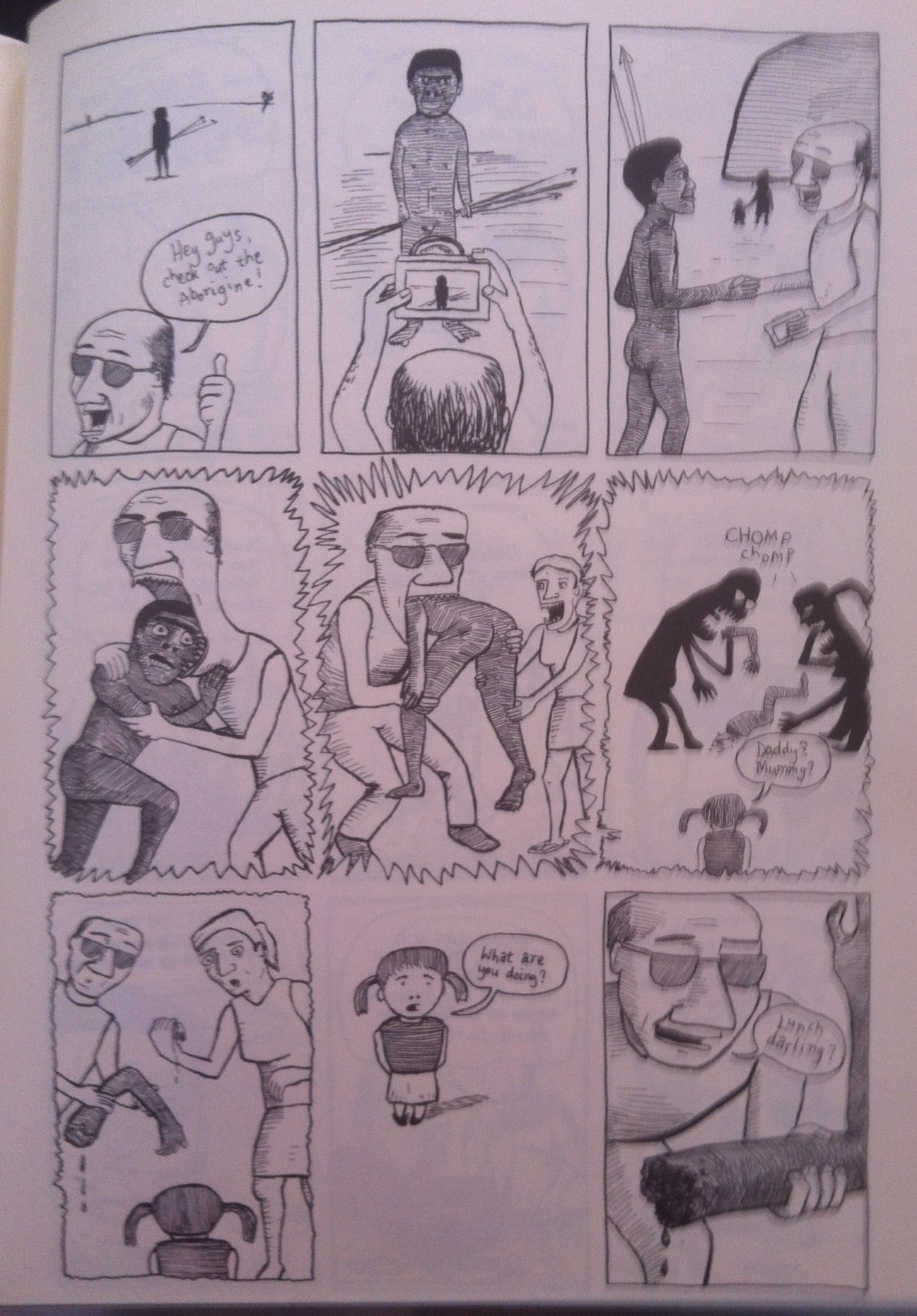
At the heart of the book is a search for something beyond individual aberration to account for so-called mental illnesses such as psychosis, substance abuse, violence and depression among Central Australian Aboriginal people. In crude, non-psychological terms, there’s a plain enough answer: they have largely been dispossessed and are on the receiving end of continuing dispossession – San Roque calls this cannibalism, which leads to one of Santospirito’s most compelling pages (especially the last two frames):

20140203-114233.jpg

The book is interested in what happens in people’s minds. ‘The tragedy here,’ according to the captions accompanying images of beer bottles,

is not about massive conflicts and brutal bloody invasion. The tragedy is about experiencing self-decomposition through the erosion of access to loving bonds with family, country and integrity of cultural practice.

All of this is lucidly articulated and graphically realised. At one point, San Roque speaks of the need ‘to analyse [his] own culture … to give up trying to understand Indigenous culture.’ ‘It isn’t my business,’ he says. ‘But the area of overlap between my culture and Aboriginal is indeed my affair. I live in it.’

That overlap manifests in a range of encounters over a long weekend: the Warlpiri people who come to town and meet in his yard, a young woman with a psychotic reaction to cannabis, a man who has killed his mother-in-law, mistaking her for his wife (‘What is in alcohol which makes me murder?’ ‘What is in your mind that lets you murder? And in such a manner?’ ‘What is in our brains that allows us to take axes to our sleeping women?’), a hunting expedition with some women and children, and so on.

Then comes the Jungian theorising. First, in looking to his own culture, San Roque goes to the epic of Gilgamesh and the descent into the underworld of the Sumerian goddess Innana. Not where most non-Indigenous Australians would look, I submit. But it’s a great story, and has the advantages of being unfamiliar to most readers (me included) and lending itself to some spectacular images. And there’s the speculation foreshadowed in the author’s note to the essay: that some places somehow contain certain dramas that the people who live there will inevitably play out over and over – the endless struggles in Iraq, for example, or the permanently brewing fights in Alice Springs, whose dreaming story involves a dogfight. It seems to me that having acknowledged that a ‘web of disordering complexes has evolved as a consequence of the psychopathologies of colonialism’, it’s odd to go looking for further explanation in mystical notions like this. Not only odd, but counterpoductive: if young men die in Lebanon because of something the air there, or people are forever scrapping in Alice Springs because they are bound to reenact the Dreaming story of the place, then there’s nothing to be done about it – and I don’t believe either of the authors of this book would agree with that conclusion.

With that misgiving, this is a beautiful, passionate, doubly intelligent book. It has become something of a self-publishing success story, and it deserves all the success it finds.

Blogging from New Caledonia 1a

This is really just footnotes to yesterday’s sonnet. If you’re looking for excellent writing about Nouméa from the perspective of a USer who lives here and engages intelligently with the place and people, I recommend Julie Harris’s blog, New Caledonia Today. If you just want just one post, try this one, which shines an interesting and uncomfortable light on relations between Kanaks and European New Caledonians.

But back to my footnoting, largely by way of pics.

The corner of our street – where Mallarmé’s languid faun is about as appropriate as the Lindsay satyr in Sydney’s Botanic Gardens:

Mallarmé

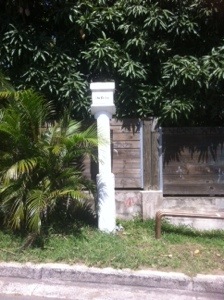
Our nearest bus stop, named with similar incongruity for renaissance man Joachim du Bellay:

du Bellay

The tricouleur, not as ubiquitous as the Stars and Stripes in the US, but enough to let you know you’re in France. And some people find it galling to have the Union Jack in the corner of their flag!

tricouleur

It’s not quite true that the tricouleur is the only flag here. Nouméa has its own city flag, of course, but there is also the Kanak national flag. The link above to the New Caledonia Today blog gives an idea of just how contentious this flag is. Here’s the only one we saw, planted on a rock in the bush across the road from a rather grand statue of Notre Dame du Pacifique. There’s supposed to be a referendum on independence some time this year. Interesting times ahead.

kanak flag

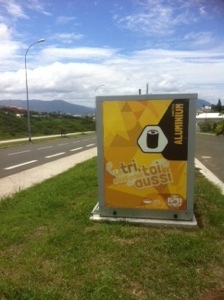
The writing on this bin says, ‘Le tri, c’est pour toi aussi’ – ‘Tri is for you too.’ It’s tri meaning sorting as in triage rather than three as in tricouleur, but the coincidence was too good to pass up.

tri

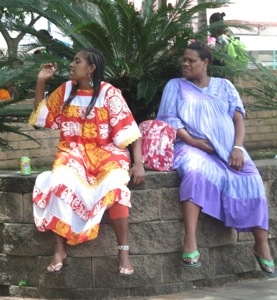
The women of colour, in both senses, are everywhere:

20140131-184410.jpgPhoto by Penny Ryan

20140131-184736.jpgPhoto by Penny Ryan

You can read about the separatist hostage-taking and subsequent deaths in the late 1980s here.

Blogging from New Caledonia

I’m writing this in a house in Portes de Fer, a suburb of Nouméa whose name translates as ‘iron gates’. We’re here for 10 days, on a holiday that was handed to us rather than planned for. A couple of months ago we received an email via homeexchange.com asking if we’d like to swap homes with a New Caledonian family. The dates fitted both our schedules, the cost of travel wasn’t prohibitive, and we knew almost nothin about New Caledonia. So we wrote back accepting, and here we are.

That’s my excuse for not being among the first to report that Jennifer Maiden’s Liquid Nitrogen won the Victorian Premier’s Literary Award, which the press release evidently described as the richest literary prize in Australia. JM commented that in the absence of superannuation it was a very welcome contribution to her finances. Just in case there’s anyone out there relying on my fannish notes to find out such news, I’m telling you now, a couple of days late. John Kinsella has a nice piece on the award in Crikey. Other Australian news, including Tony Abbott’s continuing war with the real world, does reach us, but I’m confident no one depends on this blog for that.

Inspired by the streets around here, which like those in Byron Bay are named after poets, I’m indulging my sonnet fixation:

First Impressions of Noumea, January 2014
With no rough strife at Portes de Fer
we’re lazing in rue Mallarmé,
a stroll uphill from Baudelaire
or down to bus stop du Bellay.
In town we hear no hostile gun
on Austerlitz, la Marne, Verdun.
These tricouleurs the only flags
though tri means sorting garbage bags
and colours won’t be kept to three:
dark skin, bright clothes and humble stance,
the Kanaks say, ‘We’re not in France!’
Some took up arms for Kanaky,
and died, but now if art’s a word
these words of colour will be heard.

Les Murray’s Boys who Stole the Funeral

Les Murray, The Boys Who Stole the Funeral: A novel sequence (Angus & Robertson 1980, Minerva 1993)

Here’s Laurie Duggan’s ‘translation’ of Martial’s epigram VIII lxxv, written less than a decade after The Boys Who Stole the Funeral was published:

After reading at the Lions Club
the Bard slipped and sprawled
on Taree shopping plaza's
_____crazy paving. His weedy acolytes
couldn't shift the bugger an inch.

Luckily for him, a hearse stopped
and two burly undertakers
winched and crammed the great man
______into the back,
splintering the neighbour coffin.

Was he taken home to Bunyah, you ask?
Or was he stolen by the funeral?

I like the way this capitalises on the serendipitous resonance between Martial’s scenario of the ingens dominus (huge master) who is heaved onto a funeral bier and the fact that bulky Les Murray wrote a ‘novel sequence’ about a funeral. I also like the way Martial is transposed into an Australian vernacular  But there’s something else: if there’s malice in Duggan’s image of the ‘Bard’s double humiliation, it’s a pallid thing compared to this book’s savage caricaturing of intellectuals, city people, socialists, feminists and their multitudinous ilk. When I read Duggan’s poem a fortnight ago, before I’d read The Boys Who Stole the Funeral, I thought it was a bit of mischievous fun; I now read it as a tiny piece of retaliation against a massive attack.

1bsf

A story outline would lead you to expect a great yarn with a thread of dark humour running through it. Two young men, university drop-outs, steal the corpse of an old soldier friend and take him to the country town where he has said he wanted to be buried, but where none of his family could afford to take his body. His funeral is the occasion for a great coming together of country folk, but the consequences for the boys are greater than they could have imagined – one dies a violent death and the other finds spiritual wholeness in a new, profound connection with country.

It should have been a great yarn, but alas, for all Les Murray’s greatness as a poet, he is a lousy story teller. None of the characters emerges as more than a type. A number of the barely distinguishable country folk seem to represent different aspects of salt-of-the-earth people that Murray approves of, and at the other extreme a rabid feminist–pacifist character is spectacularly implausible. Implausibility is a strong feature (reaching a peak in the boy’s killing). There’s quite a lot of dialogue, but it’s often all but impossible to tell who is supposed to be speaking. The narrative, such as it is, progresses with little regard for pacing, or motivation, or sense of place. The latter is particularly odd, given that Murray’s poetry elsewhere can evoke place with powerful specificity. Everything seems to be in the service of a weird anti-modernism. Perhaps the intention was to put forward a spiritual vision of some sort, but the vision is lost in the welter of negativity that accompanies it, so that the effect is of a mean-spirited nastiness about human beings.

I found this book deeply horrible, and also not much good. Some reviews I’ve read seem to think its wonderful – one US reviewer said that Murray’s skill made Vikram Seth’s The Golden Gate look amateurish. We live on different planets. Maybe the book really is up there with the great and I’m an idiot.

Laurie Duggan’s Old New and Selected

Laurie Duggan, New and selected poems, 1971-1993 (UQP 1996)

1ld

One result of reading poetry as it turns up in the secondhand bookshops is that I meet things out of sequence. As a retrospective of Laurie Duggan’s work, this book was superseded by 2005’s Compared to What: Selected Poems 1971–2003, and Duggan has published a number of books since then, not to mention his mainly photographic blog, Graveney Marsh. Still, this is the book I’ve got. It’s a fabulously mixed bag.

Laurie Duggan strikes me as a poet’s poet: not necessarily in the sense that he writes primarily for an audience of poets (though that could also be true), but in the sense that much of his work is concerned with the poet identity. You know how there are gay poets, and feminist poets, and nationalist poets? Well, there are also poet poets. Other poets turn up in his poems with extraordinary frequency, in two ways.

First, there are references to their work: there are poems imitating Rimbaud, Alan Wearne, John Forbes, John Tranter, and taking satiric digs at Les Murray, Robert Gray, A D Hope – ‘the last / Augustan poet claimed alive’ – and a number of translations from poets ancient and modern. I probably miss most of the allusions, but I spotted lines from Kenneth Slessor, James McAuley, Martin Johnston, and a number of 20th century US  poets.

And then there are poets as enemies, or more frequently as members of the community he belongs to:

Anna & Ken's blue V.W. crawls up the opposite hill
off for milk___cottage pie ingredients

That’s Anna Couani and Ken Bolton. I was reminded of a moment in Ken Bolton’s essay ‘Some Memories of John Forbes’ in Homage to John Forbes (2003):

I remember driving, with Anna Couani at the wheel and Laurie in the passenger front seat. The blue Vee-dub, … the car loaded up. As we got to the Broadway end of Glebe Point Road … we spotted John’s familiar figure steaming along ahead away from us down the footpath. … Laurie leaned out the window and called Heeeeyyy, POET!

And a host of poets, mostly of the so-called ‘Generation of 68’, turn up by first name as the book progresses. The sense of a community of poets persists to the final poem ‘Ornithology’ which starts out as an elegy for poets Bob Harris, Martin Johnston and Jas Duke (misspelling the title of Martin’s ‘In Memoriam’, incidentally), becomes an extended soul-searching, and could now be read as a foreshadowing elegy for John Forbes.

I don’t want to give the impression that these are coterie poems or an exercise in navel-gazing. In general, there’s a seductive, self-deprecatory wit and, especially in the continuing Blue Hills sequence (recently gathered into a single book by Puncher & Wattman) and The Ash Range from the mid 1980s, a deep engagement with place.

In a 2010 interview with Fiona Scotney published in The Long Paddock, the online component of Southerly 71/3, Duggan said this about his poetic approach:

I like the idea of plonking something here and something there next to it and the result is something else.

‘Plonking’ is a way of describing bricolage – a kind of verbal scrapbooking, of which Duggan is a superb practitioner. ‘Clayton West 1’, the first poem in the book, includes this:

____________________my Grandmother's cup
clinks in its saucer, table ordered with
teapot, grapefruit, marmalade
STH VIET TROOPS FLEE LAOS

It’s just a newspaper headline at the breakfast table, but the result here is something else – what that something is, the poem leaves up to the reader to decide. I could give a hundred examples.

‘Plonking’ also happens in Duggan’s translations, especially of the epigrams of Martial, of which there are 50 here. If you compare them to a literal translation, again and again you see something from ancient Rome plonked down next to something from 20th Century Australia, to delightful effect. Take Epigram VII xx,

Cum facias versus nulla non luce ducenos,
Vare, nihil recitas. non sapis, atque sapis.

literally:

Though you write two hundred verses every day, Varus, you recite nothing in public. You are unwise, and yet you are wise.

And in Duggan’s ‘translation’:

Dransfield, who wrote
__200 poems each day,
was wiser than his editor
__who printed them.

This was my introduction to Martial, and I find it hard to imagine a better one.

As a reintroduction to Laurie Duggan, the book is pretty good too. Oh, inspired by a page of anagrams of contemporary Australian poets  (to stick with Michael Dransfield: ‘Dead man chills fire’), I offer one of my own: I laud a grunge.

Details Unknown

Last night we went to the Penguin Plays Rough event at the Justice and Police Museum: the Grand Finale of the Details Unknown evenings. On previous evenings in the series people have presented stories, songs, and videos inspired by this photo from the museum’s archives.

des_cos126

For the grand finale, PPR handed things over to unhappen, an experimental theatre group that used the 18 pieces produced for the previous nights to create an interactive evening of experimental carry-on. There was a weird pas-de-deux in which to actors dressed in nighties enacted a bedroom murder over and over, alternating the parts of visitor and murdered woman (it didn’t seem to matter that one of the actors was male, the other female), and varying their actions in accordance with words typed by audience members. There was a silly puppet theatre. In one tiny courtyard a 1940s police photographer took mug shots. We could stand around watching a tattooed prisoner languish in her cell, though other people told me that when they went into that room they were offered a stick of opium (which turned out to be a chocolate bullet). My favourite of the small sideshows was the interrogation room, in which, though we’d been promised that interactivity did not mean audience participation, relatively unsuspecting audience members were grilled by a slightly demented pair of detectives as possible witnesses to the woman’s murder – I saw at least four people being questions, and sometimes virtually accused, and was impressed by how well they reacted under pressure: other people ran screaming from the room as soon as they realised what was happening.

The museum was originally a police station, and included a small courtroom. In that courtroom we could sit in the gallery, or perhaps it was jury seats, while one actor after another read a story that told how the woman died. We could, if we chose, draw images on butchers’ paper as we listened, and those images were hung on the walls of the murder bedroom.

It was great fun. We were promised a reward at 10 pm, but my little group had been out to midnight the night before at Flickerfest and up early, so we sloped off after only two hours or so. Penguin Plays Rough’s future is not clear. If there is to be a hiatus, it’s good that they’ve gone out with such a bang.

Usually Penguin Plays Rough has a number of wild cards – people who put their names down on the night and read something. That didn’t happen last night, but I wrote 14 rhyming lines anyhow:

Details Unknown
She’s dead, and though it may seem foolish
to make up stories, sing new songs
about her image, even ghoulish
imagining what dreadful wrongs
she may have suffered, or what shocking
act may have unclipped that stocking,
what cruel or pathetic scene
involved that true-crime magazine,
her death derides out pale inventions:
silent, name and tale unknown,
this monument of film, not stone,
though made for plain police intentions
commands our eyes: Attention here.
A life snuffed out. Be still. Revere

Southerly 73/2

David Brooks and Elizabeth McMahon (editors), Teja B. Pribac (Guest Co-editor),  Southerly Vol 73 No 2 2013: Lyre/Liar

73-2-sI didn’t read enough of this Southerly to write a review. It says more about me than about the journal that I just couldn’t make myself read a collection that focuses on exploration of ’emerging ethical implications of writing, with a particular emphasis on representations of nonhuman animals’. A quick skim seemed to show writer after writer identifying as vegan or animal liberationist in a way that felt just a little too correct-line for my taste. I may be wrong, and if I come back and find that I am, I’ll write a retraction, but I wasn’t deterred from my rash judgement by an extraordinary disclaimer from the Southerly editorial team, saying their views are not necessarily reflected by the ‘views expressed in this issue’.

I did read, though, an excellent review of Jordie Albiston’s The Book of Ethel by Mark O’Flynn (which articulates nicely some of what Albiston does with internal rhyme), some memorable poetry including ‘Mouse Plague’ by John Kinsella and ‘A Second Ago’ by Pam Brown, and an illuminating essay on lyric poetry in ‘post-theory’ times by Claire Nashar.

Ramayana for children (and westerners) in English

Upendrakishore Ray Chowdhury, Ramayana for Young Readers (translated by Swapna Dutta, The Book Mine, Hachette India 2013)

1rtl;dr: If you’re as ignorant of Indian culture as I am, this book will go a long way to filling gaps. You can buy an ebook from Hachette UK for less than $20 Australian.

The Ramayana, one of the two great epics of Hinduism, dates from well before the common era and its images and characters permeate Indian and related art. Most moderately literate westerners are at least vaguely aware of it, and have surely encountered art derived from it: monkeys battling demons in the Balinese Kecak dance; images or reliefs of Rama and Sita, possibly with a golden deer; paintings and statues of Hanuman the monkey god carrying a mountain; Javanese shadow puppets; chants of ‘Hare Rama’ in western city streets. But few of us have read even a fraction of its 24 thousand verses. This little book, just 165 small pages plus some child-friendly notes, is of course no substitute for reading the original Valmiki Ramayan, but it does tell pretty much the whole story, and enables us to put those fragments in context.

The Chheleder Ramayan, the Bengali book of which this is a translation, has its own distinctive history. Its author, Upendrakishore Ray Chowdhury (1863–1915), was a famous Bengali polymath, friend of the even more famous Rabindranath Tagore and grandfather of filmmaker Satyajit Ray. He had a personal mission to make literary works available for young people, and retold not only the Ramayana but also the other great epic, the Mahabharata. He’s not the only one to have retold these works. Indeed, the translator Swapna Dutta lists several Ramayanas that she has read. But his retelling holds a special place as a project to make the story available to early 20th century Bengali-reading children. This translation makes his Ramayana available in English for the first time.

Like all epics, it contains an awful lot of fighting, so much so that at times it reads like the script for a computer game. In the great climactic battle between the monkey army and the demons, you can almost see the game move up a level, as the lower ranking warriors are all killed or worn out and the next rank come to the fore with increasingly powerful weapons, until at the end it is the two mighty figures of Rama and Ravana facing off with nuclear-level arsenals. I have no idea how this plays out in the original, or how gripping it would be for a young western reader with no prior knowledge of the characters or the different supernatural beings, but even though I was never in doubt who would prevail, I stayed engaged.

This Rama is not a god, but an extraordinary man. His great prowess as a warrior is overshadowed by his superhuman sweetness. The story is set in motion when one of his father’s wives, incited to jealousy by an Iago-like maid, tricks King Dashratha into denying Rama his birthright as heir to the throne and sending him into exile. While Rama’s mother, the people of the kingdom, and Rama’s brothers, including the brother who is to be king instead of him, urge him to resist this manifestly unjust treatment, he refuses and accepts his father’s decrees with extraordinary persistence. He is a model of kindness, forgiveness, trusting openness.

The story stands by itself, but it’s all the richer for the many echoes (or are they foreshadowings?) of episodes from other great tales like The Iliad, tales of Greek, Roman and Norse gods, or the biblical the story of David.

My copy came free from Hachette India, and Swapna Dutta is a friend of mine from my days as editor of a children’s magazine. Swapna and her publisher have given me a great gift. There’s a preview on Google Books, and you can buy an ebook or a hard copy from Hachette UK.

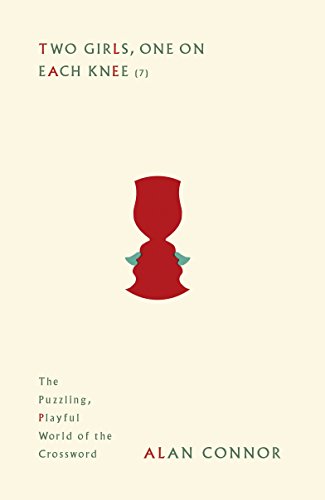
Alan Connor’s Two Girls, One on Each Knee

Alan Connor, Two Girls, One on Each Knee (Particular Books 2013)

Let me start with a factoid, a movie anecdote and a memory, all crossword-related:

  • Ronald Knox (1888–1957), Catholic convert scholar and single-handed translator of the Latin Vulgate Bible into English, is said to have completed The Times crossword each morning, first the across clues, then the down.
  • In the 1961 movie Very Important Person (also known as A Coming-out Party) the James Robertson Justice character arrives in a German prisoner-of-war camp and is left alone in a hut while the other prisoners are all on work details. He sees a copy of The Times on the rough wooden table, and turns to the crossword. His hut-mates arrive to discover that in a matter of minutes he has deprived them of their week’s only pleasure.
  • I once did a cryptic crossword in which the answer to each of three clues – referring respectively to a little pig, a village and a Shakespearean drama – was HAMLET.

None of those appears in Two Girls, One on Each Knee. but they could have: Alan Connor gives us a wealth of similar crosswordiana: gossip about famous solvers; scenes from movies, television and novels; great moments in setting. He also tells the history of crosswords, introduces us to some of the outstanding setters, and goes down the kinds of byways you would expect from someone who writes a regular column on crosswords for the Guardian. The book would be a useful guide to someone wanting to find out how cryptic clues work, or a student researching the history of crosswords, but its main mission seems to me to be to communicate the pleasures of the pastime. It fills this mission brilliantly. As something of an addict myself, I found the book immensely enjoyable.

Due homage is paid to The Times crossword, which appears in The Australian. For years I’ve been a fan, and I confess that in the past I have given money to the Murdoch empire in order to enjoy the crossword. These days I frequent a cafe where the staff tolerate me defacing the complimentary copy. I used to wish someone would edit it for Australian solvers, replacing the more parochial London references with more generally accessible ones, but really, it’s not broke so better not fix it.

There’s a chapter on The Listener, the most difficult crossword in the world, which a friend introduced me to in my 20s. The Listener went out of print decades ago but its crossword lives on in The Times each weekend. Though I rarely have access to it, it’s always a challenging pleasure. I’ve even completed it occasionally. The Spectator crossword comes closest to it in my experience, and has the advantage of being available in Australia and closer to humanly possible.

Connor compares UK and US crosswords. I once subscribed to the New York Times crossword online for a couple of months. The difference from English and Australian puzzles was striking. Apart from the shocking way brand names and capitalist enterprises appear with the same nonchalance as cities and famous people, the US puzzles have a very different kind of playfulness. I enjoyed it, but not enough to keep up my subscription.

Just one of the many clues Connor includes is by David Astle (DA), doyen of the Sydney Morning Herald‘s puzzles, and I’m surprised he rated even one, as in my experience when DA and his minions are not being annoyingly imprecise or obvious, they mosyly offer challenging exercises, but little by way of the pleasure that this book celebrates. And what can you say about a quick crossword in which eastern is clued as ‘from the east’ and pensive as ‘nervous’, or a cryptic with surface meaning as awkward and cryptic play as obvious  as ‘Spoil in a mooring site (6 letters)’? David Astle’s book Puzzled may have been as much fun as Two Girls, One on Each Knee. I hope so, but I doubt it.

One startling fact emerges from the book: there is no evidence for the frequent claims that doing crosswords, especially cryptic crosswords, is a way of staving off cognitive decline. The same can be said for the book itself: I doubt if there is any evidence that reading it will improve the reader in any way. But like the puzzles it discusses, it’s fun anyway.