Geoff Dyer’s Tarkovsky’s Zona

Geoff Dyer, Zona: A book about a film about a journey to a room (Canongate, Text 2012)

1zThis book about Andrei Tarkovsky’s Stalker came with plausible recommendation from the Book Club. Ignoring the back cover’s reassuring assertion that the book ‘fascinates from start to finish – even if you haven’t seen the film’, I decided to fill a yawning gap in my cinema-literacy and watch the movie before reading it. And I was underwhelmed, not to say bored. It may be one of the greatest films ever made, but for this viewer it’s mostly laboured, inconsistent, portentous and yet inconsequential, and dreary. ‘I do know,’ Dyer writes on page 10, ‘that if I had not seen Stalker in my early twenties my responsiveness to the world would have been radically diminished.’ So I guess it’s too late for me in my mid 60s. Admittedly I watched it on a small screen, but I suspect that if I’d gone to see it in the cinema when it was first released I would have quickly and irreversibly nodded off, and only partly because in 1979 I was a sleep deprived parent of a one-year-old.

Still, I’m always fascinated when someone I respect differs wildly from me about a book or movie, so I settled down to read, expecting to have fun. (I’d heard Geoff Dyer read hilariously from his Geoff in Venice, Death in Varanesi at the 2012 Sydney Writers’ Festival – at a time, it seems, when he was going on the Stalker marathon that led to this book.)

Zona isn’t a learned dissertation. It’s pretty much a blow by blow account of the movie, interspersed with making-of anecdotes, snippets of autobiography, descriptions of how other films have been influenced by Stalker or referred to it, comparison to other films (Dyer found Antonioni’s L’avventura intolerably boring, and perhaps this kind of book about that film just wouldn’t work at all), and reflections both serious and self-mocking on his own lifework as a writer. He probes at the reason the film has fascinated him so much: hallucinogenic substances may have something to do with it, though not, in his opinion, because they impair one’s judgement. In true essayist style, he chases off on detours, airs his snobbery (noting that Stalker has been compared to The Wizard of Oz, he tells us he hasn’t seen the latter film and ‘obviously’ has no intention of seeing it now), throws harsh adjectives at films he doesn’t like (Godard’s Breathless is unwatchable, Jim Jarmusch’s The Limits of Control is vacuous, Lars Von Trier’s Antichrist is absolutely repellent and silly), and quotes more or less casually from a vast range of cultural touchstones: Kundera and Wordsworth, Rilke and Billy Collins, Coetzee and Nadezhda Mandelstam, Cate Blanchett and Igmar Bergman, Bob Dylan and Bjork, Christian Marclay’s The Clock and James Turrell’s light sculptures. There’s a very funny account of his idiosyncratic response to Steven Soderbergh’s 2002 remake of Solaris, and an amusing account of some missed sexual opportunities.

I can’t say the book ameliorated my indifference to Tarkovsky in general or Stalker in particular. I don’t know that I’d enjoy going to the movies with Geoff Dyer, and even less watching television with him. But I have enjoyed spending a little more than 200 pages in his company as he engages with a movie that he has watched many times and been fascinated by for more than 30 years.

The Other Way

Mostly my theatre outings are relegated to the blog that appears in the right-hand column here. But as very few of my readers will have a chance to see The Other Way, here it is in the main body.

The Other Way, written and directed by Stefo Nantsou, is the third annual collaboration between the Sydney Theatre Company and Bankstown Youth Development Service (BYDS). The ABC’s inferior replacement for Ramona Koval’s Book Show (no disparagement of the excellent Michael Cathcart intended – the Powers That Be seem to have declared non-fiction books to be off limits, a stupidifying limitation) ran an interview yesterday with three people involved in the show, which you can hear here.

The show’s cast includes five professional actors, 23 school students and seven other performers from the community, some of whom wrote pieces On Western Sydney (Westside Publications 2012), an anthology of writing from and about Western Sydney edited by Michael Mohammed Ahmad & Felicity Castagna and produced under the auspices of BYDS. I mention the anthology because, although it wouldn’t be fair to say the show was based on it, there is a shared agenda of putting Western Sydney stories and story-makers into the public eye.

The action takes place in a single day, beginning with an old man summoning his family to prayer and ending with family prayer at night. In between, we see people commuting by train and going about their work days. Three main stories unfold, each involving children lost and found. In the most lighthearted, a woman loses her two small children in a shopping centre and they turn out to have been hiding for the fun of it. A second involves children being removed from a junky mother by Community Services and given into the care of a decent, loving couple. The third, which involves the family from the opening moment and nosy teenagers acting as chorus, has a young woman returning to the family after being missing for a long time. Alice Ansara has some big emotional moments of rock bottom despair as the junky mother, but it’s the story of the young woman returning to her family that is at the heart of the show. The responses of her siblings, her parents and her grandfather are richly complex (not glibly joyful, by any means). Only at the end do we discover why she left, and it’s a powerful statement about the difficulties faced by a generation caught between cultures and the vicious effects of anti-Muslim prejudice.

Binding it all together is brilliant hip-hop artist Matuse. He’s part of the family that prays; the returning daughter tells him her story; his songs provide the time frame and an exuberant conclusion; and his encounters with a little thief are a running joke whose punchline evokes not a laugh but breath of hope.

This isn’t professional/industrial theatre, where success is judged by the length of the run and size of box office takings. It’s community, where the division between audience and performers is porous, where there’s an intimate sense that people are telling their own stories and those of their neighbours. There’s a wonderful scene where a group of boys are teasing/harassing a group of girls, who are giving back as good as they get. In the middle of the chiacking and posturing one of the girls looks one of the boys full in the face and says, ‘Hello!’ and the group falls silent. The whole thing falls apart, moves onto a different planet. Sure, it was scripted and stylised, but it felt right then and there.

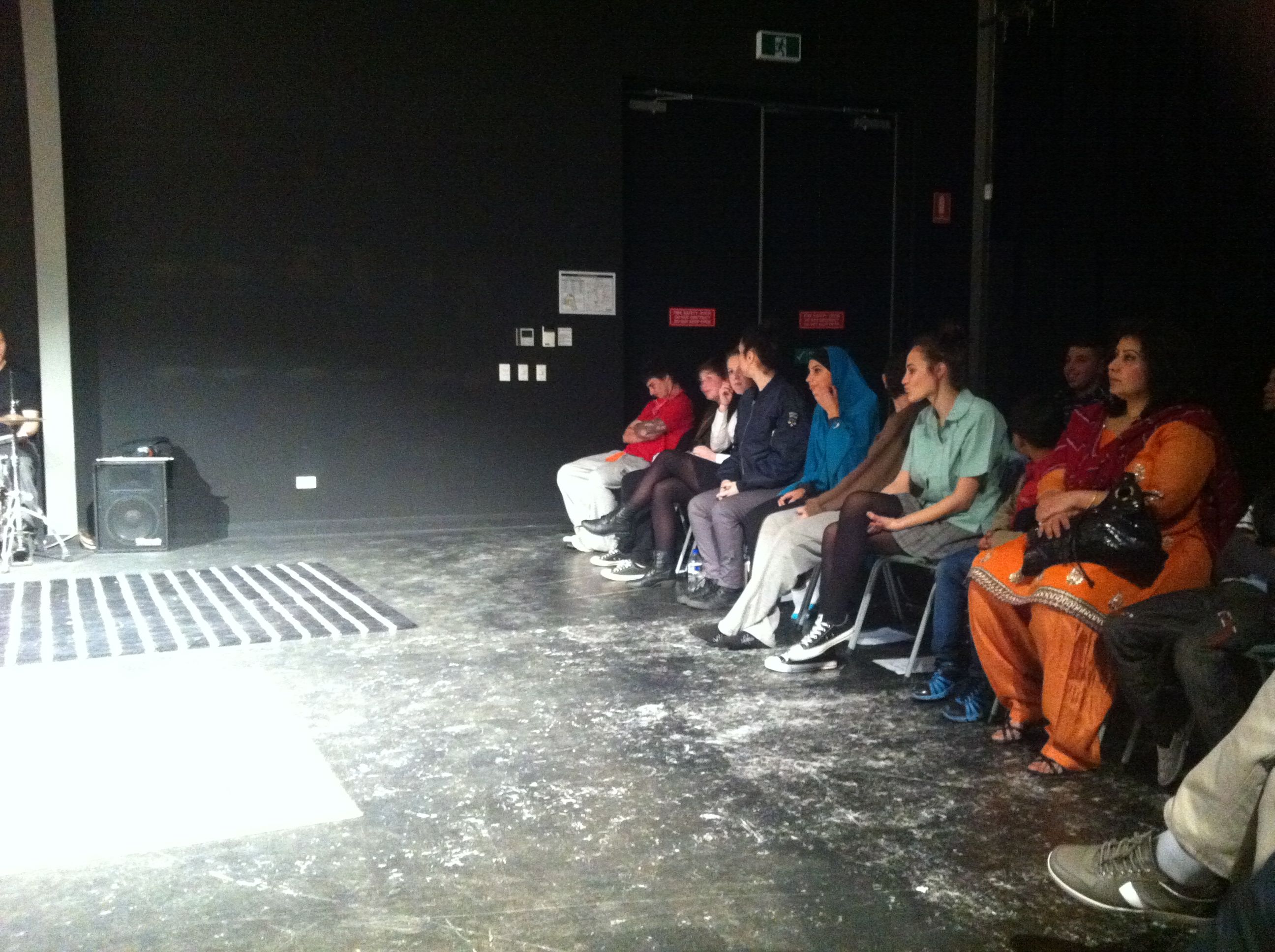
Just before the show started, a section, not of the audience but of the cast. I didn't get my hands on a program so can't say names, but from the left:

Just before the show started, a section, not of the audience but of the cast. I didn’t get my hands on a program so can’t say names, but from the left: a young man who did spectacular leaps to impress a young woman; two players of multiple minor characters; the junkie mother / train ticket collector; younger sister of the returning young woman / girl who was impressed by the boy’s athleticism; neglected son of the junkie;  Community Services worker / mother of the praying family / drummer; mother and two children from the lost-in-the-mall story.

The Other Way is on again tonight and tomorrow night and tomorrow morning (that is, Wednesday 17 and Thursday 18 July) at the Bankstown Arts Centre where tickets cost $5 or $3 (book at 02 9793 8324), and then Friday evening and Saturday afternoon at the Wharf 2 Theatre at Walsh Bay where there’s no charge, but bookings are essential (02 9250 1777 or online) and maybe impossible.

Half an acquisition

One by-product of living with an Art Student is that works of art proliferate around the house. Some are produced by the AS herself, some given to her, and some we buy. Our latest acquisition, which we bought jointly with another Art Student couple, is this photograph:

Janet-Tavener-Figs

It’s Figs, by Janet Tavener, from her recent exhibition at the Brenda May Gallery. The Art Student wanted to hang it over our bed, but it’s the middle of winter and the bed is generally cold enough to get into without having a huge photograph of melting ice sculptures hanging over it. So it has pride of place in the dining room, and the Art Student’s bright portrayal of the poppy’s life cycle keeps its place in the bedroom.

Incidentally, when we dropped in to pick up the photo today, we spent a good time enjoying Brenda May’s current exhibition, Mighty Small.

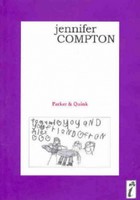
Jennifer Compton, Parker & Quink

Jennifer Compton, Parker & Quink (Ginninderra Press 2004)

1pq

Jennifer Compton was in her mid 20s when she burst onto the Australian theatre scene with her play No Man’s Land, which shared the 1974 Newcastle Playwriting Competition prize with John Romeril’s The Floating World (distinguished company!), was produced by Ken Horler at the Nimrod Theatre in Belvoir Street and, redubbed Crossfire to avoid confusion with Harold Pinter’s play of the same name, was published by Currency Press.

Parker & Quink came 30 years, 3 plays and at least 3 books of poetry later, and has been followed by other plays, other books of poetry. I came upon it by chance, as one still can in bricks-and-mortar bookshops. Time passes, we grow older, times change: that’s a recurring preoccupation of these poems, from the three-line title poem to the 18 stanzas of ‘During the Power Cut I Read, by Candlelight, “Ballade” by Kenneth Koch’.

Parker & Quink: the young might stare at these words blankly, but for us sexagenarians they have unmistakeable nostalgic power to evoke the sensual feel of a fountain pen, the aroma of quality ink, the dubious joys of blotting and smudging, perhaps even the quiet pleasure of receiving one’s first Parker pen as a reward for doing well in a school exam. The title poem, just three lines, draws on those associations, but its tone is more bemused than nostalgic:

Parker & Quink
To write your email address
with a fountain pen filled with ink
like lighting a candle on the moon.

The past isn’t just another country, it’s a whole other celestial body, with unbelievably limited, even ineffective communication technology. Yet to my way of thinking a lot of the poetry in the rest of he book uses just that technology: the kind that needs the reader to come and sit with it for a while, rather than providing instant hits, instant links. The second poem, ‘Imposing the Chat’, starts out with a chat room report of attending a gallery opening where (the capitals are hers)

ALL THE ARTWORKS HAD BEEN MADE BY
THE PARENTS OF MURDERED CHILDREN

I don’t understand chat room jargon, but I think the speaker is thrown out of the room, presumably because her subject is unacceptable. She is left to write in a form where ‘the words do not evaporate out of the top of the page’, where she can’t just shout in performative horror but goes on to grapple with the complex and disturbing experience of attending that opening, talking with some of those parents, remembering at least one of the murders and driving home wordlessly with her husband to look in at last on her sleeping children. As the first line of the poem puts it, ‘It should be hard to write.’ Sometimes candles and moonlight, however ineffective, are what’s called for.

That’s the first two poems. After them, the book touches on many subjects, speaks in many voices, reflects many moods. There are memories of a New Zealand childhood, private acknowledgement from an eminent theatre critic (though we’re left not knowing if this was real or imagined), a touch of Bildungsroman, the imitation of Kenneth Koch I mentioned earlier (a kind of compressed, fragmentary, cryptic autobiography), dreams, dramatic monologues, and perhaps my favourite, an imitation bird call whose title is, perhaps accidentally, three words from James McAuley’s ‘Magpie‘:

Every Morning, Waking
Out in the zero velvet of the night
swinging deep into left field
the first interrogatory of the aubade.

A startle of – Where was I? What!
Then the anxious, enquiring flex,
– And am I still a magpie? Yes!
awwbadge_2013

This is the seventh book I’ve read as part of the Australian Women Writers Challenge 2013. I undertook to read six and review four, and I’ve now read seven and reviewed six, so I guess I’ve met the challenge, but as a matter of interest and google fu I’ll keep adding a note when I read an AWW title.

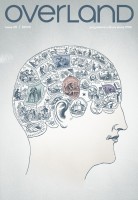
Overland 211

Jeff Sparrow (editor), Overland 211 Autumn 2013

OL211

As a happy subscriber (and not only because I won some free chocolate in last year’s subscriberthon), I’m glad to read in Jeff Sparrow’s editorial in this issue that although Overland is now a project, of which the print journal is only one part, the printed object will continue to appear regularly for the foreseeable future. I am one of the many people who, he says, ‘still like to read (in particular) long essays, literary fiction and poetry on paper, away from the distractions of their iPad’. I also enjoy the synergies that can arise within the bounds of physical covers, quite different from the boundless variety of the online world.

An example of what I mean by synergy occurs in the play of ideas and perspectives among: ‘The one day of pure form’, in which Guy Rundle argues that Anzac Day is a weird commemoration whose meaning can and does change to suit the needs of whoever happens to be in power; ‘Peregrinus Requiescat’, a short story by Warwick Newnham that, beneath a sophisticated play with form and some not always correct or correctly translated Latin, is moved by a straightforward impulse to honour a man who died in combat by marching in his place on Anzac Day; and Barry O’Donohue’s poem, ‘Vietnam ritual’, whose speaker is a Vietnam War veteran free of any commemorative or romanticising impulse. ‘The innocence of Australians’ by Ramon Glazov, a review of a collection of short stories that imagine terrorist attacks in Australia, takes on a different hue in the context of those three pieces. Glazov sees in most of the stories an inability to imagine a plausible motive for attacking Australia – because after all, so the ‘thinking’ goes, we’re innocent global citizens in the sense that what we do hardly matters, whether it’s sending a token force to kill and die in the US’s wars, or opening another coal mine. This presumed innocence isn’t the same as the ‘pure form’ that Guy Rundle sees in Anzac Day, but the two concepts talk to each other interestingly.

Synergy is there again in the way one’s mind bounces between ‘The possibility of patronage’ by Anwen Crawford, a curmudgeonly piece about the limitations of crowd-funding, pop-up galleries and other innovative ways of getting artists and money together, and ‘Paying the writers’, in which Jennifer Mills and Benjamin Laird are set up to debate responses to the trend to expect writers to accept ‘exposure’ as recompense for their work, but can’t help agreeing that some form of collective action is desirable. That bouncing affects the way one reads Alison Croggon’s characteristically elegant column ‘On Homelessness’. She doesn’t connect her two experiences of homelessness with being an artist except to imply that writing was her way of keeping her sense of self intact, but in this context one wonders if poor compensation for writing may have had something to do with the problem in the first place. And then there’s Judy Horacek’s cartoon parodying a current credit card ad: ‘A career in the arts: priceless. And for everything else, there’s dumpster diving.’

There are also stand-out stand-alones. In ‘Pump’, Stephanie Convery tells of her participation in a women’s body-building course, which manages to challenge some aspects of sexism and male domination while bowing to others: the article includes fascinating history, high comedy, memoir and challenging analysis. Apart from some Melburnian sneers at country Queensland, ‘All those women’ by Jacinda Woodhead is richly empathetic: in the context of Queensland’s dire abortion situation – abortion is a crime except under closely defined conditions; it’s hard to access, expensive and stigmatised – Woodhead presents a portrait of tiny anti-abortion, anti-war group Protect Life. While recoiling from their politics on abortion, she and pro-choice activists she interviews communicate a respect for their commitment to principles and sheer stamina. Jill Dimond’s ‘Ned Kelly’s Skull’, which justifies the phrenological cover image, includes a fascinating look at some eccentric colonials. Giovanni Tiso makes some alarming sense out of recent events in Italian politics in ‘The Net will save us’.

In the poetry section, I was relieved to see a couple of bird poems, since current Going Down Swinging submission guidelines specifically rule out ‘poems involving birds, wings, feathers or flight’ and it would be a shame if birds were to disappear from Australian poetry altogether. I’m grateful for The shearwaters by Jules Leigh Koch, ‘a long tideline / like a driftnet / to fish for stars’, and I probably would have loved ‘The swallows in Saint Peter’s Square’ by Luke Whitington for its name alone.

Not all those links will take you to a full article, at least not at the time of writing, but be patient. Overland does tend to put just about everything online in the weeks after an issue comes out. Or you could buy a hard copy and find your own synergies.

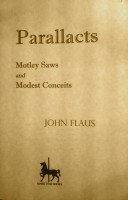
John Flaus’s Parallacts

John Flaus, Parallacts: Motley Saws and Modest Conceits (Mark Time Books 2012)

parallacts I was extremely lucky in the timing of my university studies. I started at Sydney Uni in 1967 when, because of an overhaul of the New South Wales school system, only a very small cohort had graduated from high school the year before. I was two years out of school myself, and for the next four years, I rubbed shoulders with a wonderful bunch of irregulars, especially the group doing Eng Lit Hons. Among them was a burly guy in his mid thirties who enlivened our seminars on pre-Shakespearean English drama with references to John Ford’s Westerns and wrote learned essays on film for the student newspaper, sometimes as Sean Borelich, borelich being Middle English for hairy, in honour of his impressive salt and pepper beard.

That was John Flaus. He could be relied on for an interesting opinion of any new film released downtown – memorably, Rosemary’s Baby was ‘a turd of a movie, a beautifully polished turd, but still a turd’. At SU Film Group screenings and occasional events at the Filmmakers’ Co-op, then in a space above a restaurant in Dixon Street, he educated us in the movies (which weren’t included in any university courses in that time and place). I learned from him that Hollywood produced art: it was OK to love the films of Roger Corman (which I already did) and Budd Boetticher (which he introduced me to). During one informal seminar–screening of Raoul Walsh’s Roaring Twenties, he rewound the film at one point so we could watch again Marlene Dietrich’s marvellous first, slow-blinking appearance. This was before the existence of VCRs or rewind buttons and just magical for the likes of me. John back then was a passionate advocate for film, autodidact, fanboy, nerd, polymath, teacher.

Since then, though he has generally flown under the mainstream media’s radar, his distinctive voice has been heard widely in the land as a critic and promoter of excellence in film. In the 1970s he embarked on an acting career. As far as I know his first reel outings were as himself in Dave Jones’s little-seen wonder Yackety Yack in 1974, and then a main role in John Ruane’s 1976 short film Queensland. My most recent sighting was as one of the chorus of codgers in the pub in Jack Irish on ABC TV.

All that is by way of explaining my delight when I stumbled this slim volume on the poetry shelves at Sappho’s bookshop, and for that matter my delight in reading it. It contains 120 couplets, each fitting the formal requirements announced in the first two:

THE PARALLACT (1)
Where differing perspectives contend;
Two lines, each of nine voiced syllables.

THE PARALLACT (2)
With the option of one ‘free syllable.
A discipline of my own devising.

Within this tight form, he fits all manner of things: philosophical, satirical or just plain smart-alecky observations, evocations of the turning points of movies and classic stories (Biblical, Greek, Norse, Japanese …), overheard snippets, jokes, paradoxes. The word ‘discipline’ is key. There is so much that could be said on the subject of each of these couplets, but the speaker – naturally discursive – ties himself down to just 18 or 19 syllables. You need background knowledge to appreciate quite a few of them, such as this:

JEPHTHAH’S BARGAIN
He comes victorious, true to vow;
She goes to greet him, dancing, joyful.

But in these cases, including about 20 referring to movies, he generally adds a note so the reader can chase up the reference (in the case of ‘Jephthah’s Bargain’, the note says, ‘See: Judges 11′).

Here are a few more:

BROTHERHOOD OF THE BLUE SINGLET
Sunburned, sweaty and staunch, yet denied
Our rightful place in the nation’s pride.

OCKER NUANCE
‘Where yous goin’?’ – I’m not joining you;
‘Where yez goin’?’ – I’d like to come too.

IRELAND’S REVENGE
They stole our land, laid waste our culture.
We occupied their literature.

I don’t suppose Flaus has considered starting up a blog where he posts regular parallactic film reviews and other observations. If he did, I’d subscribe. And one last thing:

ON PARALLACTS
Knowing no limits to questing thought,
he brings home the bacon, takes the pith.

Anna Goldsworthy and our Unfinished Business

Anna Goldsworthy, Unfinished Business: Sex, Freedom and Misogyny (Quarterly Essay N° 50)

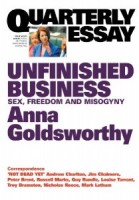
qe50 Evidently some people with tin ears believe that the USA entered a post-racial era with the election of Barack Obama. I don’t think anyone except some commentators at The Australian believes that Julia Gillard’s Prime Ministership marks a definitive victory in the struggle against sexism in Australia. But if they were, this Quarterly Essay would give them pause.

Anna Goldsworthy takes as her starting point Julia Gillard’s now famous misogyny speech (the link is in case you’ve been on another planet since last October), and broadens out to a catalogue of sexist horrors. Evidently the essay went to press before the most recent Bad Week for Women – with news from the defence forces, Liberal Party fundraising dinners, elite football players and so on. She wasn’t able to include Lieutenant General David Morrison’s stunning speech or what’s just a light-hearted joke for some Brisbane Liberals. But she has plenty of examples to back her argument that there is abroad in our culture a general permission to treat a woman in public life (and by implication elsewhere) as if she has no right to speak simply because of her gender: argument is not met with argument but with gender-based insult and possibly threats of violence. According to Goldsworthy, misogyny comes with a ‘remarkably consistent platform’ repeatedly expressed in online comments sections in its bluntest form: Shut up, you fat c*** (SUYFC)! That is to say: you have a female body and that’s enough reason for me to demand that you have no voice. Sometimes there is the added explicit threat, or I’ll hurt you.

Julia Gillard is not the only one: the fat-shaming of Gina Rinehardt on Q&A in May last year, the British tabloid press’s recent mauling of Hilary Mantel, A. A. Gill’s SUYFC to classicist Mary Beard all get an airing. So do gonzo porn, Fifty Shades of Gray, Lena Dunham’s Girls, Slutwalks, Lady Gaga, the way facebook has turned young women into their own paparazze, the ‘I’m not a feminist but …’ and ‘You’re not a proper feminist because …’ phenomena. All of these relate to the central notion that there is a pressure abroad in the culture to reduce women to their bodies, to make them ashamed of their bodies, to silence them.

The essay is very timely. It covers appalling terrain, and singles out some glimmers of hope. It’s beautifully written, judicious, nuanced and passionate. I look forward to the correspondence in N° 51, which I hope will include some expansion of her theme to Indigenous and other non-white women, and to examples of sexism that result in so many women living in poverty.

And then up the back there’s correspondence about the previous Quarterly Essay, Mark Latham’s Not Dead Yet. I didn’t read the essay itself, but Latham’s response to his respondents here is a pleasure to read.

The Book Group and Book One of Karl Ove Knausgaard’s Struggle

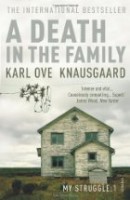
Karl Ove Knausgaard, A Death in the Family (My Struggle: 1) (2009, translation by Don Bartlett 2012, Vintage 2013)

0099555166When we googled “My Struggle” at the Book Group last month, the top result was Hitler’s Mein Kampf. We were mildly amused by what we took to be a google oddity. But the Norwegian title of Karl Ove Knausgaard’s six-volume novel is Min Kamp – a similarity that could hardly be accidental. At the Sydney Writers’ Festival, the man himself told us that the sixth and final volume is a 400 page essay about Adolf Hitler. One has to wonder: if A Death in the Family is point A, how does he get from point A to point Way Off the Chart?

But since only two of the books are available in English so far, that’s a question for later.

Before the meeting: I finished reading A Death in the Family a couple of weeks ago, just after hearing Karl Ove speak at the SWF. I would have moved straight on to the second volume, A Man in Love, if I hadn’t had other more pressing demands on my imaginative faculties. The appeal, for me, is to do with shoe leather.

In the movie business shoe leather is the term for precious screen time wasted on actors walking from place to place. Knausgaard has elevated its written equivalent to a high art. It seems no one ever just gets in a car and drives somewhere: they always turn on the indicator, check the rear-vision mirror and pull out into the traffic, then follow a series of carefully named streets until they arrive at their destination. When a character cleans a book case, it goes like this:

I sprayed the glass door of the bookcase, crumpled up the newspaper and rubbed it over the runny liquid a few times until the glass was dry and shiny. Looked around for more to do while I had the spray in my hand, but saw nothing apart from the windows, which I had determined to save until later. Instead, I went on with the bookcase, tidied everything, starting with its contents.

That man be unremarkable, but so much of the book is taken up with similar attention to detail that how a reader responds to it will have a huge influence on their response to the book as a whole. Early on, there’s a passage about growing up that helps explain what’s happening, as I understand it:

As your perspective of the world increases not only is the pain it inflicts on you less but also its meaning. Understanding the world requires you to keep a certain distance from it. Things that are too small to see with the naked eye, such as molecules and atoms, we magnify. Things that are too large, such as cloud formations, river deltas, constellations, we reduce. At length we bring it within the scope of our senses and we stabilise it with fixer. When it has been fixed we call it knowledge. Throughout our childhood and teenage years we strive to attain the correct distance from objects and phenomena. We read, we learn, we experience, we make adjustments. Then one day we reach the point where all the necessary distances have been set, all the necessary systems have been put in place. That is when time begins to pick up speed. It no longer meets any obstacles, everything is set, time races through our lives, the days pass by in a flash and before we know what is happening we are forty, fifty, sixty.

I read the narrative’s wealth of undifferentiated detail as an attempt to reverse that process: to give priority to specific observations and experiences over any abstraction, to go for immediately apprehended ‘meaning’ over calm, generalisable ‘knowledge’, to avoid our habitual exclusion of some things from consideration. As well as the tiny acts, the brand names, the hyper-specifics, we are given the narrator’s play of mind, apparently unfiltered – memories and meditations that are jogged by the brand names on cleaning products, say, his adolescent worries about the shape of his penis when erect, or  the strange feeling he had as a boy about the gravel on the floor of the family garage. And, because nothing is being left out, he tells us things that are just not talked about: how he shakes his little girl when she irritates him, the extraordinarily squalid circumstances of his father’s death, his grandmother’s incontinence. These last things don’t feel deliberately shocking – more like the inevitable result of a  decision made at the beginning to put everything in.

Karl Ove has said that the overwhelming emotion he had while writing the novel was shame. He couldn’t believe anyone would read it, and now he is embarrassed to realise that roughly half a million people know all about his failures as a parent and his sexual inadequacies (those are yet to come, perhaps in the second book).

After the meeting:  This book provoked as much sustained conversation as any we’ve discussed in the group. One man who spent his childhood in Britain was most deeply struck by the way the weather was evoked: the grimness of the winter and the way spring came as a great relief. This struck a chord with others who had lived in northern Europe for any length of time. Another man, following his daughter’s lead, had been watching a lot of Simon Amstell‘s recent melancholy stand-up and found a striking resonance with this book. Another man was struck by the book’s failure to make him empathise with the narrator – at one stage he thought it might all be total fiction, that Knausgaard the author might be no more Karl Ove the character than Mark Haddon is Christopher in The Curious Incident of the Dog in the Night-time – and in that case it’s a brilliant creation. I don’t know that anyone liked it as much as I did.

As always, the conversation ranged widely, from the sexist bile being showered on Julia Gillard to details of our lives, all to the tune of excellent pasta, grilled zucchini and fennel and tomato salad.

SFF: Dendys etc

If you had told me 15 years ago when my Elder Brilliant Offspring was 20 years old that he and I would write a short film together that he would go on to direct, and that the film would be a finalist in the Dendy Awards … Well, you wouldn’t have.

Having Ngurrumbang screened at two sold out sessions at the Sydney Film Festival has been thrilling, but it’s been a joy beyond words to have worked on this project with him. I’ve learned a huge amount from the collaboration, and from his leadership of the crew, myself included.

I’m typing this on the phone during the opening speeches of the last night of the Festival. Maybe we’ll win something. Now I’m going to pay attention. I’ll tell you if we win or lose on the comments in a couple of hours.

Southerly 72/3: Islands and Archipelagos

David Brooks and Elizabeth McMahon (editors), Southerly Vol 72 No 3 2012: Islands and Archipelagos

1southerly723

The title of this issue of Southerly, ‘Islands and Archipelagos’, refers to its subject matter, but it could just as easily refer to its form: a literary magazine, archipelago-like, is a gathering of diverse entities, each with its own integrity but all having something in common, whether a theme as in this case or something less tangible, like a tone, or an ethos, or a presiding personality.

I enjoyed my island hopping. My favourite moment is the bravura opening sentence of ‘Outcast of the Islands: Malinowski Amongst the Modernists’ by David Brooks :

If there could ever be such a thing as a True History of Modern Thought, at least one chapter would have to trace that set of strange, 
neglected, yet teasingly-almost-direct lines between a heterogeneous
 crew of squatters, graziers, country postmasters, district magistrates, missionaries, and employees of the Overland Telegraph recording details of Indigenous Australian life and culture in the mid- and late- nineteenth century and the desks of Edward Tyler at Oxford, James George Frazer at Cambridge and Emile Durkheim in Paris, and, through them, and a number of other significant late-nineteenth-century anthropologists, to the likes of T. S. Eliot, Ezra Pound, Sigmund Freud (see, for example, the first half of Totem and Taboo), Marcel Mauss (Essay on the Gift) and so many other key figures in early twentieth-century thought and aesthetics that one wonders whether the Simpson Desert or the Trobriand Islands should be given a place – a quite significant place – amongst the generating landscapes of Modernism.

Yes, that is just one sentence. The article not only delivers on the sentence’s promise but ends with a link to a provocatively titled companion piece, ‘Origins of Modernism in the Great Western Desert: An Introduction’.

Tying for second favourite moment are:

  • Michael Sharkey’s poem ‘First Eleven’, eleven stanzas consisting of phrases that evoke an Australian baby-boomer childhood, presumably to the age of 11. Much of it might be inscrutable to people of other generations and other places, but I was born in 1947, a year after Sharkey, and his deft hand worked nostalgic wonders in me, even in the minority of phrases that didn’t touch directly on my own experience:

    The Royal Visit. Easter Show.
    My sherbet packet. Liquorice stick.
    My shop-bought pie. My Iced Vo-Vo.
    My Cracker Night. My Jumping Jack.
    My father’s gas mask. Old blue tunic.
    My small sister in the clinic.
    My six-stitcher. My first duck.
    The choko vine. The dunny truck.


  • Michael Jacklin’s ‘Islands of Multilingual Literature: Community Magazines and Australia’s Many Languages’, which prises open the subject of Australian literature in languages other than English. I’ve always felt odd about the portrayal of 1950s Australia as monocultural and monolingual: Italian and other southern European languages were part of the soundscape of my 1950s north Queensland childhood; one of my best friends in primary school was Chinese; my farmer father played poker with a Greek, a Korean and a Yugoslav; in the 30s and 40s my magistrate grandfather spoke to Italians who appeared before him in their own language. This essay discusses evidence, including a journal from Brisbane in the 1930s, that there has long been lively, linguistically diverse literature in the Australian context, much of it invisible to the mainstream literary establishment.
  • a new poem by Jennifer Maiden, always a thrill. ‘Diary Poem: Uses of Ethiopia’ is in part a polemical essay, taking issue with some feminists who are ‘well in favour / of ethical security’. I’m not sure what ethical security is (Google is no help): it’s related to rigid ideological narrowness, I think, and may have elements of self-serving moralism. Feminist ‘fandom for Gillard’ is a symptom. My regular readers know that I often feel like an outsider with contemporary poetry (and by the way I think that’s more about me as a north Queensland boy than about the poetry). With this poem, I probably get the references more than most readers: not the Ethiopian art or the story of Sylvia Pankhurst, which are central to the poem and beautifully fleshed out, but the passing allusions – to Julia Gillard’s misogyny speech, and her cutting of the supporting parents’ benefit on the same day; to the earlier poem ‘A Useful Fan’, neatly encapsulated here as ‘trying to inhabit Abbott interestedly’; to a set-to on the Overland web site described as her ‘daughter the fire tiger’ (itself a reference to an earlier poem, ‘The Year of the Ox’) defending her ‘on a hostile magazine site now given / to ethical self-security’. Paradoxically, familiarity with the references predisposes me to foreground the detail of poem’s polemics (I want to argue about her view of Overland, for example, and I’m not sure about the connection she seems to be making between some feminists and abortion), rather than the poem’s central thrust, which I read as captured in the description of doves in Ethiopian art as

    aware of complex peripheries,
    well-mannered with watchfulness,
    —————————————-still.


As well as these pieces that topped my pops, there are learned essays on issues facing real islands and islanders, on Andrew McGahan, Randolph Stow, Drusilla Modjeska, and the rock band the Drones. There are short stories (especially Sandra Potter’s ‘“an empty ship in these latitudes is no joke”’, a lightly annotated list of things taken to and from Antarctica, and Terri Janke’s ‘Turtle Island’, a not-quite-ghost-story, not-quite-love-story, not-quite-war-story set in the Torres Strait in World War Two). There are other excellent poems and nearly 70 pages of reviews, plus the overflow in The Long Paddock, which includes a fine review by Sarah Holland-Batt of Ali Cobby Eckermann’s Ruby Moonlight.

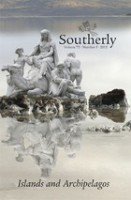
A final note: the spectacularly beautiful cover, reproduced above, is described on the contents page as Sue Kneebone’s Continental Drift, but it’s actually a detail from that work, which I recommend you have a look at on Sue Kneebone’s web site.