Southerly 72/2: True Crime

Melissa Jane Hardie (guest editor), David Brooks and Elizabeth McMahon (editors), Southerly Vol 72 No 2 2012: True Crime – Every Contact Leaves a Trace

Southerly 72-2 cover_Layout 1

The Southerly of my youth, whatever its contents, always had the same staid, non-committal design: a single colour cover with a small blowing-wind logo the only decoration. (For non-NSW readers, the southerly is a cool and often rain-bearing wind from the south-east, famously welcome for its sudden arrival on stinking hot summer days.) Those days are long past, though the little wind is still there above the title. This issue’s cover, featuring an enigmatic photo from the NSW Police Forensic Photography Archive, is a perfect teaser for an issue built around true crime stories, more than one of them drawing on that same archive.

The archive, consisting of 130 000 photographs taken in the first half of last century, found without any accompanying documentation and now held at the Justice and Police Museum in Sydney,  is an Aladdin’s cave for researchers into Sydney’s criminal history. Peter Doyle’s ‘Detective writing: mapping the Sydney pre-War underworld’ is a fascinating dip into it, complemented with an account of a couple of relatively long-lived publications, which he describes as ‘kind of ‘ trade papers for cops, full of vivid and sometimes lurid portraits and narratives from the criminal scene. In Southerly‘s online section, The Long Paddock, Ross Gibson’s ‘Collision Course‘ plays with the narrative possibilities of a selection of images – though none of them are as queerly suggestive as the one on the cover – and refers the reader to his ongoing project with Kate Richards, Life After Wartime. Marise Williams, in ‘Women’s Work’, explores the same milieu, though without drawing on that archive: the women of her title are Kate Leigh and Tilley Devine,who ran organised crime networks in Darlinghurst in the 1920s and 1930s. It’s not just the covers that have come a long way since the staid 1960s.

My favourite single prose piece in this issue is Cassandra Atherton’s ‘Raining Blood and Money’. Classified as fiction, it’s a graphic imagining of New York’s terrible 1911 Triangle Shirtwaist fire, in which 146 people, most of them women workers, died in 18 minutes. The fire was hugely significant in the history of women and labour in the USA, and in the century since it happened it has given rise to innumerable songs, stories, monographs, rallies, and organising activities, as the links on its Wikipedia page demonstrate. Some stories need to be told and retold, and Atherton’s telling feels as fresh and visceral as if it happened yesterday.

Of course, Southerly is still a scholarly journal, so: there’s a theoretical consideration of sensationalist 19th century crime writing; the formidable thinking of Deleuze and Guattari is brought to bear on Ned Kelly’s Jerilderie letter; a Black Saturday arsonist is considered in the light of the different understandings of the notion of  ‘abjection’ in the writings of Julia Kristeva and Judith Butler; Schapelle Corby is the subject of abstruse reflections that include such highly technical language as: ‘To be where you are … requires a sense of affective difference, understood as either the Spinozan–Deleuzian mapping of co-ordinates of intensities or as the forms of projective identification required in nominating and refining the arbitrary and violent constitution of the nation-state.’ Lit crit has moved on since my day.

There’s forty pages of reviews, including Kate Middleton in elegiac mode about the late Peter Steele’s Braiding the Voices, and a swag of poetry, of which Adam Aitken’s ‘The plein-air effect (after John Clare)’, Michael Farrell’s ‘Disapproval’ and Hazel Smith’s ‘Experimentalism’ stand out for me.

A dip into the Long Paddock  came up with not only Ross Gibson’s piece, but also Melissa Jane Hardie’s review of A Tragedy in Two Acts: Marcus Einfeld & Teresa Brennan by Fiona Harari. I met Teresa Brennan once, and am glad to see that this book makes more of her than a name in a false alibi: it doesn’t mention that she was at one time a writer for Barry Humphries/Edna Everage.

NSW Premier’s Literary Awards 2013

The 2012 NSW Premier’s Literary Awards Dinner  seems like just last week, yet it was actually last week that this year’s short list was announced. The list is up on the web site of the State Library, which now administers the awards.

I’ve read one of the novels with my book group (less than enthusiastic blog post here) and liked the look of another one so much I gave it to someone twice – for Christmas and then for her birthday. I haven’t read any of the non-fiction, though I have bought a copy of one. I’ve read one of the poetry books (here) and enjoyed being read to by a number of the other listed poets. Regretfully I’ve read only one of the books for children or young people (which I loved, here). I’ve seen a production of one of the playscripts (here) and one of the TV scripts (here). I haven’t read any of the ‘multicultural’ titles.

Today I received an email invitation to the Awards Dinner. Should I buy a ticket? It costs as much as about 15 nights at the movies or two cheap seats at the Opera – nearly half as much as one of the flash seats for Carmen on the Harbour. Last year I had a horse in the race, if a book by a niece counts as a horse, and the cost was immaterial. This year …?

The Maiden and the Griffin

Jennifer Maiden’s Liquid Nitrogen has been shortlisted for the Griffin International Poetry Prize, described on the Griffin Trust website as ‘the world’s largest prize for a first edition single collection of poetry written in English’. The judges’ citation reads in part:

An extended meditation on the uses and abuses of power, the moral gravity of Liquid Nitrogen is buoyed throughout by Maiden’s self-effacing sense of humour and her tenderness towards her grown daughter, Katharine, who stands at the heart of this collection. Epic in its scope and utterly eccentric in its approach, Liquid Nitrogen is a work of rare passion and unprecedented poetic achievement from one of Australia’s most prominent living writers, ‘alert to the point of twitching’, like the ox to whom she likens herself on page one, who nevertheless ‘still tramples through the difficult’.

For the full shortlist click here.

Sunil Gangopadhyay’s Lonely Monarch

Sunil Gangopadhyay, The Lonely Monarch (2005, translated from Bengali by Swapna Dutta, Hachette India 2013)

IMG_0723 My high school French and Latin teacher, Brother Gerard, taught us a healthy respect for the art of translation. When he wrote ‘Excellent attempt’ in the margin of one of my exercises, he explained that it was high praise, that all anyone could aspire to was an attempt at translation – the thing itself must remain forever elusive: if you stay too close to the original, your translation won’t sound like natural English, and if you produce something that feels natural in English you will have lost the feel of the original. Kumārajīva (343–430 CE), one of the sub-continent’s great translators of Buddhist texts from Sanskrit to Chinese, said that translation was like ‘chewing rice for others, which would not only lose its original taste, but also make people feel like vomiting’. (Translations of his statement differ.) So translators are heroic people who serve the common good, building bridges between cultures that might otherwise remain dangerously ignorant of each other, but they do so knowing that page after page, book after book, they must fail.

I don’t know any Bengali at all, so I can’t comment on the accuracy of Swapna Dutta’s translation of Sunil Gangopadhyay‘s Nihsanga Samrat. But it gave me that delicious sense of access to a place that would have remained closed to me without her labours. The eponymous lonely monarch is Sisirkumar Bhaduri (1889–1959), a pioneer of Bengali theatre, or at least a fictional stand-in for him, as this is a fictional rendition of the real Sisirkumar’s life. His theatrical project was to Bengal roughly what Louis Esson’s  Pioneer Players were to Australia, not quite a national theatre but a profound influence on audiences’ tastes, though the comparison underplays the significance of Sisirkumar. The theatre as he found it was ruled by Western conventions, women actors were generally prostitutes, the emphasis was on spectacle. He and his colleagues reached for a theatre that incorporated traditional jatra forms; his partner Kankabati was an educated woman who became even more acclaimed as an actor than he was; his plays were often adaptations from serious novels.

Calcutta (as it is called here) had a thriving theatre scene in the 1920s and 30s, rich with artistic ambition, greed, brilliant collaboration, vicious competition, surprising acts of generosity, sweet loyalty, despair, alcoholism, romance … Sisir, as he was known to his friends, was at the heart of it as an actor–producer. In a postscript to her translator’s note, Swapna Dutta gives brief introductions to twenty characters who were important personalities of the time ‘whom people outside Bengal might not know’: poets, artists, playwrights, scholars, political figures. Without this help, the sense of a flourishing cultural scene would still have been vividly realised, but for foreign readers like me the names would have passed in a blur (actually, they still mostly did, but now I knew the nature of the blur!). Some names didn’t need a note: the great Rabindranath Tagore is partly a kind of tutelary deity whose approval is beyond price for the younger generation, and partly the esteemed elder whose mould they need to break; Sunil Gangopadhyay himself makes a brief appearance as a young man among Sisir’s admirers; and Satyajit Ray, Bengali director of many great films including Pather Panchali, has a moment towards the end of the book.

Sisirkumar takes a troupe of actors to New York in 1930. The trip has its disastrous moments, but it starts with a rapturous welcome. A young Indian man living in New York explains:

Ordinary Americans hardly ever come across Indians. Most of them are under the impression that Indian women are either kept under lock and key or burnt as a sati; that young children who enter the river are devoured by crocodiles; that the roads in India are packed with sadhus and yogis, tigers and snakes. They are clueless about our art, culture, literature or music.

Although there’s no whiff of an instructional intention in this book, I’m at least a little less clueless for having read and enjoyed it.

(Sisirkumar Bhaduri does have a Wikipedia entry, but it doesn’t say very much, and IMDb lists the eight films that he directed and acted in, which were very much a sideshow to his career in the live theatre.)

Full disclosure: Swapna Dutta is a friend of mine, though we’ve never met in person. She contributed a number of elegant stories to The School Magazine when I was editor, including retellings from Hindu and Buddhist classics as well as original stories, and we have stayed in touch by email since. Hachette India sent me a complimentary copy of this book.

Heather Goodall’s Invasion to Embassy

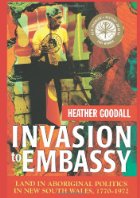
Heather Goodall, Invasion to Embassy: Land in Aboriginal Politics in New South Wales, 1770–1972 (Allen & Unwin in association with Black Books 1996)

I recently heard a distinguished novelist claim that she grew up believing New South Wales was mostly settled peacefully and that damage to the original inhabitants was largely unintended, caused by infectious diseases and the like. Despite having been correctly described by a commenter on my auxiliary blog as not knowing shit about Aboriginal matters, I was slightly better informed than that in my childhood: I knew there was a lot of frontier violence. But I think I’m like most non-Indigenous Australians in having assumed, complacently enough, that Aboriginal people, at least in this state, were irrevocably dispossessed and driven from their land in the early years of settlement. In other words, all the really bad things were done long long ago, probably by people who were just acting according to the morality of their times. Um, well, mea culpa.

The dispossession of Aboriginal people in Australia has been a long, painful process. It has played out very differently in different states and territories and different regions within states, and been resisted at every phase by Aboriginal people and their allies, using means ranging from armed resistance to eloquent letters to the press. Invasion to Embassy tells the New South Wales history, and although the stories it tells are grim, often heartbreaking, I found it exhilarating: in these dying days of what W H Stanner called the ‘great Australian silence’ – the relegation of Aboriginal experience to footnotes in our history – books like this, where Aboriginal points of view are front and centre, are like doors opening onto the real world. I wish this one could be absorbed into the bloodstream of every non-Indigenous Australian.

Heather Goodall maintains that land has been a key issue in Aboriginal politics from the beginning. ‘There are strong grounds for arguing,’ she writes in the first chapter,

that for Aboriginal people in south-eastern Australia before the invasion, land was the physical and symbolic base for almost every aspect of life. Social relations were expressed, managed and negotiated through relations to land; political standing was legitimated and authority grounded in landholding. Knowledge was structured by its relation to place, and it was taught, held in memory and performed according to this organisational framework. New experiences were analysed by and incorporated into that oral tradition and so they too became organised within it by place.

In the first decades of the colony at Port Jackson and surrounds, then:

Land was seen by its Aboriginal owners as a central factor in their experience of colonialism. Their sense of invasion, of loss and deprivation of land was expressed clearly and unarguably. It was expressed to whites alongside Aboriginal pain at the deaths of their loved ones and offence at the transgression of their laws.

It’s a book that makes you want to read bits out loud to the nearest available listener, and maybe I should have done the blogging equivalent of that by uploading regular progress reports. But that’s an idea for another time, another book. Until you read the book, here’s a string of dot points, which might be familiar to you but were mostly news to me:

  • Before 1850, owners of the large pastoral properties described Aboriginal men as virtually useless as employees, but after that date, when almost all non-Indigenous workers headed for the Victorian goldfields, those same Aboriginal men, being now necessary, were suddenly transformed into brilliant horsemen, unsurpassed as shepherds and stockmen.
  • In the second half of the 19th century, reserves were established all over the state where Aboriginal people were promised security of tenure, and where many of them cleared land and worked small farms for decades, only to have their tenancies summarily revoked by the government, with no justification that would make sense in the absence of deeply racist, genocidal assumptions.
  • The legal doctrine that Australia was terra nullius, land owned by no one, when the first European settlers arrived, was not proclaimed in law until 1889. Goodall comments that such a judgement could not have been made in 1840 ‘when there was such wide acknowledgement of Aboriginal relations to land’.
  • 154 Aboriginal men from New South Wales volunteered and fought overseas in the First World War. Although there were no discriminatory regulations or laws, it turned out in practice that the Soldier Settler scheme was only for white soldiers – just one Aboriginal man was given any land under the scheme.
  • This kind of thing happened during the Depression (page 185):

By 1933 there was a large camp of Aboriginal people just outside Cumeragunja, refused the dole in Victoria because they were New South Wales residents, but refused the dole in New South Wales because they were ‘too black’, and told they must go to the [Aborigines Protection Board] station for relief. But at Cumeragunja they were met by a manager clinging to the old APB rules, who told them that they were ‘too white’ to receive Aboriginal rations because they were not ‘predominantly of Aboriginal blood’.

The story of the first half of the 20th century is gruelling. When government agencies wanted to move Aboriginal communities from their land, the threat to remove the children was often used to force compliance. Aboriginal children were excluded from public schools in many places because white parents complained and the government gave them what they wanted – and families were again forced to move to places where some form of education, sometimes of a quality that beggars belief, was available. The ‘Dog Act’ – the 1936 amended version of the Aborigines Protection Act – created conditions in which Aboriginal people felt the government could pen them up and shift them around like animals: the reserves, which had been refuges and places where some vestige of traditional connection to land could be maintained, became virtual prisons. Even as benign a project as the creation of National Parks was the occasion of further dispossession and removal – I was shocked to reflect that to speak of wilderness in Australia is to give voice to a genocidal worldview, that is, it denies the existence of the people who lived in that part of the world for millennia.

Here are some more dot points, people and events that in any sane world would be as much part of general Australian lore as Ned Kelly, Phar Lap and the Eureka Stockade:

  • Pemulwye and Windradyne,  the two most famous leaders of armed resistance to colonisation, around Port Jackson and Bathurst respectively
  • William Cooper – if you haven’t heard of him, and even if you have, read his Wikipedia entry. He was an extraordinary leader, who wrote to his local parliamentarian in his 20s, calling on the government to secure a ‘small portion of a vast territory which is ours by Divine Right’, and in his 70s organised the Day of Mourning on the sesquicentennial Australia Day. He is honoured in the Yad VaShem Holocaust Museum in Israel as the only person in the world to have organised a private protest in response to Kristallnacht. As Goodall says, he ‘had personally experienced the whole process of demanding land and winning it, farming it in relative independence, and then facing the bitter years of dispossession and violent repression on the station [of Cumeragunja]’
  • The Cumeragunja Walk-Off, in which 200 Aboriginal men, women and children crossed the Murray River into Victoria in protest against conditions at the New South Wales station. Among other things, this is the subject of Deborah Cheetham’s opera Pecan Summer
  • The Australian Aboriginal Progressive Association – the first Aboriginal political organisation to create formal links between different communities, whose chief spokesperson was Fred Maynard, a Hunter River Koori. It took shape in the early 1920s and found allies in the right-wing nationalists of the day.
  • The Australian Aboriginal League, formed in the 1930s with a close focus on Cumeragunja (can you tell the Cumeragunja story made a deep impression on me?), but also asserting broader Aboriginal unity: ‘We should nail our colours to the mast, … making our slogan “Full equality for the dark race with the white race, and no differentiation between the full-blood and those of mixed blood”‘
  • Political alliances between Aboriginal and other organisations – ranging from the Communist Party of Australia, which saw the unjust treatment of Aboriginal people as an extension of class struggle, to PR Stephenson’s right-wing nationalists, for whom Aboriginal issues were emblematic of White Australia’s need for independence from England and English cultural domination. When different Aboriginal groups accepted help from such disparate sources, it caused serious rifts.

I could go on. Read the book! You won’t regret it.

Invasion to Embassy was published in 1996, four years after the Mabo decision had laid to rest the legal fiction of terra nullius, and the same year as John w Howard said, disingenuously, ‘Injustices were done in Australia and no one should obscure or minimise them.’ The book would have to be an example of what Geoffrey Blainey and John Howard labelled black armband history. I’m sure Keith Windschuttle could find, perhaps has found, any number of errors. But those critics miss the point. Telling these stories doesn’t deny or diminish anyone else’s story. And it’s not about handwringing, collective guilt and shame – rage, perhaps, and a profound respect for those who held out for justice and dignity through it all.

awwbadge_2013

This is the third book I’ve read as part of the Australian Women Writers Challenge 2013.

The Book Group on Karen Armstrong on the Bible

Karen Armstrong, On the Bible (Atlantic Books UK, Allen & Unwin 2007)

1ob Part of the function of a book group, or at least of mine, is to take you (me) out of your (my) comfort zone. So when On the Bible was proposed as the title for our March meeting, I resisted my urge to reach for a proverbial bargepole.

The urge didn’t come from a Dawkinsian disdain for religion. On the contrary, atheist though I am now, I was a member of the Marist Brothers in my teens and early 20s, and I treasure the memory of a series of lectures by nicotine-stained Brother Flavian, who was supposed to be teaching us Catechetics (whatever that is) but instead shared his passion for biblical studies an hour a week for a whole year. I wasn’t keen on revisiting the subject with what sounded like a dry introductory text.

But I’d seen Karen Armstrong’s TED Talk, Let’s Revive the Golden Rule, and the chap who proposed the book was very keen., so what the hell, archie, I thought, and happily supported the proposal..

It turns out that the stuff I remember from Brother Flavian’s lectures – the story of how the Bible was written and compiled, including the varied cultural and historical contexts – takes up just a fraction of the book. Karen Armstrong doesn’t linger on the poetry so much as sketch the politics, and though I miss the poetry, the politics is often fascinating, especially when there is an implied commentary on 21st century readings. For example, she describes P, the priestly strand of the Torah/Pentateuch, as proclaiming that ‘Israel was not a people because it dwelt in a particular country, but because it lived in the presence of God’; or, something that Brother Flavian could never have said but is glaringly obvious once articulated, ‘A thread of hatred runs through the New Testament.’ (Pharisee to Richard the Third: ‘You call that a hatchet job? This is a hatchet job.’)

The US title, The Bible: A Biography, is not only catchier, it also gives a better sense of what the book is: because once it has told the story of how the books of the Bible were written and assembled, it goes on with the process of canonisation (which happened over centuries, and was still being debated in Luther’s time), and then Armstrong’s real subject: how the way they were read changed over the centuries – by Jews, Catholics, Orthodox Christians and Protestants. The Midrash and Talmud, the Platonists, the early Christian Fathers up to St Augustine, the mediaeval exegetes and the Kabbalists all brought different understandings of what the Bible was, and how it should be read, and what one was to make of its many inconsistencies. Then came the Protestant Reformation and capitalism, and Lurianic Kabbalah and tikkun olam, followed by the Enlightenment, which brought Spinoza ‘who studied the historical background and literary genres of the Bible with unprecedented objectivity’ and was the forerunner of the German Higher Criticism. We arrive at last at the mystical reading of the Hasidim, and the extreme literalism of the fundamentalism that came into being in late 19th century USA:

This was an entirely new departure. In the past, some interpreters had favoured the study of the literal sense of the Bible but they had never believed that every single word of scripture was factually true. Many had admitted that, if we confined our attention to the letter, the Bible was an impossible text. The belief in biblical inerrancy … would, however, become crucial to Christian fundamentalism and would involve considerable denial. [The leaders of this approach] were responding to the challenge of modernity but in their desperation were distorting the scriptural tradition they were trying to defend.

And then there’s post-Holocaust Judaic literalism which adopted the until-then secular ideology of Zionism, and came up with a doctrine that was in fact completely novel even while claiming to be based in antiquity:

Unless Jews occupied the whole land of Israel, exactly as this was defined in the Bible, there could be no Redemption.

The blurb tells us Karen Armstrong was a religious sister briefly some decades ago. You can’t tell from this book whether she is still a Catholic or even a believer, but there’s no hostility to religion. What does come through loud and strong is her antagonism to movements that hijack the Bible for political purposes, while disregarding the extraordinary richness of its history.

There are dry stretches, where the treatment of various Kabbalists, say, or different strands of mediaeval Christian hermeneutics amount to little more than annotated lists, potentially useful if one were to go on to further study, but skippable for the drive-by reader. Perhaps, in fact, those dry patches make up most of the book, so that in effect it’s more successful as a reference book than as a narrative. I found the bits that transcended that dryness fascinating, among other things for the way they illustrate that reading, reading anything at all, is a tremendously complex act that can transform the text being read.

I was reminded of Constantine’s Sword, James Carroll’s powerful history of anti-Jewish oppression in Christianity, especially Catholicism, which could almost read as an elaboration of one thread of this book..

The meeting:
In the days leading up to the meeting there was a flurry of emails saying their writers had up after a hundred pages or less, and I wouldn’t have been surprised if the conversation last night had sputtered and died before moving on to the media’s nastiness about Julia Gillard. In fact, we stayed roughly on topic most of the evening – helped by a couple of the chaps having been to Seders the night before. Googling was banned for the evening, so there were interestingly speculative conversations about, among other things, the meaning of the orange on the Seder plate, and the colour and species of the animal that Jesus rode into Jerusalem.

Not many of us had read the whole thing. One had bought his copy of the US edition online from Able Books for 10 cents, no postage. The blurb on that edition referred to the book’s ‘cracking pace’, which we could all agree on, though it may have been precisely the ‘pace’ that made it hard going at times: the historical Jesus is dealt with in a single sentence, and I’m not sure if the historical books of the Hebrew Bible get even that. While a cracking pace is a good thing in a thriller, in an overview of a major element of western culture it tends to be either compacted or superficial. Still, I think there was a general respect for the book’s achievement in indicating the complexity of its subject without being impenetrable. Several of us remembered little, apparently casual observations that opened doors in our minds.

But there seemed to be a general thirst for some fiction as our next book

Alan Moore Unearthing Lost Girls

You know what I was saying the other day about superheroes? Well, same for pornography and illegible typographic design.

Alan Moore and Melinda Gebbie, Lost Girls (Knockabout / Top Shelf Productions 2012)

1lg

One of my sons gave me Lost Girls for my birthday. I knew enough about it to say as I tore the protective wrapping from the deluxe hardcover, ‘This is a rude book.’ I opened it at random and after a cursory glance showed the spread to my yum cha companions. ‘That’s not rude,’ someone said. ‘It’s pornographic.’ She was right. And there aren’t many spreads in the book that that’s not true of.

The eponymous lost girls are Wendy (as in Peter Pan and Wendy), Dorothy (as in The Wizard of Oz) and Alice (as in Alice in Wonderland), all grown up. They meet in a decadent European hotel just before the first World War and tell each other pornographic versions of their respective classic tales, then go on a seemingly endless series of sexual adventures. It’s a bit like a cartoon I remember from my early 20s that shows a crowd of Disney characters having an orgy. Only this goes on for, oh, 180 pages.

I can’t say I read it all, or looked at every image. I don’t know who would want to. I don’t understand why the brilliant story-teller Alan Moore and the fabulously talented artist Melinda Gebbie made the book in the first place. Evidently they married each other during the making of the series, so it can’t have been as off-putting for them as it was for me. If you want a proper discussion of the book, Tim Callahan discussed it as part of his Great Alan Moore Re-read on tor.com.


Alan Moore and Mitch Jenkins, Unearthing (Top Shelf Productions 2013)

1603091513

At the risk of incurring the wrath of truly hip commenters, I am now going to say that Unearthing also left me fairly cold. According to the back cover it began life as part of an anthology about London, and ‘evolved through a series of live performances and recordings’, before being published as this book. It’s a kind of biography of Steve Moore, a friend but no relation of Alan Moore, enmeshed with an account of Shooters Hill in South London, Alan Moore’s text and Mitch Jenkins’s photographs combined in a design phantasmagoria. I did read some bits: Steve Moore is an occultist who seems to use a lot of recreational drugs and have shared hallucinations with Alan on at least one occasion. The prose is overwrought, and in order to read it one has to variously read tiny print, decipher weird Gothic fonts, follow text presented in a spiral, distinguish pale type from an only slightly paler background, etc. And when the physical effort comes up with, for example,

The bookshelves there behind him are the hexagram with six unbroken lines, Chi’en, the Creative, are a doorway where the brilliance bleeds through from a next room that’s not there, a warren of such rooms stretching away above, below, on every side, a Hyper-London, an eternal fourfold town of lights. This is it, this is real, this lamp-glow that’s inside the world like torchlight through a choirboy’s cheeks, the mystical experience as Gilbert Chesterton’s absurd good news and it goes on for hours, goes on forever

I’m afraid I just lose the will to continue.


These books made wonderful birthday presents – beautiful, luxury objects, that took me well out of my comfort zone. I don’t know if either of them actually expanded my world, but they did make me wonder if pornography and occultism don’t have a function in common: to provide distractions from real issues in the real world. Lost Girls could even be read as saying as much in its last pages where (SPOILER ALERT) the motif of the poppy is transformed from a symbol of dreamy erotic surrender to an emblem of the carnage of war.

Books I didn’t finish

This post is a sop to the obsessive being that occupies part of my mind and insists that if I’m going to blog about my reading I should Leave Nothing Out. So here they are, the books I didn’t finish:

A C Grayling, Descartes: The life of René Descartes and its place in his times (2005, Pocket Books 2006)

1416522638 We started this as a read-aloud on a medium-length car trip, perhaps Sydney to Canberra, after hearing A C Grayling speak at a Sydney Writers’ Festival. The Art Student had previously read his polemical Against All Gods, and regaled me with some of the good bits. Neither of us knew all that much about Descartes: the AS had come across him in her Art History course and wanted to know more, and all I had was dim memories from second-year University French: ‘Je pense, donc je suis,’ a long night sitting in a stove, etc. And the cover blurb offered us revelations involving a spy story.

It’s not that the book wasn’t interesting, but the combination of philosophical seriousness and careful assembly of evidence for the hypothesis that Descartes was a spy was far from riveting. We hadn’t got much further than 50 pages (again) when we agreed that conversation or the radio would be a better option, and later neither of us felt any urge to read on solo.

Alexandra Horowitz, Inside of a Dog: What dogs see, smell, and know (Scribner 2009)

1iadThis was read-aloud for a relatively short drive, discontinued because the book was a loan rather than because of any failure on its part to hold our attention. We knew we weren’t going to read the whole thing, so as reader-aloud I was given licence to pick and choose. I read the chapters towards the end about dogs’ theory of mind – asking the question whether dogs have versions in their minds of what is going on in our minds. It’s lively, fascinating stuff. Just as interesting as the dogs are the people who construct meticulous experiments to determine what dogs are actually doing when we project so much onto them.

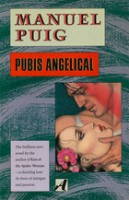
Manuel Puig, Pubis Angelical (1979, translation by Elena Brunet, Random House 1986)

1paThis book begins with a woman waking up alone in sumptuous surroundings the night after her wedding, having been drugged and subjected to sexual violence by her bridegroom. In the following chapters, written variously as diary entries and unannotated dialogue, a woman – not, it turns out, the same one – is in a hospital recovering from cancer surgery. Manuel Puig wrote The Kiss of the Spider Woman, and this novel has some kinship with that and the movies of Pedro Almodóvar. Evidently this style of febrile introspective suffering doesn’t do it for me in a novel, but I struggled on joylessly to page 50, where an arms dealer entertains some nasty images of brutally humiliating and killing his wife. Then I I gave up.

This post is about books I have no intention of returning to each of them when the urge strikes. There are others where my reading has stalled – Byron’s Don Juan, Grayling’s The Good Book, the Lehmann and Gray anthology of Australian poetry – but I’ll return to each of them in the fulness of time.

‘pose of powerlessness’

Ta-Nehisi Coates of the Atlantic reflects on what he was thinking ten years ago:

Back then I was seized with a deep feeling that what I thought did not matter much. …

I was skeptical of war, but if the U.S. was going to take out a mad tyrant, who was I to object? And more, who were you to object? I remember being out during one of the big anti-war protests and watching the crowds stream down Broadway. I remember thinking, ‘You fools believe that you matter? You think what you’re saying means anything?’

In fact it meant a lot. It meant that you got to firmly and loudly say, ‘No. Not in my name.’ It meant being on the side of those who warned against the seductive properties of power, and opposing those who would bask in it. It also meant pragmatism. …

And finally it meant the election of the country’s first black president whose ascent began at an anti-war rally in Chicago.

I say all this to say that if I regret anything it is my pose of powerlessness — my lack of faith in American democracy, my belief that the war didn’t deserve my hard thinking or hard acting … I am not a radical. But more than anything the Iraq War taught me the folly of mocking radicalism. It seemed, back then, that every ‘sensible’ and ‘serious’ person you knew – left or right – was for the war. And they were all wrong. Never forget that they were all wrong. And never forget that the radicals with their drum circles and their wild hair were right.

Going Down Swinging 33

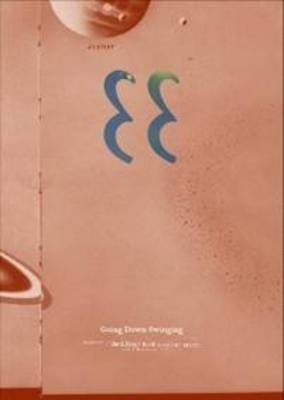
Going Down Swinging 33 (edited Geoff Lemon and Bhakthi Puvananthiran 2012)

20130222-211751.jpgGeoff Lemon, co-editor, was surely tempting fate and the critics when, as soon as the 32nd issue of GDS was complete, he nicknamed the impending No 33 the Jesus Issue. Wasn’t that like predicting the journal’s death, or at least inviting a crucifixion? Well, maybe, but after all it’s Going Down Swinging we’re talking about, whose title has been cheerfully proclaiming its imminent demise from the very start. Perhaps, then, the nickname was intimating that the physical object made of ink and dead trees was about to be resurrected, transformed into an incorporeal, wholly digital being. But no, though there is The Blue Corner online and a CD comes as part of the thing itself, the fabulous design of No 33, by Elise Santangelo and Stuart Hall, draws dramatic attention to its materiality, with tabs, die-cuts, a range of stocks, and clever use of showthrough – without, I say with heartfelt appreciation, detracting from legibility.

It looks as if the only actual consequence of the nickname was a number of Jesus-related submissions, enough of which made the cut to constitute a 38-page Jesus section. Like the rest of the magazine, these are predominantly hip inner-city Melbourne, the one surprise being ‘Out of the Kitchen Since 30 AD’, Elizabeth Redman’s straightforward personal essay reclaiming Christian faith from the reactionary fundamentalism and dubious institutional politics that tends to dominate public discussion of it.

Two other pieces stood out for me as admirably plain-speaking. André Dao’s ‘Out of Our Bodies’ is a memoir about Catholicism, atheism and mortality. He could have been describing a scene from Michael Haneke’s Amour in his final image of his grandparents singing together at his grandfather’s deathbed:

… My grandfather seemed finally to hear her, and then they were both singing, falling in and out of tune. For a moment they seemed lifted out of their slumped, brittle bodies, and their wrinkled faces were crumpled in concentration and remembered pleasure.

And Fiona Wright’s short poem ‘Consider the Camel’ feels as if it should always have been there, and manages to use the word ‘platyclades’ without missing a beat.

For the rest, there’s hardly a dud in the lot of them. ‘Atlas Dharma’, a commissioned by Cate Kennedy with watercolour illustrations by Simon MacEwan, recalls and recreates a childhood fascination with the Reader’s Digest atlas. Eric Yoshiaki Dando’s The Novel Teacher has fictional (I hope) fun with creative writing courses. Una Cruickshank gives us some memorable travel writing in ‘Varanasi’. I skipped an essay that begins with a quote from Lacan and a story that starts out, ‘Long, long ago, afore a-coming of the dust, the mani-lands were a-crowdening with mani-folk’, but that tells you more about me than them.

When I mentioned an inner-Melbourne sensibility, I wasn’t implying parochialism – quite the contrary, the feel is urbane, cosmopolitan. But I was struck by the way a number of pieces from oversea, and even interstate, stood out. You’d expect that of the stories from Russia and India (one each). It was contributions from the USA that prompted me, in the absence of an ‘About the Contributors’ section, to go Googling the authors – not because of a proofreaderish irritation at US spellings, though there was that, but because the voices were noticeably different in ways that are hard to specify – louder, more confident of their own centrality, something like that. When I think of the gigantic magazine that downloads to my RSS feeder, I’d guess that most of what I read there is from the US, and increasingly I live in a global culture. Here, where the proportion is roughly reversed, I’m surprised and reassured to feel a sense that local minds are engaging in locally inflected ways with issues that range from the intensely local to the cosmic.