To the Desert with Sturt

Daniel George Brock, To the Desert with Sturt (edited by Kenneth Peake-Jones, Royal Geographical Society of Australia, SA Branch 1975)

1dwsAfter reading Noel Beddoe’s Yalda Crossing, I realised that Charles Sturt had been through the novel’s main location at about the time of the main characters’ arrival. I wouldn’t be surprised if Noel Beddoe had drawn on Sturt’s journal of that expedition for one or two scenes.

I wasn’t impelled to re-read Sturt’s Journal. I read both of his published narratives four decades ago, and from memory he’s a fairly dry writer. But I was reluctant to leave pre-gold-rush Australia, and I remembered that this book, the journal kept by Daniel George Brock, a minor member of a later expedition, and not published until 1975, was somewhere on my bookshelves. I’d bought it hot off the press, but been put off reading it by a review that described Brock as a self-righteous whinger. This time, I decided to give it a go.

Let me say right off that the review was right: Brock has plenty of self-righteous, self-pitying moments. He records petty slights and grievances, and constantly finds Sturt and the rest of the leadership lacking, all the while keeping to the high moral ground, insisting that he doesn’t join in the general grumbling. He’s a snob and s prig and when things get desperate he’s a bit of a holy Joe, writing pages of Methodist piety. But he’s much more than that – he’s resourceful, has a romantic steak, and can spin a comic yarn. The book is fabulous. Where Sturt wrote for public consumption, Brock wrote for his mother: on his return to Adelaide, he bundled up the pages of his journal and posted them off home to England. And what you write to impress your mum and gain her sympathy is of course very different from what you write to convey your importance to the public, potential employers and posterity.

The most interesting thing about the journal, apart from the revelation that intrepid explorers can be as mean-spirited, disorganised, cliqueish and grasping as anyone else, is its string of encounters with Aboriginal people. There’s a sequence early on that unfolds like a scripted narrative: the party hear that ‘natives’ have attacked a travelling party somewhere to their north, and as a result they are in fear of being attacked themselves, but as they come closer to the place where the attack is said to have happened they learn that the factual basis for the rumour was a brutal, infanticidal attack on an Aboriginal family by members of Mitchell’s party of explorers. Brock isn’t writing with a possible courtroom and judge in mind, so he can describe this horror unguardedly.

No doubt he glosses over unsavoury aspects of his own encounters, but they do come across as genuine encounters. He notices, for example, when one man in a group of three has different scarring and deduces he is from a different place; one old man is excited to see Sturt and manages to communicate that they have met years earlier and many miles distant, on the banks of the Murrumbidgee. On more than one occasion sexual favours are offered and rejected. I can’t tell if Brock’s sense of European superiority was modified by any of these encounters, but he has a lively interest in cultural difference. Since I’m fairly sure you won’t be reading this book (whoever you are), I hope you’ll allow me a long quote. Brock and ‘the Doctor’ (John Harris Brown) are away from the main party and unexpectedly come across ‘numerous bodies of waterfowl’ on a waterhole. The Doctor shoots into the middle of the birds:

The report not only frightened the ducks, but also two native women, which were encamped in a bend of the creek, unaware of our approach. One of the women began to scream and bellow, the other crawled under a skin dragging a child with her. Being afraid to run, they made a virtue of necessity.

The Doctor was of course rather surprised at the scream, but having made himself familar (sic), and sitting down at their fire, the women became less afraid, and began to talk. No one can tell the pleasure I felt in again looking upon a strange human face, it being so long since any but our own party having come under my notice. …

We encamped, and Flood having shot a bird, I speedily secured it, saving the fat for the natives, with which they grease themselves. As the day was closing in, two men with more women and children joined us, and we all together were quite at home. The ducks, and other birds which we had, we gave them; this with the roots they had brought would be a first rate meal for them.

Sitting down as we were all together, the various parts of our dress came under notice. Among other parts, our boots were very wonderful, the mysterious lace – one chap was turning over my foot when I drew up my trowsers and shewed him my leg, and the effect of my thus exposing the color of my unexposed limb, which was tolerably fair, upon one of the females was really laughable – every lineament of her face was marked with horror.

Shewing them how the lace was unfastened, the fellow who was dandling my foot as if it was a little baby, at once began and drew the lace from every hole. I then made signs to him how it could be pulled off, which with my assistance he did; then came another poser – the sock – did it belong to my veritable body? On pulling it off, my foot being almost white, this  set the woman (who had been eagerly watching every transition, from boot to sock, from sock to foot) to a most fearful scratching of her head, and at the same time crying a lament over me, for it is possible the color which takes place in any of their dead, is not dissimilar to the color which was now presented. The man too for a moment in deep wonder, and as he looked he too scratched his poll, and gave two very decent grunts, he then began to pull the sock on again, but could not manage it.

It getting dark, and being no doubt anxious to get their evening meal, for they were pointing to their birds and at the same time patting their bellies, they were presented with a blanket and knife of which they were highly pleased; not but what they had first rate skins, some of the best I have ever seen, so large and so well prepared.

We retired from their fire, and soon were coded in our blankets, where we had not been long before four of the ladies came and sat themselves down at the Doctor’s and Captain’s feet. Their visit was obvious, and on being sent away they were sorely displeased.

One small unexpected pleasure was the word ‘mumchancing’ meaning ‘remaining silent’, which is new to me. This time, Brock is out collecting bird specimens with one of the men, Sullivan:

The heat was very great, not a bird was to be seen, and Sullivan and I were glad to coil under a gum tree in the creek for shelter; while thus, Lewis, being out looking for seeds, came to water, but he took up his rest under another tree, for Sullivan and him having words before we left the camp, it was a case of sulks with them, Lewis had nothing but a little bread with him, and a bit of sugar, gathering mint when he wanted a pot of tea (which by the way we did alternate meals). We having some bacon, on his passing us to get a pot of water I had just frizzled some and asked him if he would share; he took part in his hand and passed up to his own fire. I could not help smiling to see him, seated on his haunches, regularly mumchancing it, he at one fire, we at another. I endeavored to reconcile them, but it was a case of no go.

I like that use of ‘coil’ too, which he uses a lot, and note in passing that his spelling follows what would now be seen as North American usage.

NSWPLA Dinner: I wasn’t there

Just in case anyone was wondering after my post deliberating whether to shell out $150 for the pleasure of attending and blogging the presentation dinner for the NSW Premier’s Literary Awards: I didn’t shell out.

I thought I might storify the event from afar, and went so far as to register on the storify site and explore how to do it. But apart from a couple of images of the fabulously lit-up Mitchell Library reading room, and the relaying of this solitary comment by a winner

the tweeters confined themselves pretty much to telling us who won what. I couldn’t even tell if David Ireland, recipient of the special award, was there.*

Today’s newspapers didn’t give us much colour and movement either. The Sydney Morning Herald printed an abridged and edited version of Kathryn Heyman’s address, and a piece by Susan Wyndham listing the winners, with some detail about the Book of the Year, Ali Cobby Eckermann’s Ruby Moonlight. (That’s the only one of the prize-winners I’ve read. It’s a brilliant book.) Stephen Romei in the Australian focused on David Ireland, who it turns out wasn’t there, but wrote a ‘typically idiosyncratic acceptance speech’ which was read out by his agent.

Did George Souris keep up tradition by mispronouncing at least one person’s name? Did any prize-winner except Tim Soutphommasane say anything memorable? What was idiosyncratic about David Ireland’s speech? Was the food OK? Did everyone behave themselves? We may never know.

* But if you’re interested, the State Library of NSW did storify the event, here.

Julie Chevalier: her Darger: his girls

Julie Chevalier, Darger: his girls (Puncher & Wattmann 2012)

1dhgThe Art Student, who professes to hate poetry, recently went to a talk by Julie Chevalier about this book, and was so fascinated by the subject of Henry Darger she bought me a copy.

Darger is a fascinating man. He has a Wikipedia page. There’s a movie. John Ashbery wrote a long poem inspired by his work. Very briefly, he was a reclusive eccentric who lived in poverty and imagined a vast epic in which little girls take on armies and interplanetary beings. Shortly before his death his landlord discovered the bulky volumes of handwritten manuscript, along with the copious illustrations, and recognised a work of weird genius.

This book is an impassioned introduction to his story, or rather Julie Chevalier’s poetic record of her encounter with him. A six page introduction tells Darger’s story, defends him against hypotheses that he was a potential or actual child murderer, and argues that it’s incorrect to think of him as an Outsider Artist. The introduction is exactly the kind of courtesy I often yearn for in poetry books – but paradoxically the prosaic information was so interesting that I sometimes had trouble telling what the poetry was doing beyond reiterating it. Paradoxically again, the single poem that I found most satisfying is ‘an unusual child’, a prose poem made up entirely of phrases taken from Darger’s writing. It’s full of cliché, but generates an enormous emotional, quasi-erotic force:

she seemed for a moment to remind him of his own guardian angel in disguise _ she was smiling up again into his face _ hardened with the desperate struggle he was just then having with himself __ you resemble a guardian angel to me _ when I should be grown _ a man should protect a child _ how come you protect me _ the truth surging over him like the waves of a stormy sea _ breaking down the breakwater upon which he was seeking refuge _ a force mightier than his own will _ a voice in his soul crying out the truth _ that above all else he wanted to reach out his arms to the glorious creature

and so on.

awwbadge_2013 This is the fifth book I’ve read as part of the Australian Women Writers Challenge 2013.

Noel Beddoe’s Yalda Crossing

Noel Beddoe, The Yalda Crossing (UQP 2012)

0702249394 As Noel Beddoe says in an Author’s Note, this book is fiction, but adheres closely to the history of white settlement near what is now the township of Narrandera, including the Second Wiradjuri War and the massacre on Murdering Island. That’s the same massacre that lies in the background of our short film Ngurrumbang and Andy Kissane’s poem ‘The Station Owner’s Daughter, Narrandera’ that inspired us. It’s my great good fortune that the book wasn’t published until the screenplay was complete and pre-production was well under way – the first I heard of it was a comment from Jim Kable on my blog entry inviting people to donate via pozible. If I’d known of the book any sooner,  I would probably have been scared right off.

It’s a formidable achievement. Told from the point of view of Young James Beckett, as a teenager in the 1830s and as an old man in Sydney decades later, it is deeply embedded in its historical moments, and has a powerful sense of place. We care about the characters and come to appreciate their secrets and mysteries, not all of which are revealed, and some not until the last pages. The unfolding narrative gives us neither the ‘dun-dreary naturalism’ that Patrick White hated in Australian fiction, nor the black armband breastbeating that John w Howard claimed to discern and despise among Australian literati, nor again a ripping yarn of the frontier (though unless I’m very confused, Young James mentions reading some James Fenimore Cooper, whose novels must have been hot off the press). The tensions of the colonial society are there – English vs Irish, convicts vs free,  authority vs opportunism, women as a tiny, vulnerable minority – but they are embodied in recognisable individuals, facing particular dilemmas. I started this blog entry with the massacre, and most of the publicity for the book has centred around it, but the social, economic and moral world of the settlers is thoroughly fleshed out in its own right well before the prospect of massacre appears on the horizon.

Unlike other fictional treatments of atrocities against Aboriginal people, The Yalda Crossing lays the ground so that we understand how good people can deliberately commit abominable acts, not without reluctance, revulsion and remorse, but with a terrible sense of necessity. The good people who set the tone of the community aren’t drawn into the vortex of violence created by people less grammatically correct than they: when push comes to shove, they are the ones who orchestrate the terrible acts. Launching the book at the Sydney Institute last July, Linda Burney said that as a Wiradjuri woman, descendant of the victims, she had to skip the chapter where the massacre happens and come back to it later. Noel Beddoe, descendant of the perpetrators, doesn’t blink, and invites us, his semblables, to face our heritage with similarly unflinching gaze.

Linda Burney quoted a moment just before the massacre when a white man refuses to take part because he would lose his soul, which is more important to him than gaining the land. (Incidentally, it’s a gauge of the strength of Noel Beddoe’s writing that only when I typed it like that did I recognise the Biblical reference there.) For me, one of the devastatingly true things in the book is how that man, in spite of his genuine refusal to take part, is nonetheless in the end completely implicated.

Every bit as good, I think as Thea Astley’s A Kindness Cup or Kate Grenville’s The Secret River. (Links are to my blog entries, though the one on Kate Grenville’s book is very brief.)

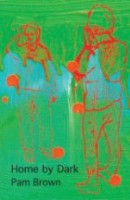
Pam Brown’s Home by Dark

Pam Brown, Home by Dark (Shearsman 2013)

1848612885The launch of this book last weekend (link is to a facebook photo gallery) was a convivial affair in an Erskineville pub. Unusually for a literary event, the football played silently on a large colour TV screen throughout, and a warm buzz of conversation echoed from the bar in the next room. Later, I saw myself in one of the facebook photos with a hand cupped behind one ear and a pained expression on my face. The pained look was, of course, nothing to do with the poetry or the company but was the result of my straining against the combined effect of Pam Brown’s quiet delivery, my deafness and the ambient noise.

On the day, Pam commented that the setting was appropriate, given the digressions and distractions of the poetry. As I was reading the book during the week, an alternative metaphor, even a fullblown analogy, occurred to me. For quietness, there’s the poems’ elliptical, almost throwaway quality – no assertive rhyme schemes, often no clear prose syntax, mostly no through narrative line; for deafness, there’s my ignorance of contemporary poetry – of the twenty or so poets mentioned in the acknowledgements or in the poems themselves, the only one I can honestly say I’ve read is Keats*, and L-A-N-G-U-A-G-E poetry and Oulipo (also mentioned) are pretty much closed books to me; for noises off, there’s PB’s daunting reputation as a poet’s poet, possibly even an academic poets’ poet – she’s the kind of person whose cover blurbs speak of precarity and sprezzatura. I realised I was approaching the page with a painful intensity, a virtual hand cupped behind my inner ear.

Well, of course scowling and squinting and feeling stupid is no way to read poetry. So I stopped it – the scowling etc – and read on regardless, going with the flow. And had a much better time. Of course, there are some poems I just didn’t get. There are some I kind of got but didn’t care about. And then there’s a lot that’s funny, thoughtful, sad, memorable … revisitable. I even read bits out to the Art Student, self proclaimed hater of poetry, and she wanted to steal them.

I think what appeals to me most is the sense in a lot of this poetry that it more or less fell out of Pam Brown’s head straight onto the page. (I know that’s an illusion, because I accidentally found an earlier version of one poem online, and got to see some of the careful reworking that went into creating that casual, uncrafted feel.) A number of the poems read as observations made while travelling – whether around town or across the planet, they display the same apparent randomness, the same self-deprecating wit, the same eye for the telling detail, the same play of mind.

From ‘Worldless’:

at the bus stop
_____long haired boys –
regenerate fashion,
_____retro,
fashions
_____arrive & go by
_______really quickly –
I had to live through
_________the entire decades!

______(peeved)

From ‘Leaving the World’ (I had to look up Jean Tinguely, but I’m glad I did):

along the LA freeway
black derricks
trundle up and down
like
Jean Tinguely sculptures
only__ominous
& witless
in a waterless world

The line that the Art Student wants to steal, the opening of ‘Haywire Here’:

who prepared this future?

and later in the same poem some lines where I enjoyed making my own sense (that may be quite different from Pam Brown’s):

and the barmaid’s
__never heard of sarsaparilla

(worse for me
_______& you)

Sarsaparilla was the favourite softdrink of my childhood, but it can be hard to find these days, so a barmaid who has never heard of it is a young woman with no sense of history. Worse, for us literary types, she hasn’t heard of Patrick White’s Season at Sarsaparilla, so we’re left feeling doubly invisible. Heh!

I recently came across a quote from 1935 letter by Wallace Stephens (of whose poetry I’ve read almost none and understood less): ‘As soon as people are perfectly sure of a poem they are just as likely as not to have no further interest in it; it loses whatever potency it had.’ And just before that, ‘As a rule, people very much prefer to take the solemn views of poetry.’ I think deciding not to scowl as I was reading this book was going against the preference for the solemn, and opening up to the potency of things I can’t be perfectly sure of.

awwbadge_2013 This is the fourth book I’ve read as part of the Australian Women Writers Challenge 2013.

* I did recognise a couple of lines from Bob Dylan, though he wasn’t acknowledged.

Blowing a trumpet

Today the Sydney Film Festival revealed the finalists in the 2013 Dendy Awards for Australian Short Films.

NgurrumbangNgurrumbang, directed by Alex Ryan from a script written by Alex and me, is on the list.

It’s eligible for the Live Fiction Award and the Rouben Mamoulian Award for Best Director, each bringing a cash prize of $5000, sponsored by Dendy Cinemas.

The competition looks stiff, which means the screenings will be worth attending. The winning film in the competition will be announced at the festival’s Closing Night on 16 June 2013. I plan to be there.

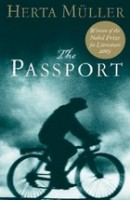
Herta Müller’s Passport

Herta Müller, The Passport (1986, translation by Martin Chalmers 1989, Serpent’s Tail 2009)

1passport

I got hold of this book via BookMooch soon after Herta Müller was awarded the Nobel Prize for Literature in 2009. Possibly because the press response wasn’t exactly encouraging (which of course it won’t be until a US writer wins), the book sat on my bedroom bookshelf for four years as a shining testament to pious intentions. I finally picked it up now because I’d read two books in translation, and decided to make it three of a kind.

It’s a very short book, just 92 pages, and it’s made up of short sentences. Here’s a random paragraph:

The skinner had given the stuffed animals to the town museum as a gift. He didn’t receive any money for them. Two men came. Their car stood in front of the skinner’s house for a whole day. It was white and closed like a room.

Sentence after sentence. Page after page. It proceeds in that staccato way. It doesn’t quite say what it’s saying. People do things, and say things, and see things. There are snippets of folklore, a bawdy song, symbolic objects, similes and metaphors as odd as the white room in that quote. You have to fill in the gaps, decode the descriptions. Only a handful of characters have names, the rest being known only by their professions or relationships. It took me until page 42 to realise I was in the middle of a narrative that I hadn’t been following. I started over. I’m glad I did.

It’s a terrible tale of the German-speaking minority in a village in Ceauçescu’s Romania. Uneducated, superstitious, despised by the Romanian majority, they live lives of quiet desperation and degradation. The village miller sets out to secure from the corrupt system a passport that will enable him, his wife and daughter to leave for West Germany.

I hated a lot of this as I was reading it: I just wanted to be told the story, to have a spade called a spade, rather than a headache being called a grain of sand moving around behind the forehead (at least, I assume that was a headache). But there is something mesmeric about it. I’m amazed that now I intend to immerse myself in that world again – not immediately, but when enough time has passed that I will be revisiting it rather than extending the current visit.

A couple of scrappy notes about the translation:

  • The English title draws attention to the plot, such as it is. The original German, taken from something the miller says at his lowest point, translates as ‘A man is nothing but a pheasant in the world’, and signals the sometimes enigmatic narrative mode.
  • There is a three-word glossary up the back. I could have done instead with a brief note at the start informing us that the original was written in German, that the action takes place in Romania (something that I’m guessing is obvious in the original but doesn’t become evident in the translation until we’re well under way), that most (all?) of the characters are German-speakers – in other words, filling us in on some things that are almost inevitably lost in translation.
  • There are one or two places where I completely didn’t know what was being described, and would love to know if it was because of the translation or the original. In particular, there’s a scene in which a woman is pleasuring herself or discovering she has some terrible disease – I’ll refrain from going into detail of the description here, but my confusion is genuine, and her husband’s comment, ‘So that’s how it is with your bladder, my lady,’ doesn’t make any sense either way. Perhaps this is the kind of thing that people mean when they say Herta Müller writes surrealism.

I suspect that this book is another that was a nightmare to translate, and it’s wonderful what a distinctive voice comes through in the telling.

PS: When I had uploaded all that I went to LibraryThing to post a version of it as a review there. And behold there was a very interesting post by Meisterpfriem, who had loved the book in German and been surprised at its lukewarm reception in Engish translation. I recommend it.

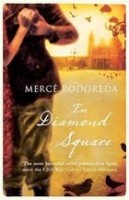
Mercè Rodoreda’s In Diamond Square with the Book Group

Mercè Rodoreda, In Diamond Square (1962, Translation by Peter Bush, Virago 2013)

1ids

Before the meeting: I came to this book with inaccurate expectations. Gabriel Garcia Marquez describes it on the cover as ‘the most beautiful novel published in Spain since the Civil War’, which I misread, lazily, as ‘about the Spanish Civil War’. True, the action of the novel spans the years of the Civil War, which is a major element in the story, but it would be quite a stretch to say the novel is about the war. The novel tells the story of Natalia, a naive, uneducated young woman from Gracia, then a poor area of Barcelona rather than what the internet now calls ‘one of the city’s hippest areas’. She marries a volatile young man whose entrepreneurial ambition fills their apartment, bizarrely and malodorously, with pigeons. The Civil War disrupts their family life when her husband and their male friends joins the militia – we see none of the combat, and none of the reasons for the war are discussed or explained, but we stay within Natalia’s narrow horizons, following her through wretchedness, deprivation, despair and unexpected happiness (though, to save spoilers, not necessarily in that order).

It’s a gripping story, with some brilliant images, but the thing that struck me most strongly was the language. Natalia is the narrator, and her voice is what makes the novel what it is. She begins:

Julie came to the cake-shop just to tell me they would be raffling coffee pots before they got to the lucky posy; she’d seen them and they were lovely, an orange split in two, showing its pips, painted on a white background. I didn’t feel like going to the dance or even going out, after I’d spent the whole day selling cakes and my fingertips ached from tying all those gilded raffia knots and handles. And because I knew Julie could manage on as little as three hours’ sleep and didn’t mind whether she slept or not.

She begins as she plans to go on, with leaps in logic (from the coffee-pot design to the question of whether she will go out or not, omitting to mention that Julie had come to take her there), syntax that doesn’t quite cohere (‘And because’ – huh?), attention to details that lead nowhere (‘an orange split in two’ etc), lack of orientation (who is Julie?), unexplained cultural references (are we supposed to know what ‘the posy’ is?), and so on. Then it took me a moment to figure out that the third they was a different they from the first two, that Julie is talking about the coffee pots, not the people who were raffling them, and because that tiny awkwardness feels like the kind of thing that happens in translation, I lost confidence as a reader , and as I read on I couldn’t tell how much of the narrative voice was Natalia’s and how much was the sound of Peter Bush wrangling the transition from Catalan into English. I wasn’t necessarily critical of the translation: perhaps this is one of those books that defies translation – as I imagine Malcolm Knox’s The Life to be. (A literal translation of DK’s ‘Well yeah … but no’ would probably leave Catalan readers floundering, but how else do you translate it?)

I read on, enjoying the book, but my unease about the translation persisted, and about a hundred pages from the end I turned to the Internet for help. I don’t know what I expected, but I found an excellent article from the British journal The Translator,Language and Characterization in Mercè Rodoreda’s La Plaça del Diamant‘ by Helena Miguélez Carballeira, which discusses the language of the book in the context of two previous translations. According to Ms Carballeira, Natalia’s discourse is what the boffins call escriptura parlada – spoken writing. Mercè Rodoreda sets out to ‘trace the discursive peculiarities’ of the uneducated Catalan working-class. Her speech is also full of features that mark it as peculiar to Barcelona, and is full of the euphemism, attention to detail and diminutives that mark stereotypically feminine speech. More than that, Carballeira argues (and I’m persuaded) that

Natàlia is a woman who feels uneasy with the very act of speaking. … The characteristics of [her] conversational, unmediated speech as a discursive device in the novel are rather predictable: there is an extensive use of idioms and colloquialisms, interjections and onomatopoeias. This yields a constant, highly idiomatic, non-straightforward use of language.

That is to say, Natalia is at least as big a headache for a translator as Knox’s DK.

A gauge of the difficulty of the task is the differences between translations. Carballeira discusses a number of fascinating examples. Here’s just one, quoted in a discussion of Natalia’s use of euphemism:

The original Catalan (1962):

I mentre em dedicava a la gran revolució amb els coloms va venir el que va venir, com una cosa que havia de ser molt curta.

From Eda O’Shiel’s The Pigeon Girl (1967):

And while I devoted my energies to the grand revolt against the pigeons, there took place what had to take place, and it seemed as if it would be over quickly.

From David H Rosenthal’s The Time of the Doves (1986):

And while I was working on the great revolution with the doves the war started and everyone thought it was going to be over quickly.

From Peter Bush’s In Diamond Square (2013):

And while I was waging my big revolution against the pigeons, what was brewing came, that they said would be a two-day wonder.

Having read this article when I was struggling, part way through the book, I had a much better time with the rest. Some of Peter Bush’s decisions had confused me. For example, he names Natalia’s husband Joe, possibly as what Carballeira calls a domesticating strategy, but when I read that his name is Quimet in the original I realised that the discord between his English name and his Catalan context had niggled away at the edge of my mind, creating a sense of unreality like the one in some CGI movies, where figures don’t quite seem to touch the ground. And another example: Joe/Quimet refuses to call Natalia by her name but calls her Pidgie, without explanation of where the name comes from – to my ear that sounded a bit like Piggsy, and so vaguely insulting, and it was a long way into the story that I realised it was short for Pigeon, and that Joe/Quimet was obsessed with those birds; in the original he calls her Columeta, which my computer translates from the Catalan as, you guessed it, Pigeon. Maybe to a British ear ‘Pidgie’ sounds more affectionate than ‘Pigeon’, but ‘Pigeon’ would have worked fine for me.

This experience makes me suspect that if I’m going to read books in translation a little bit of research will make the whole experience go better. As it happens I’ve been to Barcelona, so quite a few of the local references – Tibidabo, Parc Güell, etc – made immediate sense to me. If I hadn’t been there, I doubt if I would have bothered to get out a map, but it wouldn’t have been a bad idea. (I do think I was right, though, not to read the author’s spoilerish 1982 ‘Prologue’ until after I’d read the book.)

The meeting: We were astonishingly unanimous in our responses to the book. We’d all enjoyed it; we’d all been at least mildly disconcerted by the language, though when someone read a short passage aloud, its ‘written speech’ qualities were obvious; we’d all engaged with Natalia and formed strong opinions about Joe/Quimet; and I think we’d all had our heartstrings / tear ducts activated. There was an attempt to get someone to read the last couple of pages, which are full of sweet, kind-of-sexual tenderness, but no one was up for the challenge. We enjoyed the book so much we contemplated staying with Catalonia for our next meeting, and reading The Sun Also Rises, Homage to Catalonia and perhaps something by Colm Toibín. (We decided against it, and will be heading off to Norway instead with Karl Ove Knausgaard.)

Overland 210

Jeff Sparrow (editor), Overland 210, Autumn 2013

210-overland Your mileage will vary, but the article in this Overland that stands out for me is Beyond denial by Philip Mirowski, Jeremy Walker and Antoinette Abboud, which argues that ‘the phenomena of science denialism, emissions trading and geoengineering are not in fact unrelated or rival panaceas but rather constitute together the full neoliberal response to global warning’. The article makes a distinction between neoclassical economics and neoliberalism, describing the latter, in what I wish was a harsh caricature, as worshippers at the shrine of an all-wise market, who hold, for example, that ‘Science is not an independent mode of truth discovery: it is a boutique knowledge format only validated by “the marketplace of ideas”‘.

The neoliberal response to the climate change challenge is, if I understand the article correctly:

  1. Deny the science so as to distract attention from the crisis and buy time for commercial interests to find a way to profit
  2. Back emissions-trading schemes in order to divert political actors from using state power to curb emissions into setting up carbon markets, which won’t ever work, because the big polluters are already finding ways to go on polluting
  3. Develop grand geoengineering schemes that will make huge profits for corporations but will not address the root problem of increasing carbon dioxide concentrations or stop ocean acidification.

The article doesn’t come up with an opposing plan, but it gives a salutary map of the terrain. I recommend the whole thing.

Elsewhere, this issue strikes a nice balance between giving pleasure and holding the reader’s feet to the fire.

First, the pleasures include:

  • interesting chat from regular columnists Alison Croggon and Rjurik Davidson  about, respectively, Tolkien and Hollywood’s version of Second World War resistance movements
  • Francesca Rendle-Short writing about writing about her late father (as she has elsewhere), including poignant moments that will strike a chord with anyone who has a close relative with advancing dementia:

    [H]is hands dance largo, float and rise and fall in a slow movement set to its own tune, an adagio. First, he clasps them in front of his chest as though in a praying gesture, a supplicant hold where the palms lie flat against one another. Then he pauses a moment to pray, to ask for God’s blessing before the fingers start to stir larghetto. They loop first this way so the fingers interlace each other; then right then left, before rising up elongated in a slow, seesaw action. A ritual dance.

  • The cartography of foxes,  a deeply satisfying and unsettling short story by Theresa Layton that augurs well for Jennifer Mills’s tenure as Fiction Editor
  • Peter Minter’s report as judge of the 2012 Overland Judith Wright Poetry Prize for New and Emerging Poets, which is almost as enjoyable as the winning poems, particularly his description of how he read and re-read the submissions in the midst of domestic life
  • The winning poems, especially the winner, Augury? by Luke Fischer
  • An essay by Californian Aaron Bady that, after going on a bit about the Great American Novel, confirmed my decision not to give any cash to the makers of Zero Dark Thirty, with an argument that chimes with my experience of The Hurt Locker. The movie succeeds as propaganda, he writes,

    because it never tries to glorify the protagonist’s obsession, never tries to rationalise it, defend it or even make it seem attractive … But it’s still the one we’re stuck with for two and a half hours … You have no choice but to identify with torturers whose motivations you understand, and with the victims of Muslim terrorists whose motives you are not allowed to be privy to.

  • Judy Horacek’s dark cartoons (I couldn’t find a link), especially one that should probably be in the ‘feet to the fire’ category, in which two people holding a ‘Save the Planet’ sign face a gang holding signs that read  ‘Save our Profits’ – she manages to be funny about discouragement.

And then there’s what Overland does so well, argument and analysis of the harsh realities of our times from a progressive point of view. Some highlights:

  • Alyena Mohummadally on being same-sex attracted, Muslim, and organised in Australia
  • Panagiotis Sotiris offering an alternative view of the Greek economic situation. His repeated calls for ‘struggle and solidarity’ as the necessary response to the fascist Golden Dawn, is little more than sloganeering shorthand, but where else can you find a clear challenge to the mainstream narrative about Greek laxity finally being brought to heel by the benign forces of the EU, the IMF etc?
  • Martin Kovan on the alarming number of ethnic Tibetans who have set themselves on fire in recent years, mostly with fatal results. The article discusses how these burnings remain largely unnoticed in the West, ‘inside the narcissism of self-interested, racially conditioned and materially anaesthetised ethical immunity’, then focuses on the English Buddhist novice who self-immolated in southern France late last year. Kovan knew the monk, and his reflections are personally charged
  • Guy Rundle, self-described default Luddite, reporting on 29c3 – the twenty-ninth Chaos Communication Congress, at which hackers confronted the rise of the total-surveillance state. He reflects on the relationship between hacktivism and the Left, in particular on what their different histories mean they can learn from each other. In doing so, he manages to end the journal on a note of restrained optimism.

I’ve included links to everything except the cartoons. Overland make its entire content available on line. It also publishes background interviews on some articles in its Editors’ Blog, which is one place on the Internet where the comments don’t make you want to run screaming from the room.

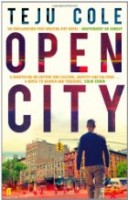
Teju Cole’s Open City

Teju Cole, Open City (2011, Faber and Faber 2012)

0571279430 Julius, the narrator–protagonist of this novel, is a psychiatrist by trade, but as far as we’re concerned he is a flâneur: we don’t quite have a word in English for such a person, one who strolls (flâne) around a city, observing people and things with a detached, intelligent curiosity, and no other agenda. Julius strolls from street to street, from church to bar, gallery to movie theatre to concert hall. He visits an old friend who is dying, phones a former girlfriend, has a casual sexual encounter, chats with the man who checks the air-conditioning vents on the subway, is mugged, runs into the sister of a friend from his teenage years. Almost always, he is moved by whim rather than intention, and when he does set out on a quest at one point, the quest comes to absolutely nothing.

The city is New York, though Julius visits Brussels for a spell and continues his flâning ways there. I didn’t read the book with a street map open beside it, but I expect that if I had I’d have known to within a block or two where I was on almost every page. The same goes for time: he visits and responds to particular films, concerts and exhibitions, and I’m reasonably sure that the date he saw them on could be approximated by a quick check of past issues of New York newspapers.

In a way, just as Julius’ wanderings trace the shape of the city, his encounters (not all of them are conversations) build a picture of the less tangible social and political world, mostly from perspectives other than the dominant one, as most of the people he talks to are not white – he himself is the Nigerian-born son of a German mother and a Nigerian father.

But the book is not the meandering bore or disguised tract that description may conjure up. True, it doesn’t have a central quest or conflict needing resolution. Also true, there are reflections on the state of racism and internalised racism in the US, on ‘political correctness’, on Middle Eastern politics. But none of the reflections amounts to a didactic ‘line’, and there is a quiet and unobtrusive overall arc. We get to know Julius, and start to wonder about him. He has an ambivalent attitude to African-Americans in general – welcoming the sense of connection but shying away from the enforcement of identity. He loves his old English professor and knows he is dying, yet visits him only twice over many weeks, and when he discovers on his third visit that his old friend has died, he resumes his peripatetic ways without missing more than a beat. There is a striking lack of affect in his account of a sexual encounter with a Czech woman in Brussels. His quest to find his German grandmother is oddly half-hearted. His music references are incredibly erudite, and you might start to wonder if ‘incredible’ might be more precise than it at first seems – that he might be straining to project an image of himself as a man of high culture. It’s not that we’re being given a coded alternative version, but we realise that, perhaps inadvertently, he is telling us a lot about what it means to be a mixed-heritage, middle-class African immigrant to the US. Perhaps it’s a sop to the conventional reader that there is a surprise revelation towards the end, but I found it both disturbing and deeply satisfying that Julius lets the revelation sit on the page with only a broad introductory comment, as if he is as stunned by it as we are.

I’m not sure what the title means. An open city, in the usual wartime context of the term, has declared that it will not defend itself in case of attack. Perhaps Manhattan is wide open, ready to yield its secrets to anyone who wants to walk its streets and buildings with eyes and mind on the alert. Or perhaps Julius is the open city of the title – laying himself out there without defensiveness.

Open City was one of the books I took home from our last Book[-swapping] Club. It took me months to actually pick it up because I’m generally suspicious of books and movies that treat New York as a cosmos. This isn’t one of those.