The Essays of Montaigne, progress report 7

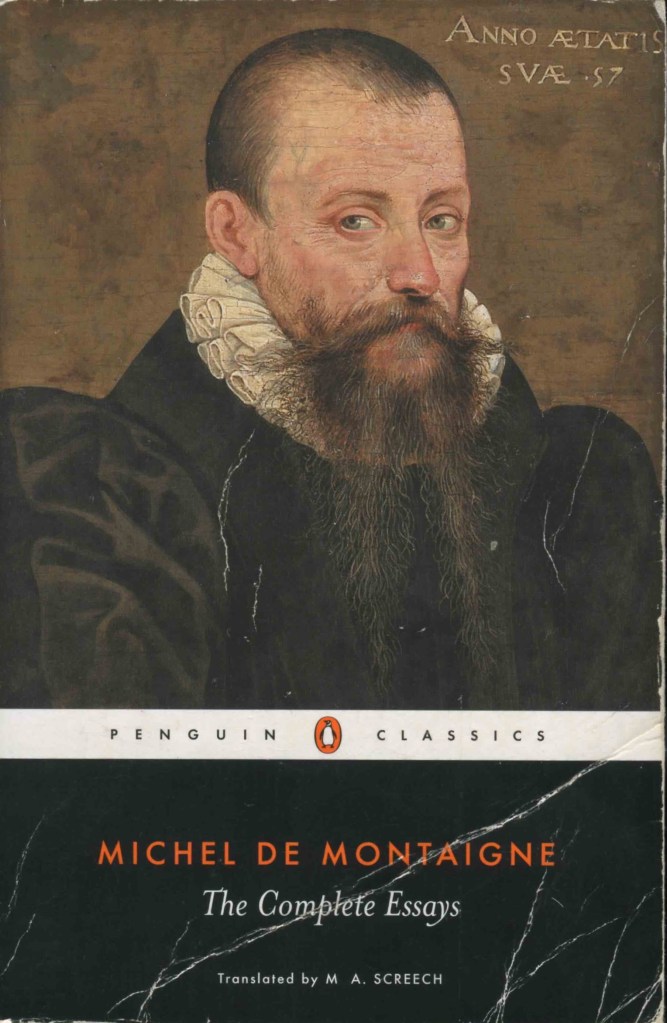
Michel de Montaigne, The Complete Essays (Penguin Classics 1991, translated by M. A. Screech)
– part way through Book 2, essay 17, ‘On presumption’ to part way through ‘On the resemblance of children to their fathers’

These aren’t so much progress reports as monthly snapshots from my reading of Montaigne’s Essays four or five pages a day. Last month I was part way though ‘On presumption’ and enjoying his unflattering self-portrait. That essay became even more fabulously self-deprecatory, including this (on page 730):

As for music, either vocal (for which my voice is quite unsuited) or instrumental, nobody could ever teach me anything. At dancing, tennis and wrestling I have never been able to acquire more than a slight, vulgar skill; and at swimming, fencing, vaulting and jumping, no skill at all. My hand is so clumsy that I cannot even read my own writing, so that I prefer to write things over again rather than to give myself the trouble of disentangling my scribbles. And my reading aloud is hardly better: I can feel myself boring my audience. That apart, I am quite a good scholar! I can never fold up a letter neatly, never sharpen a pen, never carve passably at table, nor put harness on horse, nor bear a hawk properly nor release it, nor address hounds, birds or horses.

Last month I snuck a look into the future and predicted that this month I would be writing about ‘Three good wives’. Fortunately I don’t have to spend time on that essay, as its version of a good wife is one who will kill herself when her husband dies. Did I mention that some of Montaigne’s views and attitudes can be pretty repulsive? The essay after that, ‘On the most excellent of men’, is hardly less repulsive: his three excellent men are Homer, Alexander the Great and Epaminondas, and in all three cases, including Homer, he seems to regard military skills as the main criterion for excellence. He also seems to take Alexander the Great’s PR at face value. (I shudder to think that essayists a thousand years from now will speak of Donald Trump as the greatest president ever.)

Today, however, I have started on the final essay of Book II, ‘On the resemblance of children to their fathers’, which is surely one of those that have endeared Montaigne to readers for nearly 500 years

Typically, the proclaimed subject of the essay is nowhere in sight in the first couple of pages. Instead, he reflects on the nature of his work and on changes that have happened in his life over the eight years he has been writing essays.

I think it’s true that Montaigne invented the essay form, and these paragraphs give a charming insight into how he went about it.

All the various pieces of this faggot are being bundled together on the understanding that I am only to set my hand to it in my own home and when I am oppressed by too lax an idleness. So it was assembled at intervals and at different periods, since I sometimes have occasion to be away from home for months on end. Moreover I never correct my first thoughts by second ones – well, except perhaps for the odd word, but to vary it, not to remove it. I want to show my humours as they develop, revealing each element as it is born. I could wish that I had begun earlier, especially tracing the progress of changes in me.

It’s probably that spontaneity and the possible vulnerability that goes with it, that makes the essays so alive even all these years later. Maybe I should be less judgemental about essays like the one on good wives – he may have thought differently on the subject on another day.

But that’s enough about the work. He needs to tell us about his health:

Since I began I have aged by some seven or eight years – not without some fresh gain, for those years have generously introduced me to colic paroxysms. Long commerce and acquaintance with the years rarely proceed without some such benefit I could wish that, of all those gifts which the years store up for those who haunt them, they could have chosen a present more acceptable to me, for they could not have given me anything that since childhood I have held in greater horror.

I’m roughly 30 years older than Montaigne was when he wrote that. Though I’m in reasonably good health, I recognise his impulse to tell the world about his bodily ills. As I turn the page, he moves on to one of his recurring topics: when it makes sense to kill oneself (see essay on good wives etcetera). Happily, he is leaning towards staying alive:

After about eighteen months in this distasteful state, I have already learnt how to get used to it. I have made a compact with the colical style of life; I can find sources of hope and consolation in it.

That’s a good thing for his readers, as there was a whole third book to come.


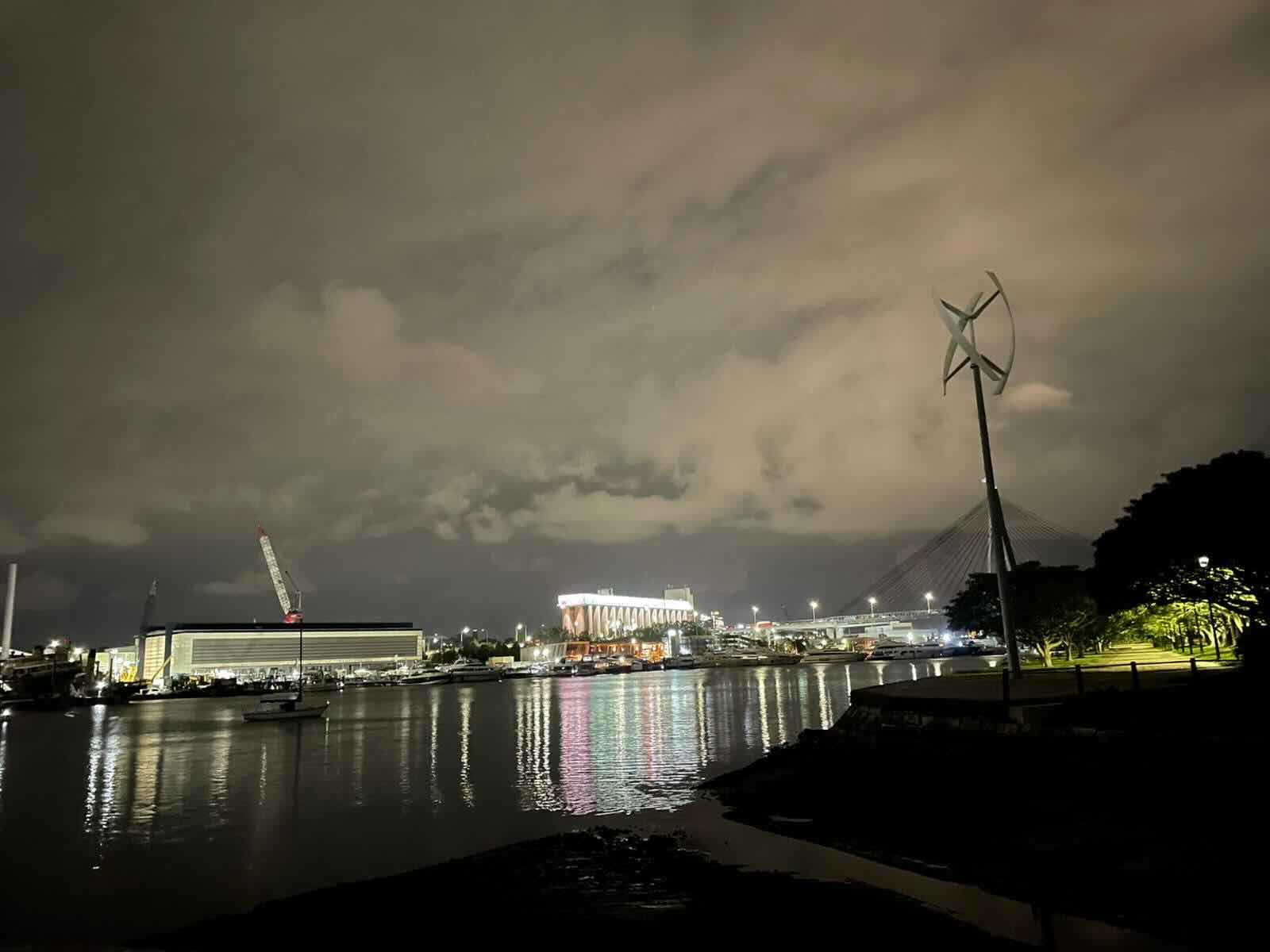
This blog post was written on Gadigal-Wangal land, where understandings of the universe beyond Montaigne’s imaginings were developed millennia before the Ancients he so loves. I acknowledge the Elders past, present and emerging of Gadigal and Wangal of the Eora Nation.

Journal Catch-up 25: Overland 253

Evelyn Araluen and Jonathan Dunk (editors), Overland 253 (Summer 2023)
(Some of the content is online at the Overland website – I’ve included links)

This Overland begins with a trio of generational contrasts.

First, gen x-er Brigid Rooney, Associate Professor of English at Sydney University has an article on the late Professor Elizabeth Webby in which, though she describes herself as a friend of her subject, she maintains a serious academic distance where you can feel a more personal tone struggling to assert itself.

Second, baby-boomer John Docker, also an Associate Professor at Sydney Uni, has a review article on a book about Sydney’s New Theatre. He begins with a convincing account of himself as a non-theatre person, and one, moreover, who is strangely ill at ease when he visits the current site of the New Theatre, which is about ten minutes by car from the suburb where he currently lives. Amusingly self-indulgent, but it might have been better to reject the commission.

In the third item, Dženana Vucic, self-identified as a millennial, has a piece about Sailor Moon, a manga serial that was big in her 1990s childhood and I’m sorry to say of very little more interest to me after reading her article than it was before – though I enjoyed the complex irony in which she pretended to claim a deeply anti-capitalist message in the show.

After that, things get serious with ‘Prison healthcare as punishment‘ by Sarah Schwartz, a gruelling article which begins with the grim statement that an Aboriginal woman ‘passed away on the floor of a prison cell on 2 January 2020, after days of crying out for help.’ It continues, ‘Three years later, a Coroner found that if she had received the healthcare she needed, she would not have died.’ It’s a penetrating look at the way for-profit prison healthcare in Victoria and other Australian states leads to terrible outcomes, especially for First Nations people. A year after the coronial findings mentioned in its first paragraph no one had been held accountable for the neglect.

Of the poetry, curated by Toby Fitch, ‘Water under the bridge‘ by Jeanine Leane stands out. Among other things, it looks at the way different generations of First Nations people have responded to colonisation. The title phrase takes on a telling ambiguity:

that there were names in the river
that were not just water under a white man's
bridge

Fiction editor Claire Corbett has gathered four excellent, diverse short stories. ‘Parliament‘ by Simon Castles is a sketch of young love and protest on the lawns of the new Parliament House in Canberra in 1988. Anna May Samson, currently starring in the dreadful Australian spin-off of Death in Paradise, packs a complex set of relationships into a very few pages in ‘Summer work‘. ‘Hot season‘ by Anna Quercia-Thomas is a post-apocalyptic pastoral vignette. In ‘At first, nobody died‘ by Nasrin Mahoutchi-Hosaini the protagonist, herself an immigrant, is on vacation from her work as a counsellor of ‘boat people’.

It took me a long time to read this journal. It wasn’t for lack of interest.


I wrote this blog post in Gadigal Wangal country, where the weather is swinging back and forth between a nurturing warmth and a chilly wind that murmurs in the casuarinas. I acknowledge Elders past and present for their continuing custodianship of this land.

What Waleed said

On the latest edition of the Minefield, Waleed Aly, formidable intellect that he is (no irony intended), made a brief statement about poetry (which you can find at 8’07’’ of the audio at this link).

I was going to write a rebuttal, but instead, here’s a little poem:

Poetry is something we don't do
After Waleed Aly
Poetry is something we don't do.
It's just not part of our repertoire.
People could get through their entire
lives without encountering
it in a meaningful way.
It's not valued.

If we put it in a newspaper –
that used to happen but
would be very strange now —
people would skip and just imagine
what sort of business it would do
in an online newspaper. It has been
part of every civilisation
throughout history and yet
it's an art form we are doing
away with.

It's inherently alienating to
a modern audience. In order
to get someone to engage
with poetry you have to get them
to read or listen to a poem
and that feels like a bridge
too far.

It's an effort, it's not what we do.
I could make you listen to a song,
I could get you to watch a documentary,
I could get you to read a novel, at a pinch
I might get you to read non fiction
and analysis, but a poem?

It's for people on the fringes,
overly artistic in spirit though
perhaps not in talent.
[Snigger from Scott]

Close your eyes and imagine a poet:
what you see has got nothing to do
with the rest of us.
Even painting or sculpture have more
presence, even if it's in caricature.
So what is the point of poetry?

It's an art form we are doing
People skip and just imagine

It feels like an effort
It's for people on the fringes
It feels like a bridge

Joëlle Gergis’ Highway to Hell

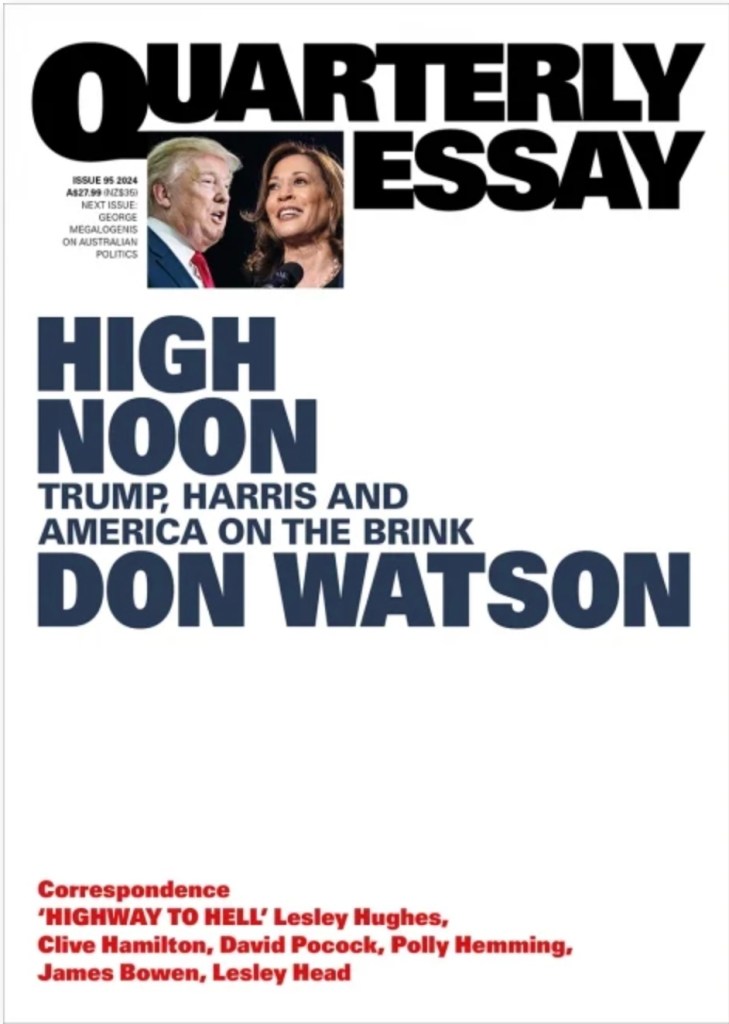
Joëlle Gergis, Highway to Hell: Climate Change and Australia’s Future (Quarterly Essay 94, 2024) – plus correspondence in Quarterly Essay 95

I’ve worn a Peter Dutton mask with devil horns in street theatre outside Anthony Albanese’s office. I’ve asked awkward questions at the AGMs of fossil fuel companies, scripted by Market Forces. I’ve participated with gusto in Move Beyond Coal‘s campaign targeting banks that provide financial backing to new coal mines. I joined the People’s Blockade of the coal port of Newcastle last November and plan to join again this year. Do I need to read ONE MORE BOOK on climate change?

Well, yes, I do. I had pushed out of my mind the terrible events of Summer 2021–2022. I even wrote about Judith Beveridge’s poem ‘Choirwood’ as if it offered some kind of hope after those fires (at this link). After reading Joëlle Gergis’s essay, the poem is still brilliant, but it feels like so much whistling in the dark.

Joëlle Gergis is one of the 234 lead authors of the most recent IPCC Report. She is a climate scientist who, she tells us in this essay, has become so frustrated at the way the reality of climate change is downplayed or ignored by those in power that she quit her job as an academic scientist to become a public advocate. I’d say she has become a Cassandra warning of the dangers, except that Cassandra was doomed to be ignored, a fate I hope will not befall Joëlle, for all our sakes.

After noting the relief of seeing the end of the denialist Morrison Government (remember ‘Labor’s war on the weekend’, and ‘Don’t be afraid, this is carbon’?), the essay tackles the current situation – better, but a long way from hopeful. Here’s a key paragraph, on page 7:

The scientific reality is that, regardless of political spin used to justify the continued exploitation of fossil fuel reserves, the laws of physics will keep warming the planet until we stop pumping carbon into the atmosphere and begin cleaning up the mess. The situation is too far gone for renewable energy alone to save us. Pinning our hopes on carbon capture technology to justify the continued burning of fossil fuels is a disastrous gamble the world can’t afford to take. So, as this fateful moment approaches, we need to take an honest look at the government’s climate policy and realistically assess the situation we are in. Are the climate wars really over, or has a new era of greenwashing just begun?

As she goes on to say what the laws of physics are up to and to outline a range of future scenarios, she begs us: ‘Please, don’t look away. Thee isn’t a moment to waste.’

I won’t try to summarise the science, but if you’re looking for a solid, accessible presentation, I doubt if you’ll find a better one anywhere. It’s a gruelling read, from which my main takeaway is that I need to grieve for the corals of the Great Barrier Reef that thrilled me as a child, for the thousands of cattle and millions of wild animals that have died and are yet inevitably to die as the planet heats up, for the vast tracts of forest, including rainforest, that have already been devastated. I need to grieve and I need to treasure what remains – and be prepared to fight for it.

After a blistering account of carbon offsets and carbon capture and sequestration (CCS) in a chapter headed ‘Chasing Unicorns’, she asserts that we know what needs to be done, but such is the power of the fossil fuel lobby that Australian governments won’t do it. True, there has been significant movement in State governments, and outside of government. But it’s pretty grim, when the main message to the reader about what can be done is to stress the importance of voting in the next federal election.

Almost any paragraph from this essay is worth quoting and pondering. On page 47*, there’s this:

To its credit, the Albanese government has tried to support Australia’s emergence as a renewable energy superpower. [She lists an impressive number of initiatives taken since the ALP’s election win in May 2022.] While these are all steps in the right direction, the challenge is not to undo all of this good work by allowing the interests of the fossil fuel industry to co-opt the process and weaken real progress towards reducing global emissions.

Rather than ‘net zero’, the goal must be to achieve ‘real zero’, which can only happen once we stop burning fossil fuels. In fact, the science tells us that around 60 per cent of oil and gas reserves and 90 per cent of coal must remain unextracted if warming is to be limited to 1.5°C. There is no way around having to eventually face this scientific reality.

But instead of facing facts, in December 2023, the federal government caved in to lobbying from the oil and gas company Santos.


The correspondents in Quarterly Essay 95 mostly agree with and amplify the arguments of the essay. There’s an excellent piece by David Pocock, who is probably the parliamentarian that Gergis meets with early in the essay. He describes his shock as a senator now for a little over two years to see how ‘policy is consistently shaped by political considerations ahead of evidence and research’. Often he says, politicians ‘are not looking for genuine, long-term solutions, but for the next opportunity to back their opponents into a corner’.

A stand-out exception to the generally supportive tone is a grim piece by Clive Hamilton. He’s not the only correspondent to describe Joëlle Gergis as operating on an ‘information deficit’ model: if only people, including those in power, had correct information they would do the right thing. Scientists have been trained to look for solid, verifiable facts and to base their actions on what they find. But it’s a mistake to assume that that’s how people in general function. Hamilton dismisses the essay’s hope as wishful thinking, argues that nothing Australian governments do can have much impact on climate change, and generally sees the outlook as bleak:

After two decades of research into the psychological, social and political complexities of persuading people to recognise and act on the science of climate change, it’s wearying when another scientist comes along convinced that it’s only a problem of someone with authority communicating the facts. I’d be more energised if Gergis, as an IPCC lead author, had written an essay arguing that it’s time for a campaign of industrial sabotage.

I would love to know how Joëlle Gergis responds to Clive Hamilton. Sadly, no response from her is included in QE 95. Maybe in Nº 96? Or maybe she’s already out there like the main character in the movie Woman at War.


I wrote this blog post in Gadigal Wangal country, where it is my great joy to live. I acknowledge Elders past and present for their continuing custodianship of this land.


My usual blogging practice is to focus on the page that coincides with my age, currently 77. But as this Quarterly Essay runs to just 72 pages including notes, I’m looking at page 47, the year of my birth minus 1900.  

Wole Soyinka’s Chronicles from the Land of the Happiest People on Earth and the Book Group

Wole Soyinka, Chronicles from the Land of the Happiest People on Earth (©2020, Penguin Random House 2021)

Before the meeting: This is a strange book. It’s a satire set in contemporary Nigeria. With Boko Haram atrocities in the immediate background, the country is rife with corruption. I’m pretty sure that if I knew more about Nigeria’s history and its current politics the book would reveal more of itself to me as a devastating, possibly despairing denunciation of Soyinka’s homeland. As it was, I enjoyed it pretty much as a child would enjoy Gulliver’s Travels – as a fantastical tale. I’m sorry to say, though, that I enjoyed it a lot less than I enjoyed the story of Lilliput as a child.

Almost half the book is taken up with setting the scene in magisterial, ironic tones. There’s a charlatan religious leader, a deeply venal and media-savvy Prime Minister, an awful lot of sarcastic hoptedoodle about national festivals and awards. It takes a long time for a central narrative thread to become clear. (Arguably, the over-all shape isn’t revealed until the last page, so what follows is possibly a spoiler of the first magnitude.) Four young Nigerian men form a strong bond when at university in Europe, agreeing that they will each contribute in a major way to their homeland. They become respectively a doctor, an engineer, a financial wizard and a public relations genius. In the book’s present time, one has gone missing, one runs foul of the government and becomes inexplicably catatonic, one has been nominated to a prestigious position in the UN, and the fourth, who I think of as the book’s central character, is a surgeon whose work patching up the survivors of Boko Haram attacks has earned him one of the country’s top honours.

The rubber hits the road at last when the surgeon discovers a monstrous commercial-culinary trade in human body parts, and the narrative finally develops a forward momentum as he and his engineer friend pit themselves against the shadowy figures behind the trade.

But just as that narrative seems to be getting somewhere, the book swerves off into interminable machinations to do with a bombing, and questions of transporting a body between Austria and Nigeria. The main story is finally resolved in an ultra-perfunctory way, with a lot of loose threads left hanging. There’s a ‘surprise’ revelation on the last page that is about as surprising as having hot water come out of a tap marked H.

The story is told with tremendous gusto, but for much of it the writer seems to care less about telling it than with having angry, satirical fun. I found myself thinking of Edward Said’s posthumously published essay, On Late Style, which we read in the Book Group a while ago (link here). He wrote of the artists who create in the late style:

The one thing that is difficult to find in their work is embarrassment, even though they are egregiously self-confident and supreme technicians. It is as if having achieved age, they want none of its supposed serenity or maturity, or any of its amiability or official ingratiation. Yet in none of them is mortality denied or evaded, but keeps coming back as the theme of death which undermines and strangely elevates their uses of language and the aesthetic.

This book is supremely unembarrassed by its own excesses and absurdities. It certainly doesn’t aspire to serenity or seek attempt to ingratiate itself with authorities, or with readers. And it is full of mortality.

At page 77*, we’re still being given the general set-up. It’s part of the engineer’s back-story, explaining how he ‘succumbed’ and agreed to work for the government:

It did not take too long to discover – with some chagrin, he would reveal to his ‘twin’, the surgeon Kighare Menka – that there was a strong work ethic in control, indeed a pervasive hands-on ethic, near identical to both theirs, with unintended literalism, just a slight slant – a prime ministerial finger in every pie!

His friendship with the surgeon Kighare Menka is the heart of the book. Here it’s invoked so that we know both men share a perspective on the Prime Minister’s corruption, and that they share an enjoyment of the ponderous wordplay that pervades the book.

The next paragraph is a good example of the narrative style. Bisoye is the engineer’s wife:

Only the twenty-million-dollar question remained: How long would he last? Thus came the pact with Bisoye – first three months, I’ll stick it out, no matter what. Agreed? After that, a choice of his single-malt whisky, always a different brand, for every month survived, plus a night out followed by a bed in, no holds barred. The nation never knew how much it owed to the blissful athleticism of the couple, and Duyole did come close to earning a full case of Islay malt, Collector’s Reserve – just one bottle short of a full case. In the display cabinet he conspicuously left a gap in the row of twelve, a silent accusation of Bisoye’s ungenerous spirit. Was it his fault he completed the task so far ahead of time?

This mock-pompous style characterises most of the narrative. A man of integrity decides to do research for a corrupt government, and to report honestly on what he finds. But he’s a man with a sense of humour and a zest for life. Like him, the narrative refuses to be drawn into hand-wringing over the corruption. It barely gets to the specifics of that corruption – saving its fire for the (hopefully) imaginary trade in human flesh. It is happy to assume the reader doesn’t need details of the realistic stuff and gives us instead the ‘blissful athleticism’ of our heroes, the opposition.

While that paragraph may fill out the engineer’s character a little, one can’t help but feel that it’s just there because the author was having a good time. Not that there’s anything wrong with that. On the contrary. But I’m not surprised to learn from the WhatsApp conversation before the meeting that most people failed to persevere to the moment when the story proper gets started.

After the meeting: There were eight of us, and we met in a pub in Balmain. Two of us had read the whole book. All but one of the others had no intention of finishing, most having given up after a hundred pages or so.

Interestingly, the person who had read about a third was the book’s keenest supporter. I don’t take notes, and I have a terrible memory, but he said something like, ‘I was irritated, intrigued, amused, horrified, perplexed, enlightened, admiring. I kept seeing parallels with news from the US in the bizarre corruption, and the dominance of bogus religion. The back story of the religious charlatan fascinated me, and I want to know what becomes of him.’

I think he was on the cusp of the moment when the character who fascinated him pretty much drops out of the story, to make a functional comeback very late in the piece. He had barely even met the surgeon Kighare. But it was excellent to be reminded that up to a certain point you think you’re reading a book where a number of strands are kind of coming together.

Someone had read that Wole Soyinka wrote the book during Covid lockdowns in two stretches of 32 days. Maybe that was just a first draft.

Someone said that they kept wondering if they’d missed something, as for instance when a character last seen entering a meeting turns up a couple of chapters later in a catatonic state, but the writing was so elliptical that they couldn’t be bothered to go back to check if there was some explanation. (No one could remember if we are ever told what happened to him. I suspect the author made a mental note to go back and flesh it out, and then forgot about it.) I think that means it’s a book that asks a lot of the reader at the sentence level, without generally offering much in return.

Someone said it might have been better in the original Nigerian. I think his point remains valid even though the book was written in Nigeria’s official language, which is English. Nigerian writer Ben Okri wrote a review for the Guardian, which I’ve found since our meeting (link here). Given how negative we all were about the book, it’s only fair that I quote from that review (though I must not that ben Okri gets a number of key plot points wrong in this review):

There are many things to remark upon in this Vesuvius of a novel, not least its brutal excoriation of a nation in moral free fall. The wonder is how Soyinka managed to formulate a tale that can carry the weight of all that chaos. With asides that are polemics, facilitated with a style that is over-ripe, its flaws are plentiful, its storytelling wayward, but the incandescence of its achievement makes these quibbles inconsequential.

Our conversation turned to other, happier things: the recent local council elections and the pleasure a couple of us had had in helping a young person vote for the first time; parenthood after 40 years; the relationship of the Bauhaus to the Arts and Crafts movement; another book group where they don’t set a date until everyone has read the book (shudders all round!); a spectacular alcoholic episode from the life of Mary McKillop (now a saint); the unmarked site of Hitler’s bunker; Rugby League (the Roosters, and the Jets at Henson Park); some swapping of notes about streaming shows. The food was excellent, though the emerging Artist could teach the pub a thing or two about caponata.


I wrote this blog post on the land of Gadigal and Wangal. I acknowledge Elders of those Nations past, present and emerging for their continuing custodianship of this beautiful land.


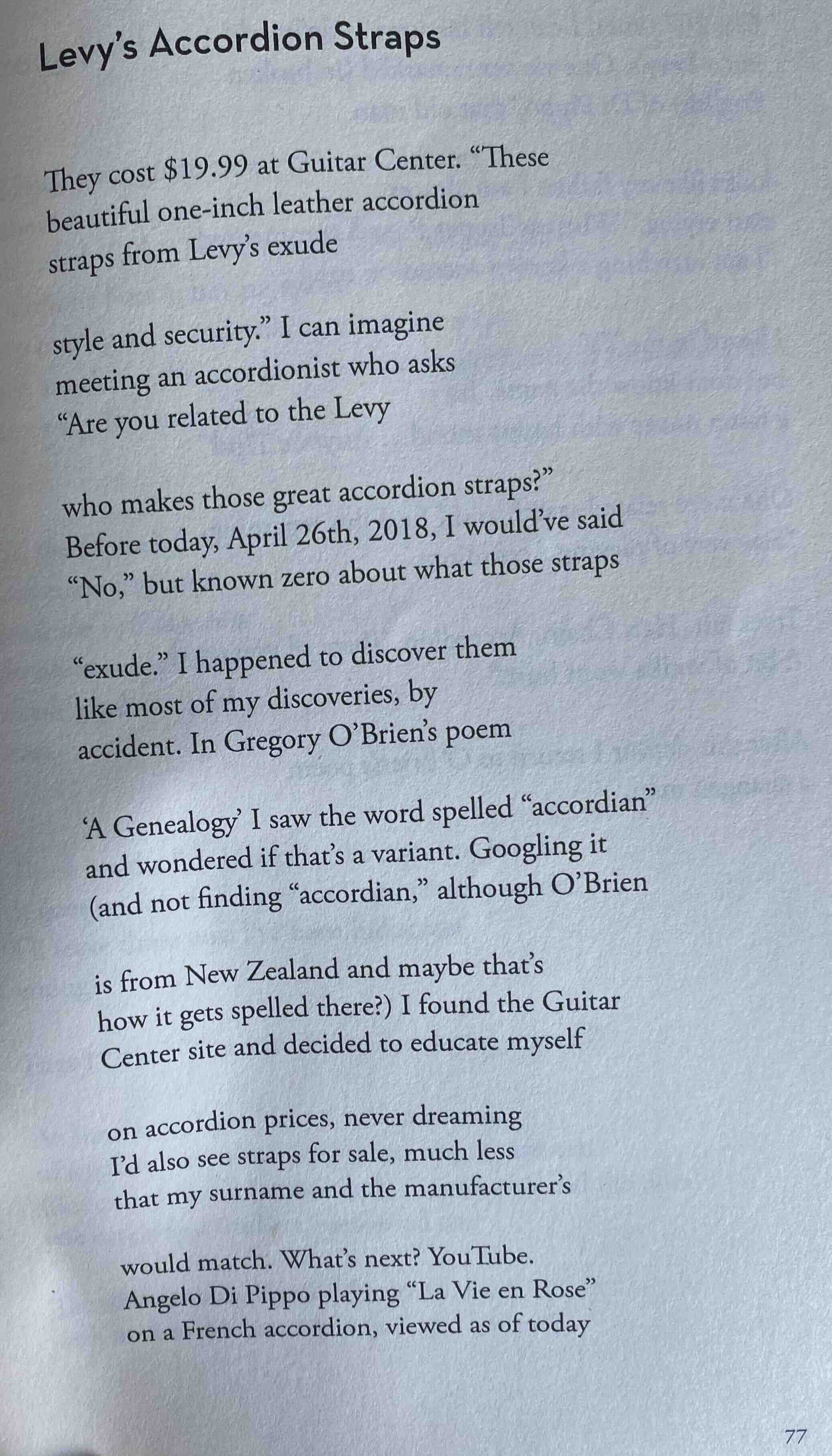
My blogging practice is to focus on the page that coincides with my age, currently 77.

Miraculous: a book

Miraculous: Tales of Ladybug and Cat Noir: De-Evilize (Volume 7?)

I was in Kinokuniya, the place I usually go for comics, and I thought it might be nice to seek out the book version of Miraculous, a TV show my six-year-old granddaughter enjoys.

What can I say? In short, if you’re interested in reading a Miraculous comic, I recommend that you look at the fine print above the bar code on the back cover and hope for a line that includes the text, ‘Volume 1 TPB’. I didn’t know to do that.

I’m not a librarian, but I do generally look on the title page of a book for its official title, and on the imprint page for publication details. This book has neither. By reading the fine print – some of it very fine – and consulting Duck Duck Go, I found out that:

  • Miraculous: Tales of Ladybug and Cat Noir is a series title
  • This volume, De-evilize, collects numbers 19 to 21 of the comic series, and is the seventh such collection
  • The three comics were published in 2017
  • I imagine that each comic issue represents one episode in the TV show. The episodes, named for the featured super-villains, were ‘Kung Food’, ‘Gamer’ and ‘Reflektra’
  • The show appears to have originated in France, though Korea was the first country to screen it
  • There is no indication on the book that this is a translation from a French text, although the action takes place in Paris, and street signs are in French
  • •Nowhere does the book mention its country of origin. It was printed in Canada but, as far as I could tell from Duck Duck Go, the publisher Action Lab Entertainment is a US company
  • Naming the author/s of this book is a complex matter: the series creator is Thomas Astruc; comics adaptation is by Nicole D’Andria; each of the three ‘chapters’ is written by a different pair of writers.

Starting in Book 7, you’re thrown into the middle of bewildering adventures in which two French teenagers (Marinette and Adrien) become superheroes (Ladybug and Cat Noir) through the agency of tiny supernatural creatures. There are magic gadgets called Miraculouses. There’s a bad guy named Hawk Moth who has little pet moths called akumas which he uses to turn disgruntled people into supervillains. Ladybug and Cat Noir do battle with the supervillains, eventually extract the akumas and restore order. The de-akumatised supervillains return to being the friends or benign relatives of Marinette and Adrien. There’s pleasantly complex teenage romantic tension, and familiar high school politics.

In this volume it’s pretty much exact the same story three times, so by the end of the second story I had got the general gist, even though, especially in the fight scenes, I couldn’t tell from the images what was actually going on. And I didn’t much like the computer-generated images. I ought to give you a little taste Here’s page 77*, in which the gentle boy Max is transformed into supervillain Gamer:

I haven’t read this book with either grandchild, but I’ve had fun dropping the catch cries ‘Spots on!’, ‘Claws out!’, ‘Lucky charm!’ and ‘Cataclysm!’ into the conversation.


I wrote this blog post in Gadigal Wangal country, where it is my great joy to live, where the days are getting warmer and the winds are strong. I acknowledge Elders past, present and emerging for their continuing custodianship of this land.


My blogging practice is to focus on the page that coincides with my age, currently 77.

Judith Beveridge’s Tintinnabulum

Judith Beveridge, Tintinnabulum (Giramondo Poetry 2024)

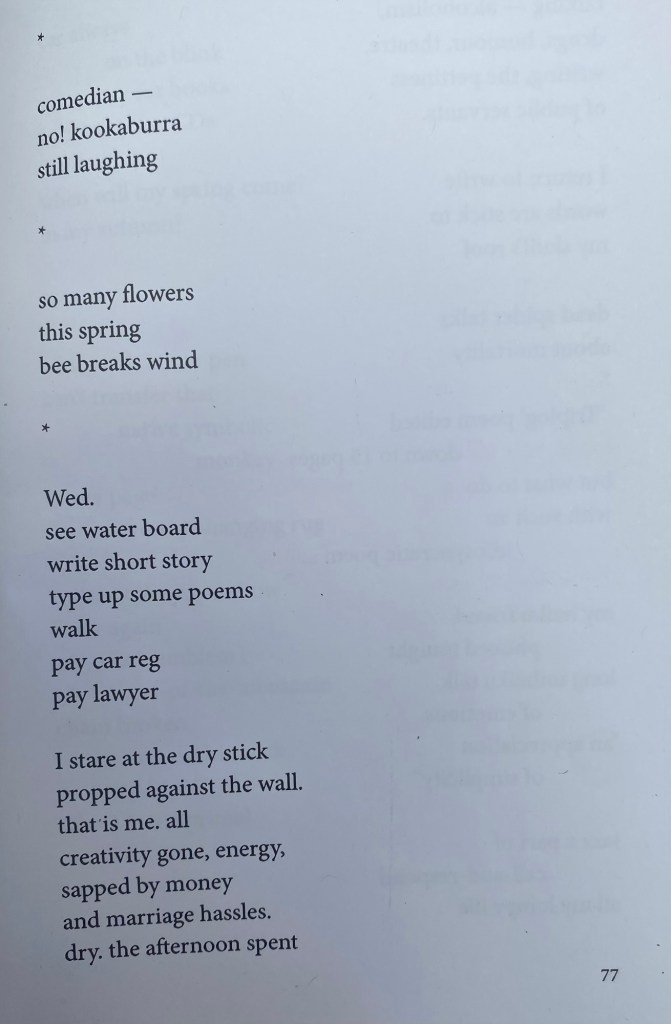
As a rule on this blog I focus on the page of a book that corresponds to my age. There’s a lot I could write about Tintinnabulum (it’s a very rich collection from one of Australia’s brilliant poets), but let’s see what happens if I skip any general discussion and go straight to page 77.

Page 77 is the second page of the poem ‘Choirwood’, the last poem in the book, which gives its name to the book’s final section. Earlier sections have dealt with the animal and human world, including a fair amount of death, danger and cruelty. So when the fourth section arrives with ten poems celebrating the natural world, it feels like the final stage of a broad conversation. Celebration has the last word:

I wouldn’t be unhappy if you stopped reading this right now, clicked on the image, and let the poem go to work on you. The speaker goes for a walk in the bush near her house one early morning and pays attention to what she sees and hears, inviting us to join her in rich, descriptive language, and then taking us further into contemplating the unseen, unheard wonders of the universe. There’s a play of metaphors to do with religion, commerce and art. It’s a gorgeous celebration of the natural world, expanding from the back yard to the cosmos.

It’s a thing about poetry that what the reader brings is an important part of how a poem works. So rather than discuss the poem line by line. I’ll tell you what I bring to it – and also some places it takes me to.

First a snippet of personal history. In early 1965, after finishing high school, I was training to be a member of a Catholic religious order. I was a postulate, the step before becoming a novice. We would rise hideously early each morning summer and winter, wash in cold water (as the wood-fired boiler wasn’t lit yet), and gather in the chapel for prayers, meditation, Mass and more prayers. All that before an eight o’clock breakfast. I was terrible at meditation – it was too easy to nod off – but loved the communal prayers, especially the call-and-response reading of psalms. I loved the bloodthirsty psalms and the whingey ones, but most of all I loved the exuberant songs of praise. This poem brings to mind a specific psalm-related memory.

There were terrible bushfires that year, and as a community of 50 or so able-bodied young men we became volunteer fire fighters. I had my turns at going out, but on this occasion I was not one of the 20 or so who had been away all night lugging their backpack sprays. Those of us who had stayed behind were in the chapel as usual when we heard the truck loaded with wearily noisy, charcoal-stained novices roaring home up the hill outside. We didn’t pause, but surely we put a little extra gusto into the resounding verses of Psalm 148. I don’t have the actual, almost singable English version we used, but here is a bit from the Jerusalem Bible:

Let earth praise Yahweh: sea-monsters and all the deeps,
_____fire and hail, snow and mist, gales that obey his decree,
mountains and hills, orchards and forests
_____wild animals and farm animals, snakes and birds,
all kings on earth and nations, princes, all rulers of the world,
_____young men and girls, old people, and children too!

No lie, we were chanting about fire praising God when that truck drove past the chapel windows.

Since that moment, any poetic celebration of nature – and ‘Choirwood’ is one – carries for me the whiff of bushfire smoke and the paradoxical joy, even exhilaration, of being young and helping to fight the fire.

It’s not odd that I should think of the psalms: the poem itself is not explicitly religious, but it has plenty of religious references – the title, the St Andrew’s Cross spider as a martyred apostle, a mandala. It’s even possible that the poet had Psalm 148 in mind. Thinking of bushfire, on the other hand, is pure idiosyncrasy …

… except …

… there’s this in the book’s acknowledgements:

The poem ‘Choirwood’ was commissioned by Judith Nangala Crispin in 2022 for the Judith Wright Regeneration Road Trip.

I looked up the Regeneration Road Trip (it has a webpage here, a facebook page here, and the album of its poetry reading for sale at this link). Organised by a group of artists who lived between Canberra and the Far South Coast of New South Wales, it took place over 10 days in September–October 2022. According to the website, that In the wake of the terrible destruction caused by bushfires the previous year, the organisers:

came together to try to find a way to help voice the emerging tidal wave of feeling and give back to the communities which are hurting. Rather than focusing on what was lost, the project began to unearth and celebrate the deep connection between the people and the landscapes, animals and plants of this special region. 

So if you know its origin story, ‘Choirwood’ itself carries a whiff of smoke.

Without the origin story, there is no word in the poem of all that destruction. There has been enough of that earlier in the book, perhaps – there’s no need to name the thing being negated, the ‘what was lost’. But a closer look reveals a hint. A note tells us something that a better-read reader might have spotted off their own bat:

The phrase ‘madrigal field’ is from Denise Levertov’s poem ‘Clouds’.

That refers to the lines where the poem’s perspective widens out:

____________________________I give thanks 
too for the forces and interactions running
beneath it all, the flowing, spinning, changing
dynamics, the 'madrigal field' choiring everything
into existence.

(By the way, notice how all those ‘ing’ words create a sound equivalent to the constant motion being described.) Especially when read in connection with the poems final lines, the ‘madrigal field’ is a wonderfully resonant phrase that suggests the mediaeval notion of the music of the spheres, and so invokes a sense of the awe-inspiring, beautifully ordered universe. But the knowledge that it is taken from ‘Clouds’ by US poet Denise Levertov (which you can read at this link) suggests a more nuanced reading. In that poem, the speaker is faced with the recent death of a loved one (or perhaps only a chilling intimation of their death). She forces to her mind a ‘vision of a sky’, that at first appears as a grey mist, but when looked at intently reveals ‘radiant traces’ of green. Only then ‘a field sprang into sight’:

a field of freshest deep spiring grass   
starred with dandelions,
green and gold
gold and green alternating in closewoven
chords, madrigal field.

Perhaps, the poem goes on, death’s chill is ‘a grey to be watched keenly’.

I can’t say I understand Denise Levertov’s poem, but her ‘madrigal field’ is a synesthesian (synesthetic?) vision of a grassy field, quite different from Judith Beveridge’s cosmic concept. Comin from ‘Clouds’, however, it keeps its emotional connotation: the field is what you see when you turn away from death / the premonition of death / destruction, and look ‘keenly’. ‘Choirwood’ is full of keen looking and listening. This, it suggests ever so subtly, can be an important part of coping with catastrophe.

I am grateful to the Giramondo Publishing Company for my copy of Tintinnabulum.


I wrote this blog post in Gadigal Wangal country, where it is my great joy to live. I acknowledge Elders past, present and emerging for their continuing custodianship of this land.

Spell the Month in Books – September

Spell the Month in Books is a linkup hosted on Reviews From the Stacks. We’re invited to find a book title, on a given theme, that starts with each letter in the month’s name, make a list, and share the link. It’s a nice way to look back over one’s reading.

This month, the theme is Back to School. Reviews from the Stacks is a Northern Hemisphere blog, where the theme is seasonally appropriate – but it’s full of possibilities for us in the planetary south as well. Here I go. Links on the book titles are to my blog posts.

The Bee Sting by Paul Murray (Hamish Hamilton 2023). Two of this book’s characters, a generation apart, have their lives transformed when they leave their home in rural Ireland to go to university in Dublin.

Edenglassie by Melissa Lucashenko (University of Queensland Press 2023). It may be stretching it a bit, but this novel, along with a lot of First Nations writing, amounts to an invitation to unlearn some Australian history, to go back to school and develop a different, richer understanding of our past. In this case, it’s the early history of what is now south-east Queensland. Sue at Whispering Gums has an excellent review.

Praiseworthy by Alexis Wright (Giramondo 2023) is another example of First Nations writing that amounts to an invitation to go back and learn different ways of looking at the world. At its heart there’s a mad scheme to cope with climate change by using the donkeys that roam wild in the Northern Territory. There are clouds of butterflies and a boy who lives in a whale’s skeleton. You see the world differently once you’ve read it.

Small Things Like These by Claire Keegan (Faber & Faber 2021) actually centres on a school. It’s hardly more than a short story, in which an Irishman faces a huge moral challenge when he discovers that terrible things are being done in the convent school just outside his village.

Deep Economy: The wealth of communities and the durable future by Bill McKibben (Henry Holt 2007). For me at least, this book was a tremendous learning experience about economics and the environmental crisis. In my 2007 blog post I described it as ‘a substantial, reasoned, systematic move towards an alternative way of thinking about these things’.

Madeline (Ludwig Betelmans 1939). How good it was, recently, to go back to this book, which I must have first read when I was at school, or perhaps when nieces and nephews were. ‘In an old house in Paris that was covered in vines …’

Blue Mars (Kim Stanley Robinson, 1996) Kim Stanley Robinson’s Mars trilogy is a terrific yarn. It’s also an education in the scientific, engineering, social and political challenges that would face an attempt to settle on Mars. I first encountered the word katabatic, among many others, in these books.

Cold Enough for Snow by Jessica Au (Giramondo 2022). The section in this slim book where the narrator goes to university and encounters a whole new world struck a chord with me, even more so than the similar experience described in The Bee Sting, because this one happens in Australia.

Voice of Reason: On Recognition and Renewal by Megan Davis (Quarterly Essay 90, 2023) is another piece of First Nations education, in this case about the recent referendum on an Indigenous Voice to Parliament. Especially in the face of the No campaign’s ultimately successful slogan, ‘If you don’t know, vote no,’ the schooling provided by this essay was salutary and continues to be.

The Essays of Montaigne, progress report 6

Michel de Montaigne, The Complete Essays (Penguin Classics 1991, translated by M. A. Screech)
– end of Book 2 Essay 12, “An apology for Raymond Sebond’ to part way through Book 2, essay 17, ‘On presumption’

The month has flown by, and it’s time for another progress report on my project of reading Montaigne’s essays, four pages every morning. Two friends have sent me examples of Montaigne cropping up in their own reading: the first has just started reading Amor Towles’s A Gentleman in Moscow, and was reminded of my project when the confined Count finally gets to read Montaigne; the second forwarded me Nicholas Gruen’s weekly newsletter for the 18th of August, which includes Montaigne’s essay ‘On a Monstrous Child’. I’m not alone in reading him.

It’s taken much more than a month, but I’ve now finished ‘An Apology for Raymond Sebond’. Whether from shrinking attention span, lack of interest, or the nature of the essay itself, I happily confess that I had trouble following its argument. It went on and on, endlessly quoting ancient philosophers, repeating itself, and proclaiming radical scepticism. I thought it was about to discover the scientific method, but no, it seemed to end up saying you can’t trust reason or the senses, but – implied rather than stated outright – you can always trust the revealed Word of God. I’m glad that one is behind me.

Today I’m part way through ‘On Presumption’. Having discussed in the preceding essay the relative worthlessness of reputation (‘glory’) compared with actual virtue, in this one Montaigne begins by saying that one’s opinion of oneself is similar to glory – prone to wishful thinking and no real indicator of one’s real worth. He’s now in the middle of a generally unflattering – and I think intentionally funny – self-portrait. He loves poetry, but is a terrible poet. He loves fine writing but:

There is nothing fluent or polished about my language; it is rough and disdainful, with rhetorical arrangements which are free and undisciplined. And I like it that way, by inclination if not by judgement. But I fully realise that I sometimes let myself go too far in that direction, striving to avoid artificiality and affectation only to fall into them at the other extreme. … Even if I were to try to follow that other smooth-flowing well-ordered style I could never get there. (Page 725–726)

False modesty? Maybe not. It does read as a genuine attempt to describe his own writing.

Beauty, he says, is the ‘first sign of distinction among men’, and height is the only quality that determines manly beauty, but his own ‘build is a little below average’. In one of the passages that makes reading him such a pleasure, he lists the qualities that don’t count:

When a man is merely short, neither the breadth and smoothness of a forehead nor the soft white of an eye nor a medium nose nor the smallness of an ear or mouth nor the regularity or whiteness of teeth nor the smooth thickness of a beard, brown as the husk of a chestnut, nor curly hair nor the correct contour of a head nor freshness of hue nor a pleasing face nor a body without smell nor limbs justly proportioned can make him beautiful. (Page 729)

Having just told us that only height matters, he implies the counter argument: he’s at least a bit sorry that men who look good and don’t smell bad aren’t regarded as beautiful. Not that he attributes those qualities to himself. He says his build is ‘tough and thickset’ and describes (in Latin, possibly quoting someone) his bristly legs and tufty chest, etc.

So this isn’t so much a progress report as a snapshot of where I’m up to when the blog post falls due. I just flicked forward 120 pages to see that next time I may be talking about an essay entitled ‘On three good wives’!


This blog post was written on Gadigal-Wangal land, where understandings of the universe beyond Montaigne’s imaginings were developed millennia before the Ancients he discusses. The weather is warming up alarmingly early. I acknowledge the Elders past, present and emerging of the Gadigal and Wangal Nations,.

Abdulrazak Gurnah’s Paradise and the Book Club

Abdulrazak Gurnah, Paradise (©1994, Bloomsbury 2004)

Abdulrazak Gurnah, winner of the Nobel Prize in Literature in 2021, was a wonderfully urbane guest at this year’s Sydney Writers’ Festival. In the session I attended he spoke mainly about his 2021 novel, Afterlives, but talked a lot about that book’s relationship with the much earlier Paradise. (Added much later: you can listen to the podcast of the conversation at this link.)

We read Afterlives a while ago in my all-male Book Group, and had a wonderful discussion of it. Now my predominantly female Book Club is tackling the earlier novel.

Before the meeting: Paradise is a long way from languishing in the shadow of Afterlives. Its action unfolds in the same part of East Africa, beginning a couple of decades earlier, in the years leading up to the First World War.

The book begins with a boy named Yusuf looking forward to receiving a customary gift of money from Uncle Aziz when Aziz’s brief visit comes to an end. There is no gift, and instead the boy is taken away with the uncle. Then he realises that he is not going back to his family and soon learns that he has been given to Aziz, who is not actually his uncle, as surety against his father’s debts. He has become little more than a slave in the merchant’s household.

The story unfold from there. There’s adventure, involving an arduous, perilous expedition into the unknown. There’s romance, where intimate moments, perhaps even a kiss, may be snatched in dark corners of a walled garden. There’s a gallery of rich, exuberant characters – Khalil, an older boy in a similar state of bondage to Yusuf; an older woman, infatuated by Yusuf’s beauty, who harasses him to the amusement of onlookers; an ancient gardener who long ago refused his freedom when actual slavery was abolished; a formidable, scarred man who organises Aziz’s trade expeditions and has a reputation as a sexual predator on young men; Aziz himself, a formidable commercial operator who remains calm in the most extreme situations.

Meanwhile, European powers are colonising East Africa. They are mostly peripheral, offscreen characters who threaten to destroy the whole world experienced by the main characters. German soldiers appear twice, once at roughly the midpoint and then again at the very end. Both times they function as a deus ex machina: the first time their unexpected arrival saves Aziz and his expedition, including Yusuf, from a vengeful tribal chief, but the incident leaves a nasty sense of something unresolved; the second time they provide the book’s final moment, which left me staring into space for a long time.

The book was only transated into Swahili – the official language along with English of Gurnah’s home nation Tanzania (known as Zanzibar back then) – after he was awarded the Nobel Prize.

After the meeting: At this meeting we discussed Annie Ernaux’s Une femme / A Woman’s Story along with Paradise, an odd pairing which meant we had two quite separate discussions.

All but one of us enjoyed this book a lot, and the dissenting voice meant we had an interesting conversation. The main character, she said, is completely passive: things just happen to him, one after another, and especially on the gruelling trade expedition that takes up a good slab of the book the bad things are repetitive. The book only becomes interesting once Yusuf is back in town and a powerful woman, in a complex way, is lusting after him. Though others were able to point out that Yusuf was constantly taking initiatives – a surreptitious excursion to town just for fun, offering unauthorised help to the ancient gardener, etc – I was struck by the similarity of this observation to what someone in my other Book Group said about the main character in Afterlives: because of the constraints on the characters, they don’t have the space to attend to their inner lives. When I tried to articulate this thought, someone said something beautifully concise and wise about the way trauma can alienate a young person from their own experience. Sadly I didn’t write it down, but to my mind it captured beautifully the way Yusuf does indeed move from one thing to the next, having no real say about the direction of his life, and no ability to form coherent thoughts about it.

I realised in the course of the discussion that the story is full of references to Joseph / Yusuf in the Hebrew Bible and the Quran, in particular the episode of Potiphar’s wife / Zuleikha. I just read a version of the Quran story on Wikipedia, and the parallels are even closer than I thought. It makes me wonder what other references may be hovering around this eminently readable tale. Joseph Conrad’s Heart of Darkness comes to mind. (Gurnah’s Gravel Heart includes a retelling of Shakespeare’s Measure for Measure, set in modern East Africa.)

We discussed the final paragraph, which I’d love to expand on here but, unlike some surprise revelations (see my blog post on Wole Soyinka’s Chronicles from the Land of the Happiest People on Earth, coming in a month or so), it really is a surprise.

Being of a certain age, we said goodnight a little after 10 o’clock.


I wrote this blog post in Gadigal Wangal country, where it is my great joy to live. In particular right now the days are getting warmer, the sun is rising earlier and setting later, and whenever I walk out my door I see tiny lizards scurrying for cover. I acknowledge Elders past, present and emerging for their continuing custodianship of this land.