Deep Suburbia

At a Sydney Writers’ Festival a couple of years ago Jennifer Maiden was reading at a Sydney-themed poetry session. She told us that she hadn’t been able to think of anything she’d written about Sydney. But when someone mentioned a couple of titles, she understood: ‘Oh, Western Sydney! I’ve got plenty about Western Sydney!’

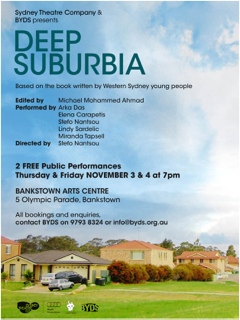
20111105-111958.jpgThe show in the rehearsal room of the new Bankstown Arts Centre last night was all about Western Sydney, when five actors from the (not-Western) Sydney Theatre Company presented Deep Suburbia. In a nutshell this was a theatrical presentation of work from an anthology of the same name published earlier this year by the Bankstown Youth Development Service (mostly known as BYDS – I had to look up its full name).

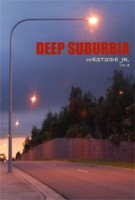
The anthology is the third in the Westside Jr series, edited like its predecessors by Michael Mohammed Ahmad. It consists almost entirely of writing produced by school students during an artists in residence program that gave guidance and mentorship to the young writers over a number of weeks. Click on the image to the left for an e-book version – it’s a good read in its own right. The back cover isn’t wrong when it says that  its ‘writers and photographers channel the unique and often misrepresented  voice of Sydney’s infamous Western Suburbs’. Jennifer Maiden thinks of herself as a voice from Western Sydney. People who enthuse about Christos Tsiolkas’ The Slap seem to read it as giving voice to a previously mute equivalent in Melbourne. This anthology and its predecessors demonstrate that given half a chance there’s a multitude of voices in the West ready to make themselves heard. I’ve been dipping into it for months, and always found something to enjoy, from sharp, short poems like this by Peta Murphy:

The mood turns from sympathy to scorn
when her end means the delay
of the 3:14 to Granville.

to longer tales of family life, or classroom romance/politics.

Last night was something of a revelation. The performers – Stefo Nantsou (who also directed), Arka Das, Elena Carapetis, Lindy Sardelic amd Miranda Tapsell – read the pieces with intelligence, humour and moments of great poignancy. They played around with form, so that the evening had a shape – among other things, the show finished with Filip Stempien’s enigmatically named ‘New Zealand Boys Drum’, a string of glimpses of the varied life of Bankstown, and we realise that a number of these glimpses have been acted out for us in the interstices of earlier readings. Most interestingly for me, the performances demonstrated something about the nature of young people’s writing. There were a couple of pieces, for instance – a rant about how annoying girls are (by someone who chose, perhaps wisely, to remain anonymous), a step-by-step account of a day spent obsessed with a boyfriend’s perceived bad mood (also anonymous), Kameron Omar’s recount of his mother’s time in hospital with an aneurysm – that one might be tempted to read as artless scribblings on the page, interesting mainly as sociological data. In performance, the depth of their creativity became blazingly evident: ‘Girls These Days’ sounds like Henry Higgins as Pizza Boy; ‘I Write to Remember’ does a brilliant job of mocking the thing it enacts; the beautifully understated ‘Aneurysm’ is permeated with quiet terror.

The show was only on for two nights. It was free, and food was provided. I’m sorry you didn’t make it. I’m very glad I did.

LoSoRhyMo #3: Written early Saturday morning

Sonnet 3: In anticipation
Today our Rita comes to town
God willing and the creeks don’t rise
(that is, if fate or Joyce don’t frown
and Qantas don’t forsake the skies).
We’ll meet her plane at ten to ten,
kiss-kiss, collect her bags and then
that welded-on Melburnian
will come with us a-journeyin’ –
White Rabbit, Sculpture by the Sea,
a ferry ride, so many jaunts.
There’s time to tour our local haunts
and if it rains, a cup of tea
at home. Our Rita’s here to stay
the whole weekend. Calooh! Callay,

‘The Second Coming’ it ain’t, but I had to make breakfast.

LoSoRhyMo #2: I couldn’t find a way to include navel in the sonnet itself

Encouraged by my commenters, I’m taking a break from work to write about work and keep up my sonnet quota, though I suspect that beyond the rhyme scheme and the correct number of lines this hardly qualifies as a sonnet:

Sonnet 2: How many A’s in ‘nav*l’?
Oh spare line editors a thought
who wield blue pencils for a crust
(though, since our kind have mostly bought
PCs or Macs on which we must
track changes, spellcheck, search/replace,
and plumb the depths of cyberspace
to verify a quote’s complete,
blue pencils are now obsolete).
We catch apostrophes that stray,
keep minuscule to just one I.
Two Cs in ‘practised’ make us cry
(unless we’re from the USA).
We care for commas, fix each error,
then make new ones – our greatest terror.

LoSoRhyMo #1: Once is a trend, twice a tradition

I’ll let this sonnet do its own explaining. The reference at the start is to these blog entries.

Sonnet 1: Here we go again
My faithful readers may remember
a year ago, in twenty-ten
this blog devoted all November
to fourteen sonnets. Now, again
(let others grow their mo’s for cancer,
or think NaNoWriMo’s an answer
to life’s questions, I don’t say
All Saints or Sadie Hawkin’s Day
should be ignored, or Kristallnacht)
LoSoRhyMo* shifts into gear
with rhymes and iambs. Now no fear
will cause this challenge to be ducked.
There’s work that’s waiting to be done,
but sonneteering’s much more fun.

*Local Sonnet Rhyming Month

The book group, The Life and Malcolm Knox

Malcolm Knox, The Life (Allen & Unwin 2011)

Before the Book Group met: I knew The Life was about a surfer, based to some extent on a real person (as spelled out in an interesting article by Nick Carroll here). I knew that it also drew on Malcolm Knox’s own fairly recent experience as a surfer. Now, unless you count the pleasant and instructive experience of copy-editing a book of essays on surfing and surf culture a couple of years ago, the closest I’ve been to riding a surfboard is to have broken a wrist the first time I rode downhill on a skateboard. Oh, and Peter Drouyn was two years behind me at boarding school, and I once had a friend who said things were gnarly. So no matter how many people recommended The Life, I would have given it a miss, as I have Tim Winton’s Breath, if it wasn’t for the Book Group. And so but yeah I have yet another reason to be grateful to the group.

I’m writing this a day after finishing the book [and about a month before the twice postponed meeting], and the voice of Dennis Keith – DK, the narrator and main character, who occasionally starts a sentence with a string of conjunctions a bit like the last sentence in my first paragraph – is still echoing in my head. He’s a wonderful character, overweight, approaching 50, living with his mother, socially incompetent and suffering from some kind of mental chaos. But once he was the world champion surfer, a genius on the waves. A double tale unfolds – the story of events leading up to his mental implosion 30 years earlier, and what transpires after the arrival of a young woman he calls his BFO – short for Bi Fricken Ographer. There’s a central love story and a violent death, but the main power of the book for me is in the world created in its language, and though I gather there’s some controversy about the way DK is recognisable in the surfing community as a version of a still-living surfing legend, for outsiders like me there’s a feel of authenticity that probably has something to do with not having moved too far from actual history.

After the group: We met last night. Malcolm Knox is a friend of one of our members, and came to the meeting as a special guest.  As a result, we stayed pretty much on topic all night, even though two of us, who arrived late, had been to the annual opening to the public of the Egyptian Room of the Petersham Masonic Hall, which would usually have been a major distraction from the book of the night.

One of the guys has been a keen surfer all his life, and knows an awful lot about the parts of the real world that the novel relates to. Others have done some surfing. To most of us the surfing world was pretty much a closed book. We’d all enjoyed the book, and I think it’s true to say that we all loved the chance to talk about it with the author. He was completely useless when asked to clarify the ending – he’s written a version where the end was clear, but it didn’t work because DK could never have got things that clear in his head, so he had to rewrite it to its present opacity. Sadly, this means that he doesn’t know who dunnit any more than any careful reader. Apart from that, he seemed happy to be quizzed about the process of writing, and rewriting, about the thinking behind a number of key decisions, about anything at all really, and we were pretty happy to do the quizzing.

Even though I count a number of brilliant writers among my friends, I’m still a boy from North Queensland who didn’t meet a Published Writer until I was 20 years old (the poet R D Murphy, aka Brother Elgar FMS), and I was very impressed by Malcolm’s generosity in joining us like this. He said he feels a sense of responsibility – if people are prepared to read his books the least he can do is sit down and have a meal with them, and anyhow he’d rather talk to eight people who have actually read it than 300 who’ve come to his talk at a festival because they couldn’t get into the one they really wanted. I hope he enjoyed the evening as much as I did.

Sarah Maddison’s Beyond White Guilt

Sarah Maddison, Beyond White Guilt: The real challenge for Black–White relations in Australia (Allen & Unwin 2011)

I’ve been having trouble blogging about this book – maybe I would have been better off writing one of those ‘X reads Y’ series of posts that take you through the book along with the blogger over the days or weeks it takes to read it. There was hardly a page when my mind wasn’t firing off in many directions, excited by one idea, quarrelling with another, irritated by an elliptical use of a reference, challenged and provoked and challenged again. But here you are, just one little blog post.

The book starts brilliantly. While strolling around her inner city suburb the author sees on the bank of the polluted and deformed Cooks River a tiny space that she imagines to be pretty much unchanged in the 200 and more years since white settlement. She pictures a group of people of the Eora nation going about their lives there, and is shocked by the mental image, not because it is new or surprising, but because she realises ‘that [she] had allowed [her] consciousness of that reality to fade.’ She goes on, ‘Unlike Aboriginal and Torres Strait Islander peoples, I could choose to “forget” or to deny or repress the reality of my place here.’

Such moments must have been experienced by every thoughtful non-Indigenous Australian – moments when, in shocking contrast to our habitual complacency, it becomes blindingly clear that our current lives rest on a history of colonial invasion and dispossession. Recounting this example in the Introduction implies a promise that the next 200 or so pages will unpack such moments: How and why does that forgetting happen? What would happen if we stopped ‘forgetting’ and began to live in the real world? How do we go about making that change? Is this a thing that we need to address as so many million individuals, is there a challenge we need to meet collectively, and if both how are they connected?

Coming from the author of Black Politics, a powerful account of the main themes and tensions in Aboriginal politics based on extensive interviews with a range of Aboriginal leaders, this implied promise feels anything but hollow.

I’m not confident that I can summarise the book’s argument adequately, but here goes:

  • When the British arrived on the continent of Australia in the late 18th century, they wanted the land, and took it, with devastating consequences for the people who were already living here. Some people baulk at calling what happened genocide, but it’s hard to see how that word is far off the mark.
  • As the Australian nation formed, and people took on the  Australian national identity, they needed stories of the nation’s origin that would allow them to feel good about themselves and the identity. Stories were told of pioneers’ hardihood, of Anzac larrikin heroism, of sporting accomplishments. The history of European–Aboriginal relations was marginalised or silenced. This version of national identity became entrenched both in public institutions and in people’s minds.
  • The objective reality is that all non-Indigenous Australians continue to benefit from the dispossession of Aboriginal and Torres Strait Islander peoples; and that Aboriginal and Torres Strait Islanders continue to struggle with the consequences of the huge and ongoing assault on their ancestors, their cultures and their communities.
  • We know this. We mostly ignore it, but we know it. [This has to be very confusing for us as children: the stories are told and discounted in the same breath.] This is a kind of anaesthesia, a dissociative story we tell ourselves.
  • To break through that anaesthesia and face the reality of our history involves emotional discomfort. Unless we face this discomfort we’re likely to either a) see the problem (if we admit there is one) as inherent to Aboriginal and Torres Strait cultures and so none of our business, or b) intervene in ways that  don’t challenge the assumptions that allowed the past and ongoing injustices to happen in the first place. [Her discussion of the Intervention is compelling.] Either way, we continue to live in a strange, dissociated state.
  • What has to change is us.
  • Real, effective change isn’t impossible. Australian history is full of examples. [She discusses  the 1967 referendum, the Reconciliation process of the 1990s, and the Sorry Books and the apology for the Stolen Generations.]
  • So what is to be done? We need a difficult conversation about remembering and forgetting. We need dialogue – as opposed to debate or just conversation – in which [I’m quoting Boori Pryor, not anyone in this book] ‘we see your tears, you see our tears’. We need to acknowledge our [now I’m quoting Sarah Maddison] ‘bonds of solidarity with the perpetrators of historical and human injustice’, and find a way to break them, that is, ‘to rethink who we are as a nation’.
  • ‘Relationships will be central to whatever path lies ahead’. An immediate opportunity is the referendum coming up in 2112 to include an acknowledgement of Aboriginal and Torres Strait Islander peoples in the Constitution.

It’s an important subject, and an important book. When you read it you may find my summary inadequate, and if so you’ll get no quarrel from me. The fact is, I found the argument hard to follow. My best guess as to why is that there are actually two books here struggling to co-exist. One is the one I’ve tried to summarise above. The other is a companion volume to Black Politics, which acknowledges and synthesises a vast body of thinking in a range of disciplines that addresses the issues of racism, colonisation and collective guilt. Notes and the bibliography account for nearly a quarter of the book’s pages. The text is studded with rich, provocative quotes, but at times it feels that no phrase, no concept can be used without deference to its originator. This may be sound academic practice, but the effect – at least for my kind of reader – is that hardly any time at all goes by without someone identified as political scientist A, legal scholar B, anti-racism educator C, political psychologist D, historian E … the list goes on … popping up, throwing a couple of words into the ring and then disappearing. I’d be going, ‘Who was that talking head? What  context did they use that phrase in?’ I would rather have read an overview of the scholarship,  White Politics, perhaps, and then moved on to Sarah Maddison’s argument. Or perhaps this is just a longwinded way of saying I found the scholarly apparatus distracting here.

Another reason for my difficulty is confusion about the word guilt. You’ll notice I haven’t used it in my summary. Is guilt a feeling or a legal verdict? Does it refer to a subjective state or a collective condition, or a vertigo-inducing combination? It seems to me that there are a number of quite distinct things rolled together in the one term here.

You can see Sarah Maddison speaking loud and clear in her own voice in a talk given at the Wheeler Centre here. I recommend it.

For Nicola

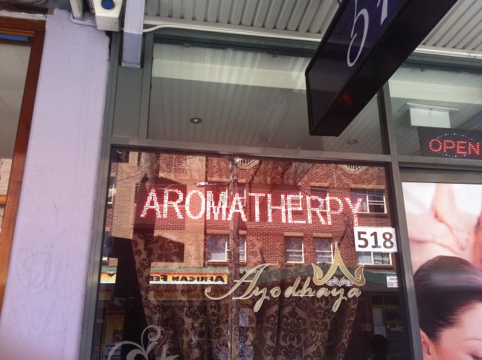
What better way to acknowledge and welcome editorabbit, cranky pedant and rabbit lover, to the blogosphere than to share a couple of images from the World That Gets By Without Editors.

This is from King Street South in Newtown. It repeats its two-A’d message in an endless animated loop.20111019-122443.jpg

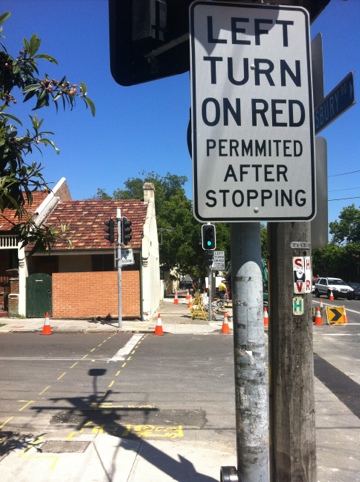
And I have wanted to take a photo of this sign for a long time. It’s one of three at the corner of Salisbury Road and Australia Street in Camperdown. Two have this charming variant spelling.
20111019-122529.jpg

SO welcome, editorabbit. The world is so full of a number of such things. I look forward to seeing many more on your site.

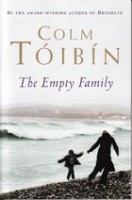
Colm Tóibín’s Empty Family

Colm Tóibín, The Empty Family (Picador 2010)

I’ve read very little by Colm Tóibín – his book on Barcelona, an extraordinarily spoilerish review of Ian McEwan’s On Chesil Beach, and that’s pretty much the lot. This collection of nine short stories, which has been beside my bed for a while and which I decided to read just now as possibly better suited to post-nasal-surgery times than a single longer work, is my introduction to his fiction.

While there are no characters who recur, and nothing like a discontinuous narrative, the book feels coherent – a number of the stories are about people returning to their country of origin after a period of exile, self-imposed or otherwise; many of them deal with Gay male experience; they are mostly set in Ireland or Barcelona, and in all of them connection with place and the people of the place are significant. An elderly Irishwoman returns to her native Dublin after a long absence to design a film set; after the fall of Franco, a Barcelona Communist returns from exile and encounters the old and new Spains; an Irishman returns from New York when his mother is dying. ‘The Pearl Fishers’ traces a delicate, questioning path through the Irish Catholic Church’s sex scandals. ‘The street’, the longest story, traces the developing relationship between two Pakistani indentured labourers in Barcelona.

I don’t know if I would have been quite so struck by this book’s Not Safe For Work bits if I hadn’t read it immediately after Philip Roth’s The Humbling, but I was struck by them. In three of the stories, there are graphic accounts of sex, probably more specific than the ones in The Humbling, but where at one stage Roth’s narrator protests, ‘This was not soft porn,’ Tóibín’s narrator and his characters are too engaged to need any such disclaimer. Both writers describe activities that I personally have no urge to participate in – Roth’s account makes me wish I’d somehow missed those pages; Tóibín’s prose manages to shed light on the nature of desire. ‘Barcelona, 1975’ reads as memoir, or at least conte à clef, and has an almost anthropological feel to it: this is how we did things in the dying days of the Franco regime, this is some of what we learned, and in particular this is how it felt.  Everywhere in his writing, you can feel the connections between people, again in stark contrast to the despairing isolation in the Roth book. That’s got to do with their different subjects, of course: Roth is writing about the loss of creativity. But I suspect I’m talking about something that goes much deeper in each writer – perhaps a cultural difference between Irish Catholic, lapsed or otherwise, and New York Jewish intellectual who is only as successful as his latest creation.

Open letter to an unnamed man on the news

Dear sir

I didn’t catch your name, but I saw you on the ABC News last night. I think there had been an earlier moment when you chanted directly to the camera, ‘No man date!’ and I guessed then that you weren’t a hardened participant in demonstrations. You didn’t have that ‘Here we are again, it won’t do any good but at least we’ll have stood up and been counted’ look about you. You actually looked as if sitting in the gallery of Parliament House and chanting should have achieved more than getting yourself expelled. You even looked as if the fact that you and you friends are opposed to a piece of legislation made it an act of tyranny for the legislation to be passed.

All the same, I was taken aback when you spoke to the television cameras and called the Prime Minister a scr*g. I understand that you were furious and speaking in the heat of the moment. I don’t know if you signed any kind of release permitting the ABC to use your image and words, or even if that’s required. You might feel pleased that you were able to make your point of view known to the whole country, indeed the world. But are you aware that by using that word, you have created the impression that from your point of view there’s something deeply affronting about having a woman for Prime Minister? I do hope you wouldn’t defend that position in your cooler moments.

Contrary to the impression created by the Leader of the Opposition and others, insulting individual politicians, on the basis of their being female or any other basis, is no substitute for argument. You had your moment in front of the cameras and however sensible, self-reliant, generous, thoughtful or even visionary you may be in the real world, you were seduced by those who set the tone for our national debate into giving the world the impression that you are a bullying misogynist. I hope your grandchildren will understand the pressure you were under and manage to be tactful.

If it’s any consolation, any number of us who protested against the Vietnam War, Apartheid, the Invasion of Iraq, the turning away of the Tampa, the Northern Territory Intervention, etc etc have undoubtedly had moments that were just as silly and noxious. Mind you, most of the time we didn’t have anything like the Murdoch machine backing us, so however self-righteous we were we lacked your apparent sense of entitlement.

I hope it’s been a good learning experience for you.

Jonathan

We almost missed it …

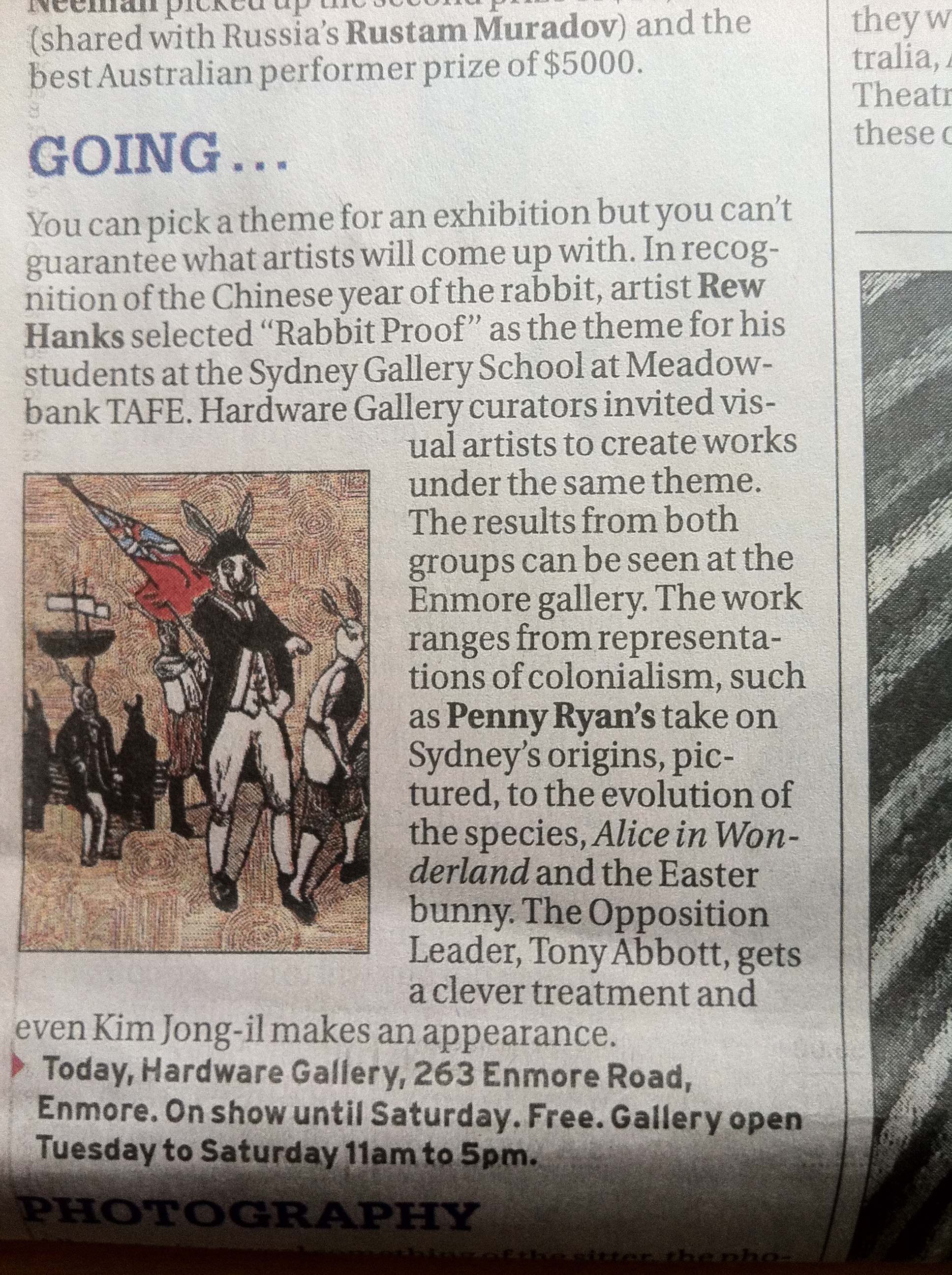
.. but the Art Student made an appearance in the print version of the Sydney Morning Herald today. ’24 Hours’, the arts diary has a para on the ‘Rabbit Proof’ exhibition at the Hardware Gallery. I couldn’t find it online, so here’s a little phone photo:

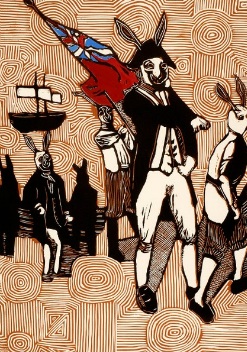
Rew Hanks’s stunning print featuring Kim Jong-Il scrapes in with an ‘even’ but the Art Student appears in bold and has her image reproduced!

She’s given me permission to upload a clearer, though still small, version of the image:

Oh the fame, oh the recognition!